HMS Consultants

Category: Healthcare Marketing Strategy

  • Digital Marketing in Healthcare: Why Strategy Should Come Before Channels

    Digital Marketing in Healthcare: Why Strategy Should Come Before Channels

    Digital Marketing in Healthcare: Why Strategy Should Come Before Channels

    Published on
    Share This

    Digital marketing in healthcare often starts from the wrong place. Many clinics, hospitals, diagnostic centres, and healthcare businesses begin by asking which platform they should use first. Should they post more on social media? Should they run Google Ads? Should they improve SEO? Should they make more videos?

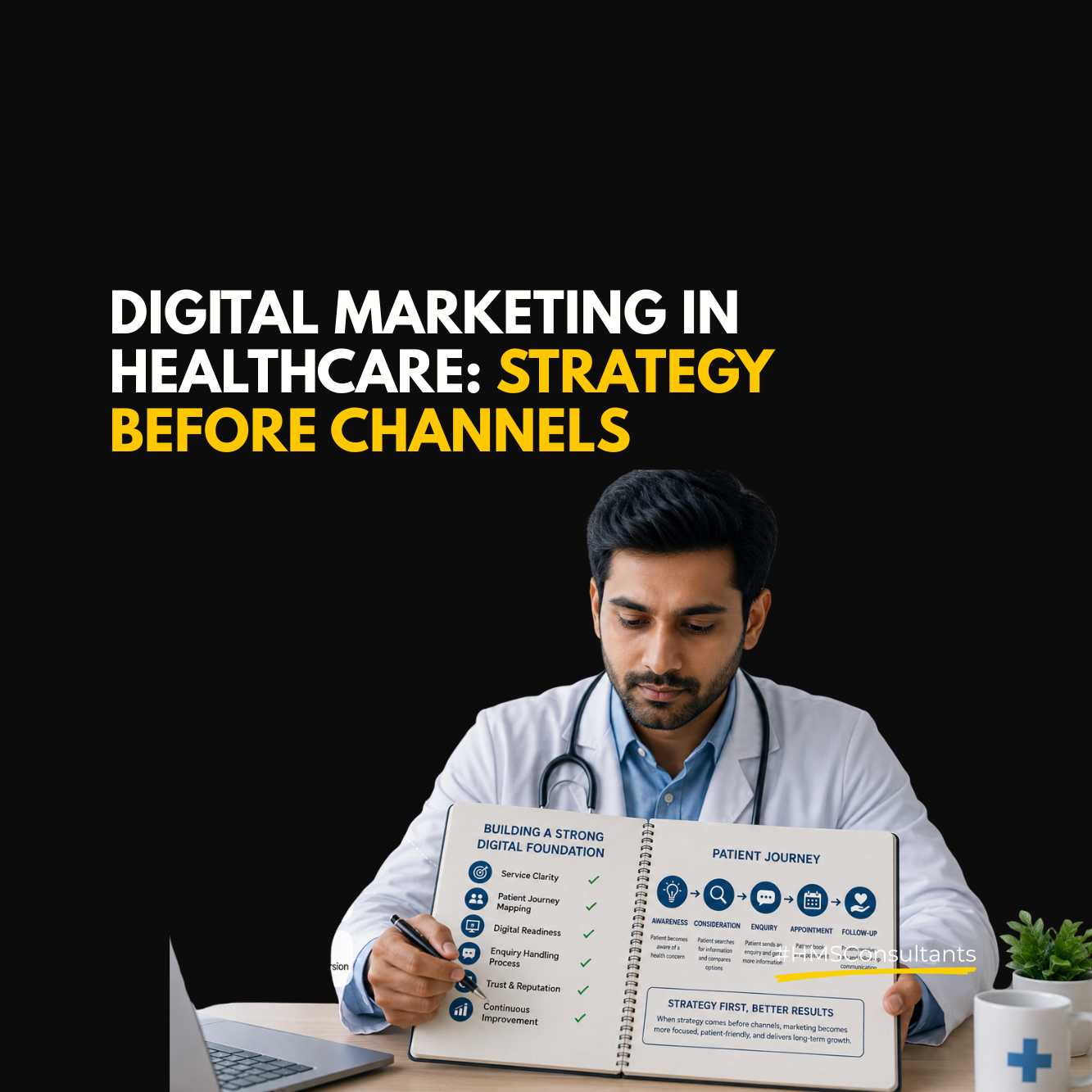
    These channels are important, but they should not come before strategy. Digital marketing in healthcare should first define what needs to be communicated, which patients need to be reached, which services need visibility, and how patient inquiries will be handled.

    Without this clarity, digital marketing becomes a random activity. There may be posts, ads, videos, website updates, and WhatsApp messages, but they may not work together toward one clear direction.

    Why Starting With Channels Creates Confusion

    Many healthcare providers choose channels before understanding the purpose behind them. A clinic may post regularly on Instagram but may not explain its services clearly. A hospital may run ads without checking whether its website page answers patient questions. A diagnostic centre may promote packages without making the booking process simple.

    The problem is not always the platform. The problem is often the lack of planning behind the platform.

    Before choosing a channel, healthcare providers should ask:

    • Which service needs attention?
    • Who is the right patient audience?
    • What does the patient need to understand?
    • What action should the patient take next?
    • Is the website or Google profile ready?
    • Is the enquiry handling process clear?

    When these questions are ignored, even strong platforms may give weak results.

    Service Clarity Should Come First

    Digital marketing for healthcare should begin with service clarity. A healthcare provider may offer many services, but not every service needs the same message or the same level of promotion.

    Some services need awareness. Some need search visibility. Some need patient education. Some need reputation support. Some need a better explanation because patients may not know when to consult.

    Before running campaigns, healthcare providers should define:

    • Which services should be promoted first.
    • What patient problem each service solves.
    • Which doctor or department handles the service.
    • What patients commonly ask about the service.
    • What information patients need before enquiry.

    If the service is not explained clearly, digital marketing may bring attention but not meaningful patient response. A patient wants to know what care is available, who provides it, when to visit, and how to take the next step.

    Understand the Patient Journey

    Patients do not always take action immediately. They may first notice a symptom, then search for information, compare providers, read reviews, visit a website, send an inquiry, and only then book an appointment.

    This is why the patient journey matters in healthcare digital marketing.

    A patient who is only becoming aware of a concern needs simple educational content. A patient comparing options needs service details, doctor information, reviews, and location clarity. A patient ready to book needs appointment details, contact number, timings, and clear instructions.

    A healthcare marketing strategy should plan communication for different stages:

    • Awareness.
    • Consideration.
    • Enquiry.
    • Appointment.
    • Follow-up.

    When communication matches the patient journey, digital marketing becomes more useful and patient-focused.

    Build Digital Readiness Before Promotion

    Running ads or campaigns before the digital presence is ready can create poor results. If patients click an ad and reach an incomplete website, outdated Google profile, unclear service page, or confusing contact process, they may not continue.

    A strong healthcare online presence should include:

    • Updated website service pages.
    • Clear doctor or department information.
    • Accurate contact details.
    • Updated Google Business Profile.
    • Patient-friendly FAQs.
    • Review visibility.
    • Appointment guidance.
    • Location and timing details.

    These details may look basic, but they directly affect patient inquiries. Healthcare digital marketing works better when patients can easily understand the provider and take the next step.

    A campaign may bring attention, but the digital presence must convert that attention into trust and action.

    Match the Channel With the Purpose

    Every digital channel has a different role. A channel should be selected only after the purpose is clear.

    Healthcare SEO helps patients find services through search. Social media helps create awareness, education, and recall. Ads support focused campaigns for specific services. WhatsApp guides patients after enquiry. Videos simplify health concerns. Reviews support trust and reputation.

    The mistake happens when every channel is expected to do everything.

    For example:

    • SEO should answer search intent.
    • Social media should educate and build recall.
    • Ads should focus on one clear action.
    • WhatsApp should guide enquiries.
    • Reviews should build confidence.
    • Website pages should explain services.

    When the channel matches the purpose, digital marketing for healthcare becomes more organised and effective.

    Enquiry Handling Is Also Part of Strategy

    Many healthcare providers think digital marketing ends when a patient sends an enquiry. In reality, that is where a major part of the patient experience begins.

    If calls are missed, WhatsApp replies are unclear, staff members do not know service details, or follow-up is weak, marketing performance is affected.

    A good enquiry process should include quick response, clear service explanation, doctor availability, appointment guidance, location details, basic instructions, and proper follow-up.

    Healthcare marketing strategy should connect digital campaigns with enquiry handling. Otherwise, marketing may generate leads but not patient appointments.

    Trust and Reputation Need Planning

    In healthcare, patients do not respond only to visibility. They also look for trust signals. Reviews, doctor profiles, patient education content, website clarity, and professional communication all influence decision-making.

    Online reputation in healthcare should not be treated as a separate activity. It should be part of the digital strategy.

    Healthcare providers should regularly review patient feedback, Google reviews, social media comments, repeated questions, common complaints, and review response quality.

    Trust is built through consistent communication and patient experience. Digital marketing should support that trust, not replace it.

    Work with HMS Consultants

    Need a clear plan to grow brand visibility, patient footfall and revenue? Explore Hospital Marketing Strategy Consulting.

    See Hospital Marketing Strategy ConsultingBook a free 30-min call

    Conclusion

    Digital marketing in healthcare should not begin with channels. It should begin with strategy.

    Before deciding on SEO, social media, ads, videos, or WhatsApp communication, healthcare providers should understand the service priority, patient audience, patient journey, message, digital readiness, enquiry process, and trust-building needs.

    Better healthcare digital marketing does not mean being active everywhere. It means being clear about what to communicate, where to communicate, and how each platform supports the patient journey.

    When strategy comes before channels, digital marketing becomes more focused, patient-friendly, and useful for long-term healthcare growth.

    Contact Us HMS Consultants

    The role of digital marketing in healthcare is to help patients find, understand, and connect with the right healthcare services. In this blog context, it should begin with strategy, service clarity, patient journey planning, digital readiness, enquiry handling, and trust-building before choosing channels.

    Digital Marketing I Digital Marketing For Doctors I healthcare digital marketing I healthcare Management I Healthcare Marketing I Healthcare Marketing Strategy I Medical Marketing I Social Media Marketing

    is something we strongly believe in, which means ‘Knowledge without application is the same as having no knowledge at all

    Akhil Dave

    Principle Consultant

    Ready to take your Personal Brand to the next level?

    Share your details below and we will connect with you to discuss your growth strategy.

    • Digital Marketing for Healthcare: Why Every Patient Touchpoint Needs a Different Message

      Digital Marketing for Healthcare: Why Every Patient Touchpoint Needs a Different Message

      Digital Marketing for Healthcare: Why Every Patient Touchpoint Needs a Different Message

      Published on
      Share This

      Digital marketing for healthcare does not work well when the same message is used everywhere. A patient searching on Google, visiting a website, reading reviews, watching a video, seeing an ad, or sending a WhatsApp inquiry is not always in the same mindset.

      Every patient touchpoint has a different purpose.

      The message should change based on where the patient is in the patient journey, what they want to understand, and what action they may take next.

      Why One Message Does Not Work Everywhere

      Many healthcare providers use the same message across all platforms. A caption becomes website content. A website paragraph becomes a WhatsApp reply. A promotional line is repeated in Google posts and ads.

      This weakens healthcare communication because each platform has a different role.

      For example:

      • Google search should answer patient intent.
      • A website should explain the service clearly.
      • Social media should educate and create recall.
      • Ads should focus on one specific action.
      • WhatsApp should guide the patient after enquiry.
      • Reviews should support confidence and reputation.
      • Videos should simplify patient concerns.

      When the same message is used everywhere, the patient may see content but may not receive the right information at the right time.

      Google Needs Search-Based Messaging

      When patients search on Google, they usually have a specific need. They may be looking for a doctor, treatment, symptom, clinic, hospital, location, or appointment details.

      At this stage, the message should be direct and useful. Patients are not looking for broad brand statements. They want quick clarity.

      Google-focused content should answer:

      • What service is available?
      • Which doctor or department handles it?
      • Where is the clinic or hospital located?
      • How can the patient book an appointment?
      • What symptoms or concerns are related?
      • What should the patient know before visiting?

      This is where digital marketing for healthcare needs search-focused content. Service pages, Google Business Profile updates, FAQs, and local SEO content should match what patients are searching for.

      If a patient searches for a specific concern and finds only a general introduction, the message may not help them move forward.

      Website Content Should Explain the Service

      A website is one of the most important patient touchpoints in healthcare digital marketing. Patients visit the website to learn more before deciding.

      Website content should not only say that a service is available. It should explain the service in a patient-friendly way.

      A useful healthcare website page should include:

      • What the service is.
      • Who may need it?
      • When to consult.
      • Which doctor or department handles it.
      • What patients can expect.
      • Basic preparation or next steps.
      • Appointment or enquiry guidance.

      The website message should be more detailed than an ad and more structured than a social media post. It should reduce confusion and help patients move from interest to enquiry.

      Social Media Should Educate First

      Social media is not always the place where patients immediately book appointments. It often works for awareness, education, recall, and patient engagement.

      The message on social media should be simple, useful, and easy to understand. It should help patients learn something, identify a concern, or remember the healthcare provider when needed.

      Social media content can include:

      • Common symptoms.
      • Preventive health tips.
      • Myths and facts.
      • Doctor awareness videos.
      • Service awareness posts.
      • Health day communication.
      • Simple FAQs.
      • Patient guidance content.

      In digital marketing for healthcare, social media should not be used only for promotion. If every post says “Book now” or “Visit us,” patients may lose interest. A better healthcare content strategy educates first and guides next.

      Ads Need One Clear Message

      Healthcare ads should not try to say everything at once. A good ad should focus on one service, one patient concern, or one clear action.

      Patients scrolling through ads do not have time to understand a broad message. The ad should quickly communicate why the service is relevant.

      An effective healthcare ad message should be:

      • Specific to one service.
      • Clear about the patient concern.
      • Simple in language.
      • Supported by a clear call-to-action.
      • Connected to a relevant landing page.
      • Ethical and not fear-based.

      For example, an ad for a preventive health package should not sound like an ad for emergency care. An ad for maternity care should not use the same tone as an ad for diagnostics. Each service has a different emotional and practical need.

      WhatsApp Should Guide After Enquiry

      Many healthcare providers use WhatsApp for patient enquiries, appointment confirmation, reminders, follow-ups, and basic communication. But WhatsApp messaging should not sound like a copied advertisement.

      When a patient sends a WhatsApp enquiry, they usually need guidance. They may want to know doctor timing, availability, location, documents required, consultation process, or follow-up steps.

      WhatsApp communication should be:

      • Clear.
      • Short.
      • Helpful.
      • Professional.
      • Easy to act on.
      • Free from unnecessary promotional language.

      A good WhatsApp message can improve patient engagement because it helps the patient take the next step without confusion.

      Instead of only sending a promotional line, the message should guide the patient with appointment details, doctor timing, location link, and basic instructions.

      Reviews Need Responsible Responses

      Reviews are also an important patient touchpoint. Patients often read them before choosing a doctor, clinic, or hospital. But the way a healthcare provider responds to reviews also matters.

      Review responses should not sound robotic, defensive, or promotional. They should show that the healthcare provider listens, respects feedback, and handles concerns responsibly.

      A good review response should:

      • Thank the patient politely.
      • Acknowledge positive feedback.
      • Respond professionally to concerns.
      • Avoid sharing private medical details.
      • Take serious concerns to a direct communication channel.
      • Maintain a calm and respectful tone.

      In healthcare digital marketing, review communication supports reputation. It also shows future patients how the healthcare provider responds when people share their experiences.

      Video Content Should Simplify One Concern

      Videos are useful because they help patients understand topics that may feel confusing in written form. But healthcare videos should not become too technical or too promotional.

      A good healthcare video should simplify one idea at a time.

      Video content can explain:

      • When to consult a doctor.
      • Common symptoms.
      • Basic treatment process.
      • Preventive care steps.
      • Myths and facts.
      • What happens during consultation.
      • Patient preparation before a test or procedure.

      The message in a video should feel natural and easy to follow. Patients should leave with better understanding, not more confusion.

      Match the Message With the Patient Journey

      The main purpose of digital marketing for healthcare is not to repeat the same content everywhere. It is to match the message with the patient journey.

      A patient may first notice a health concern, then search for information, compare options, check reviews, enquire, book, and later need follow-up communication. Each stage needs a different message.

      Awareness content cannot be the same as inquiry communication. Review response cannot be the same as the ad copy. Website content cannot be the same as a short caption.

      When healthcare communication changes according to the touchpoint, patients receive clearer guidance.

      Work with HMS Consultants

      Need a clear plan to grow brand visibility, patient footfall and revenue? Explore Hospital Marketing Strategy Consulting.

      See Hospital Marketing Strategy ConsultingBook a free 30-min call

      Conclusion

      Digital marketing for healthcare should not use one message everywhere. Every patient touchpoint has a different role, and each one needs a different communication approach.

      Google should answer search intent. Websites should explain services. Social media should educate. Ads should stay focused. WhatsApp should guide. Reviews should build confidence. Videos should simplify important concerns.

      A strong healthcare marketing strategy understands how patients move from awareness to enquiry and from enquiry to appointment. When the message matches the touchpoint, healthcare communication becomes clearer, more useful, and more patient-focused.

      Better digital marketing does not always mean more content. Sometimes, it means using the right message in the right place.

      Contact Us HMS Consultants

      Healthcare digital marketing is the use of online platforms to communicate with patients at different touch points such as Google, websites, social media, ads, WhatsApp, reviews, and videos. In this blog context, it means using the right message in the right place based on the patient journey.

      Digital Marketing I Digital Marketing For Doctors I Digital Strategy I Doctor Branding I doctor digital marketing I Doctors Digital Marketing I healthcare digital marketing I healthcare Management I Healthcare Marketing I Healthcare Marketing Strategy I online presence

      is something we strongly believe in, which means ‘Knowledge without application is the same as having no knowledge at all

      Akhil Dave

      Principle Consultant

      Ready to take your Personal Brand to the next level?

      Share your details below and we will connect with you to discuss your growth strategy.

      • Doctor Digital Marketing: How Patients Evaluate Doctors Before Booking

        Doctor Digital Marketing: How Patients Evaluate Doctors Before Booking

        Doctor Digital Marketing: How Patients Evaluate Doctors Before Booking

        Published on
        Share This

        Doctor digital marketing is not only about posting health tips, running ads, or getting more followers. For doctors, digital marketing should help patients understand the doctor’s expertise, approach, availability, and credibility before booking an appointment.

        Today, even when patients receive a recommendation, they often search the doctor’s name online, read reviews, check the clinic website, visit social media pages, or look for videos before deciding.

        This means doctor digital marketing should be planned around how patients evaluate a doctor before consultation.

        Patients First Look for the Doctor’s Identity

        Before booking, patients want to know who the doctor is. They look for simple but important details that help them understand the doctor’s professional background.

        This usually includes:

        • Doctor’s full name
        • Qualification
        • Speciality
        • Years of experience
        • Clinic or hospital association
        • Consultation location
        • Available timings
        • Key areas of practice

        If this information is missing, incomplete, or different across platforms, patients may feel unsure. A weak online presence can make even an experienced doctor look less visible or less accessible.

        Digital marketing for doctors should clearly establish the doctor’s identity across Google, website pages, directories, social media, and clinic communication. Patients should not struggle to understand who the doctor is and what type of care they provide.

        Patients Check Whether the Doctor Matches Their Concern

        Patients do not evaluate a doctor only by qualification. They also check whether the doctor is relevant to their specific health concern.

        For example, a patient with knee pain may look for an orthopaedic doctor who handles joint pain, arthritis, sports injuries, or knee replacement. A patient looking for pregnancy care may check whether the gynecologist provides antenatal care, high-risk pregnancy care, delivery support, or fertility guidance.

        This is where online marketing for doctors must move beyond general statements like “experienced doctor” or “quality care.”

        The content should clearly explain:

        • What conditions the doctor treats
        • Which patient concerns are commonly handled
        • What services are available
        • When patients should consult
        • What the patient can expect during the visit
        • Which symptoms should not be ignored

        This does not mean making exaggerated claims. It means helping patients understand whether the doctor is suitable for their concern.

        Patients Read Reviews Before Booking

        Reviews play an important role in a doctor’s digital marketing. Patients often read what others have experienced before deciding to book.

        They may observe:

        • How patients describe the doctor
        • Whether the doctor listens properly
        • Whether staff members are helpful
        • Whether appointment handling is smooth
        • Whether the clinic experience feels organised
        • How the doctor or clinic responds to feedback

        Reviews are not only about star ratings. They are signals of patient trust. A doctor may have strong clinical expertise, but if online reputation is unmanaged, patients may hesitate.

        A doctor marketing strategy should include review monitoring, professional response handling, and learning from repeated patient feedback. Positive reviews can strengthen confidence, while negative reviews should be handled carefully and ethically.

        Patients Notice How the Doctor Communicates Online

        Patients also evaluate how a doctor communicates online. This includes social media posts, videos, website content, captions, blogs, and replies to patient queries.

        A doctor’s communication style can influence patient comfort before consultation.

        Patients may feel more confident when the content is:

        • Simple to understand
        • Educational
        • Responsible
        • Calm in tone
        • Free from fear-based messaging
        • Focused on patient awareness
        • Clear about when to seek consultation

        For doctors, content should not sound like aggressive selling. Healthcare communication should guide, educate, and reassure patients.

        For example, a short video explaining when back pain needs medical attention can be more useful than a generic promotional post. A simple post explaining early signs of diabetes can help patients take timely action. Medical practice marketing becomes stronger when the doctor’s communication helps patients feel informed rather than pressured.

        Patients Compare Information Across Platforms

        A patient may not rely on only one platform. They may check Google, the website, social media, YouTube, healthcare directories, and review platforms before making a decision.

        If the information is different everywhere, it creates confusion. For example, Google may show one clinic timing, the website may show another, and social media may not mention the doctor’s current availability.

        A consistent doctor online presence should include updated details such as:

        • Doctor name and speciality
        • Clinic or hospital location
        • Contact number
        • Consultation timings
        • Services offered
        • Appointment process
        • Website or profile link
        • Patient education content

        Consistency helps patients feel that the doctor’s practice is organised and reliable.

        Patients Evaluate Convenience Before Booking

        Clinical expertise matters, but patients also consider practical details before booking. If they cannot find appointment information, location details, consultation timing, or the contact process, they may delay the decision.

        A doctor in digital marketing should make the next step easy.

        Patients should be able to understand:

        • Where the doctor is available
        • How to book an appointment
        • What timings are available
        • Whether a prior appointment is needed
        • Which number to call
        • What documents or reports to carry
        • Whether follow-up is required

        These details may look basic, but they affect patient inquiries. Many potential patients drop off not because they are uninterested, but because the booking process is unclear.

        Common Mistakes in Doctor Digital Marketing

        Many doctors or clinics make digital marketing less effective by focusing only on activity instead of patient evaluation.

        Common mistakes include:

        • Posting only festival creatives
        • Running ads without clear service pages
        • Using generic captions
        • Not updating Google Business Profile
        • Ignoring reviews
        • Not explaining services properly
        • Having incomplete doctor profiles
        • Making content too technical for patients
        • Not showing clear appointment steps

        These mistakes can reduce patient confidence. A doctor may be highly skilled, but if the digital presence is unclear, patients may not understand the doctor’s value.

        Doctor digital marketing should be structured, consistent, and patient-focused.

        Work with HMS Consultants

        Want to be known and trusted for your expertise, ethically and within guidelines? Explore Doctor Branding for doctors.

        See Doctor BrandingBook a free 30-min call

        Conclusion

        Doctor digital marketing is not just about visibility. It is about helping patients evaluate the doctor before booking.

        Patients look for identity, expertise, relevance, reviews, communication style, convenience, and trust signals. They want to know whether the doctor is suitable for their concern and whether the consultation process feels clear and reliable.

        A strong doctor marketing strategy should focus on patient questions before focusing on platforms. It should explain the doctor’s expertise, make information easy to find, manage the doctor’s reputation responsibly, and guide patients to book without pressure.

        For doctors, digital presence is often the first point at which patients begin to build trust. The clearer the doctor’s online presence, the easier it becomes for patients to understand, trust, and choose the right care.,

        Contact Us HMS Consultants

        Yes, a doctor can do digital marketing ethically and informatively. A doctor’s digital marketing should focus on patient education, clear service information, an updated online presence, reviews, appointment guidance, and helping patients understand the doctor’s expertise before booking.

        Digital Strategy I Business I Digital Marketing I doctor digital marketing I healthcare digital marketing I healthcare Management I Healthcare Marketing I Healthcare Marketing Strategy I hospital marketing I Hospital Marketing Strategies I online presence

        is something we strongly believe in, which means ‘Knowledge without application is the same as having no knowledge at all

        Akhil Dave

        Principle Consultant

        Ready to take your Personal Brand to the next level?

        Share your details below and we will connect with you to discuss your growth strategy.

        • Hospital Marketing: How to Decide Which Services to Promote First

          Hospital Marketing: How to Decide Which Services to Promote First

          Hospital Marketing: How to Decide Which Services to Promote First

          Published on
          Share This

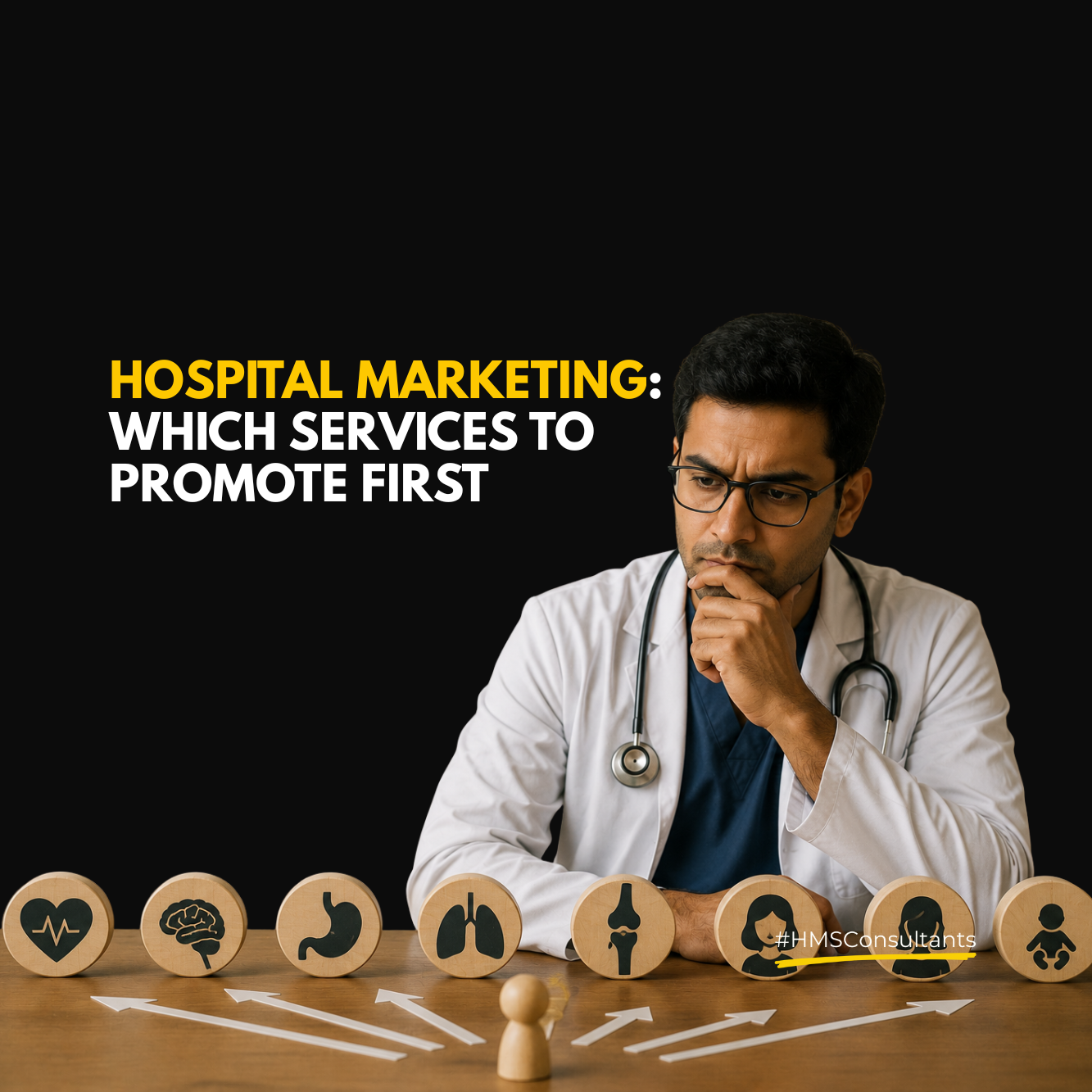
          Hospital marketing becomes difficult when everything is treated as equally important. Most hospitals have multiple departments, doctors, services, packages, and treatment areas. Naturally, every service needs visibility. But in practice, promoting everything at once often leads to scattered communication and weak results.

          A hospital cannot market emergency care, maternity, orthopedics, diagnostics, preventive health check-ups, surgery, and specialist consultations with the same message and the same urgency. Each service has different patient needs, decision time, trust requirements, and business value. This is why hospital marketing should not start with the question, “What should we post?” It should start with a better question: “Which service needs marketing attention first, and why?”

          A clear hospital marketing strategy helps hospitals decide which services to promote first based on patient demand, department readiness, local competition, service value, and growth potential.

          Why Service Prioritisation Matters in Hospital Marketing

          Many hospitals run campaigns without deciding which services deserve focus. As a result, marketing becomes too broad. One week the hospital promotes one department, the next week another, and then a general awareness post follows. This creates activity, but not always direction.

          Service prioritisation helps the hospital focus its effort where it can make the most meaningful impact.

          It helps answer:

          • Which services are patients actively looking for?
          • Which departments are underutilized?
          • Which services need better explanation?
          • Which doctors have availability to handle more patients?
          • Which services support long-term hospital business growth?
          • Which departments face stronger competition?
          • Which services are seasonal or time-sensitive?

          Without this clarity, hospital marketing may continue, but the results may remain unclear.

          Patient Demand Should Guide the First Decision

          The first factor to study is patient demand. Hospitals should not promote a service only because it exists. They should understand whether patients are searching for it, asking about it, or showing real need for it.

          Patient demand can be understood through enquiry patterns, appointment data, common patient questions, Google searches, local health concerns, seasonal illness trends, and competitor visibility.

          For example, if many patients are asking about knee pain, pregnancy care, diabetes management, fever treatment, diagnostic packages, or cardiac check-ups, those areas may need stronger communication.

          This does not mean only high-demand services should be promoted. But demand helps the hospital know where patient interest already exists. Marketing can then improve visibility, explain the service better, and guide patients more clearly.

          A hospital marketing strategy should always connect service promotion with real patient behaviour.

          Department Readiness Comes Before Promotion

          A common mistake in hospital marketing is promoting a service before the department is ready to handle the response.

          If marketing brings enquiries but the doctor is not available, the front desk is not informed, the appointment process is unclear, or follow-up is weak, the campaign may damage trust instead of supporting growth.

          Before promoting any service, the hospital should check:

          • Is the doctor or department available consistently?
          • Can the team handle more enquiries?
          • Is the front desk trained to explain the service?
          • Is the appointment process simple?
          • Is the website information clear?
          • Are packages, reports, or instructions ready where needed?
          • Is follow-up being handled properly?

          Hospital service promotion should not create demand that the hospital cannot manage. Good marketing works only when the patient journey behind it is prepared.

          Underused Services May Need Visibility First

          Many hospitals have strong services that patients do not know about. These may be clinically valuable, but they remain underutilised because they are not clearly visible online or offline.

          Sometimes the service exists on the hospital premises, but it is missing from the website. Sometimes it is not mentioned properly on Google Business Profile. Sometimes the doctor is available, but patients do not know that the department offers that care.

          Underused services can be identified by checking:

          • Services with low enquiries
          • Departments not clearly explained online
          • Doctors with weak digital visibility
          • Treatments not covered in content
          • Services missing from Google Business Profile
          • Low patient awareness despite strong capability

          These services may not need paid ads immediately. They may first need clear service pages, patient education content, doctor-led videos, Google updates, and better internal communication.

          In hospital marketing, visibility should begin with clarity.

          Growth Potential Should Be Considered Carefully

          Hospital marketing must remain ethical and patient-centred, but hospitals also need to understand which services support long-term sustainability. Some services may have higher demand, stronger repeat value, better department capacity, or greater positioning importance for the hospital.

          This is where hospital growth strategy becomes important.

          Hospitals should look at:

          • Patient need
          • Clinical strength
          • Revenue potential
          • Doctor availability
          • Department capacity
          • Local competition
          • Long-term brand positioning

          For example, if a hospital has strong orthopaedic expertise but patients are choosing competitors for joint pain or fracture care, that department may need focused promotion. If diagnostics are available but underused, preventive health packages may need better communication.

          Marketing should support services where the hospital has genuine capability, not only where it wants more visibility.

          Competition Can Reveal Service Opportunities

          A hospital should not copy competitor marketing, but it should understand what competitors are doing. Local competition often shows which services are being pushed heavily and where gaps may exist.

          Hospitals should observe:

          • Which services competitors promote most
          • How they explain those services
          • Which doctors or departments are visible online
          • What patients mention in competitor reviews
          • Where competitors are strong or weak
          • Which patient questions remain unanswered

          If many hospitals are promoting the same service, your hospital needs a clearer positioning angle. If competitors are weak in an area where your hospital has strength, that service may become a strong marketing opportunity.

          Hospital service promotion should be based on differentiation, not imitation.

          Timing Can Improve Marketing Response

          Some hospital services perform better when promoted at the right time. Timing can depend on seasons, awareness months, local health patterns, school calendars, corporate cycles, or disease trends.

          For example, fever and infection care may need stronger communication during monsoon. Respiratory care may become more relevant during pollution season. Preventive health packages may work well around health awareness campaigns. School health check-ups may be planned before academic sessions.

          Hospitals should build a service-wise marketing calendar instead of deciding campaigns at the last moment.

          This helps plan:

          • Awareness posts
          • Doctor videos
          • Google updates
          • Blog content
          • Local campaigns
          • Preventive health messages
          • Patient education material

          When timing is planned, hospital marketing becomes more consistent and less random.

          The Marketing Route Should Match the Service

          Not every service needs the same marketing channel. Some services need search visibility. Some need patient education. Some need doctor credibility. Some need local awareness. Some need Google Business Profile optimization. Some need paid campaigns.

          For example, high-search services may need SEO and Google visibility. Complex services may need blogs and educational videos. Doctor-led services may need profile strengthening and credibility-building content. Preventive services may need awareness campaigns. Competitive services may need stronger service positioning.

          The better question is not, “Should we run ads?”

          The better question is, “What does this service need before patients respond?”

          This is where hospital marketing becomes strategic. The channel should come after the service priority is clear.

          Work with HMS Consultants

          Need a clear plan to grow brand visibility, patient footfall and revenue? Explore Hospital Marketing Strategy Consulting.

          See Hospital Marketing Strategy ConsultingBook a free 30-min call

          Conclusion

          Hospital marketing becomes stronger when hospitals stop promoting everything equally and start prioritising services strategically.

          Every service does not need the same campaign, message, platform, or budget. Some services need awareness. Some need search visibility. Some need doctor credibility. Some need better patient education. Some need operational readiness before promotion.

          A clear hospital marketing strategy helps hospitals decide which services to promote first based on patient demand, department readiness, competition, timing, and growth potential.

          For hospitals that want sustainable growth, marketing should not begin with random activity.

          It should begin with the right service priority.

          Contact Us HMS Consultants

          Hospital marketing is the process of promoting a hospital’s services, departments, doctors, and patient care in a planned way. In this blog context, it means deciding which services should be promoted first based on patient demand, department readiness, competition, and growth potential.

          Healthcare Marketing I Digital Strategy I healthcare digital marketing I healthcare Management I Healthcare Marketing Strategy I hospital marketing I Hospital Marketing Strategies I Hospital Marketing Strategy

          is something we strongly believe in, which means ‘Knowledge without application is the same as having no knowledge at all

          Akhil Dave

          Principle Consultant

          Ready to take your Personal Brand to the next level?

          Share your details below and we will connect with you to discuss your growth strategy.

          • Most Hospitals Still Misunderstand Medical Marketing

            Most Hospitals Still Misunderstand Medical Marketing

            Most Hospitals Still Misunderstand Medical Marketing

            Written by
            Published on
            Share This

            Medical marketing is one of the most misunderstood functions inside Indian hospitals today. Most hospitals believe medical marketing means:
            • Advertisements.
            • Social media posts.
            • Newspaper campaigns.
            • Hoardings.
            • Healthcare camps.
            • Digital promotions.
            But despite spending heavily on these activities, many hospitals still struggle with:
            • Low OPD growth.
            • Weak patient recall.
            • Poor engagement.
            • Inconsistent referrals.
            • Limited long-term brand preference.

            This is where the real problem begins.
            Most hospitals are not failing because they are doing less marketing.
            They are failing because they misunderstand what medical marketing actually is.
            That is becoming one of the biggest challenges in healthcare marketing in 2026.

            Medical Marketing Is Not Just Advertising

            One of the biggest misconceptions in hospital marketing is treating medical marketing as advertising.

            Advertising is only one part of medical marketing.

            It is not the entire system.

            Many hospitals spend lakhs on:

            • Newspaper ads.
            • Meta campaigns.
            • Google Ads.
            • Outdoor branding.
            • Social media creatives.
            • Promotional activities.

            But after all the spending, patient growth still remains inconsistent.

            Why?

            Because patients do not choose hospitals only because they saw an advertisement.

            Healthcare decisions work differently.

            When patients need serious healthcare support, they usually:

            • Ask family members.
            • Search doctor names.
            • Check reviews.
            • Compare trust signals.
            • Speak to referred doctors.
            • Evaluate credibility before choosing a hospital.

            This means medical marketing is not simply about visibility.

            It is about building trust before the patient even walks into the hospital.

            Most Hospitals Treat Medical Marketing Like a Department

            Another major problem is that many hospitals treat medical marketing as an isolated department instead of a complete patient growth system.

            The marketing team runs campaigns.

            The reception team works separately.

            Doctors communicate differently.

            Patient follow-ups are inconsistent.

            Online reputation is unmanaged.

            And discharge communication ends the relationship completely.

            As a result, the patient experience becomes disconnected.

            Effective medical marketing does not work like isolated activities.

            It works like a connected system where:

            • Trust.
            • Communication.
            • Visibility.
            • Patient experience.
            • Retention.
            • Advocacy.

            Work together continuously.

            That is where most hospitals struggle.

            The Biggest Medical Marketing Mistake: Selling Services Instead of Solving Problems

            Most hospital communication sounds almost identical.

            Hospitals repeatedly talk about:

            • Advanced technology.
            • Expert doctors.
            • Modern infrastructure.
            • Comprehensive treatment.
            • Patient-first care.

            The problem is that almost every hospital says the same thing.

            Patients rarely choose hospitals because of generic statements.

            Patients choose hospitals when they feel:

            • Understood.
            • Reassured.
            • Guided.
            • Emotionally confident.

            This is one of the biggest shifts happening in healthcare marketing.

            Patients respond more strongly to communication that addresses:

            • Their fear.
            • Their confusion.
            • Their symptoms.
            • Their questions.

            For example:

            “Advanced orthopaedic department” feels promotional.

            But:

            “Worried about knee pain getting worse while climbing stairs?” feels personal.

            That difference changes patient attention completely.

            Strong medical marketing speaks to patient problems before promoting hospital services.

            Work with HMS Consultants

            Need a clear plan to grow brand visibility, patient footfall and revenue? Explore Hospital Marketing Strategy Consulting.

            See Hospital Marketing Strategy ConsultingBook a free 30-min call

            Most Hospitals Ignore Patients After Discharge

            One of the most overlooked parts of hospital marketing is patient retention.

            Many hospitals focus heavily on acquiring new patients while completely ignoring existing patients after discharge.

            The patient visits once.

            Treatment happens.

            And communication stops.

            No follow-up.
            No educational content.
            No reminders.
            No relationship-building.

            Six months later, when the patient needs healthcare support again, they search again from the beginning.

            Sometimes they choose another hospital entirely.

            This is one of the biggest invisible losses in medical marketing today.

            Existing patients already:

            • Know the hospital.
            • Understand the experience.
            • Trust the doctors.

            Yet many hospitals fail to nurture that trust consistently.

            Retention marketing often creates higher long-term ROI than constantly chasing new patient acquisition.

            Effective Medical Marketing Works Through Trust

            One of the most important shifts happening in medical marketing is the movement from promotion-based communication toward trust-based communication.

            Patients today evaluate hospitals across:

            • Google reviews.
            • Maps visibility.
            • Doctor videos.
            • Healthcare content.
            • Social media.
            • Referrals.
            • Online reputation.

            This means trust is being built continuously across multiple digital touchpoints.

            Hospitals that consistently:

            • Educate patients.
            • Simplify communication.
            • Respond professionally.
            • Maintain visibility.
            • Create reassuring patient experiences.

            Usually build stronger long-term preference.

            This is where medical marketing becomes different from advertising.

            Advertising creates visibility.

            Trust creates patient decisions.

            The T-V-A Approach to Medical Marketing

            One of the simplest ways to understand effective medical marketing is through three pillars:

            These three pillars work together continuously.

            Trust

            Patients must trust the hospital before choosing it confidently.

            Trust is built through:

            • Educational content.
            • Reviews.
            • Referrals.
            • Doctor communication.
            • Patient experience.
            • Reputation.

            Visibility

            Once trust-building starts, the hospital must remain visible where patients search.

            This includes:

            • Google search.
            • Maps.
            • Social media.
            • YouTube.
            • Healthcare content.
            • Local SEO.

            Advocacy

            The strongest medical marketing happens when patients start recommending the hospital themselves.

            This happens when:

            • Patient experiences feel memorable.
            • Communication feels human.
            • Follow-ups feel personal.
            • Patients feel genuinely cared for.

            Advocacy turns patients into long-term growth drivers.

            Why This Matters More in 2026

            Healthcare decisions are becoming increasingly digital.

            Patients now compare hospitals faster than ever before.

            At the same time, patient attention spans are shrinking.

            This means hospitals can no longer depend only on advertisements to grow consistently.

            Patients expect:

            • Credibility.
            • Clarity.
            • Reassurance.
            • Accessibility.
            • Trust signals.

            Before making healthcare decisions.

            That is why medical marketing in 2026 is becoming:

            • More strategic.
            • More patient-centric.
            • More trust-driven.
            • More system-oriented.

            Hospitals that continue treating medical marketing only as promotion will struggle to build long-term patient preference.

            Conclusion

            Most hospitals still misunderstand medical marketing because they treat it as advertising instead of a patient trust-building system.

            The problem is not lack of spending.

            The problem is lack of strategic alignment.

            Effective medical marketing is not built only through campaigns, promotions, or visibility.

            It is built through:

            • Trust.
            • Communication.
            • Patient experience.
            • Retention.
            • Visibility.
            • Advocacy working together continuously.

            In 2026, hospitals that understand this shift will build stronger patient relationships, stronger recall, and stronger long-term growth.

            Because patients do not choose hospitals only because they see them.

            They choose hospitals because they trust them.

            Contact Us HMS Consultants

            Medical marketing is the strategic process of building trust, visibility, patient engagement, and long-term relationships for hospitals, clinics, and healthcare providers through communication, branding, patient experience, and digital presence.

            hospital marketing I Digital Marketing I Healthcare Marketing Strategy I Medical Marketing

            is something we strongly believe in, which means ‘Knowledge without application is the same as having no knowledge at all

            Akhil Dave

            Principle Consultant

            Ready to take your Personal Brand to the next level?

            Share your details below and we will connect with you to discuss your growth strategy.

            • How to Choose a Healthcare Marketing Agency in 2026

              How to Choose a Healthcare Marketing Agency in 2026

              How to Choose a Healthcare Marketing Agency in 2026

              Published on
              Share This
              Healthcare marketing agency cost in India 2026: freelancer vs agency vs specialist

              Quick answer: To choose a healthcare marketing agency in India, check healthcare experience, NMC awareness, a strategy-first approach, transparent reporting and who will actually work on your account. Indicatively, a healthcare specialist costs roughly 2–4 times a freelancer, and the table below shows typical rates by service. Compare in-house, freelancer and agency options on cost, control and skill, and ask how success will be measured before you sign.

              Last updated: 28 October 2026 · By Akhil Dave, Founder & Principal Consultant, HMS Consultants

              In today’s competitive healthcare space, even excellent clinical talent can be overlooked if the brand behind it is not visible, credible or discoverable. Whether you run a standalone clinic, a speciality centre or a mid-sized hospital, the question is not “Do I need marketing?” It is “Who can I trust to do it right?”

              This guide helps you answer that: how to choose the right partner, what typical costs look like in India, how to tell if your marketing is working, and a sample 90-day roadmap.

              Key takeaways

              • Treat marketing as an investment with measurable outcomes, not a cost to cut.
              • In-house, freelancer and agency models differ on cost, expertise, consistency and compliance awareness.
              • Ask about healthcare experience, strategy, lead tracking and NMC awareness before hiring.
              • Specialist rates are higher than freelancer or general agency rates; compare scope, not only price.
              • Track enquiries, cost per lead and conversions monthly to know whether spend is working.

              Marketing Is an Investment, Not an Expense

              Most doctors and hospital owners hesitate to invest in marketing because of fear of wastage, ethical concerns or lack of know-how. But a well-built marketing strategy builds patient trust, visibility builds reputation and not just recall, and a strong digital presence supports steady growth.

              If you treat marketing as an expense, you will always cut it. If you treat it as an investment, you will learn how to multiply it. Not sure where you stand? Start with 5 signs your clinic needs a marketing audit.

              Work with HMS Consultants

              Want to know what is working before you spend more? Start with a structured audit.

              Explore the Marketing AuditBook a free 30-min call

              In-House vs Freelancer vs Agency: Which Should You Choose?

              The right model depends on your goals, budget and internal bandwidth. Here is how the three common options compare for clinics, hospitals and individual doctors:

              CriteriaIn-House TeamFreelancerMarketing Agency
              CostHigh (monthly salaries, tools, training)Low (per-task or monthly)Medium to High (retainer + execution)
              Expertise RangeLimited (1–2 generalists)Varies greatly (depends on the individual)Wide (strategist, designer, ad expert, SEO)
              Healthcare KnowledgeRareUsually not specialisedAvailable in healthcare-specific agencies
              ConsistencyHigh (daily availability)May vary (depends on commitment)Structured, process-driven delivery
              Creative DirectionDepends on internal leadershipRequires clear input & briefIncludes strategy, branding alignment
              ScalabilityHard to scale quicklyLimited to one person’s timeEasy to scale campaigns, channels, and formats
              Data & ReportingRequires separate analytics expertiseRarely offeredTypically part of monthly deliverables
              Compliance Awareness (NMC, PBI, ASCI)Depends on leadershipUsually unawareOften well-versed (in healthcare-specialised firms)

              Quick summary

              • In-house team is best if you already have high patient volumes and want full control over day-to-day content.
              • Freelancers suit basic content or design when the budget is tight, but you will need to guide and monitor them closely.
              • Agencies, especially those experienced in healthcare marketing, bring structured strategy, execution, analytics and domain knowledge, which suits growth-focused hospitals and clinics.

              Many healthcare teams start with freelancers and later move to a consulting and agency hybrid when they need structure, speed and healthcare-specific insight.

              How to Choose the Right Healthcare Marketing Agency

              If you are a clinic, hospital or medical practitioner, ask these questions.

              Must-ask questions

              • Have they worked with doctors, clinics or hospitals before?
              • Can they explain their approach and show verifiable work, without breaching any client’s confidentiality?
              • Do they understand healthcare ethics and the NMC advertising guidelines?
              • What is their process for strategy, not just posting?
              • How do they track leads and ROI?

              Red flags to watch

              • “We give 30 posts per month” with no strategy.
              • No access to analytics or ad dashboards.
              • Every client gets the same templated creatives.
              • No performance or consultation call after onboarding.

              Work with HMS Consultants

              Running an independent clinic on a limited budget? See how we help doctors grow their practice and visibility.

              See Medical Practice GrowthBook a free 30-min call

              Healthcare Marketing Cost in India: Freelancer vs Generalist vs Specialist

              Here is a breakdown of typical charges in India. Treat these as indicative ranges; actual quotes depend on scope and city.

              ServiceFreelancerGeneral AgencyHealthcare Specialist
              Logo Design for a clinic/hospital₹2,000–4,000₹5,000–10,000₹15,000–50,000
              Standard Stationery[Visiting Card, Letter Head, Prescription Pad, Envelope, File]₹2000–4,000₹5,000–10,000₹15,000–25,000
              Social Media Post₹250–400₹300–600₹500–1000
              Brochure (2 pages)₹1,200–2,500₹3,000–5,000₹10,000–15,000
              Monthly Social Media for a clinic / Hospital₹4,000–10,000₹10,000–25,000₹35,000–75,000
              Meta Ads Setup & Mgmt₹2,000–5,000₹4,000–10,000₹10,000–25,000
              Google Ads Management for a clinic/hospital₹3,000–6,000₹5,000–10,000₹10,000–20,000
              Landing Page for Hospital / Clinic₹1,500–3,000₹3,000–6,000₹6,000–10,000
              Content / Blog / Article₹500–1,500₹1,000–3,000₹2,000–10,000
              SEO Services for Healthcare₹5,000–10,000₹10,000–20,000₹20,000–70,000
              Hoarding Design₹2000–4,000₹5,000–10,000₹15,000–25,000
              Advertisement Design₹2000–4,000₹5,000–10,000₹15,000–25,000
              Internal Branding₹4,000–10,000₹10,000–25,000₹35,000–75,000
              Website for doctor₹4,000–10,000₹20,000–45,000₹35,000–75,000
              Hospital Website₹10,000–20,000₹30,000–50,000₹40,000–1,50,000
              Video Editing for Reel, YouTube Shorts₹350–700₹500–1000₹1000–3000
              Long video for YouTube editing cost₹1,200–2,500₹3,000–5,000₹5,000–10,000

              Note: These prices exclude ad budgets, licensing fees and photo or video shoots.

              Is Your Marketing Working? How to Know

              Whether online or offline, tracking performance is essential to make sure your budget is driving real results. Use this diagnostic checklist:

              MetricInterpretation
               Patient EnquiriesMore online leads or appointment calls (from social, website, GMB)
               GMB InsightsHigh map views, calls, direction requests—shows local discoverability
               DMs/CommentsAre people engaging with your content and asking for consultations?
               Brand AwarenessDo patients mention your social media, blogs, or online presence?
               Cost per Lead (CPL)Key metric if you run ads on Google or Meta—tracks lead quality
               Monthly Marketing ReportConsolidated metrics across platforms shared by your team/agency
               Direct Calls/WhatsAppNo. of outbound calls, message reads, responses, and follow-ups
               On-Ground Activation LeadsNo. of people reached, leads collected at camps, health events, branding stalls
               Conversion TrackingForm fills, call clicks, and offline leads turning into patients
               Campaign ROIMeasures effectiveness of ad spend, footfall from offline efforts

              Your First 90-Day Marketing Plan (Sample)

              MonthFocusActivities
              Month 1Setup & StrategyWebsite review, GMB optimisation, SEO audit, social media calendar, ad planning
              Month 2Launch & ExecuteMeta & Google ads go live, content posting begins, local SEO boosted
              Month 3Analyze & OptimizeCampaign reviews, lead quality checks, retargeting, patient feedback review

              You should expect your first visible movement in month two or three, depending on consistency and investment.

              Related reading: Hospital Marketing Consultant Fees in India: What It Costs and What You Get.

              HMS Consultants: Not an Agency, a Strategy Partner

              HMS Consultants is a healthcare marketing consultancy, not a volume-posting agency. We start with strategy, positioning and an audit, then connect it to execution partners where needed, so your spend follows a plan. See healthcare marketing strategy and about HMS Consultants.

              Conclusion

              Choosing a healthcare marketing partner is a strategic decision. Compare models honestly, ask the hard questions, insist on reporting you can read, and make sure NMC compliance is built in from day one. Knowing is knowing, doing is doing™: knowledge without application is no knowledge at all.

              Frequently asked questions

              How much does a healthcare marketing agency cost in India?

              Indicative ranges: monthly social media for a clinic or hospital is about ₹10,000–25,000 with a general agency and ₹35,000–75,000 with a healthcare specialist; healthcare SEO is about ₹20,000–70,000 a month with a specialist. These exclude ad budgets, licensing and shoots, and actual quotes vary by scope.

              Should a clinic hire a freelancer or an agency?

              Freelancers suit basic content or design when the budget is tight, but need close guidance. A healthcare-specialist agency or consultant suits growth-focused clinics and hospitals that need strategy, reporting and NMC awareness.

              What should I ask a healthcare marketing agency before hiring?

              Ask whether they have worked with doctors, clinics or hospitals, how they plan strategy beyond posting, how they track leads and cost per lead, how they handle NMC guidelines, and who will actually work on your account.

              What are red flags when choosing a healthcare marketing agency?

              Promising a fixed number of posts with no strategy, refusing access to analytics or ad dashboards, giving every client the same templated creatives, and having no review call after onboarding.

              How long does healthcare marketing take to show results?

              It depends on consistency and investment, but a structured plan typically shows first visible movement in enquiries in month two or three, after setup and strategy in month one.

              Does a healthcare marketing agency need to know the NMC guidelines?

              Yes. Healthcare promotion in India is bound by the NMC guidelines of 6 October 2026, which restrict testimonials, before-and-after claims, success rates, superlatives and offers. An agency unaware of them can put a doctor at risk.

              Hospital Marketing Audit

              For teams who want to know what is working before they spend more.

              Explore the Audit

              Hospital Marketing Consulting

              For hospitals that need strategy, positioning and a connected plan.

              Explore Hospital Consulting

              Doctor Branding

              For doctors who want a clear, ethical personal brand and trust-led visibility.

              Explore Doctor Branding

              NMC Compliance Audit

              For websites and social channels that must stay within the NMC rules.

              Explore the NMC Audit

              Disclaimer: HMS Consultants is a healthcare marketing consultancy. We are not medico-legal experts or a law firm. References to the NMC guidelines reflect our understanding of public information and are not legal advice. Please consult a qualified healthcare lawyer before acting.

              About the author: Akhil Dave is Founder & Principal Consultant of HMS Consultants, with 25+ years in healthcare marketing.

              Work with HMS Consultants

              Choosing a healthcare marketing partner? Talk to us before you sign anything.

              Explore Hospital Marketing ConsultingBook a free 30-min call

              Digital Marketing I Doctors Digital Marketing I Healthcare Marketing I Healthcare Marketing Strategy I Hospital Marketing Strategies I Marketing ideas for clinics I Marketing Trends 2025 I Medical Marketing I Social Media Marketing

              is something we strongly believe in, which means ‘Knowledge without application is the same as having no knowledge at all

              Akhil Dave

              Principle Consultant

              Ready to take your Personal Brand to the next level?

              Share your details below and we will connect with you to discuss your growth strategy.

              • The Shift in Healthcare Marketing: From Promotion to Proof

                The Shift in Healthcare Marketing: From Promotion to Proof

                Digital Marketing I Doctors Digital Marketing I Healthcare Marketing I Healthcare Marketing Strategy I Hospital Marketing Strategies I Marketing Trends 2025 I Medical Marketing

                The Shift in Healthcare Marketing: From Promotion to Proof

                Written by
                Published on
                Share This

                In an era where information is abundant and patient skepticism is at an all-time high, traditional promotional tactics are no longer enough to win patient trust. The healthcare sector is undergoing a massive transformation—from a focus on loud promotions to strategies rooted in credibility, authenticity, and results. This shift from promotion-based marketing to proof-based marketing is not just a trend; it’s the future.

                At HMS Consultants, we believe that proof-driven, patient-centric marketing strategies are the only sustainable way forward. In this blog, we’ll explore what this shift means for hospitals, clinics, and doctors, and how embracing evidence-based healthcare marketing can lead to higher engagement, better patient outcomes, and long-term growth.

                What is Proof-Based Marketing in Healthcare?

                Proof-based marketing is the strategic use of real results, data, and outcomes to promote healthcare services. Instead of flashy promotions or generic claims like “best in town,” proof-based marketing communicates:

                • Actual patient testimonials

                • Clinical results and outcome statistics

                • Case studies and recovery stories

                • Doctor credentials and patient feedback

                • Community impact and trust-building efforts

                In short, proof-based marketing answers the patient question: “Why should I trust you with my health?”

                Why the Shift from Promotion to Proof is Inevitable

                Patients today are more informed than ever. A simple Google search can provide hundreds of hospital options, treatment alternatives, and online reviews. This transparency demands authenticity over appearance.

                Key Reasons for the Shift:

                1. Patient Empowerment: Patients want to be involved in healthcare decisions. They rely on reviews, social proof, and outcomes, not ads.

                2. Digital Transformation: Search engines and platforms prioritize content that is valuable, original, and trustworthy.

                3. Healthcare is Personal: When life and health are at stake, emotional decisions are influenced by logic and real experiences.

                4. Overexposure to Marketing: Audiences are tuning out promotional noise. Authentic storytelling cuts through the clutter.

                Work with HMS Consultants

                Need a clear plan to grow brand visibility, patient footfall and revenue? Explore Hospital Marketing Strategy Consulting.

                See Hospital Marketing Strategy ConsultingBook a free 30-min call

                Impact of Proof-Based Marketing on Patient Trust & Conversions

                Trust is the new currency in healthcare marketing. When you present evidence instead of advertisements, patients are more likely to engage.

                Benefits of Proof-Driven Healthcare Marketing:

                • Increased patient inquiries and appointments

                • Higher conversion rates from digital platforms

                • Enhanced Google ranking through authentic content

                • Stronger doctor-patient relationships

                • Better word-of-mouth and online reviews

                Google loves proof. Blogs with testimonials, case studies, and factual content perform better on search engines.

                Examples of Proof-Based Marketing Tactics

                Let’s explore practical, SEO- and AEO-friendly ways to apply proof-based strategies in your healthcare business:

                1. Patient Testimonials & Video Stories

                Record short, genuine videos of patients sharing their recovery journeys. Place them on your website, YouTube, and social channels.

                2. Before & After Treatment Cases

                Visual case transformations in aesthetics, ortho, ENT, or dentistry speak volumes.

                3. Doctor Spotlights & Credentials

                Build trust by highlighting your doctors’ academic background, experience, and special interests.

                4. GMB & Online Reviews Optimization

                Encourage patients to review you on Google. Showcase 5-star reviews on landing pages.

                5. Outcome Statistics & Success Rates

                Share data about surgery success rates, infection control, recovery timelines (ensure they’re ethically presented).

                6. Community Engagement Initiatives

                Blood donation drives, health camps, wellness talks: all proof of your real-world impact.

                7. Blogging on Real Patient Concerns

                Answer questions patients are Googling: “How long does knee replacement recovery take?” “What is the cost of IVF in Ahmedabad?”

                For inspiration: Check our blog on Signs Your Clinic Needs a Marketing Audit

                Final Thoughts: Trust Over Tactics

                The future of healthcare marketing is not about doing more campaigns. It’s about doing what builds credibility.

                Stop promoting. Start proving.

                Because when patients believe in you, they choose you.

                How HMS Consultants Helps You Build Proof-Based Strategies

                At HMS Consultants, we specialize in developing strategic healthcare marketing frameworks that focus on authenticity, storytelling, and measurable results.

                We help:

                • Doctors build personal brands that inspire trust

                • Clinics identify proof-points that differentiate them

                • Hospitals structure marketing around real outcomes

                • Teams understand what today’s patients actually care about

                Our consulting-first model ensures that your existing marketing agency or internal team implements strategies aligned with patient expectations and digital growth trends.

                Want to transition your clinic or hospital to a proof-based marketing model?

                Let’s talk: Contact HMS Consultants

                #HealthcareMarketing #PatientCentricStrategy #DigitalMarketingForDoctors #ProofBasedMarketing #ClinicGrowth #PatientTrust #AkhilDave

                is something we strongly believe in, which means ‘Knowledge without application is the same as having no knowledge at all

                Akhil Dave

                Principle Consultant

                Ready to take your Personal Brand to the next level?

                Share your details below and we will connect with you to discuss your growth strategy.

                • 5 Signs Your Clinic Needs a Marketing Audit This Month

                  5 Signs Your Clinic Needs a Marketing Audit This Month

                  Doctors Digital Marketing I Healthcare Marketing Strategy I Hospital Marketing Strategies I Marketing Trends 2025 I Medical Marketing

                  5 Signs Your Clinic Needs a Marketing Audit This Month

                  Written by
                  Published on
                  Share This

                  In the fast-evolving world of healthcare, marketing has moved beyond posters in waiting rooms and word-of-mouth referrals. Today, patients are searching online, comparing options, reading reviews, and making decisions based on digital impressions. If your clinic isn’t keeping up, it may be time to take a closer look at your marketing efforts and do the Clinic Marketing Audit.

                  That’s where a marketing audit comes in.

                  As a leading healthcare marketing agency, we at HMS Consultants have worked with hundreds of doctors, clinics, and hospitals across India. We’ve noticed one consistent truth: many clinics are spending money on marketing, but few are spending it wisely.

                  Here are 5 clear signs your clinic needs a marketing audit—and how you can fix them.

                  1. You’re Not Sure Where Most of Your Patients Are Coming From

                  If you ask your front desk, “Where did this patient hear about us?” and get vague answers like “maybe Google” or “someone referred them,” you have a visibility problem.

                  Every successful marketing plan starts with tracking. Without clear data, you can’t optimise. You could be spending thousands on Google Ads or Facebook promotions, but if you don’t know what’s converting, you’re flying blind.

                  A marketing audit helps you:

                  • Identify your top-performing channels
                  • Stop wasting money on underperforming ads
                  • Refocus your efforts based on real patient behaviour

                  2. Your Social Media is Active, But Footfall Hasn’t Changed

                  Posting daily on Instagram or Facebook is great but is it driving results?

                  Engagement doesn’t always translate to bookings. If your posts are getting likes but not converting into consultations, it’s time to reassess.

                  Our audits look beyond vanity metrics. We evaluate:

                  • Content strategy vs. audience expectations
                  • Call-to-action effectiveness
                  • Conversion pathways from social media to appointment booking

                  A good branding agency for clinics will not only make you look good—but will make sure you’re growing sustainably.

                  3. You’ve Been Boosting Posts But Not Tracking ROI

                  Boosted posts are easy. But they’re also often ineffective if not targeted correctly.

                  If you’re spending on ads without tracking return on investment (ROI), it’s like throwing darts in the dark. With a proper hospital advertisement strategy, every rupee should be accountable.

                  Our marketing audits include:

                  • Campaign performance reviews
                  • CAC (Customer Acquisition Cost) analysis
                  • Recommendations for more strategic ad spend

                  We don’t just run ads—we run ROI-driven marketing.

                  Work with HMS Consultants

                  Want an independent, expert review of your hospital’s marketing? Our Hospital Marketing Audit starts at ₹25,000.

                  See the Hospital Marketing AuditBook a free 30-min call

                  4. You’re Spending More But Getting Fewer Inquiries

                  This is one of the most frustrating realities we uncover: marketing spend is increasing, but lead volume is flat or declining.

                  This could mean:

                  • Your website isn’t converting visitors
                  • Your messaging doesn’t resonate
                  • Your target audience has shifted

                  As part of our audits, we evaluate your digital assets, including your website for hospital or clinic, and how user-friendly and trust-building it is.

                  We’ll look at:

                  • Bounce rates & page performance
                  • Booking funnel optimisation
                  • Mobile experience (especially critical for healthcare seekers)

                  5. You Don’t Have a Marketing Roadmap for FY 2025–26

                  It’s April. The start of a new financial year. Yet many clinics haven’t mapped out a strategy for their brand growth.

                  A marketing audit gives you a clear, actionable roadmap for the year:

                  • Monthly activity plan (digital + offline)
                  • Branding focus and visibility goals
                  • Budget planning aligned with expected patient footfall

                  With HMS Consultants as your trusted healthcare marketing partner, we turn audits into growth strategies that deliver.

                  Why Marketing Audits Matter — Especially Now

                  In an era where patients treat their healthcare decisions like consumer choices, you can’t afford outdated marketing.

                  A marketing audit is like a health check-up—for your business. It identifies silent leaks, reveals new growth avenues, and ensures every rupee you spend is working hard for you.

                  We combine:

                  • Experience across 100+ clinics and hospitals
                  • Deep understanding of patient behaviour
                  • Tools, data, and human insights

                  So whether you’re looking for a branding agency, a digital growth partner, or simply clarity on what’s working (and what’s not)—we’ve got you covered.

                  Ready to Audit Your Marketing?

                  If even one of the five signs above felt familiar, don’t wait.

                  Let’s start this financial year strong—with a clear strategy, defined budgets, and measurable goals.

                  📩 Reach out to HMS Consultants today for your Marketing Audit.

                  We help doctors and healthcare providers across India grow with confidence, consistency, and clarity.

                  is something we strongly believe in, which means ‘Knowledge without application is the same as having no knowledge at all

                  Akhil Dave

                  Principle Consultant

                  Ready to take your Personal Brand to the next level?

                  Share your details below and we will connect with you to discuss your growth strategy.

                  • Build Your Personal Brand and Elevate Your Practice with HMS Consultants

                    Build Your Personal Brand and Elevate Your Practice with HMS Consultants

                    Build Your Personal Brand and Elevate Your Practice with HMS Consultants

                    Written by
                    Published on
                    Share This

                    Quick answer

                    Personal branding for doctors is the planned way a doctor becomes known and trusted for specific expertise. In India it combines a clear positioning, a professional online presence, helpful educational content and consistent patient experience, all within NMC guidelines on advertising and self-promotion. Doctor Branding

                    Why Personal Branding is Crucial for Doctors in India’s Healthcare Landscape

                    In India’s dynamic healthcare ecosystem, where patients often prioritise trust in a doctor’s name and credentials over a clinic or hospital’s reputation, personal branding has emerged as a powerful tool for healthcare professionals. As the relationship between doctors and patients transitions from traditional paternalism to collaborative partnerships, building a robust personal brand can enhance a doctor’s credibility and attract the right audience to their practice.

                    This blog delves into why personal branding is essential for doctors in India and how our expert marketing consultants can help healthcare professionals navigate this journey effectively.

                    The Evolving Dynamics of Doctor-Patient Relationships:

                    According to a study shared by Lupin, Indian patients increasingly view doctors as partners in their healthcare journey, rather than mere authority figures. This shift demands a proactive approach where doctors not only deliver excellent medical care but also foster trust and transparency. A well-crafted personal brand can bridge this gap, positioning doctors as empathetic, knowledgeable, and reliable caregivers.

                    Moreover, insights from Statista reveal that over 60% of patients in India prefer healthcare providers they are familiar with, further emphasising the importance of personal connection in choosing a doctor.

                    Why Personal Branding Matters for Doctors:

                    1. Building Trust:
                      Patients are more likely to trust and refer a doctor whose name is synonymous with quality care and professionalism.
                    2. Standing Out in a Competitive Market:
                      With the mushrooming of multispecialty hospitals and clinics, personal branding helps doctors differentiate themselves and their practice.
                    3. Influencing Patient Choice:
                      As per Invoca’s healthcare marketing statistics, 77% of patients conduct online research before visiting a healthcare provider. A doctor with a strong online presence has a higher chance of being selected.
                    4. Attracting the Right Patients:
                      Personal branding helps you connect with patients who align with your expertise and values, leading to better outcomes and satisfaction.
                    5. Leveraging Digital Platforms:
                      Platforms like LinkedIn, YouTube, and Instagram are excellent avenues for doctors to share their expertise and engage with their audience, building a strong personal brand.

                    HMS Consultants: Your Partner in Personal Branding

                    At HMS Consultants, we understand the unique challenges doctors face in balancing their clinical responsibilities with the need to build and manage their personal brand. Our data-driven and customized approach ensures that your personal branding efforts align seamlessly with your clinic or hospital’s overarching goals.

                    Our Services Include:

                    • Brand Identity Creation: Craft a compelling personal story and unique value proposition.
                    • Social Media Strategy: Maximize reach on platforms like LinkedIn, YouTube, and Instagram with engaging, platform-specific content.
                    • Digital Presence Optimization: Build and optimize your professional website, Google My Business profile, and social media channels.
                    • Reputation Management: Proactively manage online reviews and patient feedback to maintain a positive digital footprint.
                    • Thought Leadership: Position yourself as a subject matter expert by publishing blogs, articles, and hosting webinars.

                    Work with HMS Consultants

                    Want to be known and trusted for your expertise, ethically and within guidelines? Explore Doctor Branding for doctors.

                    See Doctor BrandingBook a free 30-min call

                    5 Quick Tips for Building a Strong Personal Brand:

                    1. Define Your Niche:
                      Highlight your area of expertise, such as paediatrics, orthopaedics, or aesthetic surgery. Patients appreciate clarity and focus in a doctor’s offerings.
                    2. Be Consistent:
                      Ensure that your messaging, tone, and visual branding remain consistent across all platforms and interactions.
                    3. Engage Authentically on Social Media:
                      Share insights, success stories, and patient education content that resonate with your target audience. Avoid overly technical jargon and keep it relatable.
                    4. Monitor Your Online Reputation:
                      Actively address both positive and negative feedback to demonstrate accountability and care for your patients’ concerns.
                    5. Collaborate with Experts:
                      Partner with consultants like HMS to streamline your branding efforts and achieve tangible results without stretching your bandwidth.

                    Free eBook

                    Doctor Personal Brand Playbook

                    Free 19-page eBook: build a personal brand patients and peers trust in 90 days, with 30 post prompts, inside the NMC rules.

                    Get the free eBook

                    People Also Ask: Your FAQs on Personal Branding for Doctors

                    In this section, we answer some of the most commonly asked questions about personal branding, tailored specifically for healthcare professionals.

                    What are the 5 P’s of personal branding?

                    The 5 P’s of personal branding include:

                    1. Passion – Showcase your dedication to your medical field.

                    2. Purpose – Clearly define your mission and goals as a healthcare professional.

                    3. Positioning – Establish yourself as an expert in your niche.

                    4. Presentation – Ensure consistent and professional communication across all platforms.

                    5. Persistence – Continuously work to build your brand with consistency and patience.

                    How to brand a doctor?

                    Branding a doctor involves:

                    1. Defining your speciality and unique value proposition.

                    2. Creating an optimised online presence through social media, websites, and directories.

                    3. Sharing thought leadership content such as blogs, webinars, and podcasts.

                    4. Leveraging patient feedback and testimonials to build trust.

                    What are the 5 C’s of personal branding?

                    The 5 C’s of personal branding include:

                    1. Clarity – Have a clear and focused message about your expertise.

                    2. Consistency – Maintain uniformity across all branding channels.

                    3. Credibility – Build trust through authentic and transparent communication.

                    4. Connection – Engage with your audience through relevant and relatable content.

                    5. Creativity – Stand out with innovative and unique branding strategies.

                    What are the 5 A’s of personal branding?

                    The 5 A’s of personal branding for doctors are:

                    1. Authenticity – Be true to your personality and values.

                    2. Authority – Establish yourself as a trusted expert in your field.

                    3. Alignment – Align your personal brand with your career goals.

                    4. Adaptability – Stay relevant by evolving with market trends.

                    5. Advocacy – Let your satisfied patients advocate for your brand through testimonials.

                    What are the 4 C’s of personal branding?

                    The 4 C’s of personal branding include:

                    Building a doctor brand patients trust?

                    HMS Consultants helps doctors and clinics grow with a strategy-first, NMC-compliant approach to visibility and patient engagement.

                    Explore Medical Practice Growth →
                    1. Confidence – Exude self-assurance in all your communications.

                    2. Competence – Showcase your skills and qualifications.

                    3. Commitment – Stay dedicated to your professional growth.

                    4. Communication – Ensure your message reaches the right audience.

                    What are the 3 C’s of personal branding?

                    The 3 C’s of personal branding are:

                    1. Character – Reflect on your professional ethics and values.

                    2. Content – Use engaging and valuable content to build your brand.

                    3. Communication – Clearly convey your expertise and experience.

                    How do I sell myself as a doctor?

                    1. Build a strong personal brand showcasing your expertise.

                    2. Network with other healthcare professionals and industry leaders.

                    3. Use digital platforms to highlight your achievements and patient success stories.

                    What is medical branding?

                    Medical branding involves creating a unique identity for healthcare providers, emphasising their expertise, patient care, and professional values to stand out in a competitive market.

                    How do you label a doctor?

                    Doctors can be labelled based on their expertise, such as:

                    1. “Trusted Pediatric Specialist.”

                    2. “Leading Orthopedic Surgeon in [City].”

                    3. “Compassionate Caregiver for Women’s Health.”

                    What is the ABC of personal branding?

                    The ABC of personal branding includes:

                    1. Authenticity – Be genuine in your interactions.

                    2. Brand Consistency – Maintain a consistent image across all channels.

                    3. Communication – Effectively reach and engage your audience.

                    What are the 4 V’s of branding?

                    The 4 V’s of branding are:

                    1. Vision – Define your long-term goals.

                    2. Voice – Develop a distinct and relatable tone.

                    3. Value – Highlight what sets you apart.

                    4. Visibility – Ensure your presence on relevant platforms.

                    What are the 8 rules of personal branding?

                    1. Be authentic.

                    2. Stay consistent.

                    3. Identify your niche.

                    4. Create high-quality content.

                    5. Be active on social media.

                    6. Engage with your audience.

                    7. Monitor your reputation.

                    8. Continuously learn and adapt.

                    What are the 4Ps of branding?

                    The 4Ps include:

                    1. Product – Your services and expertise as a doctor.

                    2. Price – The value you provide.

                    3. Place – Your physical and digital presence.

                    4. Promotion – How you communicate your brand.

                    What is the key to personal branding?

                    The key is authenticity. Be true to who you are while ensuring your brand aligns with your professional goals and values.

                    What are the four Rs of place branding?

                    1. Recognition – Building awareness of your brand.

                    2. Reputation – Maintaining a trustworthy image.

                    3. Resonance – Connecting emotionally with your audience.

                    4. Relevance – Staying relevant to your target audience’s needs.

                    The Future of Personal Branding in Healthcare

                    As India’s healthcare industry grows increasingly competitive, personal branding will continue to play a pivotal role in a doctor’s career trajectory. By building a strong, authentic brand, healthcare professionals can foster trust, attract loyal patients, and ultimately elevate their practice.

                    Conclusion: Take Charge of Your Brand Today

                    Your name is your strongest asset in healthcare. Don’t let it go unnoticed in the crowded marketplace. With HMS Consultants’ expertise, you can create a powerful personal brand that complements your clinical practice and establishes you as a trusted healthcare leader.

                    Ready to build your personal brand?

                    Contact HMS Consultants today for a free consultation and take the first step toward transforming your name into a legacy.

                    Digital Marketing For Doctors I Doctors Digital Marketing I Healthcare Marketing I Healthcare Marketing Strategy I Marketing ideas for clinics I Marketing Trends 2025 I Medical Marketing I Personal Branding

                    is something we strongly believe in, which means ‘Knowledge without application is the same as having no knowledge at all

                    Akhil Dave

                    Principle Consultant

                    Ready to take your Personal Brand to the next level?

                    Share your details below and we will connect with you to discuss your growth strategy.

                    • Medical Marketing: Effective Strategies to Boost Your Healthcare Practice

                      Medical Marketing: Effective Strategies to Boost Your Healthcare Practice

                      Digital Marketing For Doctors I Doctors Digital Marketing I Healthcare Marketing I Healthcare Marketing Strategy I Marketing ideas for clinics I Marketing Trends 2025 I Medical Marketing

                      Medical Marketing: Effective Strategies to Boost Your Healthcare Practice

                      Written by
                      Published on
                      Share This

                      Quick answer

                      Medical marketing is the ethical, planned promotion of a clinic, doctor or hospital to attract and retain patients. A strong strategy in India combines a clear positioning, a trustworthy website, local search visibility, reviews, useful patient content and regular measurement, all within NMC advertising guidelines. Hospital Marketing Strategy Consulting

                      Medical Marketing: Strategies and Ideas for Clinics, Doctors, and Healthcare Providers

                      In today’s digital era, healthcare providers, clinics, and doctors are increasingly recognising the importance of having a strong healthcare marketing strategy. With the competition in the healthcare industry intensifying, a well-executed medical marketing plan not only increases visibility but also improves patient engagement, brand trust, and overall growth. As one of India’s premier healthcare marketing companies, HMS Consultants brings a wealth of experience in crafting successful marketing strategies tailored to healthcare.

                      This article explores effective marketing ideas for clinics, strategies for the marketing of healthcare services, and insights into how healthcare marketing company like HMS Consultants help doctors and healthcare providers elevate their practice.

                      The Importance of Medical Marketing

                      Medical marketing goes beyond traditional advertising; it involves a blend of digital, local, and patient-centric strategies to attract and retain patients. A strong healthcare marketing strategy enhances patient acquisition, builds brand loyalty, and ultimately boosts the reputation and profitability of the healthcare provider. Let’s dive into effective ways to master the marketing of healthcare services.

                      Key Components of a Successful Healthcare Marketing Strategy

                      A holistic marketing strategy for healthcare should encompass various approaches tailored to both digital and in-person patient engagement. Here are essential pillars to consider:

                      Building a Patient-Centric Website

                      A user-friendly, responsive website is the cornerstone of any successful healthcare marketing strategy. Patients increasingly rely on online searches to find medical providers, so it’s critical to ensure that your website provides easy access to information about services, doctor profiles, appointment scheduling, and patient testimonials. Optimising for local search (SEO) helps attract nearby patients, especially those searching for medical services on mobile devices.

                      Search Engine Optimisation (SEO) for Healthcare Providers

                      Leveraging SEO is essential for clinics and doctors aiming to rank highly on search engines. By optimising website content with your focus keywords. For example for HMS Consultants website promotion we are using keywords like “medical marketing,” “healthcare marketing strategy,” “marketing ideas for clinics,” and “marketing for doctors,” you can increase visibility. Implement both on-page SEO (focusing on keywords, meta tags, and internal linking) and off-page SEO (backlinks from credible healthcare sites) to improve rankings.

                      Content Marketing and Patient Education

                      Patients value healthcare providers who educate them. Regularly posting insightful blog articles, FAQs, and patient success stories positions your practice as a thought leader. HMS Consultants, for example, assists healthcare providers in creating content that resonates with patients’ needs while improving SEO rankings. Content that addresses common health concerns, preventive care, and treatment options can attract a steady flow of organic traffic.

                      Social Media Engagement

                      Social media platforms like Facebook, Instagram, and LinkedIn allow clinics and doctors to engage with patients beyond the clinical setting. Sharing health tips, hosting Q&A sessions, and showcasing patient testimonials help build trust and improve patient loyalty. Additionally, doctors can use platforms like LinkedIn to build personal branding and credibility among peers and potential patients.

                      Online Reputation Management

                      In the age of online reviews, managing your reputation is critical. Encourage satisfied patients to leave reviews on platforms like Google My Business and healthcare directories. Address negative reviews professionally and empathetically to show potential patients that you prioritise patient satisfaction.

                      Work with HMS Consultants

                      Need a clear plan to grow brand visibility, patient footfall and revenue? Explore Hospital Marketing Strategy Consulting.

                      See Hospital Marketing Strategy ConsultingBook a free 30-min call

                      Email Marketing and Patient Retention

                      Email marketing is a cost-effective way to stay connected with patients. Sending newsletters, appointment reminders, and educational materials keeps your practice top-of-mind for patients and can help with retention. Personalised emails also make patients feel valued and are likely to enhance loyalty.

                      Local SEO and Google My Business Optimisation

                      For clinics and doctors, optimising for local search is crucial. A Google My Business profile with updated information, photos, and patient reviews can boost local SEO efforts. Local SEO strategies help capture patients in your vicinity who are actively searching for healthcare services.

                      Innovative Marketing Ideas for Clinics

                      For clinics and doctors looking to differentiate themselves, here are some innovative ideas:

                      Offer Virtual Consultations

                      Telemedicine is booming, and offering virtual consultations can attract patients who prefer remote services. Promoting telemedicine options on your website and social media channels can broaden your reach and improve patient convenience.

                      Host Health Webinars or Live Q&A Sessions

                      Hosting webinars on health-related topics relevant to your clinic’s specialty can attract patients who are looking to learn more about managing their health. It also establishes the doctor as a credible source of information.

                      Leverage WhatsApp for Patient Engagement

                      WhatsApp can be a powerful tool for clinics and doctors to keep patients engaged. Send reminders, follow-ups, and share health tips. It’s a direct line to patients and can significantly enhance patient experience.

                      Personalise Patient Follow-Ups

                      Personalised follow-up messages after consultations show patients that you care about their well-being. This personal touch improves patient satisfaction and encourages referrals.

                      Participate in Local Community Events

                      By engaging with the community, clinics can boost their visibility and reputation. Health camps, free screenings, and community sponsorships showcase the clinic’s commitment to community health and increase brand awareness.

                      Develop Patient-Centric Video Content

                      Video content is more engaging and helps humanise your practice. Short videos explaining common procedures, patient testimonials, and doctor introductions can be posted on YouTube and shared on social media for greater reach.

                      Utilise Influencer Marketing and Patient Testimonials

                      Influencer marketing, especially with local influencers, can help clinics reach a wider audience. Positive patient testimonials are equally effective; they build credibility and encourage word-of-mouth referrals.

                      Why Choose HMS Consultants for Your Healthcare Marketing Needs?

                      As one of the leading healthcare marketing companies in India, HMS Consultants is uniquely positioned to help clinics, doctors, and healthcare providers navigate the complexities of medical marketing. Here’s why we’re trusted by healthcare professionals:

                      • Data-Driven Strategies: We develop customized healthcare marketing strategies using data and analytics to ensure high ROI.
                      • Specialisation in Healthcare: Unlike general marketing firms, we focus exclusively on healthcare, making us experts in the nuances and regulations of this industry.
                      • Proven Track Record: Our expertise spans over two decades, with a track record of success in enhancing brand visibility, patient engagement, and profitability for our clients.
                      • Comprehensive Services: From SEO and content marketing to social media management and reputation management, we offer end-to-end solutions for all your marketing needs.

                      Measuring Success: Key Metrics for Healthcare Marketing

                      It’s essential to track and analyze the success of your healthcare marketing strategy. Some key performance indicators (KPIs) to monitor include:

                      • Website Traffic: Track visits to your website and analyse where traffic is coming from to adjust strategies as needed.
                      • Conversion Rates: Measure how many website visitors book appointments or make inquiries.
                      • Patient Acquisition Costs: Calculate the cost per new patient to understand the effectiveness of your campaigns.
                      • Patient Retention Rates: Track repeat visits or follow-up appointments to measure patient loyalty.
                      • Engagement on Social Media: Monitor likes, shares, and comments to gauge patient interest and interaction with your content.
                      • Review Ratings: Keep an eye on online reviews to ensure a positive online reputation.


                      By regularly assessing these metrics, clinics and doctors can make informed decisions to optimise their marketing strategies further.

                      “Knowing is Knowing, Doing is Doing”

                      is something we strongly believe in, which means ‘Knowledge without application is the same as having no knowledge at all

                      Akhil Dave

                      Principle Consultant

                      Ready to take your Medical Practice to the next level?

                      Share your details below and we will connect with you to discuss your growth strategy.