
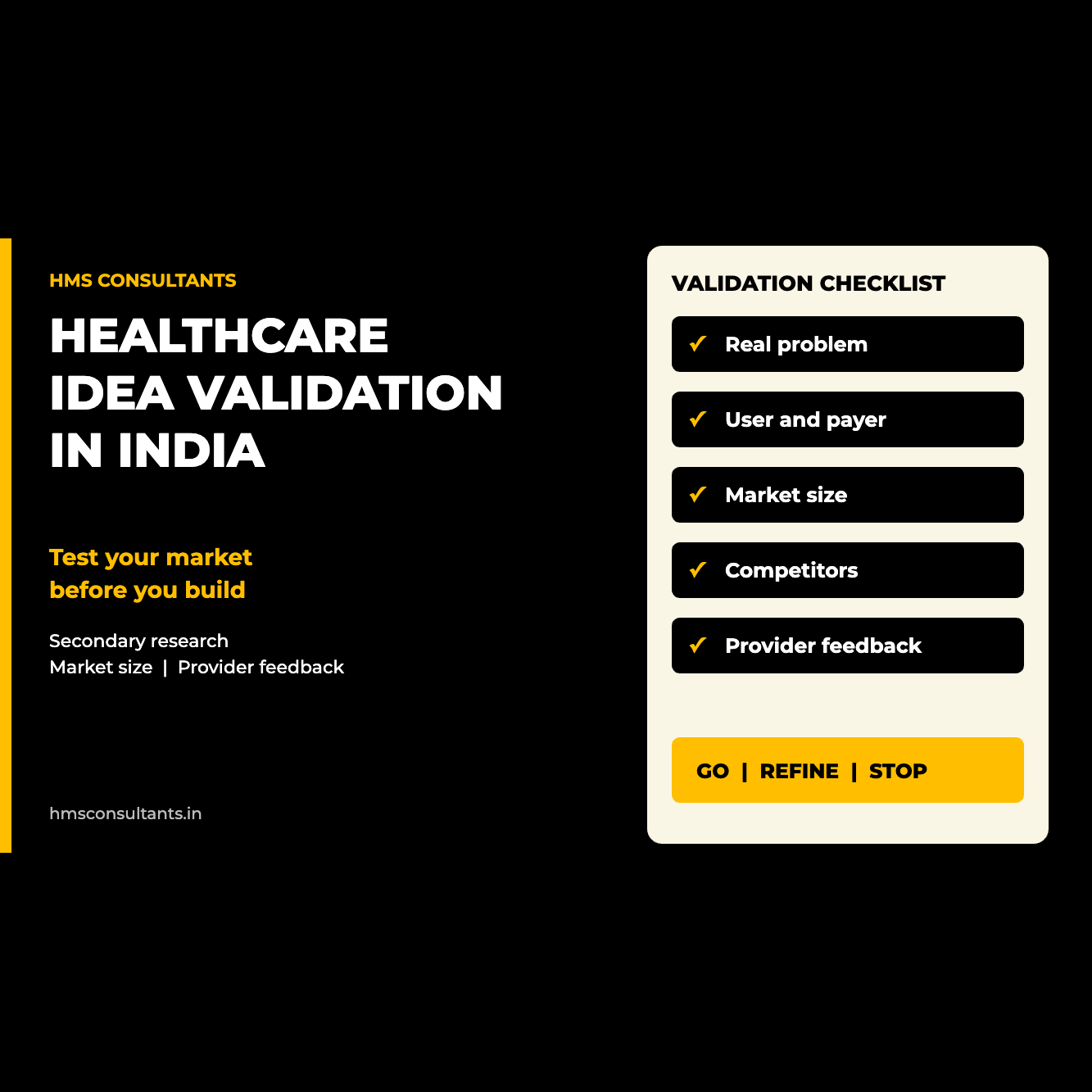
Healthcare Market Validation in India: How to Test Your Idea Before You Build (2026)
Healthcare Market Validation in India: How to Test Your Idea Before You Build (2026) Author Akhil Dave Published on October...
AI-driven personalization refers to the use of artificial intelligence technologies like machine learning, predictive analytics, and natural language processing to tailor healthcare services to individual patients.
Startups like HealthPlix and Qure.ai in India are already using AI to assist doctors in clinical decision-making, especially in radiology and cardiology.
Work with HMS Consultants
Need a clear plan to grow brand visibility, patient footfall and revenue? Explore Hospital Marketing Strategy Consulting.
See Hospital Marketing Strategy ConsultingBook a free 30-min call
Telehealth refers to the use of video calls, apps, and remote monitoring tools to deliver healthcare services without requiring a patient to visit a hospital physically.
In India, the Telemedicine Practice Guidelines by the MoHFW (March 2020) have legitimized this practice and encouraged widespread adoption.
These technologies are only as powerful as the implementation behind them. Here’s a roadmap for small clinics and large hospitals alike:
Benefit | Description |
Better Outcomes | Predictive tools catch disease early and guide treatment more accurately. |
Increased Patient Satisfaction | Personalization and convenience boost loyalty. |
Operational Efficiency | AI reduces repetitive tasks, speeds up documentation, and optimizes workflows. |
Revenue Growth | Telehealth opens up new streams and reduces no-shows. AI helps with better targeting and retention. |
Scalability | Clinics and hospitals can reach thousands more patients without physical expansion. |
While the future is promising, the road isn’t without bumps.
As India and the world rapidly integrate AI-driven personalization and telehealth into mainstream care, the narrative has largely focused on efficiency, accessibility, and innovation. However, beneath the surface of this optimistic shift lies a deeper set of questions that require urgent attention. What will this transformation mean for society in the long run? Will it truly democratize access to healthcare or reinforce existing inequalities under a digital veneer?
There is an emerging need to systematically research the long-term societal, economic, and health equity impacts of digital health technologies. One critical area is the evolving nature of the patient-provider relationship. As AI chatbots and virtual care interfaces become the new norm, the warmth of traditional bedside interactions risks being replaced by sterile automation. While AI can improve diagnosis and personalization, it cannot replicate empathy, cultural understanding, or nuanced judgment qualities that patients still deeply value. This changing dynamic must be studied and balanced thoughtfully.
Moreover, the digital divide presents a real threat to health equity. Populations in rural or under-resourced settings, the elderly, people with disabilities, and those with limited digital literacy could find themselves further marginalized if digital health tools are designed without them in mind. There’s also the risk that AI algorithms, trained on skewed datasets, may unintentionally reinforce biases leading to suboptimal or even harmful outcomes for certain groups. These concerns cannot be addressed retrospectively. Proactive regulation, inclusive design, and community consultation must be part of the process from the outset.
Economically, while digital health may promise cost reductions in the long term, the short-term investment in technology, training, cybersecurity, and data governance is significant. Smaller clinics and hospitals, especially in Tier 2 and Tier 3 cities, may find it difficult to compete or stay compliant without support. Governments and private stakeholders must work together to create subsidies, standards, and training programs that ensure an equitable playing field in this new era.
In summary, the digital health revolution is not just a technological challenge it’s a human and societal challenge. To ensure this transition benefits everyone, we need research, policy, and practice that reflect the full complexity of healthcare not just its digital efficiency. What we design today will determine whether we build a system of inclusive healing or leave vulnerable populations behind.
The convergence of AI-driven personalization and telehealth is not a passing trend – it’s a structural shift. Indian healthcare providers must view these technologies not as threats or gimmicks, but as opportunities to deepen trust, widen access, and deliver care that is smarter, faster, and more humane.
Doctors, clinics, and hospitals that embrace this transformation early will be at the forefront of a more efficient and compassionate healthcare future. Now is the time to build, adapt, and lead.
Written by Dr. Omang Gupta
Share your details below and we will connect with you to discuss your growth strategy.
Healthcare Market Validation in India: How to Test Your Idea Before You Build (2026) Author Akhil Dave Published on October...
A founder guide to healthtech and medtech go-to-market strategy in India: buyers, clinician champions, pilots, partners and a 90-day plan.
NMC Advertising Guidelines 2026: A Complete Compliance Guide for Doctors and Hospitals Author Akhil Dave Published on October 9, 2026...
A practical guide to building a hospital website that converts visitors into patient enquiries through clear CTAs, better UX, mobile...
The 7 Ps of healthcare marketing Product, Price, Place, Promotion, People, Process, and Physical Evidence provide a practical framework for...
Compare hospital marketing, digital, and social media audits to understand what each audit covers and which one your hospital should...