Quick answer: Integrated marketing communication (IMC) means every channel carries one consistent message and one plan. Omnichannel means those channels are connected around the patient’s journey, so the experience feels like one conversation. Healthcare needs both. Apply the NMC notice of 6 October 2026 channel by channel, because several common tactics, such as testimonials, promotional ads, soliciting and paid PR, are restricted for doctors.
Published: 18 November 2026 · By Akhil Dave, Founder & Principal Consultant, HMS Consultants
Most healthcare brands do not have a channel problem. They have a connection problem. The website says one thing, the Instagram page says another, and the front desk knows nothing about the WhatsApp enquiry that came in last night. This guide explains IMC and the omnichannel approach in plain terms, why each channel matters, and why the two together are the practical way to market in healthcare today. Because the NMC notice of 6 October 2026 changes what individual doctors can do on several channels, each section also carries a short NMC note. If you want the full notice first, read our NMC advertising guidelines guide.
Key takeaways
IMC aligns the message. Omnichannel connects the journey. You need both.
IMC has eight building blocks. Each does a different job.
Several common channels are restricted for doctors under the NMC notice of 6 October 2026.
Start by connecting what you already have, not by adding channels.
Integrated marketing communication (IMC) is the practice of planning every message, on every channel, as one system. The patient should hear the same promise from your website, your talks, your printed material, your reception and your staff. In healthcare this matters more than in most fields, because patients are choosing someone they must trust with their health.
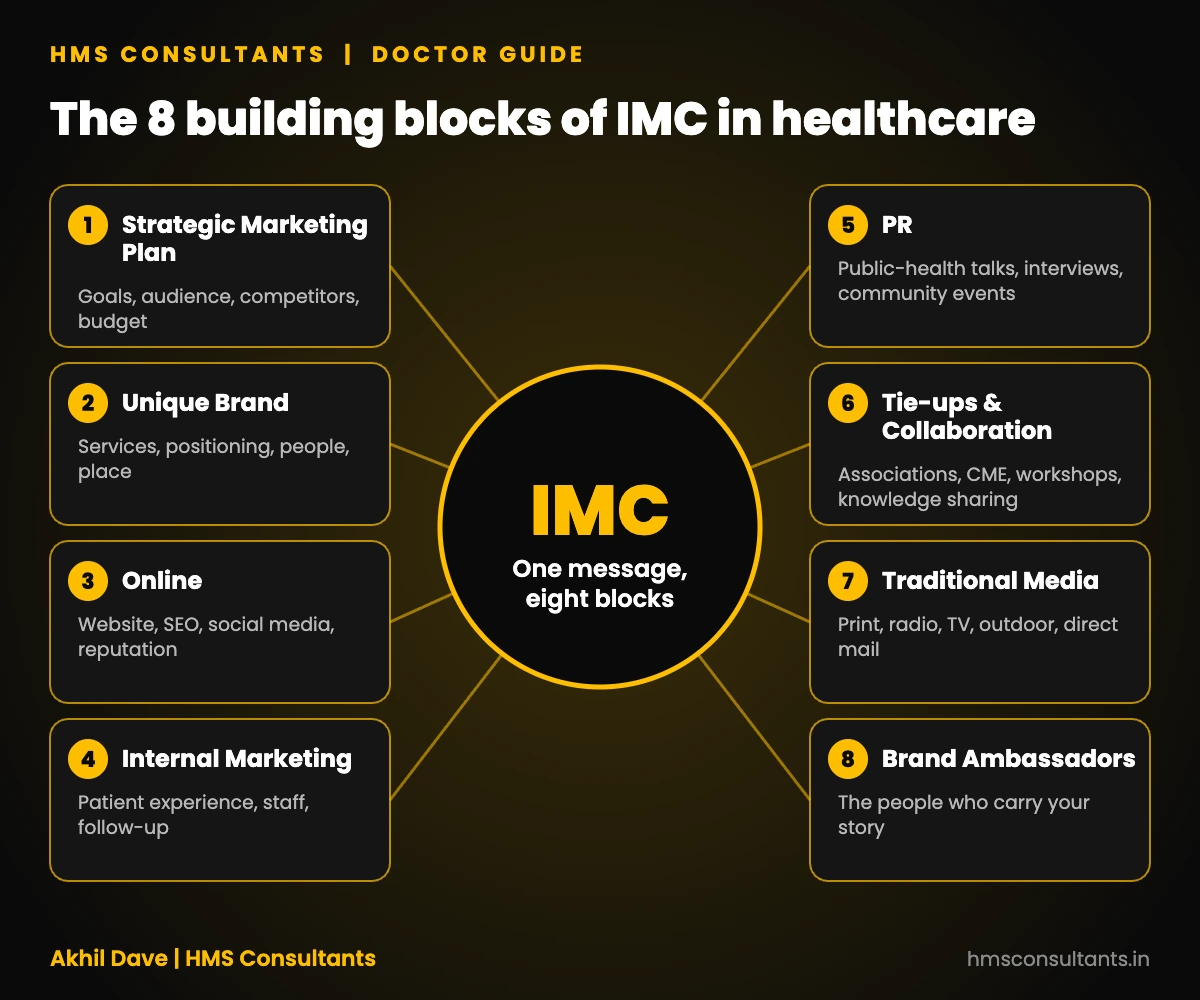
HMS Consultants uses an eight-block IMC framework for healthcare. Each block has its own job.
The eight building blocks of IMC in healthcare (HMS Consultants framework).
The blocks are: a strategic marketing plan, a unique brand, online, internal marketing, PR, tie-ups and collaboration, traditional media, and brand ambassadors. The centre of the wheel is one message. Without that centre, the blocks are just activities.
What is the omnichannel approach in healthcare?
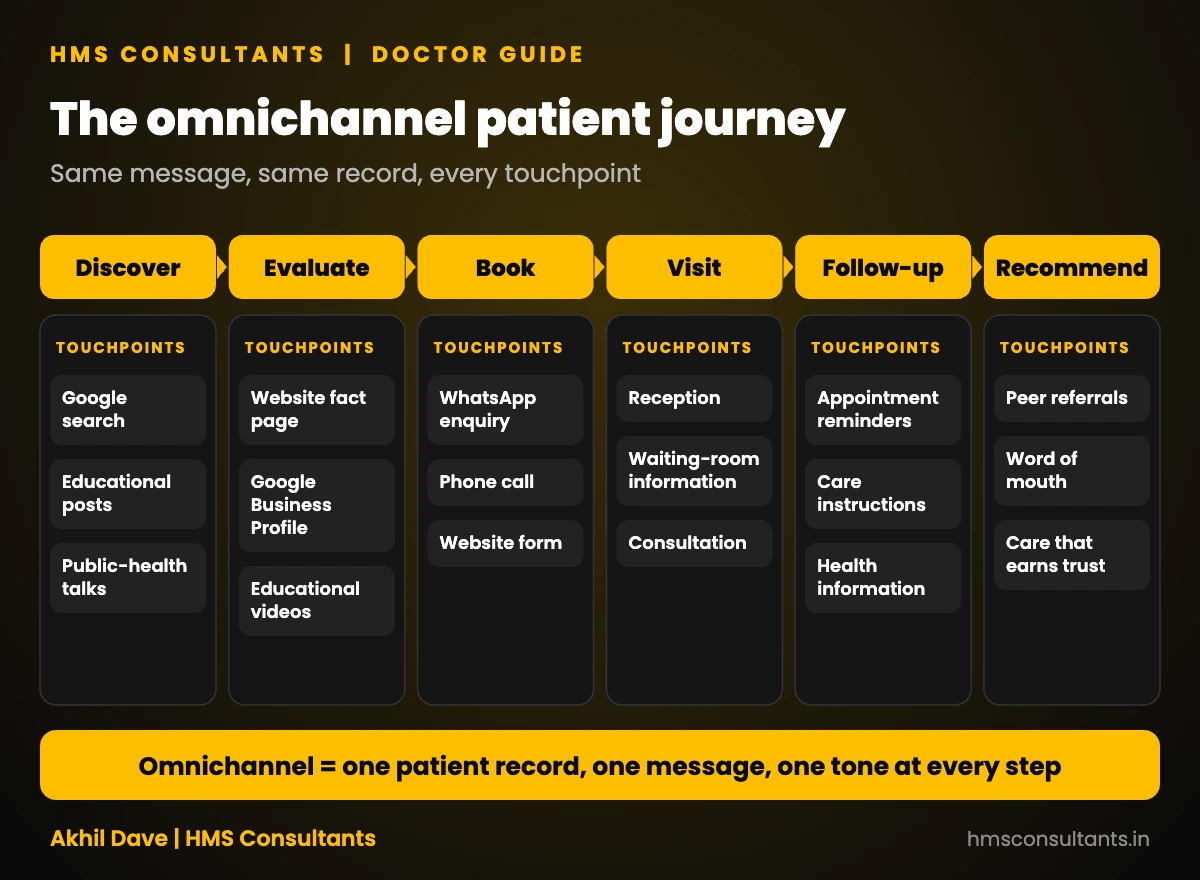
An omnichannel approach connects every touchpoint around the patient, not around the channel. A patient may find you on Google, read your website, send a WhatsApp message, call the clinic, visit, and later receive a reminder. In an omnichannel setup these are one continuous experience. The patient does not repeat their story, and each step picks up where the last one ended.
A simple test: if a patient messages you on WhatsApp and then calls, does the person who answers know about the message? If not, you are running separate channels, not an omnichannel journey.
The omnichannel patient journey: six stages, the same message and record at every step.
IMC vs multichannel vs omnichannel
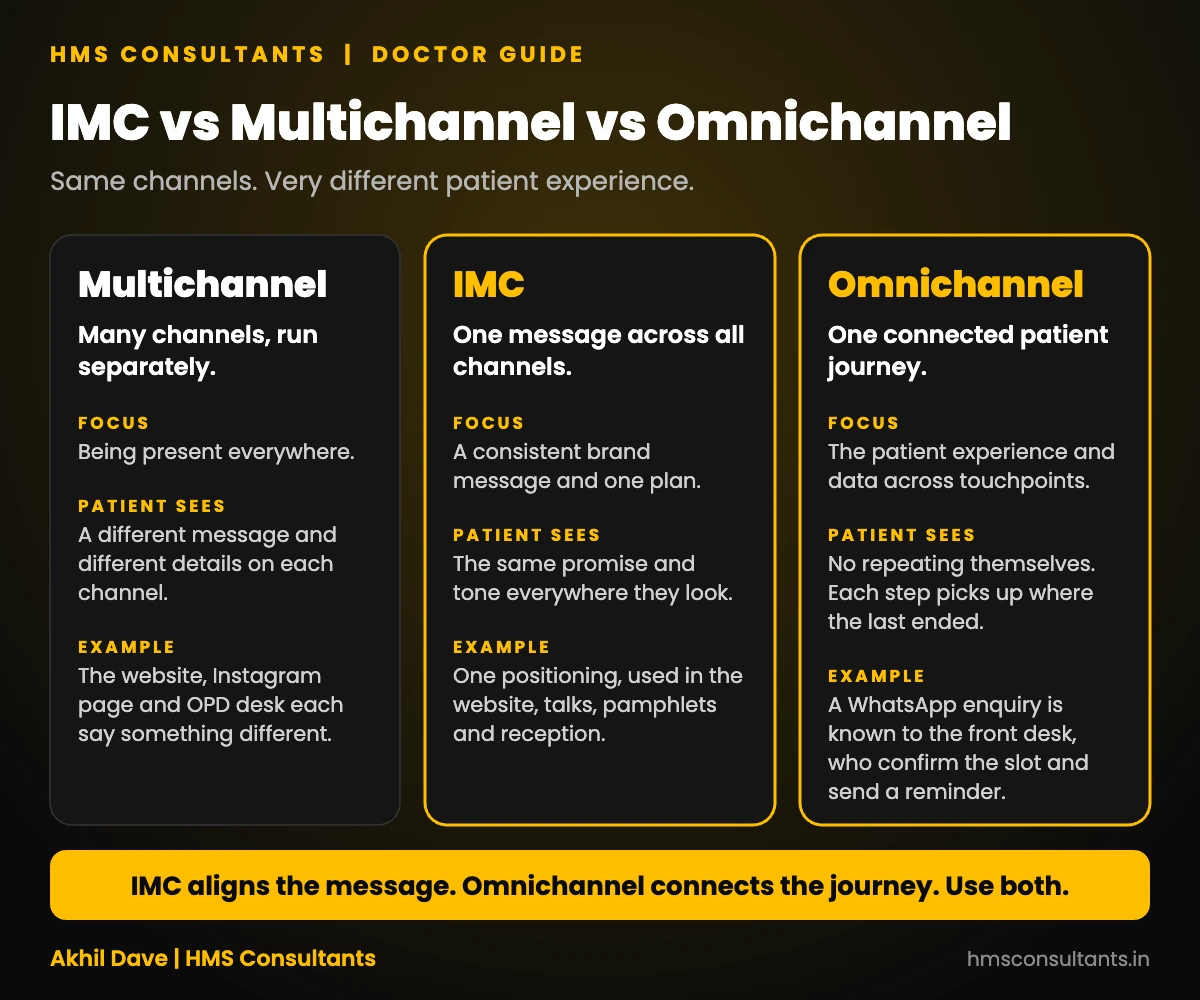
These three terms are often mixed up. They solve different problems.
Multichannel, IMC and omnichannel compared.
Approach
What it aligns
Risk if missing
Multichannel
Nothing. Channels run separately.
Mixed messages and duplicated work
IMC
The message, tone and plan
Patients lose trust when messages differ
Omnichannel
The journey and the patient data
Patients repeat themselves and drop off between steps
IMC is the strategy layer. Omnichannel is the experience layer. IMC without omnichannel gives you a consistent brand with a clumsy patient experience. Omnichannel without IMC gives you a smooth process with no clear story.
Why each channel matters in IMC
Each of the eight blocks does something the others cannot. Here is the job of each, with a note on how the NMC notice applies. The notice applies to registered medical practitioners. Hospitals should also read the note on hospitals further down.
1. Strategic marketing plan
Why it matters: it sets research, measurable goals, a SWOT analysis, the target audience, competitor review, tactics and budget. Without it, every other channel is guesswork. See our clinic marketing plan for doctors.
NMC note: planning is internal and not restricted, but the plan must not be built on prohibited tactics (cl. 8.1).
NMC note: state your name, qualifications and registration number (cl. 3.2, Explanation III). Avoid claims of being the best (cl. 8.1(ix)) and avoid advertising success rates or patient numbers (cl. 8.1(iii)).
NMC note: educational content is allowed if it does not promote your practice (cl. 5.1). Sponsored posts, fake reviews, fear-based content and manipulating search rankings are not (cl. 3.5, 8.1(i), 8.1(xii)). AI-generated content needs a source mark (cl. 7.2).
4. Internal marketing
Why it matters: patient experience, staff communication, reminders, follow-up and phone etiquette decide whether a first visit becomes loyalty. This is where omnichannel is won or lost. See patient enquiry handling.
NMC note: care communication and reminders are patient service. Requesting or sharing patient reviews and testimonials to promote yourself is not allowed (cl. 3.2, Explanation V; cl. 8.1(xi)), and patient consent does not change that (cl. 6.2).
5. PR
Why it matters: credible third-party visibility, such as talks, interviews and community events, builds authority that advertising cannot.
NMC note: public-health talks in your own name are allowed (cl. 8.2(iii)). Promotional news articles and sponsored content count as advertising (cl. 3.5, 3.2), so paid PR and advertorials are high risk for an individual doctor. Any material commercial tie must be disclosed (cl. 8.1(xi)).
6. Tie-ups and collaboration
Why it matters: associations, peer networks, CME events, workshops and knowledge sharing extend your reach through people who already have trust.
NMC note: academic and educational activity is supported (cl. 5.1). Referral fees, rebates and inducements are not (cl. 8.1(vii), 8.1(x)). Corporate and TPA tie-ups are not specifically addressed in the notice, so take legal advice before committing.
7. Traditional media
Why it matters: print, radio, TV, outdoor and direct mail still reach people who are not searching online, such as older patients and families.
NMC note: public-health talks and factual patient-education pamphlets are allowed (cl. 8.2(iii), 8.2(iv)). Promotional advertising and soliciting patients, directly or indirectly, are not (cl. 8.1(ii)). Cold calls and unsolicited SMS are not named in the notice, but they fall under soliciting, so HMS treats them as avoid.
8. Brand ambassadors
Why it matters: people who carry your story, such as patients, staff and associates, are the most trusted channel in healthcare.
NMC note: for individual doctors this block needs the most care. Patients, employees, celebrities or influencers promoting you are prohibited testimonials (cl. 8.1(ii), 8.1(xi)). The honest version is staff who deliver good care and share educational content, and patients who recommend you on their own without being asked.
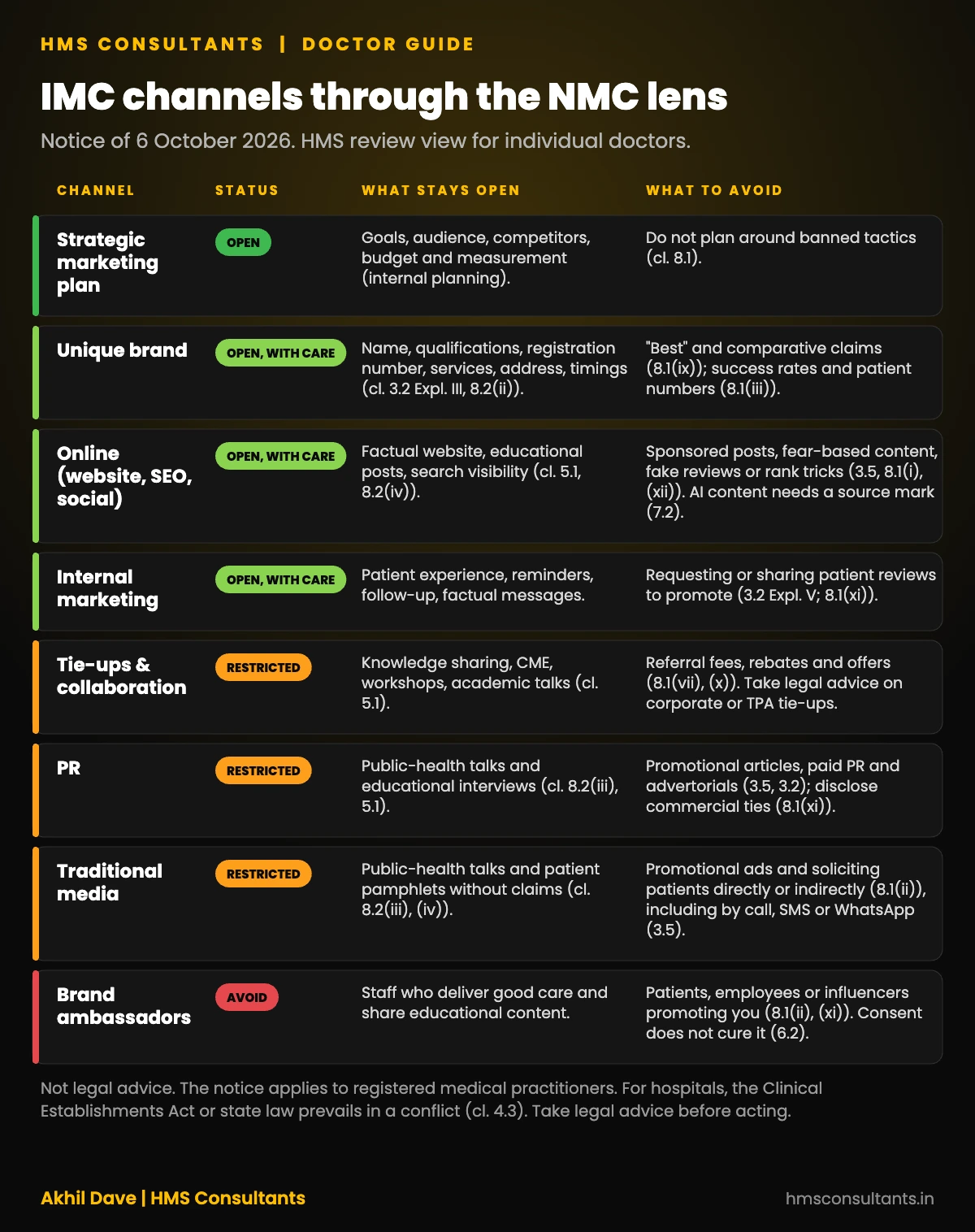
The NMC lens: what stays open and what to avoid
The NMC notice of 6 October 2026 treats digital, social, sponsored, influencer-led, search-engine and AI-assisted communication as advertising when its content or manner of dissemination is promotional (cl. 3.2). Its list of media covers print, TV, radio, social media, websites, blogs, messaging apps such as WhatsApp, podcasts, influencer marketing, digital campaigns, sponsored posts, AI-generated promotion and public interviews (cl. 3.5). That is why IMC for a doctor must be planned channel by channel.
The eight IMC blocks rated open, restricted or avoid for individual doctors. This is an HMS marketing-review view, not legal advice.
Three rules that cut across every channel
You stay responsible. Using an agency, platform or influencer does not by itself remove your responsibility for content you authorised or knowingly permitted (cl. 4.4).
No per-patient or per-lead payment. Agency, influencer or platform arrangements tied to procuring individual patients are prohibited (cl. 8.1(viii)).
AI content needs care. AI-generated promotional content must carry a source mark and must not create or alter patient images, testimonials or outcomes (cl. 7.2).
A note for hospitals
The notice is addressed to registered medical practitioners. For hospitals, the Clinical Establishments Act or the applicable state law prevails if there is a conflict (cl. 4.3), and a doctor who personally authorises or endorses prohibited content can still be examined separately (cl. 11.5). Hospitals should have their IMC plan reviewed with legal advice. HMS Consultants is a marketing consultancy, not a law firm.
Why IMC and omnichannel are recommended in today’s era
Patients meet you in several places before they book. A friend mentions you, they search, read your website, check your profile and then call or message. If each place tells a different story, trust breaks at the point of decision.
Trust is the product. In healthcare the patient cannot easily judge quality, so consistency across channels is read as reliability.
Mobile and WhatsApp are the default. Enquiries arrive on whichever channel is easiest for the patient. Your team must see them in one place, or leads are lost between channels.
Search and AI answers read the whole web. Search engines and AI assistants draw on what is published about you. Consistent factual details across your website, profiles and mentions make you easier to find and describe correctly.
The rules raise the cost of mistakes. With the NMC notice in force from 6 October 2026, one off-brand post or one careless broadcast can be a regulatory problem. A single plan with a single owner is safer than many separate efforts.
List every channel you use. Write one positioning line and the facts that must be identical everywhere: name, qualifications, registration number, address, timings.
Week 2
Fix the facts on your website and Google profile. Mark each channel open, restricted or avoid using the NMC table above.
Week 3
Connect enquiries. One shared record for WhatsApp, calls and forms. Agree who replies, in what time, in what tone.
Week 4
Plan the next 30 days of educational content around one message. Review what each channel produced, privately. Do not publish patient numbers or results.
If you want a ready structure to follow, the recorded Doctor’s Marketing Blueprint™ Masterclass covers an 8-step clinic marketing plan for ₹4,999. It does not promise patients or revenue, and enrolment is non-refundable.
Common mistakes
Treating each channel as a separate project with a separate message.
Opening new channels before connecting the ones you have.
Letting an agency or staff post without your approval (cl. 4.4).
Using patient stories, reviews or ambassadors as promotion (cl. 8.1(xi)).
Sending promotional broadcasts or unsolicited calls and messages (cl. 8.1(ii)).
Using offers, discounts or superlatives to stand out (cl. 8.1(ix), 8.1(x)).
Measuring posts and clicks but not enquiries and appointments.
Want your channels working as one plan, within the NMC notice? Start with a review of where each channel stands. You can book a free 30-minute call.
Frequently asked questions
What is IMC in healthcare?
Integrated marketing communication (IMC) is planning every message on every channel as one system, so patients hear the same consistent promise from your website, talks, printed material, reception and staff. HMS Consultants frames it as eight blocks: strategic plan, unique brand, online, internal marketing, PR, tie-ups and collaboration, traditional media, and brand ambassadors.
What is omnichannel marketing in healthcare?
Omnichannel marketing connects every touchpoint around the patient’s journey, from search to booking, visit, follow-up and recommendation, so the patient does not repeat their story and each step continues from the last.
What is the difference between multichannel, IMC and omnichannel?
Multichannel means many channels run separately. IMC aligns the message and plan across channels. Omnichannel connects the patient journey and data across touchpoints. IMC is the strategy layer and omnichannel is the experience layer.
Which channels can a doctor use under the NMC notice of 6 October 2026?
Educational content, a factual website, public-health talks and patient-education pamphlets are supported (cl. 5.1, 8.2(iii), 8.2(iv)). Testimonials, soliciting, promotional ads, referral fees, offers and sponsored promotion are restricted (cl. 8.1, 3.5). Take legal advice for specific cases.
Can a hospital use the same IMC plan as an individual doctor?
Not without review. The notice is addressed to registered medical practitioners. For hospitals, the Clinical Establishments Act or the applicable state law prevails in a conflict (cl. 4.3). Have a hospital IMC plan reviewed with legal advice.
If I hire an agency, am I still responsible for what it posts?
Yes, in most cases. Using an agency, platform or influencer does not by itself remove your responsibility for content you authorised, commissioned, sponsored or knowingly permitted (cl. 4.4). Paying an agency per patient or per lead is prohibited (cl. 8.1(viii)).
Can I use WhatsApp for patients?
Messaging apps are listed as media in the notice (cl. 3.5), so promotional messages are advertising. HMS treats informational care messages, such as appointment reminders and care instructions, as patient service, and promotional broadcasts as high risk. Take legal advice if unsure.
Hospital Marketing Audit
A review of how your marketing channels work together.
Disclaimer: HMS Consultants is a healthcare marketing consultancy. We are not a law firm and this guide is not legal advice. References to the NMC notice reflect our understanding of public information as of 18 November 2026. Items marked HMS view are our own judgement, not NMC text. Please consult a qualified healthcare lawyer before acting.
About the author:Akhil Dave is Founder & Principal Consultant of HMS Consultants, with 25+ years in healthcare marketing.
Work with HMS Consultants
Not sure which of your channels work together, or which put you at risk? Book a free call and we will map your channels against the NMC notice.
Marketing for a hospital fails when it tries to convince patients instead of reassuring them. In healthcare, trust and emotional safety drive decisions more than promotion.
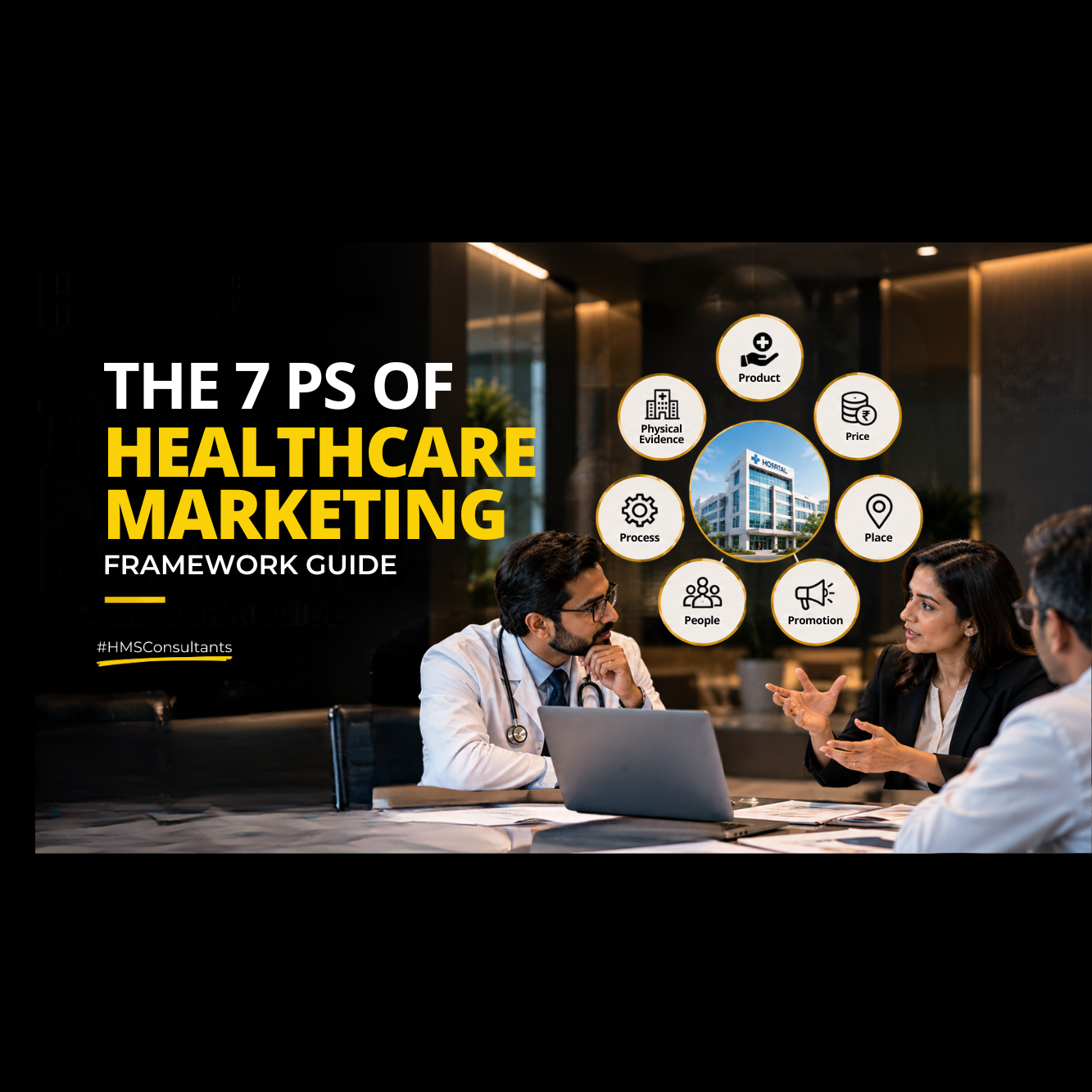
The 7 Ps of healthcare marketing Product, Price, Place, Promotion, People, Process, and Physical Evidence provide a practical framework for hospitals to strengthen marketing, patient experience, and trust.
Most hospitals don’t fail at marketing. They fail at decision-making. This blog explains why opinion-led decisions, frequent changes, and poor data discipline hurt growth.
Discover 50 practical hospital branding ideas to build patient trust, strengthen hospital brand identity, and create a consistent experience across visual, digital, patient, staff, and community touchpoints.
A hospital marketing consultant is often hired too late when growth slows and confusion rises. This delay quietly impacts patient trust, marketing efficiency, and long-term hospital growth.
Is your clinic marketing actually bringing patients? This blog breaks down how doctors can run a digital marketing audit in 2025 to track performance, improve ROI, and eliminate wasteful...