HMS Consultants

Category: Healthcare Marketing Strategy

  • Festive Season Marketing for Doctors and Clinics: Lessons from Google’s 2026 Playbook

    Festive Season Marketing for Doctors and Clinics: Lessons from Google’s 2026 Playbook

    Festive Season Marketing for Doctors and Clinics: Lessons from Google’s 2026 Playbook

    Published on
    Share This
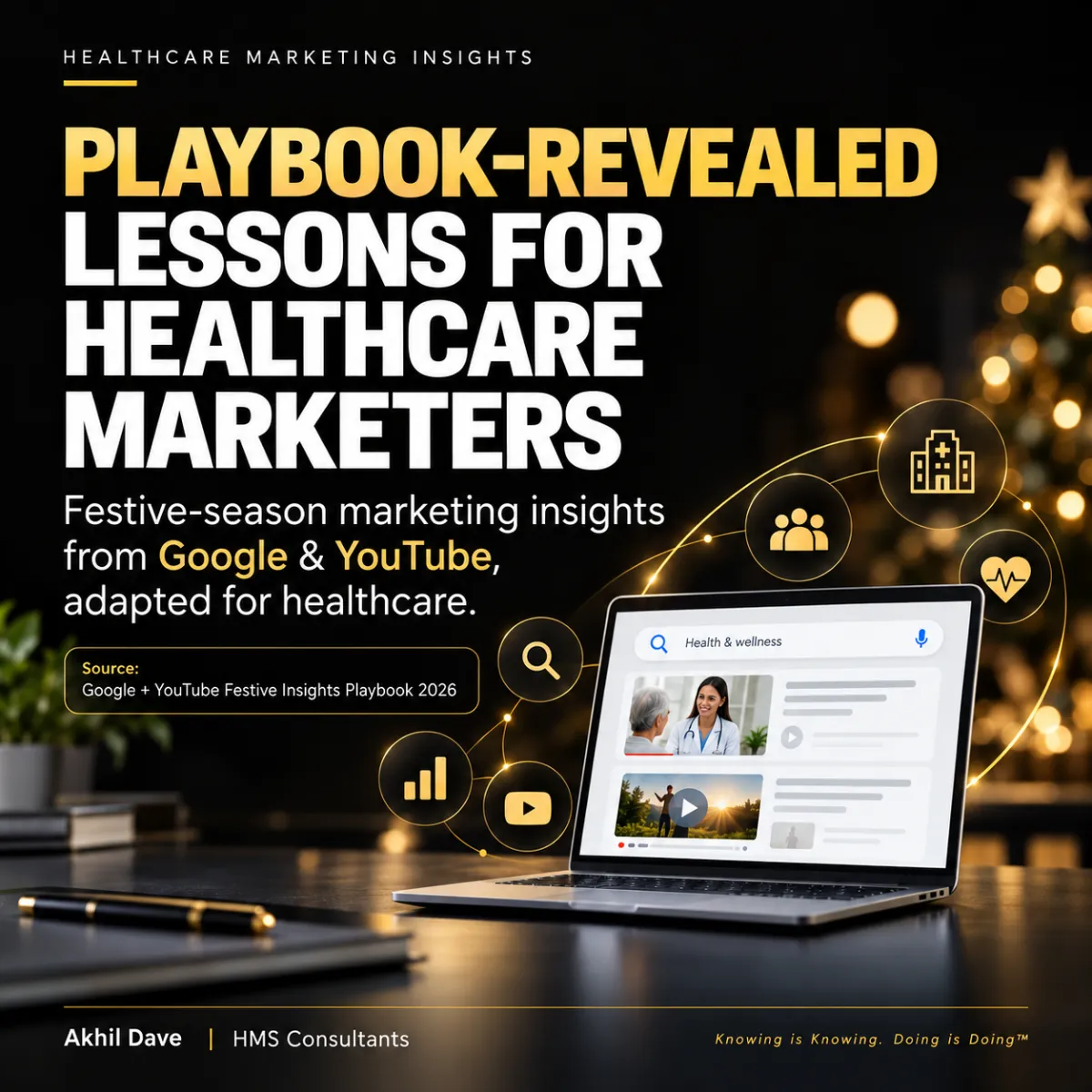
    Festive season marketing playbook lessons for healthcare marketers: Google and YouTube insights adapted for doctors and clinics

    Quick answer: Google and YouTube’s 2026 festive playbook shows that Indians discover through video and image search, research before they decide, and now use AI to decide faster. For doctors and clinics, festive season marketing means being findable, educational and consistent across Google Search, Maps, YouTube and your website, without the discounts, testimonials and influencer promotion that the NMC guidelines restrict.

    Last updated: 16 October 2026 · By Akhil Dave, Founder & Principal Consultant, HMS Consultants

    Festive season marketing for doctors is about being found, trusted and consistent online while Diwali searches peak, not about discounts. Diwali is a few weeks away. Retail brands in India have been preparing since August, and Google and YouTube have just released A Marketer’s Playbook to Win This Festive Season with the data behind it. It is written for jewellery, apparel and electronics brands, not for doctors. But the way people find, research and trust a brand online is the same way patients now find, research and trust a doctor. I read the full playbook with one question: what can a doctor or clinic owner use from this, safely?

    This guide gives you the numbers, what they mean for healthcare and where the retail playbook does not apply to you.

    Key takeaways

    • 9 in 10 festive shoppers research before buying; patients do the same before choosing a doctor.
    • Google and YouTube feature in 93% of brand discovery journeys, so your Google Business Profile, website and YouTube must agree.
    • AI search helps people decide faster, so answer clear questions in plain language.
    • Skip discounts, testimonials and influencers; the NMC guidelines restrict them.
    ₹1.2 lakh croregross festive GMV in India in 2025Datum Festive Barometer 2026; Redseer
    9 in 10festive shoppers researched before buyingGoogle playbook, 2026
    93%of Indian shoppers’ brand discovery journeys include Google and YouTubeGoogle-commissioned Ipsos, 2025
    84%of AI Mode users in India say they decide fasterGoogle-commissioned Ipsos, 2025

    Why a retail festive playbook matters to doctors and clinics

    The playbook’s survey base is festive shoppers in seven retail categories. Nobody shops for a cardiac procedure the way they shop for a phone, and we should not pretend they do. Treat these figures as direction on behaviour, not healthcare benchmarks.

    The direction is still clear. Interest in festive buying starts as early as August, shoppers research heavily, and the journey runs through video, search, creators and now AI. Patients are the same people. They watch a video, search a symptom, read reviews, ask family and then call. The marketer’s job is to be present and credible at each step.

    Patients don’t go online. They are always online.
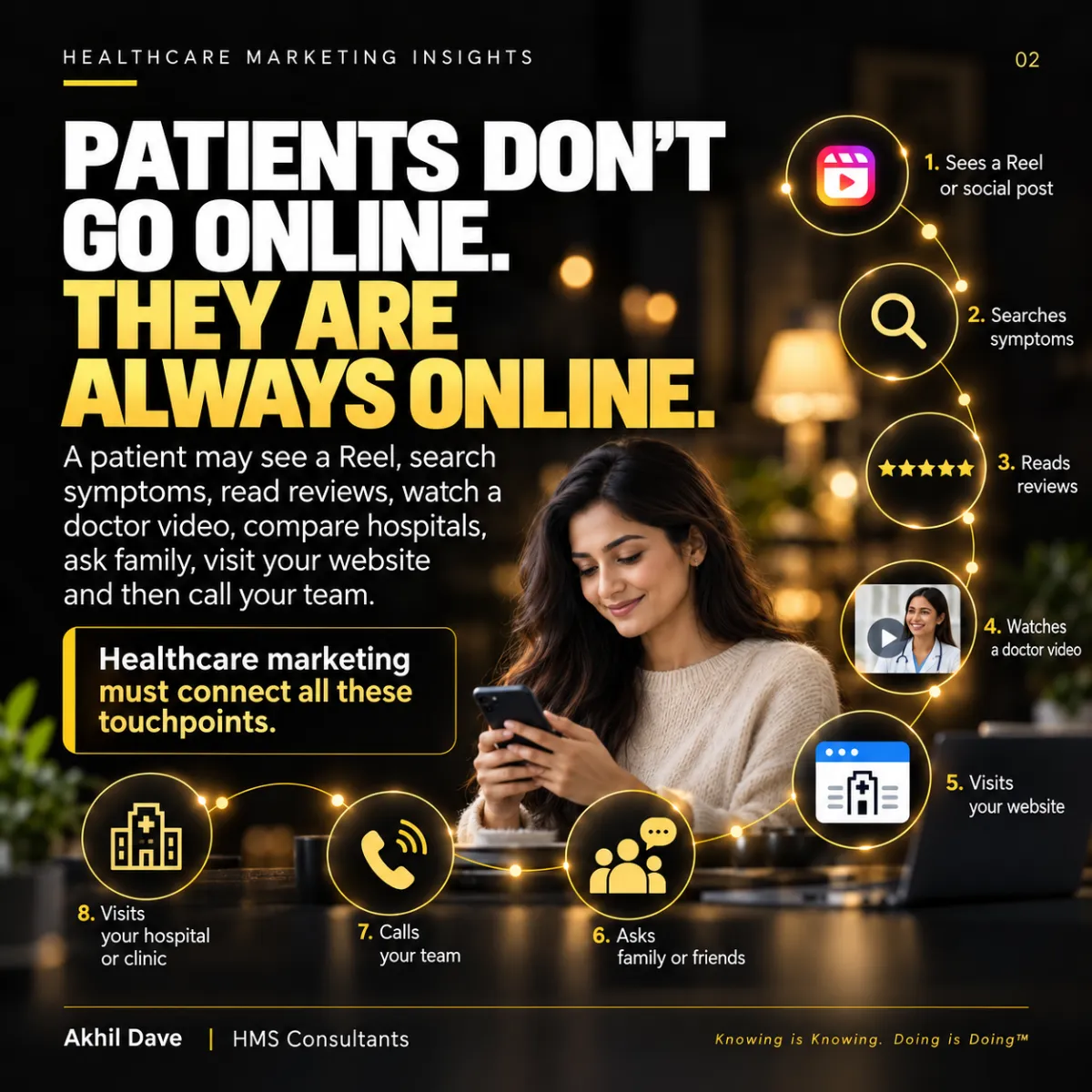
    Patient journey from seeing a Reel to searching symptoms, reading reviews, watching a doctor video and calling the clinic
    8 in 10

    shopping journeys include shoppers getting ideas from image searches, and 49% say they watch more online videos to help them shop.

    Source: Google-commissioned Ipsos Shopping Moments Study, Sept-Nov 2025

    A patient may see a Reel, search symptoms, read reviews, watch a doctor’s video, compare hospitals, ask family, visit your website and then call your team. That is eight touchpoints for one appointment. If your clinic is strong on one and missing on the rest, the patient simply chooses someone who shows up everywhere.

    What to do: list every place a patient could meet you before calling, then check that each one tells the same accurate story: your Google Business Profile, YouTube channel, website, social profiles and WhatsApp reply.

    Search and video work best when you connect them
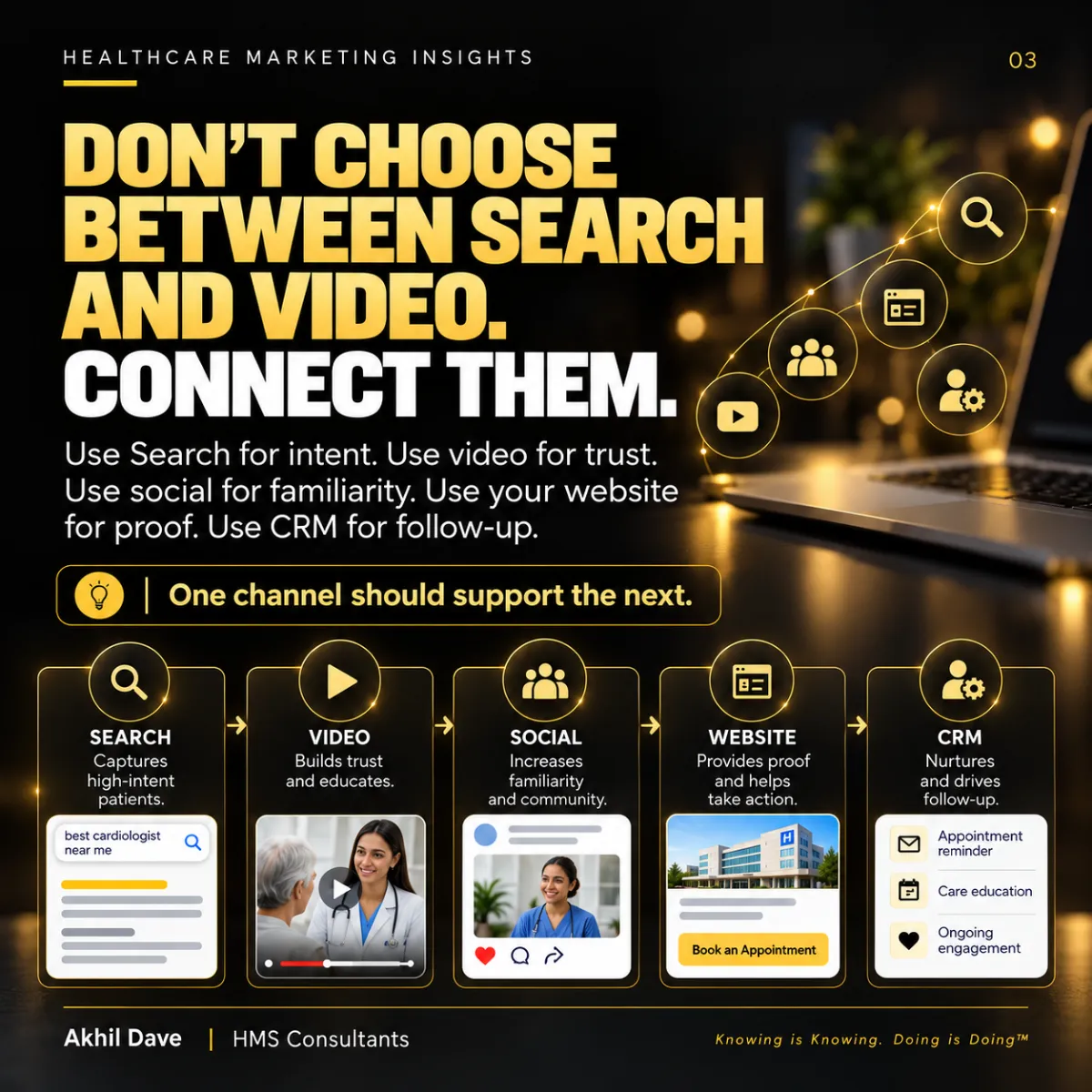
    Connected healthcare marketing channels: search captures intent, video builds trust, social adds familiarity, website provides proof and CRM follows up
    1.6x

    higher average ROI when YouTube and Search work together, compared with paid social.

    Source: Google-commissioned Ipsos Shopping Moments Study, 2025 (average across seven retail categories)

    Google’s own data comes from advertising, so read it with that in mind. The principle holds for organic work too: each channel has a job. Search captures patients who already know what they need. Video builds trust and explains. Social creates familiarity. Your website gives proof and a clear next step. Follow-up closes the loop.

    One channel should support the next. A doctor’s YouTube video should link to the matching service page. That page should show the doctor’s qualifications and a clear way to book. The booking should reach a team that replies the same day. If you want to build the video side, start with our guide to YouTube content strategy for doctors.

    Work with HMS Consultants

    Not sure which channel is helping and which is wasting effort? We map your patient journey and show you where enquiries are lost.

    See Medical Practice GrowthBook a free 30-min call

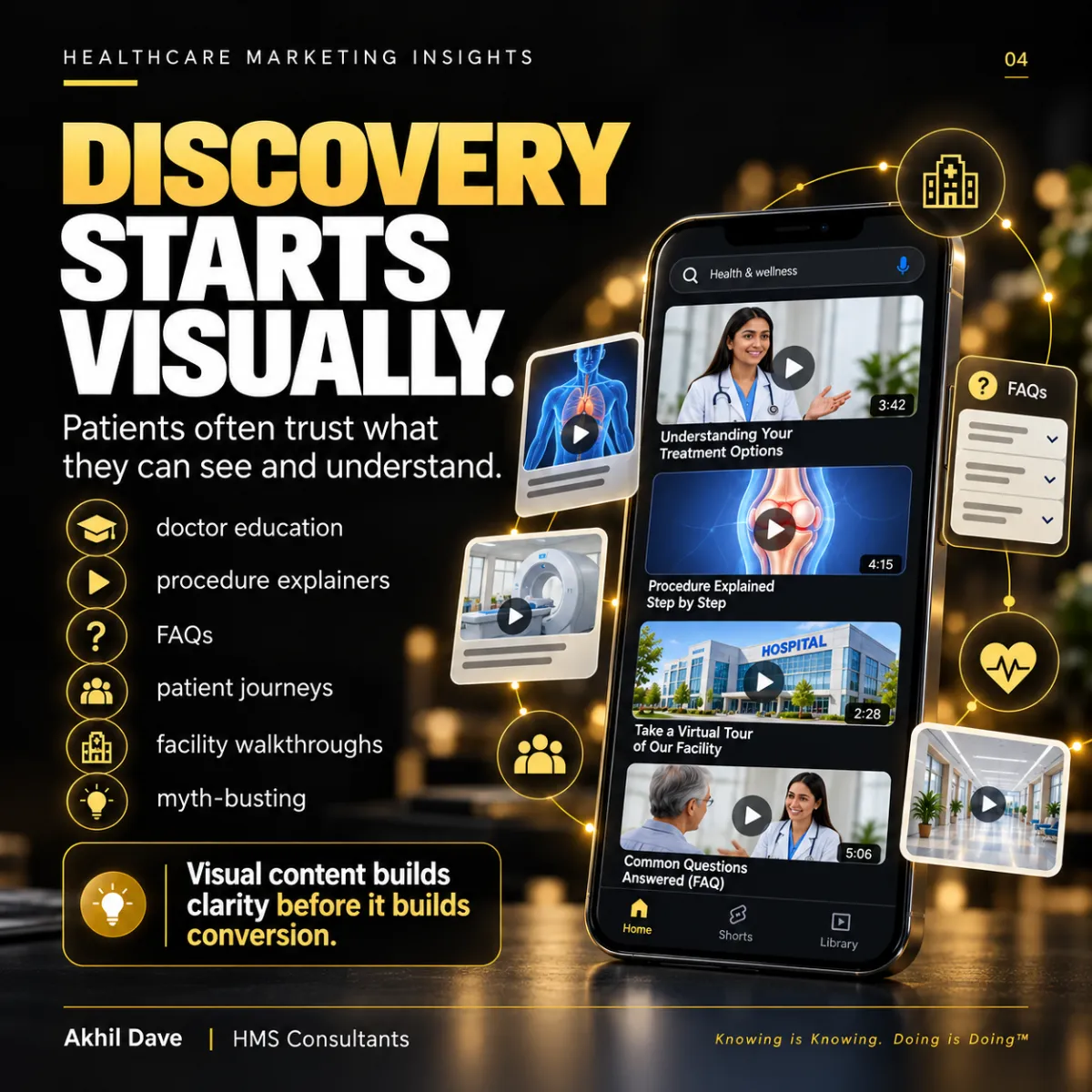
    Discovery starts visually

    Visual patient education content for doctors: condition explainers, procedure explainers, FAQs, facility walkthroughs and myth-busting videos
    80%

    of shoppers get festive inspiration from visual content. YouTube is also the number one platform to research, vet and make decisions about brands.

    Source: Google playbook, 2026; Google/Kantar Future of Video, 2025

    Patients trust what they can see and understand. Doctor education, condition explainers, procedure walkthroughs (without outcome claims), FAQs, facility tours and myth-busting all do this job. Visual content builds clarity before it builds conversion.

    Stay inside the lines: educational content in your own name is fine under the NMC guidelines. Success rates, before-and-after photos and fear-based messaging are not. When in doubt, explain the condition and when to see a doctor, and leave the selling out.

    In healthcare, trust converts better than noise
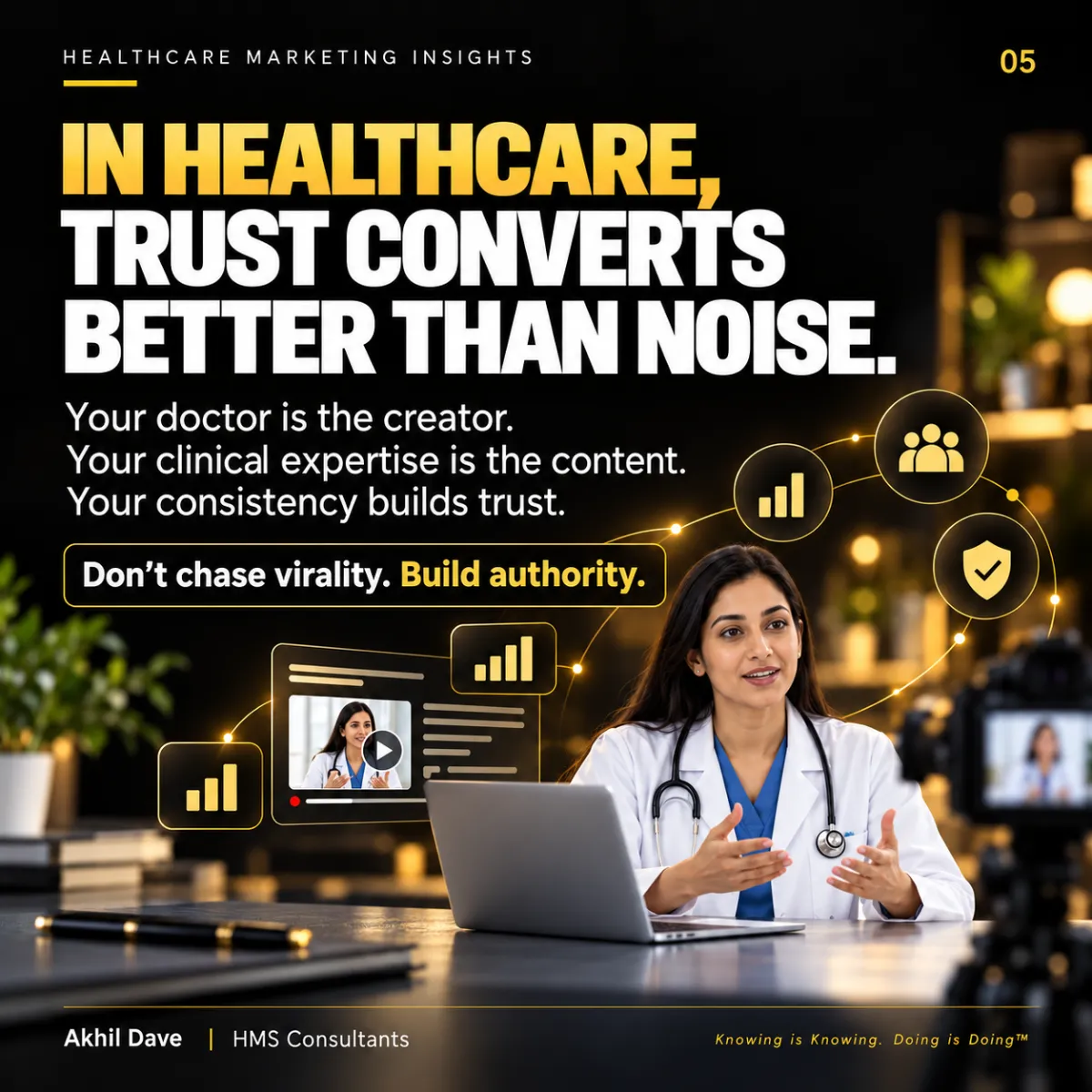
    Doctor as the creator: clinical expertise and consistent educational content build trust and authority for healthcare brands
    73%of shoppers look to online creators for inspirationGoogle-commissioned Ipsos, 2025
    89%of viewers agree YouTube has the most trusted creator contentGoogle playbook, 2026
    13xlift in brand search from creator endorsementsGoogle playbook, 2026
    5xlift in purchase from creator endorsementsGoogle playbook, 2026

    Retail brands answer this with influencer partnerships. For doctors, that route is narrow. The NMC guidelines restrict testimonials, third-party marketing and lending your name or image for promotion, and you remain responsible for what an agency or creator publishes. So the healthcare version is different and, I believe, stronger: your doctor is the creator. Your clinical expertise is the content, and your consistency builds trust.

    Don’t chase virality. Build authority. A doctor who explains one common question every week for six months is easier to trust than one who tries a trend. See our personal branding for doctors playbook for how to set that up, or explore Doctor Branding with HMS.

    AI is now part of the patient’s decision journey
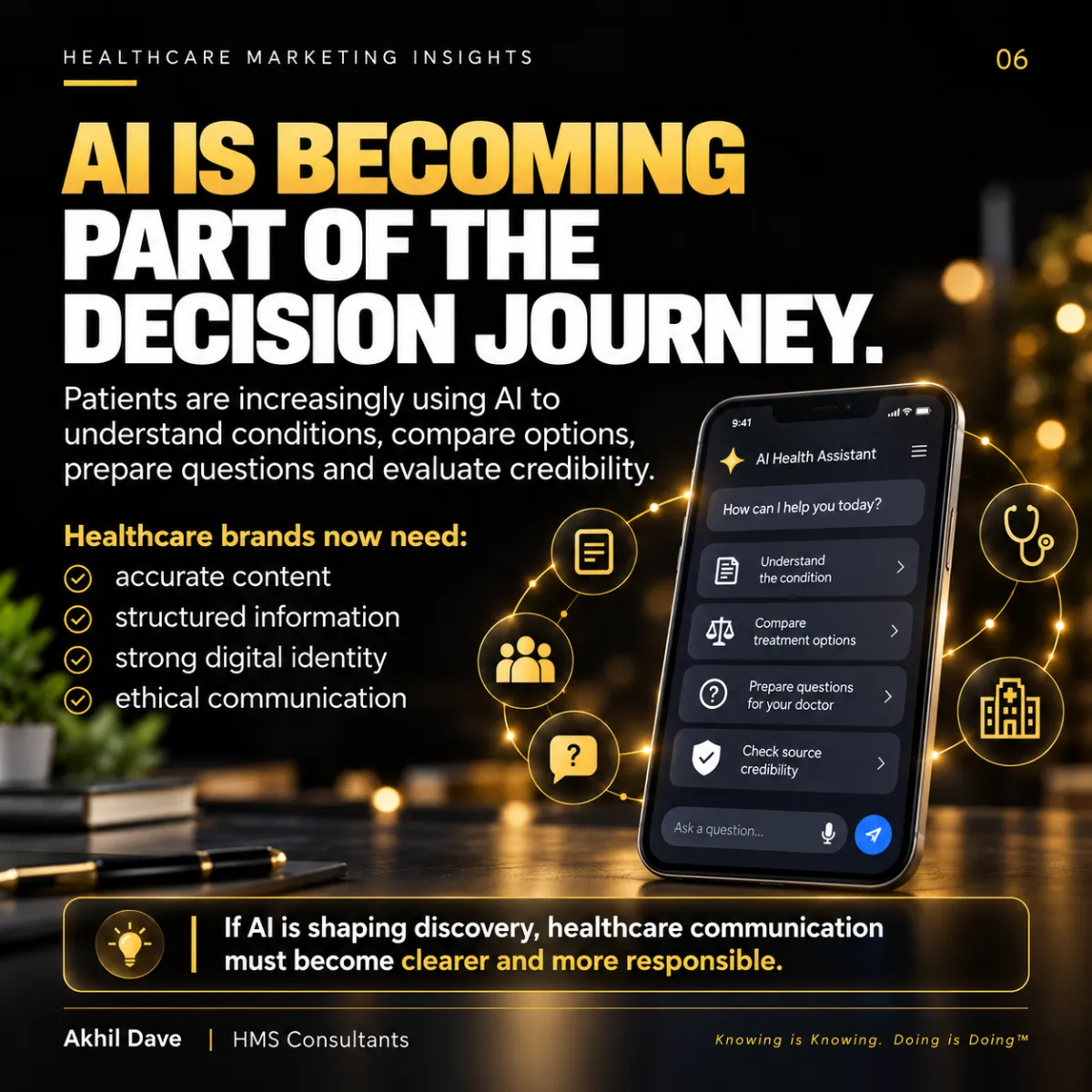
    Patients using AI assistants to understand conditions, compare options and prepare questions for the doctor
    84%

    of AI Mode users in India agree they are able to make decisions faster.

    Source: Google-commissioned Ipsos Global Consumer Journeys, Dec 2025

    Patients increasingly use AI to understand a condition, compare options and prepare questions before they even speak to a doctor. If AI is shaping discovery, healthcare communication must become clearer and more responsible. Four things matter:

    • Accurate content reviewed by the doctor.
    • Structured information: clear headings, FAQs, schema and consistent details across the web.
    • A strong digital identity: the same name, qualifications, registration number, address and phone everywhere.
    • Ethical communication: no inflated claims. Note that the NMC guidelines also restrict AI-generated promotional campaigns and require permitted AI content to be marked.

    Our guide to SEO and AEO strategy for hospitals and doctors shows how to make your pages easy for both Google and AI assistants to understand.

    Digital discovery must lead to a real-world action
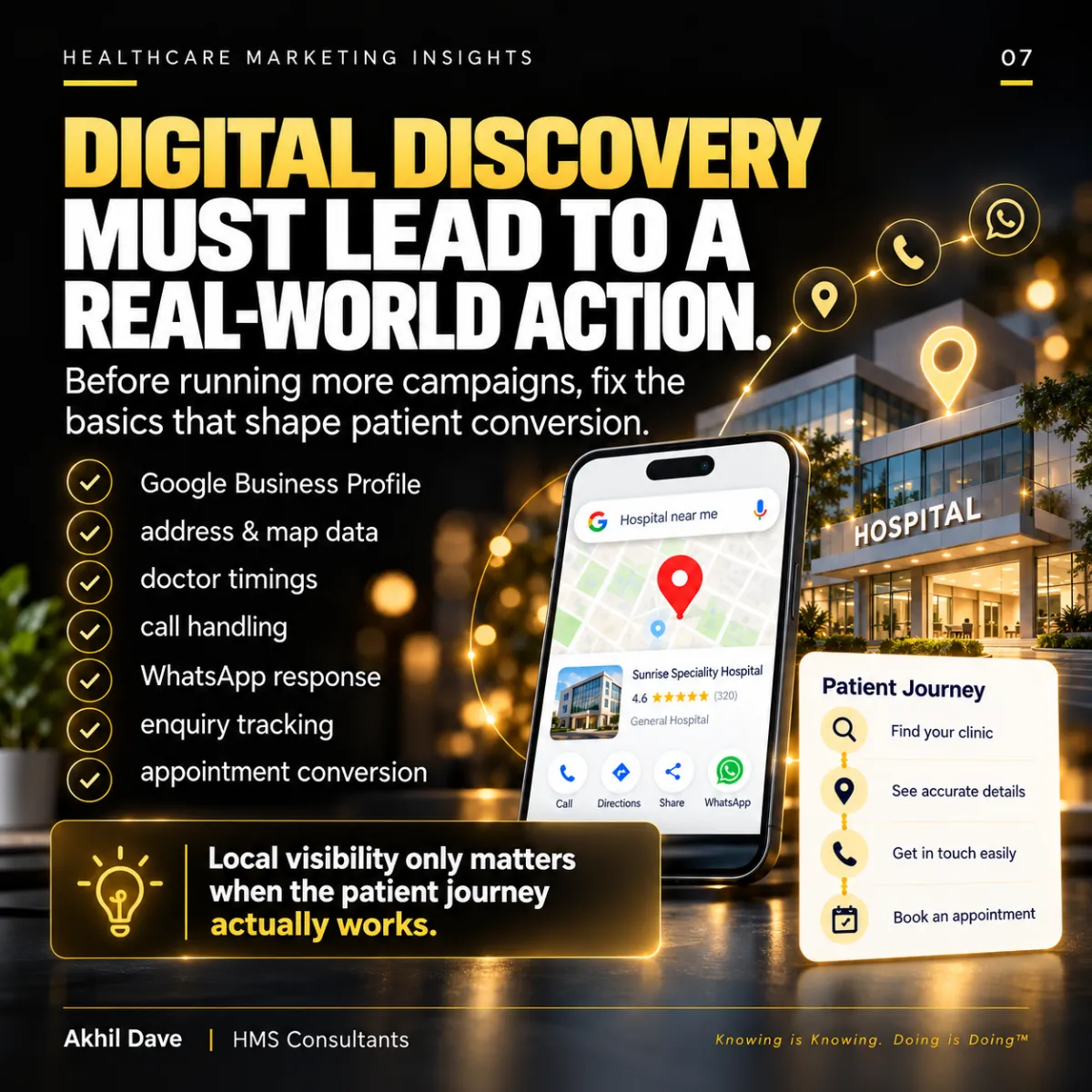
    Local visibility checklist for clinics: Google Business Profile, map data, doctor timings, call handling, WhatsApp response and appointment conversion
    70%

    of shoppers made a spontaneous purchase last festive season. Capture intent the moment it appears.

    Source: Google playbook, 2026

    Patients are not spontaneous about surgery, but they are quick about booking a consultation once they feel ready. The moment is short. If the phone rings out or WhatsApp stays silent for six hours, the patient has already moved to the next clinic on the map.

    Before you run any campaign, fix the basics that shape patient conversion:

    • Google Business Profile: correct category, services, photos and festival-week timings
    • Address and map pin, identical everywhere
    • Doctor timings and holiday availability
    • Call handling: who picks up, and what they say
    • WhatsApp response time and a clear first reply
    • Enquiry tracking: know which source each call came from
    • Appointment conversion: how many enquiries become visits

    Local visibility only matters when the patient journey actually works. Use our local SEO checklist for doctors to go through the profile and listing steps.

    Random activity creates random results
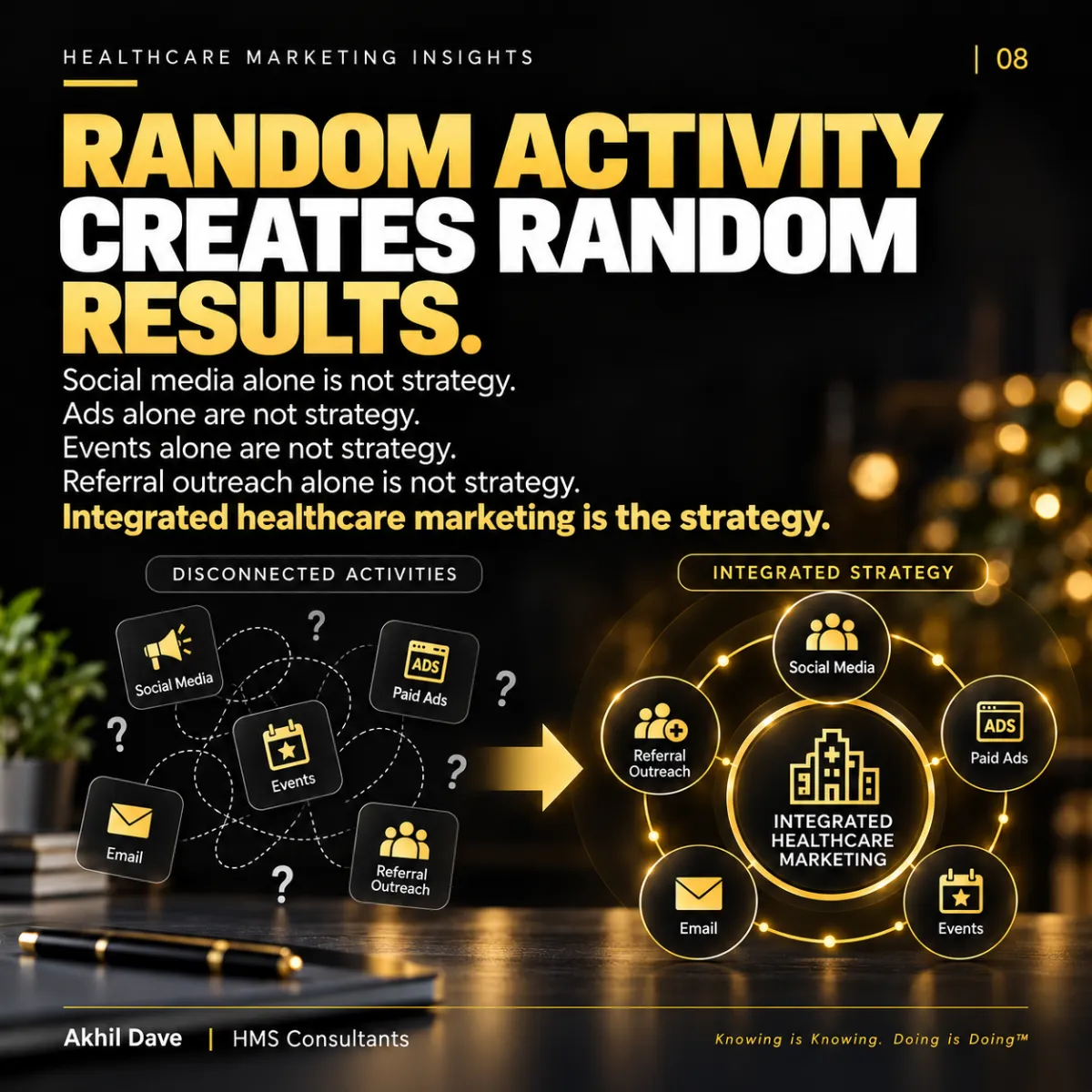
    Disconnected marketing activities such as social media, ads, events, email and referral outreach compared with one integrated healthcare marketing strategy
    200%more conversions from a full-funnel campaign than action-only (The Souled Store, 10 creators)Google playbook, 2026
    3xincrease in inquiries and qualified leads when Hyundai treated YouTube and Search as one engineGoogle playbook, 2026

    These are retail results reported by Google, so they are not a promise for your clinic. The lesson is what they have in common: the campaigns were connected. Social media alone is not strategy. Ads alone are not strategy. Events alone are not strategy. Referral outreach alone is not strategy. Integrated healthcare marketing is the strategy.

    Many clinics run five or six activities that never talk to each other. Each one looks busy. None of them adds up to a patient flow you can predict.

    Work with HMS Consultants

    Running several activities but unsure what is actually producing enquiries? A Hospital Marketing Audit gives you a clear, evidence-based picture of what is working.

    See the Hospital Marketing AuditBook a free 30-min call

    The integrated healthcare marketing flow
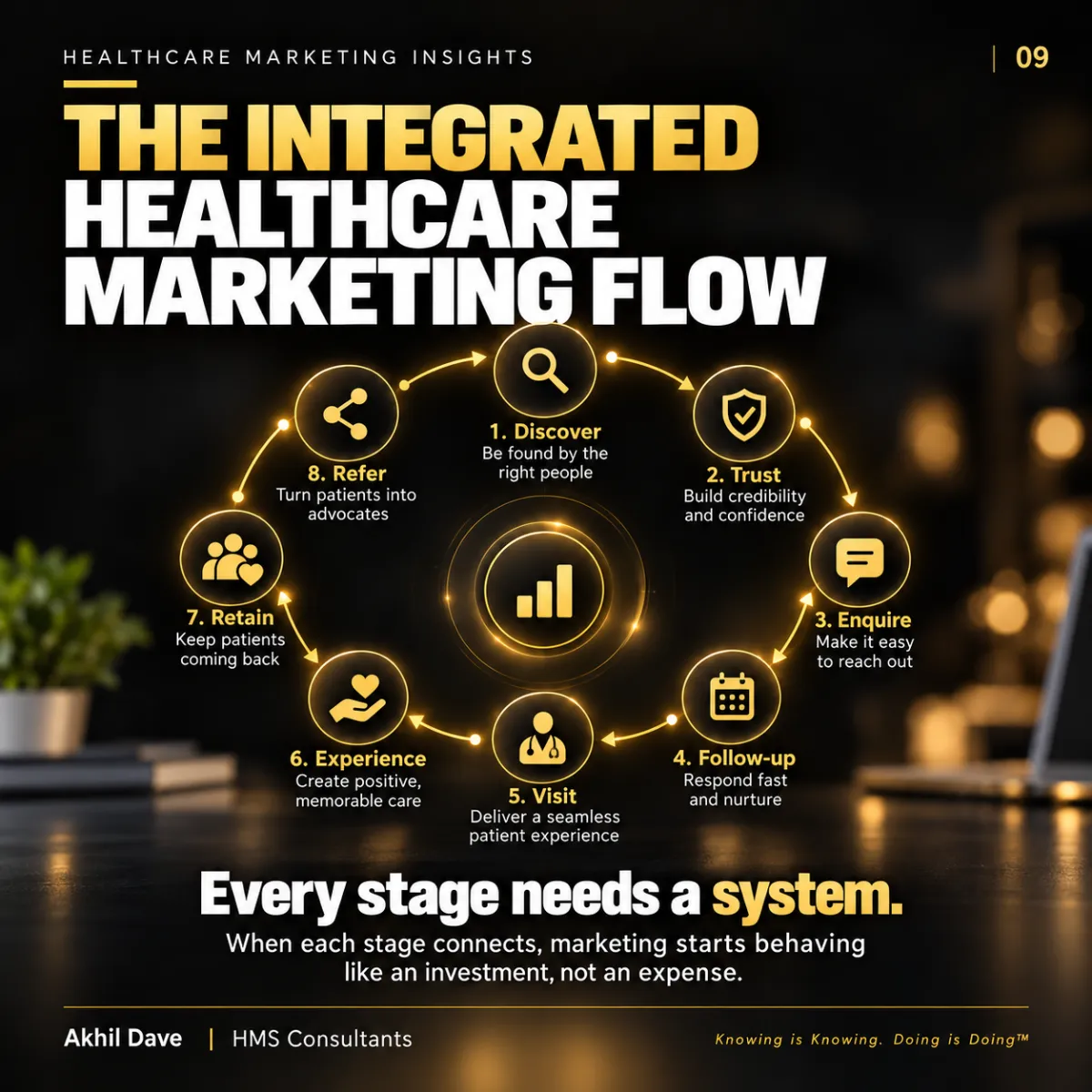
    Integrated healthcare marketing flow in eight stages: discover, trust, enquire, follow-up, visit, experience, retain and refer

    Here is the flow behind the picture. Every stage needs an owner, a process and a measure.

    StageWhat the patient needsWhat you do
    1. DiscoverTo find the right doctorGoogle Business Profile, local SEO, YouTube and website pages that answer real questions
    2. TrustCredibility and confidenceDoctor-led education, clear qualifications and registration details, accurate information
    3. EnquireAn easy way to reach youOne-tap call and WhatsApp, a simple booking page, working phone lines
    4. Follow-upA fast, human replySame-day response, a short script, reminders for missed enquiries
    5. VisitA smooth first visitDirections, timings, what to carry, calm reception
    6. ExperienceA positive, memorable visitStaff training, waiting-time communication, clear explanations
    7. RetainReasons to come backRecall for follow-ups and health-education messages
    8. ReferTo feel good recommending youGreat care and clear communication; never paid or incentivised referrals

    Every stage needs a system. When each stage connects, marketing starts behaving like an investment, not an expense.

    Related reading: Want the full system behind these lessons? Our guide to integrated healthcare marketing strategy shows the 8 parts, the 7-number scorecard and a 30-day plan.

    What not to copy from the retail playbook

    This is where retail and healthcare part ways. A clinic that copies a festive retail campaign line by line risks its reputation and, under the NMC’s October 2026 guidelines, its standing. Based on our reading of the public notice:

    Retail playbook tacticHealthcare-safe version
    Festive deals and discounts for “deal seekers”Publish fees and services factually. No discounts, coupons, contests or gifts.
    Creator and influencer endorsementsEducation in the doctor’s own name. No testimonials or influencer promotion.
    Urgency and fear of missing outPlain information on when to seek care. No fear-based or demand-creating messages.
    AI-generated ad campaignsDoctor-reviewed, accurate content. Any permitted AI content must be marked as AI-generated.
    Before-and-after reveals and success numbersAnonymised, educational use only where the guidelines allow. No success rates or patient numbers.
    Paying per lead or per patientFixed-fee agency or consultant work. No commission or pay-per-patient arrangements.

    For the full rules, read our NMC advertising guidelines 2026 guide. HMS Consultants is a healthcare marketing consultancy, not a law firm, so please confirm specifics with a qualified healthcare lawyer.

    A 3-week festive-season action plan for your clinic

    1. Week 1: Fix the foundation. Update festival-week timings on Google, check address, phone and category, set a WhatsApp greeting and reply script, and decide who answers calls when.
    2. Week 2: Publish educational content. Record two or three short doctor-led videos answering common patient questions. Add the same questions as FAQs on the matching service pages, with the doctor’s name, qualifications and registration number.
    3. Week 3: Connect and track. Link each video to its service page, each page to a booking option, and add simple tracking for calls and WhatsApp clicks. Review which source brought which enquiry.
    4. After Diwali: Review and repeat. Keep what worked, drop what did not, and set a weekly rhythm for one educational post.

    This is the order we recommend: foundation, trust, connection, then measurement.

    Which HMS service fits where you are today?

    This guide is part of the HMS Consultants October 2026 blog roundup, which collects all 13 guides published that month.

    Doctor Branding

    For doctors who want a clear, ethical personal brand and trust-led visibility.

    Explore Doctor Branding

    Medical Practice Growth

    For clinic owners who want a steady, measurable patient flow.

    Explore Practice Growth

    Hospital Marketing Consulting

    For hospitals that need strategy, positioning and a connected plan.

    Explore Hospital Consulting

    Hospital Marketing Audit

    For teams who want to know what is working before they spend more.

    Explore the Audit

    Frequently asked questions

    Can doctors run festive offers or discounts during Diwali?

    Under the NMC’s ethical advertising guidelines issued in October 2026, discounts, contests, coupons, gifts, cashbacks and free procedures that encourage unnecessary care are among the practices restricted. Fees can be stated factually. This is HMS’s reading of the public notice, not legal advice, so confirm with a qualified healthcare lawyer. Our NMC advertising guidelines guide explains the details.

    Does Google’s festive playbook apply to hospitals and clinics?

    The behaviours do: people discover through video and images, research before deciding and increasingly use AI to decide faster. The playbook itself is built on retail categories such as jewellery, apparel and electronics, so the tactics need adapting for healthcare, especially discounts, influencer endorsements and urgency messaging.

    Where do patients in India discover doctors online?

    Typically through Google Search and Maps, YouTube, a doctor’s or hospital’s website, and WhatsApp for the final step. Google and YouTube feature in 93% of Indian shoppers’ brand discovery journeys, according to Google-commissioned Ipsos research, which is a retail finding but a useful direction for healthcare.

    How can a clinic show up in AI search answers?

    Publish accurate, structured, doctor-reviewed content; keep your Google Business Profile, website and directory details identical; and answer real patient questions in plain language with clear headings and FAQs. Our guide to SEO and AEO for hospitals and doctors covers the steps.

    Should doctors work with YouTube creators or influencers?

    The NMC guidelines restrict testimonials, third-party marketing and lending your name, image or voice for promotion. The safer route is educational video made by the doctor, in the doctor’s own name, with the mandatory registration details. Read the clauses or ask a healthcare lawyer before any creator tie-up.

    What should a clinic do before Diwali week?

    Fix the basics first: holiday timings on Google, a working phone and WhatsApp response, accurate profile details, and two or three educational videos or articles linked to your appointment page. The 3-week plan in this article gives the order of work.

    Healthcare marketing needs a system
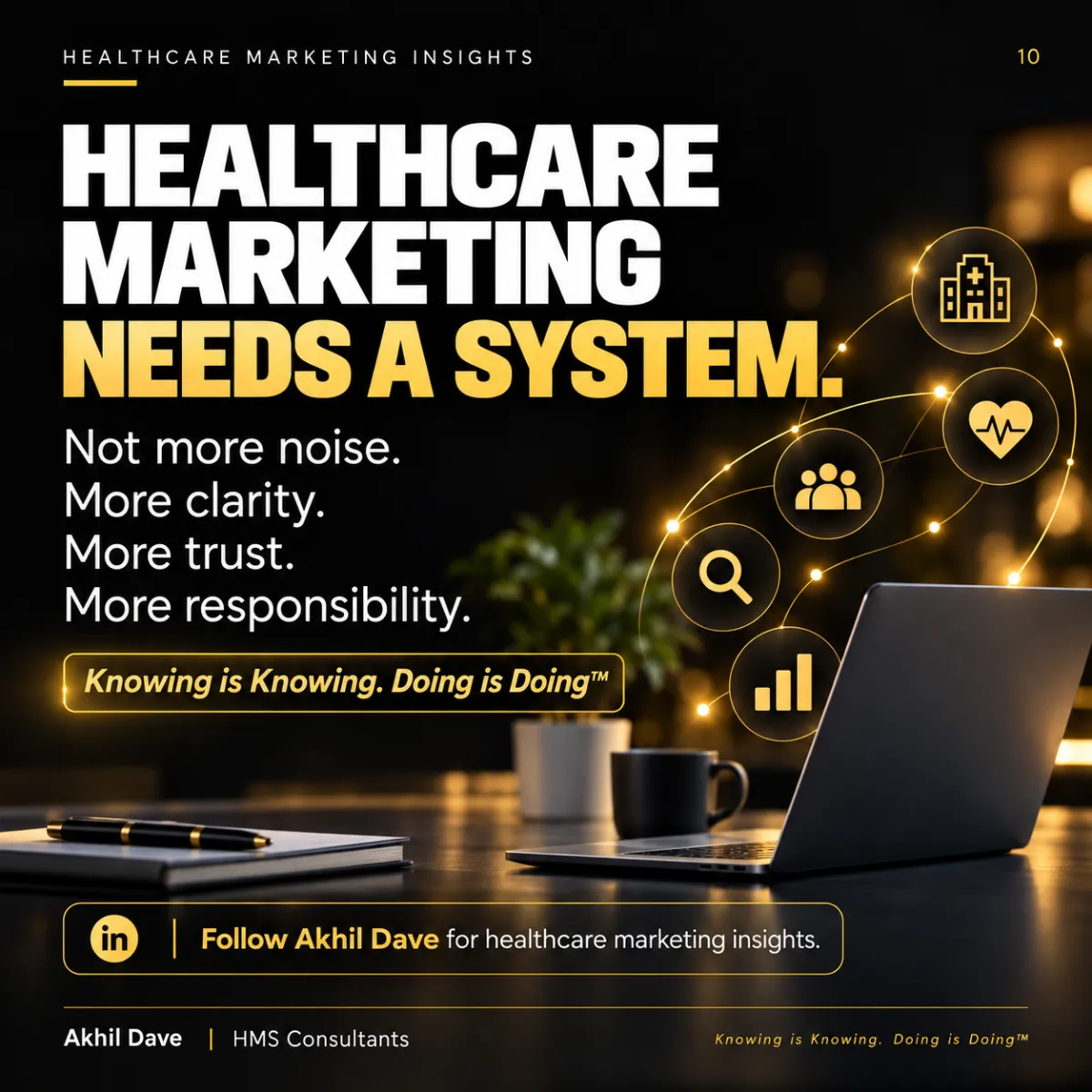
    Healthcare marketing needs a system: not noise, but clarity, trust and responsibility

    The festive playbook’s real message is not about Diwali. It is that connected marketing beats scattered marketing. For healthcare, add one more word: responsible. Not noise. More clarity. More trust. More responsibility.

    At HMS Consultants, we have worked with 58+ healthcare businesses since 2024 on exactly this: a clear strategy first, then execution. Knowing is Knowing, Doing is Doing™.

    Disclaimer: HMS Consultants is a healthcare marketing consultancy. We are not medico-legal experts or a law firm. Statistics from Google and YouTube’s playbook come from retail shopping research and are cited for behavioural direction only, not as healthcare benchmarks. References to the NMC guidelines reflect our understanding of the public notice dated 6 October 2026 and are not legal advice. Please read the official notice and consult a qualified healthcare lawyer before acting.

    About the author: Akhil Dave is Founder & Principal Consultant of HMS Consultants, with 25+ years in healthcare marketing.

    Sources

    • Google and YouTube, A Marketer’s Playbook to Win This Festive Season: Drive Festive Business Growth (India, 2026), drawing on: Datum Festive Barometer 2026; Redseer festive first-leg 11-day analysis; Google-commissioned Ipsos Shopping Moments Study, Sept-Nov 2025 (n=2,450 Indian consumers, seven retail categories); Google-commissioned Ipsos Global Consumer Journeys, Dec 2025; Google/Kantar Future of Video, 2025 (n=2,296); Google and Deloitte, The $250 Billion Commerce Frontier, 7 April 2026.
    • NMC Guidelines on Ethical Advertising and Public Communication (public notice, 6 October 2026)

    Work with HMS Consultants

    Want a festive-season and year-round plan that brings the right patients to your clinic, within the rules? Talk to us before you spend on ads.
    Talk to HMS ConsultantsBook a free 30-min call

    Digital Marketing For Doctors I Doctor Marketing I Healthcare Marketing I Healthcare Marketing Strategy

    is something we strongly believe in, which means ‘Knowledge without application is the same as having no knowledge at all

    Akhil Dave

    Principle Consultant

    Ready to take your Personal Brand to the next level?

    Share your details below and we will connect with you to discuss your growth strategy.

      Check your profile against the new NMC rules

      Get the free 19-page NMC Compliance Guide for Doctors, with a 30-minute self-audit and a 7-day fix plan.

      Download the free guide
    • Healthcare Market Validation in India: How to Test Your Idea Before You Build (2026)

      Healthcare Market Validation in India: How to Test Your Idea Before You Build (2026)

      Healthcare Market Validation in India: How to Test Your Idea Before You Build (2026)

      Published on
      Share This

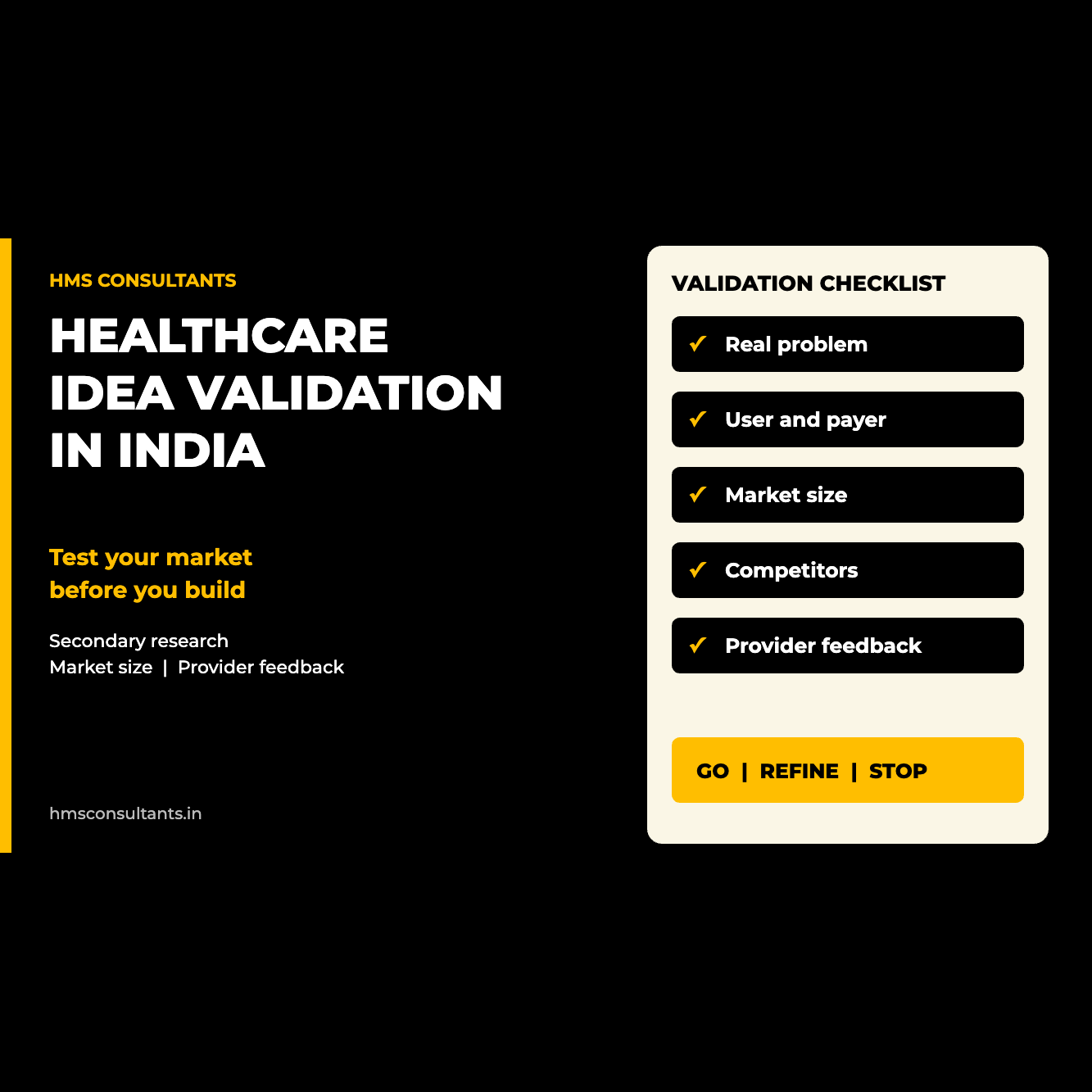
      Healthcare idea and market validation in India

      The short answer: Healthcare market validation in India means testing your idea before you build it. You confirm that a real problem exists, identify who uses the product and who pays for it, estimate the market size with clear assumptions, study competitors and pricing, and get honest feedback from doctors and hospital decision makers. The result is a clear go, refine or stop decision.

      This guide is for founders, doctors, professionals and corporates with a healthcare startup, app, device or service idea for India. It is written by Akhil Dave, who has spent 25+ years in healthcare marketing strategy and leads HMS Consultants, a healthcare marketing and strategy consultancy that helps innovators validate ideas using secondary research and a wide network of healthcare providers.

      Why validate before you build

      Most healthcare ideas begin with a strong belief: “this problem is obvious, and my solution will fix it.” Building on belief alone is expensive. CB Insights, in its study of startup shutdown post-mortems, found that 42% of failed startups cited “no market need” as a reason, the most common cause in that sample (as reported by The Week).

      Healthcare adds its own traps. The doctor who loves your idea may not control the budget. The hospital that likes the demo may take months to decide. A patient who needs the service may be unwilling or unable to pay. Validation finds these gaps early, when fixing them costs a few weeks and not a few quarters.

      What idea validation really answers

      QuestionWhat you need to knowHow you find out
      Is the problem real?Who feels it, how often, how painful it isProvider conversations, published evidence
      Who pays?Patient, hospital, doctor, insurer or employerBuyer mapping, pricing scan
      How big is the market?Number of reachable buyers times realistic price and adoptionBottom-up and top-down sizing
      Who else solves it?Direct, indirect and “do nothing” alternativesCompetitor and pricing scan
      Will it be adopted?Workflow fit, trust, switching effortConcept feedback from providers

      Step 1: Define the problem, the user and the payer

      Write the problem in one sentence without mentioning your solution. Then separate three roles that founders often mix up: the user (who touches the product), the beneficiary (who gains) and the payer (who signs the cheque). In Indian healthcare these are often three different people. A patient app may be used by patients, loved by doctors and paid for by a hospital marketing budget, or not paid for at all.

      Step 2: Estimate the market size the honest way

      Large headline numbers are tempting. For example, IMARC estimates India’s digital health market at about USD 23.78 billion in 2026, growing to USD 90 billion by 2034. These figures show momentum, but they are not your market. Your market is the slice you can actually reach and sell to.

      • Bottom-up: number of reachable buyers (for example, 150-bed-plus hospitals in your first five cities) x price per year x realistic adoption rate.
      • Top-down: take the relevant industry segment and narrow it by geography, buyer type and use case.
      • Reality check: if the two methods are far apart, one of your assumptions is wrong. Find out which.

      Always write your assumptions down, so that anyone, including an investor, can challenge and improve them.

      Step 3: Run secondary research on the right sources

      Secondary research uses information that already exists. It is fast, low cost and usually the right first step. Use sources that match the question:

      Source typeHelps you answer
      Government and public health dataDisease burden, facility counts, programmes and policy direction
      Industry and market reportsSegment size, growth, trends (treat as directional)
      Hospital and company disclosuresScale, pricing signals, technology adoption
      Funding and startup trackersWho is funded, what investors back, crowded or empty spaces
      Competitor websites and app storesFeatures, pricing, reviews, customer complaints
      Clinical literatureEvidence behind the problem and the solution

      Step 4: Test the concept with providers

      Desk research tells you what exists. It cannot tell you how a hospital administrator or a busy specialist will react. Structured conversations with the people who will use or buy your solution close that gap. Prepare a short concept note, ask open questions about how they handle the problem today, and listen for workarounds, budget and who else must approve. This is where HMS’s network of healthcare providers helps: we can arrange candid discussions with the right kind of decision makers, so that you hear honest reactions and not polite encouragement.

      Step 5: Scan competitors and pricing

      List direct competitors, indirect substitutes (including manual processes) and the option of doing nothing. Note their target buyer, pricing, strengths and gaps. A crowded space is not always bad, since it can prove demand. An empty space is not always good, since it may signal that nobody will pay.

      Go, refine or stop: how to decide

      DecisionSignals
      GoClear problem, an identified payer, a reachable market of meaningful size, positive and specific feedback, a defensible edge
      RefineReal problem but unclear payer, wrong first customer, price mismatch or weak differentiation
      Stop or pivotNo budget owner, too small a market, strong free alternatives, or feedback that stays polite but never turns into interest

      Stopping early is a valid and valuable result. It saves money, time and credibility.

      What HMS Consultants does, and what it does not

      We do: secondary research, market size estimates with clear assumptions, competitor and pricing scans, buyer and payer mapping, concept feedback through our provider network, and an honest go, refine or stop recommendation. If you go ahead, we can help build your India go-to-market strategy.

      We do not: build software or medical products, give regulatory, licensing or legal advice, provide clinical validation, or guarantee funding or sales outcomes.

      Six validation mistakes healthcare founders make

      1. Asking friends and family. They are kind, not honest.
      2. Confusing user with payer. Love from doctors is not a budget.
      3. Quoting a giant market. “1% of a huge number” is not a plan.
      4. Researching only online. You miss how hospitals really decide.
      5. Ignoring the “do nothing” competitor. Manual workarounds are often the toughest rival.
      6. Treating politeness as interest. Look for commitments, such as a pilot or a named champion.

      A 3-week validation sprint

      WeekFocusOutput
      Week 1Define and researchProblem statement, user and payer map, secondary research pack, competitor scan
      Week 2Size and testBottom-up and top-down market size with assumptions, concept note, provider feedback conversations
      Week 3DecideFindings summary, go, refine or stop recommendation, suggested next steps and first customer segment

      Frequently asked questions

      What is healthcare market validation?

      It is the process of checking, before you invest heavily in building, whether a real problem exists, who feels it, who would pay, how big the opportunity is and whether competitors already serve it. For healthcare in India it also means understanding the difference between the user and the payer.

      How do I estimate the market size of a healthcare startup in India?

      Start bottom-up: count the number of buyers you can realistically reach (for example hospitals of a certain size in your target cities), multiply by the price you can charge and the share likely to adopt. Cross-check it against a top-down figure from industry reports. Treat large headline numbers only as context, not as your market.

      Can you validate a healthcare app idea without building it?

      Yes. Secondary research, competitor and pricing scans, and structured conversations with doctors and hospital decision makers can show whether the problem is real and whether anyone would pay, before you write much code.

      What does HMS Consultants do in idea validation?

      We run secondary research, build a market size estimate with clear assumptions, scan competitors and pricing, and gather concept feedback through our network of healthcare providers. We then give you an honest view of go, refine or stop.

      Do you build the app or product?

      No. HMS Consultants is a healthcare marketing and strategy consultancy. We do not build software or medical products, and we do not provide regulatory, legal or compliance services.

      How long does validation take?

      A focused validation sprint usually takes about three weeks, depending on how well defined the idea is and how quickly feedback conversations can be arranged.

      Is a free discussion call really free?

      Yes. The 30-minute idea discussion call is free. We listen to your concept, tell you honestly what we see, and suggest what to validate first.

      Discuss your healthcare idea with HMS Consultants

      Have a healthcare startup, app or innovation idea for India? Book a free 30-minute idea discussion call. We will listen to your concept, tell you honestly what we see and suggest what to validate first. Write to akhil@hmsconsultants.in or call +91 81550 04010. You may also read our guide to healthcare startup strategy consulting.

      This guide is part of the HMS Consultants October 2026 blog roundup, which collects all 13 guides published that month.

      Disclaimer: HMS Consultants is a healthcare marketing and strategy consultancy. We are not a law firm, a regulatory consultant or a clinical authority. This article is for general information, based on public sources and our experience. Market figures are estimates and change over time. Confirm regulatory and legal points with qualified professionals before acting.

      About the author: Akhil Dave is Founder and Principal Consultant of HMS Consultants, with 25+ years in healthcare marketing strategy.

      Sources

      Work with HMS Consultants

      Testing a healthcare idea before you build? Start with a free 30-minute idea discussion call.

      See Idea and Concept ValidationBook a free 30-min call

      Healthcare Consulting I Healthcare Marketing Strategy

      is something we strongly believe in, which means ‘Knowledge without application is the same as having no knowledge at all

      Akhil Dave

      Principle Consultant

      Ready to take your Personal Brand to the next level?

      Share your details below and we will connect with you to discuss your growth strategy.

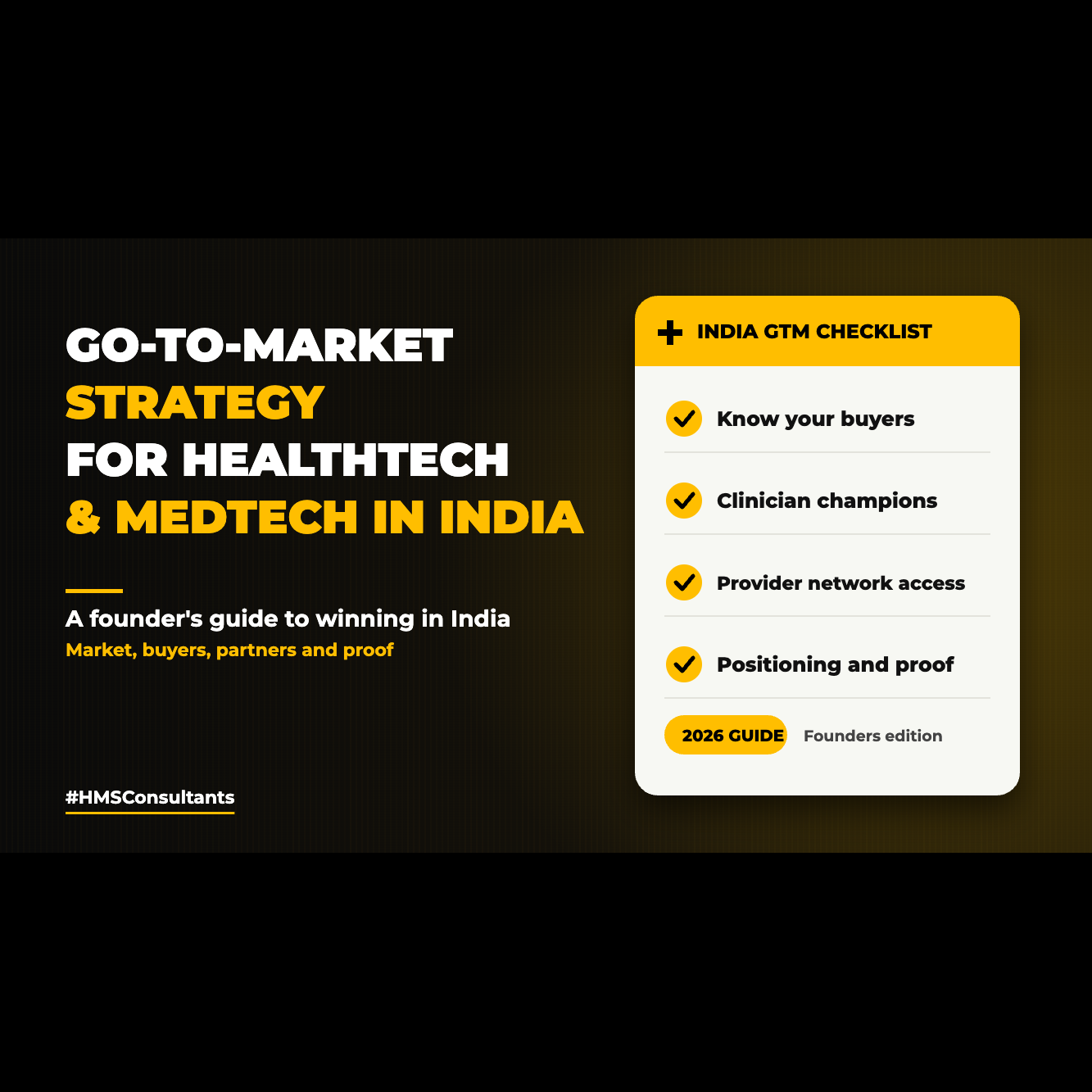
      • Healthtech and Medtech Go-to-Market Strategy in India: A Founder’s Guide (2026)

        Healthtech and Medtech Go-to-Market Strategy in India: A Founder’s Guide (2026)

        Healthtech and Medtech Go-to-Market Strategy in India: A Founder’s Guide (2026)

        Published on
        Share This

        Go-to-market strategy for healthtech and medtech in India

        The short answer: A healthtech go-to-market strategy (and a medtech GTM strategy) for India means understanding who really buys inside hospitals, positioning your product around hospital economics and clinical value, earning the trust of a few respected doctors, designing pilots that convert into purchases, choosing the right partners, and getting in front of the right healthcare leaders. Products rarely fail in India for lack of technology. They stall because the right people did not know, trust or buy them.

        This guide is for founders, product leaders and country heads of healthtech, medtech, digital health and pharma-tech companies, both Indian startups and overseas firms planning to enter India. It is written by Akhil Dave, who has spent 25+ years in healthcare marketing strategy and leads HMS Consultants, a healthcare marketing and strategy consultancy that helps healthtech and medtech companies build their India go-to-market using deep market experience and a wide network of healthcare providers.

        Launching a healthtech product in India?

        Book a free 30-min callStartup strategy consulting

        Why India is worth the effort, and why it is hard

        The opportunity is large and still import-led. The Indian medical devices market was estimated at about $15.2 billion in 2025, projected to reach $50.1 billion by 2030, with imports covering roughly 70 to 80 per cent of domestic demand, according to a Rubix Industry Insights report cited by IANS. On the digital side, the Ayushman Bharat Digital Mission had crossed 93.95 crore ABHA IDs by July 2026, with 5.33 lakh health facilities and 9.85 lakh healthcare professionals registered. Funding is more selective: Inc42 reports roughly $700 million across 54 healthtech deals in 2025, against 78 deals in 2024. Capital now rewards companies with traction, not decks.

        India is hard for three reasons. Buying is fragmented across thousands of hospitals, clinics and diagnostic chains. Trust travels through doctors and peers, not advertising. And every hospital decides differently. Treat each as a gate you must pass.

        The 6-gate India GTM framework

        We use six gates with healthtech and medtech teams. Skipping one usually shows up later as a stalled pilot or a sales team starting from zero in every new hospital.

        GateThe question to answerTypical failure if skipped
        1. Buyer mapWho decides, who pays, who can say no?Great demos to people with no budget
        2. PositioningWhy should a hospital choose us over doing nothing?A feature list nobody remembers
        3. Clinical credibilityWhich respected doctors will use and vouch for this?Pilots that never convert
        4. Pilot designWhat does a successful pilot turn into?Free pilots that go nowhere
        5. Channel and partnersDirect, distributor, or platform partner?Wrong margins, no after-sales support
        6. Visibility and proofDo the right healthcare leaders know us and trust us?Invisible outside the founder’s network

        Gate 1: Map who really buys inside a hospital

        Most founders pitch the person who loves the product, then discover someone else holds the budget. Map the buying centre before you build a sales deck.

        RoleWhat they care aboutWhat to bring
        Treating doctor or HODClinical outcome, workflow fitEvidence, a hands-on trial, peer references
        Hospital CEO, COO or medical directorRevenue, cost, reputation, differentiationBusiness case and a payback estimate
        Purchase and finance teamPrice, terms, vendor riskClear pricing, service and AMC terms
        IT and digital headIntegration, security, data protectionTechnical architecture and data-handling approach
        Biomedical engineerInstallation, uptime, spare parts, serviceService plan and training
        Government hospitalsTender specifications, procurement processTender readiness and a registered-vendor route
        Distributors and platform partnersMargin, support, brand pullTerritory plan, training, marketing support

        Gate 2: Position around hospital economics and clinical value

        Hospital leaders buy outcomes, savings and differentiation. Doctors buy better care and an easier workflow. Your positioning should answer both in plain language: what problem you solve, for which department, with what measurable result, and why now. A good test: can a hospital COO repeat your value in one sentence after a ten-minute meeting? If not, the message needs work before any outreach starts.

        Gate 3: Build clinical credibility through champions

        In Indian healthcare, a respected clinician’s opinion carries more weight than any brochure. Start with three to five champion doctors across two or three cities, not fifty doctors who barely use the product.

        • Pick opinion leaders, not just early adopters. One respected department head opens more doors than ten enthusiastic juniors.
        • Use a trusted introduction. A warm introduction through someone the doctor already trusts shortens months of cold outreach. This is where an established provider network matters most.
        • Remember doctors cannot advertise for you. Under NMC rules, doctors cannot endorse products using their name, image or professional status. Build credibility through scientific presentations, case studies, conferences and peer education instead, and confirm what is permitted with your legal advisor.

        Gate 4: Design pilots that convert

        A pilot without an agreed next step is a favour, not a sale. Before the pilot starts, agree in writing on four things: the clinical or operational question, the measurable outcome, the start and end dates, and what a successful pilot converts into, whether that is a purchase order, a rate contract or a multi-site rollout. Measure what the hospital cares about: turnaround time, error reduction, bed or OT utilisation, revenue per procedure and patient experience.

        Gate 5: Choose direct, distributor or platform partners

        Each route trades control for reach. A direct team gives you feedback and pricing control but needs capital and time. Distributors give reach and servicing but dilute your story. Hospital groups, diagnostic chains and healthtech platforms can give scale in one deal, at the price of dependence on one partner. Most companies start direct in one or two anchor cities, prove the playbook, then add partners region by region. Write your pricing, margin, training and after-sales commitments into the partner agreement before launch.

        Gate 6: Build visibility and proof among the right healthcare leaders

        Buyers, investors, partners and journalists research you before they take your call. Visibility in healthcare is about being known and trusted by the right few hundred people: hospital leaders, department heads, clinical opinion leaders, associations and conference organisers. Build it with a clear India story, founder and expert thought leadership, an active LinkedIn presence, third-party proof from pilots and conferences, and relationships that let others speak for you.

        Keep healthcare communication responsible. Claims about outcomes must be verifiable, patient data needs proper consent, and healthcare advertising is regulated. Our guide to the NMC advertising guidelines explains how the rules affect doctors and hospitals you may work with.

        What HMS Consultants does, and what it does not

        HMS Consultants is a healthcare marketing and strategy consultancy. We build your go-to-market strategy, positioning, buyer and champion mapping, pilot design, partner approach and visibility plan, using our experience of the Indian healthcare market and our network of healthcare providers. We do not handle regulatory approvals, licensing, legal or clinical-compliance work. Those belong with your regulatory consultants and lawyers, and we plan your go-to-market timeline around them.

        How our provider network shortens your India learning curve

        A consultant who has worked on the hospital side sees what a foreign playbook misses: which departments really decide, how a purchase committee behaves, when to approach a hospital group, and which conference moves a doctor community. The HMS Consultants network connects founders with experienced healthcare marketing and strategy professionals and with hospitals, clinics and doctors across India, so a company can test, localise and scale its message with people who know each market.

        Over recent months HMS has worked with healthtech companies including Expert AI and DocX System to build their visibility among doctors, hospital leaders and healthcare founders, and to connect them with the HMS network for strategic growth in India. That is the model: positioning first, visibility next, introductions third, and growth that follows trust.

        Client spotlight

        HMS is currently helping two digital health companies build visibility and relationships across the Indian healthcare ecosystem.

        Expert AI: an AI documentation tool that transcribes patient encounters and drafts clinical notes, so physicians spend less time on paperwork. Relevant for hospitals and clinicians looking to cut documentation time.

        DocX System: a platform combining professional profiles for doctors and hospitals, peer networking and digital patient referral management. Relevant for doctors, hospital groups and healthcare partners who want to be discoverable and connected.

        Building a healthtech or medtech product for India? Book a free 30-minute GTM discovery call.

        Seven mistakes that slow healthtech and medtech GTM in India

        1. Treating India as one market. Metro corporate hospitals, tier-2 private hospitals, single-doctor clinics and government hospitals buy differently.
        2. Selling features, not hospital economics. Leaders buy outcomes, savings and differentiation.
        3. Running free pilots with no conversion plan.
        4. Depending on one champion doctor. People move; build relationships across departments.
        5. Going to market before the message is clear. Outreach with a vague story burns your best contacts.
        6. Ignoring the regulatory timeline. Launch plans must follow what your regulatory advisors confirm, not the other way around.
        7. Using healthcare advertising tactics that work elsewhere. Doctor testimonials and influencer campaigns can backfire in India.

        A 90-day India GTM plan

        PeriodFocusOutput
        Days 1 to 30DiagnoseIdeal customer and buyer map, competitor and pricing scan, positioning draft, shortlist of anchor cities and hospitals
        Days 31 to 60Position and proveMessaging and India story, 3 to 5 champion clinicians through trusted introductions, pilot design with success metrics, first thought-leadership content
        Days 61 to 90Launch and learnFirst paid pilots or purchase orders, partner shortlist, review of enquiries and conversion, plan for the next two cities

        Frequently asked questions

        What is a healthtech go-to-market strategy for India?

        It is a plan that covers your buyers inside hospitals, your positioning, clinical champions, pilot design, sales channels and visibility, so a healthtech or medtech product can be adopted and paid for in India.

        How do I enter the Indian healthcare market as a foreign medtech company?

        Work on two tracks in parallel. Appoint regulatory and legal advisors to confirm what you need to sell legally in India, and build your go-to-market with a strategy partner: buyer map, positioning, champion doctors, pilots and channel partners.

        Do you help with CDSCO registration or other approvals?

        No. HMS Consultants is a healthcare marketing and strategy consultancy, not a regulatory or legal firm. We work alongside your regulatory advisors and plan your go-to-market around their timelines.

        Who buys healthtech and medtech products inside Indian hospitals?

        Several people share the decision: the treating doctor or HOD, hospital leadership, purchase and finance, IT, and biomedical engineering. Government hospitals add tender and procurement processes. Map all of them before pitching.

        How can a healthtech startup get in front of hospitals and doctors in India?

        Through trusted introductions, a few champion clinicians, credible proof from pilots, conference and association presence, and consistent thought leadership. A provider network shortens this considerably.

        Can doctors endorse my healthtech or medtech product?

        Under the NMC’s ethical advertising guidelines, doctors cannot endorse drugs, devices or health products using their name, image or professional status. Use scientific publications, educational events and compliant case studies, and confirm specifics with your legal advisor.

        How long does it take to get the first hospital customers in India?

        It varies by product, price point and hospital type. A structured 90-day plan can reach first pilots, but purchase decisions in larger hospitals often take longer. Plan the pilot and its conversion path from day one.

        How can HMS Consultants help my healthtech or medtech GTM?

        HMS Consultants, led by Akhil Dave, builds India go-to-market strategy for healthtech and medtech founders using its market expertise and network of healthcare providers and healthcare marketing consultants. See our healthcare startup strategy consulting.

        Plan your India go-to-market with HMS Consultants

        If you are a healthtech, medtech, digital health or pharma-tech founder planning to enter or scale in India, book a free 30-minute GTM discovery call. We will review your product and buyers, and tell you honestly where to focus first. Write to akhil@hmsconsultants.in or call +91 81550 04010.

        This guide is part of the HMS Consultants October 2026 blog roundup, which collects all 13 guides published that month.

        Disclaimer: HMS Consultants is a healthcare marketing and strategy consultancy. We are not a law firm, a regulatory consultant or a clinical authority. This article reflects our understanding based on research of public sources and our experience, and is for general information only. Rules change, so confirm regulatory, legal and advertising points with qualified professionals before acting.

        About the author: Akhil Dave is Founder and Principal Consultant of HMS Consultants, with 25+ years in healthcare marketing strategy.

        Sources

        Work with HMS Consultants

        Building a healthcare, healthtech or medtech startup? Get positioning and go-to-market strategy built on real hospital and doctor insight.

        See Startup Marketing StrategyBook a free 30-min call

        Free 30-min call with Akhil DaveBook a callWhatsAppCall
        Healthcare Consulting I Healthcare Marketing Strategy

        is something we strongly believe in, which means ‘Knowledge without application is the same as having no knowledge at all

        Akhil Dave

        Principle Consultant

        Ready to take your Personal Brand to the next level?

        Share your details below and we will connect with you to discuss your growth strategy.

        • NMC Advertising Guidelines 2026: A Complete Compliance Guide for Doctors and Hospitals

          NMC Advertising Guidelines 2026: A Complete Compliance Guide for Doctors and Hospitals

          NMC Advertising Guidelines 2026: A Complete Compliance Guide for Doctors and Hospitals

          Published on
          Share This
          NMC advertising guidelines 2026 for doctors and hospitals, compliance guide

          Quick answer: the NMC advertising guidelines (public notice of 6 October 2026) apply to every doctor, clinic and hospital in India. Education and factual information are allowed. Testimonials, before-and-after images, success rates, superlatives, offers and pay-per-patient agency deals are not. Penalties range from a warning to removal from the register for 1 to 3 years.

          Latest update (4 November 2026): we have not found a later NMC circular that changes these rules. Read our NMC compliance audit checklist for a step-by-step self-check.

          Last updated: 4 November 2026 · By Akhil Dave, Founder & Principal Consultant, HMS Consultants

          Related: See the 10 NMC advertising mistakes doctors make and how to fix each one.

          Related: Can a doctor post on Instagram? NMC rules explained, with a bio template and post ideas.

          Related: Still have questions? Read the 100 questions answered on the NMC advertising guidelines, with a clause reference for each answer.

          NMC advertising guidelines now apply to every doctor, clinic and hospital in India. The National Medical Commission (NMC) has issued its Guidelines on Ethical Advertising and Public Communication through a public notice dated 6 October 2026 (No. R-13014/01/2024-Ethics). They apply from publication, with no grace period stated, and were framed in connection with a Supreme Court writ petition (WP(C) 1160/2023). One principle has not changed: a doctor still cannot promote their own practice. What has changed is clarity. The 2002 Regulations spoke in principles; these NMC guidelines for doctors and hospitals name the channels (social media, WhatsApp, podcasts, influencers, online platforms, AI) and list specific prohibitions.

          Key takeaways

          • Digital promotion, including sponsored posts, influencer content and AI-assisted promotion, counts as advertising.
          • Testimonials, before-and-after images and claims such as “best” or “100% success” are barred.
          • Patient consent does not make a prohibited practice acceptable, and hiring an agency does not shift your responsibility.
          • Do not tie any agency or influencer payment to patients procured or referred.
          • Start with an audit of every channel this week; the guidelines apply from publication.

          Want to know if your website and social media comply?

          Our NMC Compliance Audit reviews your website, YouTube, Instagram, Facebook, LinkedIn and Google profile against these guidelines, with a Red-Amber-Green report in 7 working days. ₹25,000 for doctors, ₹50,000 for hospitals.

          See the NMC Compliance Audit →

          What the NMC advertising guidelines change: five things every doctor should know today

          1. Digital promotion is advertising. Sponsored posts, influencer content and AI-assisted promotion are all covered (clause 3.2).
          2. Testimonials, before-and-after images, success stories, and claims such as “best” or “100% success” are barred for promotion (clause 8.1).
          3. Patient consent does not make a prohibited practice acceptable (clause 6.2).
          4. Using an agency or influencer does not shift responsibility away from you (clause 4.4).
          5. Penalties are graded, from a warning to removal from the medical register for 1 to 3 years (clause 10.1).

          Who is covered, and the legal footing

          The guidelines apply to Registered Medical Practitioners (RMPs) and to hospitals and medical institutions. They operate alongside the NMC Act, 2019 and the Indian Medical Council (Professional Conduct, Etiquette and Ethics) Regulations, 2002, and do not override either (clauses 2.1 and 4.2).
          • Doctors (RMPs): read with the 2002 Regulations and the NMC Act. Where the two cannot be reconciled, the statute prevails.
          • Hospitals and clinics: read with the Clinical Establishments Act or the relevant state Act, which prevails in a conflict (clause 4.3).
          • Healthcare platforms hosting doctors: must follow the same norms, must not offer paid ranking of doctors, and must keep listings transparent (clause 9.4).
          • Agencies and influencers: hiring them does not absolve you of content you authorised, commissioned or knowingly permitted (clause 4.4).
          A point of confusion worth clearing: the NMC’s 2023 professional conduct regulations were put on hold by a gazette notification dated 23 August 2023. The 2002 Regulations remain the operative code, and these new guidelines are read with them.

          What you can still do

          Education and factual information remain permitted. The test is whether the content informs the public or promotes you. Doctors (clauses 5.1 and 8.2)
          • Announce starting practice, a change of practice type or address, temporary absence, resumption or succession of practice, and your charges.
          • Publish research case studies in reputed journals.
          • Give public health talks on TV, radio or electronic media in your own name and designation, without promoting an employer.
          • Share patient health-education pamphlets free of guarantees, superiority claims or misleading content.
          • Post greetings on national or professional days, without professional promotion.
          • Join awareness campaigns and educational content that do not promote your practice, solicit patients or earn money from the promotion.
          Hospitals and clinics (clauses 5.2, 8.3 and 9.1)
          • Publish factual, verifiable details: name, location, contact information, departments, facilities, equipment, emergency services, accreditation and charges.
          • Maintain a factual doctor directory with names, recognised qualifications, specialties, registration details and availability. The guidelines treat this as patient information, distinct from paid promotion.
          • Use hoardings for factual infrastructure information only.

          What is now prohibited

          Clause 8.1 sets out twelve restrictions for doctors, and clause 9.2 adds one on photographs. Hospitals have their own list in clause 8.3.
          PracticeWhat the guidelines sayClause
          Demand creation and fearNo ads that create unnecessary demand for procedures or diagnostics, or use fear-based marketing8.1(i)
          SolicitationNo direct or indirect solicitation or self-promotion; no third-party marketing; no lending your name, image or voice for promotion8.1(ii)
          Success claimsNo personal success rates or patient numbers; no “guaranteed cure” or “100% success”8.1(iii)
          Product endorsementNo endorsing drugs, devices or health products using your name, image or professional status8.1(iv)
          Case publicityNo before-and-after photos, surgical results, celebrity patients or success stories; scientific or educational use with anonymised consent is the exception8.1(v)
          Unrealistic expectationsNo concealed risks, unrealistic promises or unproven therapies8.1(vi)
          Referral paymentsNo commissions, referral fees or lead-generation payments tied to referrals8.1(vii)
          Pay-per-patient contractsAgency, influencer or platform contracts must not pay per patient procured or referred8.1(viii)
          Comparative claims“Best”, “No. 1” and “leading” only if objectively verifiable; awards and rankings must disclose methodology, date and awarding body8.1(ix)
          Offers and inducementsNo discounts, contests, coupons, gifts, cashbacks, referral benefits or free procedures that encourage unnecessary care; fees must be stated factually8.1(x)
          Testimonials and endorsementsNo testimonials from celebrities, influencers, patients, staff or others; no indirect advertising through intermediaries; disclose material commercial ties8.1(xi)
          Fake engagementNo fake followers, likes, reviews, ratings or views; no manipulation of search or algorithms8.1(xii)
          Doctor photographsNo photograph that works as self-advertisement; self-photos on letterheads and signboards are governed by 2002 Regulations 6.1.1 and 6.1.29.2
          For hospitals (clause 8.3): no patient solicitation or inducement, no superiority claims, no cure or outcome guarantees, no exaggerated claims, and no promotion of individual doctors. Factual information stays factual, but the form or frequency of communication cannot turn it into promotion.

          Is your clinic or hospital compliant?

          Not sure whether your website, social media and patient communication meet the new NMC rules? We review them and give you a clear fix list.

          Get your NMC Compliance AuditBook a free 30-min call

          Social media, reviews, SEO, influencers and AI

          Online, one test decides whether the rules apply: does the content have a promotional character? If it does, it is advertising, whatever the medium (clause 3.2).
          • Mandatory disclosure: Electronic posts must show the doctor’s name, qualifications, registration status and State or National Medical Register number. Establishments must disclose the same details for their doctors (clause 3.2, Explanations III and IV).
          • Social media: Educational content is fine. Self-promotion and soliciting patients are not (8.1(ii)). Treat posts published before 6 October as in scope and audit them.
          • Reviews and testimonials: Testimonials are prohibited (8.1(xi)), and fake, paid or manipulated reviews are barred (clause 3.2, Explanation V; 8.1(xii)). The text does not clearly address a patient’s own unsolicited review on a third-party platform. Until NMC clarifies, our advice is not to solicit, reproduce or showcase patient reviews in your promotion.
          • SEO and search: Manipulating search rankings or algorithms to create a false impression of standing is prohibited (8.1(xii)). Factual website content on services, facilities, qualifications and fees is permitted. Superlatives are not. Platforms may not sell paid ranking of doctors (9.4).
          • Influencers and agencies: No payment may be tied to patients procured or referred (8.1(vii) and (viii)). Influencer testimonials are barred, material commercial relationships must be disclosed (8.1(xi)), and you stay responsible for what they publish (4.4).
          • Artificial intelligence (clause 7.2): AI-generated promotional campaigns for commercial interest are prohibited. Permitted AI content must carry a source mark stating it is AI-generated. AI may not be used to create or alter patient images, testimonials, voices or outcomes, or to make misleading claims about diagnosis, treatment or qualifications. Government public-interest campaigns are exempt (7.3).
          • Live surgery: Broadcasts must follow NMC’s live-surgery framework on safety, consent, privacy and commercialisation (7.5).
          Some terms, such as the “commercial character” of AI content and what counts as “material” AI alteration, are not yet defined, as MediaNama’s analysis notes. Expect NMC clarifications and SOPs (clause 12).

          Patient data, consent and the DPDP Act

          Patient information can appear in communication only where the law permits it and consent and safeguards are in place (clause 6.1). Even then, consent does not rescue a practice the guidelines otherwise prohibit, such as a testimonial or a before-and-after image (6.2). What valid consent looks like (clause 6.3): specific, informed, voluntary, documented and verifiable, and in a form that meets applicable privacy law. Identifiers (clauses 6.4 and 7.4): names, faces, birthmarks and identification marks must be cropped, blurred or blacked out. Identifiable patient data must not be shared. DPDP Act link (clause 7.6): digital use of personal data must comply with the IT Act, 2000 and the Digital Personal Data Protection Act, 2023 with its 2025 Rules, as applicable and in force. The timing matters:
          DPDP Rules 2025 provisionCommencement
          Board framework (Rules 1, 2 and 17 to 21)Immediate on notification in November 2025
          Consent Manager registration (Rule 4)12 months, around November 2026
          Core fiduciary duties: notice, security safeguards, breach reporting, retention (Rules 3, 5 to 16, 22 and 23)18 months, around May 2027
          Source for the phased timeline: Storyboard18’s report on the final DPDP Rules. Confirm exact dates against the Gazette notification. So the DPDP duties on notice, security and breach reporting are not yet fully in force, but the NMC consent standard already applies. Build to the stricter of the two now. Practical steps: a separate marketing-use consent form (distinct from treatment consent), a written log of who approved each use, and a rule that no patient data goes into any AI tool without safeguards. For medical practices, the DPDP Rules also include carve-outs for healthcare providers processing children’s data, subject to conditions, so check which apply to you.

          Telemedicine, consumer law and drug advertising: the other rules that apply

          The NMC guidelines are one layer. The same content can also be tested against the following. 1. Telemedicine Practice Guidelines, 2020. India has no standalone Telemedicine Act. These are guidelines issued on 25 March 2020 and incorporated into the 2002 Regulations on 12 May 2020. Per the guidelines’ text:
          • Your State Medical Council or national registration number must appear on prescriptions, websites, electronic communications such as WhatsApp or email, and receipts (section 3.2.5).
          • You may not solicit patients for telemedicine through advertisements or inducements (section 3.7.1.4).
          • Patient confidentiality, the IT Act and data protection law apply, and misuse of patient images or data is prohibited (sections 3.7.1.1 to 3.7.1.4).
          • Platforms must list each doctor’s name, qualifications, registration number and contact details (section 5.2). AI-based platforms cannot counsel patients or prescribe (section 5.4).
          2. Consumer Protection Act, 2019 and the CCPA Guidelines, 2022. The CCPA guidelines on misleading advertisements and endorsements were notified on 9 June 2022. Advertisements must be truthful, disclaimers cannot contradict the main claim, and endorsers must act with due diligence and disclose material connections. Under Section 21, penalties reach up to Rs 10 lakh (up to Rs 50 lakh for later violations), and endorsers can be barred for up to one year (three years for repeat violations). Section 89 provides up to two years’ imprisonment for causing prejudicial false advertisements. Medical services fall within consumer law following the Supreme Court’s 1995 ruling in Indian Medical Association v. V.P. Shantha. The practical implication: a claim you publish can be cited in a consumer complaint as a promise you made. Keep every claim you publish verifiable. 3. Drugs and Magic Remedies (Objectionable Advertisements) Act, 1954. Section 3 bars advertisements suggesting a drug can diagnose, treat or prevent conditions in the Act’s Schedule of 54 conditions, including cancer, diabetes, heart disease, epilepsy and cataract. A first conviction can bring up to six months’ imprisonment, a fine, or both. Keep any medicine-related content clear of cure or prevention claims for these conditions. 4. Supreme Court self-declaration directions (2024). In Indian Medical Association v. Union of India, the Court required advertisers and advertising agencies to file a Self-Declaration Certificate before publishing an advertisement, through the Broadcast Seva portal for TV and radio and the Press Council of India portal for print and digital. If your hospital runs paid advertising through an agency, confirm with them how this applies.

          Penalties and appeals

          State Medical Councils (SMCs) enforce the guidelines against doctors through graded action (clause 10.1):
          ViolationAction
          FirstWarning and mandatory ethics training
          SecondCensure and a monetary penalty
          ThirdSuspension of registration for 3 to 6 months
          Serious (misleading cure claims, patient inducement, digital mass solicitation)Suspension for 6 to 12 months
          RepeatedRemoval from the register for 1 to 3 years
          Process safeguards: a show-cause notice and an opportunity to respond must come first (10.2), and the SMC must issue a reasoned order (10.3). Appeals (clause 11): a first appeal lies to the Ethics and Medical Registration Board of NMC within 60 days under section 30(3) of the NMC Act, 2019. A second appeal lies within 60 days of the first decision under section 30(4). Hospitals are dealt with under the Clinical Establishments Act or the applicable state Act. Doctors who personally authorised or endorsed prohibited content may also be examined separately (11.5).

          Want us to run this checklist for you?

          Our NMC compliance audit checks your website and social media against these 10 steps, so you know exactly what to change.

          Book the NMC Compliance AuditBook a free 30-min call

          A 10-step compliance checklist for doctors and hospitals

          For a fuller version covering your website, social media and Google profile, see our NMC compliance audit checklist for doctors and clinics.

          The guidelines apply from publication, so start with an audit this week.
          1. Inventory every channel that carries your name: website, Google Business Profile, Instagram, Facebook, YouTube, LinkedIn, WhatsApp broadcasts, listing platforms and hospital pages.
          2. Add disclosures. Name, qualifications, registration status and registration number on every electronic post, website page and prescription.
          3. Remove testimonials and review screenshots, before-and-after images, success stories and celebrity-patient mentions.
          4. Remove claims you cannot prove: “best”, “No. 1”, “100% success”, “guaranteed”, “painless”. Keep award or ranking claims only with the methodology, date and awarding body stated.
          5. Withdraw inducements: discounts, coupons, cashbacks, referral benefits and free-procedure offers. State fees factually.
          6. Review every agency, influencer and platform contract. No payment per patient or per lead, and no referral commissions.
          7. Stop AI-generated promotion. Label any permitted AI content, and never feed patient data into AI tools without safeguards.
          8. Fix patient consent. Use a separate, documented consent for any educational use of patient material, and mask every identifier.
          9. Align telemedicine communication: registration number on electronic communication, and no solicitation or inducement.
          10. Keep an approval log recording who wrote, approved and published each item, and brief your front-desk and social-media teams.

          Finished the checklist? Get it done for you.

          HMS Consultants audits your last 3 months of posts and every public channel, then walks you through the fixes. Not legal advice; a marketing compliance review.

          See the NMC Compliance Audit →

          Compliance is a strategy question, not only a legal one

          The guidelines do not end your ability to build trust with patients. They move it to the right place: accurate information, credible education and a clear professional identity, instead of claims and inducements. Diagnosis before promotion. Strategy before execution. Patient trust before visibility. If you would like a structured review of your website, Google presence and social channels against these guidelines, HMS Consultants offers an NMC Compliance Audit for Doctors & Hospitals. Write to akhil@hmsconsultants.in or visit hmsconsultants.in.

          Frequently asked questions

          Do the NMC advertising guidelines apply to hospitals as well as doctors?

          Yes. They apply to Registered Medical Practitioners and to hospitals and medical institutions. Hospitals are also read with the Clinical Establishments Act or the relevant state Act, and healthcare platforms hosting doctors must follow the same norms.

          Are patient testimonials and before-and-after photos allowed under the NMC guidelines?

          No. Clause 8.1 bars testimonials from patients, celebrities, influencers and staff, and it bars before-and-after images and success stories used for promotion. Patient consent does not make a prohibited practice acceptable.
          Can a doctor still post on Instagram, YouTube or LinkedIn?

          Yes, if the content educates rather than promotes. Educational and factual content is permitted. Self-promotion and soliciting patients are not, and electronic posts must show the doctor’s name, qualifications and registration details.

          Can I hire an agency or influencer to market my clinic?

          You can, but you stay responsible for what they publish. Contracts must not pay per patient procured or referred, influencer testimonials are barred, and any material commercial relationship must be disclosed.

          What are the penalties for violating the NMC advertising guidelines?

          Penalties are graded: a warning and ethics training for a first violation, then censure and a penalty, suspension of registration for 3 to 6 months, and for repeated violations removal from the register for 1 to 3 years. A show-cause notice must come first.

          Is AI-generated content allowed in doctor and hospital promotion?

          AI-generated promotional campaigns for commercial interest are prohibited under clause 7.2. Permitted AI content must carry a source mark, and AI cannot be used to create or alter patient images, testimonials, voices or outcomes.

          What should a doctor do first to become compliant?

          Inventory every channel carrying your name, add the mandatory disclosures, and remove testimonials, before-and-after images, superlatives and offers. Then review agency contracts and keep an approval log. The 10-step checklist in this guide covers each action.

          What are the NMC guidelines for doctors on social media?

          Doctors may share educational, factual health information in their own name, with name, qualifications and registration number shown. Patient testimonials, requested or shared reviews, before and after images, success-rate claims, superlatives, offers and undisclosed paid endorsements are not permitted. Permitted AI-generated content must carry an AI label.

          What is allowed under the new NMC guidelines?

          Factual information such as name, location, contact details, services, facilities and charges; announcements of starting, changing or resuming practice; research-based communication; health education talks and materials; and greetings on national or professional days without professional gain.

          This guide is part of the HMS Consultants October 2026 blog roundup, which collects all 13 guides published that month.

          Hospital Marketing Audit

          For teams who want to know what is working before they spend more.

          Explore the Audit

          Hospital Marketing Consulting

          For hospitals that need strategy, positioning and a connected plan.

          Explore Hospital Consulting

          Doctor Branding

          For doctors who want a clear, ethical personal brand and trust-led visibility.

          Explore Doctor Branding

          NMC Compliance Audit

          For websites and social channels that must stay within the NMC rules.

          Explore the NMC Audit
          Disclaimer: HMS Consultants is a healthcare marketing consultancy. We are not medico-legal experts or a law firm. This article reflects our understanding of the NMC public notice dated 6 October 2026, based on detailed research of public sources. It is for general information only and is not legal advice. Guidelines may be clarified or amended, so please read the official notice and consult a qualified healthcare lawyer before acting. About the author: Akhil Dave is Founder & Principal Consultant of HMS Consultants, with 25+ years in healthcare marketing. Sources

          Work with HMS Consultants

          Want a second pair of expert eyes on your clinic or hospital communication against the NMC guidelines? Ask about our NMC compliance audit.

          See the NMC Compliance AuditBook a free 30-min call

          Free 30-min call with Akhil DaveBook a callWhatsAppCall
          Healthcare Marketing Strategy

          is something we strongly believe in, which means ‘Knowledge without application is the same as having no knowledge at all

          Akhil Dave

          Principle Consultant

          Ready to take your Personal Brand to the next level?

          Share your details below and we will connect with you to discuss your growth strategy.

            Check your profile against the new NMC rules

            Get the free 19-page NMC Compliance Guide for Doctors, with a 30-minute self-audit and a 7-day fix plan.

            Download the free guide
          • The 7 Ps of Healthcare Marketing: A Framework Guide

            The 7 Ps of Healthcare Marketing: A Framework Guide

            The 7 Ps of Healthcare Marketing: A Framework Guide

            Published on
            Share This

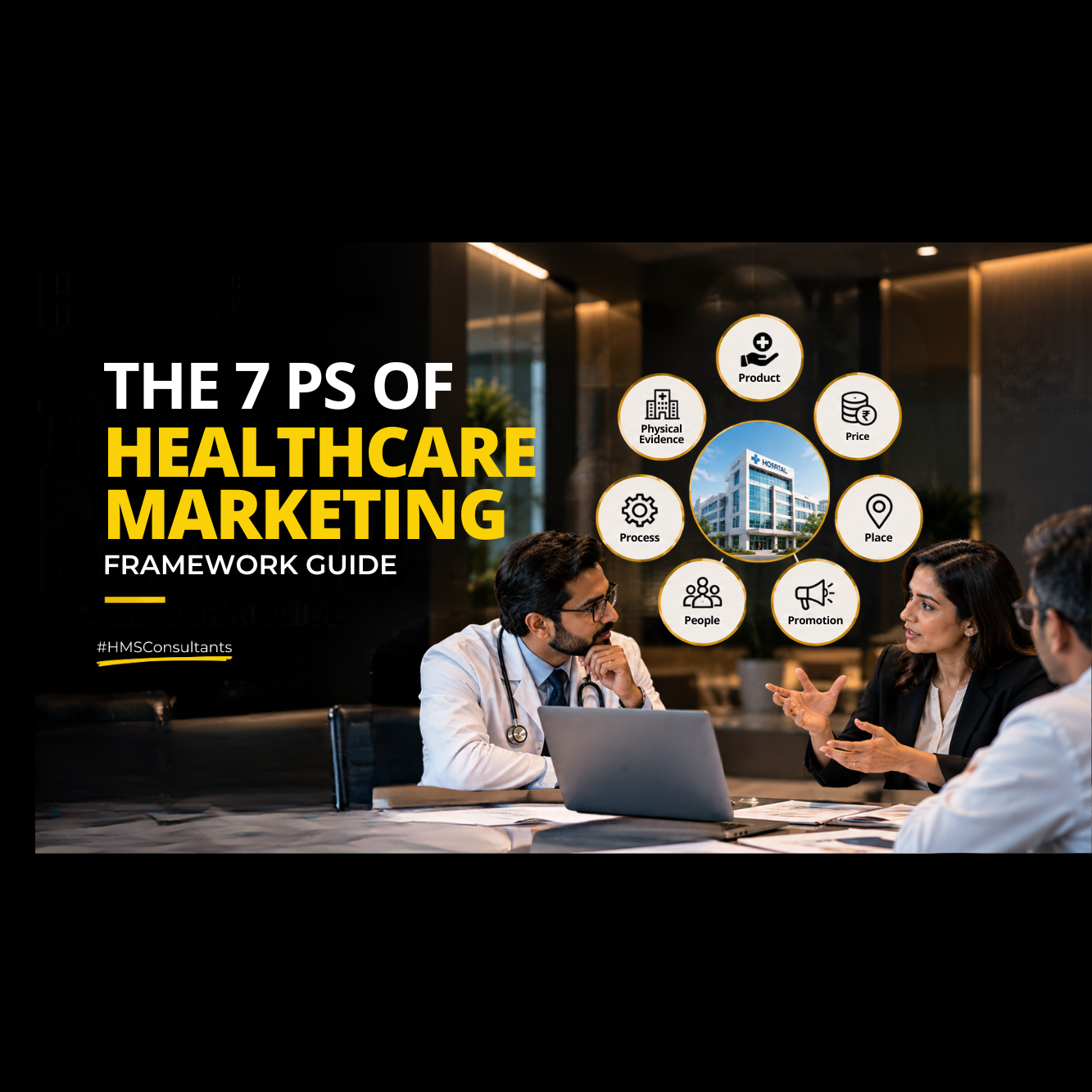
            The 7 Ps of marketing Product, Price, Place, Promotion, People, Process, and Physical Evidence is a services-marketing framework that maps directly onto healthcare, since healthcare is fundamentally a service delivered by people, through a process, in a physical setting. Most hospitals only actively manage Promotion, leaving the other six Ps to happen by default rather than by design.

            1. What Are the 7 Ps, Applied to Healthcare?

            The original 4 Ps of marketing (Product, Price, Place, Promotion) were extended to 7 for services businesses, adding People, Process, and Physical Evidence the three elements that matter enormously for something intangible and experience-based, like a hospital visit. Nearly every hospital marketing effort concentrates on Promotion alone; the other six Ps are just as important to how a patient experiences and judges the hospital, whether anyone is actively managing them or not.

            2. Product: What Are You Actually Offering?

            In healthcare, “product” is the specific service or specialty being offered not just “healthcare” broadly, but the specific procedures, specialties, and quality of care that differentiate one hospital from another. Clarity here matters: a hospital that can’t articulate what it specifically does well has nothing concrete for any of the other six Ps to communicate.

            3. Price: Transparency and Trust

            Pricing in healthcare carries unique sensitivity patients often make decisions under financial and emotional stress simultaneously. Transparent, clearly communicated pricing (even when the answer is “it depends, and here’s why”) builds more trust than vague or hidden pricing, which tends to create anxiety and erode confidence regardless of whether the actual cost is reasonable.

            4. Place: Accessibility and Location Strategy

            Place covers physical accessibility location, parking, ease of finding the facility and increasingly, digital accessibility as well, since a hospital’s website and online presence are effectively where many patients first “visit.” A hospital with a great physical location but a hard-to-navigate website is failing at “Place” in the modern sense just as much as one in an inconvenient physical location.

            5. Promotion: Ethical, Trust-First Promotion

            This is the P hospitals already spend the most time on advertising, content, social media. In healthcare specifically, promotion needs to lead with trust and education rather than urgency or aggressive sales tactics, given the sensitivity of medical decision-making. Our SEO and AEO strategy guide covers how promotion increasingly needs to work across both traditional search and AI answer engines simultaneously.

            6. People: Staff as a Marketing Asset

            Every staff member a patient interacts with reception, nursing, billing is effectively part of the marketing experience, whether trained to think of it that way or not. A hospital can run excellent external promotion and still lose trust at this stage if staff don’t reflect the same standard the marketing promised. This is explored in more depth in our guide to internal marketing strategy for hospitals.

            7. Process: The Patient Journey as a Touchpoint

            Process covers how smoothly a patient moves from first enquiry to appointment to follow-up. A confusing booking process, long unexplained wait times, or unclear discharge instructions all undermine trust regardless of how good the clinical care itself was the process is often what a patient remembers and describes to others, for better or worse.

            8. Physical Evidence: What Patients See and Feel

            Physical Evidence covers every tangible, observable element of the experience facility cleanliness and design, staff appearance, signage, printed materials, even the condition of the waiting area. These signals are processed by patients constantly and often subconsciously, shaping trust well before or entirely apart from any interaction with a doctor. Our hospital branding ideas guide covers many practical ways to strengthen this specific P.

            9. Using the Framework: A Simple Self-Assessment

            For each of the 7 Ps, ask: is this being actively, deliberately managed, or is it happening by default? Most hospitals find Promotion is actively managed, Product is reasonably clear, and the remaining five Price, Place, People, Process, and Physical Evidence are managed inconsistently or not at all. This gap is usually where the highest-leverage, least-expensive improvements are found, since they often require attention and consistency rather than new budget.

            10. How HMS Consultants Applies This Framework

            HMS Consultants uses the 7 Ps as a foundational lens in every hospital marketing audit, ensuring that strategy addresses the full patient experience rather than defaulting to promotion alone, which is where most hospital marketing effort and most hospital marketing failure tends to concentrate.

            Work with HMS Consultants

            Need a clear plan to grow brand visibility, patient footfall and revenue? Explore Hospital Marketing Strategy Consulting.

            See Hospital Marketing Strategy ConsultingBook a free 30-min call

            Frequently Asked Questions

            The 7 Ps are Product, Price, Place, Promotion, People, Process, and Physical Evidence a framework originally developed for services marketing that applies directly to healthcare, since healthcare is fundamentally a service.

            Healthcare Marketing Strategy

            is something we strongly believe in, which means ‘Knowledge without application is the same as having no knowledge at all

            Akhil Dave

            Principle Consultant

            Ready to take your Personal Brand to the next level?

            Share your details below and we will connect with you to discuss your growth strategy.

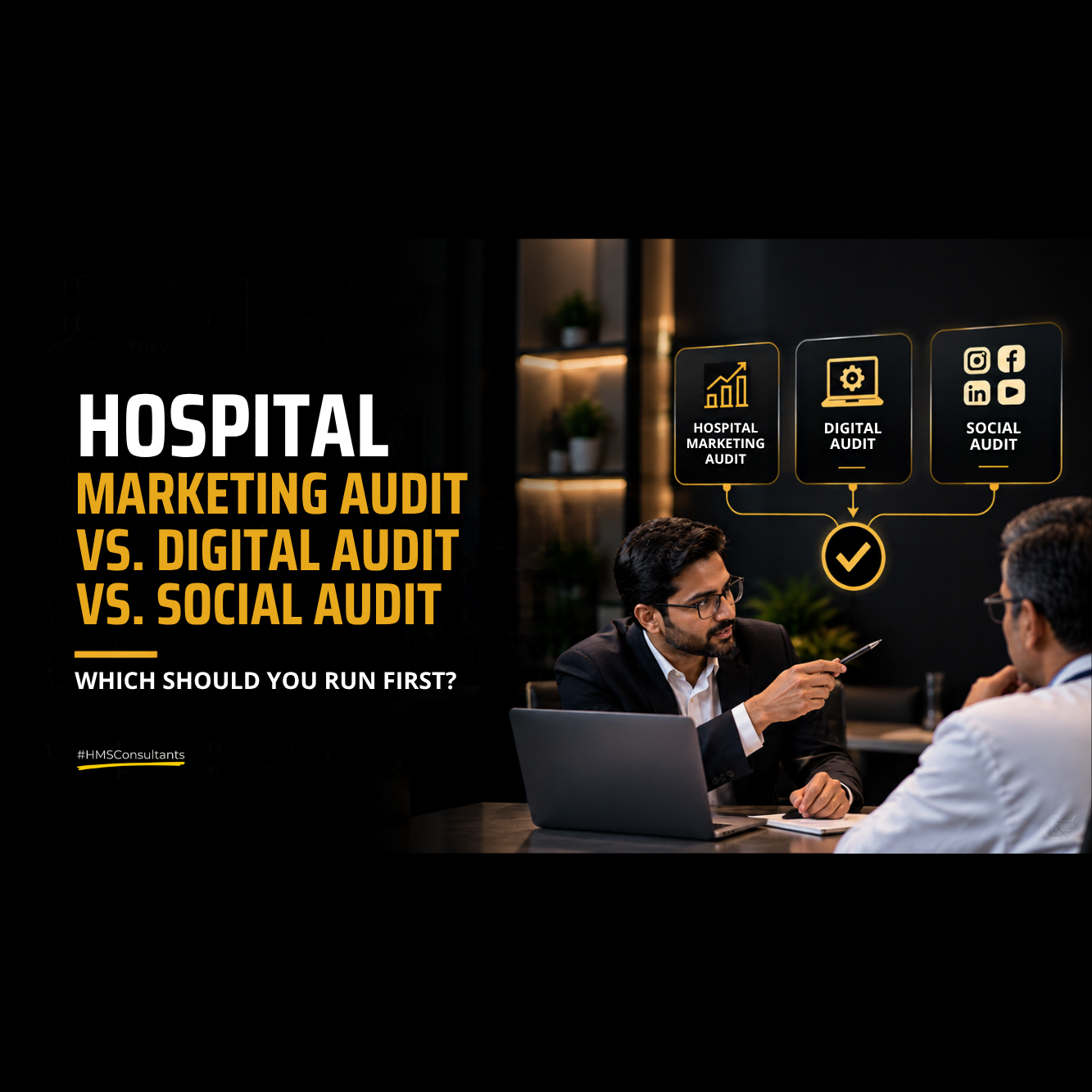
            • Hospital Marketing Audit vs. Digital vs. Social: Which Should You Run First?

              Hospital Marketing Audit vs. Digital vs. Social: Which Should You Run First?

              Hospital Marketing Audit vs. Digital vs. Social: Which Should You Run First?

              Published on
              Share This

              A full hospital marketing audit covers everything digital, offline, brand, and team. A digital marketing audit narrows in on website, SEO, and online channels specifically. A social media marketing audit narrows further still, into content, engagement, and platform fit. Most hospitals don’t need all three at once this guide helps decide where to start.

              1. Three Audits, One Common Confusion

              The terms “marketing audit,” “digital audit,” and “social media audit” get used almost interchangeably in casual conversation, but they cover meaningfully different scopes. Choosing the wrong one first can mean either missing the bigger picture (running only a social audit when the real issue is broader) or spending time and budget on a comprehensive review when a narrower, faster diagnostic would have answered the immediate question.

              2. Hospital Marketing Audit: What It Covers

              The broadest of the three, covering digital presence, offline branding, patient experience touchpoints, referral relationships, and internal team capability together. This is the right starting point for a hospital that has never had any structured marketing review done, since it surfaces the full picture before narrowing into any one area. See our full hospital marketing audit checklist for the complete breakdown.

              3. Digital Marketing Audit: What It Covers

              Narrower than the full audit, focused specifically on website performance, SEO rankings, Google Business Profile, tracking setup, and increasingly, AI search visibility. This is the right choice when the hospital already has a reasonable sense of its offline branding and team situation, but suspects the digital side specifically isn’t performing. See our hospital digital marketing audit for the full checklist.

              4. Social Media Marketing Audit: What It Covers

              The narrowest of the three, focused entirely on content quality, posting consistency, engagement, and platform fit across social channels. This is the right choice when social media specifically feels like it’s underperforming or inconsistent, and the rest of the hospital’s marketing is otherwise reasonably well understood. See our hospital social media marketing audit for the full checklist.

              5. Side-by-Side Comparison

              Scope: Hospital marketing audit (broadest digital, offline, brand, team) | Digital marketing audit (online channels only) | Social media audit (social platforms only)

              Typical duration: Hospital marketing audit (2–3 weeks) | Digital marketing audit (1–2 weeks) | Social media audit (about 1 week)

              Best for: Hospital marketing audit (no prior audit history, or a broad sense something isn’t working) | Digital marketing audit (specific concern about website/SEO/tracking) | Social media audit (specific concern about social content or engagement)

              Includes the other two?: Hospital marketing audit (yes, at a lighter level) | Digital marketing audit (touches on social referral traffic, not full social review) | Social media audit (no)

              6. Which One Should You Start With?

              If there’s no clear, specific concern  just a general sense that marketing isn’t performing as well as it should start with the full hospital marketing audit. It’s the only one of the three that surfaces where the actual priority lies, rather than assuming the priority is already known. If there’s already a specific, well-founded suspicion (the website hasn’t been touched in years, or social media has clearly gone quiet), the narrower, faster audit matching that specific concern is a reasonable and more efficient starting point.

              7. Can You Run More Than One at Once?

              Running a full hospital marketing audit already includes a lighter version of both the digital and social reviews, so running all three simultaneously as separate engagements is usually redundant. A more efficient sequence: run the full audit first, then follow up with a deeper digital or social audit specifically for whichever area the full audit flags as the highest priority.

              8. How the Three Work Together Over Time

              A reasonable long-term cadence: a full hospital marketing audit annually, with a digital marketing audit or social media audit run more frequently (quarterly or twice a year) for whichever specific channel needs closer, more frequent monitoring between full audits. This keeps the comprehensive picture current while allowing faster iteration on the channels that change most quickly.

              9. How HMS Consultants Sequences a Multi-Audit Engagement

              HMS Consultants typically starts with a full hospital marketing audit for new clients to establish the complete picture, then recommends a focused digital or social media audit only where the initial findings point to a specific, deeper need avoiding redundant work across all three at once.

              Work with HMS Consultants

              Want an independent, expert review of your hospital’s marketing? Our Hospital Marketing Audit starts at ₹25,000.

              See the Hospital Marketing AuditBook a free 30-min call

              Related reading: 10 Signs Your Hospital Needs a Marketing Audit (and What to Do First).

              Frequently Asked Questions

              A hospital marketing audit covers everything digital, offline branding, referrals, and team capability. A digital marketing audit narrows in specifically on website, SEO, and online channels.

              Healthcare Marketing Strategy

              is something we strongly believe in, which means ‘Knowledge without application is the same as having no knowledge at all

              Akhil Dave

              Principle Consultant

              Ready to take your Personal Brand to the next level?

              Share your details below and we will connect with you to discuss your growth strategy.

              • Wellness Clinic Marketing Playbook: IVF, Skin & Wellness Centres

                Wellness Clinic Marketing Playbook: IVF, Skin & Wellness Centres

                Wellness Clinic Marketing Playbook: IVF, Skin & Wellness Centres

                Published on
                Share This

                Wellness clinic marketing for IVF, skin and aesthetic, and general wellness centres requires a different approach than general hospital marketing because the patient journey involves longer consideration, higher emotional investment, and more privacy sensitivity. What works for a routine hospital visit often falls flat, or worse, feels tone-deaf, applied to a fertility or aesthetic decision.

                1. What Makes Wellness Clinic Marketing Different

                General hospital marketing often deals with more immediate, less emotionally layered decisions choosing a hospital for a scheduled procedure, or responding to an urgent need. Wellness categories like IVF, aesthetics, and broader wellness services usually involve a much longer consideration window, more research, more comparison between providers, and considerably more emotional weight attached to the decision. Marketing that treats these categories the same way as general hospital care tends to underperform, because it misses what patients are actually looking for at each stage.

                2. Why This Guide Is for Beginners, Not Marketing Experts

                A prospective IVF or aesthetic patient typically moves through a longer arc: initial awareness and research (often extending over months), emotional processing of the decision, comparison across multiple providers, and finally consultation and commitment. Marketing needs to serve each of these stages differently early-stage content should educate and build trust without pressure, while later-stage content can more directly address specific questions and next steps. Rushing a patient from awareness to a hard sell, common in more transactional marketing, tends to erode trust rather than build it in this category.

                3. IVF Clinic Marketing: What Works

                – Educational content that demystifies the IVF process step by step, reducing the anxiety of the unknown

                – Realistic expectation-setting around success rates and timelines, rather than overly optimistic messaging

                – Anonymized patient journey content, always with explicit consent, since privacy sensitivity is especially high in this category

                – A visibly calm, unhurried tone across all content the opposite of urgency-driven marketing common elsewhere

                – Clear, accessible information about cost and process, since uncertainty about either is a common source of patient anxiety

                4. Skin & Aesthetic Clinic Marketing: What Works

                – Before-and-after content used carefully and compliantly, with clear consent and appropriate disclaimers

                – Content addressing common misconceptions about specific procedures

                – Doctor-led content (see our personal branding playbook for doctors) that builds individual credibility, since aesthetic decisions are often tied closely to trust in a specific practitioner

                – Transparent information about recovery time, realistic outcomes, and cost, avoiding overpromising results

                – Strong visual consistency across platforms, since aesthetic clinics are judged partly on visual presentation itself

                5. General Wellness Centre Marketing: What Works

                – Content around specific, tangible outcomes (better sleep, stress management, specific health goals) rather than vague wellness language

                – Community-building content group programs, wellness events that reflects the more social, ongoing nature of wellness engagement compared to a one-time procedure

                – Educational content connecting lifestyle factors to the specific services offered

                – Membership or ongoing-engagement messaging where relevant, since wellness centres often depend more on repeat visits than one-time transactions

                6. Content That Builds Trust Across All Three

                Regardless of category, certain content types consistently build trust in these higher-stakes, higher-consideration categories: doctor or practitioner Q&A content answering real patient questions, transparent process explanations that reduce uncertainty, and genuine (consented) patient experiences rather than generic marketing claims. Content that acknowledges the emotional weight of the decision rather than only focusing on clinical or aesthetic outcomes tends to resonate more strongly in these categories than in general hospital marketing.

                7. Compliance & Sensitivity Considerations

                Each of these categories carries specific considerations beyond general hospital marketing compliance. IVF and fertility marketing involves significant privacy sensitivity and should never imply guaranteed outcomes. Aesthetic and skin clinic marketing involving before-and-after imagery and outcome claims often falls under specific medical council and advertising guidelines that vary by procedure type legal review of promotional material in this category is worth the investment. Wellness centre marketing has fewer strict compliance requirements but still benefits from avoiding exaggerated health claims not backed by evidence.

                8. Local SEO & Reviews for Wellness Clinics

                Patients researching IVF, aesthetic, or wellness services tend to read reviews far more thoroughly than for routine care, given the financial and emotional investment involved a strong, consistently managed Google Business Profile and review strategy (see our local SEO checklist for doctors) matters even more in this category than in general hospital marketing. Detailed, specific reviews mentioning the actual experience carry more weight in this category than a high volume of brief, generic ones.

                9. Common Mistakes in Wellness Clinic Marketing

                – Using urgency-driven, transactional messaging borrowed from unrelated industries

                – Overpromising outcomes, particularly around fertility success rates or aesthetic results

                – Treating all three categories (IVF, aesthetic, wellness) with an identical content strategy despite their different patient journeys

                – Underinvesting in review management despite reviews mattering more in this category than most others

                – Neglecting compliance review on before-and-after content or outcome claims

                10. How HMS Consultants Approaches Wellness Clinic Marketing

                HMS Consultants tailors strategy specifically to each wellness category’s distinct patient journey and compliance considerations, rather than applying a single generic healthcare marketing template drawing on direct experience across IVF, skin and aesthetic, and wellness centre clients.

                Work with HMS Consultants

                Running an independent clinic on a limited budget? See how we help doctors grow their practice and visibility.

                See Medical Practice GrowthBook a free 30-min call

                Frequently Asked Questions

                Wellness clinic categories like IVF and aesthetics involve longer decision timelines, higher emotional stakes, and more privacy sensitivity than general hospital care, requiring a different content and trust-building approach.

                Healthcare Marketing Strategy

                is something we strongly believe in, which means ‘Knowledge without application is the same as having no knowledge at all

                Akhil Dave

                Principle Consultant

                Ready to take your Personal Brand to the next level?

                Share your details below and we will connect with you to discuss your growth strategy.

                • What Is Health Care Marketing and Why Is It Different From Regular Marketing?

                  What Is Health Care Marketing and Why Is It Different From Regular Marketing?

                  What Is Health Care Marketing and Why Is It Different From Regular Marketing?

                  Published on
                  Share This

                  What is health care marketing? This is an important question because many people still think healthcare marketing is the same as regular marketing. They think it is only about promotions, social media posts, advertisements, offers, videos, or campaigns. But health care marketing is different.

                  It deals with patients, doctors, trust, medical decisions, treatment doubts, service credibility, ethical communication, and patient confidence.

                  In traditional marketing, people may buy a product because it looks attractive, feels useful, offers a discount, or piques their interest. But in healthcare, patients do not make decisions so casually. They are often worried, confused, afraid, or unsure.

                  That is why healthcare marketing should not only attract attention.

                  It should educate, guide, reassure, and build trust.

                  What Is Health Care Marketing?

                  Health care marketing is the process of helping doctors, clinics, hospitals, diagnostic centres, wellness businesses, and healthcare organisations communicate their services clearly and responsibly to patients.

                  It includes activities such as:

                  • Patient education
                  • Website and SEO
                  • Google Business Profile
                  • Social media content
                  • Doctor profile communication
                  • Service positioning
                  • Patient reviews
                  • Digital visibility
                  • Healthcare advertising
                  • Content marketing
                  • Reputation management
                  • Enquiry communication

                  But the purpose is not only to promote a healthcare service.

                  The purpose is to help patients understand the healthcare provider, trust the information, and make better decisions.

                  Good healthcare marketing connects the right patient with the right healthcare service through clear, ethical, and useful communication.

                  Why Healthcare Marketing Is Different From Regular Marketing

                  Regular marketing often focuses on attention, interest, sales, offers, product benefits, and quick conversions.

                  Healthcare marketing works differently because the decision is more sensitive.

                  A patient choosing a doctor, treatment, clinic, or hospital is not only thinking about price or convenience. They may also be thinking about safety, trust, experience, diagnosis, recovery, family concerns, and medical credibility.

                  This makes healthcare marketing more responsible.
                  A healthcare brand cannot communicate like a fashion brand, food brand, or retail brand.

                  It must be careful with claims, language, promises, images, patient stories, treatment information, and promotional messaging.

                  This is why ethical healthcare marketing is important.

                  Patient Trust Is the Centre of Healthcare Marketing

                  In healthcare, trust is the foundation of every decision.

                  Before booking an appointment, patients may check:

                  • Doctor experience
                  • Hospital reputation
                  • Google reviews
                  • Website information
                  • Social media presence
                  • Treatment details
                  • Patient testimonials
                  • Clinic location
                  • Service quality
                  • Communication clarity

                  If these trust signals are weak, patients may hesitate.

                  This means healthcare marketing should focus on building confidence before asking for action.

                  For example, a patient may not immediately book a consultation after seeing one advertisement. But if the patient sees clear content, helpful explanations, doctor credibility, good reviews, and a responsible digital presence, the trust level improves.

                  Healthcare marketing is not only about being visible.
                  It is about being credible.
                  The Role of Patient Education

                  Patient education is one of the strongest parts of healthcare marketing.
                  Many patients search online because they do not understand their symptoms, treatment options, risks, procedures, or recovery process. They want simple answers before they speak to a doctor.

                  Healthcare content should help answer questions such as:

                  • What does this symptom mean?
                  • When should I consult a doctor?
                  • What treatment options are available?
                  • Is the procedure safe?
                  • What should I expect during consultation?
                  • What myths should I avoid?
                  • How can I prevent this condition?
                  • What questions should I ask my doctor?

                  When healthcare marketing answers real patient questions, it becomes valuable.

                  It helps patients feel informed rather than pressured.

                  This is why healthcare content should educate before it promotes.

                  Healthcare Digital Marketing and Patient Behaviour

                  Healthcare digital marketing has become important because patients now search online before choosing healthcare services.

                  They use Google, social media, YouTube, websites, maps, reviews, and online directories to compare providers and understand services.

                  A strong healthcare digital marketing approach may include:

                  • Website improvement
                  • SEO
                  • Google Business Profile optimization
                  • Social media strategy
                  • Educational blogs
                  • Doctor videos
                  • Online reviews
                  • Paid campaigns
                  • Local visibility
                  • Enquiry tracking

                  But digital marketing in healthcare should not be random.

                  Every digital activity should support patient understanding, trust, and service clarity.

                  A website should not only look modern. It should answer patient questions.

                  Social media should not only look active. It should educate and build confidence.

                  Google reviews should not only increase numbers. They should reflect genuine patient experience.

                  This is where healthcare marketing strategy becomes important.

                  Work with HMS Consultants

                  Need a clear plan to grow brand visibility, patient footfall and revenue? Explore Hospital Marketing Strategy Consulting.

                  See Hospital Marketing Strategy ConsultingBook a free 30-min call

                  Why Healthcare Marketing Needs Strategy

                  Many healthcare businesses do marketing, but not all have a strategy.

                  They may post regularly, run ads, update their website, or create videos. But if these activities are not connected to patient needs and business goals, results may remain weak.

                  A healthcare marketing strategy helps answer important questions:

                  • Which service needs visibility?
                  • Who is the target patient group?
                  • What problems are patients searching for?
                  • What information is missing online?
                  • What trust signals need improvement?
                  • Is the communication ethical?
                  • Are enquiries being handled properly?
                  • Is the digital presence strong enough?
                  • Is marketing supporting long-term growth?

                  Without strategy, marketing becomes an activity.

                  With strategy, marketing becomes direction.

                  Ethical Healthcare Marketing Matters

                  Healthcare marketing must be responsible because it influences patient decisions.

                  Healthcare businesses should avoid misleading claims, exaggerated promises, fear-based messaging, fake urgency, unrealistic before-after communication, and unethical promotion.

                  Patients deserve honest and clear information.

                  Ethical healthcare marketing focuses on:

                  • Responsible claims
                  • Clear explanations
                  • Patient-friendly language
                  • Medical accuracy
                  • Respect for patient privacy
                  • Genuine reviews
                  • Trust-based communication
                  • No false promises
                  • No unnecessary fear creation

                  This is especially important for doctors, clinics, hospitals, and healthcare consultants.

                  Marketing should support patient confidence, not manipulate patient fear.

                  Role of a Healthcare Marketing Consultant

                  A healthcare marketing consultant helps healthcare businesses understand how to communicate, position, and grow responsibly.

                  The role is not only to suggest posts or advertisements.

                  A healthcare marketing consultant studies the full picture, including:

                  • Patient communication
                  • Website clarity
                  • Digital presence
                  • Google visibility
                  • Social media direction
                  • Service positioning
                  • Reviews and reputation
                  • Enquiry flow
                  • Ethical marketing gaps
                  • Healthcare business growth

                  The consultant helps healthcare businesses understand what is working, what is missing, and what needs improvement.

                  This makes healthcare marketing consulting different from basic marketing execution.

                  How HMS Supports This Direction

                  Many professionals understand marketing tools, but healthcare marketing requires a deeper understanding of patients, trust, ethics, medical communication, and healthcare business growth.

                  The HMS Certified Healthcare Marketing Consultant Program helps serious professionals understand this specialized field with a structured consulting-led approach.

                  The program introduces participants to healthcare marketing strategy, digital presence review, patient communication, service positioning, healthcare marketing audits, proposal planning, personal branding, and business development guidance.

                  It is designed for professionals who want to understand healthcare marketing beyond regular promotion and learn how to guide doctors, clinics, hospitals, and healthcare businesses with responsibility.

                  HMS provides structured learning, tools, frameworks, and guidance. The participant’s growth depends on learning consistency, communication ability, practical application, and market development.

                  Conclusion

                  Health care marketing is not regular marketing with a healthcare name.

                  It is a specialised approach that deals with patient trust, medical credibility, ethical communication, education, digital visibility, and responsible brand building.

                  In healthcare, marketing should not only create attention. It should create understanding.

                  It should not only promote services. It should build trust.

                  It should not only bring enquiries. It should help patients make informed decisions.

                  For professionals who want to grow in this field, understanding what health care marketing really means is the first step. The future of healthcare marketing will need people who can combine strategy, ethics, patient understanding, and business growth thinking.

                  Contact Us HMS Consultants

                  Health care marketing is the process of helping doctors, clinics, hospitals, diagnostic centres, and healthcare businesses communicate their services clearly, build trust, improve visibility, educate patients, and support responsible business growth.

                  Healthcare Marketing I Digital Marketing I healthcare careers I Healthcare Consulting I Healthcare Marketing Strategy

                  is something we strongly believe in, which means ‘Knowledge without application is the same as having no knowledge at all

                  Akhil Dave

                  Principle Consultant

                  Ready to take your Personal Brand to the next level?

                  Share your details below and we will connect with you to discuss your growth strategy.

                  • Branding in Healthcare: Why Knowing What You Are Not Matters

                    Branding in Healthcare: Why Knowing What You Are Not Matters

                    Branding in Healthcare: Why Knowing What You Are Not Matters

                    Published on
                    Share This

                    Branding in healthcare is not only about deciding what a hospital, clinic, doctor, diagnostic centre, or healthcare startup wants to be known for. It is also about deciding what the brand should not become.

                    Many healthcare brands try to look trusted, advanced, caring, affordable, modern, accessible, specialist, and patient-friendly all at once. But when too many identities are communicated together, the brand can become confusing.

                    This is why healthcare branding needs clear boundaries.

                    A healthcare brand identity becomes stronger when the brand knows what it stands for and what does not match its positioning. Without this clarity, patients may see many messages but still not understand the brand’s real focus.

                    Why Healthcare Brands Try to Be Everything

                    Healthcare businesses often feel pressure to appeal to every patient.

                    A clinic may want to promote all services. A hospital may want every department to get equal attention. A doctor may want to sound like a specialist and a general advisor at the same time.

                    This usually happens because healthcare businesses do not want to miss any opportunity.

                    But branding in healthcare becomes weak when the brand tries to speak to everyone in the same way. Patients may see activity everywhere, but they may not understand what the brand is actually known for.

                    A strong healthcare brand strategy should help the brand decide:

                    • What it should communicate.
                    • What it should avoid.
                    • Which patient group it mainly serves.
                    • Which services should define its identity.
                    • What tone does not suit the brand.
                    • What type of promotion can weaken its position.

                    Strong branding is not about saying more. It is about saying the right things clearly.

                    What Brand Boundaries Mean in Healthcare

                    Brand boundaries define what a healthcare brand should avoid in its communication, offers, campaigns, tone, and patient-facing identity.

                    They help a healthcare business understand what fits the brand and what does not.

                    For example:

                    • A premium speciality clinic should not communicate like a discount-focused clinic.
                    • A preventive health brand should not sound like an emergency hospital.
                    • A doctor-led speciality centre should not look like a general multi-service clinic.
                    • A wellness brand should not make unsupported medical claims.
                    • A serious clinical service should not sound like a casual lifestyle page.

                    These boundaries protect brand positioning in healthcare.

                    When boundaries are clear, the brand becomes easier to understand. Patients know what kind of healthcare provider they are looking at and whether it is relevant to their needs.

                    Knowing What You Are Not Improves Patient Perception

                    Patients form opinions from small signals. They notice how a healthcare brand speaks, what it promotes, how it explains services, and how consistent it feels across platforms.

                    If one campaign presents the brand as premium and another campaign focuses only on discounts, patients may feel unsure.

                    If a speciality clinic communicates like a general clinic, its specialist value may become weaker.

                    If a wellness brand uses too much hospital-style language, it may not match what patients expect from that brand.

                    Patient perception becomes stronger when the brand is clear.

                    A healthcare brand should be able to answer:

                    • Are we specialists or general?
                    • Are we premium or value-focused?
                    • Are we preventive, diagnostic, treatment-focused, or wellness-led?
                    • Are we doctor-led, hospital-led, or service-led?
                    • Are we speaking to families, working professionals, women, senior citizens, or a specific patient group?

                    When these answers are clear, the brand becomes easier to position and easier for patients to remember.

                    Not Every Offer Fits Every Healthcare Brand

                    Offers and campaigns can support healthcare marketing strategy, but they can also affect brand image.

                    Many healthcare businesses use:

                    • Discounts.
                    • Health packages.
                    • Free consultations.
                    • Awareness camps.
                    • Seasonal campaigns.
                    • Screening drives.
                    • Social media offers.

                    These can work when they match the brand. But not every offer is right for every healthcare brand.

                    A premium clinic may weaken its positioning if it constantly promotes heavy discounts.

                    A high-end diagnostic centre may lose its premium feel if every campaign looks like a low-cost screening offer.

                    A doctor-led practice may lose professional value if it communicates like a general promotional page.

                    Before running a campaign, the brand should ask:

                    • Does this offer match our healthcare brand identity?
                    • Will this support our long-term positioning?
                    • Will patients understand the value clearly?
                    • Does this campaign attract the right audience?
                    • Does this message make us look different or generic?

                    Good healthcare branding protects long-term perception, not only short-term attention.

                    Work with HMS Consultants

                    Need a clear plan to grow brand visibility, patient footfall and revenue? Explore Hospital Marketing Strategy Consulting.

                    See Hospital Marketing Strategy ConsultingBook a free 30-min call

                    Language Also Shapes Healthcare Branding

                    The words a healthcare brand uses matter.

                    Some brands sound too technical. Some sound too promotional. Some sound too casual. Some sounds too broad.

                    Language should align with the brand’s role.

                    For example:

                    • A cancer care service should sound sensitive and clear.
                    • A pediatric clinic should sound warm and reassuring.
                    • A surgical service should sound professional and responsible.
                    • A wellness brand should sound encouraging but not medically misleading.
                    • A diagnostic center should sound accurate, clear, and reliable.

                    Branding in healthcare becomes stronger when the tone, language, and message align with the service’s actual nature.

                    If the language is wrong, the brand may attract attention but lose credibility.

                    The Risk of Copying Competitors

                    Many healthcare brands copy competitors without checking whether that style suits them.

                    They may copy:

                    • Campaign styles.
                    • Taglines.
                    • Content formats.
                    • Social media tones.
                    • Offer structures.
                    • Design themes.
                    • Doctor video styles.

                    But what works for one healthcare brand may not fit another.

                    A small speciality clinic should not copy the communication style of a large hospital. A hospital should not copy the personal tone of an individual doctor. A diagnostic centre should not copy the branding of a wellness brand.

                    Copying can create activity, but it does not always create identity.

                    A strong healthcare brand strategy should come from the brand’s own services, patient audience, strengths, purpose, and positioning.

                    How Healthcare Brands Can Define What They Are Not

                    A healthcare brand can begin by making simple decisions about what it does not want to become.

                    For example:

                    • We are not a discount-first brand.
                    • We are not a casual health content page.
                    • We are not a general service provider.
                    • We are not an emergency care brand.
                    • We are not trying to speak to every patient group.
                    • We are not going to promote services we cannot support properly.
                    • We are not going to copy competitors without checking brand fit.

                    These decisions guide content, campaigns, design, service communication, and patient education.

                    Once a healthcare brand knows what it is not, it becomes easier to decide what it should communicate.

                    Conclusion

                    Branding in healthcare is not only about visibility, design, or promotion. It is also about protecting clarity.

                    When a healthcare brand tries to be everything, it can lose focus. Patients may see many messages, but they may not understand the brand’s real identity.

                    Knowing what the brand is not helps improve brand positioning in healthcare, protect patient perception, and support a stronger healthcare marketing strategy.

                    A healthcare brand becomes stronger when it has clear boundaries.

                    In healthcare, clarity is not always built by adding more messages. Sometimes, it is built by removing the messages that do not belong.

                    Contact Us HMS Consultants

                    Branding is important in healthcare because it helps patients understand what a healthcare brand stands for and whether it is relevant to their needs. In this blog context, strong branding also means knowing what the brand is not, so communication stays clear and focused.

                    Hospital Branding I healthcare Management I Healthcare Marketing I Healthcare Marketing Strategy I Healthcare Marketing Trends 2025 I hospital marketing

                    is something we strongly believe in, which means ‘Knowledge without application is the same as having no knowledge at all

                    Akhil Dave

                    Principle Consultant

                    Ready to take your Personal Brand to the next level?

                    Share your details below and we will connect with you to discuss your growth strategy.

                    • Hospital Marketing Strategy: Why Enquiry Quality Matters More Than Enquiry Volume

                      Hospital Marketing Strategy: Why Enquiry Quality Matters More Than Enquiry Volume

                      Hospital Marketing Strategy: Why Enquiry Quality Matters More Than Enquiry Volume

                      Published on
                      Share This

                      A hospital marketing strategy is often judged by how many enquiries it generates. More calls, more WhatsApp messages, more form submissions, and more campaign responses are usually seen as signs of good marketing.

                      But in healthcare, enquiry volume alone does not always show whether marketing is working.

                      A hospital may receive many enquiries, but if most of them are not relevant, not service-specific, not from the right location, not ready to book, or not connected to the promoted department, the strategy may still be weak.

                      Hospital marketing should not only ask, “How many enquiries did we get?”

                      It should also ask, “What kind of enquiries did we get?”

                      This is where enquiry quality becomes important.

                      Why Enquiry Volume Can Be Misleading

                      A high number of enquiries may look positive in a report, but it does not always mean better patient growth.

                      For example, a campaign may generate many calls, but most callers may only ask for price. Some may be looking for a service the hospital does not offer. Some may be outside the hospital’s service area. Some may be casual enquiries with no real intent. Some may not match the department being promoted.

                      If the hospital only counts enquiry numbers, it may assume the campaign is successful. But if very few enquiries convert into appointments, consultations, or useful patient engagement, the actual result may be poor.

                      This is why a hospital marketing strategy should measure the quality of enquiries, not just the quantity.

                      What Is a Quality Enquiry?

                      A quality enquiry is one that has a clear connection with the hospital’s services and has a reasonable chance of moving toward consultation, appointment, screening, admission, or follow-up care.

                      A good enquiry usually has:

                      • A specific patient need
                      • A relevant department or service requirement
                      • A clear location match
                      • Basic readiness to take the next step
                      • A realistic expectation
                      • A genuine health concern
                      • A proper contact detail
                      • A clear reason for reaching out

                      For example, if a maternity campaign brings enquiries from expectant mothers asking about antenatal consultation, doctor availability, delivery support, and appointment process, those enquiries are more useful than random messages asking only for discounts.

                      Quality enquiries help hospitals understand whether their marketing is reaching the right people.

                      Why Hospitals Should Track Enquiry Type

                      Every enquiry should not be treated as the same. A hospital should understand what kind of enquiries are coming in.

                      Some common enquiry types include:

                      • Appointment enquiries
                      • Service-related enquiries
                      • Price or package enquiries
                      • Doctor availability enquiries
                      • Emergency-related calls
                      • Location or timing questions
                      • Insurance or billing questions
                      • Follow-up queries
                      • Campaign-specific responses

                      When hospitals track enquiry types, they can see what patients are actually asking for.

                      This helps improve future marketing. If most enquiries are about price, the campaign may need clearer package information. If many patients ask whether a service is available, the content may not be explaining the service properly. If people call for a different department than the one promoted, the campaign message may be unclear.

                      Enquiry type gives useful insight into patient understanding.

                      Enquiry Quality Shows Marketing Clarity

                      Good hospital marketing should create clear patient understanding. If enquiries are confused, repeated, or unrelated, it may show that the marketing message is not clear enough.

                      For example, if a hospital promotes a preventive health package but patients keep asking whether it includes doctor consultation, blood tests, ECG, or reports, the campaign may not have explained the offer properly.

                      If a hospital promotes a specialist OPD and patients keep asking whether the doctor is available on that day, the campaign may need stronger appointment information.

                      If a hospital promotes a treatment service and patients do not understand who it is for, the message may be too broad.

                      A strong hospital marketing strategy should reduce confusion before the patient contacts the hospital.

                      Not Every Enquiry Means Patient Intent

                      Some enquiries are only information-seeking. Some are price comparisons. Some are early-stage awareness questions. Some are urgent. Some are ready for immediate booking.

                      Hospitals should not judge all enquiries with the same expectation.

                      For example, a patient asking about chest pain consultation may need immediate guidance. A patient asking about knee replacement may take time to compare options. A patient asking about a health check-up package may respond faster if the details are clear.

                      Understanding patient intent helps hospitals plan better communication.

                      A hospital marketing strategy should identify whether enquiries are:

                      • Ready to book
                      • Comparing options
                      • Looking for price
                      • Asking for basic information
                      • Needing reassurance
                      • Looking for a specific doctor
                      • Confused about the service

                      This makes marketing analysis more practical.

                      Why Source Quality Also Matters

                      Hospitals often track which platform generated the enquiry, such as Google, social media, ads, website, referral, or WhatsApp. But the source should not be judged only by the number of enquiries.

                      A platform that brings fewer but more relevant enquiries may be more valuable than a platform that brings many low-quality enquiries.

                      For example, a hospital may get fewer website enquiries, but those patients may already understand the service and be closer to booking. On the other hand, a social media campaign may bring more messages, but many may be casual or unrelated.

                      This does not mean one platform is better than another. It means hospitals should evaluate source quality based on enquiry relevance, not only enquiry count.

                      What Hospitals Should Measure

                      A hospital marketing strategy should track more than campaign reach and enquiry numbers.

                      Hospitals should measure:

                      • Number of enquiries
                      • Enquiry source
                      • Service or department asked for
                      • Location of the patient
                      • Type of enquiry
                      • Appointment conversion
                      • Common questions asked
                      • Reasons patients did not book
                      • Repeated confusion points
                      • Quality of campaign response

                      These details help hospitals understand whether marketing is creating useful patient movement.

                      Without this analysis, hospitals may keep spending on campaigns without knowing whether they are attracting the right patients.

                      Better Enquiry Analysis Improves Strategy

                      When hospitals study enquiry quality, they can improve future campaigns.

                      They can understand which services need clearer explanation, which campaigns bring serious patients, which platforms are creating useful responses, and which messages are creating confusion.

                      This helps the marketing team make better decisions.

                      Instead of only increasing the budget, the hospital can improve the message. Instead of running more ads, it can clarify the offer. Instead of posting more frequently, it can answer the questions patients are already asking.

                      A better hospital marketing strategy is not always about doing more. It is about learning from the enquiries already coming in.

                      Work with HMS Consultants

                      Need a clear plan to grow brand visibility, patient footfall and revenue? Explore Hospital Marketing Strategy Consulting.

                      See Hospital Marketing Strategy ConsultingBook a free 30-min call

                      Related reading: Next step: build your hospital marketing strategy in India with an 8-part plan, 7-number scorecard and free template.

                      Conclusion

                      Hospital marketing strategy should not be judged only by enquiry volume. A large number of enquiries may look impressive, but if they are not relevant, clear, or connected to real patient needs, they may not support meaningful growth.

                      Hospitals should focus on enquiry quality.

                      The right questions are:

                      Are the enquiries relevant?
                      Are they connected to the promoted service?
                      Are patients clear about what they need?
                      Are they from the right location?
                      Are they moving toward appointment or consultation?
                      What confusion is repeated again and again?

                      When hospitals understand enquiry quality, marketing becomes more focused and practical.

                      A strong hospital marketing strategy does not only generate more enquiries. It generates better enquiries, clearer patient understanding, and more useful opportunities for patient care.

                      Contact Us HMS Consultants

                      The marketing strategy of a hospital is a planned approach to attract the right patient enquiries and guide them toward consultation or care. In this blog context, it means focusing not only on enquiry numbers but also on enquiry quality, relevance, source, patient intent, and conversion.

                      Hospital Marketing Strategies I clinic marketing I Digital Marketing I Healthcare Marketing Strategy I hospital marketing I Hospital Marketing Strategy

                      is something we strongly believe in, which means ‘Knowledge without application is the same as having no knowledge at all

                      Akhil Dave

                      Principle Consultant

                      Ready to take your Personal Brand to the next level?

                      Share your details below and we will connect with you to discuss your growth strategy.