Digital Marketing for Hospitals in India: The Complete Guide
Digital marketing for hospitals in India: channels, patient journey, plan, metrics and the latest NMC update on what hospitals can post.



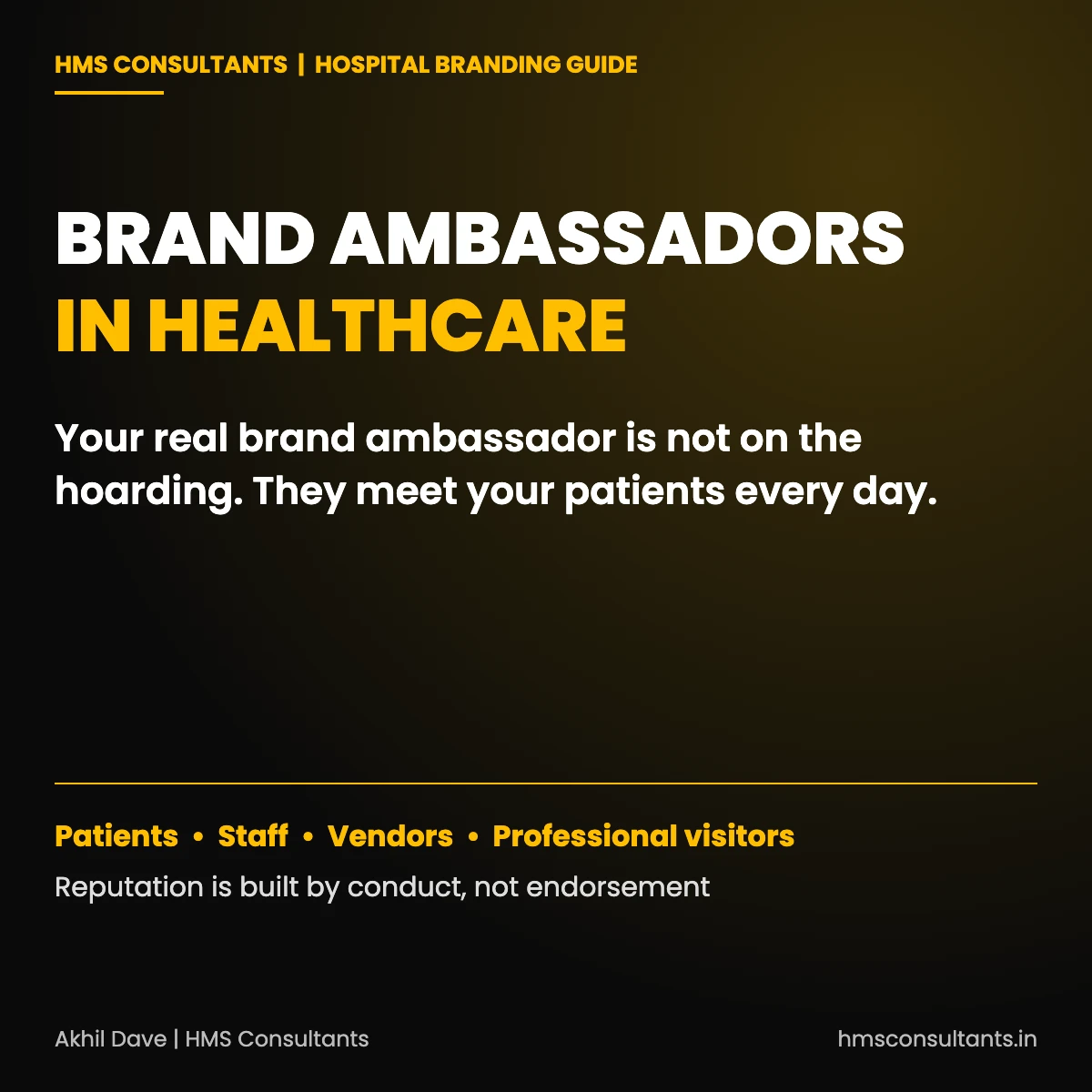
Quick answer: In healthcare, a brand ambassador is not a celebrity endorser. It is anyone whose conduct shapes how patients and families experience your organisation: patients and their families, your own staff, vendors and suppliers, and professional visitors such as medical representatives. Reputation is built by daily behaviour, clear processes and leadership attention, not by endorsement.
Published: 22 November 2026 · By Akhil Dave, Founder & Principal Consultant, HMS Consultants
Let me start with a question I ask every hospital leadership team: who are your brand ambassadors?
The first answers are usually “our patients” or a famous name on a hoarding. I understand why. But after 25+ years in healthcare marketing, working with corporate hospitals, individual doctors, clinics and healthcare associations, my view is simple: hospital branding begins with the organisation’s daily behaviour.
What people hear about you matters. What they experience when they interact with you matters just as much. In this guide I use “brand ambassador” in an editorial sense: the people whose conduct builds, or damages, your reputation. It does not mean a paid endorsement, a patient testimonial or any referral arrangement.
In consumer marketing, a brand ambassador is a familiar personality who gives a brand identity and attention. Hyundai’s association with Shah Rukh Khan (official campaign published July 2026), Tata Motors with Vicky Kaushal (announced 20 March 2025) and Hyundai with Pankaj Tripathi (Annual Report 2024–25) are dated examples, not a ranking.
Now ask the same question in healthcare. When you choose a doctor, or choose a hospital for a family member, whose voice do you listen to? Whose experience do you value? And once you reach the hospital, whose behaviour builds your trust?
That is why the healthcare answer is different. Here, a hospital brand ambassador is anyone whose daily conduct shapes the patient experience and the organisation’s reputation. It is a role defined by behaviour, not by a contract.
Ask a doctor or hospital owner who their brand ambassadors are, and the answer is often: “our patients, past patients and their families.” I agree that their experience is important.
Picture a family arriving for the first time. They are worried about treatment and unsure of the process. The doctor explains well, the nursing team listens carefully, and reception makes the next step clear. The family carries that memory home. This is what word of mouth in healthcare really is: an experience that someone chooses to talk about.
Two clear boundaries:
The next question is who delivers that experience.
Receptionists. Nursing staff. Duty doctors. Technicians. Housekeeping. Ward attendants. Security. Billing and discharge teams. Each of them handles a part of the patient’s experience, and many spend more hours with patients and families than leadership ever will.
Example 1. An elderly patient reaches the gate and cannot find registration. One security guard says, “Go inside.” Another explains the direction patiently and arranges assistance. Same building, same logo, same doctors. A different beginning for the patient.
Example 2. A family asks how long discharge will take. The team does not know the exact time. Instead of guessing, someone says, “I will check the status and update you,” and then does. That small act can matter a great deal for trust.
This is why doctor branding, clinic branding and hospital branding all need the whole team to understand how their role affects the patient. Clinical quality is essential. Respectful communication and reliable processes support it. For the identity side of the brand, see our hospital name, logo and tagline guide.
Leadership has questions to answer too. We expect empathy from staff. Are we giving them the support to do the job properly?
If information is unclear, giving the patient a clear answer is difficult. If responsibility is unclear, every department waits for another. Telling staff to “handle the patient well” is not direction. Tell them what careful listening looks like, what information to share, when to involve a senior, and who gives the update.
Good behaviour needs training, leadership and workable systems. Staff satisfaction matters, but do not assume happy staff automatically means satisfied patients. Listen to patient feedback, check the process, and improve where the gap is. For a deeper framework, read our guide on internal marketing strategy for hospitals, and see how enquiry handling shapes first impressions in patient enquiry handling.
This group gets the least space in hospital marketing discussions: consumables suppliers, maintenance teams, equipment service engineers, food and laundry vendors, IT support, and facility service providers.
They notice whether commitments are clear, whether communication is respectful, how problems are handled, and how agreed payment terms are managed. Not every vendor is local or from healthcare, but each has professional and community networks, and their experience with you can influence your organisational reputation.
Meeting your commitments responsibly says a lot on its own.
Medical representatives, equipment representatives and other professionals visit your clinic or hospital to share information about their products and services. How you treat them is part of your professional identity.
Say the doctor is busy with an emergency and the meeting cannot happen. Reception can respectfully say, “A meeting is not possible today. This is our appointment process. You can coordinate for another time.” Boundaries stay clear and dignity stays intact. You do not have to accept every request. You can show professional respect and still hold a clear boundary.
To be explicit: this is not about building a patient referral network with representatives, expecting them to bring patients, offering any referral-linked benefit or seeking promotional endorsement. It is about professional conduct. How your organisation treats the people it works with every day is part of its reputation.
Because the phrase “brand ambassador” sounds promotional, let me draw the line clearly. The NMC’s guidance on ethical advertising and public communication (6 October 2026) restricts, among other things, referral-linked benefits (clause 8.1(vii)), per-patient or per-lead payment to agencies (8.1(viii)) and testimonials by anyone (8.1(xi)).
Items above are our reading of public information as a marketing consultancy, not legal advice. Our NMC-safe personal branding guide and patient referrals guide go deeper.
You may ask, “Akhil, what is the connection with practice growth?” It shows up in the patient journey.
This is part of patient trust and reputation management. It is also honest to say that footfall, revenue and profitability are not decided by staff behaviour alone. Clinical quality, service availability, location, affordability, capacity and patient needs all play a role. And a good digital campaign creates an expectation that the organisation must then deliver responsibly. See how channels fit together in our IMC and omnichannel guide, and the role of media in hospital PR.
Here is the practical exercise. In your next team meeting, make a simple sheet.
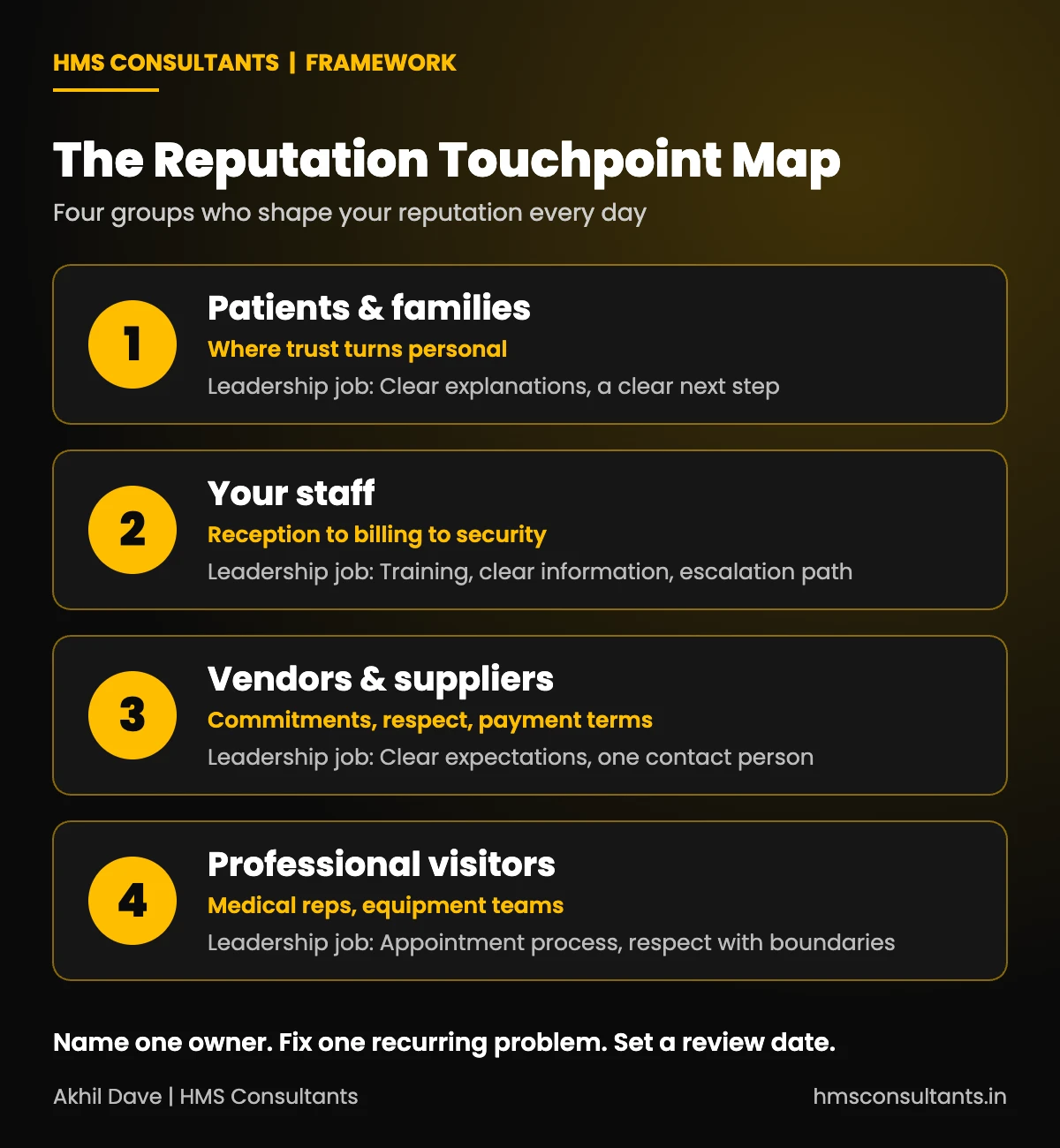
Start with one practical improvement: update reception’s information this week, role-play common patient questions in the next meeting, or name one contact person for vendor coordination. In the short term, fix one recurring problem. In the long term, build a process for training, staff feedback, grievance handling and service review.
And do not ask your team only for patient numbers. Ask: Where did patients face difficulty this week? Which concern keeps repeating? What action did we take on the last one? That is when internal marketing shows up in daily work.
My belief has always been the same: Knowing is Knowing. Doing is Doing™. If you want help mapping your hospital’s reputation touchpoints and building a practical, NMC-aware action plan, explore the Hospital Marketing Audit. You can book a free 30-minute call.
In healthcare, a brand ambassador is anyone whose daily conduct shapes how patients experience an organisation: patients and families, staff, vendors and suppliers, and professional visitors. It is an editorial idea about reputation, not a paid endorsement.
The people who interact with patients every day: receptionists, nurses, duty doctors, technicians, housekeeping, security, billing and discharge teams, supported by vendors and visitors who experience how the hospital conducts itself.
Doctors are bound by the NMC guidance on ethical advertising (6 October 2026), which restricts testimonials by anyone and other promotional practices. Hospitals should check the Clinical Establishments Act or applicable state law and seek qualified legal advice before any celebrity association.
Through training, clear information, respectful communication and workable processes, not through public endorsements or rewards for bringing patients. Staff conduct builds reputation internally; it should not become a promotional scheme.
Internal marketing connects your team with the organisation’s values, service standards and responsibilities, and supports them with training, information and escalation paths. See our internal marketing guide.
They experience how clearly you set expectations, communicate, solve problems and honour payment terms, and they talk within their own professional networks. Respectful, reliable conduct protects your reputation. Do not ask them to refer patients.
No. Staff satisfaction matters, but it is not an automatic result. Listen to patient feedback, check processes and fix gaps. Growth also depends on clinical quality, availability, location, affordability and capacity.
Map your reputation touchpoints: list who interacts with patients, note each group’s difficulty, name one owner and a review date, and fix one recurring problem this week.
Review how your hospital attracts, serves and retains patients.
Explore Marketing AuditA red, amber, green review of website, social and Google profile.
Explore the AuditDisclaimer: HMS Consultants is a healthcare marketing consultancy. We are not a law firm and this guide is not legal advice. References to the NMC notice of 6 October 2026 reflect our understanding of public information as of 22 November 2026. Celebrity and brand names are mentioned only as dated public examples, not as endorsements or rankings. Please consult a qualified healthcare lawyer before acting.
About the author: Akhil Dave is Founder & Principal Consultant of HMS Consultants, with 25+ years in healthcare marketing.
Work with HMS Consultants
Want your hospital or clinic to deliver a consistent patient experience? Start with a structured review of your marketing and reputation touchpoints.
Digital marketing for hospitals in India: channels, patient journey, plan, metrics and the latest NMC update on what hospitals can post.

Learn how healthcare businesses can capture the attention of Gen Z by embracing authenticity, personalization, sustainability, and inclusivity. This blog offers practical marketing strategies and insights tailored for healthcare...

A founder guide to healthtech and medtech go-to-market strategy in India: buyers, clinician champions, pilots, partners and a 90-day plan.
What is the difference between a healthcare marketing agency and consultancy? Learn how hospitals can choose between strategy, execution, or both based on their marketing needs.

Online reviews are today’s word-of-mouth in healthcare. Learn how hospitals can turn patient feedback into trust, transparency, and long-term reputation growth.

Discover effective marketing strategies for hospitals in the digital age. Learn how to engage patients, leverage digital tools, and build trust to enhance your hospital's brand and success.