



Is AI Ready to Be Your Healthcare Marketing Assistant?
AI can automate reminders, draft content, and speed up SEO but it can’t replace human empathy, strategy, and cultural understanding. The future of healthcare marketing is AI + Human...
Many hospitals run campaigns without deciding which services deserve focus. As a result, marketing becomes too broad. One week the hospital promotes one department, the next week another, and then a general awareness post follows. This creates activity, but not always direction.
Service prioritisation helps the hospital focus its effort where it can make the most meaningful impact.
It helps answer:
Without this clarity, hospital marketing may continue, but the results may remain unclear.
The first factor to study is patient demand. Hospitals should not promote a service only because it exists. They should understand whether patients are searching for it, asking about it, or showing real need for it.
Patient demand can be understood through enquiry patterns, appointment data, common patient questions, Google searches, local health concerns, seasonal illness trends, and competitor visibility.
For example, if many patients are asking about knee pain, pregnancy care, diabetes management, fever treatment, diagnostic packages, or cardiac check-ups, those areas may need stronger communication.
This does not mean only high-demand services should be promoted. But demand helps the hospital know where patient interest already exists. Marketing can then improve visibility, explain the service better, and guide patients more clearly.
A hospital marketing strategy should always connect service promotion with real patient behaviour.
A common mistake in hospital marketing is promoting a service before the department is ready to handle the response.
If marketing brings enquiries but the doctor is not available, the front desk is not informed, the appointment process is unclear, or follow-up is weak, the campaign may damage trust instead of supporting growth.
Before promoting any service, the hospital should check:
Hospital service promotion should not create demand that the hospital cannot manage. Good marketing works only when the patient journey behind it is prepared.
Many hospitals have strong services that patients do not know about. These may be clinically valuable, but they remain underutilised because they are not clearly visible online or offline.
Sometimes the service exists on the hospital premises, but it is missing from the website. Sometimes it is not mentioned properly on Google Business Profile. Sometimes the doctor is available, but patients do not know that the department offers that care.
Underused services can be identified by checking:
These services may not need paid ads immediately. They may first need clear service pages, patient education content, doctor-led videos, Google updates, and better internal communication.
In hospital marketing, visibility should begin with clarity.
Hospital marketing must remain ethical and patient-centred, but hospitals also need to understand which services support long-term sustainability. Some services may have higher demand, stronger repeat value, better department capacity, or greater positioning importance for the hospital.
This is where hospital growth strategy becomes important.
Hospitals should look at:
For example, if a hospital has strong orthopaedic expertise but patients are choosing competitors for joint pain or fracture care, that department may need focused promotion. If diagnostics are available but underused, preventive health packages may need better communication.
Marketing should support services where the hospital has genuine capability, not only where it wants more visibility.
A hospital should not copy competitor marketing, but it should understand what competitors are doing. Local competition often shows which services are being pushed heavily and where gaps may exist.
Hospitals should observe:
If many hospitals are promoting the same service, your hospital needs a clearer positioning angle. If competitors are weak in an area where your hospital has strength, that service may become a strong marketing opportunity.
Hospital service promotion should be based on differentiation, not imitation.
Some hospital services perform better when promoted at the right time. Timing can depend on seasons, awareness months, local health patterns, school calendars, corporate cycles, or disease trends.
For example, fever and infection care may need stronger communication during monsoon. Respiratory care may become more relevant during pollution season. Preventive health packages may work well around health awareness campaigns. School health check-ups may be planned before academic sessions.
Hospitals should build a service-wise marketing calendar instead of deciding campaigns at the last moment.
This helps plan:
When timing is planned, hospital marketing becomes more consistent and less random.
Not every service needs the same marketing channel. Some services need search visibility. Some need patient education. Some need doctor credibility. Some need local awareness. Some need Google Business Profile optimization. Some need paid campaigns.
For example, high-search services may need SEO and Google visibility. Complex services may need blogs and educational videos. Doctor-led services may need profile strengthening and credibility-building content. Preventive services may need awareness campaigns. Competitive services may need stronger service positioning.
The better question is not, “Should we run ads?”
The better question is, “What does this service need before patients respond?”
This is where hospital marketing becomes strategic. The channel should come after the service priority is clear.
Hospital marketing becomes stronger when hospitals stop promoting everything equally and start prioritising services strategically.
Every service does not need the same campaign, message, platform, or budget. Some services need awareness. Some need search visibility. Some need doctor credibility. Some need better patient education. Some need operational readiness before promotion.
A clear hospital marketing strategy helps hospitals decide which services to promote first based on patient demand, department readiness, competition, timing, and growth potential.
For hospitals that want sustainable growth, marketing should not begin with random activity.
It should begin with the right service priority.
Hospital marketing is the process of promoting a hospital’s services, departments, doctors, and patient care in a planned way. In this blog context, it means deciding which services should be promoted first based on patient demand, department readiness, competition, and growth potential.
The concept of hospital marketing is to connect the right hospital services with the right patients through clear communication, visibility, service positioning, and trust-building. It is not about promoting everything equally, but choosing services strategically and marketing them with the right message.
The 4 P’s of healthcare marketing are product, price, place, and promotion. For hospitals, this means the service being offered, the cost or value of care, the location or access point, and how the service is communicated to patients.
The 5 main hospital marketing strategies are service prioritisation, patient demand analysis, department readiness check, service positioning, and choosing the right marketing route. These help hospitals avoid random promotion and focus on services that can support patient trust and sustainable growth.
Share your details below and we will connect with you to discuss your growth strategy.
AI can automate reminders, draft content, and speed up SEO but it can’t replace human empathy, strategy, and cultural understanding. The future of healthcare marketing is AI + Human...
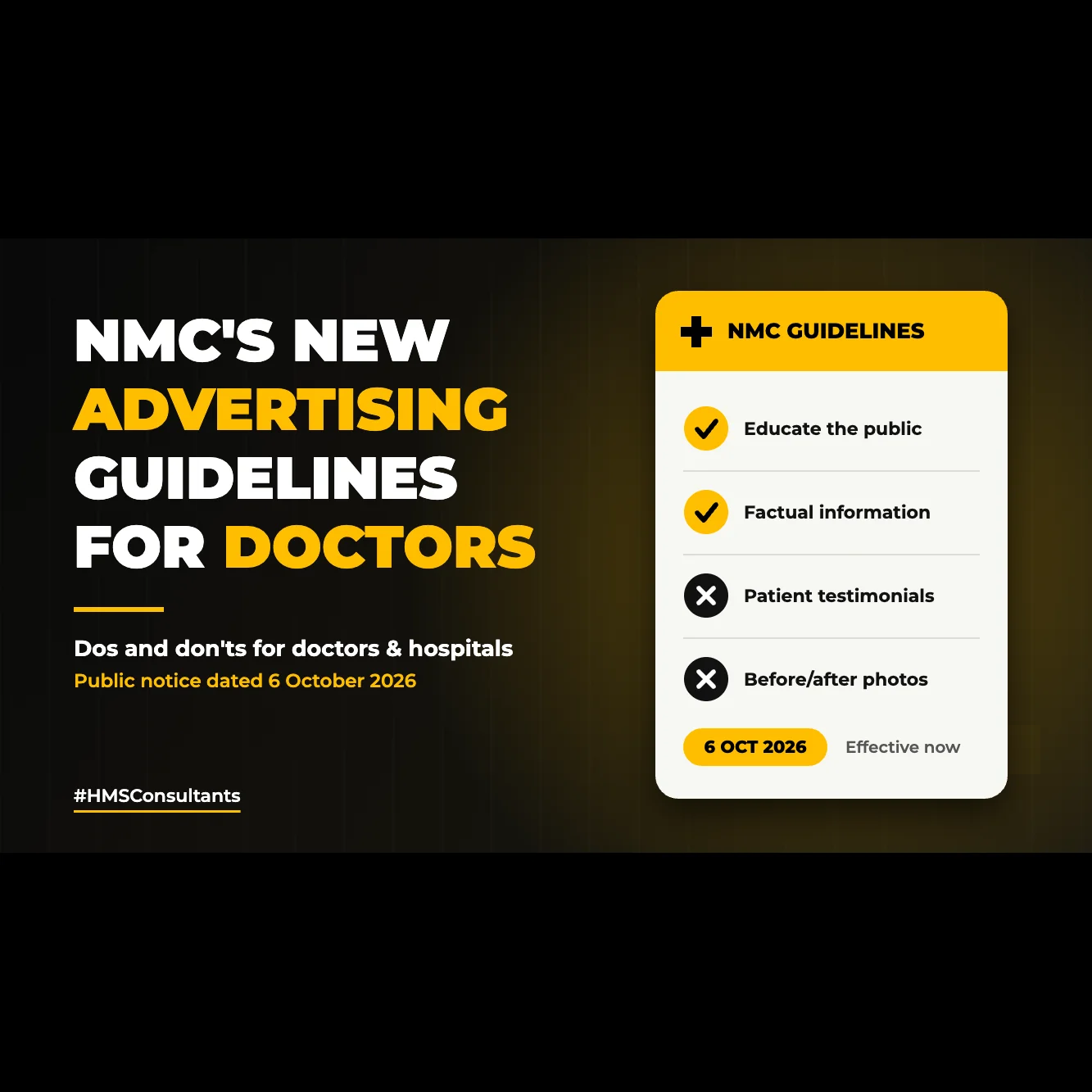
NMC Advertising Guidelines 2026: A Complete Compliance Guide for Doctors and Hospitals Author Akhil Dave Published on October 9, 2026 Share This NMC advertising guidelines now apply to every...
Health care marketing goes beyond promotion and advertising. Learn how patient trust, ethical communication, and strategic healthcare marketing help patients make informed decisions and support sustainable healthcare business growth.
Marketing strategy of hospital often looks strong on paper but fails in execution. This blog explores how gaps in patient communication, experience, and internal systems affect conversions and real...
Many hospitals in India grow around a single doctor, but long-term success requires shifting to system-led growth. This ensures scalable, reliable care and sustainable hospital growth.
Discover how Indian clinics and hospitals can grow in 2025 using local marketing language, culture, trust, and digital tools to boost patient footfall.