

10 Signs Your Hospital Needs a Marketing Audit (and What to Do First)

Author
Published on
Share This

Your hospital likely needs a marketing audit if you spend on marketing but cannot say which channel brings patients, enquiries are not turning into appointments, or your posts and ads may conflict with NMC rules. A hospital marketing audit finds where money leaks, what to fix first and how much to spend where, before you spend more.

Quick answer: do the audit first, then the plan, then the spend. A fee of ₹25,000 to ₹40,000 is small next to a year of marketing money that cannot be traced to a single patient.

1. Ten Signs Your Hospital Needs a Marketing Audit

  1. You cannot say which channel brings patients. If the answer to “where did this patient come from?” is a guess, you cannot tell what to keep and what to stop. This is the most common sign and the most expensive.
  2. Enquiries are rising, appointments are not. The leak is often after the click: calls not picked up, WhatsApp replies that take hours, no follow-up on missed enquiries. More marketing will not fix this. Our post on poor enquiry handling in hospitals explains why.
  3. Your website gets visits but few calls or bookings. Slow pages, buried phone numbers, unclear service pages and forms that are hard to use on a phone quietly waste every rupee spent on traffic. See how a hospital website converts patients.
  4. Your Google Business Profile is weak. Patients searching “hospital near me” or a specialty in your city decide in seconds. Wrong categories, missing services, no photos or unanswered questions cost you calls and directions. Start with the local SEO checklist.
  5. Reports show likes, reach and impressions, not patients. Vanity numbers keep a retainer going. Ask for enquiries, appointments and admissions by source. If your vendor cannot report these, that is a sign in itself.
  6. Everything depends on one source. One referring doctor, one platform, one agency or one ad account. If it stops, enquiries stop. An audit maps the risk and builds a second and third source.
  7. Your posts, ads or website may conflict with NMC rules. Testimonials, before-and-after images, offers, success-rate claims or “best” and “No.1” language can create regulatory risk under the NMC advertising guidelines. A marketing audit flags these early.
  8. You do not track the source of enquiries. Calls, WhatsApp, forms and walk-ins are not recorded by source. Tracking tags may also fire on pages that reveal a health condition without clear consent, which is a data protection concern.
  9. Some departments are overbooked while others sit empty. Marketing effort follows habit or the loudest doctor, not capacity and margin. An audit matches effort to the service lines that need patients and can serve them well.
  10. Your budget comes from last year or from a competitor. Without a baseline, a plan and a target, budgets drift. This sign is also common when a new leader joins, a new department opens or an agency changes.

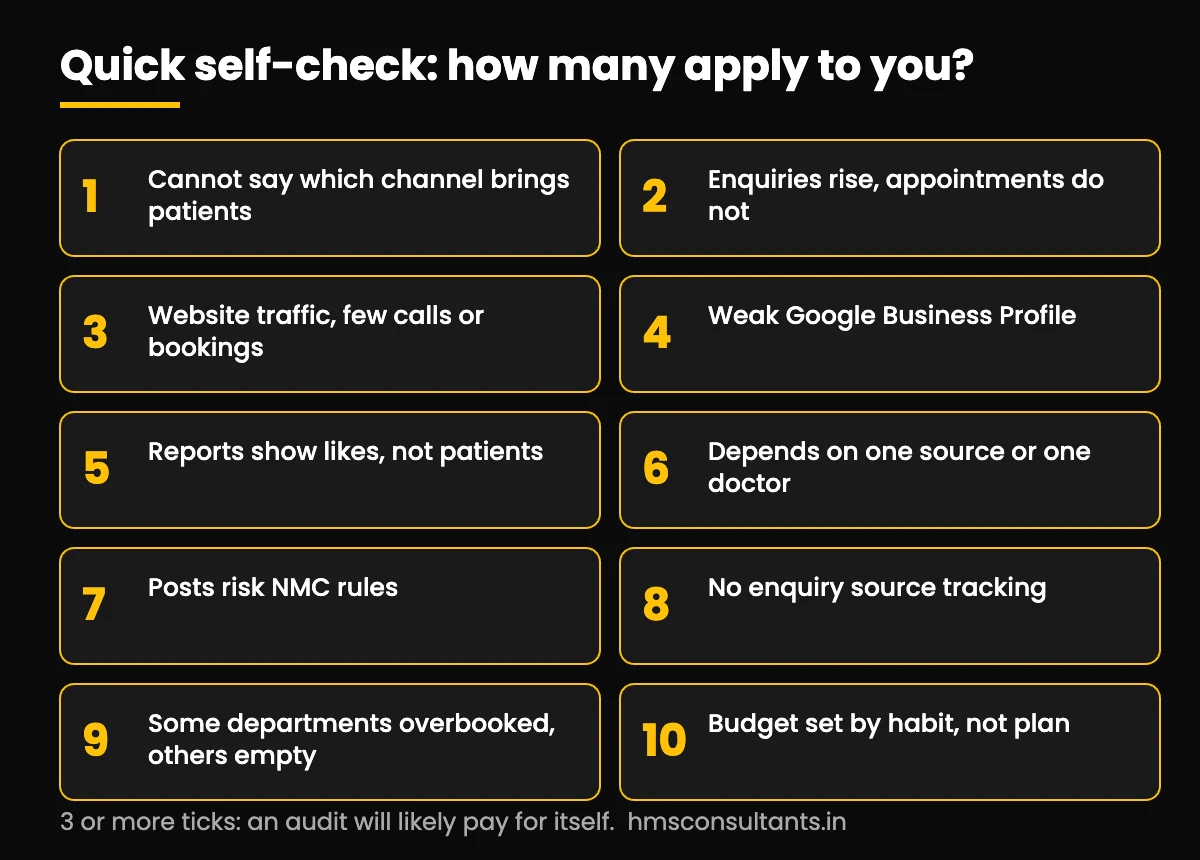
If three or more of these sound familiar, an audit will probably pay for itself. Use the self-check below.

Self-check list of 10 signs a hospital needs a marketing audit

2. What a Marketing Audit Covers

A useful audit answers the questions owners ask us most: what is working, what is wasted, what to do first and how much to put where. Ours looks at:

  • Baseline numbers: enquiries, appointments and admissions by source, and cost per enquiry.
  • Channels: Google Business Profile, website, search ads, social, video, directories and referrals.
  • Enquiry handling: response time, WhatsApp and call follow-up, missed-enquiry recovery.
  • Tracking and reporting: what you can and cannot measure today.
  • Compliance flags: NMC advertising rules, consumer law and data protection practices.
  • Output: a prioritised 90-day action plan and a suggested budget split.

Details are on the hospital marketing audit page, and the hospital marketing audit checklist shows what we look at.

3. When Should You Do an Audit?

  • Before you hire or change an agency.
  • Before you increase your marketing budget.
  • At the start of the financial year, to set a plan and baseline.
  • After a drop in enquiries or OPD footfall.
  • Before opening a new department, unit or hospital.
  • After the NMC notice of 6 October 2026, to check your pages and posts.
  • If you have not reviewed your marketing in 12 months.

4. Which Channel First? A Sensible Order

  1. Enquiry handling and tracking. Fix the leak before adding more water.
  2. Google Business Profile and local search. The highest-intent patients look here.
  3. Website conversion. Clear service pages, fast load, visible call and WhatsApp options.
  4. Google Search ads for services where patients already search and you have capacity.
  5. Educational content and video in the doctor’s or hospital’s name, built for trust over time.
  6. Follow-up, referral and community work such as camps and talks that are educational.

Social media is useful, but it rarely rescues a funnel that leaks at the first three steps.

5. How Much Budget in Which Channel?

There is no honest one-size answer. The right total depends on your growth goal, capacity and the margin of each service line. As a planning heuristic to test, not an industry benchmark, here is how we often start a conversation:

AreaStarting share of budget
Enquiry handling, tracking and reportingAbout 10%
Google Business Profile, local SEO and website conversion25% to 30%
Google Search ads for high-intent services25% to 30%
Educational content, video and social15% to 20%
Follow-up, referral and community outreachAbout 10%
Test reserve for what the data supports5% to 10%

The audit replaces this heuristic with your own numbers. Reduce spend on channels with no tracked enquiries, and scale what shows enquiries turning into appointments. For the bigger picture, read our hospital marketing strategy guide and 12-month template.

6. NMC, DPDP and Other Rules to Keep in View

Marketing for hospitals and doctors in India sits inside several rules. This is a marketing view, not legal advice.

  • NMC ethical advertising guidelines (public notice dated 6 October 2026): avoid patient testimonials, before-and-after images, success-rate or outcome claims, unverifiable superlatives, offers and inducements, and fake or purchased reviews. Doctors and clinical establishments should disclose name, qualifications and registration number on electronic posts. AI-generated promotional content has its own limits and labelling needs.
  • Agency payment structures: the guidelines bar structures that link payment to procuring or referring individual patients. Avoid pay-per-lead or pay-per-patient arrangements, and remember the doctor or hospital stays responsible for content an agency or influencer publishes.
  • Consumer law: the Consumer Protection Act, 2019 and the CCPA guidelines on misleading advertisements apply to claims and endorsements.
  • Drugs and Magic Remedies Act, 1954: be careful with claims about treating listed conditions.
  • DPDP Act, 2023 and DPDP Rules, 2025: the Rules were notified in November 2025 with phased commencement. Core duties such as notice, consent, safeguards and breach reporting are expected to apply from about May 2027, so build clear consent on forms, WhatsApp and tracking now. Confirm current dates before relying on them.

For a full review of your website and social pages, see our NMC compliance audit and the guide to NMC advertising guidelines.

7. Audit Fee vs Wasted Spend

HMS lists its audit prices openly: a focused audit at ₹25,000, a full 360° audit at ₹40,000, and an audit plus 3-month strategy sprint at ₹75,000, all excluding GST (see pricing). Compare that with the money that quietly leaks.

Illustration, not a promise: suppose your hospital spends ₹1,00,000 a month on marketing, and a third of it goes to activity that produces no traceable enquiry. That is ₹33,000 a month, or about ₹4 lakh a year. A ₹40,000 audit that identifies and redirects even part of it pays back quickly. Add the risk of a compliance problem or a leaking enquiry desk, and the audit is the cheapest decision in your marketing year. We cannot guarantee patient numbers, but we can show you where the money goes. See also what hospital marketing consultants charge in India.

8. What to Do This Week

  1. Note your enquiries, appointments and admissions for the last three months, even roughly.
  2. List every channel and vendor you pay, with monthly cost.
  3. Call your own hospital number and message your WhatsApp as a patient would. Time the response.
  4. Search your top three services plus your city on Google and see what appears.
  5. Check your site and posts against the NMC points above.
  6. Book a call and bring this list. We will tell you if an audit is the right next step.

Frequently Asked Questions

The usual causes are untracked channels, slow enquiry follow-up, a website that does not convert, a weak Google Business Profile and spreading budget thinly. An audit identifies which of these applies to you.

Hospital Marketing Strategy

is something we strongly believe in, which means ‘Knowledge without application is the same as having no knowledge at all

Akhil Dave

Principle Consultant

Ready to take your Personal Brand to the next level?

Share your details below and we will connect with you to discuss your growth strategy.