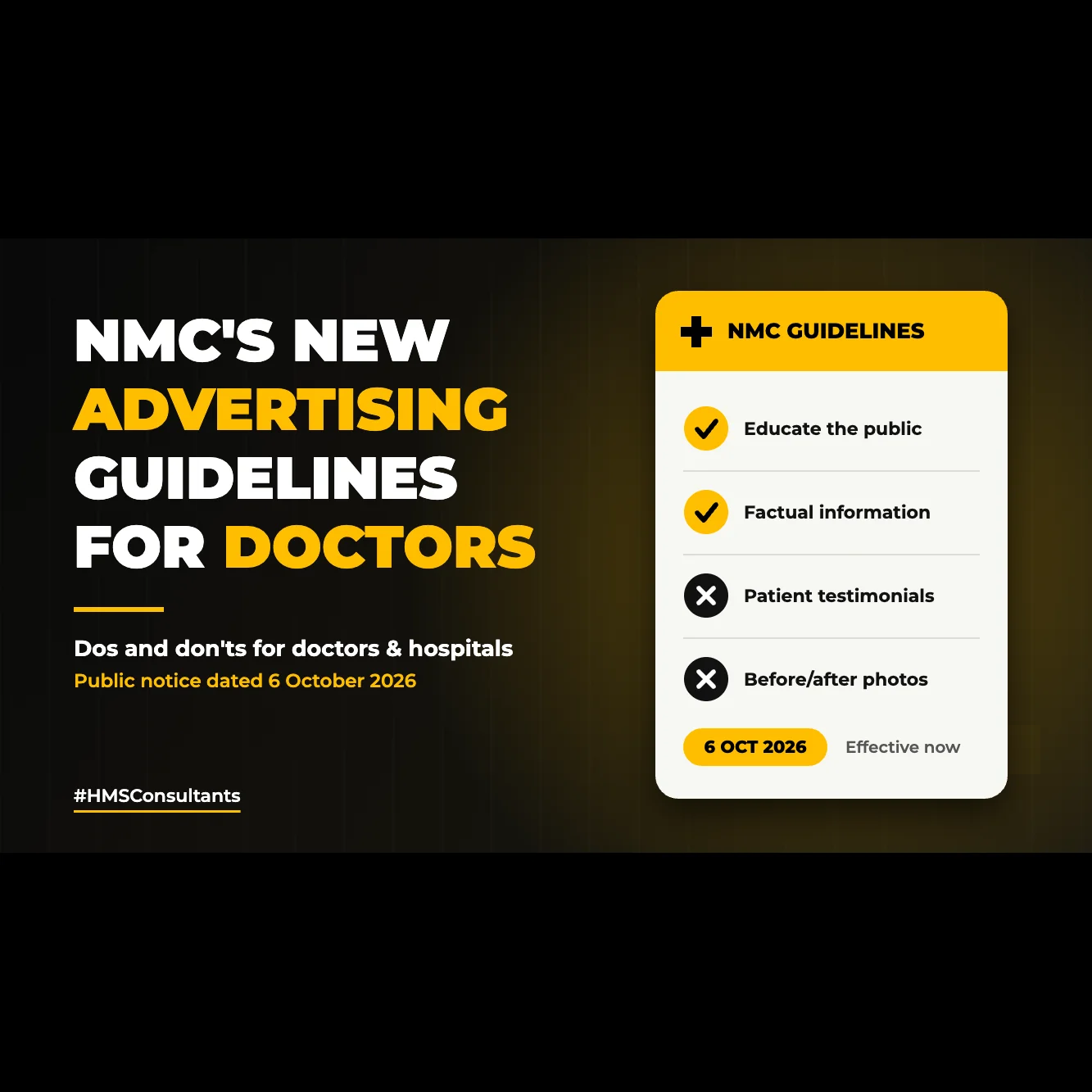
NMC advertising guidelines now apply to every doctor, clinic and hospital in India. The National Medical Commission (NMC) has issued its Guidelines on Ethical Advertising and Public Communication through a public notice dated 6 October 2026 (No. R-13014/01/2024-Ethics). They apply from publication, with no grace period stated, and were framed in connection with a Supreme Court writ petition (WP(C) 1160/2023). One principle has not changed: a doctor still cannot promote their own practice. What has changed is clarity. The 2002 Regulations spoke in principles; these NMC guidelines for doctors and hospitals name the channels (social media, WhatsApp, podcasts, influencers, online platforms, AI) and list specific prohibitions.
What the NMC advertising guidelines change: five things every doctor should know today
Digital promotion is advertising. Sponsored posts, influencer content and AI-assisted promotion are all covered (clause 3.2).
Testimonials, before-and-after images, success stories, and claims such as “best” or “100% success” are barred for promotion (clause 8.1).
Patient consent does not make a prohibited practice acceptable (clause 6.2).
Using an agency or influencer does not shift responsibility away from you (clause 4.4).
Penalties are graded, from a warning to removal from the medical register for 1 to 3 years (clause 10.1).
Who is covered, and the legal footing
The guidelines apply to Registered Medical Practitioners (RMPs) and to hospitals and medical institutions. They operate alongside the NMC Act, 2019 and the Indian Medical Council (Professional Conduct, Etiquette and Ethics) Regulations, 2002, and do not override either (clauses 2.1 and 4.2).
Doctors (RMPs): read with the 2002 Regulations and the NMC Act. Where the two cannot be reconciled, the statute prevails.
Hospitals and clinics: read with the Clinical Establishments Act or the relevant state Act, which prevails in a conflict (clause 4.3).
Healthcare platforms hosting doctors: must follow the same norms, must not offer paid ranking of doctors, and must keep listings transparent (clause 9.4).
Agencies and influencers: hiring them does not absolve you of content you authorised, commissioned or knowingly permitted (clause 4.4).
A point of confusion worth clearing: the NMC’s 2023 professional conduct regulations were put on hold by a gazette notification dated 23 August 2023. The 2002 Regulations remain the operative code, and these new guidelines are read with them.
What you can still do
Education and factual information remain permitted. The test is whether the content informs the public or promotes you. Doctors (clauses 5.1 and 8.2)
Announce starting practice, a change of practice type or address, temporary absence, resumption or succession of practice, and your charges.
Publish research case studies in reputed journals.
Give public health talks on TV, radio or electronic media in your own name and designation, without promoting an employer.
Share patient health-education pamphlets free of guarantees, superiority claims or misleading content.
Post greetings on national or professional days, without professional promotion.
Join awareness campaigns and educational content that do not promote your practice, solicit patients or earn money from the promotion.
Maintain a factual doctor directory with names, recognised qualifications, specialties, registration details and availability. The guidelines treat this as patient information, distinct from paid promotion.
Use hoardings for factual infrastructure information only.
What is now prohibited
Clause 8.1 sets out twelve restrictions for doctors, and clause 9.2 adds one on photographs. Hospitals have their own list in clause 8.3.
Practice
What the guidelines say
Clause
Demand creation and fear
No ads that create unnecessary demand for procedures or diagnostics, or use fear-based marketing
8.1(i)
Solicitation
No direct or indirect solicitation or self-promotion; no third-party marketing; no lending your name, image or voice for promotion
8.1(ii)
Success claims
No personal success rates or patient numbers; no “guaranteed cure” or “100% success”
8.1(iii)
Product endorsement
No endorsing drugs, devices or health products using your name, image or professional status
8.1(iv)
Case publicity
No before-and-after photos, surgical results, celebrity patients or success stories; scientific or educational use with anonymised consent is the exception
8.1(v)
Unrealistic expectations
No concealed risks, unrealistic promises or unproven therapies
8.1(vi)
Referral payments
No commissions, referral fees or lead-generation payments tied to referrals
8.1(vii)
Pay-per-patient contracts
Agency, influencer or platform contracts must not pay per patient procured or referred
8.1(viii)
Comparative claims
“Best”, “No. 1” and “leading” only if objectively verifiable; awards and rankings must disclose methodology, date and awarding body
8.1(ix)
Offers and inducements
No discounts, contests, coupons, gifts, cashbacks, referral benefits or free procedures that encourage unnecessary care; fees must be stated factually
8.1(x)
Testimonials and endorsements
No testimonials from celebrities, influencers, patients, staff or others; no indirect advertising through intermediaries; disclose material commercial ties
8.1(xi)
Fake engagement
No fake followers, likes, reviews, ratings or views; no manipulation of search or algorithms
8.1(xii)
Doctor photographs
No photograph that works as self-advertisement; self-photos on letterheads and signboards are governed by 2002 Regulations 6.1.1 and 6.1.2
9.2
For hospitals (clause 8.3): no patient solicitation or inducement, no superiority claims, no cure or outcome guarantees, no exaggerated claims, and no promotion of individual doctors. Factual information stays factual, but the form or frequency of communication cannot turn it into promotion.
Social media, reviews, SEO, influencers and AI
Online, one test decides whether the rules apply: does the content have a promotional character? If it does, it is advertising, whatever the medium (clause 3.2).
Mandatory disclosure: Electronic posts must show the doctor’s name, qualifications, registration status and State or National Medical Register number. Establishments must disclose the same details for their doctors (clause 3.2, Explanations III and IV).
Social media: Educational content is fine. Self-promotion and soliciting patients are not (8.1(ii)). Treat posts published before 6 October as in scope and audit them.
Reviews and testimonials: Testimonials are prohibited (8.1(xi)), and fake, paid or manipulated reviews are barred (clause 3.2, Explanation V; 8.1(xii)). The text does not clearly address a patient’s own unsolicited review on a third-party platform. Until NMC clarifies, our advice is not to solicit, reproduce or showcase patient reviews in your promotion.
SEO and search: Manipulating search rankings or algorithms to create a false impression of standing is prohibited (8.1(xii)). Factual website content on services, facilities, qualifications and fees is permitted. Superlatives are not. Platforms may not sell paid ranking of doctors (9.4).
Influencers and agencies: No payment may be tied to patients procured or referred (8.1(vii) and (viii)). Influencer testimonials are barred, material commercial relationships must be disclosed (8.1(xi)), and you stay responsible for what they publish (4.4).
Artificial intelligence (clause 7.2): AI-generated promotional campaigns for commercial interest are prohibited. Permitted AI content must carry a source mark stating it is AI-generated. AI may not be used to create or alter patient images, testimonials, voices or outcomes, or to make misleading claims about diagnosis, treatment or qualifications. Government public-interest campaigns are exempt (7.3).
Live surgery: Broadcasts must follow NMC’s live-surgery framework on safety, consent, privacy and commercialisation (7.5).
Some terms, such as the “commercial character” of AI content and what counts as “material” AI alteration, are not yet defined, as MediaNama’s analysis notes. Expect NMC clarifications and SOPs (clause 12).
Patient data, consent and the DPDP Act
Patient information can appear in communication only where the law permits it and consent and safeguards are in place (clause 6.1). Even then, consent does not rescue a practice the guidelines otherwise prohibit, such as a testimonial or a before-and-after image (6.2). What valid consent looks like (clause 6.3): specific, informed, voluntary, documented and verifiable, and in a form that meets applicable privacy law. Identifiers (clauses 6.4 and 7.4): names, faces, birthmarks and identification marks must be cropped, blurred or blacked out. Identifiable patient data must not be shared. DPDP Act link (clause 7.6): digital use of personal data must comply with the IT Act, 2000 and the Digital Personal Data Protection Act, 2023 with its 2025 Rules, as applicable and in force. The timing matters:
DPDP Rules 2025 provision
Commencement
Board framework (Rules 1, 2 and 17 to 21)
Immediate on notification in November 2025
Consent Manager registration (Rule 4)
12 months, around November 2026
Core fiduciary duties: notice, security safeguards, breach reporting, retention (Rules 3, 5 to 16, 22 and 23)
18 months, around May 2027
Source for the phased timeline: Storyboard18’s report on the final DPDP Rules. Confirm exact dates against the Gazette notification. So the DPDP duties on notice, security and breach reporting are not yet fully in force, but the NMC consent standard already applies. Build to the stricter of the two now. Practical steps: a separate marketing-use consent form (distinct from treatment consent), a written log of who approved each use, and a rule that no patient data goes into any AI tool without safeguards. For medical practices, the DPDP Rules also include carve-outs for healthcare providers processing children’s data, subject to conditions, so check which apply to you.
Telemedicine, consumer law and drug advertising: the other rules that apply
Your State Medical Council or national registration number must appear on prescriptions, websites, electronic communications such as WhatsApp or email, and receipts (section 3.2.5).
You may not solicit patients for telemedicine through advertisements or inducements (section 3.7.1.4).
Patient confidentiality, the IT Act and data protection law apply, and misuse of patient images or data is prohibited (sections 3.7.1.1 to 3.7.1.4).
Platforms must list each doctor’s name, qualifications, registration number and contact details (section 5.2). AI-based platforms cannot counsel patients or prescribe (section 5.4).
2. Consumer Protection Act, 2019 and the CCPA Guidelines, 2022. The CCPA guidelines on misleading advertisements and endorsements were notified on 9 June 2022. Advertisements must be truthful, disclaimers cannot contradict the main claim, and endorsers must act with due diligence and disclose material connections. Under Section 21, penalties reach up to Rs 10 lakh (up to Rs 50 lakh for later violations), and endorsers can be barred for up to one year (three years for repeat violations). Section 89 provides up to two years’ imprisonment for causing prejudicial false advertisements. Medical services fall within consumer law following the Supreme Court’s 1995 ruling in Indian Medical Association v. V.P. Shantha. The practical implication: a claim you publish can be cited in a consumer complaint as a promise you made. Keep every claim you publish verifiable. 3. Drugs and Magic Remedies (Objectionable Advertisements) Act, 1954. Section 3 bars advertisements suggesting a drug can diagnose, treat or prevent conditions in the Act’s Schedule of 54 conditions, including cancer, diabetes, heart disease, epilepsy and cataract. A first conviction can bring up to six months’ imprisonment, a fine, or both. Keep any medicine-related content clear of cure or prevention claims for these conditions. 4. Supreme Court self-declaration directions (2024). In Indian Medical Association v. Union of India, the Court required advertisers and advertising agencies to file a Self-Declaration Certificate before publishing an advertisement, through the Broadcast Seva portal for TV and radio and the Press Council of India portal for print and digital. If your hospital runs paid advertising through an agency, confirm with them how this applies.
Penalties and appeals
State Medical Councils (SMCs) enforce the guidelines against doctors through graded action (clause 10.1):
Violation
Action
First
Warning and mandatory ethics training
Second
Censure and a monetary penalty
Third
Suspension of registration for 3 to 6 months
Serious (misleading cure claims, patient inducement, digital mass solicitation)
Suspension for 6 to 12 months
Repeated
Removal from the register for 1 to 3 years
Process safeguards: a show-cause notice and an opportunity to respond must come first (10.2), and the SMC must issue a reasoned order (10.3). Appeals (clause 11): a first appeal lies to the Ethics and Medical Registration Board of NMC within 60 days under section 30(3) of the NMC Act, 2019. A second appeal lies within 60 days of the first decision under section 30(4). Hospitals are dealt with under the Clinical Establishments Act or the applicable state Act. Doctors who personally authorised or endorsed prohibited content may also be examined separately (11.5).
A 10-step compliance checklist for doctors and hospitals
The guidelines apply from publication, so start with an audit this week.
Inventory every channel that carries your name: website, Google Business Profile, Instagram, Facebook, YouTube, LinkedIn, WhatsApp broadcasts, listing platforms and hospital pages.
Add disclosures. Name, qualifications, registration status and registration number on every electronic post, website page and prescription.
Remove testimonials and review screenshots, before-and-after images, success stories and celebrity-patient mentions.
Remove claims you cannot prove: “best”, “No. 1”, “100% success”, “guaranteed”, “painless”. Keep award or ranking claims only with the methodology, date and awarding body stated.
Withdraw inducements: discounts, coupons, cashbacks, referral benefits and free-procedure offers. State fees factually.
Review every agency, influencer and platform contract. No payment per patient or per lead, and no referral commissions.
Stop AI-generated promotion. Label any permitted AI content, and never feed patient data into AI tools without safeguards.
Fix patient consent. Use a separate, documented consent for any educational use of patient material, and mask every identifier.
Align telemedicine communication: registration number on electronic communication, and no solicitation or inducement.
Keep an approval log recording who wrote, approved and published each item, and brief your front-desk and social-media teams.
Compliance is a strategy question, not only a legal one
The guidelines do not end your ability to build trust with patients. They move it to the right place: accurate information, credible education and a clear professional identity, instead of claims and inducements. Diagnosis before promotion. Strategy before execution. Patient trust before visibility. If you would like a structured review of your website, Google presence and social channels against these guidelines, HMS Consultants offers a Healthcare Marketing Audit. Write to akhil@hmsconsultants.in or visit hmsconsultants.in. Disclaimer: HMS Consultants is a healthcare marketing consultancy. We are not medico-legal experts or a law firm. This article reflects our understanding of the NMC public notice dated 6 October 2026, based on detailed research of public sources. It is for general information only and is not legal advice. Guidelines may be clarified or amended, so please read the official notice and consult a qualified healthcare lawyer before acting.About the author:Akhil Dave is Founder & Principal Consultant of HMS Consultants, with 25+ years in healthcare marketing. Sources
Hospital marketing techniques are evolving rapidly in 2026. This blog explains how search visibility, Google reviews, patient trust, educational content, and digital systems influence long-term hospital growth.
Patient experience is the hidden force behind hospital marketing performance. When experience and marketing align, trust grows, conversions stabilise, and long-term hospital growth becomes predictable.
Patients in 2025 begin their hospital search on Google, comparing reviews, websites and doctor profiles. Hospitals without digital presence lose trust and new patients silently.
Hospital branding in 2025 demands more than just a logo it requires trust, digital presence, patient storytelling, and compliance with NMC & data laws.
Explore the right approach to healthcare marketing during India's festival season. Learn how hospitals and clinics can promote wellness while respecting the festive spirit, keeping brand recall high without...
Many hospitals hire marketers, but few train them. Learn why structured marketing team development is the missing link in hospital growth and how HMS helps.