Last updated: 19 October 2026 · By Akhil Dave, Founder & Principal Consultant, HMS Consultants
An integrated healthcare marketing strategy connects every marketing activity, from Google and YouTube to the website, WhatsApp and the front desk, into one patient journey. Most hospitals and clinics in India already post, advertise and attend events. Very few connect them. That gap is why many spend more every year and still cannot predict how many enquiries next month will bring.
Quick answer: Random activity creates noise; an integrated system creates results. Build the system in this order: positioning, audience, message, channel, enquiry handling, follow-up and measurement. Fix the journey after the click before you spend more on ads, and keep every message accurate, educational and within the NMC advertising guidelines.
Key takeaways
Patients research online long before they call, so your reputation starts before the enquiry.
Most “marketing problems” are system problems: unanswered calls, slow WhatsApp replies, wrong timings, no tracking.
Search captures intent, video builds understanding, your website builds credibility, and the front desk converts the enquiry.
If you cannot say which activity produced which patient, you are running on assumptions.
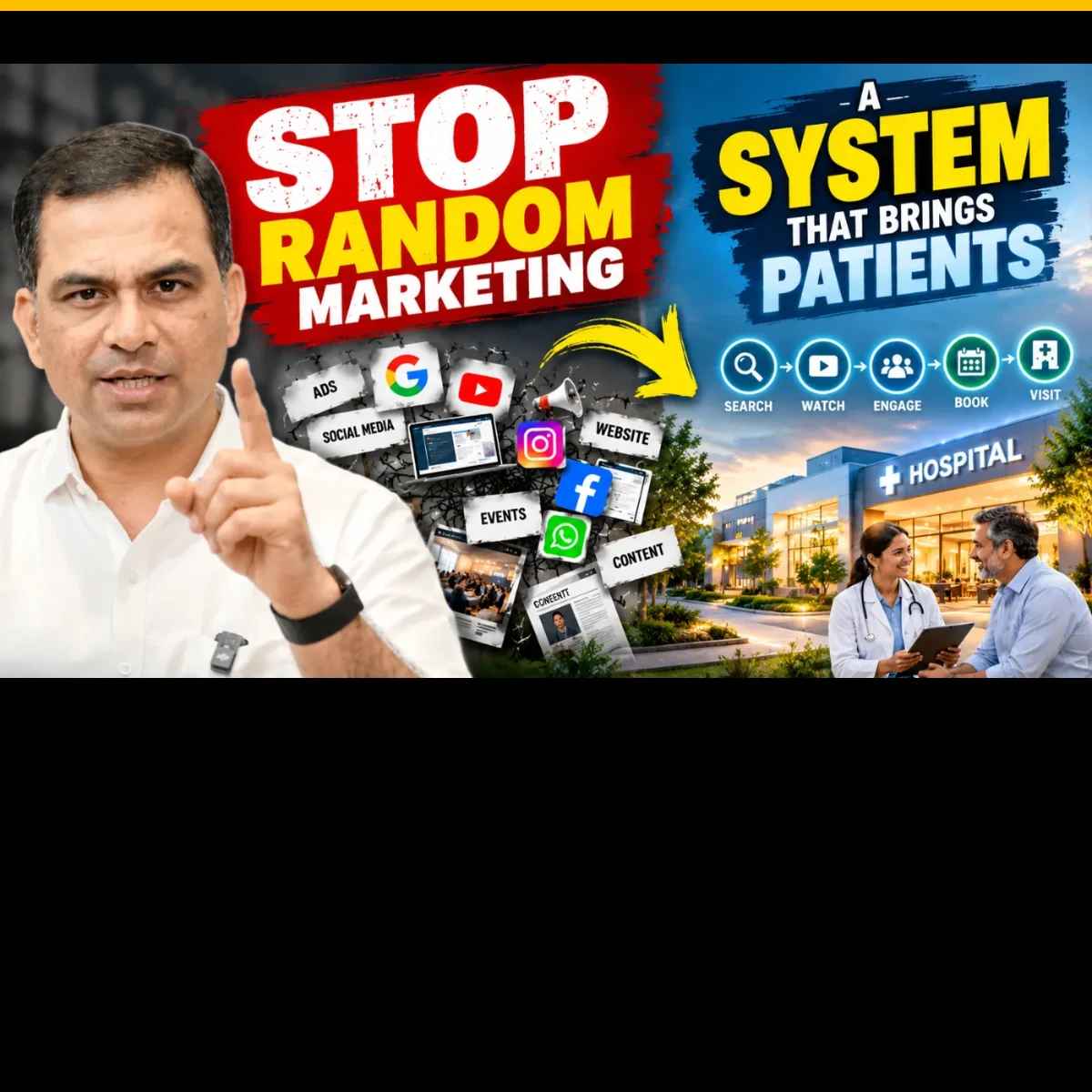
Watch: the 8 lessons behind this guide
This article builds on my video, where I took the behavioural lessons from the Google and YouTube festive marketing playbook and applied them to healthcare. The playbook is retail research, so we use it for direction, not as healthcare benchmarks. For the full playbook breakdown, read our guide to festive season marketing for doctors and clinics.
Why busy marketing still gives unpredictable results
Walk into most hospitals and you will see a lot happening. Social media is running. Google Ads are running. Videos are being made. Doctors are posting. Events are being organised. The team is busy.
Now ask one question: is all of this connected? In our audits, the typical picture is one agency on social media, another on Google Ads, an internal team on doctor outreach, a separate team on events, a website managed on its own and a front desk handling calls. Everyone is working. Everyone is working in a different direction.
That is the root of unpredictable results. You do not have a reach problem. You have a connection problem.
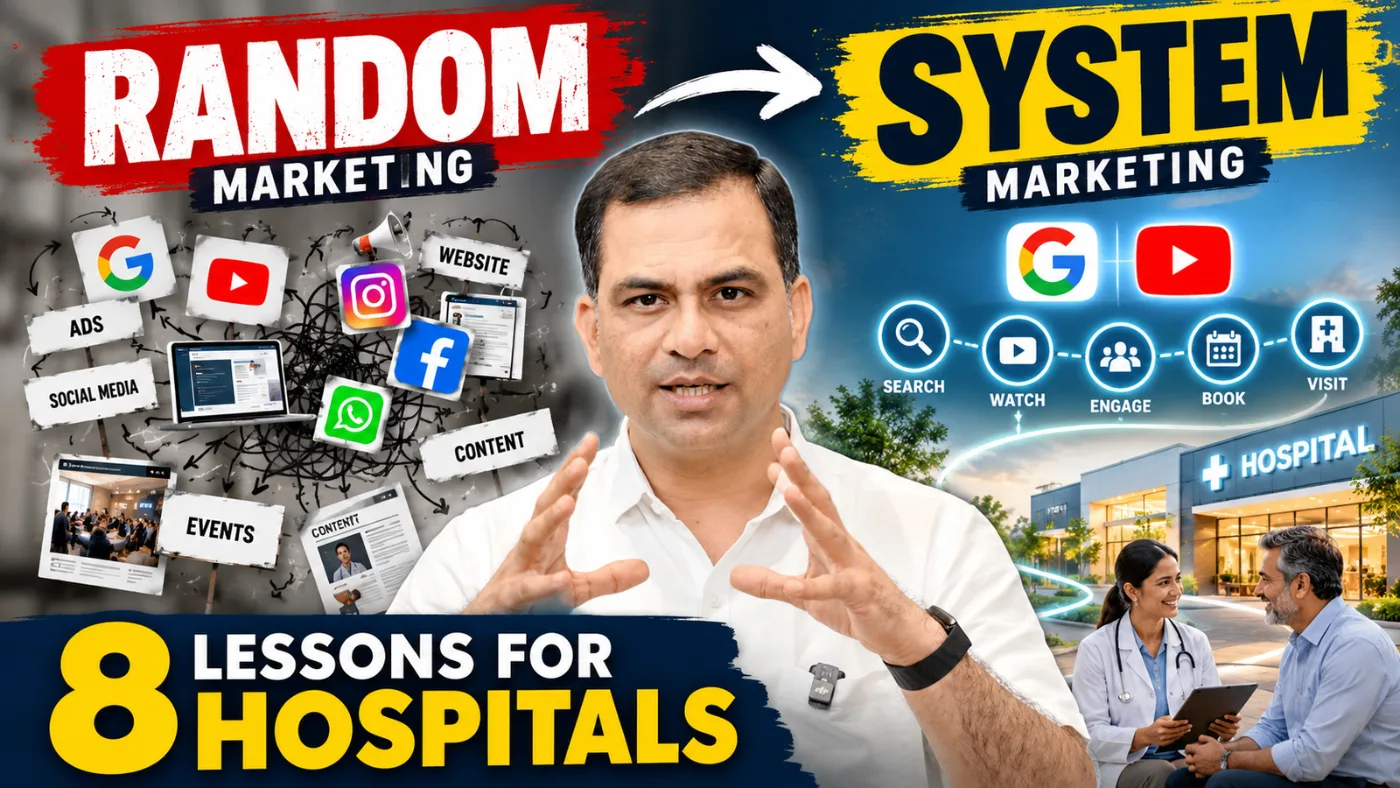
Marketing activity vs a marketing system
The difference is simple, and it decides whether marketing behaves like an expense or an investment.
Marketing activity
Marketing system
We post, advertise, attend events and print brochures
We know why we do each one, and who it is for
Questions like “Should we run Facebook ads?”
Strategy first, then the channel that fits the message
Enquiries land wherever they land
Every enquiry has an owner, a response time and a next step
Success measured in likes and views
Success measured in enquiries, appointments and patients
Spend runs on assumptions
Data creates learning, and learning improves decisions
“Should we start YouTube?” and “Should we hire influencers?” are channel questions, not strategy questions. Strategy comes first. If you want help deciding what comes first, our guide to marketing as an investment, not an expense is a good companion read.
The patient journey is always online
A person with knee pain does not walk into your hospital first. They search on Google, watch a YouTube video, read reviews, open your website, check the doctor’s profile and ask family. Only then do they call.
Journey stage
What the patient does
What must be in place
Search
Googles a symptom, treatment or “near me”
Accurate Google Business Profile, service pages that answer real questions
Watch and learn
Looks for a simple explanation
Doctor-led educational videos and FAQs
Compare
Checks the doctor, facilities and reputation
Clear doctor profiles, honest information, consistent details
Enquire
Calls, WhatsApps or fills a form
Answered calls, monitored WhatsApp, a tracked form
Book and visit
Fixes an appointment and arrives
Easy booking, correct timings, a smooth front desk
Where the journey breaks: a heart check-up example
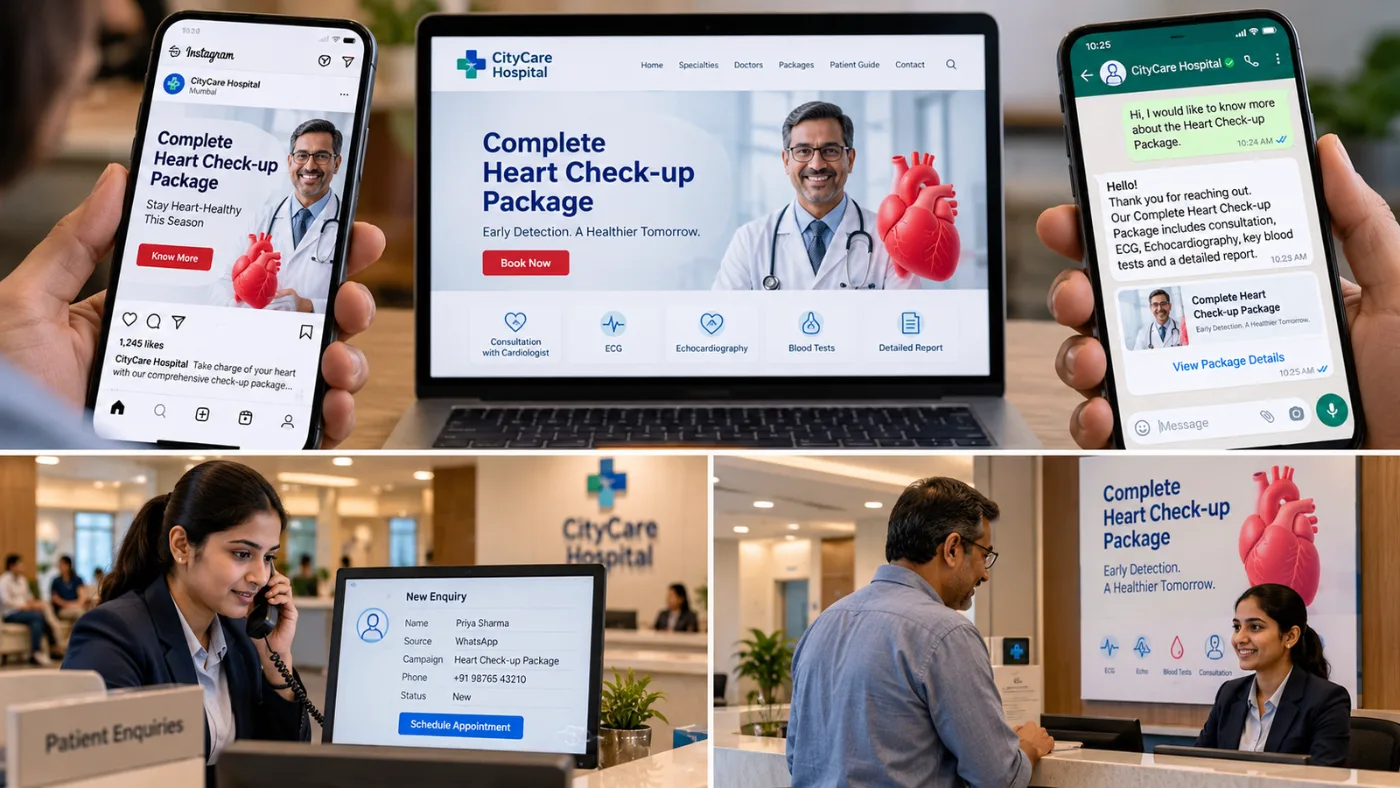
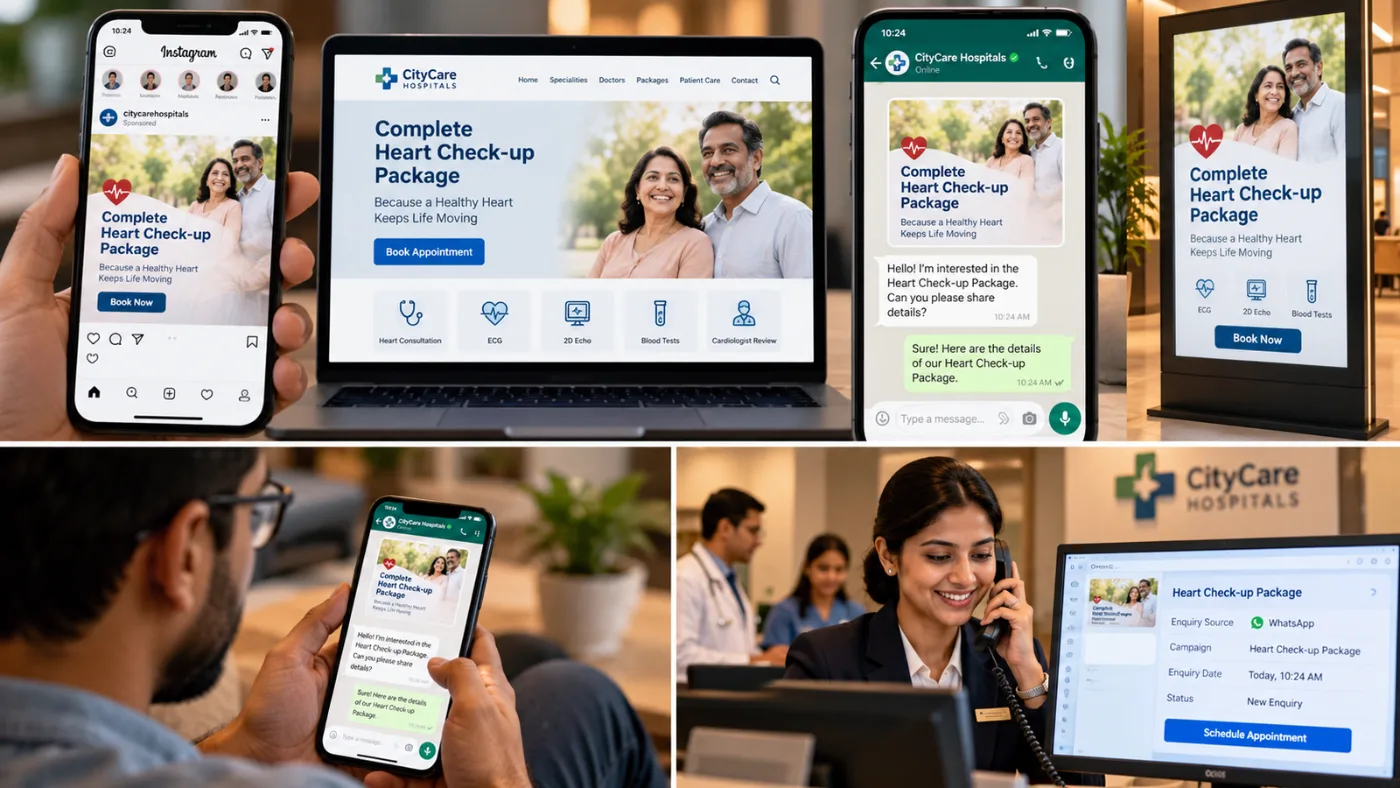
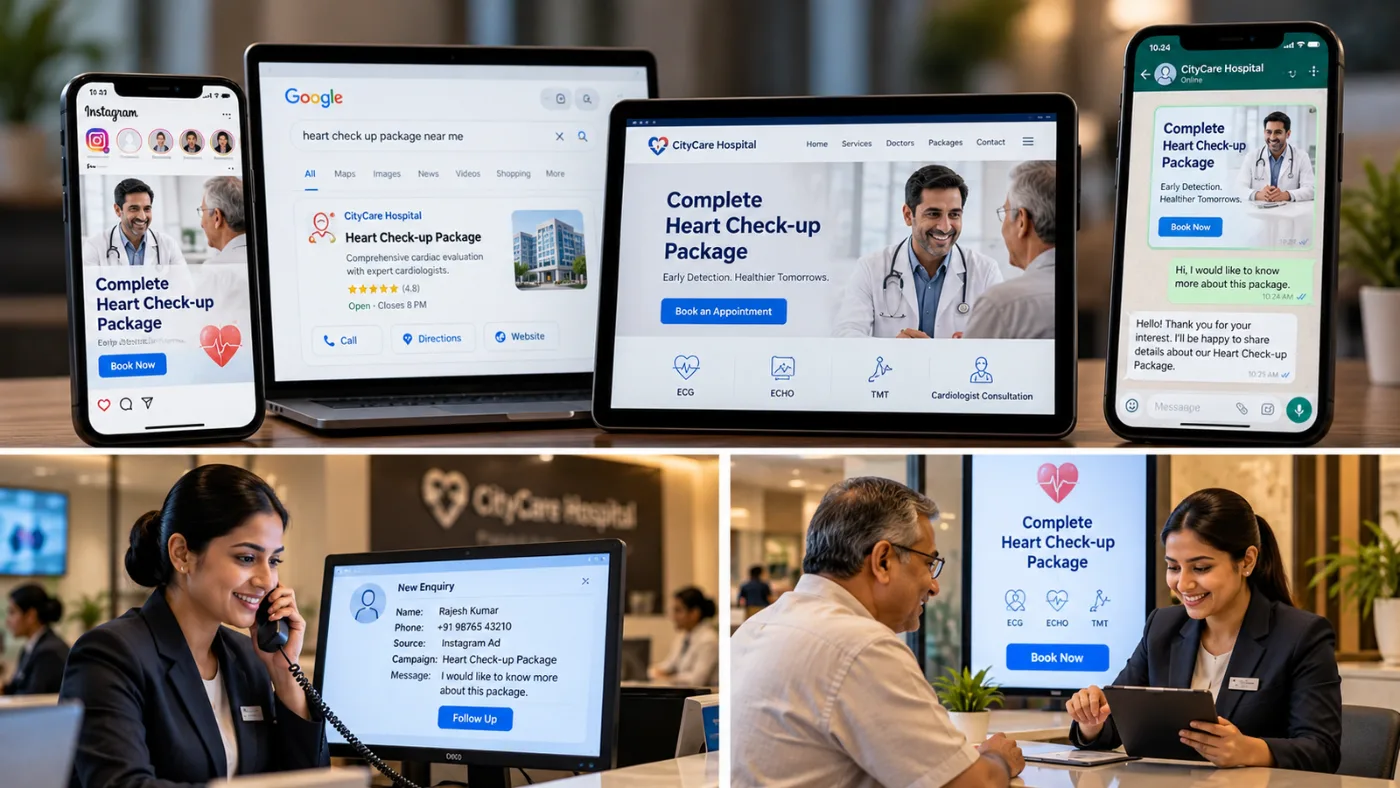
Here is an illustrative example (a fictional hospital, not a client). A hospital launches a complete heart check-up package.
The patient sees it on Instagram.
They search on Google, and different information appears.
They open the website, and the package is not there.
They message on WhatsApp, and the person replying has not heard of the campaign.
They call the front desk and hear, “Sir, please call tomorrow.”
The advertisement worked. The journey failed. Every conflicting detail lowers trust, and every difficult next step lowers conversion.
Now the connected version: one clear package, the same details on Instagram, Google, the website and WhatsApp, an enquiry that is logged with its source, a quick response and a booked appointment.
1
One patient journey. Not an Instagram team, a Google team, a website team and a front desk team.
HMS Consultants perspective
The 8 parts of an integrated healthcare marketing system
Use this as a build order. Each part feeds the next.
Positioning. What you stand for and for whom.
Target audience. Which patients, for which services.
Key messages. What you want them to understand, in plain language.
Channel strategy. Which channel carries which message.
Content plan. Educational, accurate and consistent content.
Enquiry handling. Who answers, how fast and where it is logged.
Follow-up and patient experience. What happens after the enquiry and after the visit.
Measurement. What you track and how you improve.
Each channel has a job when it is part of a system:
Patients are often scared, confused or deciding for a parent or child. Healthcare communication cannot behave like product advertising. Compare two messages: “Best Cardiac Hospital. Book now.” and “When should chest pain actually worry you?” The second helps first, so it earns more trust.
As AI tools summarise healthcare information, the original information you publish must be trustworthy. Avoid exaggerated claims, fear-based messaging, false promises and misleading comparisons. The NMC’s ethical advertising guidelines (public notice, 6 October 2026) restrict offers and discounts, testimonials, influencer and third-party promotion, success-rate claims and before-and-after images. This is our reading, not legal advice, so read the NMC advertising guidelines guide and consult a qualified healthcare lawyer.
If a hospital spends five lakh rupees a month on marketing but cannot answer these seven questions, it is operating on assumptions. Track them monthly:
A system creates data. Data creates learning. Learning creates better decisions. Better decisions create growth. See also how to use data to improve the patient experience.
A 30-day plan to build your system
Week
Focus
Output
Week 1
Write down every marketing activity and map it to the patient journey
A one-page activity map showing the gaps
Week 2
Fix the basics: Google profile, timings, call and WhatsApp handling
Consistent information everywhere
Week 3
Choose one priority service and align message, channels and website page
One connected campaign plan
Week 4
Set up enquiry tracking and the 7-number scorecard
A monthly review routine
Try this today: take a sheet of paper and write every marketing activity your clinic or hospital does. Then ask: are these connected as one patient journey, or are they separate activities? The answer shows your biggest marketing gap.
Prefer not to do it alone? Our medical practice growth work helps clinic owners build a steady, measurable patient flow.
Integrated healthcare marketing connects positioning, message, content, channels, enquiry handling, follow-up and measurement into one patient journey, instead of running social media, ads, events and the website as separate activities. The aim is that every channel tells one consistent story and every enquiry has a clear next step.
What is the difference between marketing activity and a marketing system?
Activity means posting, advertising, attending events and making videos. A system means you know why you are doing each thing, who it is for, what message it carries, which channel suits it, how enquiries are handled, what happens after the enquiry and how results are measured.
Why are my hospital’s marketing efforts not producing predictable enquiries?
The most common reasons are disconnected channels, inconsistent information across Google, website and WhatsApp, slow or untracked enquiry handling, and no measurement beyond likes and views. Fixing the journey after the click usually improves results before any extra ad spend does.
What should a hospital track to know if marketing is working?
At minimum: total enquiries, enquiry source, response time, enquiries that became appointments, appointments that became patients, revenue by service line and where patients drop out. Without these, marketing spend runs on assumptions.
Can doctors and hospitals use offers, testimonials or influencers in an integrated plan?
The NMC’s ethical advertising guidelines of October 2026 restrict offers and discounts, testimonials and third-party or influencer promotion. This is HMS’s reading of the public notice, not legal advice. A safer integrated plan relies on educational content, accurate information and a smooth patient experience.
How long does it take to build a healthcare marketing system?
A basic version, covering a journey audit, corrected profiles, enquiry tracking and one priority service campaign, can be set up in about 30 days. Results then build over the following months as content, search visibility and follow-up processes mature.
Influence with responsibility
You can post every day, run ads, make hundreds of videos and attend every event. If these are disconnected, you become busy, not better. Integrated healthcare marketing connects your positioning, message, content, channels, enquiries, follow-up, patient experience, retention, referrals and measurement. And because what we publish influences healthcare decisions, it must also be ethical, accurate and respectful of the patient.
At HMS Consultants, we have worked with 58+ healthcare businesses since 2024 on exactly this: a clear strategy first, then execution. Random activity creates noise. Integrated strategy creates results. Knowing is Knowing, Doing is Doing™.
Disclaimer: HMS Consultants is a healthcare marketing consultancy. We are not medico-legal experts or a law firm. The hospital in the example is fictional and illustrative. Statistics and ideas from Google and YouTube’s playbook come from retail shopping research and are cited for behavioural direction only. References to the NMC guidelines reflect our understanding of the public notice dated 6 October 2026 and are not legal advice. Please read the official notice and consult a qualified healthcare lawyer before acting.
About the author:Akhil Dave is Founder & Principal Consultant of HMS Consultants, with 25+ years in healthcare marketing.
Sources
Akhil Dave, Healthcare Marketing: 8 Lessons From Google & YouTube Every Hospital Needs, YouTube, 17 October 2026.
Google and YouTube, A Marketer’s Playbook to Win This Festive Season (India, 2026), used for behavioural direction only.
In healthcare, trust is the foundation of every patient relationship and a Healthcare CRM can help you strengthen it. From personalized care and accurate records to timely communication and...
Most hospitals and clinics do plenty of marketing but lack a system. Learn the 8 parts of an integrated healthcare marketing strategy, the 7-number scorecard and a 30-day plan.
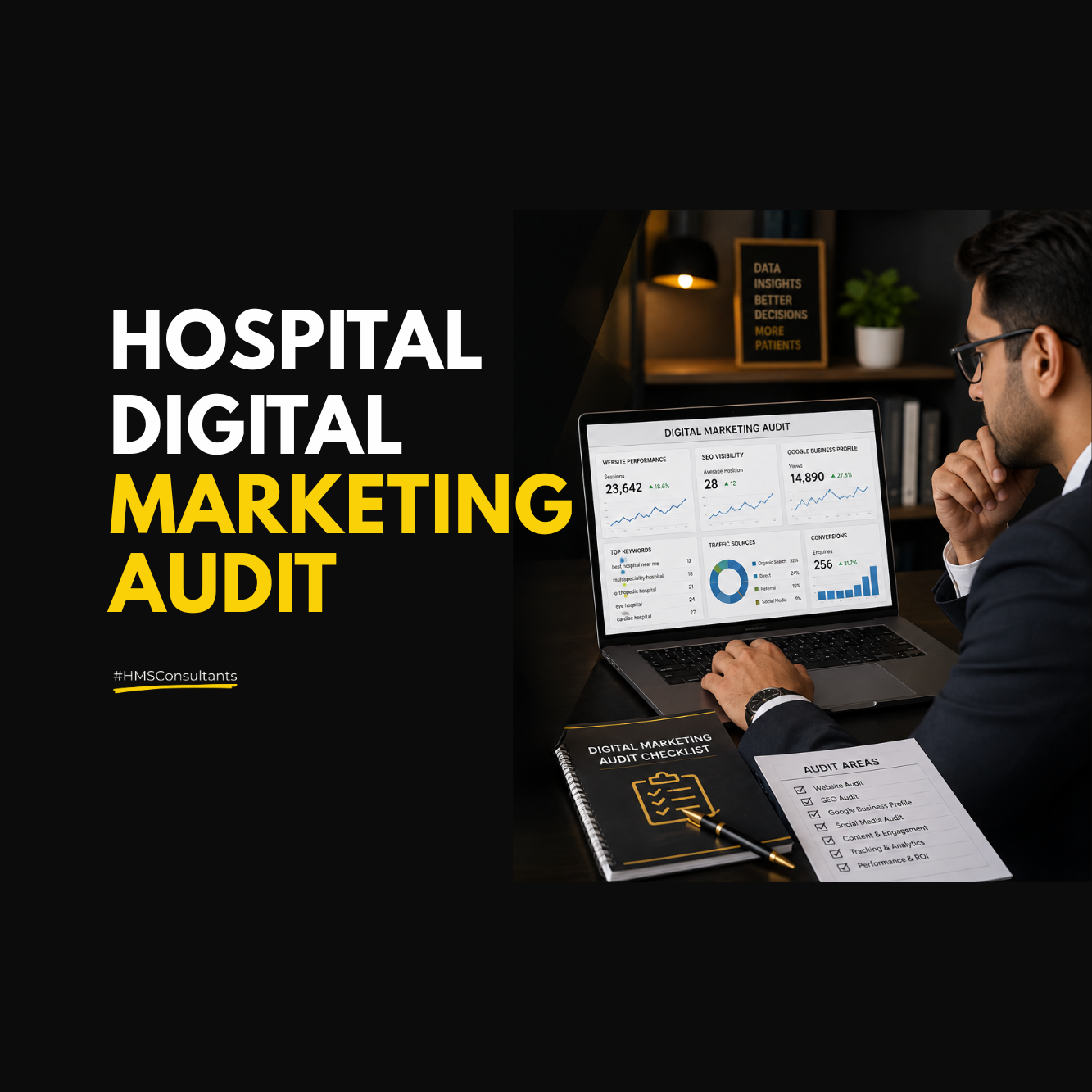
Hospital marketing audit is the first step to identifying what's helping—or hurting—your hospital's growth. This comprehensive 2026 checklist covers website performance, SEO, Google Business Profile, social media, branding, patient...
An illustration showing the significance of managing online reputation in healthcare, highlighting its impact on patient trust, doctor reputation, and overall healthcare marketing.
Stories build trust in healthcare, but they must protect dignity. Discover how hospitals in India can use ethical storytelling to balance privacy and impact.