


How to Build a Hospital Website That Converts Patients
A practical guide to building a hospital website that converts visitors into patient...
Promotional marketing works well in industries where decisions are quick, emotional, and low-risk. Healthcare is the opposite. Decisions are slow, layered, emotionally complex, and deeply personal. Patients do not just buy a service; they entrust their health, finances, and family decisions to an institution.
When marketing focuses solely on promotion, it attracts attention without providing reassurance. Patients may notice the hospital, but they are not guided through uncertainty. This gap leads to high enquiry volumes, low conversion rates, frequent drop-offs, and dissatisfaction that hospitals often misinterpret as “price sensitivity” or “competition.”
The real issue is not the offer. It is the absence of marketing infrastructure.
Marketing infrastructure is the system that supports patient understanding before, during, and after contact with the hospital. It includes how information is structured, how communication flows, how expectations are set, and how consistency is maintained across touchpoints.
A hospital with a strong marketing infrastructure ensures that when a patient searches online, the information they find is clear and reassuring. When they enquire, responses are timely and consistent. When they arrive, the experience matches what was communicated. When they leave, follow-up reinforces trust.
Promotion can attract attention, but only infrastructure can hold it.
Many hospitals invest heavily in visible activities while neglecting invisible systems. Social media calendars are maintained, ads are run regularly, and agencies are engaged, yet outcomes fluctuate month after month.
This happens because promotional efforts are layered on top of weak foundations. Messaging changes frequently. Staff interpret information differently. Patients receive mixed signals depending on whom they speak to. Follow-ups depend on individual initiative rather than system design.
Without infrastructure, marketing becomes reactive. It responds to pressure instead of guiding growth.
Patients move through healthcare decisions cautiously. They seek patterns, consistency, and reassurance. Marketing infrastructure ensures that at every stage of this journey, patients encounter the same narrative about care philosophy, approach, expectations, and outcomes.
When infrastructure is strong, patients feel oriented rather than overwhelmed. They understand what will happen next. They know who to trust. They feel less anxious asking questions. This confidence significantly improves conversion, retention, and referrals.
In such environments, marketing works quietly but powerfully.
Hospitals often expect agencies to “build marketing.” Agencies can execute visibility, but infrastructure must be co-created internally. It requires alignment between leadership, operations, clinical teams, and communication protocols.
No external partner can design internal clarity without deep collaboration. When hospitals outsource marketing without addressing internal alignment, agencies are forced to operate tactically. Results remain short-lived because the underlying system is unstable.
Strong hospitals treat marketing infrastructure as a leadership responsibility, not a vendor deliverable.
When marketing infrastructure is absent, marketing spend feels risky. Outcomes are unpredictable, and every campaign feels like a gamble. Leadership hesitates, budgets fluctuate, and trust in marketing erodes.
When infrastructure is in place, marketing spend feels more controlled. Campaigns build on existing clarity. Messages reinforce established trust. Each initiative compounds the previous one.
Marketing stops feeling like an expense and starts functioning like a capital investment, strengthening the organisation over time.
Hospitals that invest in marketing infrastructure experience slower but steadier growth. They attract fewer unqualified enquiries. Patients arrive better informed. Consultations become more productive. Resistance reduces. Teams operate with confidence rather than urgency.
Over time, these hospitals rely less on aggressive promotion because reputation and trust begin to do the work. Marketing becomes supportive rather than stressful.
This is how healthcare brands sustain growth without constant escalation of spend.
As hospitals grow, complexity increases. More departments, more doctors, more staff, and more patient touchpoints create more room for inconsistency. Without infrastructure, growth magnifies confusion.
Marketing infrastructure acts as a stabilising force. It ensures that regardless of size, patients receive a coherent experience. It allows leadership to scale without losing identity or trust.
This is why scalable hospitals invest in systems before scaling visibility.
Hospitals do not fail at marketing because they lack creativity or spending. They fail because they mistake promotion for strategy.
Proper hospital marketing is not about being seen more. It is about being understood better. It is not about generating noise. It is about building confidence. It is not about short-term spikes. It is about long-term viability.
Promotion without infrastructure creates instability.
Infrastructure without promotion creates quiet strength.
Together, they create sustainable growth.
Hospitals that recognise this shift stop chasing marketing tactics and start building marketing systems. And that is where real, lasting growth begins.
Share your details below and we will connect with you to discuss your growth strategy.
A practical guide to building a hospital website that converts visitors into patient...

The 7 Ps of healthcare marketing Product, Price, Place, Promotion, People, Process, and...
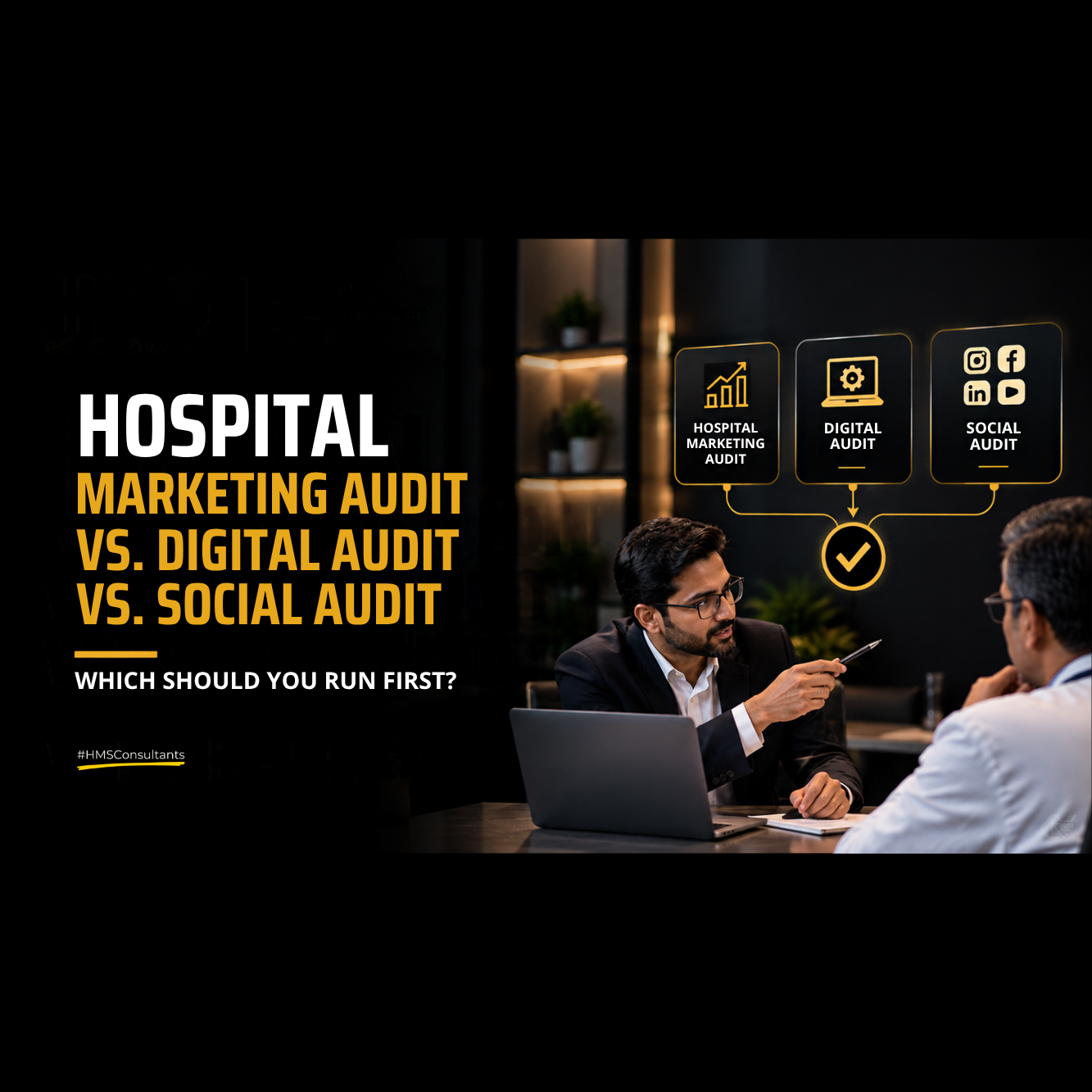
Compare hospital marketing, digital, and social media audits to understand what each audit...

Explore career paths after an MBA or MHA in healthcare management, including hospital...

Learn how to get more patient reviews for doctors and hospitals, respond to...

A wellness clinic marketing playbook for IVF, skin and aesthetic, and wellness centres...