Category: Hospital Marketing Strategy

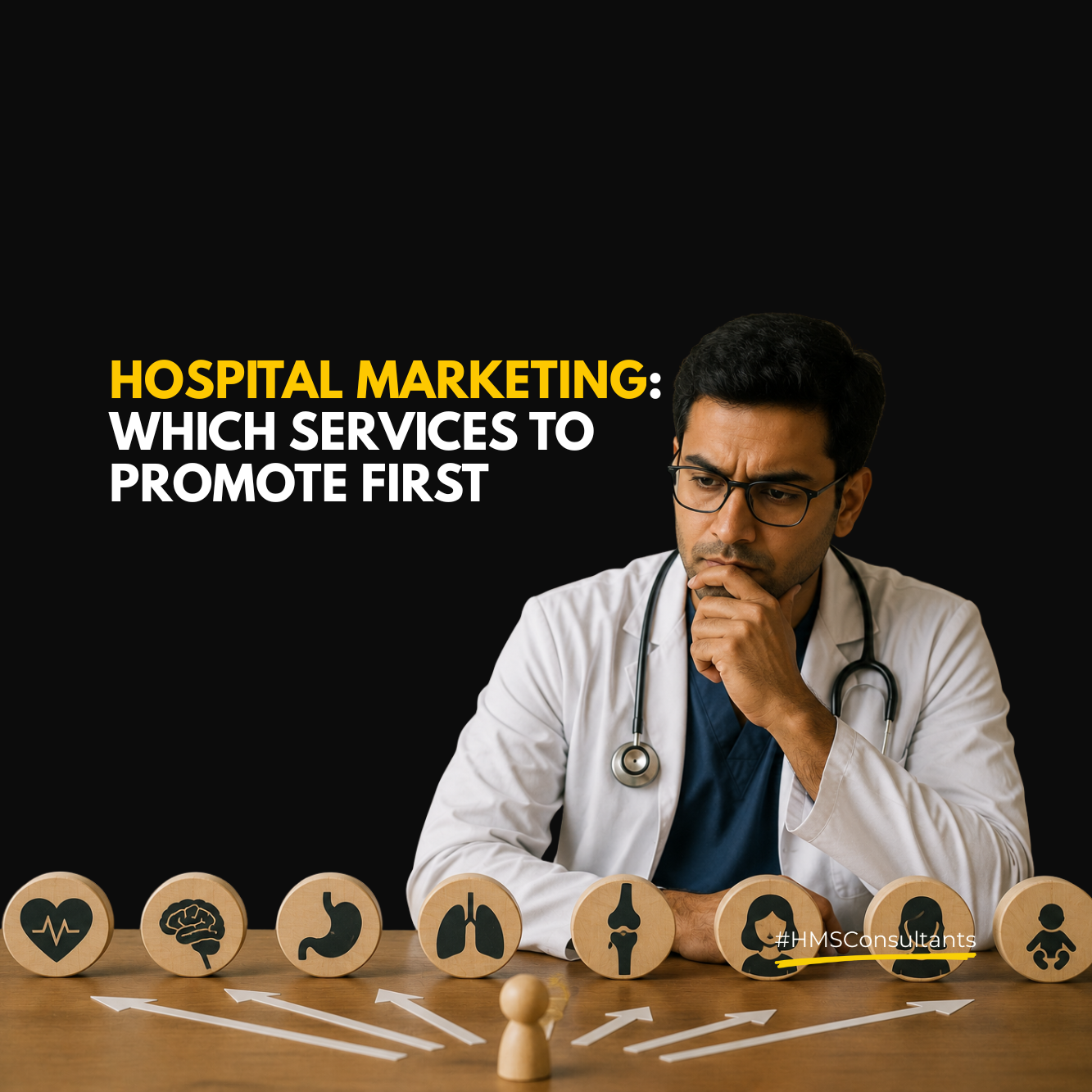
  • Hospital Marketing: How to Decide Which Services to Promote First

    Hospital Marketing: How to Decide Which Services to Promote First

    Hospital Marketing: How to Decide Which Services to Promote First

    Published on
    Share This

    Hospital marketing becomes difficult when everything is treated as equally important. Most hospitals have multiple departments, doctors, services, packages, and treatment areas. Naturally, every service needs visibility. But in practice, promoting everything at once often leads to scattered communication and weak results.

    A hospital cannot market emergency care, maternity, orthopedics, diagnostics, preventive health check-ups, surgery, and specialist consultations with the same message and the same urgency. Each service has different patient needs, decision time, trust requirements, and business value. This is why hospital marketing should not start with the question, “What should we post?” It should start with a better question: “Which service needs marketing attention first, and why?”

    A clear hospital marketing strategy helps hospitals decide which services to promote first based on patient demand, department readiness, local competition, service value, and growth potential.

    Why Service Prioritisation Matters in Hospital Marketing

    Many hospitals run campaigns without deciding which services deserve focus. As a result, marketing becomes too broad. One week the hospital promotes one department, the next week another, and then a general awareness post follows. This creates activity, but not always direction.

    Service prioritisation helps the hospital focus its effort where it can make the most meaningful impact.

    It helps answer:

    • Which services are patients actively looking for?
    • Which departments are underutilized?
    • Which services need better explanation?
    • Which doctors have availability to handle more patients?
    • Which services support long-term hospital business growth?
    • Which departments face stronger competition?
    • Which services are seasonal or time-sensitive?

    Without this clarity, hospital marketing may continue, but the results may remain unclear.

    Patient Demand Should Guide the First Decision

    The first factor to study is patient demand. Hospitals should not promote a service only because it exists. They should understand whether patients are searching for it, asking about it, or showing real need for it.

    Patient demand can be understood through enquiry patterns, appointment data, common patient questions, Google searches, local health concerns, seasonal illness trends, and competitor visibility.

    For example, if many patients are asking about knee pain, pregnancy care, diabetes management, fever treatment, diagnostic packages, or cardiac check-ups, those areas may need stronger communication.

    This does not mean only high-demand services should be promoted. But demand helps the hospital know where patient interest already exists. Marketing can then improve visibility, explain the service better, and guide patients more clearly.

    A hospital marketing strategy should always connect service promotion with real patient behaviour.

    Department Readiness Comes Before Promotion

    A common mistake in hospital marketing is promoting a service before the department is ready to handle the response.

    If marketing brings enquiries but the doctor is not available, the front desk is not informed, the appointment process is unclear, or follow-up is weak, the campaign may damage trust instead of supporting growth.

    Before promoting any service, the hospital should check:

    • Is the doctor or department available consistently?
    • Can the team handle more enquiries?
    • Is the front desk trained to explain the service?
    • Is the appointment process simple?
    • Is the website information clear?
    • Are packages, reports, or instructions ready where needed?
    • Is follow-up being handled properly?

    Hospital service promotion should not create demand that the hospital cannot manage. Good marketing works only when the patient journey behind it is prepared.

    Underused Services May Need Visibility First

    Many hospitals have strong services that patients do not know about. These may be clinically valuable, but they remain underutilised because they are not clearly visible online or offline.

    Sometimes the service exists on the hospital premises, but it is missing from the website. Sometimes it is not mentioned properly on Google Business Profile. Sometimes the doctor is available, but patients do not know that the department offers that care.

    Underused services can be identified by checking:

    • Services with low enquiries
    • Departments not clearly explained online
    • Doctors with weak digital visibility
    • Treatments not covered in content
    • Services missing from Google Business Profile
    • Low patient awareness despite strong capability

    These services may not need paid ads immediately. They may first need clear service pages, patient education content, doctor-led videos, Google updates, and better internal communication.

    In hospital marketing, visibility should begin with clarity.

    Growth Potential Should Be Considered Carefully

    Hospital marketing must remain ethical and patient-centred, but hospitals also need to understand which services support long-term sustainability. Some services may have higher demand, stronger repeat value, better department capacity, or greater positioning importance for the hospital.

    This is where hospital growth strategy becomes important.

    Hospitals should look at:

    • Patient need
    • Clinical strength
    • Revenue potential
    • Doctor availability
    • Department capacity
    • Local competition
    • Long-term brand positioning

    For example, if a hospital has strong orthopaedic expertise but patients are choosing competitors for joint pain or fracture care, that department may need focused promotion. If diagnostics are available but underused, preventive health packages may need better communication.

    Marketing should support services where the hospital has genuine capability, not only where it wants more visibility.

    Competition Can Reveal Service Opportunities

    A hospital should not copy competitor marketing, but it should understand what competitors are doing. Local competition often shows which services are being pushed heavily and where gaps may exist.

    Hospitals should observe:

    • Which services competitors promote most
    • How they explain those services
    • Which doctors or departments are visible online
    • What patients mention in competitor reviews
    • Where competitors are strong or weak
    • Which patient questions remain unanswered

    If many hospitals are promoting the same service, your hospital needs a clearer positioning angle. If competitors are weak in an area where your hospital has strength, that service may become a strong marketing opportunity.

    Hospital service promotion should be based on differentiation, not imitation.

    Timing Can Improve Marketing Response

    Some hospital services perform better when promoted at the right time. Timing can depend on seasons, awareness months, local health patterns, school calendars, corporate cycles, or disease trends.

    For example, fever and infection care may need stronger communication during monsoon. Respiratory care may become more relevant during pollution season. Preventive health packages may work well around health awareness campaigns. School health check-ups may be planned before academic sessions.

    Hospitals should build a service-wise marketing calendar instead of deciding campaigns at the last moment.

    This helps plan:

    • Awareness posts
    • Doctor videos
    • Google updates
    • Blog content
    • Local campaigns
    • Preventive health messages
    • Patient education material

    When timing is planned, hospital marketing becomes more consistent and less random.

    The Marketing Route Should Match the Service

    Not every service needs the same marketing channel. Some services need search visibility. Some need patient education. Some need doctor credibility. Some need local awareness. Some need Google Business Profile optimization. Some need paid campaigns.

    For example, high-search services may need SEO and Google visibility. Complex services may need blogs and educational videos. Doctor-led services may need profile strengthening and credibility-building content. Preventive services may need awareness campaigns. Competitive services may need stronger service positioning.

    The better question is not, “Should we run ads?”

    The better question is, “What does this service need before patients respond?”

    This is where hospital marketing becomes strategic. The channel should come after the service priority is clear.

    Conclusion

    Hospital marketing becomes stronger when hospitals stop promoting everything equally and start prioritising services strategically.

    Every service does not need the same campaign, message, platform, or budget. Some services need awareness. Some need search visibility. Some need doctor credibility. Some need better patient education. Some need operational readiness before promotion.

    A clear hospital marketing strategy helps hospitals decide which services to promote first based on patient demand, department readiness, competition, timing, and growth potential.

    For hospitals that want sustainable growth, marketing should not begin with random activity.

    It should begin with the right service priority.

    Contact Us HMS Consultants

    Hospital marketing is the process of promoting a hospital’s services, departments, doctors, and patient care in a planned way. In this blog context, it means deciding which services should be promoted first based on patient demand, department readiness, competition, and growth potential.

    Healthcare Marketing I Digital Strategy I healthcare digital marketing I healthcare Management I Healthcare Marketing Strategy I hospital marketing I Hospital Marketing Strategies I Hospital Marketing Strategy

    is something we strongly believe in, which means ‘Knowledge without application is the same as having no knowledge at all

    Akhil Dave

    Principle Consultant

    Ready to take your Personal Brand to the next level?

    Share your details below and we will connect with you to discuss your growth strategy.
    • Hospital Public Relations: The Silent Gaps That Affect Patient Trust

      Hospital Public Relations: The Silent Gaps That Affect Patient Trust

      Hospital Public Relations: The Silent Gaps That Affect Patient Trust

      Published on
      Share This

      Hospital public relations is often noticed only when something goes wrong. A negative review, a patient complaint, a media issue, or a communication mistake suddenly brings attention to reputation. But hospital public relations does not begin during a crisis. It begins much earlier through everyday patient communication, staff behaviour, online reviews, community presence, and the way the hospital responds to people.

      Many hospitals think PR means press releases, media coverage, or public events. These are part of it, but they are not the full picture. In healthcare, public relations is closely connected with patient trust.

      This means healthcare marketing cannot depend only on random posts, occasional ads, or basic promotion.

      A hospital may have experienced doctors, good facilities, and strong services, but if patients feel confused, unheard, or unsure, trust can slowly weaken. These are silent gaps. They may not look serious at first, but over time they affect hospital reputation and patient confidence.

      Why Silent PR Gaps Matter

      Patients and families do not choose a hospital casually. They search online, read reviews, ask others, check the website, call the hospital, and observe how clearly the hospital communicates.

      A patient may not understand every clinical detail, but they can sense whether the hospital feels organised, responsive, and trustworthy. That is why hospital public relations should not be treated only as publicity. It should be seen as a trust-building system.

      A hospital’s image is shaped by small experiences such as:

      • How quickly calls are answered
      • How clearly staff explain services
      • How reviews are handled
      • How complaints are acknowledged
      • How the website explains important information
      • How patients are guided before and after consultation
      • How the hospital responds during confusion or crisis

      When these areas are ignored, PR becomes reactive. The hospital starts responding only after trust is already affected.

      Gap 1: Unclear Patient Communication

      One of the biggest gaps in hospital public relations is unclear communication. Many hospitals promote their services, but they do not always explain them in a way patients can understand.

      Patients often want simple answers:

      • Which department should I visit?
      • Which doctor handles this condition?
      • How do I book an appointment?
      • What should I expect during consultation?
      • What happens after the visit?
      • Whom should I contact for help?

      If this information is missing or confusing, the patient may delay the decision or choose another hospital. Good hospital PR is not only about speaking to the public. It is about speaking clearly and responsibly.

      Gap 2: Ignoring Patient Feedback

      Patient feedback is one of the strongest signals of reputation. But many hospitals treat feedback only as a complaint, instead of seeing it as an opportunity to improve.

      A delayed response, unclear billing explanation, rude staff interaction, long waiting time, or poor follow-up may seem like a small operational issue. But when these experiences repeat, they become reputation issues.

      Patients may share their experience through:

      • Google reviews
      • Social media comments
      • WhatsApp groups
      • Family discussions
      • Local word-of-mouth
      • Direct complaints

      Hospitals should regularly review feedback and understand what patients are saying. If the same issue appears again and again, it should not be ignored. Reputation management is not only about replying to reviews. It is also about learning from them.

      Gap 3: Inconsistent Staff Messaging

      A hospital may have one brand message, but patients experience the hospital through different people. The front desk may say one thing, the call team may say another, and the department may explain something differently.

      This creates confusion.

      In healthcare, confusion directly affects trust. Patients want to feel that the hospital team is informed, aligned, and confident. If staff members give different answers about appointments, reports, doctor availability, services, or follow-up, the hospital may appear disorganised.

      Hospitals should train patient-facing teams on:

      • Basic service information
      • Appointment guidance
      • Enquiry handling
      • Complaint escalation
      • Patient-friendly language
      • Follow-up communication
      • Sensitive conversations

      Public relations is not handled only by management or marketing teams. Every staff member who speaks to a patient contributes to the hospital’s image.

      Gap 4: Poor Online Reputation Response

      Patients often check reviews before choosing a hospital. A few unmanaged reviews can influence whether someone decides to call, visit, or avoid the hospital.

      Many hospitals either ignore reviews or respond in a very generic way. Some responses sound defensive, while others do not address the concern at all. This can make patients feel that the hospital does not listen.

      A better online reputation response should include:

      • Thanking patients for positive feedback
      • Acknowledging concerns politely
      • Avoiding arguments online
      • Not sharing patient-sensitive details publicly
      • Taking serious concerns offline
      • Tracking repeated complaints
      • Improving internal processes based on feedback

      Online reputation is now a major part of hospital public relations. It cannot be treated as an optional activity.

      Gap 5: Weak Community Presence

      Hospitals are not just treatment centres. They are part of the communities they serve. A hospital may be known for its services, but if it is not visible as a responsible healthcare voice, it may miss an important trust-building opportunity.

      Community presence can include:

      • Health awareness programs
      • Preventive care campaigns
      • Patient education sessions
      • Local health talks
      • School or corporate health awareness
      • Public health messages
      • Community outreach activities

      This does not mean every hospital needs big events. It means the hospital should be seen as active, helpful, and connected to local health needs. A strong community presence builds trust before patients need treatment.

      Gap 6: No Crisis Communication Readiness

      Hospitals often think about crisis communication only after a problem happens. This can create confusion, delay, and inconsistent responses.

      A crisis may come from a patient complaint, social media issue, negative media attention, misinformation, service disruption, or internal communication failure. If the hospital does not know who should respond and what should be communicated, the situation can become worse.

      Hospitals should prepare answers to questions like:

      • Who will respond during a crisis?
      • What information can be shared?
      • How will patient privacy be protected?
      • How will staff be informed?
      • How will online comments be handled?
      • How will leadership communicate?

      Crisis communication should be planned before it is needed. A prepared hospital appears responsible and controlled. An unprepared hospital may appear silent, defensive, or confused.

      Gap 7: Marketing Claims Not Matching Patient Experience

      A hospital may promote care, trust, advanced facilities, and patient-first service. But if the actual patient experience does not match that promise, reputation suffers.

      Patients remember what they experience more than what they see in advertisements.

      If the hospital promotes smooth appointments but patients face confusion, there is a gap. If the hospital talks about compassionate care but staff communication feels cold, there is a gap. If the hospital promises patient support but follows up weakly, trust is affected.

      Hospital public relations must connect marketing promises with real patient experience. The message outside the hospital should match what patients feel inside the hospital.

      Conclusion

      Hospital public relations should not begin after reputation damage. It should be part of everyday hospital communication.

      The silent gaps in hospital PR often appear in small places: unclear information, ignored feedback, weak review response, inconsistent staff messaging, poor crisis readiness, and marketing promises that do not match patient experience.

      These gaps may not create immediate damage, but they slowly affect how patients see the hospital.

      Hospitals that want long-term growth need more than promotion. They need communication systems that support clarity, credibility, patient confidence, and trust. A strong hospital public relations strategy helps hospitals protect their reputation before damage happens and build trust before patients walk in.

      Contact Us HMS Consultants

      PR in a hospital means public relations. It is how a hospital communicates with patients, staff, community, media, and the public to build trust, manage reputation, handle feedback, and respond responsibly during sensitive situations.

      Healthcare Marketing I Digital Strategy I healthcare Management I Hospital Branding I Hospital Marketing Strategy I public relations

      is something we strongly believe in, which means ‘Knowledge without application is the same as having no knowledge at all

      Akhil Dave

      Principle Consultant

      Ready to take your Personal Brand to the next level?

      Share your details below and we will connect with you to discuss your growth strategy.

      • Healthcare Marketing Strategies: What Clinics and Hospitals Really Need

        Healthcare Marketing Strategies: What Clinics and Hospitals Really Need

        Healthcare Marketing Strategies: What Clinics and Hospitals Really Need

        Published on
        Share This

        Healthcare marketing strategies are becoming important for clinics, hospitals, diagnostic centres, wellness businesses, and healthcare startups that want to grow with clarity and trust. Today, patients do not choose a healthcare provider only because a clinic exists nearby or a hospital has a name in the city.

        Patients search online. They compare doctors. They read reviews. They check websites. They look at social media pages. They ask others. They observe how clearly a healthcare provider communicates.

        This means healthcare marketing cannot depend only on random posts, occasional ads, or basic promotion.

        Clinics and hospitals need a proper healthcare marketing strategy that supports visibility, trust, patient communication, and long-term growth.

        Why Healthcare Marketing Needs Strategy

        Many healthcare businesses are already doing marketing. They may have an Instagram page, Facebook page, Google Business Profile, website, ads, brochures, or videos.

        But the problem is not always the absence of marketing.

        The problem is the absence of direction.

        A clinic may post regularly but still not get the right enquiries. A hospital may run ads but still not improve patient trust. A doctor may have a website but still not explain services clearly. A diagnostic centre may promote packages but still struggle with local visibility.

        This happens when marketing activities are not connected to a strategy.

        A healthcare marketing strategy helps answer:

        • Who are we trying to reach?
        • What services need more visibility?
        • What are patients searching for?
        • What doubts do patients have?
        • Is our digital presence trustworthy?
        • Are we communicating clearly?
        • Are enquiries being handled properly?
        • Is marketing supporting healthcare business growth?

        Without these answers, marketing becomes scattered.

        Patients Need Trust Before Action

        Healthcare is different from regular industries. A patient does not make decisions only based on offers, attractive creatives, or repeated posts.

        Healthcare decisions involve fear, risk, family discussions, trust, medical credibility, and confidence.

        Before booking an appointment, patients often want to know:

        • Is this doctor experienced?
        • Is this clinic reliable?
        • Is the treatment safe?
        • What symptoms should I not ignore?
        • What happens during consultation?
        • Are other patients satisfied?
        • Can I trust this hospital for my family?
        • Is the information clear and responsible?

        This is why patient communication is an important part of healthcare marketing strategies.

        Marketing should not only attract attention. It should reduce confusion, answer doubts, and build confidence.

        Website and SEO Strategy

        A website is often one of the first places patients visit before choosing a doctor, clinic, or hospital. But many healthcare websites only list services without properly explaining them.

        A good healthcare website should clearly explain:

        • Doctor profile and expertise
        • Services and treatments
        • Symptoms and conditions
        • Treatment process
        • Patient FAQs
        • Location and contact details
        • Appointment process
        • Trust signals and credibility

        SEO is also important because patients search for healthcare services online. They may search for terms related to symptoms, doctors, clinics, treatments, or location-based services.

        A strong healthcare marketing strategy should include website improvement and SEO direction so patients can find useful information when they need it.

        Google Business Profile Strategy

        For clinics, doctors, hospitals, and diagnostic centres, Google Business Profile is one of the most important local visibility tools.

        Patients often search directly on Google before calling or visiting.

        A strong Google profile should include:

        • Correct clinic or hospital name
        • Updated phone number
        • Accurate location
        • Service categories
        • Opening hours
        • Photos
        • Patient reviews
        • Regular updates
        • Clear appointment information

        Many healthcare businesses ignore this area, but it can directly affect patient enquiries.

        For local healthcare visibility, the Google Business Profile should be part of every clinic and hospital marketing strategy.

        Review and Reputation Strategy

        Patient reviews influence trust. A healthcare provider may have strong clinical expertise, but if online reviews are weak, outdated, or unmanaged, patients may hesitate.

        A proper review strategy includes:

        • Encouraging genuine patient feedback
        • Responding professionally to reviews
        • Understanding common patient complaints
        • Improving patient experience
        • Avoiding fake or unethical review practices
        • Using feedback to improve service quality

        Reviews are not only marketing assets. They are also a reflection of patient experience.

        Healthcare businesses should treat reputation management as a serious part of healthcare marketing.

        Social Media Strategy

        Social media is useful, but only when it is planned properly. Posting festival creatives, random health tips, or repeated service promotions is not enough.

        Healthcare social media should include:

        • Patient education
        • Doctor explanation videos
        • Treatment awareness
        • Myth-busting content
        • Service clarity
        • Preventive care tips
        • Patient FAQs
        • Trust-building content
        • Ethical awareness posts

        Social media should support patient understanding. It should not become hard selling.

        A good healthcare content plan helps clinics and hospitals educate patients and build trust over time.

        Enquiry Flow Strategy

        Marketing does not end when a patient sends a message or calls the clinic.

        Many healthcare businesses lose potential patients because their enquiry handling is weak.

        Common issues include:

        • Delayed response
        • Poor call handling
        • Unclear appointment process
        • Lack of follow-up
        • No tracking of enquiry sources
        • Incomplete information given to patients
        • No coordination between marketing and front desk

        A strong healthcare marketing strategy should also review the enquiry journey.

        If marketing brings enquiries but the system does not handle them properly, growth becomes difficult.

        Service Positioning Strategy

        Not every service should be promoted in the same way. A clinic or hospital may offer many services, but some require more education, some require more trust-building, and some require stronger local visibility.

        Service positioning helps answer:

        • Which service should be highlighted?
        • What patient problem does it solve?
        • What makes this service trustworthy?
        • What should patients know before booking?
        • How should the service be explained simply?
        • What content is needed around this service?

        Clear service positioning helps patients understand why they should choose a particular doctor, clinic, or hospital.

        Role of a Healthcare Marketing Consultant

        A healthcare marketing consultant can help clinics and hospitals bring structure to their marketing.

        Instead of only suggesting posts or ads, a consultant studies the full picture:

        • Digital presence
        • Website and SEO
        • Google Business Profile
        • Patient communication
        • Social media content
        • Reviews and reputation
        • Enquiry flow
        • Service positioning
        • Local visibility
        • Ethical marketing direction

        This helps healthcare businesses understand what needs improvement before spending more money on marketing execution.

        A consultant brings diagnosis before action.

        How HMS Supports This Direction

        Many professionals understand marketing tools, but healthcare marketing requires a different level of responsibility. It needs patient sensitivity, ethical communication, service understanding, and the ability to connect marketing activities with business growth.

        The HMS Certified Healthcare Marketing Consultant Program helps serious professionals learn this consulting-led approach.

        Participants are introduced to practical areas such as healthcare marketing strategy, digital presence review, patient communication, service positioning, clinic and hospital marketing diagnosis, proposal planning, and business development guidance.

        The program is designed for professionals who want to understand how healthcare businesses can grow with structure, not random marketing activities.

        HMS provides the learning structure, tools, frameworks, and guidance. The participant’s growth depends on consistent learning, communication ability, practical application, and market development.

        Conclusion

        Healthcare marketing strategies are not only about posts, ads, or promotions. Clinics and hospitals need a structured approach that connects visibility, patient trust, digital presence, reputation, enquiry handling, and ethical communication.

        A good healthcare marketing strategy helps patients understand the healthcare provider better and helps healthcare businesses grow with direction.

        For professionals who want to build a future in healthcare marketing, a learning strategy is more valuable than only learning execution.

        The clinics and hospitals that grow stronger will be the ones that communicate clearly, build trust responsibly, and follow a marketing strategy that supports real patient needs.

        Contact Us HMS Consultants

        Healthcare marketing strategies are planned approaches used by doctors, clinics, hospitals, diagnostic centres, and healthcare businesses to improve visibility, patient trust, communication, enquiries, and business growth ethically.

        Healthcare Marketing I Business I Digital Marketing I Digital Strategy I Doctors Digital Marketing I healthcare careers I Healthcare Consulting I healthcare digital marketing I healthcare Management I Hospital Marketing Strategy I Social Media Marketing

        is something we strongly believe in, which means ‘Knowledge without application is the same as having no knowledge at all

        Akhil Dave

        Principle Consultant

        Ready to take your Personal Brand to the next level?

        Share your details below and we will connect with you to discuss your growth strategy.

        • Healthcare Marketing Social Media: Why Posting Alone Does Not Build Patient Trust

          Healthcare Marketing Social Media: Why Posting Alone Does Not Build Patient Trust

          Healthcare Marketing Social Media: Why Posting Alone Does Not Build Patient Trust

          Published on
          Share This

          Healthcare marketing social media has become an important part of marketing for doctors, clinics, hospitals, diagnostic centres, wellness businesses, and healthcare startups. Today, almost every healthcare business wants to be visible on Instagram, Facebook, LinkedIn, YouTube, or other digital platforms.

          But visibility alone does not build patient trust.

          Many healthcare businesses post regularly on social media, but still struggle to create meaningful patient connection. They share festival creatives, doctor photos, treatment posters, awareness day posts, offers, or generic health tips. These posts may keep the page active, but they may not always help patients make better decisions.

          In healthcare, social media should not only be about posting.

          It should be about educating, reassuring, guiding, and building trust.

          Why Social Media Matters in Healthcare

          Patients today often search online before choosing a doctor, clinic, hospital, or treatment provider. They may check Google reviews, websites, doctor profiles, social media pages, videos, and patient education content before booking an appointment.

          This means social media can influence how patients see a healthcare brand.

          A strong social media presence can help healthcare businesses:

          • Explain services clearly
          • Answer common patient doubts
          • Build doctor credibility
          • Share patient education
          • Improve brand recall
          • Support healthcare digital marketing
          • Build trust before consultation
          • Communicate with patients responsibly

          But this only works when social media is planned with purpose.

          Random posting is not enough.

          The Problem With Posting Without Strategy

          Many doctors and hospitals believe that if they post regularly, their marketing is being handled. But regular posting does not always mean effective healthcare social media marketing.

          A page may be active but still not useful for patients.

          This usually happens when content is:

          • Too promotional
          • Too generic
          • Repetitive
          • Difficult to understand
          • Not connected to patient concerns
          • Not service-focused
          • Not trust-building
          • Not aligned with the patient journey

          For example, a clinic may post about a treatment, but the post may not explain who needs it, when to consult, what symptoms to notice, or what doubts patients usually have.

          A hospital may post about a department, but may not explain why the service is important, what patients should expect, or how the hospital supports care.

          This is why healthcare content strategy matters.

          Patients Need Clarity Before Promotion

          Healthcare decisions are emotional and sensitive. Patients are often worried, confused, or unsure. They may not understand medical terms, treatment options, risks, recovery, cost, safety, or when they should seek help.

          Because of this, healthcare social media should focus on clarity before promotion.

          Good healthcare content should answer questions such as:

          • What problem does this service solve?
          • What symptoms should patients not ignore?
          • When should someone visit a doctor?
          • What can patients expect during consultation?
          • What myths should be corrected?
          • What treatment doubts are common?
          • How can patients make informed decisions?

          When content answers real patient questions, it becomes useful.

          Useful content builds trust.

          Trust Is the Real Goal of Healthcare Social Media

          In regular marketing, attention can be enough to create interest. But in healthcare, attention is not enough. A patient needs confidence before taking action.

          Patient trust is built through:

          • Simple language
          • Responsible communication
          • Consistent education
          • Clear service explanation
          • Doctor credibility
          • Patient-friendly content
          • Ethical claims
          • Helpful videos
          • Realistic information
          • Strong digital presence

          This is why healthcare marketing social media should be handled carefully. A healthcare page should not sound like hard selling. It should sound informed, responsible, and helpful.

          The goal is not only to get likes or views.

          The goal is to help patients trust the healthcare provider.

          What Good Healthcare Social Media Should Include

          A strong healthcare social media plan should include different types of content, not only promotional posts.

          Useful content categories can include:

          • Patient education posts
          • Myth vs fact content
          • Symptoms awareness
          • Doctor explanation videos
          • Treatment journey content
          • Service explanation posts
          • Preventive healthcare tips
          • Patient FAQ content
          • Trust-building posts
          • Review and reputation content
          • Behind-the-scenes care content
          • Ethical awareness campaigns

          This type of content helps patients understand the healthcare provider better.

          It also supports hospital marketing and clinic marketing by building long-term credibility.

          Why Healthcare Social Media Needs Strategy

          Healthcare social media should be connected to a larger healthcare marketing strategy. It should not be managed as a separate activity.

          Before creating content, healthcare businesses should ask:

          • Which services need visibility?
          • Who is the target patient group?
          • What doubts do patients have?
          • What information is missing online?
          • What content builds doctor credibility?
          • What content supports enquiries?
          • What content should be avoided ethically?
          • How will social media support the website, SEO, Google profile, and patient enquiries?

          This is where a healthcare marketing consultant can add value.

          A consultant can help doctors, clinics, and hospitals understand what kind of content is needed and why.

          Role of a Healthcare Marketing Consultant

          A healthcare marketing consultant does not only suggest posts. The consultant studies the healthcare business, patient journey, digital presence, service positioning, and communication gaps.

          For social media, a consultant can help with:

          • Content direction
          • Patient education planning
          • Service-based content strategy
          • Doctor credibility building
          • Ethical communication
          • Campaign planning
          • Social media audit
          • Patient trust-building
          • Integration with healthcare digital marketing
          • Enquiry-focused content planning

          This helps healthcare businesses move from random posting to meaningful communication.

          How HMS Supports This Direction

          Many professionals know how to create content or manage social media pages, but healthcare social media requires a deeper understanding of patient behaviour, trust, ethics, and healthcare communication.

          The HMS Certified Healthcare Marketing Consultant Program helps serious professionals understand this specialised side of healthcare marketing.

          Participants learn how to review digital presence, understand patient communication gaps, plan healthcare content direction, study service positioning, and think from a consulting perspective.

          The program is designed for professionals who want to move beyond basic posting and understand how healthcare marketing can support trust, visibility, and business growth responsibly.

          HMS provides structured learning, tools, frameworks, and guidance. Growth depends on how participants learn, apply, communicate, and build their consulting practice over time.

          Conclusion

          Healthcare marketing social media should not be limited to regular posting. In healthcare, content must educate, guide, reassure, and build trust.

          Doctors, clinics, hospitals, and healthcare businesses need social media that speaks to patient concerns, explains services clearly, and supports ethical communication.

          Posting creates activity.

          Strategy creates direction.

          Trust creates patient confidence.

          For professionals who want to grow in healthcare marketing, understanding social media as a trust-building tool is an important skill. The future of healthcare social media will belong to those who can combine content, strategy, ethics, and patient understanding.

          Contact Us HMS Consultants

          Healthcare marketing social media means using platforms like Instagram, Facebook, LinkedIn, and YouTube to educate patients, explain services, build trust, improve visibility, and support ethical healthcare communication.

          Healthcare Marketing I Business I Digital Marketing I Digital Strategy I Doctors Digital Marketing I healthcare careers I Healthcare Consulting I healthcare digital marketing I healthcare Management I Hospital Marketing Strategy I Social Media Marketing

          is something we strongly believe in, which means ‘Knowledge without application is the same as having no knowledge at all

          Akhil Dave

          Principle Consultant

          Ready to take your Personal Brand to the next level?

          Share your details below and we will connect with you to discuss your growth strategy.

          • The 5 Pillars of Hospital Branding That Drive Patient Trust – Not Just Footfall

            The 5 Pillars of Hospital Branding That Drive Patient Trust – Not Just Footfall

            The 5 Pillars of Hospital Branding That Drive Patient Trust – Not Just Footfall

            Written by
            Published on
            Share This

            What most hospital leadership teams do not realise is this:
            • Most hospitals in India are not suffering from a visibility problem.
            • They are suffering from a trust problem.

            Here is what is already happening:
            • They are running ads.
            • They are posting on social media.
            • They are showing up on Google.
            • Patients are finding them.

            But the real issue is patients are not choosing them, and when you ask hospital leadership why the answer is almost always the same:

            “Our marketing is not working.”

            But here is the uncomfortable truth – The marketing is working. The brand is not.

            There is a fundamental difference between a hospital that is visible and a hospital that is trusted. Visibility brings patients to the door. Brand is what makes them walk in and come back.

            Hospital branding is not a logo. It is not your hospital’s colours, your tagline, or your website design. Those are the surface. Branding is what lives underneath what patients feel before they arrive, during their visit, and long after they leave.

            This piece is about the five pillars that hold that brand together. Without even one of them, the structure weakens. And most Indian hospitals, right now, are missing at least two.

            What Hospital Branding Really Means

            Walk into the marketing department of most mid-size hospitals in India, and you will find a mood board. Colours. Fonts. A logo concept. A tagline that someone spent three weeks arguing about.

            That is brand design. It is not hospital branding.

            Hospital branding is the total perception a patient carries about your institution formed through every search result, every phone call, every waiting room experience, every conversation with a doctor, every follow-up message they did or did not receive.

            Patients do not evaluate these moments separately. They experience them together. And the cumulative impression of those moments that is your brand. Not what you designed in a boardroom. What you delivered at every touchpoint.

            The 5 Pillars of Hospital Branding That Drive Patient Trust

            Here is what holds a hospital brand together and what breaks it when even one of these is absent.

            PillarWhat It MeansWhat Happens Without It
            1. Brand Promise The specific transformation your hospital commits to delivering not a tagline, but a lived standard. Patients have no reason to choose you over any other hospital in your city or speciality.
            2. Brand Personality The consistent voice, tone, and human character of your hospital how you speak, respond, and behave across every touchpoint. Your hospital feels corporate, cold, or inconsistent trust never forms.
            3. Patient Experience Every physical and emotional interaction from the first search to post-discharge your brand is only as strong as its weakest touchpoint. Strong visibility, weak conversion patients enquire but do not choose.
            4. Proof & Credibility Real outcomes, real patient stories, real clinical data, the evidence that makes your brand promise believable. You say it. Patients do not believe it. And the competitor with better proof wins.
            5. Presence & Consistency Showing up in the same way, same message, same values, same quality across digital, physical, and human channels. Patients see a different hospital every time they interact. Confusion replaces trust.

            Pillar 1: Brand Promise – The Standard You Set Before the Patient Arrives

            Every hospital communicates something to patients before a single consultation happens. It is in the way you respond to an enquiry. The language on your website. The tone of your social media. The speed of your callbacks.

            That communication is your brand promise whether you intentionally set it or not.

            Hospitals that build strong brands define this promise consciously. Not as a tagline, but as a standard. Not “We care about patients” but “Every patient who calls us will receive a callback within 15 minutes, a clear diagnosis, and a follow-up within 72 hours.”

            That kind of specificity is what turns a promise into a brand.

            Pillar 2: Brand Personality – How Your Hospital Speaks When No One Is Watching

            Patients do not just choose hospitals for their equipment or their specialist list. They choose hospitals they feel something about.

            Brand personality is the human character of your hospital: its warmth, its authority, its communication style. It shows up in how your front desk answers the phone. How your discharge summary is worded. How your social media responds to a comment.

            A hospital with a clear brand personality feels consistent. A hospital without one feels different every time a patient interacts with it and inconsistency is the opposite of trust.

            Pillar 3: Patient Experience – Where Brand Promises Are Either Kept or Broken

            This is where most hospital brands collapse.

            A hospital invests in a beautiful website, strong ads, and compelling social content. The patient enquires. Then they call  and the phone rings twelve times before someone answers. Or they visit, and the waiting time is three hours with no communication. Or they are discharged without a single follow-up.

            That is not a patient experience failure. That is a brand failure.

            In hospital branding, every interaction is a brand touchpoint. The receptionist is brand. The signage is brand. The cleanliness of the corridor is brand. Patients are not separating these from your marketing. They are adding them all up  and forming a verdict.

            Pillar 4: Proof and Credibility – Because Trust Cannot Be Claimed. It Can Only Be Earned.

            You can say your hospital is the best. Every hospital in your city says the same thing.

            Proof is what separates a brand from a claim. Real patient outcomes. Genuine testimonials. Clinical data. Doctor credentials that go beyond a list of degrees. Case studies that show what changed for a real person.

            In 2026, patients in India are more informed than ever before. They research before they visit. They compare. They read reviews. They watch doctor reels. A hospital brand without visible, verifiable proof is a brand asking for trust it has not yet earned.

            Proof does not have to be complex. A patient who says  in their own words, with their own face  “I can walk again” does more for your hospital brand than a full-page newspaper ad.

            Pillar 5: Presence and Consistency – The Pillar That Holds All the Others Together

            The most common reason hospital brands fail is not one dramatic mistake. It is slow, quiet inconsistency.

            The hospital that posts on Instagram for three months and then goes silent. The one that promises compassionate care on its website but delivers rushed consultations. The one that has a strong Google presence but a homepage that has not been updated in two years.

            Brand presence is not about being everywhere. It is about being the same reliably, recognisably  wherever you are.

            Patients are pattern-recognition machines. They trust what they can predict. A hospital brand that shows up consistently same values, same quality, same voice becomes predictable. And in healthcare, predictability is a form of safety.

            The Hospital Branding Mistake That Is Costing Indian Hospitals the Most

            Most hospitals in India are investing in marketing without first investing in brand.

            They are spending on ads that bring patients in and losing them to an experience that does not match what was promised. They are building visibility without building trust. And the result is enquiries that do not convert, patients who do not return, and referrals that never happen.

            The hospitals that will lead Indian healthcare in the next decade are not going to be the ones with the biggest buildings or the most expensive equipment.

            They are going to be the ones patients remember. The ones patients return to. The ones patients tell their families about without being asked.

             That is what hospital branding  one right, built on all five pillars delivers.

            Not just footfall. Trust.

            Conclusion

            Most hospitals in India are not losing patients to better hospitals.

            They are losing them to better brands.

            Not bigger. Not more expensive. Not more equipped. Just clearer. More consistent. More trustworthy at every single touchpoint a patient encounters before they ever walk through the door.

            That is the gap the five pillars close.

            And the hospitals that close it first in their city, in their speciality, in their market do not just grow their footfall.

            They become the hospital patients think of first. Return to always. And recommend without being asked.

            That is not marketing.

            That is what hospital branding, done right, actually delivers.

            Contact Us HMS Consultants

            Hospital branding is the structured identity a hospital builds through its promise, personality, patient experience, clinical proof, and consistent presence. It matters because patients in 2026 choose hospitals they trust not just the ones they find.

            Hospital Marketing Strategy I Hospital Branding

            is something we strongly believe in, which means ‘Knowledge without application is the same as having no knowledge at all

            Akhil Dave

            Principle Consultant

            Ready to take your Personal Brand to the next level?

            Share your details below and we will connect with you to discuss your growth strategy.

            • 8 Copywriting Frameworks for Healthcare Marketing That Actually Work

              8 Copywriting Frameworks for Healthcare Marketing That Actually Work

              8 Copywriting Frameworks for Healthcare Marketing That Actually Work

              Written by
              Published on
              Share This

              Most hospitals in India have something in common.
              Good doctors. Decent infrastructure. Genuine commitment to patient care.
              And yet their marketing does not work.

              Not because they lack budget. Not because they lack creativity.
              But because nobody taught them how to communicate.
              They write content about their hospital. When they should be writing content for their patient.
              They talk about what they have. When they should be talking about what changes.
              They describe procedures. When they should be describing transformations.

              This is the gap that copywriting frameworks close. And in healthcare where trust is everything and the decision is deeply personal the right framework does not just improve your content. It changes how patients see, feel, and respond to your hospital.

              In this comprehensive guide, I am sharing 8 copywriting frameworks specifically applied to healthcare marketing. Each one comes with real-world patient-facing examples, a breakdown of when to use it, and the exact insight most hospital marketers miss.

              Whether you are a hospital owner, a clinic marketing head, a doctor building your personal brand, or a healthcare marketing professional this guide is your strategic toolkit.

              What Are Copywriting Frameworks in Healthcare Marketing?

              A copywriting framework is a structured formula that guides how you communicate a message in what sequence, using what emotional and logical triggers, and with what goal in mind.

              In healthcare marketing, frameworks are especially important because:

              • Patients make decisions based on emotion, then justify with logic
              • Trust is the primary currency and it must be earned, not assumed
              • The stakes are high a patient choosing a hospital is not buying a product, they are placing their health in your hands
              • Ethical communication is non-negotiable frameworks help maintain that standard

              Used correctly, copywriting frameworks help hospitals, clinics, and individual practitioners produce content that stops the scroll, builds credibility, and converts patient interest into appointments consistently and ethically.

              Why Healthcare Marketing Needs Structured Copywriting

              India’s healthcare sector is growing faster than its marketing practices. Hospitals are opening. Specialists are multiplying. Digital platforms are democratising reach. But most healthcare content still reads like a brochure from 2005. The hospitals and clinics that are winning patient trust today are not necessarily the ones with the biggest budgets. They are the ones communicating most effectively writing content that speaks directly to the patient’s fears, hopes, and decisions. Here is what structured copywriting does that generic content cannot:

              Here is what structured copywriting does that generic content cannot:

              Generic Healthcare ContentFramework-Driven Content
              Talks about the hospitalTalks to the patient
              Describes featuresDescribes transformations
              InformsPersuades and earns trust
              Starts with solutionStarts with the patient’s pain
              Generic, forgettableSpecific, memorable, shareable

              The 8 Copywriting Frameworks for Healthcare Marketing

              Here are the 8 most powerful copywriting frameworks, each explained with patient-facing healthcare examples showing exactly how a hospital or doctor should write to their patients.

              1. SB7 — The StoryBrand Framework

              Developed by Donald Miller, the StoryBrand framework is built on a single, powerful insight: make the patient the hero not your hospital.

              Most hospitals position themselves as the hero of their own story talking about their equipment, their awards, their legacy. StoryBrand flips this entirely.

              S1 – CharacterThe Patient is the Hero
              Your story centres on the patient, their fears, and their journey not your hospital.
              S2 – Problem3 Levels of Problem
              External: ‘I need a specialist.’ Internal: ‘I am scared.’ Philosophical: ‘I deserve good care.’
              S3 – GuideYour Hospital is the Trusted Guide
              Not the hero the mentor. Show empathy first, then competence.
              S4 – PlanGive a Clear 3-Step Path
              Book. Consult. Heal. Simplicity creates action. Confusion creates abandonment.
              S5 – CTADirect and Transitional CTA
              Direct: Book now. Transitional: Download free guide. Both must always be visible.
              S6 – FailureShow the Cost of Inaction
              What happens if the patient delays or chooses wrong? Make it real ethically.
              S7 – SuccessPaint the Vision of Success
              They heal. They trust. They return. They refer. This is your most powerful message.

               Patient-Facing Example:

              Hospital Writing to Patient (SB7 — Problem Step)

              “You have been living with back pain for months. Painkillers help for a few hours. But it always comes back. You have stopped doing things you love and quietly, you wonder if it will ever get better.”

              When to Use SB7:

              • Hospital brand storytelling and website copy
              • Patient testimonial campaigns
              • Long-form social media posts and LinkedIn articles
              • Doctor profile pages and specialist landing pages

              The SB7 insight most hospitals miss: They start every piece of content with ‘We’, we offer, we provide, we have. Start with ‘You’ instead. Every time.

              2. AIDA — Attention, Interest, Desire, Action

              AIDA is the oldest and most widely used copywriting formula in the world and most hospital marketers still do not use it correctly.

              A – AttentionStop the Scroll Instantly
              You have 1.7 seconds. Your first line must hit a nerve a fear, a frustration, or a bold truth.
              I – InterestMake Them Lean In
              Build curiosity. Introduce something they do not know yet but need to.
              D – DesireCreate the Want
              Use outcomes, data, and results. Make them feel the gap between where they are and where they could be.
              A – ActionOne Clear, Frictionless Ask
              One CTA only. Low-risk, easy to say yes to. Remove all friction from the next step.

              Patient-Facing Example:

              Hospital Writing to Patient (AIDA — Full Sequence)

              A: “Most patients wait 6 months before seeing a cardiologist. By then, the window for prevention has often closed.”I: “Heart disease rarely announces itself. It builds silently and the first sign for many patients is the event they were trying to prevent.”D: “Patients who get a preventive cardiac screening before symptoms appear have an 85% higher chance of avoiding a major cardiac event in the next 5 years.”A: “Book your 30-minute preventive cardiac consultation today. Walk in no referral needed.”


              The #1 AIDA Mistake in Healthcare:

              Most hospital ads jump from A (Attention) directly to the last A (Action) skipping Interest and Desire entirely. They grab attention then immediately demand action. That is not marketing. That is shouting into a crowd.

              3. PAS — Problem, Agitate, Solve

              PAS is the most emotionally direct framework in this list. Three steps. Brutally simple. Devastatingly effective when used in healthcare content.

              P – ProblemName the Exact Pain Precisely
              The more specific the problem statement, the more the right patient thinks ‘this was written for me.’
              A – AgitateMake Them Feel the Full Weight of It
              Expand the problem. Show what it costs in daily life the missed moments, the quiet fear, the lost time.
              S – SolvePresent the Solution with Confidence
              Now, and only now. Your audience is ready. The solution lands 10x harder because you earned the right.

              Patient-Facing Example:

              Hospital Writing to Patient (PAS — Diabetes Management)

              P: “You are watching what you eat. You are taking your medication on time. But your sugar levels are still not where they should be.”A: “And the worst part you do not know what you are missing. Every week of uncontrolled blood sugar is not just a number on a report. It is nerve endings at risk. It is your kidneys working harder. It is your vision under quiet, cumulative threat.”S: “Our structured diabetes management programme combines clinical care with a personalised lifestyle plan. Patients typically see measurable improvement in HbA1c within 90 days with a care team that stays with you through every step.”

              4. PASTOR — The Extended Storytelling Framework

              PASTOR is PAS’s more powerful, more human older brother. It adds Story, Testimony, Offer, and Response turning a short punch into a deep trust-building narrative.

              P – ProblemName the Pain Your Patient is Living
              Be specific. One patient. One pain. Not a demographic. A person.
              A – AmplifyShow the True Cost of Staying Stuck
              Connect to daily life what they have stopped doing, who they cannot be, what they fear.
              S – StoryShare a Real Patient Transformation
              Data convinces the mind. Story convinces the heart. Use a case that mirrors your reader exactly.
              T – TestimonyLet Real Patients Speak for You
              One genuine testimonial removes more resistance than ten advertisements.
              O – OfferPresent Your Solution Clearly
              Name what you do, who it is for, and the exact outcome it delivers. No jargon.
              R – ResponseOne Simple, Low-Fear Next Step
              Make it feel easy. Walk in or call whatever feels easier. Remove every reason to hesitate.

              Patient-Facing Example (Testimony Step):

              Hospital Writing to Patient (PASTOR — Testimony Step)

              “I wish I had come sooner. The pain I had been living with for a year gone in six weeks. I had convinced myself it would pass on its own. It did not. Coming here was the best decision I made.” Patient, Orthopaedic OPD

              PASTOR vs PAS — When to Use Which:

              Use PAS for short, punchy social media posts that need to create urgency quickly. Use PASTOR for long-form LinkedIn articles, blog content, case studies, and any content where you need to build deep trust before making an offer.

              5. BAB — Before, After, Bridge

              The BAB framework is built on the most powerful idea in all of marketing: transformation. Not what your hospital does what changes for the patient.

              B – BeforePaint the Patient’s World Right Now
              Raw. Real. Relatable. The more accurately you describe their current pain, the more they trust you before meeting you.
              A – AfterPaint Their World as it Could Be
              Vivid. Hopeful. Specific. Make the transformation feel tangible and within reach — not distant and vague.
              B – BridgeShow Exactly How to Get There
              Your hospital, doctor, or service as the clear, credible path. Add proof. Add process. Add outcomes.

              Patient-Facing Example:

              Hospital Writing to Patient (BAB — Pulmonology)

              Before: “You have not slept through the night in three months. The cough will not stop. You are exhausted and quietly worried it might be something serious.”After: “Imagine waking up tomorrow with clear lungs. Sleeping without interruption. Getting back to your morning walk  without stopping to catch your breath.”Bridge: “Our pulmonology team has helped 2,000+ patients breathe freely again. It starts with one consultation a clear diagnosis, a clear plan, a clear path forward.”

              The BAB Insight Most Hospitals Miss:

              Most hospital content starts at the Bridge jumping straight to ‘our services, our team, our expertise.’ But a patient who has not felt heard will never feel persuaded. Earn the right to present your solution by first showing you understand their problem.

              6. H·I·C — Hook, Insight, CTA

              H·I·C is LinkedIn’s native content formula. It is the simplest, most effective structure for daily healthcare content on social platforms and the most underused.

              H – HookStop the Scroll in 2 Lines
              On LinkedIn, you get exactly 2 lines before ‘see more’ cuts you off. Those 2 lines decide everything. Create a gap a question the reader needs answered.
              I – InsightYour Unique, Earned Point of View
              Not generic tips. Not copy-paste facts. The specific observation only someone with your experience can make.
              C – CTAOne Specific, Meaningful Ask
              Not ‘like and share.’ Something that moves the right person closer to you a question, a DM, a next step.

              4 Hook Types That Work in Healthcare Marketing:

              Hook TypeExample
              ContrarianGood doctors do not always get good patients. Here is the uncomfortable truth.
              Bold Statistic47% of patients choose a hospital before ever calling them. This is why.
              Bold TruthYour hospital’s biggest competitor is not another hospital. It is patient inertia.
              Direct QuestionWhen did you last update your Google Business profile? That silence is costing you.

              7. W·W·H — What, Why, How

              The W·W·H framework solves the most common problem in healthcare content: starting with How before earning the right to say it.

              W – WhatState One Clear, Specific Idea
              No jargon. No medical complexity. One thing a patient can repeat to a family member in 10 seconds.
              W – WhyConnect it to Their Life Not Their Diagnosis
              Why does this matter to how they live, move, sleep, and feel? Not to their medical chart.
              H – HowGive a Concrete, Simple 3-Step Path
              Patients freeze when the next step feels complex. Break it down. Numbered steps remove hesitation.

               Patient-Facing Example:

              Hospital Writing to Patient (W·W·H — Orthopaedics)

              What: “A knee replacement surgery can get you walking pain-free within 6-8 weeks.”Why: “Because every month you delay, the surrounding muscles weaken. What starts as a 6-week recovery slowly becomes a 6-month one. Pain today costs more than treatment today.”How: “Step 1 — A 20-minute consultation with our orthopaedic specialist.  Step 2 — A personalised recovery plan built around your lifestyle. Step 3 — Walk out of our facility stronger than you walked in.”

              The 3 Patient Questions W·W·H Answers:

              • What answers: ‘Does this apply to me and my situation right now?’
              • Why answers: ‘Does this actually matter enough for me to act on?’
              • How answers: ‘Can I actually do this is it easy enough to start?’

              The mistake 9 out of 10 hospitals make: They start with How and skip What and Why entirely. A patient who does not feel the What and Why will never act on the How, no matter how easy you make it.

              8. SPIN — Situation, Problem, Implication, Need-Payoff

              Originally developed as a sales framework, SPIN is the most powerful consultative communication tool in healthcare marketing. Use it in patient education content, consultation scripts, social media, and direct communication.

              S – SituationMirror the Patient’s World Back to Them
              Accurately reflecting their current reality builds instant credibility before you have offered anything.
              P – ProblemSurface the Hidden Problem
              Name the problem they feel but have not articulated. This creates a powerful moment of recognition and trust.
              I – ImplicationShow What Staying Stuck Will Cost
              Not fear tactics honest, specific consequences. What happens in the next 1-3 years if this is not addressed?
              N – Need-PayoffLet the Patient Arrive at the Answer
              The most powerful CTA in healthcare is a question, not a command. When a patient names why they need help, they own the decision.

              Patient-Facing Example:

              Hospital Writing to Patient (SPIN — Diabetes Management)

              S: “You have been managing your blood sugar with medication for three years. Your HbA1c is still above 8. You are watching your diet but the numbers are not moving the way you hoped.”P: “The truth is medication alone rarely stabilises diabetes long term without a structured lifestyle intervention running alongside it. Most patients do not know this until it is too late.”I: “Uncontrolled HbA1c above 8 for three or more years significantly raises the risk of nerve damage, vision loss, and kidney complications not someday, but in the next 2-3 years.”N: “Patients who combine medication with a structured diabetes management programme see HbA1c drop 1.5-2 points within 90 days — and stay there. What would it mean for your life if your numbers finally stabilised?”

              Why SPIN Works Better in Healthcare Than Any Other Industry:

              Healthcare decisions are driven by fear, hope, and trust not logic and price comparison. SPIN works with these emotions ethically. It does not manipulate  it illuminates. It takes a patient from ‘I am managing fine’ to ‘I need to act now’ through clarity, not pressure.

              Quick Reference: Which Framework to Use When

              FrameworkBest Content TypePrimary Goal
              SB7Brand narrative, website, campaignsBuild patient trust through story
              AIDAAds, promos, announcementsDrive appointment conversions
              PASShort posts, emails, quick contentCreate urgency around a problem
              PASTORLong-form articles, case studiesBuild deep authority and trust
              BABTestimonials, transformation contentShow life-changing outcomes
              H·I·CDaily LinkedIn and social postsBuild personal brand consistently
              W·W·HEducational blogs, patient guidesPosition as a knowledge authority
              SPINConsultative content, scriptsGuide patients to self-convinced decisions

              Conclusion

              You now have 8 of the most powerful copywriting frameworks in healthcare marketing each explained, each applied, each made practical with real patient-facing examples.

              But here is the honest truth that every hospital marketer needs to hear:

              Reading this guide is Knowing. Applying these frameworks consistently, correctly, in every piece of content your hospital produces is Doing. And in healthcare marketing, Doing is where growth lives.

              The hospitals in India that will win the next decade of patient trust are not going to be the ones with the biggest marketing budgets. They are going to be the ones that communicate best.

              They will be the ones who understand that a patient is not choosing a hospital they are choosing safety, trust, and hope.

              And every framework in this guide is designed to communicate exactly that.

              Is Your Hospital’s Marketing Using the Right Framework?

              Most hospitals are not and it is costing them patient footfall and revenue every single day.

              At HMS Consultants, we do not just advise we prescribe. Like a doctor diagnoses before treating, we diagnose your marketing before recommending a strategy.

              Book a free 30-minute marketing strategy consultation with Akhil Dave today.

              www.hmsconsultants.in  |  akhil@hmsconsultants.in  |  +91 81550 04010

              Contact Us HMS Consultants

              The best framework depends on your goal. For building long-term patient trust and brand narrative, SB7 (StoryBrand) is highly effective. For driving immediate appointment conversions, AIDA works well. For thought leadership content on LinkedIn, H·I·C is the most practical. Most successful healthcare marketers combine multiple frameworks across different content types rather than relying on one.

              Hospital Marketing Strategy I Healthcare Marketing

              Akhil Dave

              Founder & Principal Consultant — HMS Consultants (HMS Advisors Pvt Ltd)

              Founder Chairman — AHMP India Foundation

              Akhil Dave is India’s leading healthcare marketing strategist with 25+ years of hands-on experience working with hospitals, clinics, and healthcare organisations across India. He is the founder of HMS Consultants India’s first dedicated healthcare marketing strategy consultancy and the Founder Chairman of AHMP India Foundation, India’s first platform for healthcare marketing professionals.

              His philosophy: “Knowing is Knowing. Doing is Doing.”

              Connect: Akhil Dave hms consultants  |  The White Shirt man

              is something we strongly believe in, which means ‘Knowledge without application is the same as having no knowledge at all

              Akhil Dave

              Principle Consultant

              Ready to take your Personal Brand to the next level?

              Share your details below and we will connect with you to discuss your growth strategy.

              • Marketing Strategy of Hospital: The Gap Between Planning and Execution

                Marketing Strategy of Hospital: The Gap Between Planning and Execution

                Marketing Strategy of Hospital: The Gap Between Planning and Execution

                Written by
                Published on
                Share This

                A well-defined marketing strategy of hospital is something almost every healthcare organisation claims to have. Documents are prepared, budgets are allocated, agencies are onboarded, and campaigns are launched. On paper, everything appears structured.

                Yet, the outcome often tells a different story.

                Patient footfall does not increase as expected. Enquiries do not convert. Digital presence improves, but trust does not. Over time, the strategy is questioned not because it was wrong, but because it did not translate into results.

                The real issue lies not in planning, but in execution.
                It is something customers interpret.

                The Illusion of Having a Strategy

                Most hospitals approach marketing strategy as a planning exercise. It begins with identifying target audiences, defining services, and selecting channels such as social media, Google Ads, or local outreach.

                At this stage, everything seems aligned. The hospital believes it knows:

                • What it offers
                • Who it is targeting
                • How it will communicate

                However, what is often missing is a deeper question:

                Can this strategy actually be executed in the current system?

                A strategy is not just what is written.
                It is what the hospital is capable of consistently delivering.

                Where Execution Begins to Break Down

                The gap between planning and execution rarely appears immediately. It surfaces gradually, across multiple touchpoints.

                A campaign may generate enquiries, but calls go unanswered.
                A patient may visit the website, but cannot find clear information.
                A consultation may happen, but follow-up is inconsistent.

                Individually, these seem like operational issues.
                Collectively, they define whether the marketing strategy of hospital works or fails.

                Execution is not a single action. It is the alignment of multiple small systems that shape patient experience.

                Strategy Is Built at the Top. Execution Happens at the Edges

                One of the most common disconnects in hospital marketing is where strategy is created and where it is experienced.

                Strategy is often designed at the leadership level, sometimes with external inputs. Execution, however, depends on front-desk staff, call handlers, coordinators, and internal processes.

                This creates a structural gap.

                The strategy may emphasise patient experience, but if the first interaction feels rushed or unclear, the perception changes instantly. A hospital may invest in visibility, but if response time is slow, the effort does not convert.

                This is why execution is not about activity. It is about consistency across every patient interaction.

                Why More Marketing Does Not Solve the Problem

                When results do not meet expectations, the natural response is to increase marketing efforts. More campaigns are launched. Budgets are increased. New platforms are explored.

                But this rarely fixes the issue.

                Because the problem is not always visibility.
                It is often conversion and experience.

                If the underlying system cannot handle enquiries efficiently, more visibility only increases the gap. Patients who might have converted instead move to another option, often without any feedback.

                This is where many hospitals misinterpret performance.
                They measure activity instead of outcomes.

                The Role of Clarity in Execution

                In 2026, patient behaviour has become more structured. People search, compare, and decide before visiting. This means that a hospital’s marketing strategy of hospital is experienced digitally first.

                Patients expect clarity at every stage:

                • What the hospital offers
                • What the process looks like
                • What they can expect next

                If this clarity is missing, hesitation increases.

                Execution, therefore, is not just operational efficiency.
                It is the ability to make every step understandable.

                Hospitals that simplify communication often see better outcomes, even without increasing marketing spend.

                Where Modern Strategy Is Evolving: The Role of AI, AEO and GEO

                One of the significant shifts in recent years is how technology is helping reduce the gap between planning and execution.

                Artificial intelligence is no longer limited to analytics. It is being used to understand patient behaviour, track interactions, and identify drop-off points in the journey. This allows hospitals to move from assumption-based strategy to insight-driven execution.

                At the same time, AEO (Answer Engine Optimization) is changing how hospitals appear in search. Patients are no longer just clicking on links they are getting direct answers. Hospitals that structure their content clearly are more likely to be seen as reliable sources.

                Similarly, GEO (Geographic Optimization) ensures that hospitals are visible in local decision-making moments. A patient searching for care in a specific city expects relevant, location-based results. If a hospital is not optimised for this, it may not even enter the consideration set.

                These are not separate marketing tactics.
                They are tools that strengthen execution.

                They help ensure that what is planned is actually experienced by the patient in the intended way.

                The Real Gap: Alignment, Not Effort

                When we look closely, the gap between planning and execution is not caused by lack of effort. It is caused by lack of alignment.

                The strategy may say one thing, but the system delivers another. Communication may promise clarity, but the process creates confusion. Visibility may increase, but experience does not support it.

                Patients do not evaluate these elements separately.
                They experience them together.

                A single inconsistency can outweigh multiple positive signals.

                What Hospitals Need to Rethink

                Improving execution does not always require a new strategy. It often requires re-evaluating how the existing strategy is implemented.

                Hospitals need to ask:

                • Are enquiries being handled consistently?
                • Is information easy to access and understand?
                • Are internal teams aligned with the strategy?
                • Is the patient journey clearly defined?

                These questions are simple, but their impact is significant.

                Because in most cases, the difference between a working and a failing strategy is not the idea it is the execution behind it.

                Conclusion

                The marketing strategy of hospital is not defined by documents, campaigns, or platforms. It is defined by what patients actually experience.

                In 2026, patients are making decisions earlier, faster, and with more information. They are not waiting to be convinced. They are evaluating signals clarity, responsiveness, consistency, and trust.

                Hospitals that focus only on planning will continue to see gaps in results.
                Hospitals that focus on execution will begin to see alignment.

                Because ultimately, a strategy does not fail when it is wrong.
                It fails when it is not lived through every interaction.

                Contact Us HMS Consultants

                A marketing strategy of hospital is a structured plan to attract, engage, and convert patients through clear communication, efficient systems, and consistent patient experience across all touchpoints.

                Hospital Marketing Strategy I Healthcare Marketing

                is something we strongly believe in, which means ‘Knowledge without application is the same as having no knowledge at all

                Akhil Dave

                Principle Consultant

                Ready to take your Personal Brand to the next level?

                Share your details below and we will connect with you to discuss your growth strategy.

                • 7 Ps of Marketing in 2026: What Customers Actually Experience

                  7 Ps of Marketing in 2026: What Customers Actually Experience

                  7 Ps of Marketing in 2026: What Customers Actually Experience

                  Written by
                  Published on
                  Share This

                  The 7 Ps of Marketing Product, Price, Place, Promotion, People, Process, and Physical Evidence have been used for decades to design marketing strategies. The framework itself hasn’t changed. What has changed is how people experience it.

                  In 2026, customers do not interact with these elements separately. They don’t think, “This hospital has good promotion but weak process.” They experience everything at once, in a single, continuous decision.

                  This shift is subtle but important.

                  Marketing is no longer something businesses do.
                  It is something customers interpret.

                  And that is where the 7 Ps of Marketing need to be understood differently.

                  The Framework Has Not Changed. The Visibility Has.

                  The 7 Ps were originally created to help businesses structure their strategy internally. Over time, they became especially relevant for service industries because services are intangible and depend heavily on experience.

                  In 2026, this framework has moved outside the organisation.

                  Every P is now:

                  • visible online
                  • compared instantly
                  • validated through reviews
                  • interpreted without explanation

                  Customers don’t wait for your brochure.
                  They build perception before you even know they exist.

                  Product Is No Longer What You Offer. It Is What Gets Understood First

                  Most businesses still define their product internally:
                  “We offer this service, this specialty, this treatment.”

                  But customers don’t evaluate offerings.
                  They evaluate understanding.

                  If someone cannot quickly understand:

                  • what you do
                  • who it is for
                  • what outcome to expect

                  they move on.

                  Search engines, AI summaries, and content platforms now prioritise clarity. The businesses that win are not those with the best product alone, but those whose product is easiest to understand.

                  So the real shift is:
                  The product hasn’t changed.
                  The threshold for understanding it has.

                  Price Is Now About Predictability, Not Positioning

                  Pricing used to be a strategic positioning decision premium, affordable, or competitive.

                  In 2026, pricing is evaluated as a confidence signal.

                  Customers ask:

                  • Will this cost suddenly increase?
                  • Are there hidden charges?
                  • Is this transparent enough to trust?

                  The 7 Ps framework always included price as a core element influencing decision-making.
                  But today, its role has expanded beyond cost.

                  A clear price reduces hesitation.
                  An unclear price delays decisions.

                  And in most cases, delayed decisions mean lost customers.

                  Place Is No Longer Location. It Is Presence at the Moment of Search

                  A business can exist physically but still be absent digitally.

                  And in 2026, absence at the moment of search means exclusion from decision-making.

                  Customers discover options through:

                  • Google
                  • maps
                  • AI-generated answers
                  • voice search

                  This is why “place” is no longer geography.
                  It is discoverability.

                  If you are not present when the question is asked,
                  you are not part of the answer.

                  Promotion Has Shifted from Messaging to Meaning

                  Promotion used to be about visibility ads, campaigns, creatives.

                  Now it is about interpretation.

                  Customers don’t consume ads the way they used to.
                  They scan, compare, and validate.

                  They trust:

                  • explanations over slogans
                  • clarity over creativity
                  • structure over noise

                  The purpose of promotion is no longer to convince.
                  It is to reduce confusion.

                  This is why content, FAQs, and structured information now outperform traditional campaigns in many industries.

                  People Are No Longer Internal. They Are Public

                  In the traditional 7 Ps, “People” referred to employees staff, teams, service providers.

                  In 2026, people include:

                  • reviewers
                  • past customers
                  • public feedback
                  • shared experiences

                  Customer experience is no longer private.
                  It is documented, searchable, and visible.

                  A single interaction can influence hundreds of future decisions.

                  Which means:
                  People are no longer part of delivery.
                  They are part of marketing itself.

                  Process Is No Longer Efficiency. It Is Friction

                  Businesses evaluate process based on efficiency.

                  Customers evaluate process based on effort.

                  They notice:

                  • how easy it is to enquire
                  • how quickly they get a response
                  • how clearly they are guided

                  They don’t see your system.
                  They feel its friction.

                  And friction is where most decisions drop.

                  The 7 Ps framework has always emphasised process as a key component of service delivery.
                  In 2026, it has become one of the strongest differentiators.

                  Physical Evidence Is No Longer Physical

                  Physical evidence once meant infrastructure, environment, and tangible cues.

                  Today, it includes:

                  • website
                  • reviews
                  • digital presence
                  • visual perception

                  Customers form opinions before visiting.

                  They don’t walk in to evaluate.
                  They evaluate before walking in.

                  This is why perception now starts online, not offline.

                  The Real Shift: The 7 Ps Now Work as One System

                  Earlier, businesses could optimise each P separately.

                  Today, everything is connected.

                  A weak process affects reviews.
                  Reviews affect perception.
                  Perception affects price acceptance.
                  Price affects conversion.

                  The 7 Ps are no longer independent variables.
                  They are interdependent signals.

                  Conclusion

                  The 7 Ps of Marketing are still relevant in 2026, not because they define strategy, but because they define how customers experience it.

                  The framework has not evolved.
                  Customer behaviour has.

                  Businesses that still treat the 7 Ps as internal checklists will struggle to stay consistent.
                  Those that treat them as a customer decision system will grow naturally.

                  Because today, marketing does not begin when you communicate.
                  It begins when someone tries to understand you.

                  Contact Us HMS Consultants

                  The 7 Ps of marketing are Product, Price, Place, Promotion, People, Process, and Physical Evidence. These elements form a complete framework used to design and evaluate marketing strategies across industries, including healthcare.

                  Hospital Marketing Strategy I Healthcare Marketing

                  is something we strongly believe in, which means ‘Knowledge without application is the same as having no knowledge at all

                  Akhil Dave

                  Principle Consultant

                  Ready to take your Personal Brand to the next level?

                  Share your details below and we will connect with you to discuss your growth strategy.