Search results for: “digital”

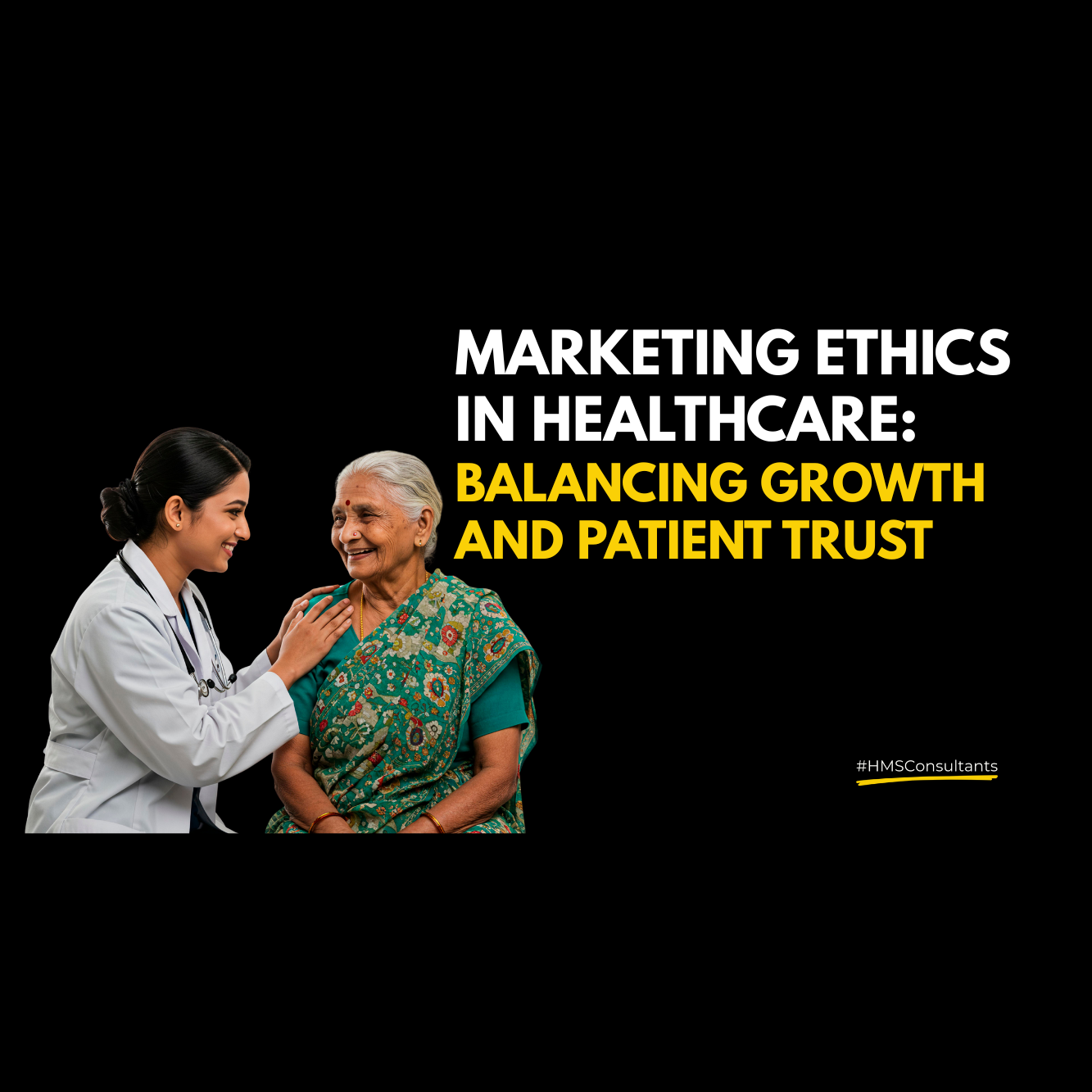
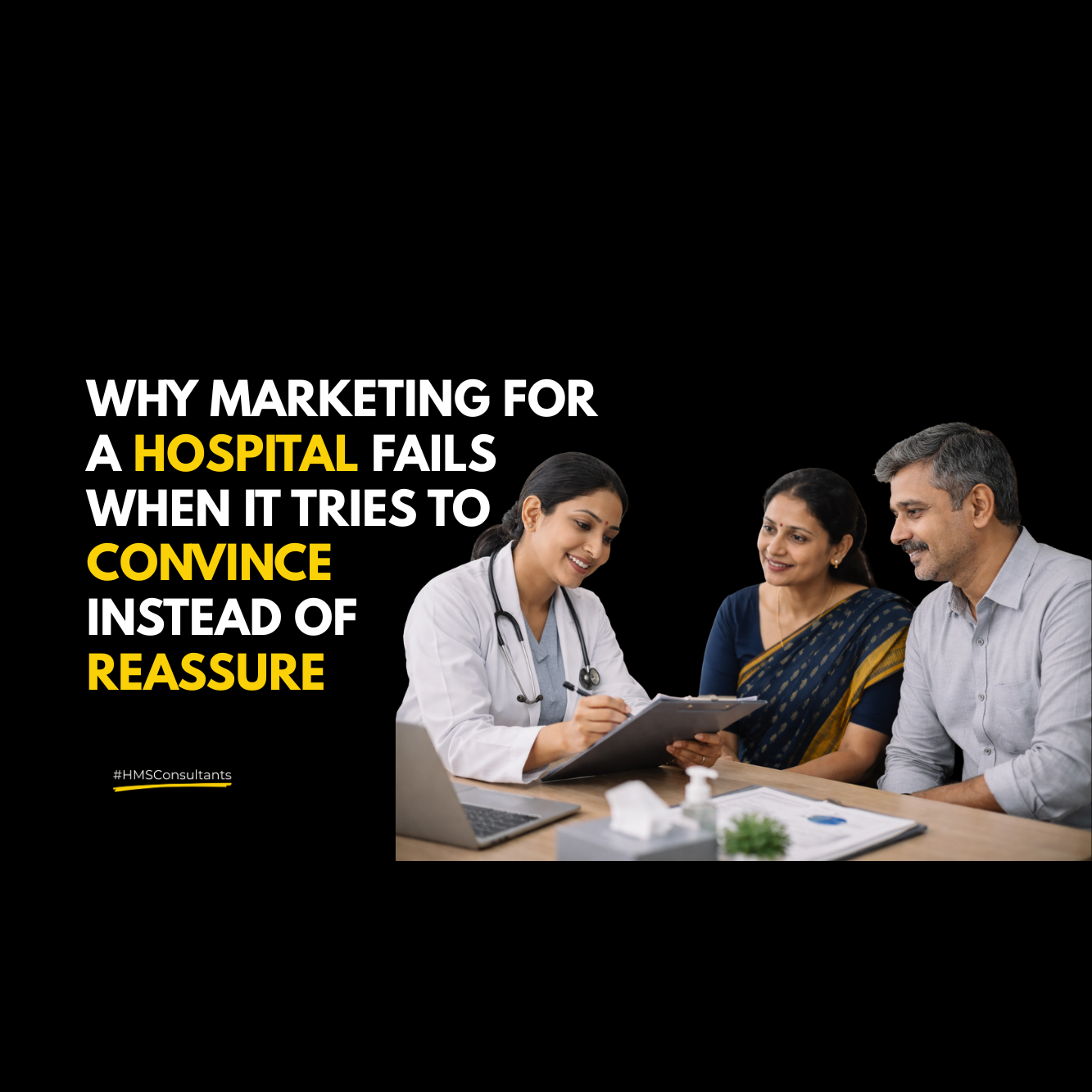
  • Why Marketing for a Hospital Fails When It Tries to “Convince” Instead of Reassure

    Why Marketing for a Hospital Fails When It Tries to “Convince” Instead of Reassure

    Why Marketing for a Hospital Fails When It Tries to “Convince” Instead of Reassure

    Written by
    Published on
    Share This

    Marketing for a hospital is often approached with the same mindset used in other industries: attract attention, highlight strengths, differentiate aggressively, and push for action. On paper, this approach appears logical. In practice, it quietly undermines trust.

    Hospitals that struggle with inconsistent enquiries, hesitant patients, and unpredictable growth are rarely suffering from lack of visibility. They are suffering from a mismatch between how marketing communicates and how patients make healthcare decisions. In healthcare, patients are not looking to be convinced. They are looking to feel safe.

    This difference defines whether marketing works or merely exists.

    Why Persuasion Is the Wrong Goal in Hospital Marketing

    Persuasion assumes that patients are neutral observers waiting to be influenced. In reality, patients approach hospitals from a place of anxiety, uncertainty, and emotional vulnerability. They are not evaluating options casually they are seeking reassurance under pressure.

    Marketing for a hospital that focuses on convincing patients to choose faster, act sooner, or commit decisively often increases resistance. Patients sense urgency where they need calm. They see promotion where they need clarity.

    In healthcare, persuasion without reassurance feels risky.

    How Patients Interpret Hospital Marketing Messages

    Patients do not analyse hospital marketing messages consciously. They respond instinctively. Tone, language, and framing shape whether a hospital feels trustworthy or overwhelming.

    Messages that emphasise superiority, scale, or urgency may attract attention but fail to reduce fear. Patients may read, watch, or engage, yet still delay contact. The decision barrier remains intact because emotional needs were not addressed.

    Effective marketing for a hospital aligns with how patients process information during stress. It slows the decision down instead of pushing it forward prematurely.

    Why “More Information” Often Creates Less Confidence

    Hospitals often respond to hesitation by adding information. More service pages, more credentials, more technology descriptions, more achievements. While well-intentioned, this approach can overwhelm patients already struggling to process complex medical choices.

    Confidence does not come from information volume. It comes from information relevance. Patients want to know what applies to their situation, what will happen next, and what support looks like in practice.

    Marketing that organises information around patient questions builds confidence. Marketing that showcases everything builds confusion.

    The Emotional Contract Behind Marketing for a Hospital

    Every hospital marketing message enters into an emotional contract with the patient. It sets expectations about communication, care, and behaviour. When those expectations are not met, trust weakens quickly.

    This is why marketing promises must be restrained and precise. Overstatement, even subtle, creates a gap that experience cannot always bridge. Patients may not complain, but they disengage.

    Strong hospital marketing respects this contract. It under-promises and over-delivers, allowing trust to grow organically.

    Why Reassurance Converts Better Than Promotion

    Reassurance answers the questions patients are often afraid to ask. Will I be listened to? Will things be explained clearly? Will decisions be rushed? Will I be treated with respect? Will there be support if complications arise?

    Marketing for a hospital that acknowledges these concerns openly creates a sense of safety. Patients feel seen rather than targeted. This feeling lowers resistance and shortens the decision cycle naturally.

    Conversion improves not because patients are pushed, but because hesitation dissolves.

    The Link Between Marketing and Patient Experience

    Marketing does not end when a patient contacts the hospital. It continues through every interaction. If the tone of enquiry handling, consultation, billing, or follow-up contradicts the reassurance marketing provided, trust erodes.

    This is why marketing for a hospital cannot be separated from patient experience design. Communication before contact must match communication during care. When alignment exists, marketing strengthens experience. When it does not, marketing becomes a liability.

    Hospitals that understand this treat marketing as an extension of care, not a separate activity.

    Why Hospitals Mistake Activity for Effectiveness

    Many hospitals equate active marketing with effective marketing. Regular posts, frequent campaigns, multiple platforms, and constant updates create a sense of motion. Yet growth remains uneven.

    The missing element is often emotional alignment. Activity amplifies whatever message is present. If the message does not reassure, more activity simply amplifies uncertainty.

    Effective marketing for a hospital is quieter, steadier, and more deliberate. It prioritises tone over volume.

    The Long-Term Advantage of Reassurance-Led Marketing

    Hospitals that build marketing around reassurance experience slower but steadier growth. Patients arrive more informed. Consultations are smoother. Acceptance rates improve. Referrals increase without prompting.

    Over time, marketing dependency reduces. Reputation begins to carry weight. Growth becomes less volatile because trust compounds.

    This is the opposite of short-term promotional spikes, which demand constant renewal.

    Conclusion: Marketing for a Hospital Succeeds When It Reduces Fear, Not When It Pushes Choice

    Hospitals do not need louder marketing. They need calmer marketing.

    Marketing for a hospital works when it respects the emotional reality of healthcare decisions. Patients do not want to be convinced. They want to feel understood, supported, and safe.

    Hospitals that design marketing around reassurance rather than persuasion build trust before the first visit. And in healthcare, trust is the only marketing outcome that truly sustains growth.

    Contact Us HMS Consultants

    Marketing for a hospital is the process of building patient trust, awareness, and confidence through clear communication, consistent experience, and ethical messaging. It focuses on helping patients feel reassured and informed rather than persuading them aggressively.

    Doctors Digital Marketing I Healthcare Marketing I Hospital Marketing Strategies I Marketing ideas for clinics I Marketing Trends 2025 I Medical Marketing I Social Media Marketing

    is something we strongly believe in, which means ‘Knowledge without application is the same as having no knowledge at all

    Akhil Dave

    Principle Consultant

    Ready to take your Personal Brand to the next level?

    Share your details below and we will connect with you to discuss your growth strategy.
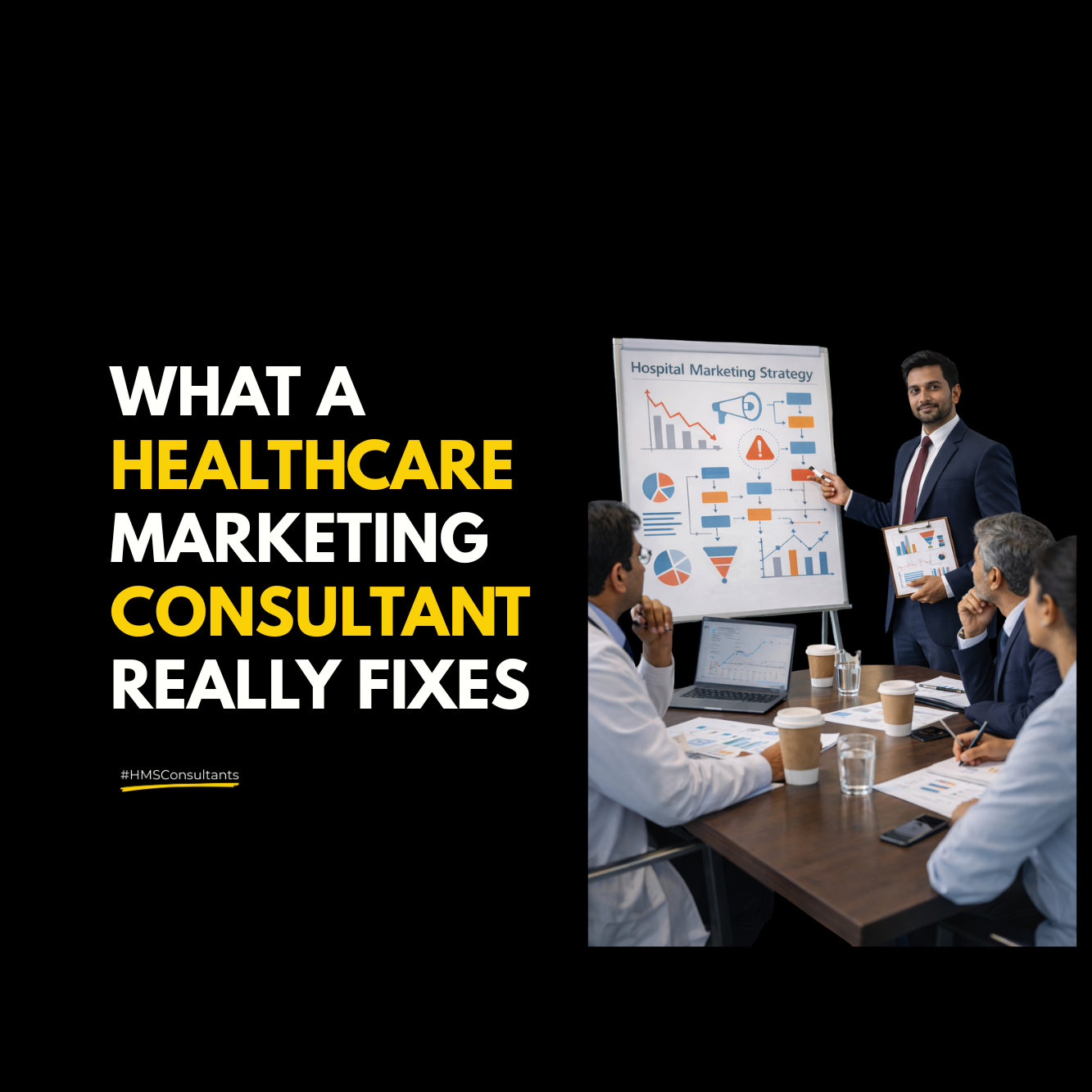
    • Why a Hospital Marketing Strategy Fails When It Is Built Around Channels Instead of Decisions

      Why a Hospital Marketing Strategy Fails When It Is Built Around Channels Instead of Decisions

      Why a Hospital Marketing Strategy Fails When It Is Built Around Channels Instead of Decisions

      Written by
      Published on
      Share This

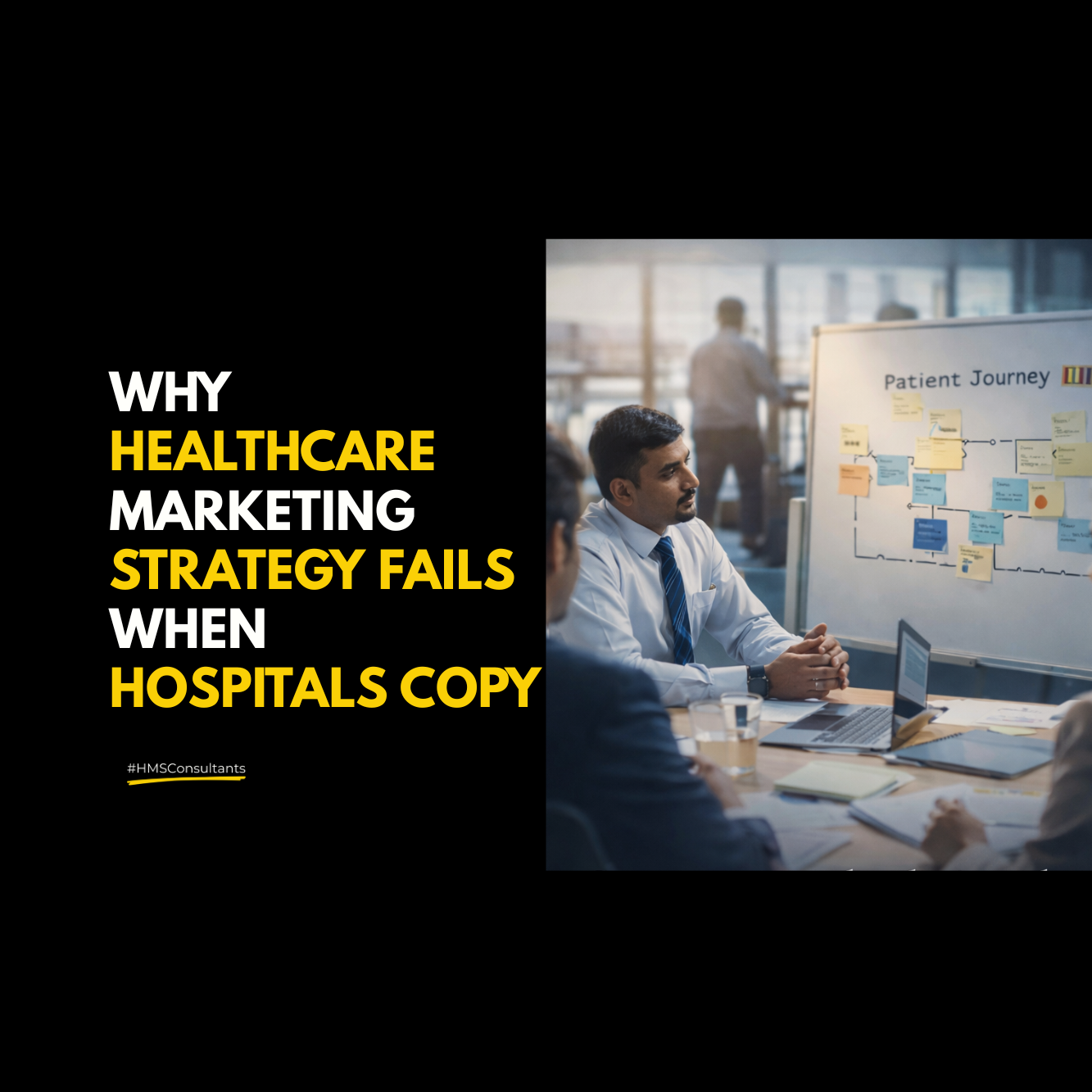
      Hospital marketing strategy is often discussed in terms of platforms. Websites, social media, Google Ads, SEO, WhatsApp, offline branding, referral programmes strategy meetings frequently revolve around where the hospital should be visible. While channel selection matters, it is rarely the reason marketing succeeds or fails.

      Most hospital marketing strategies fail not because the wrong channels were chosen, but because the strategy was never anchored to how patients actually make decisions.

      In healthcare, visibility does not create confidence. Decision clarity does.

      Why Channel-First Thinking Dominates Hospital Marketing

      Hospitals operate in complex, time-constrained environments. Leadership wants clarity, teams want direction, and agencies want execution scope. Channels offer structure. They are easy to plan, easy to measure, and easy to justify.

      As a result, hospital marketing strategy often becomes a checklist of activities rather than a framework for influencing patient behaviour. Effort increases, activity looks consistent, but outcomes remain volatile.

      The mistake is subtle. Marketing becomes busy without becoming meaningful.

      How Patients Actually Decide And Why Strategy Misses This

      Patients do not move through channels. They move through states of mind.

      They begin with uncertainty, move into comparison, seek reassurance, and finally act when confidence outweighs fear. A hospital marketing strategy that ignores these stages may reach patients repeatedly without ever supporting their decision.

      This is why many hospitals experience strong traffic with weak conversion. The strategy addressed exposure, not hesitation.

      From a healthcare marketing strategy perspective, understanding why a patient pauses is far more valuable than knowing where they came from.

      Why More Marketing Does Not Fix a Weak Strategy

      When outcomes underperform, hospitals often increase marketing intensity. More ads, more posts, more campaigns. This response feels logical, but it treats symptoms rather than causes.

      If messaging does not reduce uncertainty, repetition only amplifies confusion. Patients see the hospital more often, but do not feel more confident. Over time, marketing begins to feel intrusive rather than reassuring.

      A hospital marketing strategy must first resolve doubt before it seeks attention.

      The Role of Trust in Hospital Marketing Strategy

      Trust is not a by-product of marketing in healthcare. It is the objective.

      Every element of hospital marketing strategy should answer one question clearly: Does this help a patient feel safer about choosing us? If the answer is unclear, the activity adds noise without value.

      Trust is built through consistency of message, clarity of explanation, and alignment between promise and experience. When strategy focuses on these principles, channels naturally perform better.

      When it does not, no channel can compensate.

      Why Strategy Breaks When Marketing Is Isolated From Experience

      Hospital marketing strategy often exists separately from operational reality. Marketing communicates excellence, but patient experience delivers inconsistency. This gap weakens credibility faster than any negative review.

      Patients may be impressed initially, but trust erodes when communication, processes, or behaviour contradict expectations. Marketing then has to work harder to repair damage it did not create.

      A strong hospital marketing strategy is inseparable from patient experience design. One reinforces the other.

      What a Decision-Centric Hospital Marketing Strategy Looks Like

      A decision-centric strategy begins by mapping where patients hesitate, what they fear, and what information they lack. Messaging is then designed to resolve these gaps gradually, not force action prematurely.

      Such a strategy evolves over time. It learns from patient interactions, reviews, and outcomes. Instead of changing direction frequently, it deepens insight.

      Hospitals that adopt this approach see steadier growth, better-prepared patients, and lower marketing volatility.

      Why Leadership Thinking Determines Strategy Quality

      Hospital marketing strategy reflects leadership priorities. When leadership focuses on short-term numbers, strategy becomes reactive. When leadership prioritises clarity and consistency, strategy matures.

      This is why similar hospitals using similar channels experience vastly different outcomes. Strategy quality is less about tools and more about intent.

      Hospitals that treat marketing as a leadership function, not a tactical one, build stronger foundations for growth.

      The Long-Term Cost of Channel-Driven Strategy

      Channel-driven strategies fragment over time. Each platform develops its own logic, tone, and objectives. Messaging becomes inconsistent. Learning is lost. Patients receive mixed signals.

      Eventually, hospitals restart strategy entirely new agencies, new platforms, new promises  without realising the underlying issue remains unresolved.

      This cycle is costly, exhausting, and avoidable.

      Conclusion: Hospital Marketing Strategy Succeeds When It Follows the Patient’s Mind, Not the Platform

      A hospital marketing strategy should not be defined by where the hospital appears, but by how patients decide.

      Channels are tools. Decisions are the real battleground.

      Hospitals that build strategy around patient hesitation, trust formation, and clarity create systems that grow steadily and sustainably. Those that build strategy around platforms chase attention without earning confidence.

      In healthcare, growth does not come from being seen everywhere.
      It comes from being understood at the right moment.

      That is what a real hospital marketing strategy is designed to do.

      Contact Us HMS Consultants

      A hospital marketing strategy is a structured approach to attracting, converting, and retaining patients by aligning communication, experience, and trust-building across the patient journey. It focuses not just on visibility, but on helping patients make confident healthcare decisions.

      Doctors Digital Marketing I Healthcare Marketing I Hospital Marketing Strategies I Marketing ideas for clinics I Marketing Trends 2025 I Medical Marketing I Social Media Marketing

      is something we strongly believe in, which means ‘Knowledge without application is the same as having no knowledge at all

      Akhil Dave

      Principle Consultant

      Ready to take your Personal Brand to the next level?

      Share your details below and we will connect with you to discuss your growth strategy.

      • Why Healthcare Branding Is Not About Logos, Colours, or Taglines

        Why Healthcare Branding Is Not About Logos, Colours, or Taglines

        Why Healthcare Branding Is Not About Logos, Colours, or Taglines

        Written by
        Published on
        Share This

        Healthcare branding is often misunderstood at its core. When hospitals talk about branding, conversations usually revolve around visual identity logos, colour palettes, typography, taglines, and design consistency. While these elements are visible and necessary, they represent only the surface of branding, not its substance.

        This misunderstanding explains why many hospitals invest in rebranding exercises yet see little change in patient trust, loyalty, or long-term growth. The problem is not poor design. The problem is that healthcare branding is treated as an aesthetic exercise instead of a behavioural one.

        In healthcare, branding is not what a hospital looks like. It is what patients experience, remember, and believe.

        Why Healthcare Branding Is Formed in Moments, Not Materials

        Patients do not build opinions about hospitals while looking at logos. They build opinions while waiting, asking questions, receiving explanations, facing uncertainty, and making decisions under stress. These moments shape perception far more powerfully than any visual asset.

        Healthcare branding is formed when a patient feels heard instead of rushed, when clarity replaces confusion, and when reassurance is offered at the right time. These experiences become stories patients share consciously or subconsciously with family, friends, and online communities.

        Hospitals that focus only on visual branding often miss this deeper layer. They look polished but feel inconsistent. Patients notice this gap immediately, even if they cannot articulate it.


        The Difference Between Corporate Branding and Healthcare Branding

        Corporate branding relies heavily on differentiation, recall, and emotional association. Healthcare branding operates under a different psychological contract. Patients are not looking for novelty or personality they are looking for safety, predictability, and trust.

        This is why branding strategies borrowed from consumer industries often fail in healthcare. They prioritise attention over reassurance and uniqueness over reliability. In healthcare, excessive differentiation can actually increase anxiety.

        Effective healthcare branding reduces uncertainty. It makes outcomes feel predictable, processes feel understandable, and decisions feel supported. This is why the strongest hospital brands often feel calm rather than exciting.

        Why Healthcare Branding Breaks When It Is Owned by One Department

        Many hospitals assign branding responsibility to marketing or design teams. This creates a structural problem. Branding in healthcare is expressed through clinical communication, front-desk behaviour, billing conversations, follow-ups, and discharge processes areas marketing teams do not fully control.

        When branding is isolated within one department, inconsistency is inevitable. Visual messaging may promise care and clarity, while operational reality delivers confusion or urgency. Patients experience this as misalignment, not marketing failure.

        Healthcare branding succeeds only when it is owned institution-wide and reinforced at every patient touchpoint.

        How Patient Experience Becomes the Real Brand

        Patients remember how they were treated far more clearly than what was promised. Over time, these memories form the hospital’s brand reputation.

        A hospital may position itself as patient-centric, but if appointment systems feel chaotic or explanations feel rushed, the brand collapses at the point of experience. Conversely, hospitals with modest visibility but consistent experience often develop stronger reputations organically.

        This is why healthcare branding cannot be separated from patient experience. Experience is not a support function; it is the brand delivery mechanism.

        Why Healthcare Branding Directly Impacts Growth

        Strong healthcare branding reduces friction across the entire patient journey. Patients hesitate less, ask fewer repetitive questions, and feel more confident in decisions. Referrals increase because recommending the hospital feels safe. Staff perform better because expectations are clearer.

        From a hospital growth perspective, branding that is rooted in experience lowers acquisition costs, improves conversion, and stabilises demand. Growth becomes less dependent on constant promotion and more dependent on reputation.

        This is the compounding power of effective healthcare branding.

        The Long-Term Cost of Superficial Branding

        Hospitals that focus only on visual rebranding often find themselves repeating the exercise every few years. Each cycle promises renewed growth but delivers diminishing returns. Patients notice the polish but still experience inconsistency.

        Over time, trust weakens. Marketing must work harder to compensate. Branding becomes an expense instead of an asset.

        Superficial branding does not fail immediately. It fails gradually by not compounding.

        What Strong Healthcare Branding Actually Looks Like

        Strong healthcare branding feels consistent across time, people, and situations. Patients encounter the same clarity online as they do in person. Communication feels aligned across departments. Expectations are set honestly and met reliably.

        This consistency reassures patients at every stage. It also empowers teams, because behaviour aligns naturally with brand values instead of being forced through guidelines.

        In such hospitals, branding stops being discussed frequently because it simply works.

        Why Healthcare Branding Is a Leadership Responsibility

        Healthcare branding cannot be delegated entirely to marketing agencies or design teams. It requires leadership commitment to consistency, clarity, and patient-centred thinking.

        Leaders shape how decisions are made, how staff are supported, and how trade-offs are handled. These decisions directly influence patient experience, and therefore brand perception.

        Hospitals with strong brands are rarely accidental. They are intentionally designed from the top down and reinforced from the inside out.

        Conclusion: Healthcare Branding Is What Patients Trust When No One Is Explaining

        In healthcare, branding is not what hospitals say about themselves. It is what patients believe after experiencing care.

        Logos, colours, and taglines may attract attention, but they do not sustain trust. Trust is sustained through consistency, clarity, and behaviour.

        Hospitals that understand healthcare branding stop chasing perception and start designing experience. Over time, this approach creates institutions that patients recognise, trust, and return to not because of how they look, but because of how they feel.

        That is the only kind of healthcare branding that truly lasts.


        Contact Us HMS Consultants

        Healthcare branding is the process of shaping how patients perceive, trust, and experience a hospital or healthcare provider. It goes beyond logos and visuals and is formed through patient interactions, communication clarity, staff behaviour, and overall care experience across the patient journey.

        Doctors Digital Marketing I Healthcare Marketing I Hospital Marketing Strategies I Marketing ideas for clinics I Marketing Trends 2025 I Medical Marketing I Social Media Marketing

        is something we strongly believe in, which means ‘Knowledge without application is the same as having no knowledge at all

        Akhil Dave

        Principle Consultant

        Ready to take your Personal Brand to the next level?

        Share your details below and we will connect with you to discuss your growth strategy.

        • Why Personal Branding for Doctors Fails When It Is Treated Like Marketing

          Why Personal Branding for Doctors Fails When It Is Treated Like Marketing

          Why Personal Branding for Doctors Fails When It Is Treated Like Marketing

          Written by
          Published on
          Share This

          Personal branding for doctors has become one of the most misunderstood concepts in healthcare growth. Everywhere, doctors are advised to be visible, post consistently, build an online presence, and “market themselves” to stay relevant. Social media platforms reinforce this advice by rewarding frequency, engagement, and personality-driven content. On the surface, this appears logical. In practice, it often produces the opposite result.

          Many doctors invest time and effort into visibility but still struggle to convert attention into trust, loyalty, or meaningful patient relationships. The issue is not effort or intent. The issue is that personal branding for doctors is repeatedly approached as marketing, rather than as trust architecture.

          In healthcare, this distinction is critical.

          Why Visibility Alone Weakens Doctor Credibility Over Time

          Doctors are not evaluated the way consumer brands are. Patients do not follow doctors for entertainment, opinions, or relatability alone. They follow because they are seeking reassurance during moments of uncertainty. When personal branding focuses primarily on visibility, frequency, or trend participation, credibility begins to erode quietly.

          Patients may engage with content, but engagement does not equal confidence. Over time, excessive visibility without depth creates familiarity without authority. Doctors begin to feel “present everywhere” but not necessarily trusted more.

          This is why many doctors experience a plateau despite consistent posting. The audience grows, but trust does not compound.

          The Psychological Gap Between Doctors and Branding Advice

          Most personal branding frameworks come from industries where attention is the primary currency. Healthcare operates on a different psychological contract. Doctors are bound by ethics, responsibility, and trust expectations that do not allow exaggerated claims, emotional manipulation, or self-promotion in the conventional sense.

          This creates internal conflict. Doctors feel uncomfortable highlighting achievements, uncertain about tone, and wary of appearing commercial. As a result, branding efforts either feel forced or overly cautious. Neither builds strong trust.

          Effective personal branding for doctors resolves this conflict by shifting focus from self-promotion to patient clarity.

          What Patients Actually Look for in a Doctor’s Personal Brand

          Patients rarely search for “the most popular doctor” or “the most followed specialist.” They search for signs of safety. They want to know whether a doctor explains clearly, listens patiently, respects concerns, and guides decisions calmly.

          Personal branding that works in healthcare mirrors the consultation experience patients hope to have. It answers doubts before they are voiced. It explains complexity without intimidation. It communicates boundaries honestly and avoids sensationalism.

          When patients encounter this kind of content repeatedly, trust forms naturally. The doctor feels familiar in a reassuring way, not in a performative one.

          Why Educational Content Alone Is Not Enough

          Many doctors focus personal branding entirely on education. They share medical facts, awareness posts, and procedural explanations. While education is important, it does not automatically translate into trust.

          Patients do not struggle because of lack of information. They struggle because of uncertainty around implications, outcomes, and decisions. Education that does not address emotional context remains incomplete.

          Personal branding for doctors becomes effective when education is paired with guidance. Patients want to understand not just what a condition is, but what it means for them.

          The Role of Consistency in Doctor Personal Branding

          Consistency in personal branding is often misunderstood as posting regularly. In healthcare, consistency of thinking matters far more than consistency of output.

          Patients trust doctors whose communication philosophy remains stable across time. The tone is calm. The message is measured. The approach to care is clear. Even infrequent content builds authority when it reflects a coherent worldview.

          Doctors who chase trends sacrifice this coherence. Doctors who protect it build durable brands.

          Why Personal Branding Cannot Be Separated From Practice Environment

          Personal branding for doctors does not exist in isolation. Patients eventually experience the hospital, clinic, or system surrounding the doctor. If the experience contradicts the brand promise, trust weakens.

          This is why personal branding works best when aligned with institutional clarity. The doctor’s communication should reflect how care is actually delivered. When alignment exists, branding reinforces experience. When it does not, branding feels misleading, even unintentionally.

          Long-term trust requires this alignment.

          How Personal Branding Influences Patient Decisions Before First Contact

          A strong personal brand shortens the trust-building phase. Patients arrive with familiarity. Consultations feel smoother. Resistance reduces. Conversations become more productive. Decisions are made with less friction.

          These outcomes are often attributed to “better leads” or “marketing success.” In reality, they are the result of pre-built trust through consistent, patient-centred communication.

          From a healthcare growth perspective, this is one of the most efficient advantages personal branding can create.

          Why Most Doctors Quit Personal Branding Too Early

          Doctors often stop personal branding efforts because results feel unclear. Likes fluctuate. Growth seems slow. Conversion is difficult to attribute.

          What is missed is that personal branding in healthcare compounds quietly. Trust forms over repeated exposure, not immediate response. The payoff shows up in subtle ways: easier consultations, higher acceptance, stronger referrals, and long-term loyalty.

          Doctors who expect immediate outcomes abandon the process before it matures.

          Conclusion: Personal Branding for Doctors Is Not About Being Known, But Being Trusted

          Personal branding for doctors fails when it mimics consumer marketing. It succeeds when it reflects clinical thinking, ethical restraint, and patient empathy.

          Doctors do not need to be louder. They need to be clearer. They do not need to be everywhere. They need to be consistent. They do not need to sell themselves. They need to reduce uncertainty.

          In healthcare, trust is the brand.

          Doctors who understand this build personal brands that last longer than algorithms, trends, or platforms and that is the only kind of branding that truly works.

          Contact Us HMS Consultants

          Personal branding for doctors is the process of building trust, credibility, and familiarity with patients through consistent communication of a doctor’s values, thinking, and approach to care. It is not about self-promotion, but about helping patients feel confident and informed before they ever step into a clinic or hospital.

          Doctors Digital Marketing I Healthcare Marketing I Hospital Marketing Strategies I Marketing ideas for clinics I Marketing Trends 2025 I Medical Marketing I Social Media Marketing

          is something we strongly believe in, which means ‘Knowledge without application is the same as having no knowledge at all

          Akhil Dave

          Principle Consultant

          Ready to take your Personal Brand to the next level?

          Share your details below and we will connect with you to discuss your growth strategy.

          • Why Healthcare Marketing Must Be Taught in Medical Colleges in India

            Why Healthcare Marketing Must Be Taught in Medical Colleges in India

            Why Healthcare Marketing Must Be Taught in Medical Colleges in India

            Written by
            Published on
            Share This

            Healthcare marketing is rapidly becoming an essential skill for doctors, hospitals, and healthcare institutions in India. Patients today search online before choosing a doctor, trust digital platforms for health information, and increasingly rely on social media, YouTube, and AI tools to understand medical conditions. Yet, despite this shift, healthcare marketing and ethical digital communication are still not taught in most medical colleges in India. Medical students graduate with strong clinical knowledge, but without structured education on healthcare branding, patient communication, digital responsibility, or practice development. This growing gap between medical education and real-world healthcare communication is now impacting both patient trust and the professional readiness of future doctors.

            This is why the need for healthcare marketing education in medical colleges has become critical. Introducing healthcare marketing and branding concepts during MBBS and medical training can prepare future doctors to communicate ethically, counter misinformation, build credible digital identities, and develop patient-centric healthcare practices. As healthcare becomes increasingly digital, marketing education is no longer about promotion it is about responsible public health communication.

            The digital health conversation is exploding.

            But healthcare education around it is still silent.

            Scroll through any social platform today and you’ll see an ocean of health-related content reels on immunity, podcasts on hormones, influencers talking about gut health, entrepreneurs selling wellness programs, and creators offering medical advice.

            Some of it is helpful.
            Much of it is unverified.
            And a growing portion is dangerously misleading.

            At the same time, India is producing thousands of highly qualified doctors every year experts in diagnosis, treatment, and patient care.

            Yet, when these doctors step into the real world, they are rarely prepared for one reality:

            Healthcare today is not only practiced in clinics and hospitals. It is practiced on digital platforms.

            Patients are no longer passive recipients of care.
            They research.
            They compare.
            They follow.
            They judge credibility online before they ever step into a consultation room.

            And this raises a serious question for our education system:

            Why isn’t Healthcare Marketing and Ethical Health Communication taught in medical colleges?

            The Reality Young Doctors Face After Graduation

            In my years of working closely with hospitals, doctors, and healthcare institutions across India, one pattern repeats itself.

            Doctors leave medical college extremely strong in clinical knowledge but almost completely unprepared for:

            • Building their professional identity
            • Communicating medical knowledge to the public
            • Managing their digital presence
            • Educating patients ethically at scale
            • Creating trust in competitive healthcare markets
            • Developing their own practice or institutional brand

            Most learn marketing accidentally.

            Through:

            •  trial and error
            • wrong agency guidance
            • trend-based posting
            • copying influencers
            • promotional confusion
            • and sometimes reputational damage

            They were trained to save lives.
            But not trained to communicate health responsibly in a digital world.

            Why Healthcare Marketing Is Not Like Any Other Industry

            Healthcare is not FMCG.
            It is not real estate.
            It is not education.
            It is not entertainment.

            Healthcare deals with:

            • vulnerability
            • fear
            • trust
            • ethics
            • long-term reputation
            • irreversible impact

            In healthcare, marketing is not about visibility.
            It is about credibility.

            It is not about persuasion.
            It is about education.

            It is not about selling.
            It is about serving responsibly.

            This is why healthcare marketing cannot be learned from generic marketing courses or YouTube tutorials.

            It requires:
            • ethical grounding
            • patient psychology understanding
            • regulatory awareness
            • clinical sensitivity
            • long-term brand thinking

            Which is exactly why it belongs inside medical education not outside it.

            The Shift in Patient Behaviour Doctors Cannot Ignore

            The Gujarat, Delhi, Mumbai, and Bangalore patient of today and the Indian patient of tomorrow is:

            • digitally active
              • information-hungry
              • experience-driven
              • comparison-oriented
              • review-dependent
              • influenced before consultation

            Doctors are now being chosen before they are met.

            Hospitals are being evaluated before they are visited.

            Reputation is being built or broken daily on:

            • Google
            • YouTube
            • Instagram
            • LinkedIn
            • health platforms
            • AI search tools

            Healthcare communication has become part of healthcare delivery itself.

            And yet, our future doctors are learning none of it structurally.

            Why Medical Colleges Must Act Now

            Medical institutions do not only create clinicians.
            They shape the voices of healthcare in society.

            If medical colleges integrate healthcare marketing and ethical health communication education, they will:

            • empower doctors to counter misinformation
            • build responsible digital medical leaders
            • protect public health narratives
            • support entrepreneurial doctors
            • strengthen hospital ecosystems
            • reduce unethical promotional practices
            • elevate India’s healthcare credibility globally

            This is no longer optional knowledge.
            It is professional survival skill.

            What a Healthcare Marketing Education Module Should Include

            If healthcare marketing is to be taught in medical colleges, it must go far beyond “social media tips.”

            A meaningful curriculum should cover:

            1. Foundations of Healthcare Marketing

            • What healthcare marketing really means
            • Difference between commercial marketing and healthcare marketing
            • Ethics, guidelines, and responsible communication
            • The doctor’s role as an educator in society

            2. Strategic Brand Foundations

            • Doctor brand persona
            • Hospital brand identity
            • Trust-building frameworks
            • Patient psychology
            • Reputation management
            • Internal branding in healthcare
            • Staff as brand ambassadors

            3. Patient & Market Understanding

            • Patient persona creation
            • Target segment selection
            • Community needs analysis
            • Referral ecosystem
            • Local healthcare positioning

            4. Integrated Healthcare Communication (IMC)

            • Online + offline alignment
            • Content ecosystems
            • Educational campaigns
            • Community outreach models
            • Experience-driven communication

            5. Digital Platforms for Doctors

            • Social media for healthcare education
            • YouTube & long-form patient education
            • Crisis communication
            • Doctor personal branding
            • Hospital storytelling
            • Patient engagement design

            6. Practice Development Fundamentals

            • Building ethical visibility
            • Sustainable growth models
            • Patient experience mapping
            • Word-of-mouth acceleration
            • Trust-based marketing systems

            7. AI & Modern Tools for Healthcare Marketing

            • AI for patient insight research
            • Content ideation & validation
            • Communication planning
            • Workflow productivity
            • Data-driven decisions
            • Ethical use of automation

            This kind of curriculum does not make doctors “marketers.”

            It makes them responsible communicators, strategic thinkers, and future-ready healthcare leaders.

            The Opportunity for Medical Institutions

            Medical colleges today have the opportunity to lead India into a new era of healthcare professionalism.

            Through:
            • credit-based modules
            • guest lecture series
            • certificate programs
            • healthcare communication labs
            • industry immersion programs
            • ethics-based digital training

            They can ensure that future doctors are not only clinically competent but also socially responsible, digitally prepared, and strategically aware.

            A Personal Perspective

            For over a decade, I have worked exclusively in healthcare marketing and practice development.

            I have had the privilege of collaborating with:

            • hospitals and healthcare groups
            • individual doctors and specialists
            • medical universities and management institutions
            • healthcare leadership forums
            • practice development conclaves
            • student communities

            Across these interactions, one insight has become extremely clear:

            Doctors do not lack intent.
            They lack structured exposure.

            They want to educate.
            They want to build trust.
            They want to communicate responsibly.

            But no one formally prepares them for it.

            My core belief has always been simple:

            Knowing is knowing. Doing is doing.™

            If we want ethical healthcare communication in society, we must start doing something about it inside our education systems.

            Why HMS Consultants Is Building This Education Ecosystem

            At HMS Consultants, we work as a strategy-first healthcare marketing consultancy.

            But alongside hospital growth and practice development, we are deeply invested in:

            • healthcare education
            • institutional collaborations
            • student mentorship
            • doctor training
            • leadership development
            • ethical marketing frameworks

            Our work with healthcare professionals, universities, and industry bodies has consistently shown us that education is the strongest long-term intervention.

            We believe healthcare marketing must be taught not as promotion but as responsibility.

            An Open Invitation

            If you represent a:

            • medical college
            • healthcare university
            • hospital group
            • academic institution
            • student body
            • healthcare leadership forum

            and wish to explore structured healthcare marketing and ethical communication education programs, we would be happy to collaborate.

            Because the future of healthcare will not be shaped only by treatments.

            It will be shaped by how responsibly we communicate health.

            Contact Us HMS Consultants

            Healthcare marketing refers to the strategic and ethical communication of healthcare services, doctors, hospitals, and public health information to patients and communities. Unlike commercial marketing, healthcare marketing focuses on trust-building, patient education, reputation management, and responsible communication rather than promotion or sales.

            Doctors Digital Marketing I Healthcare Marketing I Hospital Marketing Strategies I Marketing ideas for clinics I Marketing Trends 2025 I Medical Marketing I Social Media Marketing

            is something we strongly believe in, which means ‘Knowledge without application is the same as having no knowledge at all

            Akhil Dave

            Principle Consultant

            Ready to take your Personal Brand to the next level?

            Share your details below and we will connect with you to discuss your growth strategy.

            • Healthcare Marketing Education & Capability Building

              Healthcare Marketing Education & Capability Building

              Healthcare Marketing Education & Capability Building

              Building ethical, strategic, and future-ready healthcare marketing capabilities for institutions, hospitals, and healthcare professionals.

              At HMS Consultants, Healthcare Marketing Education & Capability Building is a structured institutional service designed to strengthen how future and current healthcare professionals understand, communicate, and build healthcare brands.

              This service focuses on developing marketing thinking, brand sensibility, ethical communication practices, digital marketing for doctors and strategic capability within medical colleges, universities, hospitals, and healthcare organizations.

              What is Healthcare Marketing?
              Watch the Video

              Our objective is not to teach tactics
              but to build long-term capability inside the healthcare ecosystem.

              HMS Consultants

              Why You Need This Service

              Healthcare today is no longer defined only by clinical excellence.
              It is shaped by trust, visibility, communication, experience, and perception.

              Yet most healthcare professionals enter practice with:

              • No formal exposure to healthcare marketing
              • No understanding of ethical digital communication
              • No clarity on brand-building in healthcare
              • No framework for patient-centric engagement
              • No preparation for today’s competitive, digital-first healthcare environment

              At the same time:

              • Patients are choosing doctors online
              • Health information is dominated by non-medical influencers
              • Hospitals are expected to behave like healthcare brands
              • Doctors are expected to communicate, not just treat

              This gap between clinical education and real-world healthcare practice is widening.

              Healthcare Marketing Education & Capability Building exists to close this gap.

              HMS Consultants

              WHAT TO EXPECT FROM THIS SERVICE

              When institutions and healthcare organizations engage HMS under this service, they can expect a structured, contextual, and healthcare-specific education approach, focused on capability not motivation.

              Healthcare Marketing Foundations

              Core understanding of how healthcare marketing differs from traditional marketing, including trust dynamics, ethical boundaries, patient behavior, and healthcare brand structures.

              Brand & Communication Frameworks

              Training around brand persona, patient personas, positioning, experience design, internal branding, and the role of healthcare professionals as brand ambassadors.

              Ethical Digital & Marketing Practices

              Clear frameworks on ethical content, patient communication, digital presence, and professional visibility aligned with healthcare values and regulations.

              Strategic Thinking Development

              Helping students and professionals move from random promotion to structured marketing thinking, planning, and long-term brand building.

              Modern Capability Integration

              Introduction to AI-assisted research, content planning, patient education systems, and data-informed healthcare communication.

              Institution-Centric Customisation

              All programs are designed based on the academic level, institutional goals, hospital environment, or professional maturity of the audience.

              HMS Consultants

              SERVICE DELIVERY FORMATS

              Healthcare Marketing Education & Capability Building can be delivered through:

              • Medical college & university guest lectures
              • Certificate and foundation programs in assciation with AHMP India Foundation
              • Hospital in-house capability development
              • Faculty development workshops
              • Leadership and management programs
              • Young doctor and healthcare entrepreneur programs
              • Long-term academic collaborations
              Each engagement is custom-built, not templated.

              HMS CONSULTANTS APPROACH

              This service is led and curated by Akhilchandra Dave, Founder & Principal Consultant, HMS Consultants with experience spanning: 

              • Healthcare marketing strategy
              • Practice development consulting
              • Brand building for doctors and hospitals
              • Healthcare education and mentoring
              • Institutional healthcare ecosystems
              • Professional capability development
              HMS brings a unique combination of:
              • On-ground healthcare consulting
              • Institutional education exposure
              • Industry frameworks
              • Ethical healthcare positioning
              • Strategic brand architecture
              This ensures the education remains practical, ethical, contextual, and future ready.

              It is a structured institutional service that helps medical colleges, hospitals, and healthcare organizations build foundational and advanced understanding of healthcare marketing, branding, ethical communication, and strategic growth.

              Help Center

              FAQs

              Get expert answers to common questions about healthcare marketing strategies.

              Need More Answers?

              Click the button below and fill up the form, our team will reach out to you related to your project’s queries.

              “Knowing is Knowing, Doing is Doing”

              is something we strongly believe in, which means ‘Knowledge without application is the same as having no knowledge at all

              Akhil Dave

              Principle Consultant

              Ready to build healthcare marketing capability within your institution?

              Connect with HMS Consultants to explore structured healthcare marketing education programs designed for medical colleges, hospitals, and healthcare organizations.

                Learning by HMS Consultants

                Stay Updated and Connected

                Stay ahead with our expert insights and latest updates in healthcare marketing. Visit our blogs for valuable tips, industry trends, etc.

                What more we have to offer?

                Discover other services

                If you’re finding some other services fit for your business, you’ll probably find it right here!

              • Why Most Healthcare Marketing Fails After the First Year, And How to Build a 5-Year Growth Engine

                Why Most Healthcare Marketing Fails After the First Year, And How to Build a 5-Year Growth Engine

                Why Most Healthcare Marketing Fails After the First Year, And How to Build a 5-Year Growth Engine

                Written by
                Published on
                Share This

                The first year of healthcare marketing often feels encouraging. Visibility improves, activity increases, enquiries start coming in, and there is a sense that growth has finally begun. Hospitals feel validated in their investment in marketing, and leadership gains confidence that the right direction has been chosen.

                Then something changes.

                Results begin to plateau. Costs rise. Engagement feels repetitive. The same campaigns that once delivered outcomes now require higher spending to maintain momentum. Marketing feels more like maintenance than progress. At this stage, many hospitals conclude that marketing has “stopped working.”

                In reality, healthcare marketing rarely fails suddenly. It erodes slowly because it was never designed for longevity.

                Why First-Year Marketing Often Looks Successful

                Early success in hospital marketing is usually driven by novelty. New campaigns capture attention. Fresh content stands out. Platforms reward initial activity. Internal teams feel energised by visible movement. For hospitals that previously had little structure, even basic consistency produces noticeable improvement.

                This phase creates a dangerous illusion. Leadership assumes that repeating the same efforts will continue delivering growth. Marketing is seen as a repeatable activity rather than an evolving system.

                The problem is that novelty fades quickly in healthcare. Trust, unlike attention, does not compound automatically.

                The Core Reason Healthcare Marketing Loses Momentum

                Healthcare marketing fails after the first year because most hospitals build campaigns, not engines.

                Campaigns are time-bound. They depend on constant input, fresh creatives, new platforms, and increasing budgets. Engines, on the other hand, are systems that improve with use. They learn, adapt, and compound insight over time.

                When marketing is campaign-led, growth depends on continuous stimulation. When stimulation stops or becomes repetitive, performance declines. Hospitals then chase new ideas without fixing the underlying structure.

                This is why marketing fatigue sets in for both teams and audiences.

                Why Short-Term Thinking Dominates Hospital Marketing Decisions

                Healthcare leaders operate in high-pressure environments. Monthly numbers matter. OPD fluctuations create anxiety. Budget reviews demand justification. Under these conditions, short-term performance naturally dominates decision-making.

                Marketing strategies are adjusted frequently as directions change. Platforms are switched. Messaging resets. While these changes feel proactive, they often disrupt learning cycles. Marketing never gets enough time to mature, and insights are lost before they compound.

                Long-term growth requires patience that healthcare systems rarely allow themselves.

                The Cost of Replacing Strategy With Activity

                When marketing underperforms, hospitals often increase activity rather than improve strategy. More posts, more ads, more platforms, more content. This creates motion without direction.

                Over time, activity becomes disconnected from outcomes. Teams focus on execution rather than learning. Reports show effort, not progress. Leadership feels busy but not confident.

                This is the point where marketing becomes exhausting rather than enabling.

                Why Sustainable Hospital Growth Requires a Different Mindset

                Sustainable healthcare marketing is not about constant visibility. It is about building systems that repeatedly reduce patients’ uncertainty.

                Patients return, refer, and trust when they experience consistency. Consistency does not come from campaigns. It comes from aligned messaging, predictable experience, and clear decision pathways.

                Hospitals that grow steadily treat marketing as a long-term investment in trust infrastructure, not a series of promotional bursts.

                What a 5-Year Healthcare Marketing Engine Actually Looks Like

                A long-term marketing engine is built around learning loops rather than output targets. Each year strengthens the next. Patient questions inform content. Interaction patterns refine messaging. Experience gaps shape communication. Reviews influence education. Referrals reinforce positioning.

                Instead of resetting strategy annually, hospitals deepen it. Marketing becomes calmer, clearer, and more efficient over time. Spend stabilises. Conversion improves. Dependence on aggressive promotion has reduced.

                This is how marketing shifts from a cost centre to a growth asset.

                Why Hospitals That Think Long-Term Spend Less Over Time

                Counterintuitively, long-term marketing thinking reduces expenditure. Hospitals that build engines rely less on constant acquisition because retention and referrals improve naturally. Content remains relevant longer. SEO authority compounds. Brand trust strengthens.

                Short-term marketing requires escalation. Long-term marketing rewards consistency.

                From a hospital growth perspective, this difference determines whether marketing remains manageable or becomes a perpetual struggle.

                The Role of Leadership in Long-Term Marketing Success

                No marketing engine survives without leadership alignment. Leaders must protect the strategy from constant disruption. They must allow learning cycles to complete. They must evaluate trends rather than isolated months.

                Hospitals that treat marketing as a leadership agenda rather than a departmental task are far more likely to sustain growth beyond the first year. Strategy continuity becomes a competitive advantage.

                Why Most Hospitals Restart Instead of Evolving

                When marketing feels stale, many hospitals restart rather than refine. New agencies, new platforms, new directions. Each restart discards accumulated insight. The system never matures.

                Hospitals that evolve rather than restart carry learning forward. They optimise, not replace. Growth becomes incremental but durable.

                This distinction separates organisations that survive from those that scale.

                Conclusion: Marketing That Lasts Is Designed to Outgrow Tactics

                Healthcare marketing fails after the first year, not because it stops working, but because it was never built to last.

                Campaign-driven growth peaks quickly and declines just as fast. Engine-driven growth compounds quietly and steadily. Hospitals that understand this difference stop chasing novelty and start building systems.

                In healthcare, where trust is earned slowly and lost quickly, long-term marketing is not optional. It is the only form of marketing that truly works.

                Hospitals that invest in five-year thinking do not just grow.
                They stabilise, mature, and earn the right to scale.

                Contact Us HMS Consultants

                Healthcare marketing often plateaus after the first year because most hospitals rely on short-term campaigns instead of long-term systems. Campaigns lose effectiveness as novelty fades, while sustainable growth requires compounding trust and learning over time.

                Doctors Digital Marketing I Healthcare Marketing I Hospital Marketing Strategies I Marketing ideas for clinics I Marketing Trends 2025 I Medical Marketing I Social Media Marketing

                is something we strongly believe in, which means ‘Knowledge without application is the same as having no knowledge at all

                Akhil Dave

                Principle Consultant

                Ready to take your Personal Brand to the next level?

                Share your details below and we will connect with you to discuss your growth strategy.

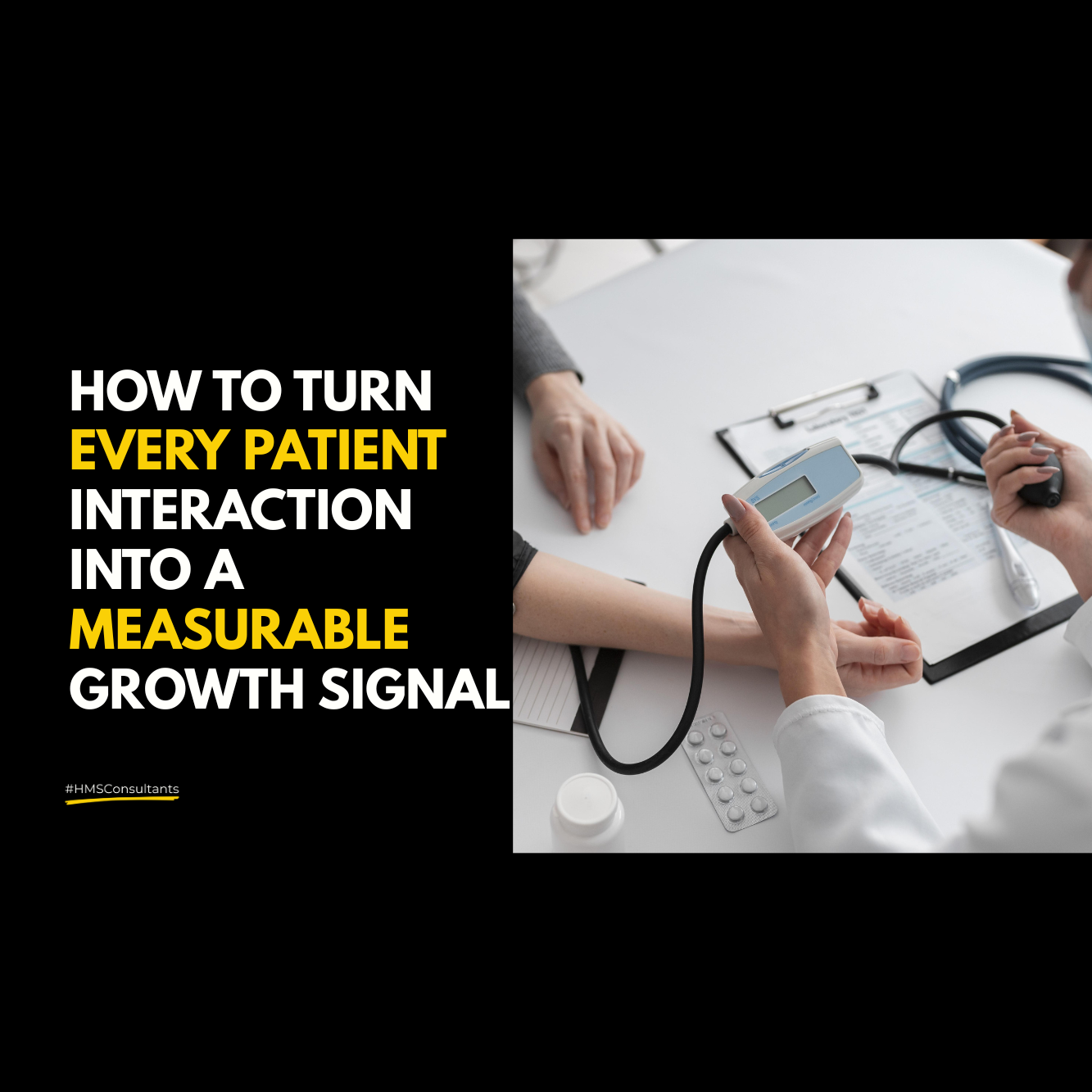
                • How to Turn Every Patient Interaction Into a Measurable Growth Signal

                  How to Turn Every Patient Interaction Into a Measurable Growth Signal

                  How to Turn Every Patient Interaction Into a Measurable Growth Signal

                  Written by
                  Published on
                  Share This

                  Hospitals interact with patients hundreds of times every day. Phone calls, WhatsApp messages, OPD registrations, consultations, billing conversations, discharge instructions, follow-ups, and review requests form an ongoing stream of interactions. Most hospitals treat these moments as operational necessities, tasks to be completed and moved past. Once the interaction ends, it disappears into routine.

                  This is one of the most significant missed opportunities in hospital growth.

                  Every patient interaction carries information about trust, clarity, hesitation, satisfaction, and intent. When hospitals fail to observe and interpret these signals, marketing decisions are made in isolation, experience gaps remain invisible, and growth becomes unpredictable. Hospitals that scale sustainably do not create growth by adding more interactions they grow by learning from every interaction that already exists.

                  Why Hospitals Struggle to Measure What Actually Drives Growth

                  Hospitals are excellent at measuring outputs. OPD numbers, admissions, revenue, bed occupancy, and conversion ratios are reviewed regularly. What is rarely measured is why those numbers move.

                  Patient interactions are treated as transient events rather than data points. A call is answered, a consultation is completed, a discharge is done, and the system moves on. No insight is captured about what confused the patient, what reassured them, what delayed their decision, or what increased their confidence.

                  As a result, hospital marketing strategy relies heavily on assumptions. Campaigns are adjusted without understanding patient hesitation. Experience changes are made without knowing which interactions caused friction. Growth decisions are reactive instead of evidence-led.

                  Patient Interactions Are Behavioural Data, Not Just Conversations

                  From a healthcare marketing perspective, patient interactions reveal behavioural truth. The questions patients ask, the pauses they take, the clarifications they seek, and the objections they raise indicate exactly where trust is forming or breaking.

                  When multiple patients ask similar questions before booking, it signals unclear communication earlier in the journey. When patients hesitate after diagnosis, it reflects unaddressed fear or financial ambiguity. When follow-ups drop off, it points to experience gaps rather than marketing failure.

                  Hospitals that listen to these patterns gain insight no dashboard can provide.

                  Why Growth Signals Are Often Hidden in Plain Sight

                  Most growth signals do not appear dramatic. They show up quietly in tone changes, repeated doubts, delayed responses, or softened enthusiasm. Because these signals do not directly impact daily operations, they are ignored.

                  Hospitals often assume that if patients do not complain, everything is fine. In reality, patients rarely complain. They adapt, disengage, or choose another provider. These silent exits are the costliest form of loss because they leave no visible trail.

                  By the time declining growth is noticed, the underlying signals have been present for months.

                  The Link Between Patient Interactions and Hospital Marketing Performance

                  Hospital marketing does not fail at the point of promotion. It fails at the translation stage. Marketing may generate interest, but patient interactions determine whether that interest becomes confidence.

                  If enquiry handling feels rushed, marketing performance drops. If explanations are unclear, conversion weakens. If follow-ups feel inconsistent, repeat visits are reduced. These outcomes are often attributed to marketing inefficiency when they are actually interaction failures.

                  This is why experienced healthcare marketing consultants focus as much on patient communication systems as on campaigns and channels.

                  Why Counting Interactions Is Not the Same as Measuring Them

                  Many hospitals track interaction volume. Number of calls handled. Messages responded to. Appointments booked. These numbers indicate workload, not insight.

                  Measuring interactions requires attention to quality. How long did patients take to decide? What questions delayed commitment? Where did confusion repeat? Which interactions consistently led to reassurance?

                  Hospitals that fail to distinguish between quantity and quality continue to optimise staffing and marketing budgets without improving decision flow.

                  Turning Interactions Into Strategic Feedback Loops

                  When hospitals begin treating interactions as feedback loops, decision-making changes, and marketing messages are refined based on real patient language. Website content improves because it reflects actual doubts. Staff training becomes targeted rather than generic. Experience redesign focuses on moments that matter most.

                  This creates alignment between hospital marketing and patient experience. Growth becomes easier due to natural friction.

                  Such systems do not require complex technology. They require intentional observation and disciplined review.

                  Why This Approach Strengthens SEO and Digital Trust

                  Search engines increasingly reward content that reflects real user intent. Hospitals that understand patient interactions publish content that mirrors genuine questions, concerns, and language. This improves search relevance, dwell time, and topical authority.

                  From an SEO standpoint, interaction-driven insights help hospitals rank not just for keywords, but for trust-based queries. Patients recognise clarity when they see it. They stay longer. They return. They convert.

                  Growth becomes both digital and experiential.

                  The Leadership Shift Required to Capture Growth Signals

                  Turning interactions into growth signals requires leadership commitment. It demands moving beyond outcome reviews and into behaviour reviews. Leaders must ask not just what happened, but why it happened.

                  Hospitals that make this shift stop guessing. They stop chasing tactics. Marketing decisions become grounded. Experience improvements become targeted. Teams feel supported because feedback is constructive rather than reactive.

                  This is where hospital growth strategy matures from execution to intelligence.

                  Why Hospitals That Ignore Interaction Signals Eventually Plateau

                  Hospitals that rely only on high-level metrics eventually hit a ceiling. Growth slows, marketing costs rise, and patient loyalty weakens. Leaders sense stagnation but struggle to diagnose its cause.

                  The missing piece is almost always hidden in everyday interactions that were never studied. Hospitals that revisit these signals regain clarity. Those who ignore them remain stuck optimising the surface.

                  Conclusion: Growth Is Already Talking, Hospitals Need to Listen

                  Hospitals do not need more data to grow. They need to listen better to the data they already generate.

                  Every patient interaction contains information about trust, readiness, and decision-making. When hospitals learn to capture and interpret these signals, marketing becomes smarter, experience becomes smoother, and growth becomes sustainable.

                  In healthcare marketing, growth does not begin with louder promotion.
                  It begins with quieter observation.

                  Hospitals that listen carefully build systems that grow not by force, but by understanding, and that is the most durable growth strategy of all.

                  Contact Us HMS Consultants

                  Patient interactions include every touchpoint such as phone calls, WhatsApp chats, OPD registration, consultations, billing discussions, discharge instructions, follow-ups, and review requests.

                  Doctors Digital Marketing I Healthcare Marketing I Hospital Marketing Strategies I Marketing ideas for clinics I Marketing Trends 2025 I Medical Marketing I Social Media Marketing

                  is something we strongly believe in, which means ‘Knowledge without application is the same as having no knowledge at all

                  Akhil Dave

                  Principle Consultant

                  Ready to take your Personal Brand to the next level?

                  Share your details below and we will connect with you to discuss your growth strategy.

                  • What Hospitals Should Do With Their 100+ Google Reviews (Hint: Not What You Think)

                    What Hospitals Should Do With Their 100+ Google Reviews (Hint: Not What You Think)

                    What Hospitals Should Do With Their 100+ Google Reviews (Hint: Not What You Think)

                    Written by
                    Published on
                    Share This

                    Hospitals often celebrate reaching a milestone in Google reviews. Fifty reviews. One hundred reviews. A strong star rating. Internally, this achievement is treated as proof of credibility and digital success. Marketing teams showcase it, leadership feels reassured, and attention quickly shifts to the next campaign or platform.

                    Yet for most hospitals, this is where the opportunity quietly ends.

                    Google reviews are rarely used as a strategic asset. They are displayed, monitored, and occasionally responded to, but seldom analysed or integrated into broader hospital marketing and growth strategy. As a result, hospitals accumulate reviews without extracting their real value not just for reputation, but for trust-building, conversion, and long-term performance.

                    The mistake lies in assuming that reviews are an outcome. In reality, reviews are data.

                    Why Google Reviews Matter More Than Any Advertisement in Healthcare

                    In healthcare, patients trust people more than institutions. Before contacting a hospital, patients look for lived experiences that resemble their own fears, doubts, and expectations. Google reviews serve as social proof, but, more importantly, they provide emotional validation.

                    Unlike advertisements, reviews are unsolicited narratives. They reflect what patients remember, what they value, and what they choose to talk about after care is complete. This makes them far more influential than promotional messaging, especially in high-anxiety decisions, such as those in healthcare.

                    From a healthcare marketing perspective, Google reviews are not just reputation signals. They are decision accelerators.

                    The Common Misuse of Google Reviews by Hospitals

                    Most hospitals treat reviews defensively. The focus is on maintaining ratings, replying politely, and managing negative feedback to prevent reputational damage. While this is important, it represents only a fraction of the value reviews hold.

                    What hospitals rarely do is study reviews for patterns. They do not systematically analyse language, recurring themes, emotional triggers, or moments that patients consistently mention. As a result, reviews remain static testimonials instead of dynamic insight sources.

                    This is why hospitals with hundreds of reviews often see no proportional improvement in conversion or patient trust. Visibility exists, but learning does not.

                    What Reviews Reveal That Marketing Reports Never Will

                    Marketing dashboards show clicks, impressions, and leads. Google reviews show why people felt safe, confused, reassured, or disappointed. They reveal what patients actually noticed, not what the hospital intended to communicate.

                    Reviews often highlight factors that hospitals usually underestimate, such as the tone of communication, the waiting experience, explanation clarity, staff behaviour, billing transparency, and emotional support. These elements rarely appear in marketing plans, yet they dominate patient memory.

                    Hospitals that ignore these insights continue refining campaigns while repeating the same experiential gaps.

                    Why Star Ratings Alone Are a Weak Growth Indicator

                    Star ratings offer a quick snapshot but lack depth. A high rating without context does little to reduce uncertainty. Patients read reviews not to count stars, but to understand stories.

                    They look for situations similar to their own. They scan for reassurance that their fears will be handled well. They seek signals of empathy, patience, and reliability.

                    Hospitals that rely solely on ratings miss the opportunity to address these deeper trust needs. Reviews should be interpreted as narratives, not scores.

                    Reviews as a Window Into Patient Psychology

                    Every review is written at a specific emotional moment, relief after recovery, gratitude after reassurance, frustration after confusion, or disappointment after unmet expectations. These emotions reflect how patients experience the hospital’s systems, not just its clinical outcomes.

                    When hospitals analyse reviews through a psychological lens, they begin to see where trust is built and where it erodes. They identify which interactions reduce anxiety and which amplify it. This understanding is invaluable for improving both patient experience and marketing effectiveness.

                    In a hospital growth strategy, such insights are far more actionable than surface-level metrics.

                    Why Reviews Should Shape Content, Not Just Reputation

                    One of the most overlooked uses of Google reviews is content strategy. Reviews contain the exact language patients use to describe care, outcomes, and concerns. This language is gold for SEO and clarity in communication.

                    Hospitals that align website copy, blog content, and patient education material with review language speak in a voice patients already trust. This improves search relevance, reduces bounce rates, and increases engagement.

                    From an SEO standpoint, reviews help hospitals match real search intent rather than assumed intent.

                    How Reviews Influence Conversion Without Being Clicked

                    Many patients read reviews without interacting further. They do not click links or fill forms. Instead, reviews quietly shape perception. They reduce hesitation. They validate the choice. They tip the balance toward contacting the hospital when the moment feels right.

                    This influence is invisible in analytics but powerful in practice. Hospitals that underestimate this effect misjudge the true ROI of reputation management.

                    Why Hospitals With Many Reviews Still Struggle to Grow

                    Hospitals often assume that accumulating reviews will automatically lead to growth. When this does not happen, frustration sets in. The real issue is not the number of reviews, but their disconnection from decision-making systems.

                    If reviews are not reflected in communication training, website messaging, enquiry handling, and experience design, they remain isolated signals. Growth requires integration, not accumulation.

                    Turning Reviews Into a Strategic Growth Asset

                    Hospitals that use reviews strategically do not treat them solely as feedback. They treat them as input. They feed insights into marketing messaging, staff training, experience redesign, and patient education.

                    Over time, this alignment strengthens trust across touchpoints. Marketing feels more authentic. Patient conversations feel more aligned. Growth becomes steadier.

                    This is where reputation management shifts from defence to strategy.

                    Conclusion: Reviews Are Not Validation, They Are Direction

                    Google reviews are not trophies to be displayed. They are mirrors reflecting how patients experience care.

                    Hospitals that look into this mirror honestly gain clarity. They understand what truly matters to patients and adjust accordingly. Hospitals that glance at it briefly and move on miss one of the most valuable growth resources available to them.

                    In healthcare marketing, trust is not created by what hospitals say about themselves.
                    It is created by what patients say when no one asks them to.

                    And those who listen carefully build institutions that grow not just in numbers, but in credibility and confidence.

                    Contact Us HMS Consultants

                    They build patient trust, show real experiences, and influence decisions more than ads or star ratings.

                    Doctors Digital Marketing I Healthcare Marketing I Hospital Marketing Strategies I Marketing ideas for clinics I Marketing Trends 2025 I Medical Marketing I Social Media Marketing

                    is something we strongly believe in, which means ‘Knowledge without application is the same as having no knowledge at all

                    Akhil Dave

                    Principle Consultant

                    Ready to take your Personal Brand to the next level?

                    Share your details below and we will connect with you to discuss your growth strategy.

                    • Why Hospital Social Media Metrics Lie, And What Metrics Actually Tell You Growth Is Real

                      Why Hospital Social Media Metrics Lie, And What Metrics Actually Tell You Growth Is Real

                      Why Hospital Social Media Metrics Lie, And What Metrics Actually Tell You Growth Is Real

                      Written by
                      Published on
                      Share This

                      Hospitals today are surrounded by numbers. Likes, views, reach, impressions, engagement rates, follower counts, dashboards are full, reports look impressive, and activity appears consistent. Social media metrics have become the most visible proof of “marketing happening.” Yet despite this apparent success, many hospitals still struggle with unpredictable OPD, weak conversions, and inconsistent growth.

                      This disconnect is not accidental. Most hospital social media metrics lie, not because they are false, but because they are incomplete and often misinterpreted. When hospitals rely on surface-level metrics to judge marketing performance, they optimise for visibility rather than viability, attention rather than trust, and activity rather than growth.

                      The Comfort of Vanity Metrics in Healthcare Marketing

                      Social media metrics are comforting because they are immediate and easily measurable. A post performs well, engagement rises, reach expands, and the team feels reassured. For leadership, these numbers offer a sense of control and progress in an otherwise complex healthcare marketing environment.

                      The problem is that visibility metrics measure reaction, not decision-making. In healthcare, reactions are cheap. Decisions are expensive. A patient may like a post without trusting the hospital. They may watch a reel without intending to seek care. They may follow a page out of curiosity, not conviction.

                      When hospitals confuse attention with intent, they overestimate marketing performance and lose strategic clarity.

                      Why Engagement Does Not Equal Trust in Healthcare

                      In consumer brands, engagement often correlates with purchase behaviour. In healthcare, this relationship breaks down. Patients engage with content for many reasons, such as fear, curiosity, anxiety, or general awareness, none of which guarantee readiness to act.

                      A highly engaged post about symptoms may attract people who are worried but not prepared to visit a hospital. A viral reel may bring followers from outside the hospital’s service area. Educational content may be saved and shared without ever translating into OPD.

                      From a healthcare marketing strategy perspective, engagement measures interest, not confidence. Growth depends on confidence.

                      The Algorithm Problem Hospitals Rarely Account For

                      Social media platforms are designed to reward content that keeps users scrolling, not content that drives healthcare decisions. Algorithms prioritise emotion, novelty, relatability, and frequency. Content that performs well algorithmically is not always content that builds medical credibility.

                      Hospitals that chase algorithm-friendly metrics often dilute their messaging. Simplified soundbites replace educational depth. Clinical nuance is sacrificed for engagement. Over time, this creates a brand that is visible but shallow.

                      This is why many hospitals experience high social media activity with slight improvement in patient quality or conversion. The platform’s goals are misaligned with the hospital’s goals.

                      Why Hospitals Keep Optimising the Wrong Metrics

                      Hospitals optimise what they are shown. Most social media reports emphasise reach, engagement, and follower growth because those are the easiest to display. Metrics that reflect real healthcare marketing performance,  such as enquiry quality, patient readiness, consultation efficiency, and repeat visits, sit outside social dashboards.

                      As a result, teams spend months improving metrics that look good internally but do not influence external growth outcomes. Leadership reviews numbers that look positive while underlying performance remains unchanged.

                      This creates a false sense of progress and delays necessary strategic correction.

                      What Metrics Actually Indicate Real Hospital Growth

                      Real growth indicators in healthcare marketing are quieter and slower to show, but far more reliable. They reflect changes in patient behaviour, not platform behaviour.

                      When marketing is effective, hospitals notice that enquiries become more specific and informed. Patients arrive with clearer expectations. Consultation time is used more productively. Treatment acceptance improves. Follow-ups become easier. Referrals increase without prompting.

                      These outcomes are rarely captured in social media reports, yet they are the actual signals of marketing maturity.

                      Why Social Media Should Support, Not Define, Hospital Marketing Strategy

                      Social media is a powerful awareness and education channel, but it is a poor primary success metric. Hospitals that treat social platforms as the centre of their marketing strategy often end up optimising for noise rather than outcomes.

                      In a mature healthcare marketing system, social media supports larger objectives. It reinforces trust built elsewhere. It prepares patients for conversations. It aligns expectations with reality. It complements websites, enquiry handling, patient experience, and referral systems.

                      When social media is isolated from this system, it becomes performative rather than productive.

                      The Long-Term Cost of Chasing the Wrong Numbers

                      Optimising for vanity metrics has long-term consequences. Content strategies drift away from patient needs. Teams become reactive to algorithm changes. Leadership loses visibility into what is actually driving growth. Marketing decisions become increasingly disconnected from operational reality.

                      Eventually, hospitals are forced to spend more for the same outcomes because trust was never built in the first place.

                      From a hospital growth perspective, this is one of the most expensive mistakes organisations make, not because social media is ineffective, but because it is misunderstood.

                      How High-Performing Hospitals Use Social Metrics Correctly

                      Hospitals that use social media effectively treat metrics as directional signals, not success indicators. They observe trends without being governed by them. They correlate social activity with downstream outcomes rather than evaluating it in isolation.

                      Most importantly, they understand that social media is a means of pre-conditioning trust, not closing decisions. When used with this clarity, social platforms contribute meaningfully to growth without distorting strategy.

                      Conclusion: Growth Is Quiet, Metrics Are Loud

                      The loudest numbers in hospital marketing are often the least important. Likes, views, and reach create the illusion of success without guaranteeing impact. Real growth shows up in calmer ways in patient confidence, operational ease, referral consistency, and long-term trust.

                      Hospitals that want sustainable growth must learn to look beyond social media dashboards and ask harder questions about behaviour, readiness, and experience.

                      In healthcare marketing, what feels measurable is not always what matters.
                      And what truly matters often takes longer to show, but lasts far longer when it does.

                      Contact Us HMS Consultants

                      Doctors Digital Marketing I Healthcare Marketing I Hospital Marketing Strategies I Marketing ideas for clinics I Marketing Trends 2025 I Medical Marketing I Social Media Marketing

                      is something we strongly believe in, which means ‘Knowledge without application is the same as having no knowledge at all

                      Akhil Dave

                      Principle Consultant

                      Ready to take your Personal Brand to the next level?

                      Share your details below and we will connect with you to discuss your growth strategy.