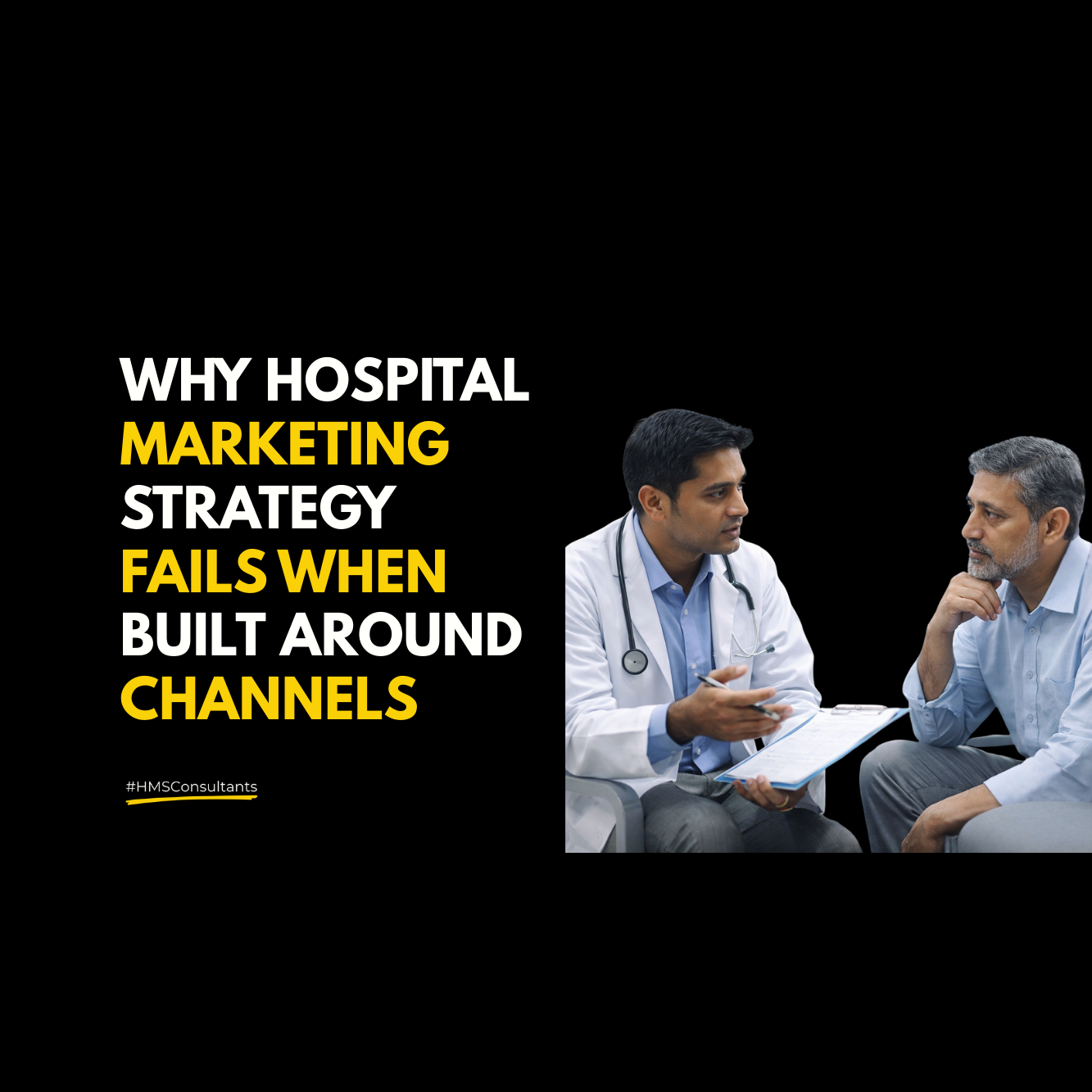
Why a Hospital Marketing Strategy Fails When It Is Built Around Channels Instead of Decisions
Hospital marketing strategy is often discussed in terms of platforms. Websites, social media, Google Ads, SEO, WhatsApp, offline branding, referral programmes strategy meetings frequently revolve around where the hospital should be visible. While channel selection matters, it is rarely the reason marketing succeeds or fails.
Most hospital marketing strategies fail not because the wrong channels were chosen, but because the strategy was never anchored to how patients actually make decisions.
In healthcare, visibility does not create confidence. Decision clarity does.
Why Channel-First Thinking Dominates Hospital Marketing
Hospitals operate in complex, time-constrained environments. Leadership wants clarity, teams want direction, and agencies want execution scope. Channels offer structure. They are easy to plan, easy to measure, and easy to justify.
As a result, hospital marketing strategy often becomes a checklist of activities rather than a framework for influencing patient behaviour. Effort increases, activity looks consistent, but outcomes remain volatile.
The mistake is subtle. Marketing becomes busy without becoming meaningful.
How Patients Actually Decide And Why Strategy Misses This
Patients do not move through channels. They move through states of mind.
They begin with uncertainty, move into comparison, seek reassurance, and finally act when confidence outweighs fear. A hospital marketing strategy that ignores these stages may reach patients repeatedly without ever supporting their decision.
This is why many hospitals experience strong traffic with weak conversion. The strategy addressed exposure, not hesitation.
From a healthcare marketing strategy perspective, understanding why a patient pauses is far more valuable than knowing where they came from.
Why More Marketing Does Not Fix a Weak Strategy
When outcomes underperform, hospitals often increase marketing intensity. More ads, more posts, more campaigns. This response feels logical, but it treats symptoms rather than causes.
If messaging does not reduce uncertainty, repetition only amplifies confusion. Patients see the hospital more often, but do not feel more confident. Over time, marketing begins to feel intrusive rather than reassuring.
A hospital marketing strategy must first resolve doubt before it seeks attention.
The Role of Trust in Hospital Marketing Strategy
Trust is not a by-product of marketing in healthcare. It is the objective.
Every element of hospital marketing strategy should answer one question clearly: Does this help a patient feel safer about choosing us? If the answer is unclear, the activity adds noise without value.
Trust is built through consistency of message, clarity of explanation, and alignment between promise and experience. When strategy focuses on these principles, channels naturally perform better.
When it does not, no channel can compensate.
Why Strategy Breaks When Marketing Is Isolated From Experience
Hospital marketing strategy often exists separately from operational reality. Marketing communicates excellence, but patient experience delivers inconsistency. This gap weakens credibility faster than any negative review.
Patients may be impressed initially, but trust erodes when communication, processes, or behaviour contradict expectations. Marketing then has to work harder to repair damage it did not create.
A strong hospital marketing strategy is inseparable from patient experience design. One reinforces the other.
What a Decision-Centric Hospital Marketing Strategy Looks Like
A decision-centric strategy begins by mapping where patients hesitate, what they fear, and what information they lack. Messaging is then designed to resolve these gaps gradually, not force action prematurely.
Such a strategy evolves over time. It learns from patient interactions, reviews, and outcomes. Instead of changing direction frequently, it deepens insight.
Hospitals that adopt this approach see steadier growth, better-prepared patients, and lower marketing volatility.
Why Leadership Thinking Determines Strategy Quality
Hospital marketing strategy reflects leadership priorities. When leadership focuses on short-term numbers, strategy becomes reactive. When leadership prioritises clarity and consistency, strategy matures.
This is why similar hospitals using similar channels experience vastly different outcomes. Strategy quality is less about tools and more about intent.
Hospitals that treat marketing as a leadership function, not a tactical one, build stronger foundations for growth.
The Long-Term Cost of Channel-Driven Strategy
Channel-driven strategies fragment over time. Each platform develops its own logic, tone, and objectives. Messaging becomes inconsistent. Learning is lost. Patients receive mixed signals.
Eventually, hospitals restart strategy entirely new agencies, new platforms, new promises without realising the underlying issue remains unresolved.
This cycle is costly, exhausting, and avoidable.
Conclusion: Hospital Marketing Strategy Succeeds When It Follows the Patient’s Mind, Not the Platform
A hospital marketing strategy should not be defined by where the hospital appears, but by how patients decide.
Channels are tools. Decisions are the real battleground.
Hospitals that build strategy around patient hesitation, trust formation, and clarity create systems that grow steadily and sustainably. Those that build strategy around platforms chase attention without earning confidence.
In healthcare, growth does not come from being seen everywhere.
It comes from being understood at the right moment.
That is what a real hospital marketing strategy is designed to do.
A hospital marketing strategy is a structured approach to attracting, converting, and retaining patients by aligning communication, experience, and trust-building across the patient journey. It focuses not just on visibility, but on helping patients make confident healthcare decisions.
A hospital marketing strategy fails when it prioritises channels and promotions over patient decision-making. Visibility without clarity increases awareness but does not reduce patient hesitation, which is why traffic may rise while conversions remain inconsistent.
Hospital advertising focuses on short-term visibility and reach, while a hospital marketing strategy focuses on long-term trust, patient confidence, and sustainable growth. Advertising is one component of strategy, not the strategy itself.
A hospital marketing strategy should first focus on understanding patient hesitation, fears, and information gaps. Strategy becomes effective when it addresses why patients delay decisions, not just where they can be targeted.
Patient trust is central because healthcare decisions are high-risk and emotionally driven. A hospital marketing strategy that builds trust through clarity, consistency, and honest communication performs better than one focused only on promotions or claims.
Yes. A hospital marketing strategy does not depend on the number of channels used, but on how well communication aligns with patient expectations and experience. Fewer, well-aligned channels often perform better than fragmented multi-channel efforts.
Hospital marketing strategy should involve leadership, marketing teams, and operations. Since patient experience directly affects marketing outcomes, strategy must align across departments rather than being owned by marketing alone.
A hospital marketing strategy begins influencing patient behaviour early, but meaningful and stable results typically build over time. Trust-based strategies show stronger impact in consistency, referrals, and conversion quality rather than immediate spikes.
Hospitals often change marketing strategy because they evaluate short-term results instead of long-term behaviour trends. Without allowing learning cycles to mature, strategy resets replace optimisation, leading to repeated stagnation.
A hospital marketing strategy becomes sustainable when it is decision-centric, patient-focused, and aligned with real experience. Strategies designed around trust, clarity, and consistency grow stronger over time instead of requiring constant reinvention.
is something we strongly believe in, which means ‘Knowledge without application is the same as having no knowledge at all
Akhil Dave
Principle Consultant
Ready to take your Personal Brand to the next level?
Share your details below and we will connect with you to discuss your growth strategy.

Hospital Growth with Doctor Personal Branding 2025
In 2025, healthcare branding is about more than logos. Discover how doctor personal…
Medical Marketing: Why Patient Questions Should Shape Your Content
medical marketing, healthcare marketing, medical content marketing, patient questions, healthcare content strategy, patient…
Local Marketing for Clinics & Hospitals in India 2025
Discover how Indian clinics and hospitals can grow in 2025 using local marketing…
Why Doctors Digital Marketing Fails When It Is Treated as Promotion Instead of Professional Presence
Doctors digital marketing fails when it is treated as promotion instead of professional…

Unlocking Healthcare Marketing Success with HMS Consultants: Affordable Strategies for Indian Healthcare Providers
In the dynamic landscape of healthcare marketing, many Indian healthcare providers struggle to…
What Hospitals Should Do With Their 100+ Google Reviews (Hint: Not What You Think)
Google reviews are not just ratings for hospitals they are powerful insights into…