Search results for: “marketing trends”

  • The Future of Healthcare Marketing: Trends to Watch

    The Future of Healthcare Marketing: Trends to Watch

    The Future of Healthcare Marketing: Trends to Watch

    Written by
    Published on
    Share This

    In the rapidly evolving healthcare landscape, staying ahead of marketing trends is crucial for healthcare providers. As technology advances and patient expectations shift, new marketing strategies emerge, reshaping how healthcare services are promoted and delivered. This blog explores the future of healthcare marketing and highlights key trends to watch.

    Telehealth and Virtual Care

    The rise of telehealth and virtual care has transformed the healthcare industry. Promoting these services will be a significant focus in future marketing strategies. Telehealth offers convenience and accessibility, making it an attractive option for patients. Emphasise the benefits of virtual care in your marketing materials, such as reduced travel time, enhanced safety, and 24/7 availability.

    Key Points:

    • Highlight the convenience and accessibility of telehealth services.
    • Use testimonials and success stories to showcase the effectiveness of virtual care.
    • Optimise your website and social media for keywords like “telehealth services,” “virtual care appointments,” and “online doctor consultations.”

    Personalised Marketing

    Personalised marketing uses data analytics to create tailored messages and content for individual patients. This approach enhances patient engagement and satisfaction by addressing specific needs and preferences. Patient data can be used to deliver personalised email campaigns, targeted social media ads, and customised health recommendations. One should always obtain prior consent from patients to use their data to share various marketing communications from the hospital or healthcare setup; the same can be done at the time of data collection from the patient.

    Key Points:

    • Leverage data analytics to understand patient behaviour and preferences.
    • Create personalised email campaigns and targeted social media ads.
    • Use keywords like “personalised healthcare,” “customised patient care,” and “tailored health services.”

    AI and Machine Learning

    AI and machine learning are revolutionising healthcare marketing by providing deeper insights into patient behaviour and optimising marketing strategies. AI-powered tools can predict patient needs, personalise communication, and automate tasks like appointment reminders.

    Key Points:

    • Implement AI-powered chatbots for instant patient responses on your hospital webiste or clinic website and Official WhatsApp Business Number
    • Use machine learning to analyse patient data and optimise marketing strategies.
    • Incorporate terms like “AI in healthcare,” “machine learning for patient engagement,” and “AI-driven healthcare marketing.”

    Content Marketing and Patient Education

    High-quality content is essential for educating patients and building trust. Create informative blog posts, videos, and infographics on health topics relevant to your audience. Content marketing helps establish your practice as a trusted source of information and improves online visibility.

    Key Points:

    • Develop educational content on common health concerns and treatments.
    • Use multimedia formats like videos and infographics to enhance engagement.
    • Optimise content for keywords such as “healthcare content marketing,” “patient education resources,” and “medical information blog.”

    Social Media Engagement

    Social media platforms offer excellent opportunities for healthcare providers to connect with patients. Through social media engagement, share valuable content, respond to patient queries, and create a sense of community. Regularly update your profiles with educational posts, patient testimonials, and health tips.

    Key Points:

    • Share educational and engaging content on social media platforms.
    • Host live Q&A sessions to interact with patients in real time.
    • Use keywords like “healthcare social media marketing,” “patient engagement on social media,” and “social media for hospital.”

    Video Marketing

    Video marketing is a powerful tool for healthcare providers. Use videos to explain medical procedures, share patient success stories, and provide virtual tours of your facilities. Video content is engaging and easily digestible, making it ideal for conveying complex information.

    Key Points:

    • Create educational videos on medical procedures and health tips for YouTube in form of long YouTube video and YouTube shorts
    • Share patient testimonials through video to build trust.
    • Incorporate terms like “healthcare video marketing” “medical video content,” and “patient testimonial videos.”

    Mobile Optimization

    With the increasing use of mobile devices, ensuring your website is mobile-friendly is very important. A mobile-optimised website provides a seamless user experience, improving patient engagement and search engine rankings. Ensure your website loads quickly and is easy to navigate on all devices.

    Key Points:

    • Optimise your website for mobile devices to enhance user experience.
    • Use responsive design to ensure your site looks good on all screens.
    • Focus on keywords like “mobile-friendly healthcare website” “responsive medical website design,” and “mobile SEO for healthcare.”

    Data Privacy and Security

    As healthcare marketing becomes more data-driven, ensuring data privacy and security is paramount. In your marketing messages, highlight your commitment to protecting patient information and complying with regulations like HIPAA [USA]

    Key Points:

    • Emphasise your commitment to data privacy and security in marketing materials.
    • Ensure compliance with HIPAA and other relevant regulations.
    • Use keywords such as “HIPAA-compliant marketing,” “healthcare data security,” and “patient privacy protection.”


    Voice Search Optimization

    With the rise of voice-activated assistants, optimising your content for voice search is becoming increasingly important. Patients use voice search to find healthcare services and information, so ensure your content is optimised for natural language and long-tail keywords.

    Key Points:

    • Optimise content for voice search by using natural language and long-tail keywords.
    • Focus on phrases like “find a doctor near me” and “best telehealth services.”
    • Include keywords such as “voice search optimisation,” “voice-activated healthcare services,” and “voice search healthcare marketing.”

    Influencer Marketing

    Collaborating with healthcare or fitness influencers can help expand your reach and credibility. Influencers can share their experiences with your services, provide health tips, and engage with your audience.

    Key Points:

    • Identify and collaborate with influencers relevant to your target audience.
    • Share authentic endorsements and experiences through influencers.
    • Use keywords like “healthcare influencer partnerships,” “medical influencer marketing,” and “influencer collaborations in healthcare.”


    Conclusion

    The future of healthcare marketing is dynamic and technology-driven. By staying informed about emerging trends like telehealth, personalised marketing, AI, and social media engagement, healthcare providers can effectively reach and engage with patients. Implementing these strategies and optimising your content with relevant keywords will ensure your marketing efforts are successful and future-proof.

    Insights by

    Shayna Girdher, Associate Consultant (Management Trainee)

    Business, Digital Marketing, Healthcare AI, Healthcare Marketing, Social Media Marketing

    “Knowing is Knowing, Doing is Doing”

    is something we strongly believe in, which means ‘Knowledge without application is the same as having no knowledge at all

    Akhil Dave

    Principle Consultant

    Ready to take your healthcare marketing to the next level?

    Fill out the form below, and our consultant will contact you for a detailed, personalised consultation.

    • Digital Marketing in Healthcare: Why Strategy Should Come Before Channels

      Digital Marketing in Healthcare: Why Strategy Should Come Before Channels

      Digital Marketing in Healthcare: Why Strategy Should Come Before Channels

      Published on
      Share This

      Digital marketing in healthcare often starts from the wrong place. Many clinics, hospitals, diagnostic centres, and healthcare businesses begin by asking which platform they should use first. Should they post more on social media? Should they run Google Ads? Should they improve SEO? Should they make more videos?

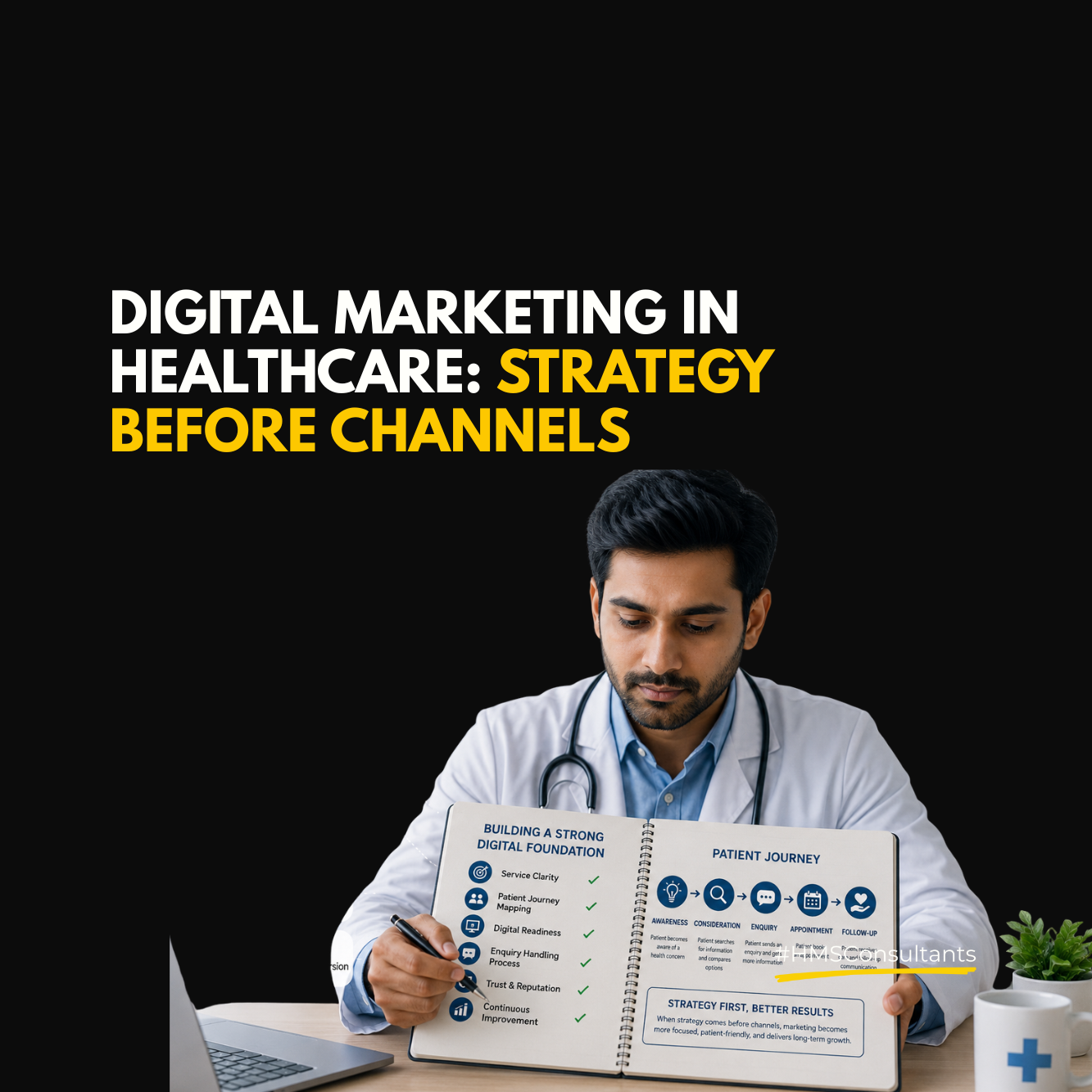
      These channels are important, but they should not come before strategy. Digital marketing in healthcare should first define what needs to be communicated, which patients need to be reached, which services need visibility, and how patient inquiries will be handled.

      Without this clarity, digital marketing becomes a random activity. There may be posts, ads, videos, website updates, and WhatsApp messages, but they may not work together toward one clear direction.

      Why Starting With Channels Creates Confusion

      Many healthcare providers choose channels before understanding the purpose behind them. A clinic may post regularly on Instagram but may not explain its services clearly. A hospital may run ads without checking whether its website page answers patient questions. A diagnostic centre may promote packages without making the booking process simple.

      The problem is not always the platform. The problem is often the lack of planning behind the platform.

      Before choosing a channel, healthcare providers should ask:

      • Which service needs attention?
      • Who is the right patient audience?
      • What does the patient need to understand?
      • What action should the patient take next?
      • Is the website or Google profile ready?
      • Is the enquiry handling process clear?

      When these questions are ignored, even strong platforms may give weak results.

      Service Clarity Should Come First

      Digital marketing for healthcare should begin with service clarity. A healthcare provider may offer many services, but not every service needs the same message or the same level of promotion.

      Some services need awareness. Some need search visibility. Some need patient education. Some need reputation support. Some need a better explanation because patients may not know when to consult.

      Before running campaigns, healthcare providers should define:

      • Which services should be promoted first.
      • What patient problem each service solves.
      • Which doctor or department handles the service.
      • What patients commonly ask about the service.
      • What information patients need before enquiry.

      If the service is not explained clearly, digital marketing may bring attention but not meaningful patient response. A patient wants to know what care is available, who provides it, when to visit, and how to take the next step.

      Understand the Patient Journey

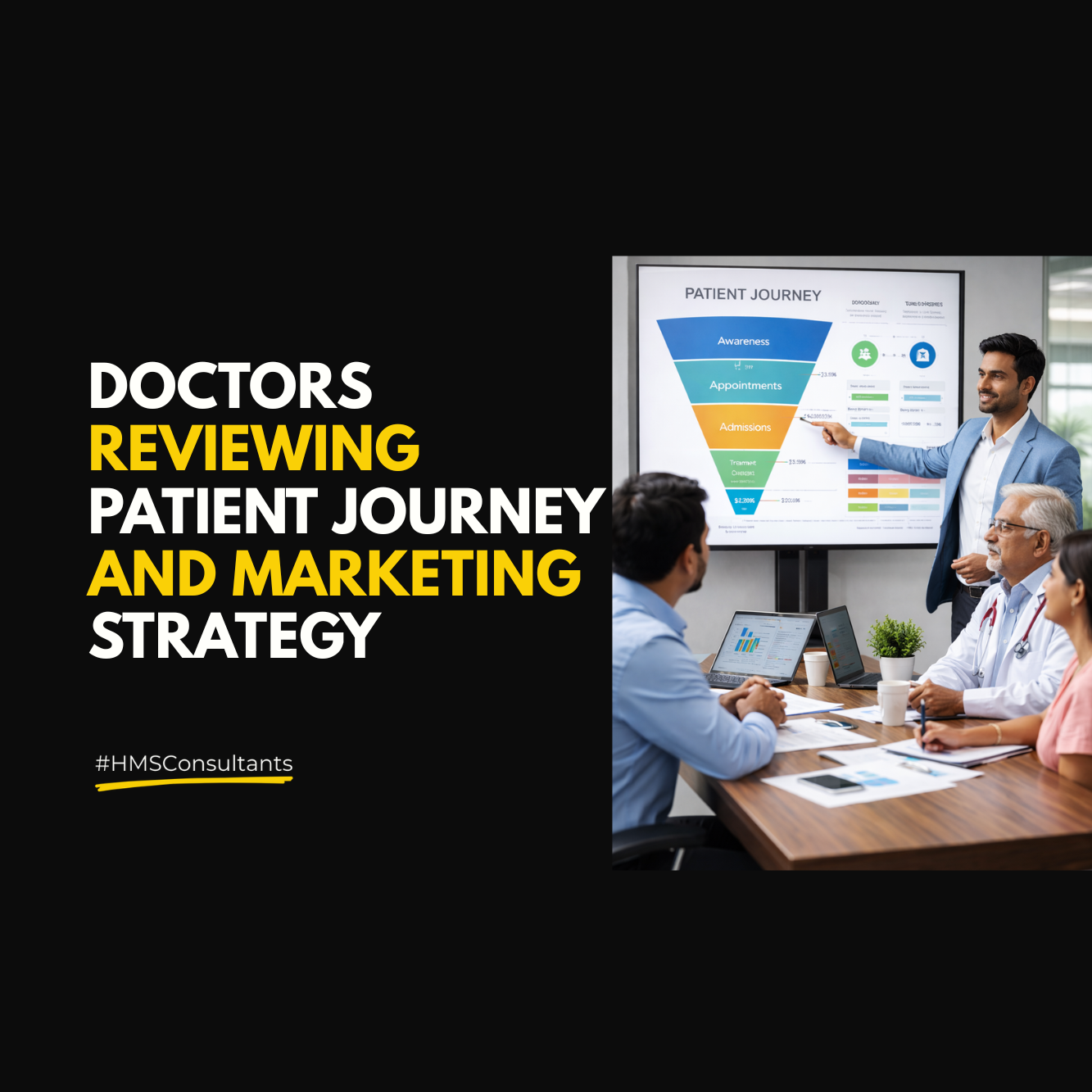
      Patients do not always take action immediately. They may first notice a symptom, then search for information, compare providers, read reviews, visit a website, send an inquiry, and only then book an appointment.

      This is why the patient journey matters in healthcare digital marketing.

      A patient who is only becoming aware of a concern needs simple educational content. A patient comparing options needs service details, doctor information, reviews, and location clarity. A patient ready to book needs appointment details, contact number, timings, and clear instructions.

      A healthcare marketing strategy should plan communication for different stages:

      • Awareness.
      • Consideration.
      • Enquiry.
      • Appointment.
      • Follow-up.

      When communication matches the patient journey, digital marketing becomes more useful and patient-focused.

      Build Digital Readiness Before Promotion

      Running ads or campaigns before the digital presence is ready can create poor results. If patients click an ad and reach an incomplete website, outdated Google profile, unclear service page, or confusing contact process, they may not continue.

      A strong healthcare online presence should include:

      • Updated website service pages.
      • Clear doctor or department information.
      • Accurate contact details.
      • Updated Google Business Profile.
      • Patient-friendly FAQs.
      • Review visibility.
      • Appointment guidance.
      • Location and timing details.

      These details may look basic, but they directly affect patient inquiries. Healthcare digital marketing works better when patients can easily understand the provider and take the next step.

      A campaign may bring attention, but the digital presence must convert that attention into trust and action.

      Match the Channel With the Purpose

      Every digital channel has a different role. A channel should be selected only after the purpose is clear.

      Healthcare SEO helps patients find services through search. Social media helps create awareness, education, and recall. Ads support focused campaigns for specific services. WhatsApp guides patients after enquiry. Videos simplify health concerns. Reviews support trust and reputation.

      The mistake happens when every channel is expected to do everything.

      For example:

      • SEO should answer search intent.
      • Social media should educate and build recall.
      • Ads should focus on one clear action.
      • WhatsApp should guide enquiries.
      • Reviews should build confidence.
      • Website pages should explain services.

      When the channel matches the purpose, digital marketing for healthcare becomes more organised and effective.

      Enquiry Handling Is Also Part of Strategy

      Many healthcare providers think digital marketing ends when a patient sends an enquiry. In reality, that is where a major part of the patient experience begins.

      If calls are missed, WhatsApp replies are unclear, staff members do not know service details, or follow-up is weak, marketing performance is affected.

      A good enquiry process should include quick response, clear service explanation, doctor availability, appointment guidance, location details, basic instructions, and proper follow-up.

      Healthcare marketing strategy should connect digital campaigns with enquiry handling. Otherwise, marketing may generate leads but not patient appointments.

      Trust and Reputation Need Planning

      In healthcare, patients do not respond only to visibility. They also look for trust signals. Reviews, doctor profiles, patient education content, website clarity, and professional communication all influence decision-making.

      Online reputation in healthcare should not be treated as a separate activity. It should be part of the digital strategy.

      Healthcare providers should regularly review patient feedback, Google reviews, social media comments, repeated questions, common complaints, and review response quality.

      Trust is built through consistent communication and patient experience. Digital marketing should support that trust, not replace it.

      Conclusion

      Digital marketing in healthcare should not begin with channels. It should begin with strategy.

      Before deciding on SEO, social media, ads, videos, or WhatsApp communication, healthcare providers should understand the service priority, patient audience, patient journey, message, digital readiness, enquiry process, and trust-building needs.

      Better healthcare digital marketing does not mean being active everywhere. It means being clear about what to communicate, where to communicate, and how each platform supports the patient journey.

      When strategy comes before channels, digital marketing becomes more focused, patient-friendly, and useful for long-term healthcare growth.

      Contact Us HMS Consultants

      The role of digital marketing in healthcare is to help patients find, understand, and connect with the right healthcare services. In this blog context, it should begin with strategy, service clarity, patient journey planning, digital readiness, enquiry handling, and trust-building before choosing channels.

      Digital Marketing I Digital Marketing For Doctors I healthcare digital marketing I healthcare Management I Healthcare Marketing I Healthcare Marketing Strategy I Medical Marketing I Social Media Marketing

      is something we strongly believe in, which means ‘Knowledge without application is the same as having no knowledge at all

      Akhil Dave

      Principle Consultant

      Ready to take your Personal Brand to the next level?

      Share your details below and we will connect with you to discuss your growth strategy.

      • Hospital Marketing: How to Decide Which Services to Promote First

        Hospital Marketing: How to Decide Which Services to Promote First

        Hospital Marketing: How to Decide Which Services to Promote First

        Published on
        Share This

        Hospital marketing becomes difficult when everything is treated as equally important. Most hospitals have multiple departments, doctors, services, packages, and treatment areas. Naturally, every service needs visibility. But in practice, promoting everything at once often leads to scattered communication and weak results.

        A hospital cannot market emergency care, maternity, orthopedics, diagnostics, preventive health check-ups, surgery, and specialist consultations with the same message and the same urgency. Each service has different patient needs, decision time, trust requirements, and business value. This is why hospital marketing should not start with the question, “What should we post?” It should start with a better question: “Which service needs marketing attention first, and why?”

        A clear hospital marketing strategy helps hospitals decide which services to promote first based on patient demand, department readiness, local competition, service value, and growth potential.

        Why Service Prioritisation Matters in Hospital Marketing

        Many hospitals run campaigns without deciding which services deserve focus. As a result, marketing becomes too broad. One week the hospital promotes one department, the next week another, and then a general awareness post follows. This creates activity, but not always direction.

        Service prioritisation helps the hospital focus its effort where it can make the most meaningful impact.

        It helps answer:

        • Which services are patients actively looking for?
        • Which departments are underutilized?
        • Which services need better explanation?
        • Which doctors have availability to handle more patients?
        • Which services support long-term hospital business growth?
        • Which departments face stronger competition?
        • Which services are seasonal or time-sensitive?

        Without this clarity, hospital marketing may continue, but the results may remain unclear.

        Patient Demand Should Guide the First Decision

        The first factor to study is patient demand. Hospitals should not promote a service only because it exists. They should understand whether patients are searching for it, asking about it, or showing real need for it.

        Patient demand can be understood through enquiry patterns, appointment data, common patient questions, Google searches, local health concerns, seasonal illness trends, and competitor visibility.

        For example, if many patients are asking about knee pain, pregnancy care, diabetes management, fever treatment, diagnostic packages, or cardiac check-ups, those areas may need stronger communication.

        This does not mean only high-demand services should be promoted. But demand helps the hospital know where patient interest already exists. Marketing can then improve visibility, explain the service better, and guide patients more clearly.

        A hospital marketing strategy should always connect service promotion with real patient behaviour.

        Department Readiness Comes Before Promotion

        A common mistake in hospital marketing is promoting a service before the department is ready to handle the response.

        If marketing brings enquiries but the doctor is not available, the front desk is not informed, the appointment process is unclear, or follow-up is weak, the campaign may damage trust instead of supporting growth.

        Before promoting any service, the hospital should check:

        • Is the doctor or department available consistently?
        • Can the team handle more enquiries?
        • Is the front desk trained to explain the service?
        • Is the appointment process simple?
        • Is the website information clear?
        • Are packages, reports, or instructions ready where needed?
        • Is follow-up being handled properly?

        Hospital service promotion should not create demand that the hospital cannot manage. Good marketing works only when the patient journey behind it is prepared.

        Underused Services May Need Visibility First

        Many hospitals have strong services that patients do not know about. These may be clinically valuable, but they remain underutilised because they are not clearly visible online or offline.

        Sometimes the service exists on the hospital premises, but it is missing from the website. Sometimes it is not mentioned properly on Google Business Profile. Sometimes the doctor is available, but patients do not know that the department offers that care.

        Underused services can be identified by checking:

        • Services with low enquiries
        • Departments not clearly explained online
        • Doctors with weak digital visibility
        • Treatments not covered in content
        • Services missing from Google Business Profile
        • Low patient awareness despite strong capability

        These services may not need paid ads immediately. They may first need clear service pages, patient education content, doctor-led videos, Google updates, and better internal communication.

        In hospital marketing, visibility should begin with clarity.

        Growth Potential Should Be Considered Carefully

        Hospital marketing must remain ethical and patient-centred, but hospitals also need to understand which services support long-term sustainability. Some services may have higher demand, stronger repeat value, better department capacity, or greater positioning importance for the hospital.

        This is where hospital growth strategy becomes important.

        Hospitals should look at:

        • Patient need
        • Clinical strength
        • Revenue potential
        • Doctor availability
        • Department capacity
        • Local competition
        • Long-term brand positioning

        For example, if a hospital has strong orthopaedic expertise but patients are choosing competitors for joint pain or fracture care, that department may need focused promotion. If diagnostics are available but underused, preventive health packages may need better communication.

        Marketing should support services where the hospital has genuine capability, not only where it wants more visibility.

        Competition Can Reveal Service Opportunities

        A hospital should not copy competitor marketing, but it should understand what competitors are doing. Local competition often shows which services are being pushed heavily and where gaps may exist.

        Hospitals should observe:

        • Which services competitors promote most
        • How they explain those services
        • Which doctors or departments are visible online
        • What patients mention in competitor reviews
        • Where competitors are strong or weak
        • Which patient questions remain unanswered

        If many hospitals are promoting the same service, your hospital needs a clearer positioning angle. If competitors are weak in an area where your hospital has strength, that service may become a strong marketing opportunity.

        Hospital service promotion should be based on differentiation, not imitation.

        Timing Can Improve Marketing Response

        Some hospital services perform better when promoted at the right time. Timing can depend on seasons, awareness months, local health patterns, school calendars, corporate cycles, or disease trends.

        For example, fever and infection care may need stronger communication during monsoon. Respiratory care may become more relevant during pollution season. Preventive health packages may work well around health awareness campaigns. School health check-ups may be planned before academic sessions.

        Hospitals should build a service-wise marketing calendar instead of deciding campaigns at the last moment.

        This helps plan:

        • Awareness posts
        • Doctor videos
        • Google updates
        • Blog content
        • Local campaigns
        • Preventive health messages
        • Patient education material

        When timing is planned, hospital marketing becomes more consistent and less random.

        The Marketing Route Should Match the Service

        Not every service needs the same marketing channel. Some services need search visibility. Some need patient education. Some need doctor credibility. Some need local awareness. Some need Google Business Profile optimization. Some need paid campaigns.

        For example, high-search services may need SEO and Google visibility. Complex services may need blogs and educational videos. Doctor-led services may need profile strengthening and credibility-building content. Preventive services may need awareness campaigns. Competitive services may need stronger service positioning.

        The better question is not, “Should we run ads?”

        The better question is, “What does this service need before patients respond?”

        This is where hospital marketing becomes strategic. The channel should come after the service priority is clear.

        Conclusion

        Hospital marketing becomes stronger when hospitals stop promoting everything equally and start prioritising services strategically.

        Every service does not need the same campaign, message, platform, or budget. Some services need awareness. Some need search visibility. Some need doctor credibility. Some need better patient education. Some need operational readiness before promotion.

        A clear hospital marketing strategy helps hospitals decide which services to promote first based on patient demand, department readiness, competition, timing, and growth potential.

        For hospitals that want sustainable growth, marketing should not begin with random activity.

        It should begin with the right service priority.

        Contact Us HMS Consultants

        Hospital marketing is the process of promoting a hospital’s services, departments, doctors, and patient care in a planned way. In this blog context, it means deciding which services should be promoted first based on patient demand, department readiness, competition, and growth potential.

        Healthcare Marketing I Digital Strategy I healthcare digital marketing I healthcare Management I Healthcare Marketing Strategy I hospital marketing I Hospital Marketing Strategies I Hospital Marketing Strategy

        is something we strongly believe in, which means ‘Knowledge without application is the same as having no knowledge at all

        Akhil Dave

        Principle Consultant

        Ready to take your Personal Brand to the next level?

        Share your details below and we will connect with you to discuss your growth strategy.

        • Most Hospitals Still Misunderstand Medical Marketing

          Most Hospitals Still Misunderstand Medical Marketing

          Most Hospitals Still Misunderstand Medical Marketing

          Written by
          Published on
          Share This

          Medical marketing is one of the most misunderstood functions inside Indian hospitals today. Most hospitals believe medical marketing means:
          • Advertisements.
          • Social media posts.
          • Newspaper campaigns.
          • Hoardings.
          • Healthcare camps.
          • Digital promotions.
          But despite spending heavily on these activities, many hospitals still struggle with:
          • Low OPD growth.
          • Weak patient recall.
          • Poor engagement.
          • Inconsistent referrals.
          • Limited long-term brand preference.

          This is where the real problem begins.
          Most hospitals are not failing because they are doing less marketing.
          They are failing because they misunderstand what medical marketing actually is.
          That is becoming one of the biggest challenges in healthcare marketing in 2026.

          Medical Marketing Is Not Just Advertising

          One of the biggest misconceptions in hospital marketing is treating medical marketing as advertising.

          Advertising is only one part of medical marketing.

          It is not the entire system.

          Many hospitals spend lakhs on:

          • Newspaper ads.
          • Meta campaigns.
          • Google Ads.
          • Outdoor branding.
          • Social media creatives.
          • Promotional activities.

          But after all the spending, patient growth still remains inconsistent.

          Why?

          Because patients do not choose hospitals only because they saw an advertisement.

          Healthcare decisions work differently.

          When patients need serious healthcare support, they usually:

          • Ask family members.
          • Search doctor names.
          • Check reviews.
          • Compare trust signals.
          • Speak to referred doctors.
          • Evaluate credibility before choosing a hospital.

          This means medical marketing is not simply about visibility.

          It is about building trust before the patient even walks into the hospital.

          Most Hospitals Treat Medical Marketing Like a Department

          Another major problem is that many hospitals treat medical marketing as an isolated department instead of a complete patient growth system.

          The marketing team runs campaigns.

          The reception team works separately.

          Doctors communicate differently.

          Patient follow-ups are inconsistent.

          Online reputation is unmanaged.

          And discharge communication ends the relationship completely.

          As a result, the patient experience becomes disconnected.

          Effective medical marketing does not work like isolated activities.

          It works like a connected system where:

          • Trust.
          • Communication.
          • Visibility.
          • Patient experience.
          • Retention.
          • Advocacy.

          Work together continuously.

          That is where most hospitals struggle.

          The Biggest Medical Marketing Mistake: Selling Services Instead of Solving Problems

          Most hospital communication sounds almost identical.

          Hospitals repeatedly talk about:

          • Advanced technology.
          • Expert doctors.
          • Modern infrastructure.
          • Comprehensive treatment.
          • Patient-first care.

          The problem is that almost every hospital says the same thing.

          Patients rarely choose hospitals because of generic statements.

          Patients choose hospitals when they feel:

          • Understood.
          • Reassured.
          • Guided.
          • Emotionally confident.

          This is one of the biggest shifts happening in healthcare marketing.

          Patients respond more strongly to communication that addresses:

          • Their fear.
          • Their confusion.
          • Their symptoms.
          • Their questions.

          For example:

          “Advanced orthopaedic department” feels promotional.

          But:

          “Worried about knee pain getting worse while climbing stairs?” feels personal.

          That difference changes patient attention completely.

          Strong medical marketing speaks to patient problems before promoting hospital services.

          Most Hospitals Ignore Patients After Discharge

          One of the most overlooked parts of hospital marketing is patient retention.

          Many hospitals focus heavily on acquiring new patients while completely ignoring existing patients after discharge.

          The patient visits once.

          Treatment happens.

          And communication stops.

          No follow-up.
          No educational content.
          No reminders.
          No relationship-building.

          Six months later, when the patient needs healthcare support again, they search again from the beginning.

          Sometimes they choose another hospital entirely.

          This is one of the biggest invisible losses in medical marketing today.

          Existing patients already:

          • Know the hospital.
          • Understand the experience.
          • Trust the doctors.

          Yet many hospitals fail to nurture that trust consistently.

          Retention marketing often creates higher long-term ROI than constantly chasing new patient acquisition.

          Effective Medical Marketing Works Through Trust

          One of the most important shifts happening in medical marketing is the movement from promotion-based communication toward trust-based communication.

          Patients today evaluate hospitals across:

          • Google reviews.
          • Maps visibility.
          • Doctor videos.
          • Healthcare content.
          • Social media.
          • Referrals.
          • Online reputation.

          This means trust is being built continuously across multiple digital touchpoints.

          Hospitals that consistently:

          • Educate patients.
          • Simplify communication.
          • Respond professionally.
          • Maintain visibility.
          • Create reassuring patient experiences.

          Usually build stronger long-term preference.

          This is where medical marketing becomes different from advertising.

          Advertising creates visibility.

          Trust creates patient decisions.

          The T-V-A Approach to Medical Marketing

          One of the simplest ways to understand effective medical marketing is through three pillars:

          These three pillars work together continuously.

          Trust

          Patients must trust the hospital before choosing it confidently.

          Trust is built through:

          • Educational content.
          • Reviews.
          • Referrals.
          • Doctor communication.
          • Patient experience.
          • Reputation.

          Visibility

          Once trust-building starts, the hospital must remain visible where patients search.

          This includes:

          • Google search.
          • Maps.
          • Social media.
          • YouTube.
          • Healthcare content.
          • Local SEO.

          Advocacy

          The strongest medical marketing happens when patients start recommending the hospital themselves.

          This happens when:

          • Patient experiences feel memorable.
          • Communication feels human.
          • Follow-ups feel personal.
          • Patients feel genuinely cared for.

          Advocacy turns patients into long-term growth drivers.

          Why This Matters More in 2026

          Healthcare decisions are becoming increasingly digital.

          Patients now compare hospitals faster than ever before.

          At the same time, patient attention spans are shrinking.

          This means hospitals can no longer depend only on advertisements to grow consistently.

          Patients expect:

          • Credibility.
          • Clarity.
          • Reassurance.
          • Accessibility.
          • Trust signals.

          Before making healthcare decisions.

          That is why medical marketing in 2026 is becoming:

          • More strategic.
          • More patient-centric.
          • More trust-driven.
          • More system-oriented.

          Hospitals that continue treating medical marketing only as promotion will struggle to build long-term patient preference.

          Conclusion

          Most hospitals still misunderstand medical marketing because they treat it as advertising instead of a patient trust-building system.

          The problem is not lack of spending.

          The problem is lack of strategic alignment.

          Effective medical marketing is not built only through campaigns, promotions, or visibility.

          It is built through:

          • Trust.
          • Communication.
          • Patient experience.
          • Retention.
          • Visibility.
          • Advocacy working together continuously.

          In 2026, hospitals that understand this shift will build stronger patient relationships, stronger recall, and stronger long-term growth.

          Because patients do not choose hospitals only because they see them.

          They choose hospitals because they trust them.

          Contact Us HMS Consultants

          Medical marketing is the strategic process of building trust, visibility, patient engagement, and long-term relationships for hospitals, clinics, and healthcare providers through communication, branding, patient experience, and digital presence.

          hospital marketing I Digital Marketing I Healthcare Marketing Strategy I Medical Marketing

          is something we strongly believe in, which means ‘Knowledge without application is the same as having no knowledge at all

          Akhil Dave

          Principle Consultant

          Ready to take your Personal Brand to the next level?

          Share your details below and we will connect with you to discuss your growth strategy.

          • Why Most Hospital Marketing Looks Exactly the Same

            Why Most Hospital Marketing Looks Exactly the Same

            Why Most Hospital Marketing Looks Exactly the Same

            Written by
            Published on
            Share This

            Most hospital marketing today looks almost identical.

            The websites feel similar. The advertisements use the same language. Social media posts follow the same patterns. Almost every hospital talks about “patient-first care,” “advanced technology,” “expert doctors,” and “world-class treatment.” Even visually, many hospitals use the same colours, layouts, and communication styles.

            Over time, this creates a major problem in hospital marketing: Patients stop noticing the difference.

            This is becoming one of the biggest challenges in healthcare marketing in 2026. The issue is no longer only about visibility or advertising budgets. Most hospitals are already active online. They are running campaigns, posting content, managing websites, and investing in digital marketing for hospitals.

            The real problem is that much of the communication feels interchangeable.

            When every hospital sounds the same, patients struggle to remember what makes one hospital different from another. And when patients cannot clearly recall the difference, they usually make decisions based on convenience, location, reviews, or familiarity rather than strong brand preference.

            That is where hospital marketing slowly begins to lose its impact.

            The Problem Is Not Lack of Marketing

            Most hospitals are already investing in healthcare marketing.

            They are running advertisements. Posting on social media. Improving websites. Creating videos. Managing Google profiles. Publishing healthcare content. Running awareness campaigns.

            The activity exists.

            But most of the communication sounds so similar that patients mentally group hospitals together instead of remembering them individually.

            This happens because many hospitals are marketing categories instead of positioning.

            They talk about:

            • Quality care.
            • Advanced infrastructure.
            • Experienced doctors.
            • Patient satisfaction.
            • Modern technology.
            • Comprehensive treatment.

            The problem is that almost every hospital says the same thing.

            As a result, patients rarely remember a hospital because of its messaging alone.

            Why Patients Forget Most Hospital Marketing

            Patients are exposed to hundreds of healthcare messages every month.

            Most of them disappear quickly because the communication feels generic.

            A patient scrolling through Instagram may see:

            • Another doctor awareness video.
            • Another hospital achievement post.
            • Another health tip graphic.
            • Another “best care” advertisement.

            None of these automatically creates memory.

            This is one of the least discussed realities in hospital marketing.

            Visibility does not always create recall.

            A hospital may appear regularly online and still remain forgettable because the communication lacks distinction.

            Patients usually remember hospitals that communicate something specific, consistent, and emotionally recognisable.

            Not hospitals that simply repeat industry language.

            The “Patient-First Care” Problem

            Almost every hospital today claims to provide patient-first care.

            But from a patient’s perspective, this statement has become expected rather than differentiating.

            Patients assume every hospital should care about patients.

            The same applies to phrases like:

            • World-class treatment.
            • Advanced healthcare.
            • Expert team.
            • Trusted care.
            • Comprehensive services.

            These phrases are so widely used in healthcare marketing that they no longer help patients understand why one hospital is different from another.

            This creates a major branding problem.

            If every hospital sounds the same, patients stop building strong mental associations with any particular hospital brand.

            And in healthcare, memory strongly influences patient decisions.

            Hospital Branding Is Becoming a Memory Challenge

            One of the biggest changes happening in hospital branding is that patients now make decisions across multiple digital touchpoints.

            They may:

            • See a hospital on Instagram.
            • Read Google reviews.
            • Search Maps.
            • Visit the website,
            • Watch a doctor’s video.
            • Discuss options with family members.

            All of these interactions shape perception.

            But unless the hospital communicates a clear and consistent identity across these touchpoints, patients struggle to remember it in a meaningful way.

            This is why hospital marketing is increasingly becoming a memory and positioning challenge rather than simply an advertising challenge.

            The hospitals patients remember are usually the hospitals that:

            • Communicate consistently.
            • Simplify their messaging.
            • Focus on recognisable strengths.
            • Create a clear emotional impression.

            What Patients Actually Remember

            Patients rarely remember hospitals because of slogans.

            They usually remember:

            • How clearly the hospital communicated.
            • How approachable the doctors felt.
            • How easy the process seemed.
            • How responsive the staff were.
            • How reassuring the experience felt.
            • Whether the hospital seemed relevant to their specific concern.

            This is where effective hospital marketing becomes different from repetitive hospital promotion.

            The goal is not simply to say more.

            The goal is to create recognition.

            Hospitals that build recognisable communication patterns are easier for patients to remember during important healthcare decisions.

            Why Hospitals Start Looking Interchangeable

            Many hospitals unintentionally create similarity by following the same industry trends.

            They use:

            • Similar website layouts.
            • Similar healthcare visuals.
            • Similar social media formats.
            • Similar campaign styles.
            • Similar branding language.

            Over time, the hospital loses distinctiveness.

            Patients no longer feel they are looking at a unique healthcare brand. They feel they are looking at another version of the same hospital communication they have already seen elsewhere.

            This is especially common in digital marketing for hospitals.

            Many hospitals focus heavily on content frequency but not enough on communication identity.

            Posting regularly is important.

            But if the messaging feels generic, the hospital becomes visible without becoming memorable.

            Why This Matters More in 2026

            Healthcare decisions are becoming increasingly digital.

            Patients now compare hospitals across:

            • Google reviews.
            • AI search results.
            • Maps listings.
            • Social media.
            • Healthcare content.
            • Doctor visibility.
            • Online reputation.

            This means patients are exposed to more hospital communication than ever before.

            At the same time, attention spans are shrinking.

            If a hospital does not communicate something distinct quickly, patients move on.

            This is why healthcare marketing is shifting from volume-based communication toward recognisable communication.

            Hospitals no longer need to communicate more than everyone else.

            They need to communicate more clearly than everyone else.

            What Strong Hospital Marketing Actually Looks Like

            Strong hospital marketing is not necessarily louder marketing.

            It is clearer marketing.

            The hospitals that build stronger long-term visibility are usually the hospitals that:

            • Communicate consistently.
            • Focus on recognisable positioning.
            • Simplify messaging.
            • Maintain clarity across platforms.
            • Avoid generic healthcare language.

            Patients should quickly understand:

            • What the hospital is known for.
            • What kind of experience it provides.
            • Why it feels different from competitors.

            That clarity creates memory.

            And memory strongly influences patient preference.

            Conclusion

            Most hospital marketing looks exactly the same because many hospitals are communicating identical messages in identical ways.

            The problem is not lack of effort. It is a lack of distinction.

            When hospitals repeat the same healthcare language, patients stop noticing meaningful differences between brands. And when patients cannot clearly remember a hospital, marketing loses much of its influence.

            In 2026, successful hospital marketing will depend less on how frequently hospitals communicate and more on how clearly patients remember them.

            Because in healthcare, the hospital patients remember is often the hospital they eventually choose.

            Contact Us HMS Consultants

            Hospital marketing is the process of building patient awareness, trust, and recall through branding, communication, digital presence, and patient experience. In 2026, hospital marketing is increasingly focused on helping patients clearly remember what makes a hospital different from competitors.

            hospital marketing I Digital Marketing

            is something we strongly believe in, which means ‘Knowledge without application is the same as having no knowledge at all

            Akhil Dave

            Principle Consultant

            Ready to take your Personal Brand to the next level?

            Share your details below and we will connect with you to discuss your growth strategy.

            • Marketing a Hospital in 2026: The Rise of Zero-Click Patient Decisions

              Marketing a Hospital in 2026: The Rise of Zero-Click Patient Decisions

              Marketing a Hospital in 2026: The Rise of Zero-Click Patient Decisions

              Written by
              Published on
              Share This

              For years, many healthcare organisations believed the patient journey began on their website. A person would search online, click a hospital page, compare services, read about doctors, and then decide whether to enquire.

              That journey is changing quickly.

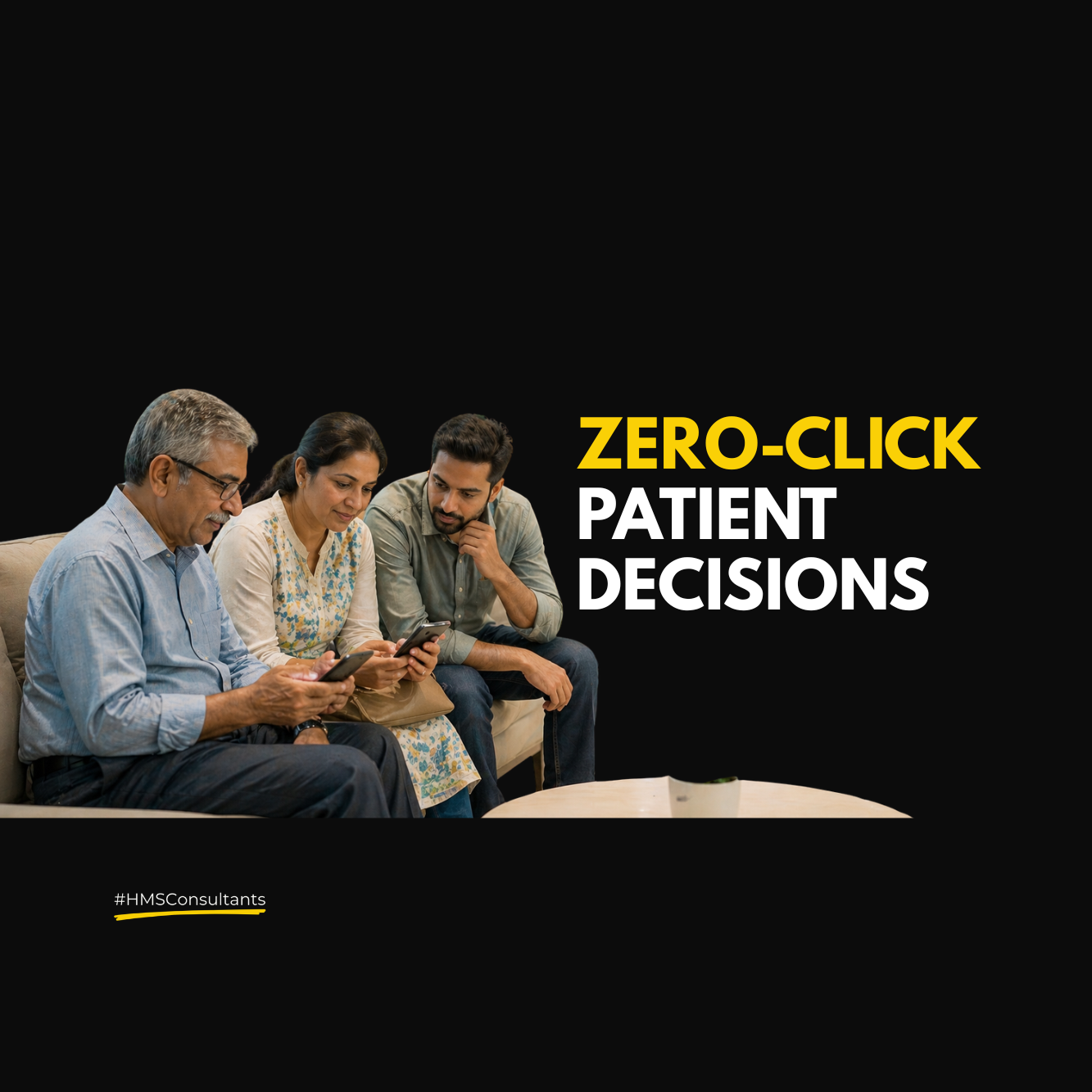
              In 2026, many patient decisions are being shaped before the website visit ever happens. Search results, map listings, reviews, snippets, and AI-generated summaries are influencing choices earlier than most hospitals realise. This shift is redefining marketing a hospital. Today, success is not only about bringing people to a website. It is about winning trust in the moments before the click.

              What Is a Zero-Click Patient Decision?

              A zero-click patient decision happens when someone forms a preference, shortlists a provider, or takes action without opening the hospital website.

              For example:

              A patient searches:

              “Best eye hospital near me”

              They see:

              • Ratings
              • Distance
              • Opening hours
              • Review highlights
              • Call button
              • Photos

              They call directly.

              No website visit.

              Another patient searching for maternity care or orthopaedic treatment may compare visible trust signals and shortlist hospitals instantly.

              This means traditional assumptions around marketing a hospital need to evolve. Website traffic alone no longer tells the full story.

              Why Hospital Marketing Has Changed in 2026

              Older growth strategies often focused on:

              • Website redesign
              • Paid campaigns
              • Social media reach
              • Landing pages
              • Promotional visibility

              These still matter, but they no longer control the first impression.

              Today, hospitals are judged in seconds through search behaviour.

              Patients silently ask:

              • Does this place feel trustworthy?
              • Is it nearby and convenient?
              • Are the reviews recent and credible?
              • Can I contact them quickly?
              • Does the hospital look active and organised?

              If confidence is low, they move on.

              That is why marketing a hospital now depends as much on discoverability and trust as on promotion.

              The Real Homepage Is No Longer the Website

              Many hospitals still treat their website as the main front door.

              But for many users, the first homepage is now:

              • Google Business Profile
              • Google Maps
              • Search result previews
              • Reviews platforms
              • AI-generated answers

              That is where first impressions are formed.

              A hospital may have an excellent website, but if its search presence is weak, many patients may never reach it.

              Modern hospital growth begins where patients actually search.

              Five Signals Driving Patient Choice Today

              1. Review Quality and Recency

              Patients no longer look only at star ratings.

              They examine:

              • How recent reviews are
              • Whether feedback feels genuine
              • Repeated praise patterns
              • Complaint responses
              • Mentions of service quality

              Strong reviews reduce hesitation and improve enquiry intent.

              2. Location Confidence

              Convenience strongly influences healthcare decisions.

              Patients evaluate:

              • Travel time
              • Landmark familiarity
              • Parking ease
              • Emergency accessibility
              • Neighbourhood trust

              This is where GEO (Geographic Optimization) matters. Strong local visibility helps hospitals appear in the right searches at the right time.

              3. Information Completeness

              Missing or outdated information creates doubt quickly.

              Patients expect:

              • Correct phone numbers
              • Timings
              • Specialty details
              • Accurate address
              • Useful photos
              • Current information

              In healthcare, incomplete profiles feel risky.

              4. Easy Next Steps

              Modern users prefer simple actions:

              • Click to call
              • WhatsApp enquiry
              • Directions
              • Appointment request

              If the next step feels effortless, conversions improve.

              If contact feels confusing, interest drops.

              5. Search Summary Perception

              AI summaries and search snippets increasingly shape early impressions.

              If a hospital repeatedly appears associated with:

              • Trusted maternity care
              • Advanced eye treatment
              • Emergency readiness
              • Strong patient feedback

              it enters the shortlist faster.

              This is now a major layer of marketing a hospital in 2026.

              How AEO Is Reshaping Discovery

              AEO (Answer Engine Optimisation) means structuring information so search systems can answer patient questions directly.

              Examples:

              • Which hospital is open now nearby?
              • Best cataract surgery hospital in Bathinda
              • Trusted skin clinic near me
              • Emergency hospital with ICU in Ahmedabad

              Hospitals that publish clear, structured answers become easier to discover and trust.

              Patients increasingly ask questions instead of browsing multiple pages.

              How AI Is Becoming a Silent Referral Source

              Historically, hospitals grew through:

              • Doctor referrals
              • Family recommendations
              • Word of mouth

              Now AI-assisted search is influencing early consideration.

              When users ask healthcare questions, AI tools may summarise visible options using signals such as:

              • Reputation
              • Local relevance
              • Consistency
              • Content clarity
              • Review strength

              This means marketing a hospital now includes preparing for AI-led discovery.

              Why Many Hospitals Misread Performance

              A hospital may say:

              “Our website traffic is low.”

              But that may not reflect reality.

              Patients may be:

              • Calling from Maps
              • Saving listings
              • Checking reviews
              • Comparing profiles
              • Navigating directly
              • Deciding from snippets

              So some hospitals underestimate performance, while others fail to see where interest is leaking away.

              Modern measurement must go beyond sessions and clicks.

              What Smart Hospitals Are Doing Differently

              Hospitals adapting fastest are focusing on:

              • Google profile optimisation
              • Review systems
              • Accurate listings
              • Specialty discoverability
              • Local SEO strength
              • Answer-led content
              • Faster enquiry handling
              • Trust-focused visibility

              They understand that growth is no longer one campaign. It is an ecosystem.

              The Future of Hospital Growth and Discovery

              The future belongs to hospitals that are:

              • Easy to find
              • Easy to trust
              • Easy to understand
              • Easy to contact

              Patients want confidence quickly.

              Hospitals that reduce friction across search, reviews, and first contact will continue to grow steadily.

              Those relying only on advertising may remain visible but not always chosen.

              Conclusion

              Marketing a hospital in 2026 is no longer only about attracting visitors to a website.

              It is about influencing zero-click decisions made through maps, reviews, search snippets, and AI-generated answers before the visit ever begins.

              Hospitals that recognise this shift can build stronger patient pipelines with less wasted effort.

              Because today, many decisions happen before the click.

              Contact Us HMS Consultants

              Zero-click behaviour in marketing a hospital means patients choose, call, or shortlist a hospital directly through maps, ratings, reviews, or search snippets without first visiting the hospital website or landing page.

              Healthcare Marketing I Digital Marketing

              is something we strongly believe in, which means ‘Knowledge without application is the same as having no knowledge at all

              Akhil Dave

              Principle Consultant

              Ready to take your Personal Brand to the next level?

              Share your details below and we will connect with you to discuss your growth strategy.

              • Why Hospital Marketing Budgets Don’t Fix Growth

                Why Hospital Marketing Budgets Don’t Fix Growth

                Why Hospital Marketing Budgets Don’t Fix Growth

                Written by
                Published on
                Share This

                Hospital marketing budget discussions usually begin with a familiar assumption: if growth slows, spending must increase. More ads, more platforms, more agencies. Budget becomes the default solution. Yet many hospitals see a different reality. Visibility increases. Campaign activity expands. But patient flow remains inconsistent.

                The issue is rarely the size of the hospital marketing budget. It is how that budget is being used to compensate for deeper gaps in strategy, communication, and patient experience.

                Why Hospital Marketing Budgets Expand When Clarity Shrinks

                Hospitals often increase their marketing budget during periods of uncertainty. Enquiries fluctuate, conversions feel unstable, and leadership looks for control through scale.

                However, budget expansion often masks unclear positioning, weak sequencing, or gaps in patient communication. Instead of improving outcomes, marketing spend begins to reassure internal teams rather than guide patient decisions.

                This creates a dangerous pattern. As clarity decreases, spending increases. And as spending increases without clarity, inefficiencies multiply.

                A hospital marketing budget grows fastest when strategic clarity is lowest.

                The False Comfort of More Spend

                Increasing the hospital marketing budget creates visible activity. Campaigns increase. Dashboards look stronger. Teams feel productive.

                But visibility is not the same as effectiveness.

                If patients remain uncertain, additional spend amplifies confusion rather than resolving it. Enquiries may increase, but confidence does not. This leads to higher lead volumes but unstable conversions.

                Money increases noise. It does not automatically build trust.

                Hospitals often mistake activity for progress. In reality, progress comes from improving how patients understand and evaluate the hospital, not from increasing how often they see it.

                Where Budget Efficiency Breaks: Marketing vs Operations

                A hospital marketing budget is often planned without considering operational readiness.

                Marketing generates interest, but systems such as OPD flow, front desk communication, appointment handling, and follow-ups may not be prepared to convert that interest.

                This creates leakage:

                • Patients drop off after first contact
                • Follow-ups increase without closure
                • Conversion stability declines

                The problem is not marketing effort. It is experience mismatch.

                When patient experience does not align with marketing promises, trust weakens. And when trust weakens, no amount of additional spend can compensate for it.

                Budget Size vs Budget Intelligence

                A larger hospital marketing budget does not guarantee better results.

                A smaller, well-structured budget focused on patient decision points often performs better than a larger, unfocused one.

                Effective budgets:

                • Invest in moments of patient hesitation
                • Prioritize clarity over channel expansion
                • Reduce duplication instead of increasing presence
                • Focus on conversion stability rather than visibility

                Budget size is visible. Budget intelligence is decisive.

                Hospitals that understand this shift move from spending more to spending better.

                Why Leadership Often Misreads Budget Performance

                Hospital leadership often evaluates marketing budgets through short-term metrics such as:

                • Cost per lead
                • Monthly conversions
                • Immediate ROI

                These metrics reward urgency-driven tactics and overlook long-term trust building.

                This leads to:

                • Short-term gains
                • Long-term instability
                • Reduced patient confidence

                When teams are pressured to deliver quick results, they prioritise tactics that generate immediate activity rather than strategies that build sustained trust.

                Sustainable growth requires patience, not pressure.
                A hospital marketing budget performs best when leadership values consistency over urgency.

                How to Plan a Smarter Hospital Marketing Budget

                A hospital marketing budget should be planned based on patient hesitation, not channels.

                Instead of asking where to spend, hospitals should ask:

                • Where do patients delay decisions?
                • What information is missing?
                • What creates confusion or doubt?

                Budgets aligned with these questions:

                • Reduce unnecessary spend
                • Improve predictability of outcomes
                • Increase conversion quality
                • Strengthen patient confidence

                Marketing should guide decisions, not compensate for confusion.

                When clarity improves, the need for excessive spending reduces naturally.

                Conclusion

                Hospitals do not struggle because their marketing budgets are too small.
                They struggle because budgets are used to solve problems they were never meant to fix.

                A hospital marketing budget performs best when it:

                • Supports patient clarity
                • Aligns with real experience
                • Reduces hesitation

                Growth in healthcare does not respond to louder spending.
                It responds to better alignment between communication, experience, and trust.

                Hospitals that understand this stop increasing budgets reactively and start improving systems proactively.
                And when that happens, growth becomes calmer, more predictable, and more sustainable.

                Contact Us HMS Consultants

                A hospital marketing budget is the planned allocation of resources used to support patient awareness, trust-building, and decision-making. It includes spending on communication, digital presence, and patient engagement, but should primarily focus on improving clarity and patient experience rather than just increasing promotional activity.

                Doctors Digital Marketing I Healthcare Marketing I Hospital Marketing Strategies I Marketing ideas for clinics I Marketing Trends 2025 I Medical Marketing I Social Media Marketing

                is something we strongly believe in, which means ‘Knowledge without application is the same as having no knowledge at all

                Akhil Dave

                Principle Consultant

                Ready to take your Personal Brand to the next level?

                Share your details below and we will connect with you to discuss your growth strategy.

                • Why a Hospital Marketing Consultant Is Brought In Too Late and What That Delay Actually Costs

                  Why a Hospital Marketing Consultant Is Brought In Too Late and What That Delay Actually Costs

                  Why a Hospital Marketing Consultant Is Brought In Too Late and What That Delay Actually Costs

                  Written by
                  Published on
                  Share This

                  A hospital marketing consultant is usually engaged when frustration peaks and hospital growth and patient footfall are not meeting expectations. Marketing feels expensive. Growth feels inconsistent. Teams feel busy but unsure. Leadership senses something is wrong, yet no single campaign or channel explains the problem.

                  By the time a marketing consultant is called in, the hospital has often spent months, sometimes years, compensating for structural gaps with more activity. This delay is not just costly in budget terms. It quietly erodes trust, efficiency, and strategic clarity.

                  Why Hospitals Delay Calling a Marketing Consultant

                  Hospitals often believe marketing problems can be solved internally, or by working with an outsourced social media or advertising agency for better execution. New hires are made. Agencies are changed. Tools are added. Reporting becomes more detailed.

                  These steps feel proactive, but they avoid a harder question: Is the problem execution, or is it alignment?

                  A hospital marketing consultant is usually delayed because leadership hopes that effort will fix clarity. In healthcare, effort without alignment amplifies confusion.

                  What a Hospital Marketing Consultant Looks for First

                  Contrary to expectation, a hospital marketing consultant does not begin with campaigns or platforms. They look for decision friction. Where do patients hesitate? Where do teams compensate manually? Where does communication repeat itself unnecessarily? What is working and what is not working? Which source brings more patients to the existing practice? What exactly is our target audience? 

                  These patterns reveal misalignment between marketing promises, patient expectations, and operational reality. Once identified, many “marketing problems” disappear without adding activity.

                  Consulting starts with audit & diagnosis, not delivery.

                  The Hidden Cost of Waiting Too Long

                  Delaying consulting support creates invisible costs. Marketing teams burn out. Patient conversations become repetitive. Conversion rates fluctuate unpredictably. Leadership loses confidence in marketing as a function.

                  These costs rarely appear in financial statements. They appear in decision fatigue, reactive planning, and constant optimisation cycles.

                  A hospital marketing consultant reduces these costs by restoring coherence early.

                  Why Agencies Cannot Replace Consultants

                  Agencies execute within a brief. Consultants question the brief itself. When hospitals rely solely on agencies, execution improves but misalignment remains.

                  A hospital marketing consultant works upstream of execution. They redefine priorities, sequencing, and success criteria so agencies can perform effectively.

                  Without this layer, hospitals often rotate agencies without fixing the root issue.

                  How Marketing Consultants Change the Nature of Marketing Conversations

                  Once a consultant is involved, conversations shift. Instead of asking “what should we run next,” teams ask “what is blocking patient confidence.” Metrics are discussed in context. Funnels are evaluated behaviourally, not mechanically.
                  This shift reduces noise and increases focus. Marketing becomes calmer, not louder.

                  That calm is a sign of strategic health.

                  The Long-Term Impact of Early Consulting

                  Hospitals that engage a marketing consultant early experience fewer resets. Growth becomes steadier. Marketing spend becomes more predictable. Teams spend more time improving experience and less time firefighting performance issues.

                  Most importantly, leadership gains a clearer lens to evaluate marketing decisions without relying solely on dashboards.

                  Clarity compounds faster than campaigns.

                  A Hospital Marketing Consultant Is Most Valuable Before Things Feel Broken

                  Hospitals do not need consultants because marketing fails. They need consultants because marketing works harder than it should.

                  A hospital marketing consultant identifies friction before it becomes frustration. They align decisions before effort escalates. They help hospitals stop compensating and start structuring growth.

                  In healthcare, the costliest delay is not slow marketing.
                  It is waiting too long to fix what quietly blocks trust.

                  Hospitals that understand this bring consultants in early and grow with far less noise.

                  Contact Us HMS Consultants

                  A hospital marketing consultant is a strategic advisor who diagnoses alignment gaps between marketing, patient behaviour, and hospital operations. Unlike agencies, consultants focus on fixing structural issues that prevent marketing from delivering stable, long-term growth.

                  Doctors Digital Marketing I Healthcare Marketing I Hospital Marketing Strategies I Marketing ideas for clinics I Marketing Trends 2025 I Medical Marketing I Social Media Marketing

                  is something we strongly believe in, which means ‘Knowledge without application is the same as having no knowledge at all

                  Akhil Dave

                  Principle Consultant

                  Ready to take your Personal Brand to the next level?

                  Share your details below and we will connect with you to discuss your growth strategy.

                  • What a Hospital Marketing Expert Sees in the First 30 Days That Others Miss for Years

                    What a Hospital Marketing Expert Sees in the First 30 Days That Others Miss for Years

                    What a Hospital Marketing Expert Sees in the First 30 Days That Others Miss for Years

                    Written by
                    Published on
                    Share This

                    A hospital marketing expert is often called in when leadership feels something is wrong but cannot clearly articulate what it is. Marketing is active. Visibility exists. Teams are busy. Reports look acceptable. Yet growth feels inconsistent, fragile, and effort-heavy.

                    Within the first 30 days, an experienced hospital marketing expert usually sees the problem clearly. Not because of superior tools or data access but because patterns repeat across hospitals, and they rarely sit where hospitals expect them to.

                    5 things a hospital marketing expert typically identifies in the first 30 days:

                    • Recurring patient questions that indicate unresolved hesitation
                    • Misalignment between marketing messaging and actual patient readiness
                    • Experience gaps that marketing quietly compensates for
                    • Unnecessary friction in the decision-making or booking journey
                    • Metrics that measure activity rather than outcomes

                    Why Experts Look for Friction, Not Campaigns

                    Most hospitals expect a hospital marketing expert to evaluate ads, content, or platforms first. In reality, experts look for friction. Where do patients hesitate? Where does clarity break? Where does effort increase without proportional outcome?

                    Campaigns rarely explain growth problems in healthcare. Friction does. A hospital marketing expert understands that performance issues are usually behavioural, not creative. Visibility is seldom the root cause. Unresolved hesitation is.

                    “The problem is almost never that patients haven’t heard of the hospital. It’s that something in the experience stops them from acting on what they’ve heard.”

                    What Experts Notice Immediately About Patient Behaviour

                    Within weeks, patterns emerge. Patients ask the same questions repeatedly. They delay decisions after consultations. They seek reassurance that should have been addressed earlier in the patient journey.

                    These behaviours indicate that marketing communication is not aligned with patient readiness a core concept in any sound healthcare marketing strategy. A hospital marketing expert notices this misalignment quickly because it shows up consistently across touchpoints.

                    Hospitals often normalise this behaviour. Experts do not. This difference in perspective is what makes early diagnosis possible.

                    Why Internal Teams Stop Seeing the Real Problem

                    Internal teams adapt to systems over time. Workarounds become routine. Confusion becomes expected. Marketing quietly compensates for experience gaps without anyone deliberately deciding this is acceptable.

                    A hospital marketing expert brings distance. They are not emotionally invested in existing processes. This allows them to question what insiders accept as just how things work.

                    This external perspective is often uncomfortable and extremely valuable. It is one reason why hospitals that engage a healthcare marketing consultant India-based or otherwise, see faster clarity than those relying solely on internal review.

                    The Difference Between What Experts Change and What Hospitals Expect Them to Change

                    Hospitals often expect new campaigns, new messaging, or new platforms. Experts focus elsewhere. They change sequencing. They simplify communication. They remove unnecessary steps. They slow down decisions where patients feel rushed.

                    These changes rarely look dramatic. But they reduce resistance significantly and in healthcare, reduced resistance directly improves patient acquisition rates.

                    A hospital marketing expert optimises systems, not surface activity. This is the distinction between sustainable growth and the exhausting cycle of campaign-dependent results.

                    What a hospital marketing expert changes vs. what hospitals expect:

                    • Hospitals expect: new ad campaigns, new platforms, new creative
                    • Experts focus on: decision sequencing, communication clarity, friction removal
                    • Hospitals expect: more volume, more content, more follow-ups
                    • Experts focus on: alignment between message and patient readiness

                    Why Experts Ask Fewer Questions but Better Ones

                    Experienced experts do not ask for endless data. They ask precise questions. Where do patients hesitate most? What do they misunderstand? When do they disengage quietly?

                    The answers to these questions reveal more than dashboards ever could. This is why a hospital growth consultant often identifies core issues faster than teams with deeper access and years of context.

                    Clarity comes from focus, not volume.

                    “The most revealing question is never about numbers. It is: what do patients say just before they decide not to proceed?”
                    How Expert Insight Reduces Marketing Pressure

                    Once friction points are identified and corrected, marketing effort reduces naturally. Fewer reminders are needed. Follow-ups shorten. Conversion stabilises.

                    Hospitals often assume growth requires more effort more campaigns, more spend, more team hours. A hospital marketing expert demonstrates that growth in healthcare often requires less noise and more alignment.

                    This is when marketing stops feeling exhausting. And it is when leadership begins to trust data again because the data starts reflecting reality instead of compensating for hidden friction.

                    Why Hospitals Delay Calling in Experts

                    Many hospitals delay engaging a hospital marketing expert because they believe issues can be solved internally with more effort or new execution. By the time an expert is brought in, inefficiencies have compounded and teams are fatigued.

                    Experts are most valuable before frustration peaks. Early clarity prevents expensive resets later. This timing difference often determines the return on consulting and the speed of recovery.

                    What Happens After the First 30 Days

                    After the first month, the hospital marketing expert’s role shifts. From observation to refinement. From diagnosis to structure. From insight to alignment.

                    The hospital begins to see marketing differently not as a set of activities, but as a system influencing patient confidence. Budget decisions change. Measurement changes. The team stops chasing vanity metrics and starts tracking signals of trust.

                    This shift is subtle. But it changes how decisions are made long-term.

                    Conclusion: A Hospital Marketing Expert Sees What Noise Hides

                    Hospitals do not struggle because they lack activity or intent. They struggle because noise hides friction.

                    A hospital marketing expert cuts through this noise quickly not by doing more, but by seeing clearly. They notice hesitation patterns, misalignment, and unnecessary complexity that others have learned to ignore.

                    In healthcare, growth does not come from louder marketing. It comes from removing what quietly blocks trust.

                    Hospitals that understand this stop chasing performance and start building systems that work even when no one is watching.

                    Looking to work with a hospital marketing expert? Explore HMS Consultants’ healthcare marketing services 

                    Contact Us HMS Consultants

                    A hospital marketing expert is a strategic advisor who evaluates how marketing, patient behaviour, and internal systems align. Their role is not to run campaigns, but to identify friction points, clarify decision flow, and improve trust-led growth across the patient journey.

                    Doctors Digital Marketing I Healthcare Marketing I Hospital Marketing Strategies I Marketing ideas for clinics I Marketing Trends 2025 I Medical Marketing I Social Media Marketing

                    is something we strongly believe in, which means ‘Knowledge without application is the same as having no knowledge at all

                    Akhil Dave

                    Principle Consultant

                    Ready to take your Personal Brand to the next level?

                    Share your details below and we will connect with you to discuss your growth strategy.

                    • Why Doctors Digital Marketing Fails When It Is Treated as a Content Problem

                      Why Doctors Digital Marketing Fails When It Is Treated as a Content Problem

                      Why Doctors Digital Marketing Fails When It Is Treated as a Content Problem

                      Written by
                      Published on
                      Share This

                      Doctors digital marketing is often approached as a consistency challenge. Post more. Be visible regularly. Follow formats that work. Stay active so patients remember you. When results don’t improve, the solution usually suggested is better content planning or higher posting frequency.

                      This framing is misleading.

                      Doctors digital marketing rarely fails because of content volume. It fails because content is being created without a decision context. Patients consume information, but it does not move them closer to choosing a doctor.

                      In healthcare, information alone does not create confidence.

                      Why Patients Don’t Decide After Seeing Doctor Content

                      Patients engaging with doctors online are usually not looking to be impressed. They are trying to understand seriousness, risk, and next steps. Educational posts may increase awareness, but awareness does not equal readiness.

                      Doctors digital marketing struggles when it assumes that learning automatically leads to trust. Patients often understand more after consuming content, yet feel more cautious, not less. This is because information raises questions faster than it resolves them.

                      Without guidance, content increases hesitation.

                      The Gap Between Education and Decision-Making

                      Most doctors focus their digital marketing on explaining conditions, treatments, or procedures. While this is valuable, it addresses only one part of the patient journey. Patients also need help interpreting what that information means for them.

                      Doctors digital marketing becomes ineffective when it explains facts but avoids uncertainty. Patients want to know how decisions are made, what usually happens next, and how risks are handled in real life.

                      Content that stops at education leaves patients informed but undecided.

                      Why More Content Makes Doctors Digital Marketing Worse

                      When results plateau, doctors often increase output. More reels, more carousels, more posts. This creates familiarity but not progression. Patients may recognise the doctor but still hesitate to book.

                      Excess content without decision framing overwhelms patients. They see multiple messages but struggle to connect them into a clear path forward. Doctors then assume digital marketing doesn’t work, when the real issue is sequencing.

                      Doctors digital marketing should simplify thinking, not multiply it.

                      How Decision Framing Changes Digital Marketing Outcomes

                      Decision framing means helping patients understand when to act, not just what exists. It addresses timing, seriousness, and choice criteria. When doctors integrate decision framing into their digital communication, content begins to guide rather than inform passively.

                      Patients start to see themselves in the information. Questions become more specific. Conversations shift from “what is this?” to “is this right for me?”

                      This shift marks effective doctors digital marketing.

                      Why Doctors Avoid Decision-Oriented Content

                      Many doctors hesitate to discuss decisions openly online because they fear being seen as persuasive or promotional. This leads to safe, neutral education that avoids commitment signals.

                      Ironically, this restraint keeps patients stuck. Decision-oriented content does not mean pushing treatment. It means explaining how decisions are usually approached, what factors matter, and when waiting is acceptable.

                      Doctors digital marketing improves when uncertainty is acknowledged, not avoided.

                      The Operational Impact of Better Digital Marketing

                      When doctors digital marketing is decision-led, consultations become smoother. Patients arrive with context. Time is spent on clarification rather than repetition. Treatment discussions become more balanced.

                      Doctors often underestimate this operational benefit. Digital clarity reduces in-clinic friction even if online metrics look unchanged initially.

                      This is where long-term value appears.

                      Why Algorithms Reward Decision-Led Content

                      Search engines and social platforms increasingly favour content that retains attention and satisfies intent. Decision-led content keeps users engaged because it feels relevant and complete.

                      Doctors digital marketing that helps patients move mentally toward clarity performs better over time than content that only explains concepts. Engagement quality matters more than reach.

                      Algorithms follow behaviour. Patients reward usefulness.

                      Conclusion: Doctors Digital Marketing Works When It Helps Patients Decide, Not Just Learn

                      Doctors digital marketing does not fail because doctors are inconsistent or uncreative. It fails because content is treated as an information exercise rather than a decision-support system.

                      Patients do not need more facts. They need help navigating uncertainty safely.

                      When doctors shift digital communication from education-only to decision-aware guidance, marketing stops feeling exhausting and starts feeling purposeful.

                      In healthcare, clarity converts better than frequency.

                      Doctors who understand this stop chasing content calendars and start building confidence one informed decision at a time.

                      Contact Us HMS Consultants

                      Doctors digital marketing refers to how doctors use digital platforms to educate patients, reduce uncertainty, and support healthcare decision-making. It focuses on clarity, guidance, and trust-building rather than frequent posting, promotion, or visibility-driven content strategies.

                      Doctors Digital Marketing I Healthcare Marketing I Hospital Marketing Strategies I Marketing ideas for clinics I Marketing Trends 2025 I Medical Marketing I Social Media Marketing

                      is something we strongly believe in, which means ‘Knowledge without application is the same as having no knowledge at all

                      Akhil Dave

                      Principle Consultant

                      Ready to take your Personal Brand to the next level?

                      Share your details below and we will connect with you to discuss your growth strategy.