Search results for: “marketing trends”

  • Why a Hospital Marketing Strategy Fails When It Is Built Around Channels Instead of Decisions

    Why a Hospital Marketing Strategy Fails When It Is Built Around Channels Instead of Decisions

    Why a Hospital Marketing Strategy Fails When It Is Built Around Channels Instead of Decisions

    Written by
    Published on
    Share This

    Hospital marketing strategy is often discussed in terms of platforms. Websites, social media, Google Ads, SEO, WhatsApp, offline branding, referral programmes strategy meetings frequently revolve around where the hospital should be visible. While channel selection matters, it is rarely the reason marketing succeeds or fails.

    Most hospital marketing strategies fail not because the wrong channels were chosen, but because the strategy was never anchored to how patients actually make decisions.

    In healthcare, visibility does not create confidence. Decision clarity does.

    Why Channel-First Thinking Dominates Hospital Marketing

    Hospitals operate in complex, time-constrained environments. Leadership wants clarity, teams want direction, and agencies want execution scope. Channels offer structure. They are easy to plan, easy to measure, and easy to justify.

    As a result, hospital marketing strategy often becomes a checklist of activities rather than a framework for influencing patient behaviour. Effort increases, activity looks consistent, but outcomes remain volatile.

    The mistake is subtle. Marketing becomes busy without becoming meaningful.

    How Patients Actually Decide And Why Strategy Misses This

    Patients do not move through channels. They move through states of mind.

    They begin with uncertainty, move into comparison, seek reassurance, and finally act when confidence outweighs fear. A hospital marketing strategy that ignores these stages may reach patients repeatedly without ever supporting their decision.

    This is why many hospitals experience strong traffic with weak conversion. The strategy addressed exposure, not hesitation.

    From a healthcare marketing strategy perspective, understanding why a patient pauses is far more valuable than knowing where they came from.

    Why More Marketing Does Not Fix a Weak Strategy

    When outcomes underperform, hospitals often increase marketing intensity. More ads, more posts, more campaigns. This response feels logical, but it treats symptoms rather than causes.

    If messaging does not reduce uncertainty, repetition only amplifies confusion. Patients see the hospital more often, but do not feel more confident. Over time, marketing begins to feel intrusive rather than reassuring.

    A hospital marketing strategy must first resolve doubt before it seeks attention.

    The Role of Trust in Hospital Marketing Strategy

    Trust is not a by-product of marketing in healthcare. It is the objective.

    Every element of hospital marketing strategy should answer one question clearly: Does this help a patient feel safer about choosing us? If the answer is unclear, the activity adds noise without value.

    Trust is built through consistency of message, clarity of explanation, and alignment between promise and experience. When strategy focuses on these principles, channels naturally perform better.

    When it does not, no channel can compensate.

    Why Strategy Breaks When Marketing Is Isolated From Experience

    Hospital marketing strategy often exists separately from operational reality. Marketing communicates excellence, but patient experience delivers inconsistency. This gap weakens credibility faster than any negative review.

    Patients may be impressed initially, but trust erodes when communication, processes, or behaviour contradict expectations. Marketing then has to work harder to repair damage it did not create.

    A strong hospital marketing strategy is inseparable from patient experience design. One reinforces the other.

    What a Decision-Centric Hospital Marketing Strategy Looks Like

    A decision-centric strategy begins by mapping where patients hesitate, what they fear, and what information they lack. Messaging is then designed to resolve these gaps gradually, not force action prematurely.

    Such a strategy evolves over time. It learns from patient interactions, reviews, and outcomes. Instead of changing direction frequently, it deepens insight.

    Hospitals that adopt this approach see steadier growth, better-prepared patients, and lower marketing volatility.

    Why Leadership Thinking Determines Strategy Quality

    Hospital marketing strategy reflects leadership priorities. When leadership focuses on short-term numbers, strategy becomes reactive. When leadership prioritises clarity and consistency, strategy matures.

    This is why similar hospitals using similar channels experience vastly different outcomes. Strategy quality is less about tools and more about intent.

    Hospitals that treat marketing as a leadership function, not a tactical one, build stronger foundations for growth.

    The Long-Term Cost of Channel-Driven Strategy

    Channel-driven strategies fragment over time. Each platform develops its own logic, tone, and objectives. Messaging becomes inconsistent. Learning is lost. Patients receive mixed signals.

    Eventually, hospitals restart strategy entirely new agencies, new platforms, new promises  without realising the underlying issue remains unresolved.

    This cycle is costly, exhausting, and avoidable.

    Conclusion: Hospital Marketing Strategy Succeeds When It Follows the Patient’s Mind, Not the Platform

    A hospital marketing strategy should not be defined by where the hospital appears, but by how patients decide.

    Channels are tools. Decisions are the real battleground.

    Hospitals that build strategy around patient hesitation, trust formation, and clarity create systems that grow steadily and sustainably. Those that build strategy around platforms chase attention without earning confidence.

    In healthcare, growth does not come from being seen everywhere.
    It comes from being understood at the right moment.

    That is what a real hospital marketing strategy is designed to do.

    Contact Us HMS Consultants

    A hospital marketing strategy is a structured approach to attracting, converting, and retaining patients by aligning communication, experience, and trust-building across the patient journey. It focuses not just on visibility, but on helping patients make confident healthcare decisions.

    Doctors Digital Marketing I Healthcare Marketing I Hospital Marketing Strategies I Marketing ideas for clinics I Marketing Trends 2025 I Medical Marketing I Social Media Marketing

    is something we strongly believe in, which means ‘Knowledge without application is the same as having no knowledge at all

    Akhil Dave

    Principle Consultant

    Ready to take your Personal Brand to the next level?

    Share your details below and we will connect with you to discuss your growth strategy.

    • Healthcare Marketing Toolkit

      Healthcare Marketing Toolkit

      Ethical Guide 002

      Ethical Social Media Marketing for Doctors: Practical Guidebooks (India)

      Ethical social media marketing well help you apply the learnings immediately, we have compiled a set of practical, implementation-ready PDFs based on published regulations and best-practice guidance.

      You will receive all PDFs instantly on email after submitting the form.

      Here's what you get with the guide-book.

      What you will receive?

      11 practical documents you can read, save, and implement across Instagram, Facebook, YouTube, LinkedIn, and Google profiles.

      Glimpse #1

      Ethical Social Media Checklist (Before You Post)

      A one-page printable checklist to review intent, claims, privacy, professionalism, and disclosures before publishing any post.

      Glimpse #2

      The Laxman Rekha Decision Test (Intent + Context + Consequence)

      A fast self-audit framework with trigger questions to identify whether a post is education-led or slipping into inducement.

      Glimpse #3

      Platform-wise Do/Don’t Pack

      Clear do’s and don’ts for Instagram/FB/Reels, YouTube, LinkedIn, Google Business Profile/Maps (plus optional WhatsApp etiquette).

      Glimpse #4

      Content Pillars for Ophthalmology (Education-First)

      A structured content blueprint with ophthalmology-focused pillars and guidance on what to say and what to avoid.

      Glimpse #5

      Safe Formats Library (Templates)

      Ready templates for FAQ posts, Myth vs Fact, “3 Symptoms/3 Don’ts/3 When to consult”, process explainers, and professional identity posts.

      Glimpse #6

      Consent + Privacy Toolkit

      Practical rules on consent (necessary but not sufficient), de-identification, and minimum safe practices for patient-related content.

      Glimpse #7

      Comment, DM, and Online Advice Protocol

      What to reply publicly, when to move to consultation, and copy-paste responses that keep conversations safe and professional.

      Glimpse #8

      Advertising and Promotion Boundaries

      What is allowed as factual information vs what becomes inducement, including simple disclosure language for partnerships.

      Glimpse #9

      Red Flags Page

      A single-page list of high-risk patterns (guarantees, “best” claims, before/after bait, OT-as-a-stage, peer criticism) with corrective direction.

      Glimpse #10

      Personal Brand Foundation: A Working Sheet for Doctors

      A clarity-driven worksheet to define identity, behaviour, proof, and presence—so personal branding stays ethical and inside-out.

      Three Simple Steps

      How to access the PDFs?

      Step #1

      Click Download the Guidebooks

      Step #2

      Fill in your basic details

      Step #3

      Receive the complete set instantly on email (with direct download links)

      Learning by HMS Consultants

      Stay Updated and Connected

      Stay ahead with our expert insights and latest updates in healthcare marketing. Visit our blogs for valuable tips, industry trends, etc.

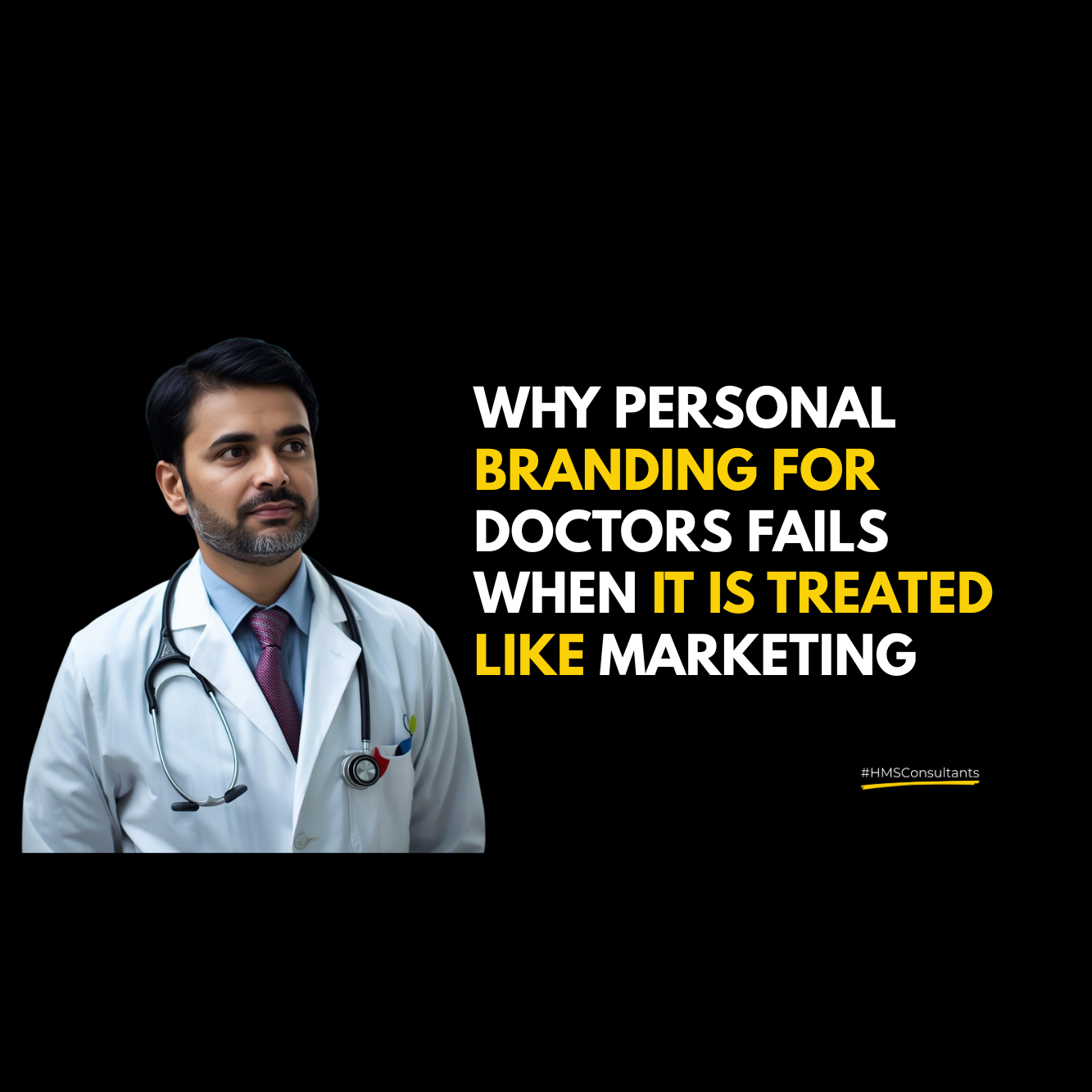
    • Why Personal Branding for Doctors Fails When It Is Treated Like Marketing

      Why Personal Branding for Doctors Fails When It Is Treated Like Marketing

      Why Personal Branding for Doctors Fails When It Is Treated Like Marketing

      Written by
      Published on
      Share This

      Personal branding for doctors has become one of the most misunderstood concepts in healthcare growth. Everywhere, doctors are advised to be visible, post consistently, build an online presence, and “market themselves” to stay relevant. Social media platforms reinforce this advice by rewarding frequency, engagement, and personality-driven content. On the surface, this appears logical. In practice, it often produces the opposite result.

      Many doctors invest time and effort into visibility but still struggle to convert attention into trust, loyalty, or meaningful patient relationships. The issue is not effort or intent. The issue is that personal branding for doctors is repeatedly approached as marketing, rather than as trust architecture.

      In healthcare, this distinction is critical.

      Why Visibility Alone Weakens Doctor Credibility Over Time

      Doctors are not evaluated the way consumer brands are. Patients do not follow doctors for entertainment, opinions, or relatability alone. They follow because they are seeking reassurance during moments of uncertainty. When personal branding focuses primarily on visibility, frequency, or trend participation, credibility begins to erode quietly.

      Patients may engage with content, but engagement does not equal confidence. Over time, excessive visibility without depth creates familiarity without authority. Doctors begin to feel “present everywhere” but not necessarily trusted more.

      This is why many doctors experience a plateau despite consistent posting. The audience grows, but trust does not compound.

      The Psychological Gap Between Doctors and Branding Advice

      Most personal branding frameworks come from industries where attention is the primary currency. Healthcare operates on a different psychological contract. Doctors are bound by ethics, responsibility, and trust expectations that do not allow exaggerated claims, emotional manipulation, or self-promotion in the conventional sense.

      This creates internal conflict. Doctors feel uncomfortable highlighting achievements, uncertain about tone, and wary of appearing commercial. As a result, branding efforts either feel forced or overly cautious. Neither builds strong trust.

      Effective personal branding for doctors resolves this conflict by shifting focus from self-promotion to patient clarity.

      What Patients Actually Look for in a Doctor’s Personal Brand

      Patients rarely search for “the most popular doctor” or “the most followed specialist.” They search for signs of safety. They want to know whether a doctor explains clearly, listens patiently, respects concerns, and guides decisions calmly.

      Personal branding that works in healthcare mirrors the consultation experience patients hope to have. It answers doubts before they are voiced. It explains complexity without intimidation. It communicates boundaries honestly and avoids sensationalism.

      When patients encounter this kind of content repeatedly, trust forms naturally. The doctor feels familiar in a reassuring way, not in a performative one.

      Why Educational Content Alone Is Not Enough

      Many doctors focus personal branding entirely on education. They share medical facts, awareness posts, and procedural explanations. While education is important, it does not automatically translate into trust.

      Patients do not struggle because of lack of information. They struggle because of uncertainty around implications, outcomes, and decisions. Education that does not address emotional context remains incomplete.

      Personal branding for doctors becomes effective when education is paired with guidance. Patients want to understand not just what a condition is, but what it means for them.

      The Role of Consistency in Doctor Personal Branding

      Consistency in personal branding is often misunderstood as posting regularly. In healthcare, consistency of thinking matters far more than consistency of output.

      Patients trust doctors whose communication philosophy remains stable across time. The tone is calm. The message is measured. The approach to care is clear. Even infrequent content builds authority when it reflects a coherent worldview.

      Doctors who chase trends sacrifice this coherence. Doctors who protect it build durable brands.

      Why Personal Branding Cannot Be Separated From Practice Environment

      Personal branding for doctors does not exist in isolation. Patients eventually experience the hospital, clinic, or system surrounding the doctor. If the experience contradicts the brand promise, trust weakens.

      This is why personal branding works best when aligned with institutional clarity. The doctor’s communication should reflect how care is actually delivered. When alignment exists, branding reinforces experience. When it does not, branding feels misleading, even unintentionally.

      Long-term trust requires this alignment.

      How Personal Branding Influences Patient Decisions Before First Contact

      A strong personal brand shortens the trust-building phase. Patients arrive with familiarity. Consultations feel smoother. Resistance reduces. Conversations become more productive. Decisions are made with less friction.

      These outcomes are often attributed to “better leads” or “marketing success.” In reality, they are the result of pre-built trust through consistent, patient-centred communication.

      From a healthcare growth perspective, this is one of the most efficient advantages personal branding can create.

      Why Most Doctors Quit Personal Branding Too Early

      Doctors often stop personal branding efforts because results feel unclear. Likes fluctuate. Growth seems slow. Conversion is difficult to attribute.

      What is missed is that personal branding in healthcare compounds quietly. Trust forms over repeated exposure, not immediate response. The payoff shows up in subtle ways: easier consultations, higher acceptance, stronger referrals, and long-term loyalty.

      Doctors who expect immediate outcomes abandon the process before it matures.

      Conclusion: Personal Branding for Doctors Is Not About Being Known, But Being Trusted

      Personal branding for doctors fails when it mimics consumer marketing. It succeeds when it reflects clinical thinking, ethical restraint, and patient empathy.

      Doctors do not need to be louder. They need to be clearer. They do not need to be everywhere. They need to be consistent. They do not need to sell themselves. They need to reduce uncertainty.

      In healthcare, trust is the brand.

      Doctors who understand this build personal brands that last longer than algorithms, trends, or platforms and that is the only kind of branding that truly works.

      Contact Us HMS Consultants

      Personal branding for doctors is the process of building trust, credibility, and familiarity with patients through consistent communication of a doctor’s values, thinking, and approach to care. It is not about self-promotion, but about helping patients feel confident and informed before they ever step into a clinic or hospital.

      Doctors Digital Marketing I Healthcare Marketing I Hospital Marketing Strategies I Marketing ideas for clinics I Marketing Trends 2025 I Medical Marketing I Social Media Marketing

      is something we strongly believe in, which means ‘Knowledge without application is the same as having no knowledge at all

      Akhil Dave

      Principle Consultant

      Ready to take your Personal Brand to the next level?

      Share your details below and we will connect with you to discuss your growth strategy.

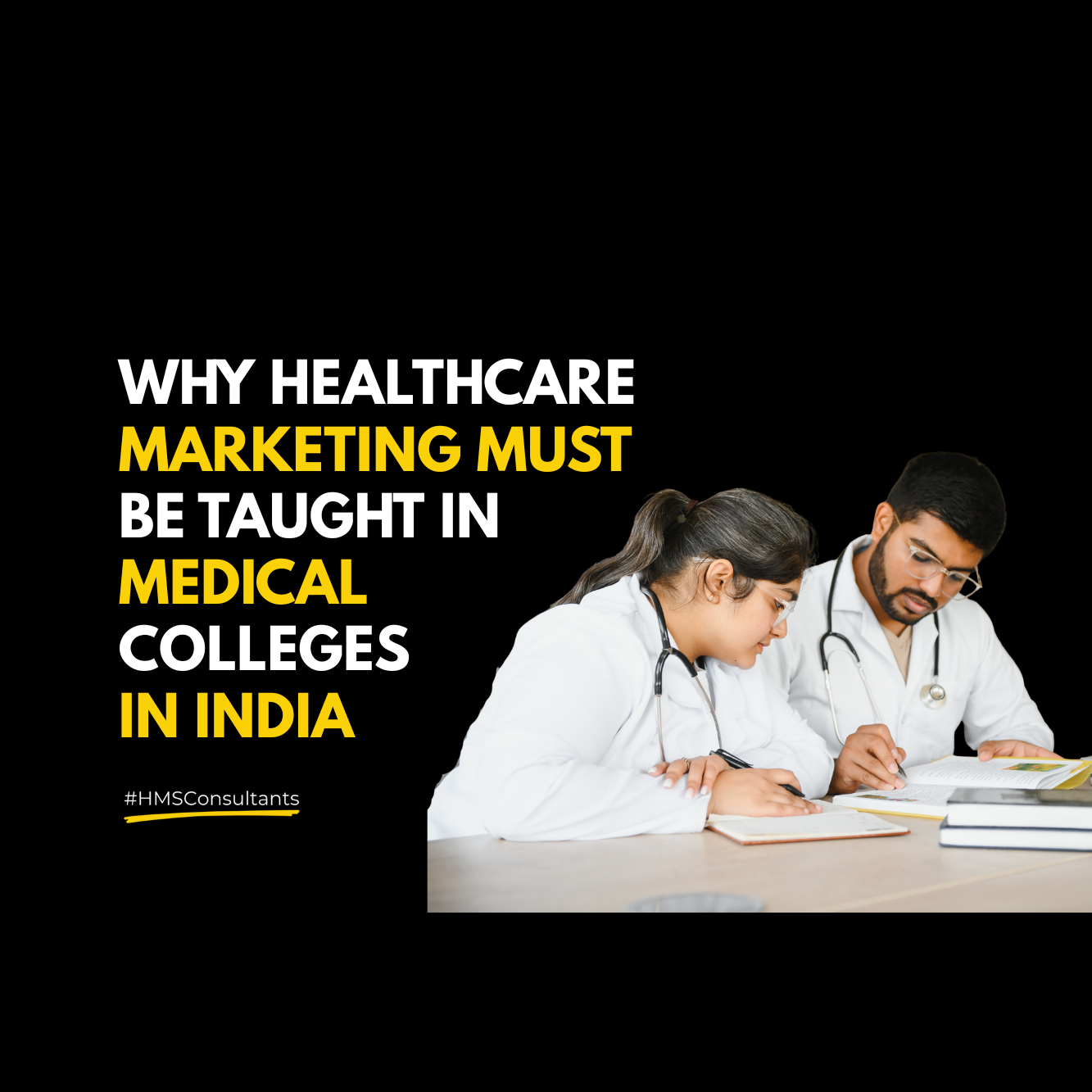
      • Why Healthcare Marketing Must Be Taught in Medical Colleges in India

        Why Healthcare Marketing Must Be Taught in Medical Colleges in India

        Why Healthcare Marketing Must Be Taught in Medical Colleges in India

        Written by
        Published on
        Share This

        Healthcare marketing is rapidly becoming an essential skill for doctors, hospitals, and healthcare institutions in India. Patients today search online before choosing a doctor, trust digital platforms for health information, and increasingly rely on social media, YouTube, and AI tools to understand medical conditions. Yet, despite this shift, healthcare marketing and ethical digital communication are still not taught in most medical colleges in India. Medical students graduate with strong clinical knowledge, but without structured education on healthcare branding, patient communication, digital responsibility, or practice development. This growing gap between medical education and real-world healthcare communication is now impacting both patient trust and the professional readiness of future doctors.

        This is why the need for healthcare marketing education in medical colleges has become critical. Introducing healthcare marketing and branding concepts during MBBS and medical training can prepare future doctors to communicate ethically, counter misinformation, build credible digital identities, and develop patient-centric healthcare practices. As healthcare becomes increasingly digital, marketing education is no longer about promotion it is about responsible public health communication.

        The digital health conversation is exploding.

        But healthcare education around it is still silent.

        Scroll through any social platform today and you’ll see an ocean of health-related content reels on immunity, podcasts on hormones, influencers talking about gut health, entrepreneurs selling wellness programs, and creators offering medical advice.

        Some of it is helpful.
        Much of it is unverified.
        And a growing portion is dangerously misleading.

        At the same time, India is producing thousands of highly qualified doctors every year experts in diagnosis, treatment, and patient care.

        Yet, when these doctors step into the real world, they are rarely prepared for one reality:

        Healthcare today is not only practiced in clinics and hospitals. It is practiced on digital platforms.

        Patients are no longer passive recipients of care.
        They research.
        They compare.
        They follow.
        They judge credibility online before they ever step into a consultation room.

        And this raises a serious question for our education system:

        Why isn’t Healthcare Marketing and Ethical Health Communication taught in medical colleges?

        The Reality Young Doctors Face After Graduation

        In my years of working closely with hospitals, doctors, and healthcare institutions across India, one pattern repeats itself.

        Doctors leave medical college extremely strong in clinical knowledge but almost completely unprepared for:

        • Building their professional identity
        • Communicating medical knowledge to the public
        • Managing their digital presence
        • Educating patients ethically at scale
        • Creating trust in competitive healthcare markets
        • Developing their own practice or institutional brand

        Most learn marketing accidentally.

        Through:

        •  trial and error
        • wrong agency guidance
        • trend-based posting
        • copying influencers
        • promotional confusion
        • and sometimes reputational damage

        They were trained to save lives.
        But not trained to communicate health responsibly in a digital world.

        Why Healthcare Marketing Is Not Like Any Other Industry

        Healthcare is not FMCG.
        It is not real estate.
        It is not education.
        It is not entertainment.

        Healthcare deals with:

        • vulnerability
        • fear
        • trust
        • ethics
        • long-term reputation
        • irreversible impact

        In healthcare, marketing is not about visibility.
        It is about credibility.

        It is not about persuasion.
        It is about education.

        It is not about selling.
        It is about serving responsibly.

        This is why healthcare marketing cannot be learned from generic marketing courses or YouTube tutorials.

        It requires:
        • ethical grounding
        • patient psychology understanding
        • regulatory awareness
        • clinical sensitivity
        • long-term brand thinking

        Which is exactly why it belongs inside medical education not outside it.

        The Shift in Patient Behaviour Doctors Cannot Ignore

        The Gujarat, Delhi, Mumbai, and Bangalore patient of today and the Indian patient of tomorrow is:

        • digitally active
          • information-hungry
          • experience-driven
          • comparison-oriented
          • review-dependent
          • influenced before consultation

        Doctors are now being chosen before they are met.

        Hospitals are being evaluated before they are visited.

        Reputation is being built or broken daily on:

        • Google
        • YouTube
        • Instagram
        • LinkedIn
        • health platforms
        • AI search tools

        Healthcare communication has become part of healthcare delivery itself.

        And yet, our future doctors are learning none of it structurally.

        Why Medical Colleges Must Act Now

        Medical institutions do not only create clinicians.
        They shape the voices of healthcare in society.

        If medical colleges integrate healthcare marketing and ethical health communication education, they will:

        • empower doctors to counter misinformation
        • build responsible digital medical leaders
        • protect public health narratives
        • support entrepreneurial doctors
        • strengthen hospital ecosystems
        • reduce unethical promotional practices
        • elevate India’s healthcare credibility globally

        This is no longer optional knowledge.
        It is professional survival skill.

        What a Healthcare Marketing Education Module Should Include

        If healthcare marketing is to be taught in medical colleges, it must go far beyond “social media tips.”

        A meaningful curriculum should cover:

        1. Foundations of Healthcare Marketing

        • What healthcare marketing really means
        • Difference between commercial marketing and healthcare marketing
        • Ethics, guidelines, and responsible communication
        • The doctor’s role as an educator in society

        2. Strategic Brand Foundations

        • Doctor brand persona
        • Hospital brand identity
        • Trust-building frameworks
        • Patient psychology
        • Reputation management
        • Internal branding in healthcare
        • Staff as brand ambassadors

        3. Patient & Market Understanding

        • Patient persona creation
        • Target segment selection
        • Community needs analysis
        • Referral ecosystem
        • Local healthcare positioning

        4. Integrated Healthcare Communication (IMC)

        • Online + offline alignment
        • Content ecosystems
        • Educational campaigns
        • Community outreach models
        • Experience-driven communication

        5. Digital Platforms for Doctors

        • Social media for healthcare education
        • YouTube & long-form patient education
        • Crisis communication
        • Doctor personal branding
        • Hospital storytelling
        • Patient engagement design

        6. Practice Development Fundamentals

        • Building ethical visibility
        • Sustainable growth models
        • Patient experience mapping
        • Word-of-mouth acceleration
        • Trust-based marketing systems

        7. AI & Modern Tools for Healthcare Marketing

        • AI for patient insight research
        • Content ideation & validation
        • Communication planning
        • Workflow productivity
        • Data-driven decisions
        • Ethical use of automation

        This kind of curriculum does not make doctors “marketers.”

        It makes them responsible communicators, strategic thinkers, and future-ready healthcare leaders.

        The Opportunity for Medical Institutions

        Medical colleges today have the opportunity to lead India into a new era of healthcare professionalism.

        Through:
        • credit-based modules
        • guest lecture series
        • certificate programs
        • healthcare communication labs
        • industry immersion programs
        • ethics-based digital training

        They can ensure that future doctors are not only clinically competent but also socially responsible, digitally prepared, and strategically aware.

        A Personal Perspective

        For over a decade, I have worked exclusively in healthcare marketing and practice development.

        I have had the privilege of collaborating with:

        • hospitals and healthcare groups
        • individual doctors and specialists
        • medical universities and management institutions
        • healthcare leadership forums
        • practice development conclaves
        • student communities

        Across these interactions, one insight has become extremely clear:

        Doctors do not lack intent.
        They lack structured exposure.

        They want to educate.
        They want to build trust.
        They want to communicate responsibly.

        But no one formally prepares them for it.

        My core belief has always been simple:

        Knowing is knowing. Doing is doing.™

        If we want ethical healthcare communication in society, we must start doing something about it inside our education systems.

        Why HMS Consultants Is Building This Education Ecosystem

        At HMS Consultants, we work as a strategy-first healthcare marketing consultancy.

        But alongside hospital growth and practice development, we are deeply invested in:

        • healthcare education
        • institutional collaborations
        • student mentorship
        • doctor training
        • leadership development
        • ethical marketing frameworks

        Our work with healthcare professionals, universities, and industry bodies has consistently shown us that education is the strongest long-term intervention.

        We believe healthcare marketing must be taught not as promotion but as responsibility.

        An Open Invitation

        If you represent a:

        • medical college
        • healthcare university
        • hospital group
        • academic institution
        • student body
        • healthcare leadership forum

        and wish to explore structured healthcare marketing and ethical communication education programs, we would be happy to collaborate.

        Because the future of healthcare will not be shaped only by treatments.

        It will be shaped by how responsibly we communicate health.

        Contact Us HMS Consultants

        Healthcare marketing refers to the strategic and ethical communication of healthcare services, doctors, hospitals, and public health information to patients and communities. Unlike commercial marketing, healthcare marketing focuses on trust-building, patient education, reputation management, and responsible communication rather than promotion or sales.

        Doctors Digital Marketing I Healthcare Marketing I Hospital Marketing Strategies I Marketing ideas for clinics I Marketing Trends 2025 I Medical Marketing I Social Media Marketing

        is something we strongly believe in, which means ‘Knowledge without application is the same as having no knowledge at all

        Akhil Dave

        Principle Consultant

        Ready to take your Personal Brand to the next level?

        Share your details below and we will connect with you to discuss your growth strategy.

        • Healthcare Marketing Education & Capability Building

          Healthcare Marketing Education & Capability Building

          Healthcare Marketing Education & Capability Building

          Building ethical, strategic, and future-ready healthcare marketing capabilities for institutions, hospitals, and healthcare professionals.

          At HMS Consultants, Healthcare Marketing Education & Capability Building is a structured institutional service designed to strengthen how future and current healthcare professionals understand, communicate, and build healthcare brands.

          This service focuses on developing marketing thinking, brand sensibility, ethical communication practices, digital marketing for doctors and strategic capability within medical colleges, universities, hospitals, and healthcare organizations.

          What is Healthcare Marketing?
          Watch the Video

          Our objective is not to teach tactics
          but to build long-term capability inside the healthcare ecosystem.

          HMS Consultants

          Why You Need This Service

          Healthcare today is no longer defined only by clinical excellence.
          It is shaped by trust, visibility, communication, experience, and perception.

          Yet most healthcare professionals enter practice with:

          • No formal exposure to healthcare marketing
          • No understanding of ethical digital communication
          • No clarity on brand-building in healthcare
          • No framework for patient-centric engagement
          • No preparation for today’s competitive, digital-first healthcare environment

          At the same time:

          • Patients are choosing doctors online
          • Health information is dominated by non-medical influencers
          • Hospitals are expected to behave like healthcare brands
          • Doctors are expected to communicate, not just treat

          This gap between clinical education and real-world healthcare practice is widening.

          Healthcare Marketing Education & Capability Building exists to close this gap.

          HMS Consultants

          WHAT TO EXPECT FROM THIS SERVICE

          When institutions and healthcare organizations engage HMS under this service, they can expect a structured, contextual, and healthcare-specific education approach, focused on capability not motivation.

          Healthcare Marketing Foundations

          Core understanding of how healthcare marketing differs from traditional marketing, including trust dynamics, ethical boundaries, patient behavior, and healthcare brand structures.

          Brand & Communication Frameworks

          Training around brand persona, patient personas, positioning, experience design, internal branding, and the role of healthcare professionals as brand ambassadors.

          Ethical Digital & Marketing Practices

          Clear frameworks on ethical content, patient communication, digital presence, and professional visibility aligned with healthcare values and regulations.

          Strategic Thinking Development

          Helping students and professionals move from random promotion to structured marketing thinking, planning, and long-term brand building.

          Modern Capability Integration

          Introduction to AI-assisted research, content planning, patient education systems, and data-informed healthcare communication.

          Institution-Centric Customisation

          All programs are designed based on the academic level, institutional goals, hospital environment, or professional maturity of the audience.

          HMS Consultants

          SERVICE DELIVERY FORMATS

          Healthcare Marketing Education & Capability Building can be delivered through:

          • Medical college & university guest lectures
          • Certificate and foundation programs in assciation with AHMP India Foundation
          • Hospital in-house capability development
          • Faculty development workshops
          • Leadership and management programs
          • Young doctor and healthcare entrepreneur programs
          • Long-term academic collaborations
          Each engagement is custom-built, not templated.

          HMS CONSULTANTS APPROACH

          This service is led and curated by Akhilchandra Dave, Founder & Principal Consultant, HMS Consultants with experience spanning: 

          • Healthcare marketing strategy
          • Practice development consulting
          • Brand building for doctors and hospitals
          • Healthcare education and mentoring
          • Institutional healthcare ecosystems
          • Professional capability development
          HMS brings a unique combination of:
          • On-ground healthcare consulting
          • Institutional education exposure
          • Industry frameworks
          • Ethical healthcare positioning
          • Strategic brand architecture
          This ensures the education remains practical, ethical, contextual, and future ready.

          It is a structured institutional service that helps medical colleges, hospitals, and healthcare organizations build foundational and advanced understanding of healthcare marketing, branding, ethical communication, and strategic growth.

          Help Center

          FAQs

          Get expert answers to common questions about healthcare marketing strategies.

          Need More Answers?

          Click the button below and fill up the form, our team will reach out to you related to your project’s queries.

          “Knowing is Knowing, Doing is Doing”

          is something we strongly believe in, which means ‘Knowledge without application is the same as having no knowledge at all

          Akhil Dave

          Principle Consultant

          Ready to build healthcare marketing capability within your institution?

          Connect with HMS Consultants to explore structured healthcare marketing education programs designed for medical colleges, hospitals, and healthcare organizations.

            Learning by HMS Consultants

            Stay Updated and Connected

            Stay ahead with our expert insights and latest updates in healthcare marketing. Visit our blogs for valuable tips, industry trends, etc.

            What more we have to offer?

            Discover other services

            If you’re finding some other services fit for your business, you’ll probably find it right here!

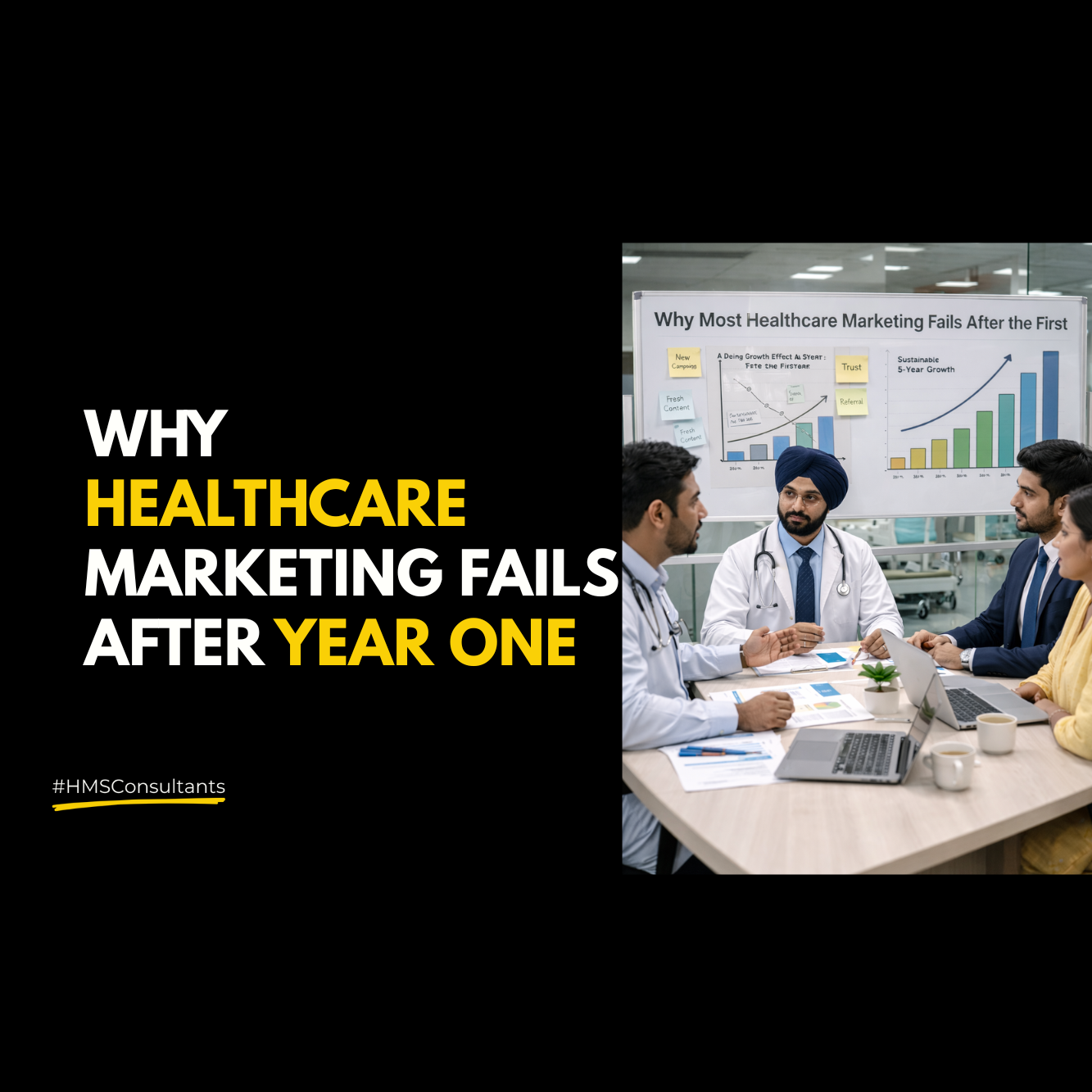
          • Why Most Healthcare Marketing Fails After the First Year, And How to Build a 5-Year Growth Engine

            Why Most Healthcare Marketing Fails After the First Year, And How to Build a 5-Year Growth Engine

            Why Most Healthcare Marketing Fails After the First Year, And How to Build a 5-Year Growth Engine

            Written by
            Published on
            Share This

            The first year of healthcare marketing often feels encouraging. Visibility improves, activity increases, enquiries start coming in, and there is a sense that growth has finally begun. Hospitals feel validated in their investment in marketing, and leadership gains confidence that the right direction has been chosen.

            Then something changes.

            Results begin to plateau. Costs rise. Engagement feels repetitive. The same campaigns that once delivered outcomes now require higher spending to maintain momentum. Marketing feels more like maintenance than progress. At this stage, many hospitals conclude that marketing has “stopped working.”

            In reality, healthcare marketing rarely fails suddenly. It erodes slowly because it was never designed for longevity.

            Why First-Year Marketing Often Looks Successful

            Early success in hospital marketing is usually driven by novelty. New campaigns capture attention. Fresh content stands out. Platforms reward initial activity. Internal teams feel energised by visible movement. For hospitals that previously had little structure, even basic consistency produces noticeable improvement.

            This phase creates a dangerous illusion. Leadership assumes that repeating the same efforts will continue delivering growth. Marketing is seen as a repeatable activity rather than an evolving system.

            The problem is that novelty fades quickly in healthcare. Trust, unlike attention, does not compound automatically.

            The Core Reason Healthcare Marketing Loses Momentum

            Healthcare marketing fails after the first year because most hospitals build campaigns, not engines.

            Campaigns are time-bound. They depend on constant input, fresh creatives, new platforms, and increasing budgets. Engines, on the other hand, are systems that improve with use. They learn, adapt, and compound insight over time.

            When marketing is campaign-led, growth depends on continuous stimulation. When stimulation stops or becomes repetitive, performance declines. Hospitals then chase new ideas without fixing the underlying structure.

            This is why marketing fatigue sets in for both teams and audiences.

            Why Short-Term Thinking Dominates Hospital Marketing Decisions

            Healthcare leaders operate in high-pressure environments. Monthly numbers matter. OPD fluctuations create anxiety. Budget reviews demand justification. Under these conditions, short-term performance naturally dominates decision-making.

            Marketing strategies are adjusted frequently as directions change. Platforms are switched. Messaging resets. While these changes feel proactive, they often disrupt learning cycles. Marketing never gets enough time to mature, and insights are lost before they compound.

            Long-term growth requires patience that healthcare systems rarely allow themselves.

            The Cost of Replacing Strategy With Activity

            When marketing underperforms, hospitals often increase activity rather than improve strategy. More posts, more ads, more platforms, more content. This creates motion without direction.

            Over time, activity becomes disconnected from outcomes. Teams focus on execution rather than learning. Reports show effort, not progress. Leadership feels busy but not confident.

            This is the point where marketing becomes exhausting rather than enabling.

            Why Sustainable Hospital Growth Requires a Different Mindset

            Sustainable healthcare marketing is not about constant visibility. It is about building systems that repeatedly reduce patients’ uncertainty.

            Patients return, refer, and trust when they experience consistency. Consistency does not come from campaigns. It comes from aligned messaging, predictable experience, and clear decision pathways.

            Hospitals that grow steadily treat marketing as a long-term investment in trust infrastructure, not a series of promotional bursts.

            What a 5-Year Healthcare Marketing Engine Actually Looks Like

            A long-term marketing engine is built around learning loops rather than output targets. Each year strengthens the next. Patient questions inform content. Interaction patterns refine messaging. Experience gaps shape communication. Reviews influence education. Referrals reinforce positioning.

            Instead of resetting strategy annually, hospitals deepen it. Marketing becomes calmer, clearer, and more efficient over time. Spend stabilises. Conversion improves. Dependence on aggressive promotion has reduced.

            This is how marketing shifts from a cost centre to a growth asset.

            Why Hospitals That Think Long-Term Spend Less Over Time

            Counterintuitively, long-term marketing thinking reduces expenditure. Hospitals that build engines rely less on constant acquisition because retention and referrals improve naturally. Content remains relevant longer. SEO authority compounds. Brand trust strengthens.

            Short-term marketing requires escalation. Long-term marketing rewards consistency.

            From a hospital growth perspective, this difference determines whether marketing remains manageable or becomes a perpetual struggle.

            The Role of Leadership in Long-Term Marketing Success

            No marketing engine survives without leadership alignment. Leaders must protect the strategy from constant disruption. They must allow learning cycles to complete. They must evaluate trends rather than isolated months.

            Hospitals that treat marketing as a leadership agenda rather than a departmental task are far more likely to sustain growth beyond the first year. Strategy continuity becomes a competitive advantage.

            Why Most Hospitals Restart Instead of Evolving

            When marketing feels stale, many hospitals restart rather than refine. New agencies, new platforms, new directions. Each restart discards accumulated insight. The system never matures.

            Hospitals that evolve rather than restart carry learning forward. They optimise, not replace. Growth becomes incremental but durable.

            This distinction separates organisations that survive from those that scale.

            Conclusion: Marketing That Lasts Is Designed to Outgrow Tactics

            Healthcare marketing fails after the first year, not because it stops working, but because it was never built to last.

            Campaign-driven growth peaks quickly and declines just as fast. Engine-driven growth compounds quietly and steadily. Hospitals that understand this difference stop chasing novelty and start building systems.

            In healthcare, where trust is earned slowly and lost quickly, long-term marketing is not optional. It is the only form of marketing that truly works.

            Hospitals that invest in five-year thinking do not just grow.
            They stabilise, mature, and earn the right to scale.

            Contact Us HMS Consultants

            Healthcare marketing often plateaus after the first year because most hospitals rely on short-term campaigns instead of long-term systems. Campaigns lose effectiveness as novelty fades, while sustainable growth requires compounding trust and learning over time.

            Doctors Digital Marketing I Healthcare Marketing I Hospital Marketing Strategies I Marketing ideas for clinics I Marketing Trends 2025 I Medical Marketing I Social Media Marketing

            is something we strongly believe in, which means ‘Knowledge without application is the same as having no knowledge at all

            Akhil Dave

            Principle Consultant

            Ready to take your Personal Brand to the next level?

            Share your details below and we will connect with you to discuss your growth strategy.

            • How Hospitals Can Build a Referral Marketing Engine That Works Without Ads

              How Hospitals Can Build a Referral Marketing Engine That Works Without Ads

              How Hospitals Can Build a Referral Marketing Engine That Works Without Ads

              Written by
              Published on
              Share This

              The Most Powerful Marketing Channel Hospitals Don’t Control Directly

              Most hospitals associate growth with visibility. Ads, social media, campaigns, and promotions dominate marketing conversations. Referrals, when discussed, are often treated as a bonus, something that happens organically if clinical outcomes are good.

              This assumption is expensive.

              In reality, referrals are one of the most predictable, scalable, and cost-efficient growth engines in healthcare. Yet most hospitals leave referrals entirely to chance. They hope patients will recommend them. They expect doctors to generate word-of-mouth. They wait for goodwill to translate into growth.

              Hospitals that grow steadily do not rely on hope. They design referral systems.

              Why Referral Marketing Works Differently in Healthcare

              Healthcare referrals are not transactional. They are trust transfers.

              When a patient recommends a hospital, they are not promoting a service; they are vouching for safety, dignity, and care. When a doctor refers a patient, they are transferring professional credibility. When a family recommends a provider, they are sharing lived experience.

              This makes referrals far more potent than advertisements. They arrive with pre-existing trust, lower resistance, and higher conversion probability.

              Yet because referrals feel intangible, hospitals rarely apply a strategy to them.

              The Common Myth: “Good Work Automatically Brings Referrals”

              Clinical excellence is essential, but it does not automatically translate into referrals.

              Patients may be satisfied yet never refer because they are unsure whether it is appropriate. Doctors may trust a hospital, but hesitate to refer if communication is inconsistent. Families may have had a positive experience but lack an apparent reason or moment to recommend.

              Referrals do not disappear because the care was poor. They disappear because no system guided them.

              Why Most Hospitals Rely on Passive Referrals

              Passive referral models depend on memory and goodwill. They assume patients will remember the hospital at the right moment and articulate that recommendation clearly to others.

              In reality, memory fades quickly. Emotions settle. Life moves on.

              Without reinforcement, even intense experiences lose recall value. This is why hospitals that provide excellent care often receive far fewer referrals than expected.

              Referral growth requires intentional design, not just good outcomes.

              Referral Marketing Is a System, Not a Request

              Many hospitals attempt to grow referrals by asking directly. “Please refer us.” “Tell others about us.” “Share your experience.”

              These requests rarely work.

              Effective referral marketing focuses on making referrals easy, natural, and timely. It aligns moments of emotional satisfaction with clear cues for recommendation. It removes friction rather than adding pressure.

              A referral system does not ask for promotion. It enables advocacy.

              Where Referral Opportunities Actually Come From

              Referrals do not originate at discharge alone. They emerge at moments of relief, reassurance, and clarity.

              When a diagnosis is explained patiently.
              When anxiety is reduced.
              When billing is transparent.
              When follow-up feels thoughtful.
              When recovery is smoother than expected.

              These moments create emotional peaks. Hospitals that recognise and reinforce these peaks convert experience into advocacy.

              Hospitals that miss them lose a silent opportunity.

              The Role of Internal Behaviour in Referral Growth

              Referral marketing fails when internal behaviour is inconsistent. Patients may trust a doctor but feel frustrated by interactions with staff. Families may appreciate treatment but feel confused by processes. Doctors may value expertise but hesitate due to communication gaps.

              Referrals require consistency across the system. Every touchpoint contributes to whether someone feels confident recommending the hospital.

              This is why referral marketing cannot be owned solely by marketing teams. It is a cross-functional growth strategy.

              Why Referral Engines Reduce Marketing Dependency

              Hospitals that build strong referral systems gradually reduce dependence on paid marketing. Acquisition costs fall. Conversion rates improve. New patients arrive with clearer expectations. Resistance reduces.

              This does not mean advertising disappears. It means advertising plays a supporting role rather than carrying the entire growth burden.

              Referral-driven hospitals grow calmer. Their marketing becomes steadier and more predictable.

              Designing Referral Systems Without Discounts or Incentives

              In healthcare, ethical boundaries matter. Referral marketing must never feel transactional or manipulative.

              The strongest referral engines do not rely on discounts or incentives. They rely on clarity, communication, and continuity.

              Patients refer when they understand what the hospital stands for, who it is right for, and why it helped them. Doctors refer when processes are reliable, feedback loops are clear, and patient care feels collaborative. 

              Systems built on trust outperform systems built on rewards.

              Why Referral Marketing Is the Most Sustainable Hospital Growth Strategy

              Unlike ads, referrals compound. Each positive experience strengthens future growth. Each referred patient arrives with higher trust and a greater likelihood of referral in turn.

              Over time, this creates a flywheel effect. Growth becomes self-reinforcing rather than spend-dependent.

              Hospitals that invest in referral systems are investing in long-term viability, not short-term visibility.

              Conclusion: Referrals Don’t Happen by Accident, They Happen by Design

              Hospitals do not lack referral potential. They lack referral systems.

              Reasonable care is essential, but it is not enough. Without structure, timing, and reinforcement, even the best experiences fade without impact.

              Hospitals that build intentional referral engines stop aggressively chasing growth. Growth begins to come to them- quieter, steadier, and more reliable.

              In healthcare marketing, the most potent growth channel is not the one you pay for.
              It is the one you intentionally earn and design.

              Contact Us HMS Consultants

              Doctors Digital Marketing I Healthcare Marketing I Hospital Marketing Strategies I Marketing ideas for clinics I Marketing Trends 2025 I Medical Marketing I Social Media Marketing

              is something we strongly believe in, which means ‘Knowledge without application is the same as having no knowledge at all

              Akhil Dave

              Principle Consultant

              Ready to take your Personal Brand to the next level?

              Share your details below and we will connect with you to discuss your growth strategy.

              • The Hidden Link Between Patient Experience and Hospital Marketing Performance

                The Hidden Link Between Patient Experience and Hospital Marketing Performance

                The Hidden Link Between Patient Experience and Hospital Marketing Performance

                Written by
                Published on
                Share This

                When Marketing Works but Results Still Feel Fragile

                Many hospitals invest consistently in marketing. Visibility improves, enquiries increase, and brand recall begins to form. Yet despite all this effort, outcomes remain unpredictable. Some patients convert, others disappear quietly. Referrals fluctuate. Online reviews feel disconnected from marketing spend. Leadership senses that something critical is missing, even though marketing activity appears strong.

                That missing link is often patient experience.

                In Indian healthcare, patient experience is rarely discussed in the same breath as hospital marketing performance. One is seen as operational, the other as promotional. This separation is artificial and costly. In reality, patient experience is one of the strongest determinants of how well marketing performs, converts, and compounds over time.

                Why Marketing and Experience Are Treated as Separate Worlds

                Traditionally, hospital marketing has focused on visibility and acquisition, while patient experience has been treated as a service quality or HR concern. Marketing teams track leads and reach. Operations teams handle waiting times and coordination. Clinical teams focus on outcomes. Each function operates in parallel, often without shared accountability.

                This structure creates blind spots. Marketing promises a specific experience, while operations deliver another. Patients bridge this emotional gap, forming impressions that directly affect trust, loyalty, and word of mouth.

                When experience and marketing are disconnected, marketing performance becomes volatile. When they are aligned, marketing becomes far more effective without increasing spend.

                How Patient Experience Shapes Marketing Outcomes Before Marketing Can

                Patient experience influences marketing performance long before a campaign runs. A patient who had a confusing visit last year will hesitate even if they see a strong advertisement today. A family that feels respected during a consultation becomes receptive to future communication. A rushed discharge weakens long-term loyalty, regardless of brand visibility.

                Marketing does not operate in a vacuum. It enters a context shaped by past experiences, shared stories, and informal reputation. In healthcare, this context is powerful and persistent.

                Hospitals that ignore experience while evaluating marketing results are analysing only half the equation.

                Why Poor Experience Dilutes Even Strong Marketing

                Marketing can attract attention, but it cannot override lived experience. When patient experience is inconsistent, marketing outcomes suffer quietly.

                Patients may enquire but not commit. They may visit once but not return. They may accept consultation but resist treatment. They may recover clinically, but choose another provider next time. None of this shows up clearly in marketing dashboards, yet it directly affects ROI.

                Hospitals often misinterpret these outcomes as marketing inefficiency, when the real issue lies in experiential gaps that erode confidence at critical moments.

                Experience as the Silent Conversion Engine

                Conversion in healthcare is not a single event. It is a gradual accumulation of confidence. Every interaction contributes: the tone of the first response, the clarity of explanation, the predictability of process, the respect shown during vulnerable moments.

                A strong patient experience reduces friction at every stage. Patients arrive more prepared. Conversations feel easier. Objections reduce. Decisions happen faster. Follow-ups feel natural instead of forced.

                In such environments, marketing does not need to persuade aggressively. It simply supports decisions patients already feel comfortable making.

                Why Experience-Driven Hospitals Spend Less to Achieve More

                Hospitals with strong patient experience often notice an interesting pattern. Over time, they require less aggressive marketing to maintain growth. Referrals increase. Reviews improve organically. Repeat visits rise. Brand recall strengthens without constant promotion.

                This is not accidental. Experience creates advocacy, and advocacy lowers acquisition costs.

                Marketing performance improves not because budgets increase, but because trust compounds. This is one of the most overlooked advantages of investing in patient experience.

                The Leadership Gap That Keeps Experience Undervalued

                Patient experience is often undervalued because it lacks clear ownership. Marketing teams do not control it. Operations teams feel overburdened. Clinical teams prioritise outcomes. Leadership sees experience as necessary but struggles to translate it into strategy.

                As a result, experience remains reactive rather than designed. Improvements happen only after complaints, not before drop-offs.

                Hospitals that treat experience as a strategic lever, reviewed alongside marketing and financial performance, gain a significant advantage. They understand that experience consistency is not just a quality metric, but a growth multiplier.

                Why Experience Cannot Be “Fixed” After Marketing

                Some hospitals attempt to improve experience only after marketing scales. This sequence rarely works. Growth magnifies whatever exists. If experience systems are weak, marketing exposes them faster.

                Experience must be strengthened before or alongside marketing, not after. Otherwise, marketing becomes a stress test that the system is not prepared to handle.

                This is why experienced healthcare marketing consultants focus as much on internal readiness and patient journey design as on campaigns and channels.

                When Marketing and Experience Finally Align

                Hospitals that align marketing with patient experience notice a fundamental shift. Conversations become calmer. Expectations are clearer. Staff feel supported rather than pressured. Patients arrive with confidence instead of confusion.

                Marketing stops being questioned constantly because outcomes stabilise. Growth feels intentional rather than reactive. Leadership regains control over trajectory.

                At this stage, marketing and experience no longer compete for attention. They reinforce each other.

                Conclusion: Marketing Performance Is a Reflection of Experience Quality

                In Indian healthcare, the most potent marketing advantage is not louder messaging or bigger budgets. It is a consistent, thoughtful patient experience.

                Marketing performance improves when patients feel understood, respected, and guided. Experience shapes perception long after campaigns end. It influences decisions that no advertisement can force.

                Hospitals that recognise the hidden link between patient experience and marketing performance stop chasing short-term visibility and start building long-term credibility.

                In healthcare, growth does not belong to the most visible institutions.
                It belongs to the ones patients trust enough to return to and recommend.

                And that trust is built, interaction by interaction, through experience.

                Contact Us HMS Consultants

                Doctors Digital Marketing I Healthcare Marketing I Hospital Marketing Strategies I Marketing ideas for clinics I Marketing Trends 2025 I Medical Marketing I Social Media Marketing

                is something we strongly believe in, which means ‘Knowledge without application is the same as having no knowledge at all

                Akhil Dave

                Principle Consultant

                Ready to take your Personal Brand to the next level?

                Share your details below and we will connect with you to discuss your growth strategy.

                • Hospital Marketing Is Not Promotion, It’s Infrastructure

                  Hospital Marketing Is Not Promotion, It’s Infrastructure

                  Hospital Marketing Is Not Promotion, It’s Infrastructure

                  Written by
                  Published on
                  Share This

                  The Costly Misunderstanding at the Core of Hospital Marketing

                  Most hospitals think of marketing as promotion. Campaigns, advertisements, social media posts, videos, and visibility initiatives dominate the conversation. Marketing is treated as something external, an activity performed to attract attention, generate enquiries, and increase footfall.

                  This narrow understanding is one of the biggest reasons hospital marketing feels expensive, inconsistent, and unreliable.

                  In reality, hospital marketing is not promotion.
                  It is infrastructure.

                  Just like clinical infrastructure supports treatment and operational infrastructure supports delivery, marketing infrastructure supports trust, decision-making, and long-term growth. When hospitals reduce marketing to promotion alone, they ignore the foundation that makes promotion effective.

                  Why Promotional Marketing Breaks Down in Healthcare

                  Promotional marketing works well in industries where decisions are quick, emotional, and low-risk. Healthcare is the opposite. Decisions are slow, layered, emotionally complex, and deeply personal. Patients do not just buy a service; they entrust their health, finances, and family decisions to an institution.

                  When marketing focuses solely on promotion, it attracts attention without providing reassurance. Patients may notice the hospital, but they are not guided through uncertainty. This gap leads to high enquiry volumes, low conversion rates, frequent drop-offs, and dissatisfaction that hospitals often misinterpret as “price sensitivity” or “competition.”

                  The real issue is not the offer. It is the absence of marketing infrastructure.

                  What Marketing Infrastructure Actually Means in a Hospital Context

                  Marketing infrastructure is the system that supports patient understanding before, during, and after contact with the hospital. It includes how information is structured, how communication flows, how expectations are set, and how consistency is maintained across touchpoints.

                  A hospital with a strong marketing infrastructure ensures that when a patient searches online, the information they find is clear and reassuring. When they enquire, responses are timely and consistent. When they arrive, the experience matches what was communicated. When they leave, follow-up reinforces trust.

                  Promotion can attract attention, but only infrastructure can hold it.

                  Why Hospitals Feel They Are “Doing Marketing” But Seeing No Stability

                  Many hospitals invest heavily in visible activities while neglecting invisible systems. Social media calendars are maintained, ads are run regularly, and agencies are engaged, yet outcomes fluctuate month after month.

                  This happens because promotional efforts are layered on top of weak foundations. Messaging changes frequently. Staff interpret information differently. Patients receive mixed signals depending on whom they speak to. Follow-ups depend on individual initiative rather than system design.

                  Without infrastructure, marketing becomes reactive. It responds to pressure instead of guiding growth.

                  The Role of Marketing Infrastructure in Patient Decision-Making

                  Patients move through healthcare decisions cautiously. They seek patterns, consistency, and reassurance. Marketing infrastructure ensures that at every stage of this journey, patients encounter the same narrative about care philosophy, approach, expectations, and outcomes.

                  When infrastructure is strong, patients feel oriented rather than overwhelmed. They understand what will happen next. They know who to trust. They feel less anxious asking questions. This confidence significantly improves conversion, retention, and referrals.

                  In such environments, marketing works quietly but powerfully.

                  Why Marketing Infrastructure Cannot Be Outsourced Entirely

                  Hospitals often expect agencies to “build marketing.” Agencies can execute visibility, but infrastructure must be co-created internally. It requires alignment between leadership, operations, clinical teams, and communication protocols.

                  No external partner can design internal clarity without deep collaboration. When hospitals outsource marketing without addressing internal alignment, agencies are forced to operate tactically. Results remain short-lived because the underlying system is unstable.

                  Strong hospitals treat marketing infrastructure as a leadership responsibility, not a vendor deliverable.

                  How Infrastructure Changes the Nature of Marketing Spend

                  When marketing infrastructure is absent, marketing spend feels risky. Outcomes are unpredictable, and every campaign feels like a gamble. Leadership hesitates, budgets fluctuate, and trust in marketing erodes.

                  When infrastructure is in place, marketing spend feels more controlled. Campaigns build on existing clarity. Messages reinforce established trust. Each initiative compounds the previous one.

                  Marketing stops feeling like an expense and starts functioning like a capital investment, strengthening the organisation over time.

                  The Long-Term Advantage of Infrastructure-Led Marketing

                  Hospitals that invest in marketing infrastructure experience slower but steadier growth. They attract fewer unqualified enquiries. Patients arrive better informed. Consultations become more productive. Resistance reduces. Teams operate with confidence rather than urgency.

                  Over time, these hospitals rely less on aggressive promotion because reputation and trust begin to do the work. Marketing becomes supportive rather than stressful.

                  This is how healthcare brands sustain growth without constant escalation of spend.

                  Why Infrastructure Matters More as Hospitals Scale

                  As hospitals grow, complexity increases. More departments, more doctors, more staff, and more patient touchpoints create more room for inconsistency. Without infrastructure, growth magnifies confusion.

                  Marketing infrastructure acts as a stabilising force. It ensures that regardless of size, patients receive a coherent experience. It allows leadership to scale without losing identity or trust.

                  This is why scalable hospitals invest in systems before scaling visibility.

                  Conclusion: Promotion Attracts Attention, Infrastructure Builds Institutions

                  Hospitals do not fail at marketing because they lack creativity or spending. They fail because they mistake promotion for strategy.

                  Proper hospital marketing is not about being seen more. It is about being understood better. It is not about generating noise. It is about building confidence. It is not about short-term spikes. It is about long-term viability.

                  Promotion without infrastructure creates instability.
                  Infrastructure without promotion creates quiet strength.
                  Together, they create sustainable growth.

                  Hospitals that recognise this shift stop chasing marketing tactics and start building marketing systems. And that is where real, lasting growth begins.

                  Contact Us HMS Consultants

                  Doctors Digital Marketing I Healthcare Marketing I Hospital Marketing Strategies I Marketing ideas for clinics I Marketing Trends 2025 I Medical Marketing I Social Media Marketing

                  is something we strongly believe in, which means ‘Knowledge without application is the same as having no knowledge at all

                  Akhil Dave

                  Principle Consultant

                  Ready to take your Personal Brand to the next level?

                  Share your details below and we will connect with you to discuss your growth strategy.

                  • From Visibility to Viability: Why Hospital Marketing Must Go Beyond Lead Generation

                    From Visibility to Viability: Why Hospital Marketing Must Go Beyond Lead Generation

                    From Visibility to Viability: Why Hospital Marketing Must Go Beyond Lead Generation

                    Written by
                    Published on
                    Share This

                    When Being Visible Still Doesn’t Feel Sustainable

                    Many hospitals reach a stage where visibility is no longer the problem. Their name appears on Google. Social media is active. Advertisements run regularly. Enquiries arrive through calls, forms, and WhatsApp. On paper, marketing is doing its job.

                    Yet despite this visibility, something feels off. Growth feels unstable. OPD fluctuates. Staff feel stretched. Conversion remains unpredictable. Leadership senses that while attention has increased, viability has not.

                    This is the point where hospitals must confront a brutal truth: visibility alone does not build a sustainable healthcare institution. Marketing that focuses only on lead generation creates motion, not momentum. For growth to last, marketing must move beyond visibility and toward viability.

                    Why Lead Generation Became the Default Goal

                    The dominance of digital platforms has reshaped how marketing success is measured. Impressions, clicks, reach, and leads are easy to track, report, and compare. Over time, these metrics began to define success, even in healthcare.

                    Hospitals, under pressure to justify spending, embraced lead generation as a tangible outcome. More leads meant marketing was working. Fewer leads meant something needed to change. This mindset slowly reduced marketing to a numbers game.

                    What got lost in this process was a deeper question: What happens to patients after the lead is generated?

                    The Hidden Gap Between Leads and Real Growth

                    Lead generation captures attention, but attention alone does not translate into trust. Healthcare decisions involve fear, uncertainty, financial considerations, and family influence. Patients may enquire without being ready. They may visit without committing. They may accept consultation without agreeing to treatment.

                    When marketing is optimised only to maximise leads, it often ignores readiness. The system becomes efficient at attracting people but ineffective at guiding them through decision-making.

                    Hospitals then experience a frustrating paradox. Lead numbers increase, but conversions do not scale proportionately. Marketing dashboards look healthy, while business outcomes feel fragile.

                    Why Viability Requires More Than Demand

                    Viability in healthcare is not about how many people notice the hospital. It is about how many patients trust it enough to choose it consistently, return when needed, and recommend it to others.

                    This level of confidence cannot be manufactured through advertising alone. It is built through clarity, consistency, and experience. Viable hospitals align marketing with their operational reality. They promise only what they can deliver and deliver what they promise.

                    Marketing that supports viability does not chase every possible patient. It attracts the right patients and prepares them for what lies ahead.

                    When Marketing and Operations Speak Different Languages

                    One of the biggest obstacles to viability is the disconnect between marketing narratives and operational experience. Marketing may communicate warmth, efficiency, and expertise, while patients encounter confusion, delays, or inconsistency upon arrival.

                    This mismatch erodes credibility quickly. Patients feel misled, even if unintentionally. Over time, this gap increases resistance, reduces loyalty, and weakens brand strength.

                    Marketing that aims for viability works closely with operations. It reflects real processes, realistic timelines, and honest outcomes. This alignment may reduce superficial appeal, but it strengthens trust, the most valuable currency in healthcare.

                    Why Short-Term Wins Often Undermine Long-Term Stability

                    Aggressive lead generation can create temporary spikes in activity, but it often hides structural weaknesses. Hospitals feel busy, but systems struggle to cope. Teams operate in constant urgency. Patient experience deteriorates quietly.

                    These short-term wins mask long-term risks. Over time, dissatisfied patients stop returning. Referrals slow down. Reputation suffers. Marketing must work harder each year to maintain the same level of activity.

                    Viable marketing avoids this trap by focusing on sustainable flows rather than momentary surges. It prioritises quality of engagement over quantity of leads.

                    Redefining the Role of Marketing in a Hospital

                    When marketing moves beyond lead generation, its role changes fundamentally. It becomes a bridge between patient expectations and hospital reality. It educates patients before they arrive. It sets the context for decisions. It prepares families for what to expect.

                    In this model, marketing supports doctors by creating informed patients. It supports staff by reducing confusion. It promotes leadership by creating predictability.

                    Marketing is no longer a standalone function. It becomes an integral part of the hospital’s growth architecture.

                    What Viability-Focused Marketing Actually Achieves

                    Hospitals that adopt this approach notice subtle but powerful shifts. Enquiries may reduce slightly, but quality improves significantly. Consultations feel smoother. Treatment acceptance increases. Follow-ups become easier. Patients feel more aligned with the hospital’s approach.

                    Growth becomes calmer and more manageable. Marketing spends feel justified because outcomes extend beyond immediate numbers. Trust compounds over time.

                    This is the difference between being seen and being chosen.

                    Conclusion: Sustainable Growth Begins When Marketing Serves the System

                    Visibility creates awareness. Viability creates longevity.

                    Hospitals that focus only on lead generation remain dependent on constant promotion. Hospitals that focus on viability build systems that sustain growth even when marketing intensity reduces.

                    The future of healthcare marketing lies not in louder campaigns, but in smarter alignment. Marketing must serve the system, not strain it. It must guide patients, not overwhelm them. It must support care, not distract from it.

                    When hospitals shift from visibility to viability, marketing finally becomes what it was meant to be: a strategic force that enables trust, stability, and long-term success.

                    Contact Us HMS Consultants

                    Doctors Digital Marketing I Healthcare Marketing I Hospital Marketing Strategies I Marketing ideas for clinics I Marketing Trends 2025 I Medical Marketing I Social Media Marketing

                    is something we strongly believe in, which means ‘Knowledge without application is the same as having no knowledge at all

                    Akhil Dave

                    Principle Consultant

                    Ready to take your Personal Brand to the next level?

                    Share your details below and we will connect with you to discuss your growth strategy.