Category: Hospital Marketing Strategies

  • Clinic Marketing: Why the Waiting Area Should Not Stay Silent

    Clinic Marketing: Why the Waiting Area Should Not Stay Silent

    Clinic Marketing: Why the Waiting Area Should Not Stay Silent

    Published on
    Share This

    Clinic marketing is usually planned around what happens outside the clinic. Doctors and clinic owners think about Google visibility, social media posts, ads, reviews, referrals, and websites. These are important, but one valuable marketing space is often ignored: the waiting area.

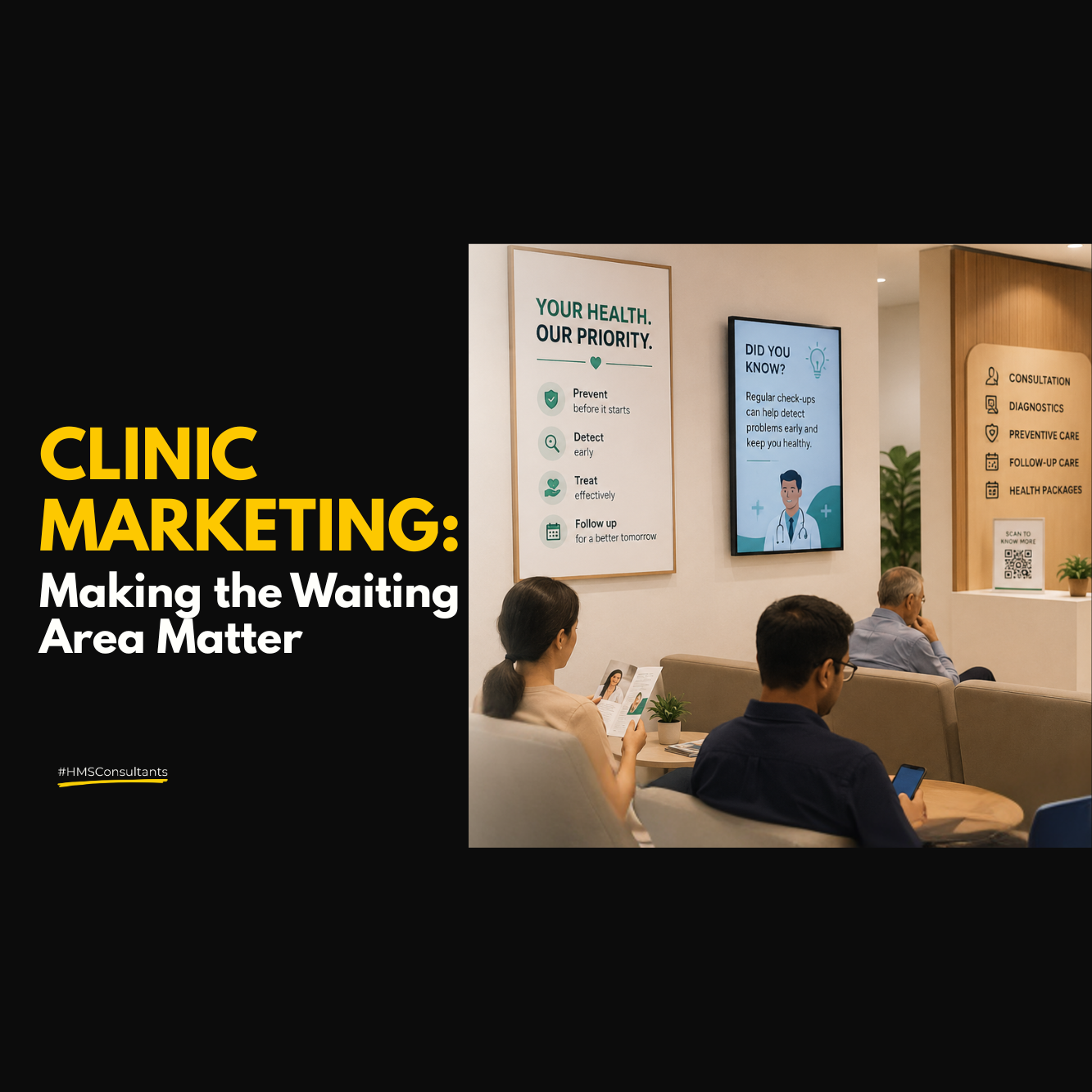
    Patients spend time in the clinic before consultation. They sit, observe, read, listen, and form opinions. This time should not be wasted. A clinic waiting area can quietly support patient education, service awareness, and better communication without making patients feel like they are being sold something.

    The waiting area is not just a place where patients wait. It is a space where clinics can help patients understand their health concerns, learn about available services, prepare for consultations, and remember the clinic better.

    This is why clinic marketing should also include what happens inside the clinic.


    Why the Waiting Area Matters in Clinic Marketing

    A patient sitting in the waiting area is already interested in care. They may have come for consultation, follow-up, reports, medicine guidance, or a family member’s appointment. Their attention is naturally connected to health.

    This makes the waiting area a useful space for patient communication.

    Many clinics keep this space silent or fill it only with generic posters. But the waiting area can answer common patient questions and reduce confusion before the consultation begins.

    It can help patients understand:

    • What services are available in the clinic?
    • Which symptoms should not be ignored?
    • What preventive care matters.
    • What reports or records they should carry.
    • When follow-up is important.
    • How to book future appointments.
    • What health concerns need regular monitoring?

    In-clinic marketing does not need to be loud. It should be useful, simple, and patient-friendly.clinic waiting area

    Waiting Time Can Become Learning Time

    Most patients do not enjoy waiting. But if the clinic uses that time well, patients can learn something helpful before meeting the doctor.

    For example, a diabetes clinic can display simple information about sugar monitoring, foot care, diet awareness, and follow-up importance. A dental clinic can show content about gum care, cavities, teeth cleaning, and warning signs. A physiotherapy clinic can explain posture, exercise precautions, and basic pain management.

    This type of patient education helps patients become more informed. It also supports the doctor, as patients may come to the consultation with greater awareness.

    Waiting-area content can include:

    • Posters.
    • Digital screens.
    • Simple brochures.
    • QR codes for service pages.
    • Doctor education videos.
    • FAQs.
    • Preventive care tips.
    • Follow-up reminders.

    The goal is not to overload patients. The goal is to give them short, clear, and useful information.

    Explain Services Without Hard Selling

    Many clinics offer more services than patients realise. A patient may visit for one concern but may not know that the clinic also provides preventive check-ups, diagnostic support, counselling, minor procedures, follow-up care, or related treatment services.

    The waiting area can help patients understand these services naturally.

    For example, instead of writing “Book our package today,” the clinic can explain who may need the service and when it is useful.

    A better approach is:

    • “When should you consider a preventive health check-up?”
    • “What signs show you may need an eye examination?”
    • “Why regular dental cleaning matters.”
    • “When should children visit a pediatrician?”
    • “Why follow-up after treatment is important.”

    This keeps the communication educational. Patients understand the value of the service without feeling pressured.

    Clinic marketing works better when it helps patients make informed decisions.

    Use the Waiting Area to Reduce Repeated Questions

    Clinic staff often answer the same questions again and again. Patients may ask about timings, reports, follow-up visits, test preparation, payment options, appointment process, or doctor availability.

    Some of these questions can be answered clearly inside the waiting area.

    Clinics can display simple information such as:

    • Appointment process.
    • Consultation flow.
    • Report collection timing.
    • Follow-up instructions.
    • Emergency contact guidance.
    • Documents to carry.
    • Clinic working hours.
    • Basic preparation for tests or procedures.

    This can reduce pressure on the front desk and improve patient experience. When patients already understand basic instructions, communication between staff becomes smoother.

    A well-planned clinic waiting area supports both marketing and operations.

    Make Doctor Expertise Easier to Understand

    Patients often know the doctor’s name, but they may not fully understand the doctor’s areas of practice. The waiting area can help explain this clearly.

    This does not mean displaying exaggerated claims. It means presenting doctor information in a simple and responsible way.

    A clinic can share:

    • Doctor’s specialty.
    • Areas of practice.
    • Common conditions treated.
    • Patient education topics.
    • Consultation focus areas.
    • Follow-up care guidance.

    For example, an orthopaedic clinic can mention joint pain, sports injuries, arthritis, fracture care, back pain, and mobility concerns. A gynecology clinic can explain pregnancy care, menstrual concerns, PCOS awareness, fertility guidance, and women’s preventive health.

    This improves patient awareness and helps patients understand the clinic’s care focus.

    Keep the Communication Simple and Visual

    Waiting-area content should not be too long or too technical. Patients may not read heavy paragraphs while sitting in a clinic. They need short messages, clear visuals, and easy language.

    Good waiting-area communication should be:

    • Short.
    • Clear.
    • Visual.
    • Patient-friendly.
    • Easy to understand.
    • Relevant to the clinic’s services.
    • Free from fear-based messaging.

    For example, instead of writing a long paragraph about hypertension, a clinic can use a simple poster: “High blood pressure may not show symptoms. Regular monitoring helps detect risk early.”

    The message should help the patient understand, not create fear.

    Clinic marketing inside the waiting area should feel calm, helpful, and professional.

    Connect Offline Communication With Digital Channels

    The waiting area can also guide patients toward the clinic’s digital platforms. But this should be done in a useful way.

    Clinics can use QR codes to help patients:

    • Read service information.
    • Book follow-up appointments.
    • Watch doctor education videos.
    • Access health tips.
    • Leave feedback.
    • Save the clinic contact number.
    • Visit the clinic website.

    This connects in-clinic communication with digital visibility. A patient who sees a helpful poster can scan a QR code and continue learning later.

    This is a practical way to combine offline and online clinic marketing without making the experience too promotional.

    What Clinics Should Avoid

    The waiting area should not become a cluttered advertising wall. Too many posters, confusing banners, or aggressive promotional messages can reduce the professional feel of the clinic.

    Clinics should avoid:

    • Overcrowding walls with too much content.
    • Using fear-based health messages.
    • Making unrealistic claims.
    • Showing too many offers.
    • Using technical medical language.
    • Displaying outdated information.
    • Ignoring design and readability.

    Patients should feel informed, not overwhelmed. The waiting area should support trust and clarity.

    Conclusion

    Clinic marketing does not happen only online or outside the clinic. It also happens inside the clinic, especially in the waiting area.

    The waiting area is a valuable space where patients can learn, understand services, prepare for consultation, and receive useful health guidance. It can reduce repeated questions, improve patient awareness, explain doctor expertise, and support stronger patient communication.

    A silent waiting area is a missed opportunity. With simple posters, digital screens, QR codes, brochures, FAQs, and doctor education content, clinics can turn waiting time into meaningful patient education.

    Good clinic marketing is not always about louder promotion. Sometimes, it is about using the spaces patients already interact with and making them more helpful, clear, and informative.

    Contact Us HMS Consultants

    Clinic marketing can be done by using both online and in-clinic communication. Along with Google visibility, social media, reviews, and websites, clinics should use the waiting area for patient education, service awareness, doctor information, FAQs, and appointment guidance.

    clinic marketing I hospital marketing I Hospital Marketing Strategies I Hospital Marketing Strategy I Marketing ideas for clinics

    is something we strongly believe in, which means ‘Knowledge without application is the same as having no knowledge at all

    Akhil Dave

    Principle Consultant

    Ready to take your Personal Brand to the next level?

    Share your details below and we will connect with you to discuss your growth strategy.

    • Branding Hospital: Why Service Names and Brand Clarity Matter

      Branding Hospital: Why Service Names and Brand Clarity Matter

      Branding Hospital: Why Service Names and Brand Clarity Matter

      Published on
      Share This

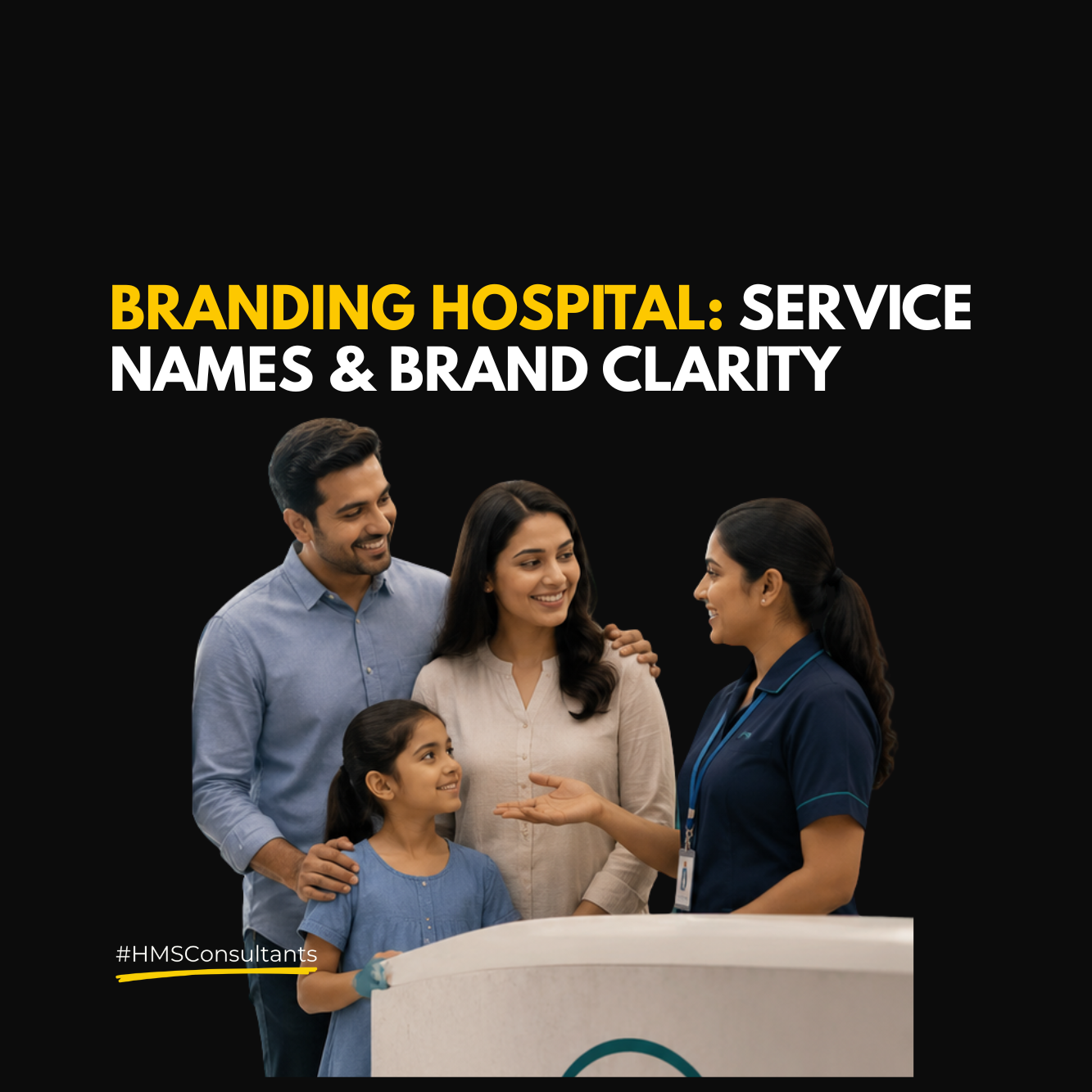
      Branding hospital is not only about logos, colors, taglines, interiors, or advertisements. One important part of hospital branding that is often ignored is how clearly the hospital names, organizes, and communicates its services.

      Many hospitals offer multiple departments, clinics, packages, programs, procedures, doctor-led services, and specialised centres. But when these services are named differently across the website, Google Business Profile, brochures, reception desk, banners, and social media, patients may feel confused.

      For example, the same service may be called “Heart Care” on one platform, “Cardiology” on another, “Cardiac OPD” in a banner, “Chest Pain Clinic” on social media, and “Heart Specialist Consultation” at the reception desk. Internally, the hospital team may understand what these terms mean. But for a patient, too many names can create uncertainty.

      This is why hospital brand clarity matters. A hospital brand should make services easier to understand, not harder to identify.


      Why Service Names Matter in Hospital Branding

      Patients do not always understand medical terms the way hospital teams do. They search, ask, and enquire in simple language. A patient may not search for “orthopaedic department” first. They may search for “knee pain doctor,” “joint pain treatment,” or “fracture care near me.”

      If hospital service names are too technical, unclear, or inconsistent, patients may not understand whether the hospital offers what they need.

      Clear hospital service names help patients quickly understand:

      • What the service is about.
      • Which health concern does it relate to?
      • Which doctor or department handles it?
      • Whether the service is relevant to their problem.
      • What is the next step they should take?

      Hospital branding becomes stronger when patients can understand the hospital’s services without confusion.

      The Problem With Multiple Names for the Same Service

      One common issue in branding a hospital is using different names for the same or related services. This often happens when different teams create content separately.

      The website team may use one name. The social media team may use another. The front desk may explain it differently. The doctor may use a clinical term. The brochure may mention a package name. Over time, the hospital communication becomes fragmented.

      For example:

      • “Women’s Health Clinic”
      • “Gynaecology Department”
      • “Maternity Care”
      • “Pregnancy Clinic”
      • “Antenatal Care Services”

      All these may be connected, but patients may not know how they relate to each other. Some may think they are separate services. Some may not know which one to choose.

      This weakens hospital service communication because the patient has to decode the hospital’s language. A strong hospital brand should reduce this confusion.

      Patients Need Simple and Familiar Language

      Hospital teams often use clinical or internal terms because they are familiar with them. But patients usually think in terms of symptoms, needs, and concerns.

      A patient may think:

      • I have chest pain.
      • My child has a fever.
      • I need pregnancy care.
      • I want a health check-up.
      • My father has knee pain.
      • I need an eye test.

      If the hospital only uses technical department names, the patient may not immediately connect their concern with the right service.

      This does not mean hospitals should avoid medical terms completely. It means medical terms should be supported with patient-friendly explanations.

      For example, instead of only saying “Cardiology,” the hospital can explain it as “heart care for chest pain, blood pressure, heart check-ups, and cardiac concerns.” This makes the service easier to understand.

      Healthcare branding should help patients connect their concern with the right care.

      How Confusing Service Names Affect Enquiries

      Unclear service names can directly affect patient enquiries. When patients do not understand which service to choose, they may delay calling, ask repeated questions, or move to another hospital that explains things more clearly.

      Confusion may happen when:

      • Service names are too technical.
      • The same service has different names across platforms.
      • Packages are not explained properly.
      • Department names and doctor services are mixed.
      • Website pages do not match Google Business Profile listings.
      • Social media posts use terms not found on the website.
      • Front desk communication is different from online content.

      For patients, this can create doubt. They may wonder whether the hospital offers the service, which doctor to meet, what appointment to book, or whether the service is suitable for their concern.

      Hospital brand clarity helps reduce these doubts. It makes the enquiry process smoother and more confident.

      Organizing Departments, Packages, and Programs

      A hospital may have many layers of services. There may be departments, sub-specialities, health packages, screening programs, day-care procedures, emergency services, OPDs, and doctor-led clinics.

      If these are not organised properly, the hospital brand can look confusing even if the hospital offers good care.

      A clear hospital service structure should answer:

      • What are the main departments?
      • What services come under each department?
      • Which services need separate pages or listings?
      • Which packages need a simple explanation?
      • Which doctor handles which service?
      • Which terms should be used consistently everywhere?

      For example, a hospital can use “Orthopaedics” as the department name and then clearly list related services such as joint pain, fracture care, arthritis care, sports injury care, spine problems, and knee replacement.

      This helps patients understand both the department and the specific concern it addresses.

      Consistency Across Every Platform

      Hospital branding becomes stronger when the same service language is used across all patient-facing platforms.

      This includes:

      • Website service pages.
      • Google Business Profile.
      • Social media posts.
      • Brochures and banners.
      • Reception communication.
      • WhatsApp replies.
      • Doctor profile pages.
      • Appointment scripts.
      • Health camp communication.

      If the website says one thing and the reception says another, the brand feels unorganised. If Google lists a service but the website does not explain it, patients may feel unsure. If social media promotes a service using a name that is not visible anywhere else, the patient journey becomes disconnected.

      Consistency does not mean every platform must use the exact same paragraph. It means the service name, meaning, and patient guidance should remain aligned.

      Brand Clarity Supports Hospital Positioning

      Hospital positioning becomes stronger when patients clearly understand what the hospital offers and what it is known for. A hospital may want to be known for advanced care, specialist services, preventive health, emergency support, maternity care, diagnostics, or multi-speciality treatment. But that positioning becomes weak if the services are not communicated clearly.

      Patients should not feel that the hospital is saying too many things in too many different ways.

      Clear service naming helps create stronger recall. When patients repeatedly see the same service language across platforms, they begin to connect the hospital name with specific healthcare needs.

      For example, if a hospital wants to strengthen its maternity care positioning, the communication around pregnancy care, antenatal visits, delivery support, high-risk pregnancy, and postnatal guidance should be organised clearly under one service structure.

      This makes the hospital easier to understand and easier to remember.

      What Hospitals Should Avoid

      Hospitals should avoid creating service names only to sound advanced or different. If the name is attractive but unclear, it may not help patients.

      Hospitals should avoid:

      • Using too many names for the same service.
      • Creating package names without explaining what they include.
      • Using only medical terminology without patient-friendly meaning.
      • Promoting services online that staff cannot explain clearly.
      • Mixing department names, symptoms, and procedures without structure.
      • Changing service names across platforms without a clear reason.

      Branding hospital should make communication simpler, not more complicated.

      Conclusion

      Branding hospital is not only about how the hospital looks. It is also about how clearly patients understand what the hospital offers.

      When service names are confusing, inconsistent, or too technical, patients may struggle to connect their health concern with the right department or doctor. This can affect enquiries, patient understanding, and hospital recall.

      Clear hospital service names, organised service structure, and consistent communication help make hospital branding stronger. They allow patients to understand services faster, ask better questions, and take the next step with more confidence.

      A strong hospital brand is not built only through design. It is also built through clarity.

      When patients can easily understand what the hospital offers, the brand becomes easier to trust, remember, and choose.

      Contact Us HMS Consultants

      Branding in a hospital means creating a clear and consistent identity that helps patients understand what the hospital offers. In this blog context, hospital branding also includes clear service names, organised departments, simple communication, and consistency across website, Google profile, reception, and social media.

      Digital Marketing I Hospital Branding I hospital marketing I Hospital Marketing Strategies I Hospital Marketing Strategy

      is something we strongly believe in, which means ‘Knowledge without application is the same as having no knowledge at all

      Akhil Dave

      Principle Consultant

      Ready to take your Personal Brand to the next level?

      Share your details below and we will connect with you to discuss your growth strategy.

      • Marketing Ideas for Hospital: How to Use Local Community Presence for Better Recall

        Marketing Ideas for Hospital: How to Use Local Community Presence for Better Recall

        Marketing Ideas for Hospital: How to Use Local Community Presence for Better Recall

        Published on
        Share This

        Marketing ideas for hospital should not always begin with digital campaigns, paid ads, or social media posts. For many hospitals, especially those serving a specific city or locality, stronger recall is built through regular community presence.

        A hospital may have good doctors, services, facilities, and online visibility. But if people living nearby do not remember the hospital when a healthcare need arises, marketing may still feel incomplete. Local recall matters because patients often choose hospitals they have seen, heard about, or interacted with through trusted community activities.

        This is where local hospital marketing becomes important. A hospital should not only be visible online. It should also be present in the area it serves’s health awareness, preventive care, and community conversations.

        Why Local Recall Matters

        Hospitals are not chosen casually. People may not need a hospital every day, but when a health concern comes up, they remember names that feel familiar, reliable, and accessible.

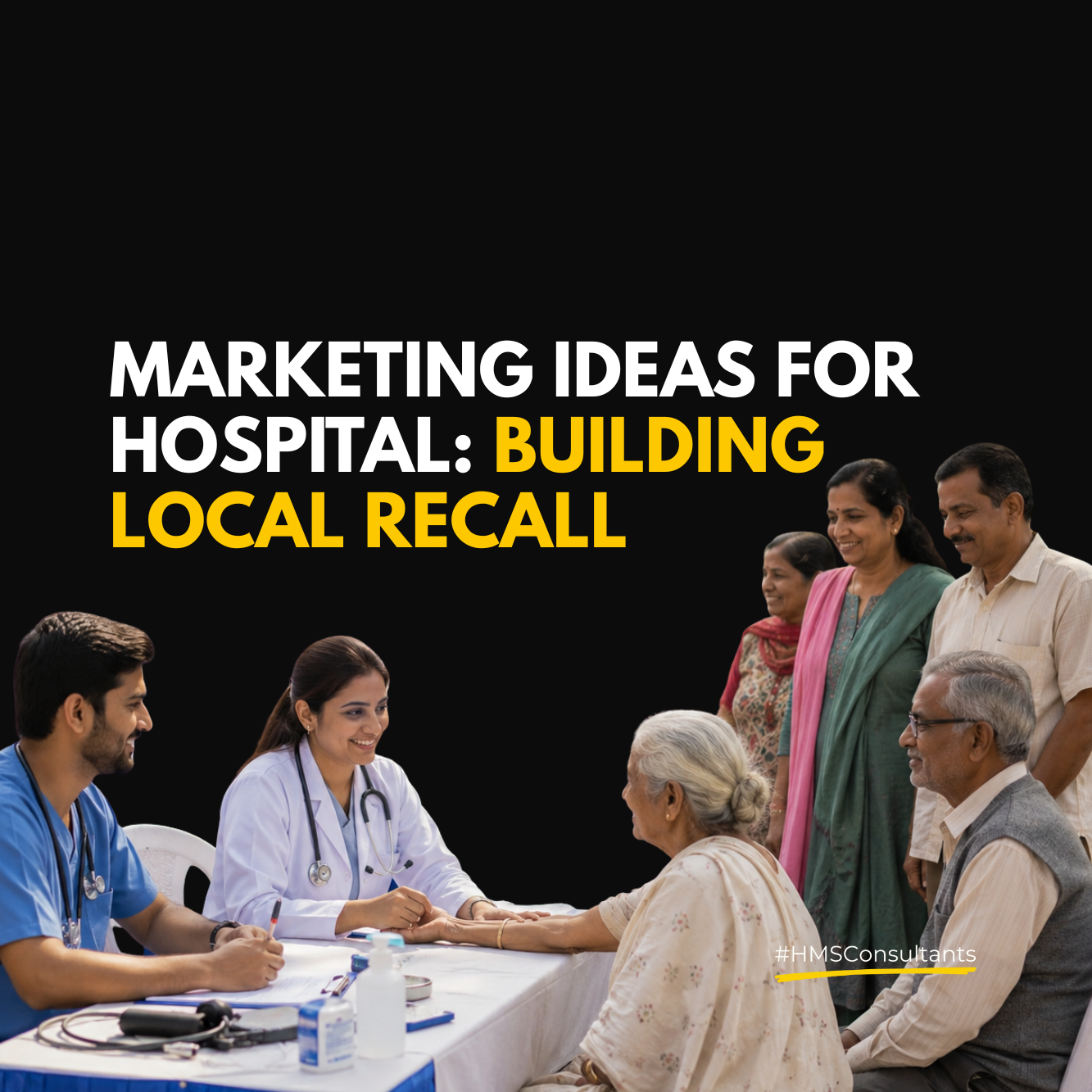
        Local recall is built when people repeatedly see the hospital in useful and responsible ways.This can happen through health awareness programs, preventive check-up drives, residential society sessions, school health talks, corporate wellness activities, seasonal health campaigns, and local partnerships.

        That is why community presence is one of the most practical marketing ideas for hospital growth, especially for hospitals that depend on patients from nearby areas.

        Community Health Awareness Programs

        Community health awareness is one of the strongest ways to build hospital recall. Hospitals can organise awareness sessions around common health concerns that people often ignore until symptoms become serious.

        These sessions should not sound promotional. They should focus on simple and useful health education.

        Hospitals can create awareness around:

        • Diabetes
        • Heart health
        • Women’s health
        • Bone and joint care
        • Child health
        • Eye care
        • Cancer screening
        • Seasonal infections
        • Mental health

        When doctors explain health concerns in simple language, people begin to see the hospital as a helpful healthcare guide, not only a place for treatment.

        Preventive Health Check-Up Drives

        Preventive check-up drives can support both public health awareness and hospital visibility. Many people delay health check-ups because they do not feel an immediate need. When hospitals take preventive care closer to the community, people become more aware of early detection and regular monitoring.

        These drives can be planned in:

        • Residential societies
        • Schools and colleges
        • Corporate offices
        • Senior citizen groups
        • Community centres
        • Local clubs
        • Industrial areas

        The purpose should not only be to collect leads. It should be to educate people about why preventive health matters and when they should consult a doctor.

        A well-planned preventive drive can improve hospital visibility while also creating useful community engagement.

        Local Partnerships for Better Reach

        Hospitals can build stronger community presence by partnering with local groups and institutions. These partnerships help hospitals reach people in places where health conversations are already relevant.

        Useful partnerships can include schools, colleges, housing societies, corporate offices, NGOs, local associations, senior citizen groups, fitness centres, women’s groups, and industrial units.

        For example, a hospital can conduct a bone health session for senior citizens, a menstrual health awareness session in a college, or a heart health talk for working professionals.

        Among different marketing ideas for hospital visibility, local partnerships are useful because they help the hospital reach targeted groups rather than speaking to a broad audience.

        Seasonal Health Campaigns

        Every local area faces seasonal health concerns. Hospitals can use these concerns to plan timely awareness campaigns that are useful for the community.

        Seasonal campaigns may include:

        • Monsoon fever awareness
        • Dengue and malaria prevention
        • Respiratory care during pollution season
        • Heatstroke awareness in summer
        • Flu prevention
        • Skin and allergy awareness
        • Child health during school reopening
        • Senior care during winter

        These campaigns work well because they connect with what people are already experiencing. When a hospital shares timely health guidance, people see the information as relevant and useful.

        Seasonal communication also helps hospitals remain visible throughout the year without depending only on promotional content.

        Residential Society and Corporate Activities

        Residential societies and corporate offices are important spaces for local hospital marketing. Families, senior citizens, working professionals, and children are part of these communities.

        Hospitals can conduct short, focused sessions on practical topics such as:

        • When to consult for chest pain
        • Early signs of diabetes
        • Joint pain and mobility care
        • Child fever warning signs
        • Women’s health after 40
        • Senior citizen fall prevention
        • Importance of regular screening
        • Stress and lifestyle health

        These sessions should be easy to understand and directly useful. The goal is not to make the activity too technical. The aim is to help people know when to take health concerns seriously and when to seek medical advice.

        Offline Presence Can Support Online Recall

        Community activities should not end after the event. Hospitals can use offline activities to support online recall as well.

        After a health camp, awareness session, or community activity, hospitals can share:

        • Event highlights
        • Doctor education clips
        • Key health tips
        • Photos from the session
        • Short awareness posts
        • Follow-up health guidance

        This helps the hospital extend the impact of offline activities to digital platforms. People who attended the event remember it, while others can still discover the hospital through online updates.

        This balance of offline and online communication makes hospital visibility stronger.

        What Hospitals Should Avoid

        Community presence should be handled responsibly. If every activity looks like direct promotion, people may lose interest.

        Hospitals should avoid:

        • Turning health talks into sales pitches
        • Using fear-based communication
        • Promising guaranteed results
        • Sharing patient-sensitive information
        • Using overly technical language
        • Conducting one-time camps without follow-up
        • Promoting services without patient education

        The purpose of community-based hospital marketing is to educate, connect, and build recall. It should feel helpful before it feels promotional.

        Conclusion

        Marketing ideas for hospital growth should include more than online campaigns and advertisements. For hospitals serving a local area, community presence can play an important role in building long-term recall.

        Health awareness programs, preventive check-up drives, local partnerships, residential society sessions, corporate wellness programs, and seasonal campaigns can help hospitals stay connected with people around them.

        Strong community presence helps people remember the hospital before a healthcare need becomes urgent. Better hospital marketing does not always mean louder promotion. Sometimes, it means being consistently present where the community needs useful health guidance.

        Contact Us HMS Consultants

        Hospital marketing can be done by building both online visibility and local community presence. Hospitals should use health awareness programs, preventive check-up drives, local partnerships, seasonal campaigns, residential society sessions, and useful digital updates to stay connected with nearby patients.

        Digital Marketing I Doctor Branding I healthcare digital marketing I Healthcare Marketing I Hospital Branding I hospital marketing I Hospital Marketing Strategies I Hospital Marketing Strategy I local community building

        is something we strongly believe in, which means ‘Knowledge without application is the same as having no knowledge at all

        Akhil Dave

        Principle Consultant

        Ready to take your Personal Brand to the next level?

        Share your details below and we will connect with you to discuss your growth strategy.

        • Doctor Digital Marketing: How Patients Evaluate Doctors Before Booking

          Doctor Digital Marketing: How Patients Evaluate Doctors Before Booking

          Doctor Digital Marketing: How Patients Evaluate Doctors Before Booking

          Published on
          Share This

          Doctor digital marketing is not only about posting health tips, running ads, or getting more followers. For doctors, digital marketing should help patients understand the doctor’s expertise, approach, availability, and credibility before booking an appointment.

          Today, even when patients receive a recommendation, they often search the doctor’s name online, read reviews, check the clinic website, visit social media pages, or look for videos before deciding.

          This means doctor digital marketing should be planned around how patients evaluate a doctor before consultation.

          Patients First Look for the Doctor’s Identity

          Before booking, patients want to know who the doctor is. They look for simple but important details that help them understand the doctor’s professional background.

          This usually includes:

          • Doctor’s full name
          • Qualification
          • Speciality
          • Years of experience
          • Clinic or hospital association
          • Consultation location
          • Available timings
          • Key areas of practice

          If this information is missing, incomplete, or different across platforms, patients may feel unsure. A weak online presence can make even an experienced doctor look less visible or less accessible.

          Digital marketing for doctors should clearly establish the doctor’s identity across Google, website pages, directories, social media, and clinic communication. Patients should not struggle to understand who the doctor is and what type of care they provide.

          Patients Check Whether the Doctor Matches Their Concern

          Patients do not evaluate a doctor only by qualification. They also check whether the doctor is relevant to their specific health concern.

          For example, a patient with knee pain may look for an orthopaedic doctor who handles joint pain, arthritis, sports injuries, or knee replacement. A patient looking for pregnancy care may check whether the gynecologist provides antenatal care, high-risk pregnancy care, delivery support, or fertility guidance.

          This is where online marketing for doctors must move beyond general statements like “experienced doctor” or “quality care.”

          The content should clearly explain:

          • What conditions the doctor treats
          • Which patient concerns are commonly handled
          • What services are available
          • When patients should consult
          • What the patient can expect during the visit
          • Which symptoms should not be ignored

          This does not mean making exaggerated claims. It means helping patients understand whether the doctor is suitable for their concern.

          Patients Read Reviews Before Booking

          Reviews play an important role in a doctor’s digital marketing. Patients often read what others have experienced before deciding to book.

          They may observe:

          • How patients describe the doctor
          • Whether the doctor listens properly
          • Whether staff members are helpful
          • Whether appointment handling is smooth
          • Whether the clinic experience feels organised
          • How the doctor or clinic responds to feedback

          Reviews are not only about star ratings. They are signals of patient trust. A doctor may have strong clinical expertise, but if online reputation is unmanaged, patients may hesitate.

          A doctor marketing strategy should include review monitoring, professional response handling, and learning from repeated patient feedback. Positive reviews can strengthen confidence, while negative reviews should be handled carefully and ethically.

          Patients Notice How the Doctor Communicates Online

          Patients also evaluate how a doctor communicates online. This includes social media posts, videos, website content, captions, blogs, and replies to patient queries.

          A doctor’s communication style can influence patient comfort before consultation.

          Patients may feel more confident when the content is:

          • Simple to understand
          • Educational
          • Responsible
          • Calm in tone
          • Free from fear-based messaging
          • Focused on patient awareness
          • Clear about when to seek consultation

          For doctors, content should not sound like aggressive selling. Healthcare communication should guide, educate, and reassure patients.

          For example, a short video explaining when back pain needs medical attention can be more useful than a generic promotional post. A simple post explaining early signs of diabetes can help patients take timely action. Medical practice marketing becomes stronger when the doctor’s communication helps patients feel informed rather than pressured.

          Patients Compare Information Across Platforms

          A patient may not rely on only one platform. They may check Google, the website, social media, YouTube, healthcare directories, and review platforms before making a decision.

          If the information is different everywhere, it creates confusion. For example, Google may show one clinic timing, the website may show another, and social media may not mention the doctor’s current availability.

          A consistent doctor online presence should include updated details such as:

          • Doctor name and speciality
          • Clinic or hospital location
          • Contact number
          • Consultation timings
          • Services offered
          • Appointment process
          • Website or profile link
          • Patient education content

          Consistency helps patients feel that the doctor’s practice is organised and reliable.

          Patients Evaluate Convenience Before Booking

          Clinical expertise matters, but patients also consider practical details before booking. If they cannot find appointment information, location details, consultation timing, or the contact process, they may delay the decision.

          A doctor in digital marketing should make the next step easy.

          Patients should be able to understand:

          • Where the doctor is available
          • How to book an appointment
          • What timings are available
          • Whether a prior appointment is needed
          • Which number to call
          • What documents or reports to carry
          • Whether follow-up is required

          These details may look basic, but they affect patient inquiries. Many potential patients drop off not because they are uninterested, but because the booking process is unclear.

          Common Mistakes in Doctor Digital Marketing

          Many doctors or clinics make digital marketing less effective by focusing only on activity instead of patient evaluation.

          Common mistakes include:

          • Posting only festival creatives
          • Running ads without clear service pages
          • Using generic captions
          • Not updating Google Business Profile
          • Ignoring reviews
          • Not explaining services properly
          • Having incomplete doctor profiles
          • Making content too technical for patients
          • Not showing clear appointment steps

          These mistakes can reduce patient confidence. A doctor may be highly skilled, but if the digital presence is unclear, patients may not understand the doctor’s value.

          Doctor digital marketing should be structured, consistent, and patient-focused.

          Conclusion

          Doctor digital marketing is not just about visibility. It is about helping patients evaluate the doctor before booking.

          Patients look for identity, expertise, relevance, reviews, communication style, convenience, and trust signals. They want to know whether the doctor is suitable for their concern and whether the consultation process feels clear and reliable.

          A strong doctor marketing strategy should focus on patient questions before focusing on platforms. It should explain the doctor’s expertise, make information easy to find, manage the doctor’s reputation responsibly, and guide patients to book without pressure.

          For doctors, digital presence is often the first point at which patients begin to build trust. The clearer the doctor’s online presence, the easier it becomes for patients to understand, trust, and choose the right care.,

          Contact Us HMS Consultants

          Yes, a doctor can do digital marketing ethically and informatively. A doctor’s digital marketing should focus on patient education, clear service information, an updated online presence, reviews, appointment guidance, and helping patients understand the doctor’s expertise before booking.

          Digital Strategy I Business I Digital Marketing I doctor digital marketing I healthcare digital marketing I healthcare Management I Healthcare Marketing I Healthcare Marketing Strategy I hospital marketing I Hospital Marketing Strategies I online presence

          is something we strongly believe in, which means ‘Knowledge without application is the same as having no knowledge at all

          Akhil Dave

          Principle Consultant

          Ready to take your Personal Brand to the next level?

          Share your details below and we will connect with you to discuss your growth strategy.

          • Hospital Marketing: How to Decide Which Services to Promote First

            Hospital Marketing: How to Decide Which Services to Promote First

            Hospital Marketing: How to Decide Which Services to Promote First

            Published on
            Share This

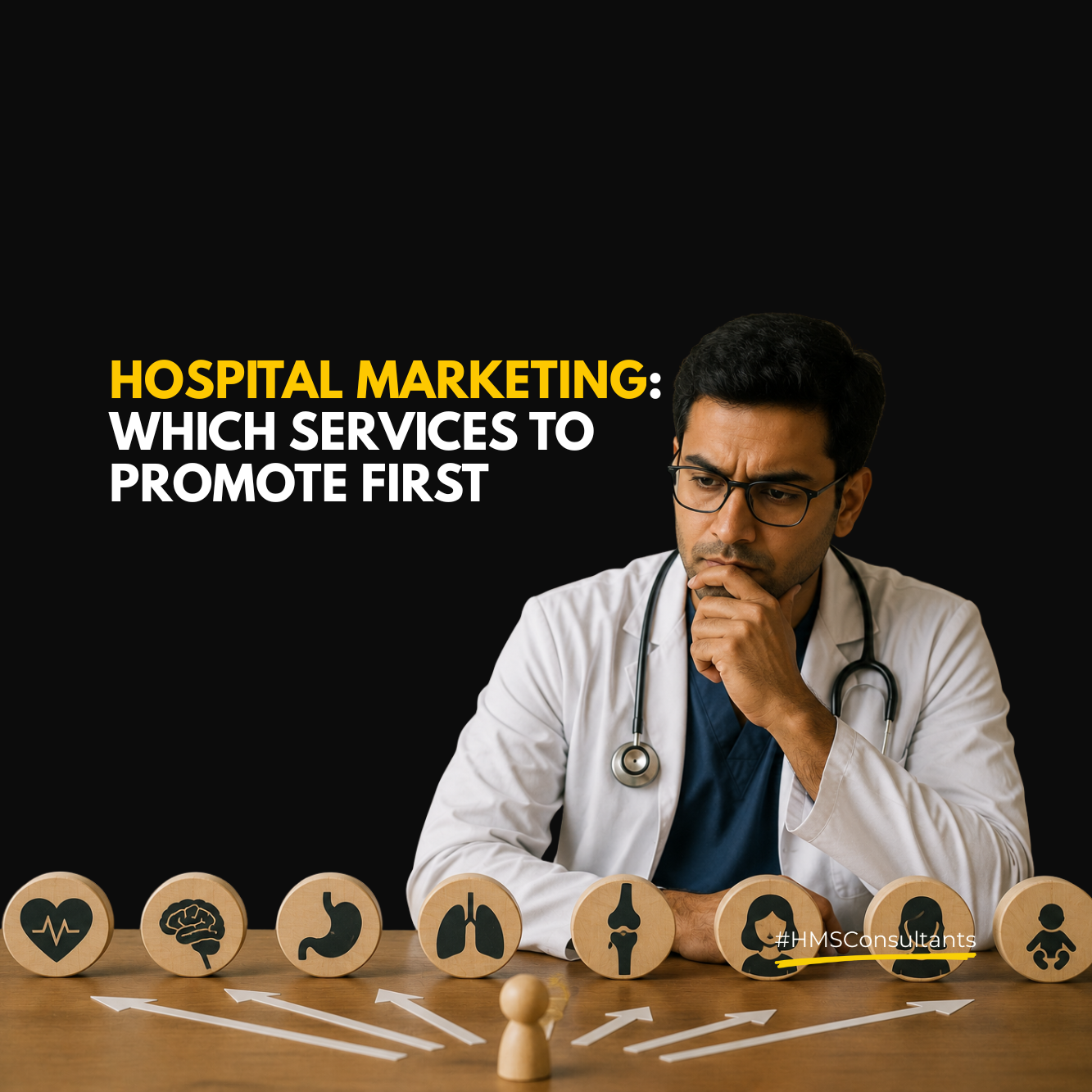
            Hospital marketing becomes difficult when everything is treated as equally important. Most hospitals have multiple departments, doctors, services, packages, and treatment areas. Naturally, every service needs visibility. But in practice, promoting everything at once often leads to scattered communication and weak results.

            A hospital cannot market emergency care, maternity, orthopedics, diagnostics, preventive health check-ups, surgery, and specialist consultations with the same message and the same urgency. Each service has different patient needs, decision time, trust requirements, and business value. This is why hospital marketing should not start with the question, “What should we post?” It should start with a better question: “Which service needs marketing attention first, and why?”

            A clear hospital marketing strategy helps hospitals decide which services to promote first based on patient demand, department readiness, local competition, service value, and growth potential.

            Why Service Prioritisation Matters in Hospital Marketing

            Many hospitals run campaigns without deciding which services deserve focus. As a result, marketing becomes too broad. One week the hospital promotes one department, the next week another, and then a general awareness post follows. This creates activity, but not always direction.

            Service prioritisation helps the hospital focus its effort where it can make the most meaningful impact.

            It helps answer:

            • Which services are patients actively looking for?
            • Which departments are underutilized?
            • Which services need better explanation?
            • Which doctors have availability to handle more patients?
            • Which services support long-term hospital business growth?
            • Which departments face stronger competition?
            • Which services are seasonal or time-sensitive?

            Without this clarity, hospital marketing may continue, but the results may remain unclear.

            Patient Demand Should Guide the First Decision

            The first factor to study is patient demand. Hospitals should not promote a service only because it exists. They should understand whether patients are searching for it, asking about it, or showing real need for it.

            Patient demand can be understood through enquiry patterns, appointment data, common patient questions, Google searches, local health concerns, seasonal illness trends, and competitor visibility.

            For example, if many patients are asking about knee pain, pregnancy care, diabetes management, fever treatment, diagnostic packages, or cardiac check-ups, those areas may need stronger communication.

            This does not mean only high-demand services should be promoted. But demand helps the hospital know where patient interest already exists. Marketing can then improve visibility, explain the service better, and guide patients more clearly.

            A hospital marketing strategy should always connect service promotion with real patient behaviour.

            Department Readiness Comes Before Promotion

            A common mistake in hospital marketing is promoting a service before the department is ready to handle the response.

            If marketing brings enquiries but the doctor is not available, the front desk is not informed, the appointment process is unclear, or follow-up is weak, the campaign may damage trust instead of supporting growth.

            Before promoting any service, the hospital should check:

            • Is the doctor or department available consistently?
            • Can the team handle more enquiries?
            • Is the front desk trained to explain the service?
            • Is the appointment process simple?
            • Is the website information clear?
            • Are packages, reports, or instructions ready where needed?
            • Is follow-up being handled properly?

            Hospital service promotion should not create demand that the hospital cannot manage. Good marketing works only when the patient journey behind it is prepared.

            Underused Services May Need Visibility First

            Many hospitals have strong services that patients do not know about. These may be clinically valuable, but they remain underutilised because they are not clearly visible online or offline.

            Sometimes the service exists on the hospital premises, but it is missing from the website. Sometimes it is not mentioned properly on Google Business Profile. Sometimes the doctor is available, but patients do not know that the department offers that care.

            Underused services can be identified by checking:

            • Services with low enquiries
            • Departments not clearly explained online
            • Doctors with weak digital visibility
            • Treatments not covered in content
            • Services missing from Google Business Profile
            • Low patient awareness despite strong capability

            These services may not need paid ads immediately. They may first need clear service pages, patient education content, doctor-led videos, Google updates, and better internal communication.

            In hospital marketing, visibility should begin with clarity.

            Growth Potential Should Be Considered Carefully

            Hospital marketing must remain ethical and patient-centred, but hospitals also need to understand which services support long-term sustainability. Some services may have higher demand, stronger repeat value, better department capacity, or greater positioning importance for the hospital.

            This is where hospital growth strategy becomes important.

            Hospitals should look at:

            • Patient need
            • Clinical strength
            • Revenue potential
            • Doctor availability
            • Department capacity
            • Local competition
            • Long-term brand positioning

            For example, if a hospital has strong orthopaedic expertise but patients are choosing competitors for joint pain or fracture care, that department may need focused promotion. If diagnostics are available but underused, preventive health packages may need better communication.

            Marketing should support services where the hospital has genuine capability, not only where it wants more visibility.

            Competition Can Reveal Service Opportunities

            A hospital should not copy competitor marketing, but it should understand what competitors are doing. Local competition often shows which services are being pushed heavily and where gaps may exist.

            Hospitals should observe:

            • Which services competitors promote most
            • How they explain those services
            • Which doctors or departments are visible online
            • What patients mention in competitor reviews
            • Where competitors are strong or weak
            • Which patient questions remain unanswered

            If many hospitals are promoting the same service, your hospital needs a clearer positioning angle. If competitors are weak in an area where your hospital has strength, that service may become a strong marketing opportunity.

            Hospital service promotion should be based on differentiation, not imitation.

            Timing Can Improve Marketing Response

            Some hospital services perform better when promoted at the right time. Timing can depend on seasons, awareness months, local health patterns, school calendars, corporate cycles, or disease trends.

            For example, fever and infection care may need stronger communication during monsoon. Respiratory care may become more relevant during pollution season. Preventive health packages may work well around health awareness campaigns. School health check-ups may be planned before academic sessions.

            Hospitals should build a service-wise marketing calendar instead of deciding campaigns at the last moment.

            This helps plan:

            • Awareness posts
            • Doctor videos
            • Google updates
            • Blog content
            • Local campaigns
            • Preventive health messages
            • Patient education material

            When timing is planned, hospital marketing becomes more consistent and less random.

            The Marketing Route Should Match the Service

            Not every service needs the same marketing channel. Some services need search visibility. Some need patient education. Some need doctor credibility. Some need local awareness. Some need Google Business Profile optimization. Some need paid campaigns.

            For example, high-search services may need SEO and Google visibility. Complex services may need blogs and educational videos. Doctor-led services may need profile strengthening and credibility-building content. Preventive services may need awareness campaigns. Competitive services may need stronger service positioning.

            The better question is not, “Should we run ads?”

            The better question is, “What does this service need before patients respond?”

            This is where hospital marketing becomes strategic. The channel should come after the service priority is clear.

            Conclusion

            Hospital marketing becomes stronger when hospitals stop promoting everything equally and start prioritising services strategically.

            Every service does not need the same campaign, message, platform, or budget. Some services need awareness. Some need search visibility. Some need doctor credibility. Some need better patient education. Some need operational readiness before promotion.

            A clear hospital marketing strategy helps hospitals decide which services to promote first based on patient demand, department readiness, competition, timing, and growth potential.

            For hospitals that want sustainable growth, marketing should not begin with random activity.

            It should begin with the right service priority.

            Contact Us HMS Consultants

            Hospital marketing is the process of promoting a hospital’s services, departments, doctors, and patient care in a planned way. In this blog context, it means deciding which services should be promoted first based on patient demand, department readiness, competition, and growth potential.

            Healthcare Marketing I Digital Strategy I healthcare digital marketing I healthcare Management I Healthcare Marketing Strategy I hospital marketing I Hospital Marketing Strategies I Hospital Marketing Strategy

            is something we strongly believe in, which means ‘Knowledge without application is the same as having no knowledge at all

            Akhil Dave

            Principle Consultant

            Ready to take your Personal Brand to the next level?

            Share your details below and we will connect with you to discuss your growth strategy.

            • Hospital Marketing Techniques That Actually Work in 2026

              Hospital Marketing Techniques That Actually Work in 2026

              Hospital Marketing Techniques That Actually Work in 2026

              Written by
              Published on
              Share This

              Hospital marketing techniques are changing rapidly in 2026. Many hospitals are still investing heavily in traditional promotions, social media activity, newspaper advertisements, and random campaigns, expecting consistent patient growth. But patient behaviour has changed completely.

              Today, patients do not choose hospitals the same way they did a few years ago.

              Before booking appointments, most patients now:
              • Search hospitals on Google.
              • Compare reviews.
              • Evaluate doctor’s credibility.
              • Visit hospital websites.
              • Check social proof.
              • Look for reassurance before making decisions.

              This means hospital marketing today is no longer only about visibility.
              It is about building systems that help patients trust the hospital during their decision-making journey.
              That is where most traditional hospital marketing techniques begin to fail.

              Many hospitals still focus heavily on:

              • Generic advertisements.
              • Social media posting.
              • Offline promotions.
              • Hoardings.
              • Awareness campaigns.

              The activity may create attention temporarily. But long-term hospital growth now depends on discoverability, conversion systems, patient retention, reputation management, and healthcare trust infrastructure.

              This is why hospitals that are consistently growing in 2026 are not always the ones spending the most on marketing.

              Search Visibility Has Become One of the Most Important Hospital Marketing Techniques

              One of the biggest changes in healthcare marketing is the shift toward search-first patient behaviour.

              Most healthcare journeys now begin online.

              Patients search for:

              • Symptoms.
              • Specialists.
              • Hospitals.
              • Procedures.
              • Treatments.
              • Healthcare advice.

              Before making decisions.

              This is why search visibility has become one of the most powerful hospital marketing techniques in 2026.

              Hospitals that appear prominently in patient searches usually create stronger enquiry opportunities than hospitals that rely solely on advertisements.

              Search visibility includes:

              • Local SEO.
              • Google Business optimisation.
              • Speciality-based pages.
              • Mobile-friendly websites.
              • Service-focused content.
              • Location-based discoverability.

              Patients rarely search only:

              “Hospital”

              They search:

              • “Best orthopaedic hospital near me”
              • “Cardiologist in Ahmedabad”
              • “Eye hospital for cataract surgery”
              • “Best hospital for knee replacement”

              This means hospitals now need department-level discoverability rather than only brand-level visibility.

              The hospitals winning digitally today are usually the hospitals that understand local search intent deeply.

              Google Reviews Have Become a Core Hospital Marketing Technique

              Most patients today read reviews before contacting hospitals.

              That makes online reputation one of the most influential hospital marketing techniques currently working in healthcare.

              Patients notice:

              • Review quality.
              • Patient experiences.
              • Complaint handling.
              • Response professionalism.
              • Consistency of feedback.

              Reviews are no longer passive feedback.

              They directly influence patient confidence.

              Many hospitals still treat reviews casually. Some ask randomly. Others ignore negative reviews entirely.

              But hospitals growing consistently online usually build structured review systems.

              This includes:

              • Ethical review collection.
              • Post-treatment feedback systems.
              • Response management.
              • Reputation monitoring.

              When patients compare hospitals online, reviews often become one of the strongest trust signals influencing final decisions.

              Because patients trust patient experiences more than advertisements.

              Educational Content Is Replacing Promotional Marketing

              One of the biggest shifts happening in healthcare marketing is the rise of educational authority.

              Patients today do not only want to find hospitals.

              They want to:

              • Understand conditions.
              • Reduce fear.
              • Evaluate treatment options.
              • Feel informed before consultations.

              This is why educational healthcare content has become one of the strongest hospital marketing techniques in 2026.

              Hospitals using:

              • Blogs.
              • Specialist videos.
              • Healthcare FAQs.
              • Treatment explainers.
              • Patient education content.

              Usually build stronger long-term digital trust.

              Educational content helps hospitals become more discoverable while also improving patient confidence.

              Over time, this creates:

              • Authority.
              • Reassurance.
              • Stronger engagement.
              • Better conversion quality.

              Promotional marketing attracts attention temporarily.

              Educational authority builds long-term trust.

              That difference is becoming extremely important in modern healthcare marketing.

              Doctor Visibility Is Becoming a Growth Driver for Hospitals

              Patients often choose hospitals because of doctors.

              This means doctor visibility is becoming one of the most important hospital marketing techniques today. Individual doctors should focus more on their Personal Branding, which drives patients towards their clinics and hospitals.

              Modern hospital marketing is no longer only hospital-centric.

              It is increasingly doctor-led digitally.

              Hospital Websites Must Work Like Conversion Systems

              Many hospitals still treat websites like brochures. But patient expectations have changed.

              A hospital website today acts like a 24-hour patient acquisition and trust-building system.

              Patients evaluate:

              • Professionalism.
              • Credibility.
              • Accessibility.
              • Reassurance.

              Through the website before making contact.

              Poor hospital websites usually create:

              • Patient confusion.
              • Drop-offs.
              • Weak enquiry conversion.

              Modern hospital websites should include:

              • Speciality-focused pages.
              • Fast loading speed.
              • Mobile responsiveness.
              • Clear appointment systems.
              • Doctor profiles.
              • Patient reviews.
              • Healthcare education.

              Because patients judge hospitals digitally before visiting physically.

              WhatsApp Retention Systems Are Becoming Essential

              One of the most underused hospital marketing techniques is patient retention communication.

              Many hospitals focus heavily on new patient acquisition while neglecting post-treatment engagement completely.

              This creates a patient drop-off.

              WhatsApp systems now help hospitals improve:

              • Follow-up communication.
              • Appointment reminders.
              • Discharge guidance.
              • Patient education.
              • Long-term engagement.

              In India, especially, WhatsApp has already become part of daily patient communication behaviour.

              Hospitals that integrate communication systems strategically usually achieve stronger patient continuity than hospitals that rely solely on campaigns.

              Why Most Hospitals Still Struggle Despite Marketing

              Many hospitals still struggle with marketing because their systems remain disconnected internally.

              Common problems include:

              • Weak enquiry handling.
              • Delayed responses.
              • Inconsistent communication.
              • Poor patient coordination.
              • Fragmented departments.
              • Lack of follow-up systems.

              Marketing may attract enquiries initially.

              But operational gaps reduce actual conversion.

              This is why hospital marketing today must work together with:

              • Reception teams.
              • Patient coordinators.
              • CRM systems.
              • Enquiry management.
              • Patient experience processes.

              Hospitals no longer grow only through campaigns.

              They grow through connected systems.

              The Future of Hospital Marketing Techniques

              Healthcare marketing is shifting rapidly toward:

              • AI-assisted discovery.
              • Search-driven patient behaviour
              • Local intent marketing.
              • Trust-based conversion.
              • Predictive engagement.
              • Patient experience systems.

              Patients today expect:

              • Accessibility.
              • Speed.
              • Reassurance.
              • Digital clarity.
              • Convenience.

              This means hospital marketing techniques in 2026 must become more integrated, measurable, and patient-focused than ever before.

              The hospitals growing consistently today are usually building:

              • Discoverability systems.
              • Educational authority.
              • Reputation architecture.
              • Retention workflows.
              • Patient trust infrastructure.

              That is becoming the real future of healthcare growth.

              Conclusion

              Hospital marketing techniques in 2026 are no longer only about promotions, advertisements, or social media visibility.

              Modern patient behaviour has changed completely.

              Patients now research hospitals deeply before making healthcare decisions. They compare reviews, evaluate doctors, analyse websites, and search for reassurance before booking appointments.

              This means hospitals must move beyond awareness-based marketing and focus on:

              • Discoverability.
              • Reputation.
              • Educational authority.
              • Retention.
              • Patient trust systems.

              Because hospitals no longer grow simply by marketing more.

              They grow by building systems patients trust.

              Contact Us HMS Consultants

              Hospital Marketing Strategies I Digital Marketing

              is something we strongly believe in, which means ‘Knowledge without application is the same as having no knowledge at all

              Akhil Dave

              Principle Consultant

              Ready to take your Personal Brand to the next level?

              Share your details below and we will connect with you to discuss your growth strategy.

              • Why Hospital Marketing Budgets Don’t Fix Growth

                Why Hospital Marketing Budgets Don’t Fix Growth

                Why Hospital Marketing Budgets Don’t Fix Growth

                Written by
                Published on
                Share This

                Hospital marketing budget discussions usually begin with a familiar assumption: if growth slows, spending must increase. More ads, more platforms, more agencies. Budget becomes the default solution. Yet many hospitals see a different reality. Visibility increases. Campaign activity expands. But patient flow remains inconsistent.

                The issue is rarely the size of the hospital marketing budget. It is how that budget is being used to compensate for deeper gaps in strategy, communication, and patient experience.

                Why Hospital Marketing Budgets Expand When Clarity Shrinks

                Hospitals often increase their marketing budget during periods of uncertainty. Enquiries fluctuate, conversions feel unstable, and leadership looks for control through scale.

                However, budget expansion often masks unclear positioning, weak sequencing, or gaps in patient communication. Instead of improving outcomes, marketing spend begins to reassure internal teams rather than guide patient decisions.

                This creates a dangerous pattern. As clarity decreases, spending increases. And as spending increases without clarity, inefficiencies multiply.

                A hospital marketing budget grows fastest when strategic clarity is lowest.

                The False Comfort of More Spend

                Increasing the hospital marketing budget creates visible activity. Campaigns increase. Dashboards look stronger. Teams feel productive.

                But visibility is not the same as effectiveness.

                If patients remain uncertain, additional spend amplifies confusion rather than resolving it. Enquiries may increase, but confidence does not. This leads to higher lead volumes but unstable conversions.

                Money increases noise. It does not automatically build trust.

                Hospitals often mistake activity for progress. In reality, progress comes from improving how patients understand and evaluate the hospital, not from increasing how often they see it.

                Where Budget Efficiency Breaks: Marketing vs Operations

                A hospital marketing budget is often planned without considering operational readiness.

                Marketing generates interest, but systems such as OPD flow, front desk communication, appointment handling, and follow-ups may not be prepared to convert that interest.

                This creates leakage:

                • Patients drop off after first contact
                • Follow-ups increase without closure
                • Conversion stability declines

                The problem is not marketing effort. It is experience mismatch.

                When patient experience does not align with marketing promises, trust weakens. And when trust weakens, no amount of additional spend can compensate for it.

                Budget Size vs Budget Intelligence

                A larger hospital marketing budget does not guarantee better results.

                A smaller, well-structured budget focused on patient decision points often performs better than a larger, unfocused one.

                Effective budgets:

                • Invest in moments of patient hesitation
                • Prioritize clarity over channel expansion
                • Reduce duplication instead of increasing presence
                • Focus on conversion stability rather than visibility

                Budget size is visible. Budget intelligence is decisive.

                Hospitals that understand this shift move from spending more to spending better.

                Why Leadership Often Misreads Budget Performance

                Hospital leadership often evaluates marketing budgets through short-term metrics such as:

                • Cost per lead
                • Monthly conversions
                • Immediate ROI

                These metrics reward urgency-driven tactics and overlook long-term trust building.

                This leads to:

                • Short-term gains
                • Long-term instability
                • Reduced patient confidence

                When teams are pressured to deliver quick results, they prioritise tactics that generate immediate activity rather than strategies that build sustained trust.

                Sustainable growth requires patience, not pressure.
                A hospital marketing budget performs best when leadership values consistency over urgency.

                How to Plan a Smarter Hospital Marketing Budget

                A hospital marketing budget should be planned based on patient hesitation, not channels.

                Instead of asking where to spend, hospitals should ask:

                • Where do patients delay decisions?
                • What information is missing?
                • What creates confusion or doubt?

                Budgets aligned with these questions:

                • Reduce unnecessary spend
                • Improve predictability of outcomes
                • Increase conversion quality
                • Strengthen patient confidence

                Marketing should guide decisions, not compensate for confusion.

                When clarity improves, the need for excessive spending reduces naturally.

                Conclusion

                Hospitals do not struggle because their marketing budgets are too small.
                They struggle because budgets are used to solve problems they were never meant to fix.

                A hospital marketing budget performs best when it:

                • Supports patient clarity
                • Aligns with real experience
                • Reduces hesitation

                Growth in healthcare does not respond to louder spending.
                It responds to better alignment between communication, experience, and trust.

                Hospitals that understand this stop increasing budgets reactively and start improving systems proactively.
                And when that happens, growth becomes calmer, more predictable, and more sustainable.

                Contact Us HMS Consultants

                A hospital marketing budget is the planned allocation of resources used to support patient awareness, trust-building, and decision-making. It includes spending on communication, digital presence, and patient engagement, but should primarily focus on improving clarity and patient experience rather than just increasing promotional activity.

                Doctors Digital Marketing I Healthcare Marketing I Hospital Marketing Strategies I Marketing ideas for clinics I Marketing Trends 2025 I Medical Marketing I Social Media Marketing

                is something we strongly believe in, which means ‘Knowledge without application is the same as having no knowledge at all

                Akhil Dave

                Principle Consultant

                Ready to take your Personal Brand to the next level?

                Share your details below and we will connect with you to discuss your growth strategy.

                • Why a Hospital Marketing Consultant Is Brought In Too Late and What That Delay Actually Costs

                  Why a Hospital Marketing Consultant Is Brought In Too Late and What That Delay Actually Costs

                  Why a Hospital Marketing Consultant Is Brought In Too Late and What That Delay Actually Costs

                  Written by
                  Published on
                  Share This

                  A hospital marketing consultant is usually engaged when frustration peaks and hospital growth and patient footfall are not meeting expectations. Marketing feels expensive. Growth feels inconsistent. Teams feel busy but unsure. Leadership senses something is wrong, yet no single campaign or channel explains the problem.

                  By the time a marketing consultant is called in, the hospital has often spent months, sometimes years, compensating for structural gaps with more activity. This delay is not just costly in budget terms. It quietly erodes trust, efficiency, and strategic clarity.

                  Why Hospitals Delay Calling a Marketing Consultant

                  Hospitals often believe marketing problems can be solved internally, or by working with an outsourced social media or advertising agency for better execution. New hires are made. Agencies are changed. Tools are added. Reporting becomes more detailed.

                  These steps feel proactive, but they avoid a harder question: Is the problem execution, or is it alignment?

                  A hospital marketing consultant is usually delayed because leadership hopes that effort will fix clarity. In healthcare, effort without alignment amplifies confusion.

                  What a Hospital Marketing Consultant Looks for First

                  Contrary to expectation, a hospital marketing consultant does not begin with campaigns or platforms. They look for decision friction. Where do patients hesitate? Where do teams compensate manually? Where does communication repeat itself unnecessarily? What is working and what is not working? Which source brings more patients to the existing practice? What exactly is our target audience? 

                  These patterns reveal misalignment between marketing promises, patient expectations, and operational reality. Once identified, many “marketing problems” disappear without adding activity.

                  Consulting starts with audit & diagnosis, not delivery.

                  The Hidden Cost of Waiting Too Long

                  Delaying consulting support creates invisible costs. Marketing teams burn out. Patient conversations become repetitive. Conversion rates fluctuate unpredictably. Leadership loses confidence in marketing as a function.

                  These costs rarely appear in financial statements. They appear in decision fatigue, reactive planning, and constant optimisation cycles.

                  A hospital marketing consultant reduces these costs by restoring coherence early.

                  Why Agencies Cannot Replace Consultants

                  Agencies execute within a brief. Consultants question the brief itself. When hospitals rely solely on agencies, execution improves but misalignment remains.

                  A hospital marketing consultant works upstream of execution. They redefine priorities, sequencing, and success criteria so agencies can perform effectively.

                  Without this layer, hospitals often rotate agencies without fixing the root issue.

                  How Marketing Consultants Change the Nature of Marketing Conversations

                  Once a consultant is involved, conversations shift. Instead of asking “what should we run next,” teams ask “what is blocking patient confidence.” Metrics are discussed in context. Funnels are evaluated behaviourally, not mechanically.

                  This shift reduces noise and increases focus. Marketing becomes calmer, not louder.

                  That calm is a sign of strategic health.

                  The Long-Term Impact of Early Consulting

                  Hospitals that engage a marketing consultant early experience fewer resets. Growth becomes steadier. Marketing spend becomes more predictable. Teams spend more time improving experience and less time firefighting performance issues.

                  Most importantly, leadership gains a clearer lens to evaluate marketing decisions without relying solely on dashboards.

                  Clarity compounds faster than campaigns.

                  A Hospital Marketing Consultant Is Most Valuable Before Things Feel Broken

                  Hospitals do not need consultants because marketing fails. They need consultants because marketing works harder than it should.

                  A hospital marketing consultant identifies friction before it becomes frustration. They align decisions before effort escalates. They help hospitals stop compensating and start structuring growth.

                  In healthcare, the costliest delay is not slow marketing.
                  It is waiting too long to fix what quietly blocks trust.

                  Hospitals that understand this bring consultants in early and grow with far less noise.

                  Contact Us HMS Consultants

                  A hospital marketing consultant is a strategic advisor who diagnoses alignment gaps between marketing, patient behaviour, and hospital operations. Unlike agencies, consultants focus on fixing structural issues that prevent marketing from delivering stable, long-term growth.

                  Doctors Digital Marketing I Healthcare Marketing I Hospital Marketing Strategies I Marketing ideas for clinics I Marketing Trends 2025 I Medical Marketing I Social Media Marketing

                  is something we strongly believe in, which means ‘Knowledge without application is the same as having no knowledge at all

                  Akhil Dave

                  Principle Consultant

                  Ready to take your Personal Brand to the next level?

                  Share your details below and we will connect with you to discuss your growth strategy.

                  • Public Relations in a Hospital: What It Actually Does and Why Most Hospitals Underestimate It

                    Public Relations in a Hospital: What It Actually Does and Why Most Hospitals Underestimate It

                    Public Relations in a Hospital: What It Actually Does and Why Most Hospitals Underestimate It

                    Written by
                    Published on
                    Share This

                    Public relations in a hospital is not only about press releases, media handling, or public announcements. It is the way a hospital communicates with patients, families, staff, media, and the community to build credibility, manage reputation, and respond responsibly during sensitive situations.

                    In India’s rapidly evolving healthcare landscape, where patients make decisions based on trust and reputation long before they step into an OPD, effective public relations in a hospital is not a communications luxury. It is a clinical-trust infrastructure.

                    What public relations in a hospital covers at a glance:

                    •       Patient and community communication before, during, and after care
                    •       Media relations, press coverage, and crisis communication
                    •       Internal staff communications that shape patient-facing behaviour
                    •       Reputation management across digital and offline touchpoints
                    •       Community outreach, health awareness programmes, and public trust building
                    •       Liaison with government bodies, accreditation agencies, and health media

                    What Is Public Relations in a Hospital?

                    Public relations in a hospital is the strategic management of how a hospital communicates with every group it depends on  patients, families, staff, media, the local community, government bodies, and referring doctors. It shapes perception, builds credibility, and protects institutional reputation when challenges arise.

                    Unlike advertising, which pays for placement and controls the message entirely, hospital PR earns trust through consistency, transparency, and genuine community presence. It is the difference between a hospital patients choose because they saw an ad and a hospital patients trust because they have heard and felt its reputation.

                    “Advertising tells people what a hospital wants them to believe. Public relations is what people believe when the hospital is not saying anything.”

                    Why Hospital PR Should Not Be Only Reactive

                    Hospitals often notice PR only when there is a complaint, negative review, media issue, or public concern. But public relations in a hospital should not begin only after something goes wrong.

                    A strong hospital PR approach works before problems become public. It helps hospitals create clear systems for patient communication, staff responses, review handling, media queries, public clarification, and crisis readiness.

                    When PR is treated only as a reaction, hospitals may respond late or inconsistently. But when PR is planned, the hospital can communicate more clearly, reduce confusion, and protect its reputation before issues become larger.

                    Why Public Relations in a Hospital Is Different From Advertising

                    Hospitals often conflate PR with advertising, or treat both as interchangeable parts of marketing. They are fundamentally different tools with very different effects on patient decision-making.

                    Advertising vs. PR in a hospital:

                    •       Advertising: paid, controlled, immediate but short-lived in trust impact
                    •       PR: earned, credible, slower to build but far more durable
                    •       Advertising builds awareness. PR builds trust.
                    •       Advertising reaches new patients. PR retains existing ones and generates referrals.
                    •       Advertising can be ignored. Trusted PR shapes behaviour before any contact with the hospital.

                    For Indian hospitals, word-of-mouth and community reputation remain the most powerful patient acquisition channels. Public relations in a hospital directly feeds these channels advertising cannot replicate this effect regardless of budget.

                    The 6 Core Functions of Public Relations in a Hospital

                    1. Patient and community communication

                    Effective hospital PR ensures patients are never left in an information vacuum. Clear, consistent, and compassionate communication before, during, and after treatment reduces anxiety, builds confidence, and increases follow-through on care plans. When patients feel informed, they feel respected  and they talk about it.

                    2. Media relations and press coverage

                    Hospitals that manage media relationships proactively control their narrative far better than those who only engage during crises. Sharing clinical milestones, health campaigns, and community health data with journalists builds goodwill that pays dividends when difficult stories arise.

                    3. Crisis communication

                    Every hospital will face a crisis a medical error, a public complaint, a staff incident, or a regulatory issue. Public relations in a hospital determines whether these moments damage trust permanently or are managed with transparency. Hospitals without a crisis communication protocol are always caught unprepared.

                    “A crisis does not create a hospital’s PR problem. It reveals whether the hospital had a PR strategy at all.”

                    4. Internal communications

                    PR is not only external. How leadership communicates with doctors, nurses, and staff directly shapes the culture patients experience. Hospitals with strong internal communication have staff who visibly embody institutional values and patients notice.

                    5. Community outreach and health awareness

                    Health camps, awareness drives, school visits, and community initiatives are structured PR investments. They build visibility in communities the hospital serves, establish clinical authority, and create trust long before a patient needs to book an appointment.

                    6. Digital reputation management

                    Online reviews, Google ratings, and social media presence are now primary inputs in patient decision-making across India. Managing these consistently is a core function of modern public relations in a hospital not a task to be delegated casually.

                    How Hospital PR Affects Patient Trust Before the First Visit

                    Most hospital administrators think of patient trust as something built during or after care. In reality, a patient’s trust is largely formed before they arrive  shaped by what they have read, heard, and been told by others in their community.

                    Public relations in a hospital manages this pre-visit trust systematically. A hospital that is spoken of respectfully in the community, has transparent online communication, and is visibly present in local health initiatives is one patients approach with confidence rather than apprehension.

                    This pre-visit confidence shortens time from awareness to booking, reduces OPD drop-off, and improves consultation quality  because patients arrive prepared rather than anxious.

                    Crisis Communication: The Part of Hospital PR Most Hospitals Ignore Until It Is Too Late

                    No hospital wants to think about crisis communication until it needs it. This is one of the most expensive mistakes in hospital management. A well-prepared PR function includes a documented crisis protocol, a designated spokesperson, clear escalation paths, and a media response framework.

                    When a crisis arises and in any hospital of meaningful size, it will the first 24 to 48 hours are decisive. Hospitals that respond with transparency limit damage significantly. Hospitals that go silent or issue contradictory statements find the communication failure becomes larger than the original incident.

                    Principles of effective hospital crisis communication:

                    1.     Respond early with facts, even if incomplete. Silence is interpreted as guilt.
                    2.     Designate a single spokesperson. Contradictory voices amplify damage.
                    3.     Acknowledge impact on patients and families before defending the institution.
                    4.     Communicate internally before news breaks externally.
                    5.     Follow up consistently one statement is never enough in a fast-moving situation.

                    Public Relations in a Hospital vs. Marketing: How They Work Together

                    Hospital PR and hospital marketing are not the same function, but they must work together to be effective. Marketing drives awareness and patient acquisition. PR builds the credibility and trust that makes marketing believable.

                    A hospital that spends heavily on marketing without a functioning PR foundation is building on unstable ground. When hospital PR and marketing are aligned when every campaign builds on a credible, community-trusted reputation both functions perform significantly better. Conversion improves. Referrals increase without incentives.

                    Why Public Relations in a Hospital Is Especially Important in India

                    India’s healthcare environment has specific characteristics that make hospital PR particularly high-stakes. Patient literacy varies enormously across demographics. Medical decision-making is deeply family-influenced. Trust in institutional healthcare coexists with significant scepticism about commercial motives. And social media has given patient voices unprecedented reach.

                    A single patient’s negative experience shared on WhatsApp or Google Maps can reach thousands of prospective patients within hours. At the same time, a hospital that is genuinely trusted in its community with visible, consistent, and honest relationships with the people it serves has a resilience that advertising alone cannot create.

                    How to Build a Hospital PR Strategy: Where to Start

                    Building an effective hospital PR function does not require a large department or significant budget at the outset. It requires clarity, consistency, and commitment from hospital leadership.

                    Hospital PR Readiness Checklist

                    A hospital can begin improving PR by checking whether basic communication systems are already in place.

                    1. Is one person responsible for hospital communication?
                    2. Are patient complaints acknowledged on time?
                    3. Does the front desk know how to communicate delays?
                    4. Are review responses handled professionally?
                    5. Is there a basic crisis response protocol?
                    6. Are media queries handled by one authorised person?
                    7. Are doctors and staff informed before public communication?
                    8. Are community activities documented and communicated clearly?

                    Conclusion: Public Relations in a Hospital Is Not a Department. It Is a Culture.

                    The most effective hospital PR is not produced by a communications team in isolation. It is the natural output of a hospital where patients are genuinely respected, staff are well-informed, and leadership communicates with honesty and consistency.

                    Public relations in a hospital builds the trust that makes everything else in healthcare marketing work better. It reduces patient acquisition cost, increases campaign durability, and creates the community standing that no advertising budget can buy.

                    In India’s healthcare market where trust is the primary currency and reputation travels faster than any campaign hospitals that invest in PR as a strategic function rather than a reactive one will find that growth becomes steadier, quieter, and far more sustainable.

                    Looking to work with a hospital marketing expert? Explore HMS Consultants’ healthcare marketing services 

                    Contact Us HMS Consultants

                    The role of PR in a hospital is to manage clear communication between the hospital, patients, families, staff, media, and the public. It helps protect reputation, respond during sensitive situations, handle public concerns, support patient trust, and keep hospital communication responsible and consistent.

                    Doctors Digital Marketing I Healthcare Marketing I Hospital Marketing Strategies I Marketing ideas for clinics I Marketing Trends 2025 I Medical Marketing I Social Media Marketing

                    is something we strongly believe in, which means ‘Knowledge without application is the same as having no knowledge at all

                    Akhil Dave

                    Principle Consultant

                    Ready to take your Personal Brand to the next level?

                    Share your details below and we will connect with you to discuss your growth strategy.

                    • What a Hospital Marketing Expert Sees in the First 30 Days That Others Miss for Years

                      What a Hospital Marketing Expert Sees in the First 30 Days That Others Miss for Years

                      What a Hospital Marketing Expert Sees in the First 30 Days That Others Miss for Years

                      Written by
                      Published on
                      Share This

                      A hospital marketing expert is often called in when leadership feels something is wrong but cannot clearly articulate what it is. Marketing is active. Visibility exists. Teams are busy. Reports look acceptable. Yet growth feels inconsistent, fragile, and effort-heavy.

                      Within the first 30 days, an experienced hospital marketing expert usually sees the problem clearly. Not because of superior tools or data access but because patterns repeat across hospitals, and they rarely sit where hospitals expect them to.

                      5 things a hospital marketing expert typically identifies in the first 30 days:

                      • Recurring patient questions that indicate unresolved hesitation
                      • Misalignment between marketing messaging and actual patient readiness
                      • Experience gaps that marketing quietly compensates for
                      • Unnecessary friction in the decision-making or booking journey
                      • Metrics that measure activity rather than outcomes

                      Why Experts Look for Friction, Not Campaigns

                      Most hospitals expect a hospital marketing expert to evaluate ads, content, or platforms first. In reality, experts look for friction. Where do patients hesitate? Where does clarity break? Where does effort increase without proportional outcome?

                      Campaigns rarely explain growth problems in healthcare. Friction does. A hospital marketing expert understands that performance issues are usually behavioural, not creative. Visibility is seldom the root cause. Unresolved hesitation is.

                      “The problem is almost never that patients haven’t heard of the hospital. It’s that something in the experience stops them from acting on what they’ve heard.”

                      What Experts Notice Immediately About Patient Behaviour

                      Within weeks, patterns emerge. Patients ask the same questions repeatedly. They delay decisions after consultations. They seek reassurance that should have been addressed earlier in the patient journey.

                      These behaviours indicate that marketing communication is not aligned with patient readiness a core concept in any sound healthcare marketing strategy. A hospital marketing expert notices this misalignment quickly because it shows up consistently across touchpoints.

                      Hospitals often normalise this behaviour. Experts do not. This difference in perspective is what makes early diagnosis possible.

                      Why Internal Teams Stop Seeing the Real Problem

                      Internal teams adapt to systems over time. Workarounds become routine. Confusion becomes expected. Marketing quietly compensates for experience gaps without anyone deliberately deciding this is acceptable.

                      A hospital marketing expert brings distance. They are not emotionally invested in existing processes. This allows them to question what insiders accept as just how things work.

                      This external perspective is often uncomfortable and extremely valuable. It is one reason why hospitals that engage a healthcare marketing consultant India-based or otherwise, see faster clarity than those relying solely on internal review.

                      The Difference Between What Experts Change and What Hospitals Expect Them to Change

                      Hospitals often expect new campaigns, new messaging, or new platforms. Experts focus elsewhere. They change sequencing. They simplify communication. They remove unnecessary steps. They slow down decisions where patients feel rushed.

                      These changes rarely look dramatic. But they reduce resistance significantly and in healthcare, reduced resistance directly improves patient acquisition rates.

                      A hospital marketing expert optimises systems, not surface activity. This is the distinction between sustainable growth and the exhausting cycle of campaign-dependent results.

                      What a hospital marketing expert changes vs. what hospitals expect:

                      • Hospitals expect: new ad campaigns, new platforms, new creative
                      • Experts focus on: decision sequencing, communication clarity, friction removal
                      • Hospitals expect: more volume, more content, more follow-ups
                      • Experts focus on: alignment between message and patient readiness

                      Why Experts Ask Fewer Questions but Better Ones

                      Experienced experts do not ask for endless data. They ask precise questions. Where do patients hesitate most? What do they misunderstand? When do they disengage quietly?

                      The answers to these questions reveal more than dashboards ever could. This is why a hospital growth consultant often identifies core issues faster than teams with deeper access and years of context.

                      Clarity comes from focus, not volume.

                      “The most revealing question is never about numbers. It is: what do patients say just before they decide not to proceed?”

                      How Expert Insight Reduces Marketing Pressure

                      Once friction points are identified and corrected, marketing effort reduces naturally. Fewer reminders are needed. Follow-ups shorten. Conversion stabilises.

                      Hospitals often assume growth requires more effort more campaigns, more spend, more team hours. A hospital marketing expert demonstrates that growth in healthcare often requires less noise and more alignment.

                      This is when marketing stops feeling exhausting. And it is when leadership begins to trust data again because the data starts reflecting reality instead of compensating for hidden friction.

                      Why Hospitals Delay Calling in Experts

                      Many hospitals delay engaging a hospital marketing expert because they believe issues can be solved internally with more effort or new execution. By the time an expert is brought in, inefficiencies have compounded and teams are fatigued.

                      Experts are most valuable before frustration peaks. Early clarity prevents expensive resets later. This timing difference often determines the return on consulting and the speed of recovery.

                      What Happens After the First 30 Days

                      After the first month, the hospital marketing expert’s role shifts. From observation to refinement. From diagnosis to structure. From insight to alignment.

                      The hospital begins to see marketing differently not as a set of activities, but as a system influencing patient confidence. Budget decisions change. Measurement changes. The team stops chasing vanity metrics and starts tracking signals of trust.

                      This shift is subtle. But it changes how decisions are made long-term.

                      Conclusion: A Hospital Marketing Expert Sees What Noise Hides

                      Hospitals do not struggle because they lack activity or intent. They struggle because noise hides friction.

                      A hospital marketing expert cuts through this noise quickly not by doing more, but by seeing clearly. They notice hesitation patterns, misalignment, and unnecessary complexity that others have learned to ignore.

                      In healthcare, growth does not come from louder marketing. It comes from removing what quietly blocks trust.

                      Hospitals that understand this stop chasing performance and start building systems that work even when no one is watching.

                      Looking to work with a hospital marketing expert? Explore HMS Consultants’ healthcare marketing services 

                      Contact Us HMS Consultants

                      A hospital marketing expert is a strategic advisor who evaluates how marketing, patient behaviour, and internal systems align. Their role is not to run campaigns, but to identify friction points, clarify decision flow, and improve trust-led growth across the patient journey.

                      Doctors Digital Marketing I Healthcare Marketing I Hospital Marketing Strategies I Marketing ideas for clinics I Marketing Trends 2025 I Medical Marketing I Social Media Marketing

                      is something we strongly believe in, which means ‘Knowledge without application is the same as having no knowledge at all

                      Akhil Dave

                      Principle Consultant

                      Ready to take your Personal Brand to the next level?

                      Share your details below and we will connect with you to discuss your growth strategy.