Search results for: “patient education”

  • What a Hospital Marketing Expert Sees in the First 30 Days That Others Miss for Years

    What a Hospital Marketing Expert Sees in the First 30 Days That Others Miss for Years

    What a Hospital Marketing Expert Sees in the First 30 Days That Others Miss for Years

    Written by
    Published on
    Share This

    A hospital marketing expert is often called in when leadership feels something is wrong but cannot clearly articulate what it is. Marketing is active. Visibility exists. Teams are busy. Reports look acceptable. Yet growth feels inconsistent, fragile, and effort-heavy.

    Within the first 30 days, an experienced hospital marketing expert usually sees the problem clearly. Not because of superior tools or data access but because patterns repeat across hospitals, and they rarely sit where hospitals expect them to.

    5 things a hospital marketing expert typically identifies in the first 30 days:

    • Recurring patient questions that indicate unresolved hesitation
    • Misalignment between marketing messaging and actual patient readiness
    • Experience gaps that marketing quietly compensates for
    • Unnecessary friction in the decision-making or booking journey
    • Metrics that measure activity rather than outcomes

    Why Experts Look for Friction, Not Campaigns

    Most hospitals expect a hospital marketing expert to evaluate ads, content, or platforms first. In reality, experts look for friction. Where do patients hesitate? Where does clarity break? Where does effort increase without proportional outcome?

    Campaigns rarely explain growth problems in healthcare. Friction does. A hospital marketing expert understands that performance issues are usually behavioural, not creative. Visibility is seldom the root cause. Unresolved hesitation is.

    “The problem is almost never that patients haven’t heard of the hospital. It’s that something in the experience stops them from acting on what they’ve heard.”

    What Experts Notice Immediately About Patient Behaviour

    Within weeks, patterns emerge. Patients ask the same questions repeatedly. They delay decisions after consultations. They seek reassurance that should have been addressed earlier in the patient journey.

    These behaviours indicate that marketing communication is not aligned with patient readiness a core concept in any sound healthcare marketing strategy. A hospital marketing expert notices this misalignment quickly because it shows up consistently across touchpoints.

    Hospitals often normalise this behaviour. Experts do not. This difference in perspective is what makes early diagnosis possible.

    Why Internal Teams Stop Seeing the Real Problem

    Internal teams adapt to systems over time. Workarounds become routine. Confusion becomes expected. Marketing quietly compensates for experience gaps without anyone deliberately deciding this is acceptable.

    A hospital marketing expert brings distance. They are not emotionally invested in existing processes. This allows them to question what insiders accept as just how things work.

    This external perspective is often uncomfortable and extremely valuable. It is one reason why hospitals that engage a healthcare marketing consultant India-based or otherwise, see faster clarity than those relying solely on internal review.

    The Difference Between What Experts Change and What Hospitals Expect Them to Change

    Hospitals often expect new campaigns, new messaging, or new platforms. Experts focus elsewhere. They change sequencing. They simplify communication. They remove unnecessary steps. They slow down decisions where patients feel rushed.

    These changes rarely look dramatic. But they reduce resistance significantly and in healthcare, reduced resistance directly improves patient acquisition rates.

    A hospital marketing expert optimises systems, not surface activity. This is the distinction between sustainable growth and the exhausting cycle of campaign-dependent results.

    What a hospital marketing expert changes vs. what hospitals expect:

    • Hospitals expect: new ad campaigns, new platforms, new creative
    • Experts focus on: decision sequencing, communication clarity, friction removal
    • Hospitals expect: more volume, more content, more follow-ups
    • Experts focus on: alignment between message and patient readiness

    Why Experts Ask Fewer Questions but Better Ones

    Experienced experts do not ask for endless data. They ask precise questions. Where do patients hesitate most? What do they misunderstand? When do they disengage quietly?

    The answers to these questions reveal more than dashboards ever could. This is why a hospital growth consultant often identifies core issues faster than teams with deeper access and years of context.

    Clarity comes from focus, not volume.

    “The most revealing question is never about numbers. It is: what do patients say just before they decide not to proceed?”

    How Expert Insight Reduces Marketing Pressure

    Once friction points are identified and corrected, marketing effort reduces naturally. Fewer reminders are needed. Follow-ups shorten. Conversion stabilises.

    Hospitals often assume growth requires more effort more campaigns, more spend, more team hours. A hospital marketing expert demonstrates that growth in healthcare often requires less noise and more alignment.

    This is when marketing stops feeling exhausting. And it is when leadership begins to trust data again because the data starts reflecting reality instead of compensating for hidden friction.

    Why Hospitals Delay Calling in Experts

    Many hospitals delay engaging a hospital marketing expert because they believe issues can be solved internally with more effort or new execution. By the time an expert is brought in, inefficiencies have compounded and teams are fatigued.

    Experts are most valuable before frustration peaks. Early clarity prevents expensive resets later. This timing difference often determines the return on consulting and the speed of recovery.

    What Happens After the First 30 Days

    After the first month, the hospital marketing expert’s role shifts. From observation to refinement. From diagnosis to structure. From insight to alignment.

    The hospital begins to see marketing differently not as a set of activities, but as a system influencing patient confidence. Budget decisions change. Measurement changes. The team stops chasing vanity metrics and starts tracking signals of trust.

    This shift is subtle. But it changes how decisions are made long-term.

    Conclusion: A Hospital Marketing Expert Sees What Noise Hides

    Hospitals do not struggle because they lack activity or intent. They struggle because noise hides friction.

    A hospital marketing expert cuts through this noise quickly not by doing more, but by seeing clearly. They notice hesitation patterns, misalignment, and unnecessary complexity that others have learned to ignore.

    In healthcare, growth does not come from louder marketing. It comes from removing what quietly blocks trust.

    Hospitals that understand this stop chasing performance and start building systems that work even when no one is watching.

    Looking to work with a hospital marketing expert? Explore HMS Consultants’ healthcare marketing services 

    Contact Us HMS Consultants

    A hospital marketing expert is a strategic advisor who evaluates how marketing, patient behaviour, and internal systems align. Their role is not to run campaigns, but to identify friction points, clarify decision flow, and improve trust-led growth across the patient journey.

    Doctors Digital Marketing I Healthcare Marketing I Hospital Marketing Strategies I Marketing ideas for clinics I Marketing Trends 2025 I Medical Marketing I Social Media Marketing

    is something we strongly believe in, which means ‘Knowledge without application is the same as having no knowledge at all

    Akhil Dave

    Principle Consultant

    Ready to take your Personal Brand to the next level?

    Share your details below and we will connect with you to discuss your growth strategy.
    • AI Discovery Optimisation Strategy for Healthcare

      AI Discovery Optimisation Strategy for Healthcare

      AI Discovery Optimisation Strategy for Healthcare

      Strategic Consulting for AI Search Visibility (AEO & GEO)

      Healthcare discovery is evolving rapidly.

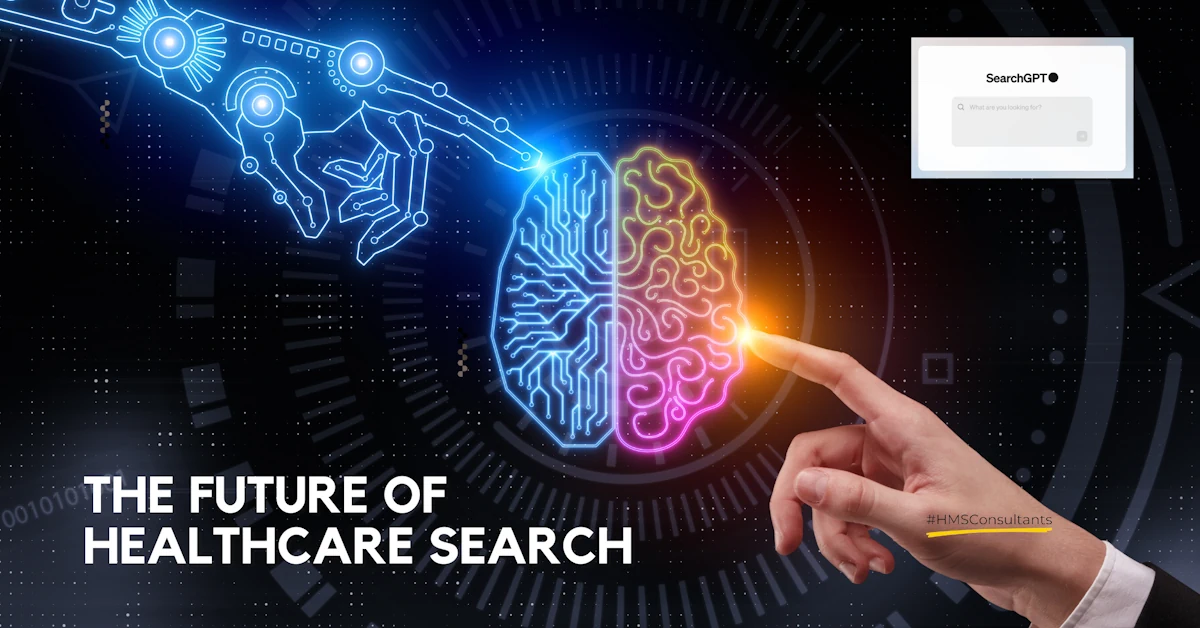
      Patients are no longer relying only on Google searches. Increasingly they are asking questions directly to AI assistants such as ChatGPT, Google Gemini, Microsoft Copilot, and Perplexity.

      Instead of browsing multiple websites, patients now ask:

      • Best hospital near me

      • Best cataract surgeon in Punjab

      • Best diabetes treatment program in India

      AI platforms analyse available information and recommend doctors, hospitals, and treatments.

      The critical question for healthcare organisations is:

      Will AI systems recommend your hospital or your competitors?

      At HMS Consultants, we help healthcare businesses understand and prepare for this shift through AI Discovery Optimisation Strategy.

      What is Healthcare Marketing?
      Watch the Video

      HMS Consultants

      What is AI Discovery Optimisation?

      AI Discovery Optimisation is a strategic approach that ensures your healthcare brand is structured, positioned, and communicated in a way that AI systems can understand, trust, and recommend.

      This includes optimisation for emerging AI discovery platforms such as:

      • ChatGPT

      • Google Gemini

      • Microsoft Copilot

      • Perplexity AI

      • Future AI-driven healthcare search systems

      The discipline is commonly known as:

      • AEO – Answer Engine Optimisation

      • GEO – Generative Engine Optimisation

        It focuses on how AI systems discover, interpret, and recommend healthcare providers.

      HMS Consultants

      Important Note About Our Role

      HMS Consultants is a healthcare marketing strategy consulting firm.

      Our role is to:

      • analyse your current digital presence
      • identify opportunities in AI discovery
      • design a clear strategic roadmap

      The implementation of recommendations can be executed by:

      • your internal marketing team
      • your digital marketing agency
      • your website development team
      • freelancers or external vendors

      This ensures you receive independent strategic guidance rather than agency-driven execution.

      HMS Consultants

      Why AI Discovery Matters for Healthcare

      Patient behaviour has changed significantly.

      Today patients:

      • search symptoms online
      • compare treatment options
      • evaluate hospitals digitally before visiting

      AI assistants are increasingly becoming a trusted source of healthcare information and recommendations.

      Hospitals and clinics that build structured digital authority and credible medical knowledge online will have higher chances of being recommended by AI platforms.

      Organizations that start preparing today will gain a significant long-term advantage in patient discovery and digital trust.

      HMS Consultants

      Our AI Discovery Strategy Framework

      Our consultancy approach helps healthcare organisations understand how AI platforms perceive their brand and what strategic actions are required to improve visibility.

      1. AI Discovery Audit

      We analyse how AI platforms currently identify and reference your hospital or clinic.

      This includes:

      • testing queries across multiple AI platforms
      • identifying whether your brand appears in AI responses
      • benchmarking against competing hospitals
      • mapping digital authority signals

      2. AI Search Behaviour Analysis

      Understanding how patients search for treatments through AI systems is critical.

      We study:

      • common patient queries
      • treatment-specific questions
      • specialty-based search behaviour
      • regional healthcare discovery patterns

      3. Healthcare Entity Structuring

      AI platforms rely heavily on entity-based understanding.

      We help structure how your hospital, doctors, specialties, and treatments are presented digitally so that AI systems clearly understand your expertise and relevance.

      4. AI-Friendly Website Strategy

      Your website plays a central role in how AI systems understand your organization.

      We provide strategic guidance for:

      • website architecture
      • treatment knowledge pages
      • structured medical content
      • FAQ knowledge bases
      • schema and structured data planning

      5. Digital Authority & Trust Signals

      AI systems rely on signals from across the internet.

      We evaluate and provide strategic recommendations for:

      • online reviews and reputation
      • authoritative mentions
      • directory listings
      • knowledge sources referenced by AI platforms

      6. AI Visibility Roadmap

      Based on our analysis, we prepared a clear strategic roadmap outlining:

      • priority improvements
      • content strategy
      • authority-building actions
      • digital presence optimisation

      This roadmap can then be executed by your internal or external marketing partners.

      Who Should Use This Service?

      This strategic consulting service is ideal for:

      • multi-specialty hospitals

      • specialty clinics

      • doctor-led healthcare brands

      • healthcare startups

      • healthcare programs and initiatives

      Organizations looking to build long-term digital authority and AI discoverability will benefit significantly from this strategy.

      HMS Consultants

      Why HMS Consultants

      HMS Consultants is one of India’s first dedicated healthcare marketing consultancy firms focused exclusively on doctors, clinics, and hospitals.

      With more than two decades of healthcare marketing expertise, our consulting approach focuses on strategic clarity before execution.

      We help healthcare organisations:

      • understand emerging digital trends

      • develop structured marketing strategies

      • build sustainable patient acquisition systems

      Our philosophy remains simple:

      Knowing is Knowing and Doing is Doing™

      Understanding the future of healthcare discovery is important.

      But implementing the right strategy is what creates real growth.

      Start Preparing for the Future of Healthcare Discovery

      AI assistants are rapidly becoming a new layer of patient discovery.

      Healthcare organizations that start building AI visibility today will be better positioned for the next era of digital healthcare search.

      HMS Consultants helps healthcare organisations understand this shift and build a strategic roadmap for the future.

      AI Discovery Optimisation is a strategic approach that helps hospitals, clinics, and healthcare brands structure their digital presence so that AI platforms such as ChatGPT, Google Gemini, Microsoft Copilot, and Perplexity can easily understand, trust, and recommend them. It focuses on improving how AI systems discover, interpret, and present healthcare providers when patients search for medical information or treatment options.

      Help Center

      FAQs

      Get expert answers to common questions about healthcare marketing strategies.

      Need More Answers?

      Click the button below and fill up the form, our team will reach out to you related to your project’s queries.

      “Knowing is Knowing, Doing is Doing”

      is something we strongly believe in, which means ‘Knowledge without application is the same as having no knowledge at all

      Akhil Dave

      Principle Consultant

      Ready to build healthcare marketing capability within your institution?

      Connect with HMS Consultants to explore structured healthcare marketing education programs designed for medical colleges, hospitals, and healthcare organizations.

        Learning by HMS Consultants

        Stay Updated and Connected

        Stay ahead with our expert insights and latest updates in healthcare marketing. Visit our blogs for valuable tips, industry trends, etc.

        What more we have to offer?

        Discover other services

        If you’re finding some other services fit for your business, you’ll probably find it right here!

      • The Complete Clinic & Hospital Growth Guide for Doctors

        The Complete Clinic & Hospital Growth Guide for Doctors

        The Complete Clinic & Hospital Growth Guide for Doctors

        Written by
        Published on
        Share This

        Why Your OPD Is Inconsistent And What To Fix Before Spending on Marketing

        Doctors do not search “marketing trends.”

        They search:

        • Why is my OPD not growing?
        • How to increase patient footfall in clinic?
        • Why are patients not choosing my hospital?
        • How to rank clinic on Google Maps?
        • Should I hire a marketing agency?
        • What is the right marketing budget for clinic?
        • What is the right clinic marketing strategy?

          If you have searched any of these questions, you are not alone.

        Across India, clinic owners and hospital promoters are facing the same reality:

        • Clinical outcomes are strong
        • Infrastructure is adequate
        • Experience is sufficient
        • Yet patient flow feels unpredictable

        This is not a competence problem.

        It is a visibility and clarity problem.

        This guide answers the most common growth questions doctors ask and outlines what must be structurally fixed before any marketing effort begins.

        1. Why Are Patients Not Coming to My Clinic?

        This is usually the first question.

        The assumption is:

        “Maybe competition is high.”

        But in most cases, patients are not rejecting you after evaluation.

        They are excluding you before evaluation.

        Modern patient decision-making happens in three silent steps:

        1. Search
        2. Compare
        3. Validate

        If your clinic is not visible during these moments on Google Maps, reviews, website clarity, or digital consistency you never enter the shortlist.

        The issue is rarely medical competence.

        The issue is pre-visit perception.

        2. Why Is My OPD Inconsistent?

        Inconsistent OPD is often blamed on:

        • Seasonality
        • Competition
        • Economic slowdown

        While these factors matter, the deeper causes usually include:

        • Weak Google Business Profile presence
        • Poor or unmanaged reviews
        • No structured patient follow-up system
        • Inconsistent communication tone
        • Unclear positioning (what exactly are you known for?)

        When visibility and patient experience are fragmented, trust weakens and trust drives OPD.

        OPD growth strategy is not about ads.

        It is about reducing uncertainty in the patient’s mind.

        3. How Do Patients Choose a Doctor Today?

        Doctors assume patients compare clinical expertise.

        Patients compare reassurance.

        They ask:

        • Is this place reliable?
        • Do others trust them?
        • Are reviews recent?
        • Does the doctor communicate clearly?
        • Is the hospital professional?

        Search behaviour reveals this clearly.

        Queries like:

        • “best hospital near me”
        • “best clinic for diabetes”
        • “top orthopaedic doctor near me”

        are not about ranking first.

        They are about emotional safety.

        If your clinic marketing strategy ignores psychology, visibility alone will not convert.

        4. How to Increase Patient Footfall in Clinic 

        High-intent search:

        “How to increase patient footfall in clinic”

        The wrong answer:

        Run ads.

        The right sequence:

        Step 1: Clarify Positioning

        What are you known for?

        General care? Diabetes? Women’s health? Preventive care?

        If your positioning is unclear, no marketing can compensate.

        Step 2: Fix Local Discoverability

        • Optimize Google Business Profile
        • Ensure accurate NAP (Name, Address, Phone)
        • Encourage ethical reviews
        • Add updated photos and services

        Local SEO for clinics drives sustainable footfall.

        Step 3: Structure Patient Journey

        • Appointment confirmation
        • Reminder system
        • Post-visit follow-up
        • Feedback loop

        Without CRM or WhatsApp automation, patients forget, delay, or drop off.

        Step 4: Align Communication

        Your website, GMB, social media, and offline messaging must sound coherent.

        Footfall increases when clarity increases.

        5. How to Rank Clinic on Google Maps?

        Another high-intent question.

        Google Maps visibility depends on:

        • Complete Google Business Profile
        • Review volume and recency
        • Category accuracy
        • Consistent local citations
        • Proximity and engagement

        Maps ranking is not a shortcut strategy.

        It reflects consistency and reputation.

        If your Google rating is below 4.0, that alone may reduce patient conversion by 30–40%.

        6. Why Do Reviews Matter So Much?

        Doctors often ask:

        “Are reviews really that important?”

        Yes.

        Reviews are modern word-of-mouth.

        When patients search:

        • “best clinic near me”
        • “hospital for surgery near me”

        they filter based on ratings.

        But review management is not about asking aggressively.

        It begins with:

        • Reduced waiting time
        • Clear communication
        • Transparent billing
        • Polite staff behaviour

        Reputation is operational before it is digital.

        7. What Is Hospital Marketing Strategy?

        Hospital marketing strategy is not advertising.

        It is structured clarity across:

        Marketing becomes necessary only after clarity is established.

        Ads amplify structure.

        They cannot replace it.

        8. Should I Hire a Marketing Agency?

        This question reflects anxiety about control.

        Doctors fear:

        • Loss of voice
        • Over-commercialization
        • Ethical compromise

        The real question is not agency vs no agency.

        It is:

        Do you have internal clarity before execution?

        If not, external execution will create noise.

        Strategy must precede tactics.

        9. What Is the Right Marketing Budget for Clinic?

        Another common search.

        There is no universal number.

        Budget should depend on:

        • Revenue targets
        • Service mix
        • Geography
        • Existing visibility
        • Operational readiness

        If your patient experience is weak, increasing budget increases dissatisfaction.

        Budget follows clarity.

        10. How Important Is Personal Branding for Doctors?

        Personal branding for doctors is not self-promotion.

        It is professional visibility.

        Patients trust:

        • Consistent communication
        • Educational content
        • Clear positioning
        • Familiarity

        Doctors who publish educational insights ethically build long-term authority.

        Silence does not build credibility in the digital era.

        11. Can Doctors Do Digital Marketing Ethically?

        Yes — if done responsibly.

        Ethical healthcare marketing includes:

        • Educational posts
        • Awareness campaigns
        • Transparent service communication
        • Responsible review management

        It excludes:

        • Exaggerated claims
        • Before-after manipulation
        • Guarantees
        • Fear-based messaging

        Marketing done correctly strengthens professional dignity.

        12. What Role Do CRM, HMIS, and WhatsApp Play in Growth?

        Growth is not only acquisition.

        It is retention.

        Technology enables:

        • Appointment reminders
        • Follow-up scheduling
        • Chronic patient tracking
        • Feedback collection
        • Re-engagement campaigns

        WhatsApp funneling improves conversion dramatically when structured ethically.

        Patient journey mapping transforms irregular OPD into predictable growth.

        13. Why Visibility Alone Does Not Guarantee Growth

        Many clinics increase Instagram activity or run Google Ads but see no revenue shift.

        Because:

        • Positioning is unclear
        • Internal workflows are misaligned
        • Staff is untrained
        • Conversion systems are absent

        Marketing without internal alignment creates temporary spikes, not sustainable growth.

        14. The Real Diagnostic Question

        Instead of asking:

        “How to get more patients?”

        Ask:

        “What is preventing patients from confidently choosing us?”

        Growth is a clarity problem before it is a promotion problem.

        15. The Structured Approach to Clinic & Hospital Growth

        A sustainable medical practice growth strategy requires:

        1. Diagnostic audit
        2. Positioning clarity
        3. Patient journey mapping
        4. Visibility architecture (SEO, Maps, Reviews)
        5. Ethical communication framework
        6. Technology integration (CRM, WhatsApp, EMR)
        7. Measured amplification

        When structure precedes visibility, growth becomes predictable.

        Final Thought

        If you have been searching:

        • How to increase OPD
        • How to grow hospital revenue
        • Why patients are not choosing my clinic
        • How to improve Google rating
        • How to market a new clinic in India

        You are not searching for marketing.

        You are searching for clarity.

        Marketing is not the solution to confusion.

        Clarity is.

        When clarity is designed into your positioning, patient journey, and communication system, visibility becomes a natural outcome.

        If This Resonates

        If these questions feel familiar and you would prefer a structured diagnostic conversation instead of random execution advice, you may connect with HMS Consultants.

        We operate as strategy advisors, not execution agencies.

        Contact Us HMS Consultants

        Doctors Digital Marketing I Healthcare Marketing I Hospital Marketing Strategies I Marketing ideas for clinics I Marketing Trends 2025 I Medical Marketing I Social Media Marketing

        is something we strongly believe in, which means ‘Knowledge without application is the same as having no knowledge at all

        Akhil Dave

        Principle Consultant

        Ready to take your Personal Brand to the next level?

        Share your details below and we will connect with you to discuss your growth strategy.

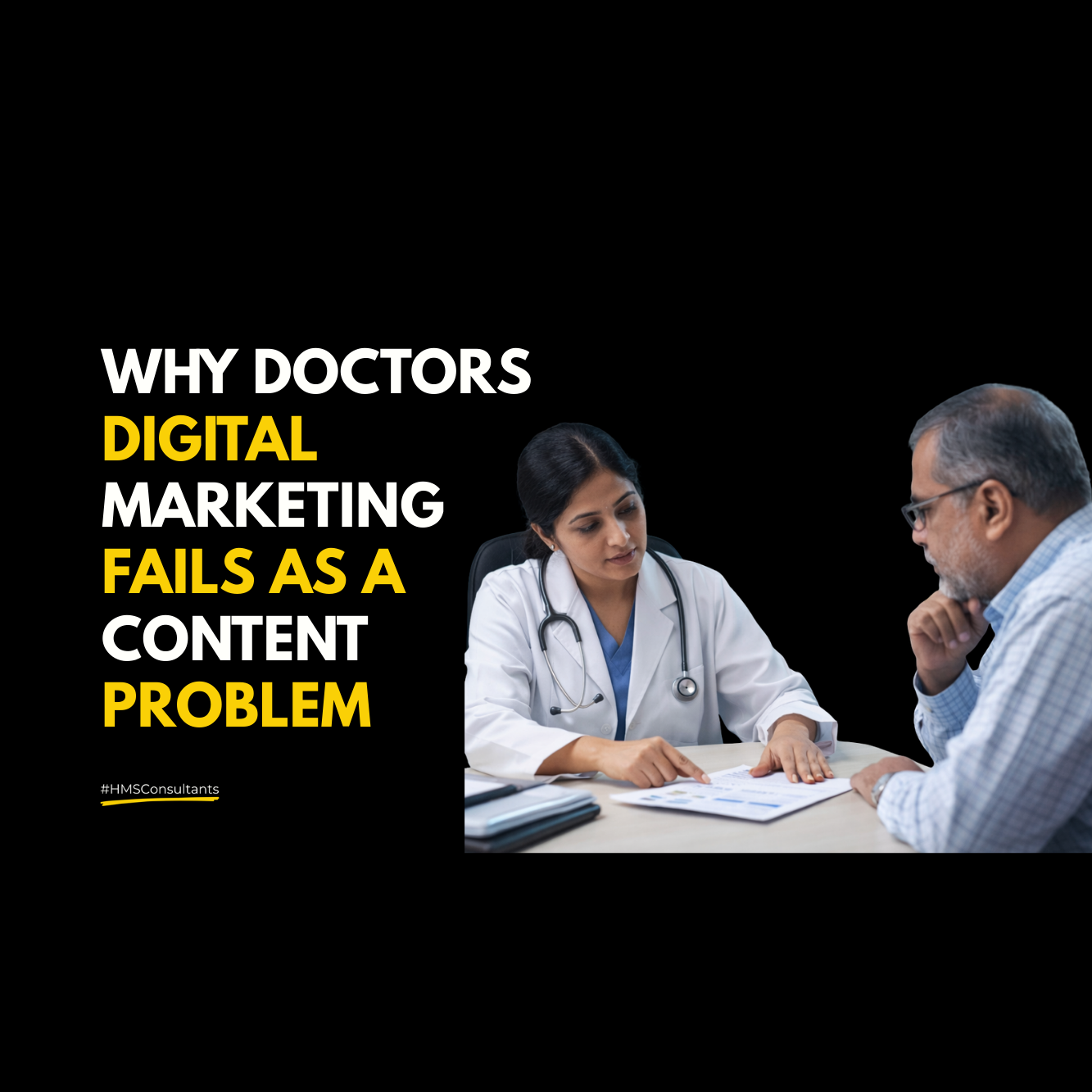
        • Why Doctors Digital Marketing Fails When It Is Treated as a Content Problem

          Why Doctors Digital Marketing Fails When It Is Treated as a Content Problem

          Why Doctors Digital Marketing Fails When It Is Treated as a Content Problem

          Written by
          Published on
          Share This

          Doctors digital marketing is often approached as a consistency challenge. Post more. Be visible regularly. Follow formats that work. Stay active so patients remember you. When results don’t improve, the solution usually suggested is better content planning or higher posting frequency.

          This framing is misleading.

          Doctors digital marketing rarely fails because of content volume. It fails because content is being created without a decision context. Patients consume information, but it does not move them closer to choosing a doctor.

          In healthcare, information alone does not create confidence.

          Why Patients Don’t Decide After Seeing Doctor Content

          Patients engaging with doctors online are usually not looking to be impressed. They are trying to understand seriousness, risk, and next steps. Educational posts may increase awareness, but awareness does not equal readiness.

          Doctors digital marketing struggles when it assumes that learning automatically leads to trust. Patients often understand more after consuming content, yet feel more cautious, not less. This is because information raises questions faster than it resolves them.

          Without guidance, content increases hesitation.

          The Gap Between Education and Decision-Making

          Most doctors focus their digital marketing on explaining conditions, treatments, or procedures. While this is valuable, it addresses only one part of the patient journey. Patients also need help interpreting what that information means for them.

          Doctors digital marketing becomes ineffective when it explains facts but avoids uncertainty. Patients want to know how decisions are made, what usually happens next, and how risks are handled in real life.

          Content that stops at education leaves patients informed but undecided.

          Why More Content Makes Doctors Digital Marketing Worse

          When results plateau, doctors often increase output. More reels, more carousels, more posts. This creates familiarity but not progression. Patients may recognise the doctor but still hesitate to book.

          Excess content without decision framing overwhelms patients. They see multiple messages but struggle to connect them into a clear path forward. Doctors then assume digital marketing doesn’t work, when the real issue is sequencing.

          Doctors digital marketing should simplify thinking, not multiply it.

          How Decision Framing Changes Digital Marketing Outcomes

          Decision framing means helping patients understand when to act, not just what exists. It addresses timing, seriousness, and choice criteria. When doctors integrate decision framing into their digital communication, content begins to guide rather than inform passively.

          Patients start to see themselves in the information. Questions become more specific. Conversations shift from “what is this?” to “is this right for me?”

          This shift marks effective doctors digital marketing.

          Why Doctors Avoid Decision-Oriented Content

          Many doctors hesitate to discuss decisions openly online because they fear being seen as persuasive or promotional. This leads to safe, neutral education that avoids commitment signals.

          Ironically, this restraint keeps patients stuck. Decision-oriented content does not mean pushing treatment. It means explaining how decisions are usually approached, what factors matter, and when waiting is acceptable.

          Doctors digital marketing improves when uncertainty is acknowledged, not avoided.

          The Operational Impact of Better Digital Marketing

          When doctors digital marketing is decision-led, consultations become smoother. Patients arrive with context. Time is spent on clarification rather than repetition. Treatment discussions become more balanced.

          Doctors often underestimate this operational benefit. Digital clarity reduces in-clinic friction even if online metrics look unchanged initially.

          This is where long-term value appears.

          Why Algorithms Reward Decision-Led Content

          Search engines and social platforms increasingly favour content that retains attention and satisfies intent. Decision-led content keeps users engaged because it feels relevant and complete.

          Doctors digital marketing that helps patients move mentally toward clarity performs better over time than content that only explains concepts. Engagement quality matters more than reach.

          Algorithms follow behaviour. Patients reward usefulness.

          Conclusion: Doctors Digital Marketing Works When It Helps Patients Decide, Not Just Learn

          Doctors digital marketing does not fail because doctors are inconsistent or uncreative. It fails because content is treated as an information exercise rather than a decision-support system.

          Patients do not need more facts. They need help navigating uncertainty safely.

          When doctors shift digital communication from education-only to decision-aware guidance, marketing stops feeling exhausting and starts feeling purposeful.

          In healthcare, clarity converts better than frequency.

          Doctors who understand this stop chasing content calendars and start building confidence one informed decision at a time.

          Contact Us HMS Consultants

          Doctors digital marketing refers to how doctors use digital platforms to educate patients, reduce uncertainty, and support healthcare decision-making. It focuses on clarity, guidance, and trust-building rather than frequent posting, promotion, or visibility-driven content strategies.

          Doctors Digital Marketing I Healthcare Marketing I Hospital Marketing Strategies I Marketing ideas for clinics I Marketing Trends 2025 I Medical Marketing I Social Media Marketing

          is something we strongly believe in, which means ‘Knowledge without application is the same as having no knowledge at all

          Akhil Dave

          Principle Consultant

          Ready to take your Personal Brand to the next level?

          Share your details below and we will connect with you to discuss your growth strategy.

          • Why Most Healthcare Marketing Strategy Documents Never Translate Into Real Growth

            Why Most Healthcare Marketing Strategy Documents Never Translate Into Real Growth

            Why Most Healthcare Marketing Strategy Documents Never Translate Into Real Growth

            Written by
            Published on
            Share This

            Healthcare marketing strategy is discussed extensively in hospitals today. Presentations are created, plans are approved, agencies are onboarded, and execution begins with enthusiasm. Yet months later, leadership often feels dissatisfied. Visibility may improve, activity may increase, but growth remains inconsistent and fragile.

            This gap does not exist because healthcare marketing strategy is unclear. It exists because most strategies are designed to look complete on paper, not to survive real patient behaviour.

            In healthcare, strategy fails not at planning but at translation.

            Why Healthcare Marketing Strategy Looks Strong but Performs Weak

            Most healthcare marketing strategies are built around channels, campaigns, and timelines. They outline what will be done, where it will be promoted, and how often content will be published. These elements create a sense of structure and control, which leadership finds reassuring.

            What they rarely address is how patients actually move from uncertainty to decision. Strategy documents often assume linear behaviour see message, trust hospital, book appointment. In reality, healthcare decisions are fragmented, emotional, and delayed.

            When strategy is built on idealised behaviour instead of real behaviour, execution struggles no matter how disciplined the team is.

            The Missing Layer in Most Healthcare Marketing Strategy

            The missing layer is decision design.

            Patients do not need more exposure. They need fewer unanswered questions. They hesitate not because they haven’t seen the hospital, but because they are unsure about outcomes, processes, costs, or communication.

            A healthcare marketing strategy that does not explicitly map patient hesitation points remains incomplete. It may generate traffic, but it does not generate confidence.

            This is why many hospitals feel they are “doing marketing” but still lack predictability.

            Why Strategy Breaks Down at the Point of Experience

            Healthcare marketing strategy often exists independently of patient experience. Messaging promises clarity, care, and guidance, while real interactions feel rushed, fragmented, or inconsistent. Patients notice this mismatch immediately.

            Marketing then gets blamed for overpromising, while operations blame marketing for unrealistic expectations. In reality, the strategy failed to align communication with experience from the beginning.

            A strong healthcare marketing strategy is not just a communication plan. It is an experience-alignment framework.

            How Healthcare Marketing Strategy Should Be Designed Instead

            Effective healthcare marketing strategy starts with understanding how patients think before they choose, not how hospitals want to be seen. It asks questions such as:
            What worries patients most at each stage?
            Where do they pause or delay decisions?
            What information reduces fear instead of increasing it?

            Strategy then becomes a system that gradually builds clarity and reassurance, rather than a set of promotional activities.

            When this shift happens, marketing begins to feel calmer, more focused, and more effective.

            Why More Execution Does Not Fix a Weak Strategy

            Hospitals often respond to underperformance by increasing execution intensity. More ads, more content, more platforms. This creates movement but not momentum.

            If the underlying healthcare marketing strategy does not resolve patient uncertainty, increasing output only amplifies confusion. Patients see more messages but do not feel more confident.

            Growth improves only when strategy is corrected not when execution is accelerated.

            The Role of Trust in Healthcare Marketing Strategy

            Trust is not a by-product of marketing in healthcare. It is the primary objective.

            Every strategic decision should be evaluated through one lens: Does this reduce patient hesitation? If the answer is unclear, the activity adds noise rather than value.

            Hospitals that centre trust in their healthcare marketing strategy experience better conversion, stronger referrals, and lower long-term marketing pressure.

            Why Leadership Determines Strategy Effectiveness

            Healthcare marketing strategy reflects leadership thinking. When leaders demand quick results, strategies become reactive. When leaders allow learning cycles, strategies mature.

            Hospitals that treat marketing as a leadership agenda not a departmental task build strategies that compound instead of resetting every year.

            This leadership patience is often the difference between temporary visibility and sustainable growth.

            What Real Success Looks Like in Healthcare Marketing Strategy

            Successful healthcare marketing strategy rarely feels dramatic. Growth becomes steadier. Patients arrive better informed. Consultations become smoother. Referrals increase naturally. Marketing spend stabilises rather than escalates.

            These outcomes indicate that strategy is working at a behavioural level not just a reporting level.

            Hospitals often notice this only in hindsight, because real strategy success is quiet.

            Conclusion: Healthcare Marketing Strategy Must Be Built for Reality, Not Presentation

            Healthcare marketing strategy fails when it is designed to impress internally instead of guide patients externally. Plans look complete, but behaviour remains unchanged.

            Strategy that works accepts complexity. It respects patient psychology. It aligns communication with experience. It prioritises trust over tactics.

            In healthcare, strategy does not succeed because it is well-written.
            It succeeds because it makes decisions easier for patients.

            Hospitals that understand this stop rewriting strategies and start building systems that grow with confidence, not pressure.

            Contact Us HMS Consultants

            A healthcare marketing strategy is a structured approach to building patient trust, visibility, and growth by aligning communication, experience, and decision-making with how patients actually choose healthcare providers.

            Doctors Digital Marketing I Healthcare Marketing I Hospital Marketing Strategies I Marketing ideas for clinics I Marketing Trends 2025 I Medical Marketing I Social Media Marketing

            is something we strongly believe in, which means ‘Knowledge without application is the same as having no knowledge at all

            Akhil Dave

            Principle Consultant

            Ready to take your Personal Brand to the next level?

            Share your details below and we will connect with you to discuss your growth strategy.

            • Why Healthcare Marketing ROI Is Invisible in Most Hospitals (And How to Fix That)

              Why Healthcare Marketing ROI Is Invisible in Most Hospitals (And How to Fix That)

              Why Healthcare Marketing ROI Is Invisible in Most Hospitals (And How to Fix That)

              Written by
              Published on
              Share This

              Healthcare marketing ROI is one of the most discussed and least understood concepts in hospital leadership conversations. Marketing budgets are approved, campaigns are executed, reports are reviewed, and yet the same question keeps resurfacing: Is this actually working? Despite activity, visibility, and even enquiry flow, many hospitals remain unsure whether marketing is delivering real value or simply consuming resources.

              This uncertainty does not exist because ROI cannot be measured in healthcare. It exists because most hospitals measure the wrong things and expect clarity from incomplete signals.

              Why ROI in Healthcare Marketing Feels Harder Than It Actually Is

              Healthcare decisions are not transactional. Patients do not see an ad and immediately convert. They research, hesitate, consult family, delay decisions, and return when confidence builds. This elongated decision cycle creates a disconnect between marketing activity and outcomes.

              Hospitals often expect marketing ROI to behave like retail ROI quick attribution, linear journeys, and immediate conversion. When this does not happen, marketing is labelled as “hard to measure,” even though the issue lies in expectation, not feasibility.

              Healthcare marketing ROI is delayed, distributed, and cumulative. Measuring it requires patience and structure, not guesswork.

              The Attribution Trap That Distorts Healthcare Marketing ROI

              Most hospitals attempt to measure ROI by linking a patient to a single source. Google Ads, social media, referrals, or walk-ins are treated as isolated contributors. This approach ignores how patients actually behave.

              A patient may read blogs, see social content, check Google reviews, speak to a friend, and only then call the hospital. Assigning ROI to one touchpoint oversimplifies reality and undervalues long-term trust-building activities.

              When hospitals rely on last-touch attribution, they overinvest in short-term channels and underinvest in foundational strategy.

              Why Enquiry Volume Is a Poor ROI Indicator

              Many hospitals evaluate healthcare marketing ROI using enquiry numbers. More enquiries are assumed to mean better ROI. This assumption is misleading.

              Enquiry volume says nothing about readiness, trust, or likelihood to convert. High enquiry numbers with low conversion often indicate weak clarity, not strong marketing. Teams become busier, but growth remains unstable.

              True ROI shows up when enquiry quality improves when patients arrive informed, confident, and aligned with the hospital’s offering.

              How Patient Confidence Reflects Real Marketing ROI

              One of the clearest indicators of healthcare marketing ROI is patient confidence at first contact. Confident patients ask fewer repetitive questions, understand next steps, and engage meaningfully in consultations.

              These outcomes rarely appear in marketing reports, yet they directly affect conversion, doctor time, operational efficiency, and patient satisfaction. Hospitals that track only leads miss these deeper performance signals.

              ROI in healthcare is behavioural before it is financial.

              Why Marketing ROI Breaks When Experience Is Ignored

              Healthcare marketing does not end at enquiry. If patient experience contradicts marketing messaging, ROI collapses downstream. Confusion at reception, rushed explanations, or unclear billing negate marketing effort instantly.

              Hospitals often attempt to fix ROI by adjusting campaigns, when the real leak exists inside experience delivery. Marketing cannot compensate for inconsistency.

              This is why healthcare marketing ROI must be evaluated across communication, experience, and outcome, not just promotion.

              What Sustainable Healthcare Marketing ROI Actually Looks Like

              Sustainable ROI does not spike dramatically. It stabilises gradually. Marketing costs as a percentage of revenue reduce over time. Conversion improves without aggressive follow-up. Referrals increase organically. Dependence on paid channels decreases.

              These signals indicate that trust is compounding. When trust compounds, ROI improves quietly and consistently.

              Hospitals that chase immediate ROI spikes often sacrifice long-term efficiency.

              Why Leadership Perception Shapes ROI Outcomes

              Healthcare marketing ROI is influenced heavily by leadership expectations. When leaders demand immediate returns, strategies become short-term. When leaders allow learning cycles, ROI improves structurally.

              Hospitals that treat marketing as an investment in trust infrastructure rather than a monthly expense gain clarity faster. They stop asking whether marketing works and start understanding how it works.

              Fixing Healthcare Marketing ROI Starts With Asking Better Questions

              Instead of asking how many leads came in, hospitals should ask how prepared patients were. Instead of asking which channel performed best, they should ask where patients hesitated less. Instead of asking what to cut, they should ask what is compounded.

              Healthcare marketing ROI becomes visible when questions shift from activity to behaviour.

              Conclusion: Healthcare Marketing ROI Is Built, Not Calculated

              Healthcare marketing ROI cannot be extracted from dashboards alone. It emerges from alignment between strategy, communication, and experience.

              Hospitals that try to calculate ROI without fixing structure remain confused. Hospitals that build clarity into every patient interaction eventually see ROI stabilise and strengthen.

              In healthcare, ROI is not the reward for spending money.
              It is the reward for reducing uncertainty consistently.

              Contact Us HMS Consultants

              Healthcare marketing ROI refers to the value hospitals gain from marketing efforts in terms of patient trust, conversion quality, operational efficiency, and long-term growth. Unlike consumer marketing, ROI in healthcare is cumulative and behaviour-driven, not immediate or purely transactional.

              Doctors Digital Marketing I Healthcare Marketing I Hospital Marketing Strategies I Marketing ideas for clinics I Marketing Trends 2025 I Medical Marketing I Social Media Marketing

              is something we strongly believe in, which means ‘Knowledge without application is the same as having no knowledge at all

              Akhil Dave

              Principle Consultant

              Ready to take your Personal Brand to the next level?

              Share your details below and we will connect with you to discuss your growth strategy.

              • Healthcare Marketing Toolkit

                Healthcare Marketing Toolkit

                Ethical Guide 002

                Ethical Social Media Marketing for Doctors: Practical Guidebooks (India)

                Ethical social media marketing well help you apply the learnings immediately, we have compiled a set of practical, implementation-ready PDFs based on published regulations and best-practice guidance.

                You will receive all PDFs instantly on email after submitting the form.

                Here's what you get with the guide-book.

                What you will receive?

                11 practical documents you can read, save, and implement across Instagram, Facebook, YouTube, LinkedIn, and Google profiles.

                Glimpse #1

                Ethical Social Media Checklist (Before You Post)

                A one-page printable checklist to review intent, claims, privacy, professionalism, and disclosures before publishing any post.

                Glimpse #2

                The Laxman Rekha Decision Test (Intent + Context + Consequence)

                A fast self-audit framework with trigger questions to identify whether a post is education-led or slipping into inducement.

                Glimpse #3

                Platform-wise Do/Don’t Pack

                Clear do’s and don’ts for Instagram/FB/Reels, YouTube, LinkedIn, Google Business Profile/Maps (plus optional WhatsApp etiquette).

                Glimpse #4

                Content Pillars for Ophthalmology (Education-First)

                A structured content blueprint with ophthalmology-focused pillars and guidance on what to say and what to avoid.

                Glimpse #5

                Safe Formats Library (Templates)

                Ready templates for FAQ posts, Myth vs Fact, “3 Symptoms/3 Don’ts/3 When to consult”, process explainers, and professional identity posts.

                Glimpse #6

                Consent + Privacy Toolkit

                Practical rules on consent (necessary but not sufficient), de-identification, and minimum safe practices for patient-related content.

                Glimpse #7

                Comment, DM, and Online Advice Protocol

                What to reply publicly, when to move to consultation, and copy-paste responses that keep conversations safe and professional.

                Glimpse #8

                Advertising and Promotion Boundaries

                What is allowed as factual information vs what becomes inducement, including simple disclosure language for partnerships.

                Glimpse #9

                Red Flags Page

                A single-page list of high-risk patterns (guarantees, “best” claims, before/after bait, OT-as-a-stage, peer criticism) with corrective direction.

                Glimpse #10

                Personal Brand Foundation: A Working Sheet for Doctors

                A clarity-driven worksheet to define identity, behaviour, proof, and presence—so personal branding stays ethical and inside-out.

                Three Simple Steps

                How to access the PDFs?

                Step #1

                Click Download the Guidebooks

                Step #2

                Fill in your basic details

                Step #3

                Receive the complete set instantly on email (with direct download links)

                Learning by HMS Consultants

                Stay Updated and Connected

                Stay ahead with our expert insights and latest updates in healthcare marketing. Visit our blogs for valuable tips, industry trends, etc.

              • Why Healthcare Branding Is Not About Logos, Colours, or Taglines

                Why Healthcare Branding Is Not About Logos, Colours, or Taglines

                Why Healthcare Branding Is Not About Logos, Colours, or Taglines

                Written by
                Published on
                Share This

                Healthcare branding is often misunderstood at its core. When hospitals talk about branding, conversations usually revolve around visual identity logos, colour palettes, typography, taglines, and design consistency. While these elements are visible and necessary, they represent only the surface of branding, not its substance.

                This misunderstanding explains why many hospitals invest in rebranding exercises yet see little change in patient trust, loyalty, or long-term growth. The problem is not poor design. The problem is that healthcare branding is treated as an aesthetic exercise instead of a behavioural one.

                In healthcare, branding is not what a hospital looks like. It is what patients experience, remember, and believe.

                Why Healthcare Branding Is Formed in Moments, Not Materials

                Patients do not build opinions about hospitals while looking at logos. They build opinions while waiting, asking questions, receiving explanations, facing uncertainty, and making decisions under stress. These moments shape perception far more powerfully than any visual asset.

                Healthcare branding is formed when a patient feels heard instead of rushed, when clarity replaces confusion, and when reassurance is offered at the right time. These experiences become stories patients share consciously or subconsciously with family, friends, and online communities.

                Hospitals that focus only on visual branding often miss this deeper layer. They look polished but feel inconsistent. Patients notice this gap immediately, even if they cannot articulate it.


                The Difference Between Corporate Branding and Healthcare Branding

                Corporate branding relies heavily on differentiation, recall, and emotional association. Healthcare branding operates under a different psychological contract. Patients are not looking for novelty or personality they are looking for safety, predictability, and trust.

                This is why branding strategies borrowed from consumer industries often fail in healthcare. They prioritise attention over reassurance and uniqueness over reliability. In healthcare, excessive differentiation can actually increase anxiety.

                Effective healthcare branding reduces uncertainty. It makes outcomes feel predictable, processes feel understandable, and decisions feel supported. This is why the strongest hospital brands often feel calm rather than exciting.

                Why Healthcare Branding Breaks When It Is Owned by One Department

                Many hospitals assign branding responsibility to marketing or design teams. This creates a structural problem. Branding in healthcare is expressed through clinical communication, front-desk behaviour, billing conversations, follow-ups, and discharge processes areas marketing teams do not fully control.

                When branding is isolated within one department, inconsistency is inevitable. Visual messaging may promise care and clarity, while operational reality delivers confusion or urgency. Patients experience this as misalignment, not marketing failure.

                Healthcare branding succeeds only when it is owned institution-wide and reinforced at every patient touchpoint.

                How Patient Experience Becomes the Real Brand

                Patients remember how they were treated far more clearly than what was promised. Over time, these memories form the hospital’s brand reputation.

                A hospital may position itself as patient-centric, but if appointment systems feel chaotic or explanations feel rushed, the brand collapses at the point of experience. Conversely, hospitals with modest visibility but consistent experience often develop stronger reputations organically.

                This is why healthcare branding cannot be separated from patient experience. Experience is not a support function; it is the brand delivery mechanism.

                Why Healthcare Branding Directly Impacts Growth

                Strong healthcare branding reduces friction across the entire patient journey. Patients hesitate less, ask fewer repetitive questions, and feel more confident in decisions. Referrals increase because recommending the hospital feels safe. Staff perform better because expectations are clearer.

                From a hospital growth perspective, branding that is rooted in experience lowers acquisition costs, improves conversion, and stabilises demand. Growth becomes less dependent on constant promotion and more dependent on reputation.

                This is the compounding power of effective healthcare branding.

                The Long-Term Cost of Superficial Branding

                Hospitals that focus only on visual rebranding often find themselves repeating the exercise every few years. Each cycle promises renewed growth but delivers diminishing returns. Patients notice the polish but still experience inconsistency.

                Over time, trust weakens. Marketing must work harder to compensate. Branding becomes an expense instead of an asset.

                Superficial branding does not fail immediately. It fails gradually by not compounding.

                What Strong Healthcare Branding Actually Looks Like

                Strong healthcare branding feels consistent across time, people, and situations. Patients encounter the same clarity online as they do in person. Communication feels aligned across departments. Expectations are set honestly and met reliably.

                This consistency reassures patients at every stage. It also empowers teams, because behaviour aligns naturally with brand values instead of being forced through guidelines.

                In such hospitals, branding stops being discussed frequently because it simply works.

                Why Healthcare Branding Is a Leadership Responsibility

                Healthcare branding cannot be delegated entirely to marketing agencies or design teams. It requires leadership commitment to consistency, clarity, and patient-centred thinking.

                Leaders shape how decisions are made, how staff are supported, and how trade-offs are handled. These decisions directly influence patient experience, and therefore brand perception.

                Hospitals with strong brands are rarely accidental. They are intentionally designed from the top down and reinforced from the inside out.

                Conclusion: Healthcare Branding Is What Patients Trust When No One Is Explaining

                In healthcare, branding is not what hospitals say about themselves. It is what patients believe after experiencing care.

                Logos, colours, and taglines may attract attention, but they do not sustain trust. Trust is sustained through consistency, clarity, and behaviour.

                Hospitals that understand healthcare branding stop chasing perception and start designing experience. Over time, this approach creates institutions that patients recognise, trust, and return to not because of how they look, but because of how they feel.

                That is the only kind of healthcare branding that truly lasts.


                Contact Us HMS Consultants

                Healthcare branding is the process of shaping how patients perceive, trust, and experience a hospital or healthcare provider. It goes beyond logos and visuals and is formed through patient interactions, communication clarity, staff behaviour, and overall care experience across the patient journey.

                Doctors Digital Marketing I Healthcare Marketing I Hospital Marketing Strategies I Marketing ideas for clinics I Marketing Trends 2025 I Medical Marketing I Social Media Marketing

                is something we strongly believe in, which means ‘Knowledge without application is the same as having no knowledge at all

                Akhil Dave

                Principle Consultant

                Ready to take your Personal Brand to the next level?

                Share your details below and we will connect with you to discuss your growth strategy.

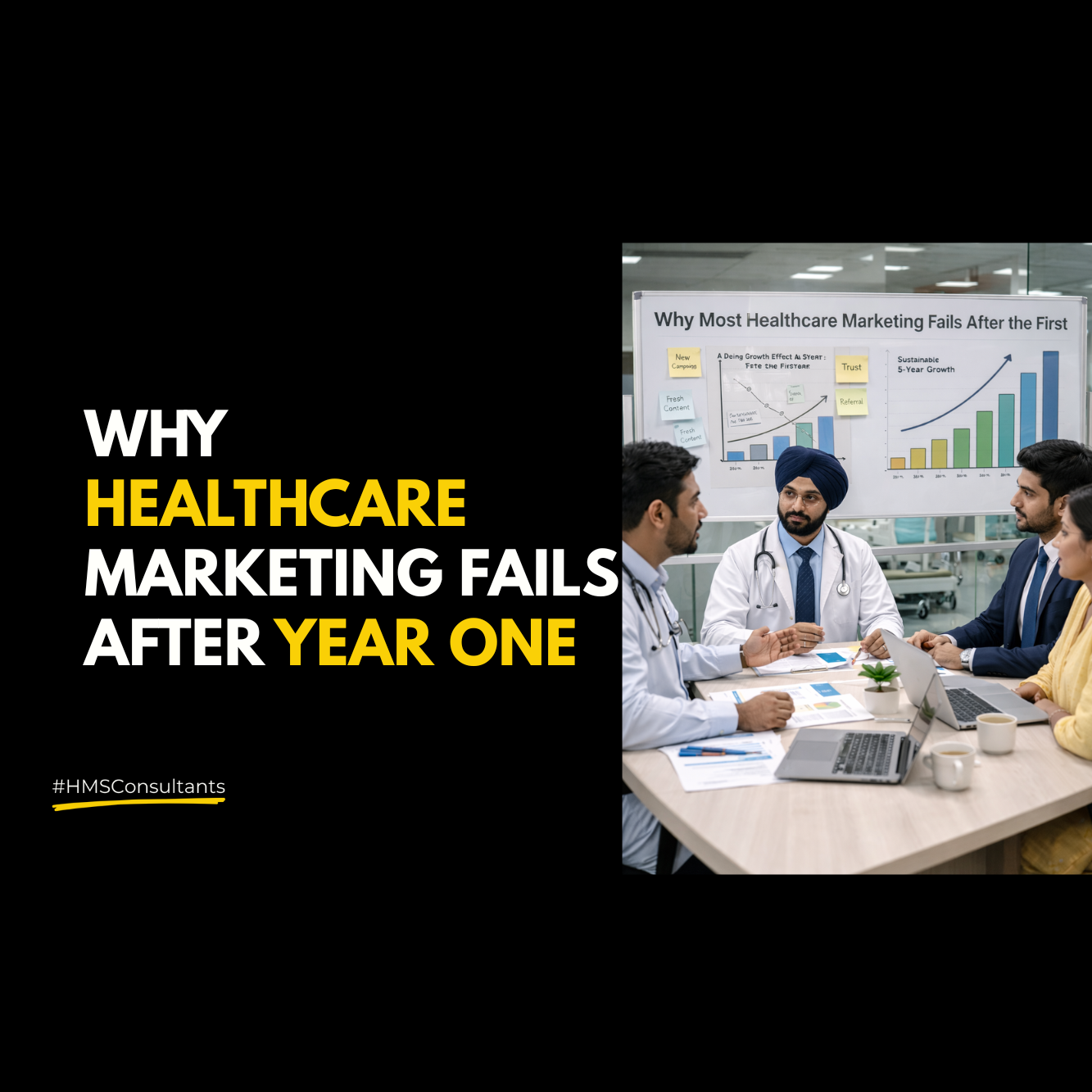
                • Why Most Healthcare Marketing Fails After the First Year, And How to Build a 5-Year Growth Engine

                  Why Most Healthcare Marketing Fails After the First Year, And How to Build a 5-Year Growth Engine

                  Why Most Healthcare Marketing Fails After the First Year, And How to Build a 5-Year Growth Engine

                  Written by
                  Published on
                  Share This

                  The first year of healthcare marketing often feels encouraging. Visibility improves, activity increases, enquiries start coming in, and there is a sense that growth has finally begun. Hospitals feel validated in their investment in marketing, and leadership gains confidence that the right direction has been chosen.

                  Then something changes.

                  Results begin to plateau. Costs rise. Engagement feels repetitive. The same campaigns that once delivered outcomes now require higher spending to maintain momentum. Marketing feels more like maintenance than progress. At this stage, many hospitals conclude that marketing has “stopped working.”

                  In reality, healthcare marketing rarely fails suddenly. It erodes slowly because it was never designed for longevity.

                  Why First-Year Marketing Often Looks Successful

                  Early success in hospital marketing is usually driven by novelty. New campaigns capture attention. Fresh content stands out. Platforms reward initial activity. Internal teams feel energised by visible movement. For hospitals that previously had little structure, even basic consistency produces noticeable improvement.

                  This phase creates a dangerous illusion. Leadership assumes that repeating the same efforts will continue delivering growth. Marketing is seen as a repeatable activity rather than an evolving system.

                  The problem is that novelty fades quickly in healthcare. Trust, unlike attention, does not compound automatically.

                  The Core Reason Healthcare Marketing Loses Momentum

                  Healthcare marketing fails after the first year because most hospitals build campaigns, not engines.

                  Campaigns are time-bound. They depend on constant input, fresh creatives, new platforms, and increasing budgets. Engines, on the other hand, are systems that improve with use. They learn, adapt, and compound insight over time.

                  When marketing is campaign-led, growth depends on continuous stimulation. When stimulation stops or becomes repetitive, performance declines. Hospitals then chase new ideas without fixing the underlying structure.

                  This is why marketing fatigue sets in for both teams and audiences.

                  Why Short-Term Thinking Dominates Hospital Marketing Decisions

                  Healthcare leaders operate in high-pressure environments. Monthly numbers matter. OPD fluctuations create anxiety. Budget reviews demand justification. Under these conditions, short-term performance naturally dominates decision-making.

                  Marketing strategies are adjusted frequently as directions change. Platforms are switched. Messaging resets. While these changes feel proactive, they often disrupt learning cycles. Marketing never gets enough time to mature, and insights are lost before they compound.

                  Long-term growth requires patience that healthcare systems rarely allow themselves.

                  The Cost of Replacing Strategy With Activity

                  When marketing underperforms, hospitals often increase activity rather than improve strategy. More posts, more ads, more platforms, more content. This creates motion without direction.

                  Over time, activity becomes disconnected from outcomes. Teams focus on execution rather than learning. Reports show effort, not progress. Leadership feels busy but not confident.

                  This is the point where marketing becomes exhausting rather than enabling.

                  Why Sustainable Hospital Growth Requires a Different Mindset

                  Sustainable healthcare marketing is not about constant visibility. It is about building systems that repeatedly reduce patients’ uncertainty.

                  Patients return, refer, and trust when they experience consistency. Consistency does not come from campaigns. It comes from aligned messaging, predictable experience, and clear decision pathways.

                  Hospitals that grow steadily treat marketing as a long-term investment in trust infrastructure, not a series of promotional bursts.

                  What a 5-Year Healthcare Marketing Engine Actually Looks Like

                  A long-term marketing engine is built around learning loops rather than output targets. Each year strengthens the next. Patient questions inform content. Interaction patterns refine messaging. Experience gaps shape communication. Reviews influence education. Referrals reinforce positioning.

                  Instead of resetting strategy annually, hospitals deepen it. Marketing becomes calmer, clearer, and more efficient over time. Spend stabilises. Conversion improves. Dependence on aggressive promotion has reduced.

                  This is how marketing shifts from a cost centre to a growth asset.

                  Why Hospitals That Think Long-Term Spend Less Over Time

                  Counterintuitively, long-term marketing thinking reduces expenditure. Hospitals that build engines rely less on constant acquisition because retention and referrals improve naturally. Content remains relevant longer. SEO authority compounds. Brand trust strengthens.

                  Short-term marketing requires escalation. Long-term marketing rewards consistency.

                  From a hospital growth perspective, this difference determines whether marketing remains manageable or becomes a perpetual struggle.

                  The Role of Leadership in Long-Term Marketing Success

                  No marketing engine survives without leadership alignment. Leaders must protect the strategy from constant disruption. They must allow learning cycles to complete. They must evaluate trends rather than isolated months.

                  Hospitals that treat marketing as a leadership agenda rather than a departmental task are far more likely to sustain growth beyond the first year. Strategy continuity becomes a competitive advantage.

                  Why Most Hospitals Restart Instead of Evolving

                  When marketing feels stale, many hospitals restart rather than refine. New agencies, new platforms, new directions. Each restart discards accumulated insight. The system never matures.

                  Hospitals that evolve rather than restart carry learning forward. They optimise, not replace. Growth becomes incremental but durable.

                  This distinction separates organisations that survive from those that scale.

                  Conclusion: Marketing That Lasts Is Designed to Outgrow Tactics

                  Healthcare marketing fails after the first year, not because it stops working, but because it was never built to last.

                  Campaign-driven growth peaks quickly and declines just as fast. Engine-driven growth compounds quietly and steadily. Hospitals that understand this difference stop chasing novelty and start building systems.

                  In healthcare, where trust is earned slowly and lost quickly, long-term marketing is not optional. It is the only form of marketing that truly works.

                  Hospitals that invest in five-year thinking do not just grow.
                  They stabilise, mature, and earn the right to scale.

                  Contact Us HMS Consultants

                  Healthcare marketing often plateaus after the first year because most hospitals rely on short-term campaigns instead of long-term systems. Campaigns lose effectiveness as novelty fades, while sustainable growth requires compounding trust and learning over time.

                  Doctors Digital Marketing I Healthcare Marketing I Hospital Marketing Strategies I Marketing ideas for clinics I Marketing Trends 2025 I Medical Marketing I Social Media Marketing

                  is something we strongly believe in, which means ‘Knowledge without application is the same as having no knowledge at all

                  Akhil Dave

                  Principle Consultant

                  Ready to take your Personal Brand to the next level?

                  Share your details below and we will connect with you to discuss your growth strategy.

                  • Why Hospital Social Media Metrics Lie, And What Metrics Actually Tell You Growth Is Real

                    Why Hospital Social Media Metrics Lie, And What Metrics Actually Tell You Growth Is Real

                    Why Hospital Social Media Metrics Lie, And What Metrics Actually Tell You Growth Is Real

                    Written by
                    Published on
                    Share This

                    Hospitals today are surrounded by numbers. Likes, views, reach, impressions, engagement rates, follower counts, dashboards are full, reports look impressive, and activity appears consistent. Social media metrics have become the most visible proof of “marketing happening.” Yet despite this apparent success, many hospitals still struggle with unpredictable OPD, weak conversions, and inconsistent growth.

                    This disconnect is not accidental. Most hospital social media metrics lie, not because they are false, but because they are incomplete and often misinterpreted. When hospitals rely on surface-level metrics to judge marketing performance, they optimise for visibility rather than viability, attention rather than trust, and activity rather than growth.

                    The Comfort of Vanity Metrics in Healthcare Marketing

                    Social media metrics are comforting because they are immediate and easily measurable. A post performs well, engagement rises, reach expands, and the team feels reassured. For leadership, these numbers offer a sense of control and progress in an otherwise complex healthcare marketing environment.

                    The problem is that visibility metrics measure reaction, not decision-making. In healthcare, reactions are cheap. Decisions are expensive. A patient may like a post without trusting the hospital. They may watch a reel without intending to seek care. They may follow a page out of curiosity, not conviction.

                    When hospitals confuse attention with intent, they overestimate marketing performance and lose strategic clarity.

                    Why Engagement Does Not Equal Trust in Healthcare

                    In consumer brands, engagement often correlates with purchase behaviour. In healthcare, this relationship breaks down. Patients engage with content for many reasons, such as fear, curiosity, anxiety, or general awareness, none of which guarantee readiness to act.

                    A highly engaged post about symptoms may attract people who are worried but not prepared to visit a hospital. A viral reel may bring followers from outside the hospital’s service area. Educational content may be saved and shared without ever translating into OPD.

                    From a healthcare marketing strategy perspective, engagement measures interest, not confidence. Growth depends on confidence.

                    The Algorithm Problem Hospitals Rarely Account For

                    Social media platforms are designed to reward content that keeps users scrolling, not content that drives healthcare decisions. Algorithms prioritise emotion, novelty, relatability, and frequency. Content that performs well algorithmically is not always content that builds medical credibility.

                    Hospitals that chase algorithm-friendly metrics often dilute their messaging. Simplified soundbites replace educational depth. Clinical nuance is sacrificed for engagement. Over time, this creates a brand that is visible but shallow.

                    This is why many hospitals experience high social media activity with slight improvement in patient quality or conversion. The platform’s goals are misaligned with the hospital’s goals.

                    Why Hospitals Keep Optimising the Wrong Metrics

                    Hospitals optimise what they are shown. Most social media reports emphasise reach, engagement, and follower growth because those are the easiest to display. Metrics that reflect real healthcare marketing performance,  such as enquiry quality, patient readiness, consultation efficiency, and repeat visits, sit outside social dashboards.

                    As a result, teams spend months improving metrics that look good internally but do not influence external growth outcomes. Leadership reviews numbers that look positive while underlying performance remains unchanged.

                    This creates a false sense of progress and delays necessary strategic correction.

                    What Metrics Actually Indicate Real Hospital Growth

                    Real growth indicators in healthcare marketing are quieter and slower to show, but far more reliable. They reflect changes in patient behaviour, not platform behaviour.

                    When marketing is effective, hospitals notice that enquiries become more specific and informed. Patients arrive with clearer expectations. Consultation time is used more productively. Treatment acceptance improves. Follow-ups become easier. Referrals increase without prompting.

                    These outcomes are rarely captured in social media reports, yet they are the actual signals of marketing maturity.

                    Why Social Media Should Support, Not Define, Hospital Marketing Strategy

                    Social media is a powerful awareness and education channel, but it is a poor primary success metric. Hospitals that treat social platforms as the centre of their marketing strategy often end up optimising for noise rather than outcomes.

                    In a mature healthcare marketing system, social media supports larger objectives. It reinforces trust built elsewhere. It prepares patients for conversations. It aligns expectations with reality. It complements websites, enquiry handling, patient experience, and referral systems.

                    When social media is isolated from this system, it becomes performative rather than productive.

                    The Long-Term Cost of Chasing the Wrong Numbers

                    Optimising for vanity metrics has long-term consequences. Content strategies drift away from patient needs. Teams become reactive to algorithm changes. Leadership loses visibility into what is actually driving growth. Marketing decisions become increasingly disconnected from operational reality.

                    Eventually, hospitals are forced to spend more for the same outcomes because trust was never built in the first place.

                    From a hospital growth perspective, this is one of the most expensive mistakes organisations make, not because social media is ineffective, but because it is misunderstood.

                    How High-Performing Hospitals Use Social Metrics Correctly

                    Hospitals that use social media effectively treat metrics as directional signals, not success indicators. They observe trends without being governed by them. They correlate social activity with downstream outcomes rather than evaluating it in isolation.

                    Most importantly, they understand that social media is a means of pre-conditioning trust, not closing decisions. When used with this clarity, social platforms contribute meaningfully to growth without distorting strategy.

                    Conclusion: Growth Is Quiet, Metrics Are Loud

                    The loudest numbers in hospital marketing are often the least important. Likes, views, and reach create the illusion of success without guaranteeing impact. Real growth shows up in calmer ways in patient confidence, operational ease, referral consistency, and long-term trust.

                    Hospitals that want sustainable growth must learn to look beyond social media dashboards and ask harder questions about behaviour, readiness, and experience.

                    In healthcare marketing, what feels measurable is not always what matters.
                    And what truly matters often takes longer to show, but lasts far longer when it does.

                    Contact Us HMS Consultants

                    Doctors Digital Marketing I Healthcare Marketing I Hospital Marketing Strategies I Marketing ideas for clinics I Marketing Trends 2025 I Medical Marketing I Social Media Marketing

                    is something we strongly believe in, which means ‘Knowledge without application is the same as having no knowledge at all

                    Akhil Dave

                    Principle Consultant

                    Ready to take your Personal Brand to the next level?

                    Share your details below and we will connect with you to discuss your growth strategy.