Tag: Healthcare Marketing

  • Personal Branding for Doctors: Build Your Brand, Build Your Practice

    Personal Branding for Doctors: Build Your Brand, Build Your Practice

    Personal Branding for Doctors: Build Your Brand, Build Your Practice

    Written by
    Published on
    Share This

    Personal branding for doctors is becoming one of the biggest growth drivers in healthcare today. Not because doctors need to become influencers. Not because healthcare is becoming entertainment. But because patient behaviour has changed completely in 2026.

    Today, when patients need a specialist, they usually do not make decisions immediately after receiving a referral. Before booking an appointment, they search online. They Google the doctor’s name, read reviews, compare profiles, check clinic information, and try to understand whether the doctor feels trustworthy before making the first call.

    This is where many experienced doctors are struggling silently.

    Two doctors may have the same qualifications, similar years of experience, excellent patient outcomes, and practice in the same city. But one doctor consistently receives patient enquiries while the other struggles with low visibility and inconsistent patient flow.

    The difference is often not clinical.
    The difference is discoverability.
    And this is exactly why personal branding for doctors is becoming essential in modern healthcare marketing.

    The Invisible Doctor Problem.

    This happens when highly experienced doctors remain digitally invisible despite years of successful medical practice and strong offline reputation.

    Many doctors today already have:

    • Years of patient trust.
    • Strong treatment outcomes.
    • Long-standing referrals.
    • Excellent clinical expertise.

    But when patients search their name online, they often find incomplete information or weak digital presence.

    In many cases, patients find:

    • Incomplete profiles.
    • Outdated clinic details.
    • Weak Google visibility.
    • Missing reviews.
    • No educational content at all.

    At the same time, another doctor with stronger digital visibility appears consistently across platforms. Patients see:

    • Google search results.
    • LinkedIn profiles.
    • Instagram education.
    • Reviews.
    • Healthcare videos.
    • Patient engagement.

    Patients trust what they can find online.

    This does not always mean the digitally visible doctor is clinically superior. It simply means the digitally visible doctor becomes easier for patients to trust.

    And that is changing healthcare decision-making completely.

    Why Patients Search Doctors Online Before Booking

    Healthcare decisions today are deeply digital. Patients no longer depend only on offline referrals or family recommendations before choosing a doctor.

    Before booking consultations, patients usually:

    • Google the doctor’s name.
    • Read reviews.
    • Compare ratings.
    • Check educational content.
    • Evaluate clinic presence.
    • Search patient experiences online.

    This behaviour is growing rapidly across specialties such as cardiology, orthopaedics, dermatology, ophthalmology, dental, cosmetic medicine, neurology, fertility, and general practice.

    Patients today are not only evaluating qualifications.

    They are evaluating trust digitally.

    This is one of the biggest reasons why personal branding for doctors matters more than ever before.

    Personal Branding for Doctors Is Not About Fame

    One of the biggest misconceptions in healthcare marketing is that personal branding means becoming famous online.

    Many doctors assume personal branding requires:

    • Viral reels.
    • Daily content.
    • Entertainment-based videos.
    • Influencer-style visibility.

    But real personal branding for doctors works very differently.

    It focuses on:

    • Trust.
    • Authority.
    • Discoverability.
    • Visibility.
    • Patient confidence.

    The goal is not internet fame.

    The goal is to ensure that when patients search for healthcare answers online, they find the right doctor with confidence.

    This is why strong doctor branding today depends more on educational communication and trust-building than aggressive promotion.

    Personal branding in healthcare is not vanity.

    It is authority with visibility.

    Owning your name on Google.

    When patients search:
    “Dr. [Doctor Name] + City”

    They should ideally find:

    • Google Business Profile.
    • Clinic information.
    • Hospital profile pages.
    • Practo or JustDial listings.
    • Patient reviews.
    • Educational content.
    • Professional visibility.

    But many doctors still have poor digital discoverability because their online presence is incomplete or inconsistent.

    Some doctors still have:

    • Incorrect clinic information.
    • Weak search visibility.
    • Outdated contact details.
    • Incomplete listings.
    • No meaningful content online.

    This creates a trust gap immediately.

    Patients often interpret weak digital visibility as weak credibility.

    Strong personal branding for doctors begins with:

    • Discoverability.
    • Accurate information.
    • Professional visibility.
    • Digital trust-building.

    This is not advanced marketing.

    This is basic digital hygiene in modern healthcare.

    Choose One Platform and Stay Consistent

    Another major mistake doctors make is trying to stay active everywhere at the same time.

    Many doctors believe they need:

    • Instagram.
    • LinkedIn.
    • YouTube.
    • Facebook.
    • Multiple platforms together.

    But the Digital Doctor Framework focuses more on consistency than frequency.

    For many doctors, one platform is enough initially.

    LinkedIn usually works better when:

    • Patients are professionals.
    • Referral networks matter.
    • Corporate visibility is important.

    Instagram often works better when:

    • The specialty is visually driven.
    • Patients search visually.
    • Healthcare education performs better through visual communication.

    This is especially relevant for:

    • Dermatologists.
    • Dentists.
    • Ophthalmologists.
    • Cosmetic specialists.
    • Orthopaedic surgeons.

    The goal is not posting every day.

    The goal is long-term consistency.

    Even one educational post every week can gradually build visibility, authority, and patient trust.

    Answer the Question Your Patients Are Already Asking.

    Every doctor repeatedly hears patient questions such as:

    • Is LASIK safe?
    • Is angioplasty painful?
    • How long does recovery after knee replacement take?
    • When should surgery become necessary?
    • Is this procedure risky?
    • What happens after treatment?

    Patients are already searching these questions online every day.

    When doctors answer these questions through:

    • Blogs.
    • Videos.
    • FAQs.
    • Educational posts.
    • Healthcare explainers.

    Content Authority.

    This changes patient behaviour completely.

    The patient may begin trusting the doctor before the first consultation itself.

    That is the power of educational healthcare communication.

    This is also why personal branding for doctors is becoming one of the strongest patient acquisition systems in healthcare today.

    Not because content becomes viral.

    But because it creates:

    • Reassurance.
    • Trust.
    • Familiarity.
    • Authority.
    • Confidence.

    Reviews Have Become the New Word-of-Mouth

    Another major part of personal branding for doctors is review management.

    Most patients today read reviews before booking appointments. In many cases, reviews work as modern digital referrals.

    Patients often trust:

    • Ratings.
    • Patient testimonials.
    • Healthcare experiences.

    More than advertisements.

    Doctors who actively:

    • Collect reviews ethically.
    • Maintain professional responses.
    • Engage respectfully.

    Usually build stronger trust online.

    Patients are not only asking:

    “Is this doctor qualified?”

    They are also asking:

    “Can I trust this doctor with my healthcare problem?”

    This is why reviews influence healthcare decisions so strongly today.

    Let Patients Become the Brand.

    The strongest doctor brands today are often built through patient advocacy.

    Patient testimonials, recovery journeys, and healthcare experiences create emotional reassurance for future patients. Because the biggest question most patients silently ask is:

    “Did this treatment work for someone like me?”

    When recovered patients share their experiences authentically, trust transfers instantly.

    This is why patient advocacy is becoming one of the strongest pillars of healthcare marketing today.

    Strong doctor brands are built through:

    • Educational authority.
    • Discoverability.
    • Patient trust.
    • Reviews.
    • Real healthcare experiences.

    Why Younger Doctors Sometimes Grow Faster Online

    One uncomfortable reality in healthcare today is this:

    Many younger doctors become digitally discoverable faster than highly experienced doctors.

    This does not mean they are clinically superior.

    It means they are easier to find online.

    Patients today often trust:

    • Visible doctors.
    • Educational content.
    • Strong reviews.
    • Active online presence.

    A doctor with years of excellent experience and strong clinical expertise may still struggle digitally if visibility remains weak.

    At the same time, another doctor with:

    • Educational content.
    • Stronger search visibility.
    • Patient reviews.
    • Better discoverability.

    May become the first choice online.

    This is not about popularity.

    It is about accessibility and trust.

    Personal Branding for Doctors Is Becoming Essential

    The Digital Doctor Framework discussed here connects directly with the TVA Framework:

    • Trust
    • Visibility
    • Advocacy

    Personal branding for doctors becomes the strongest form of Advocacy in healthcare.

    Because when doctors become:

    • Trusted.
    • Visible.
    • Discoverable.
    • Authoritative.

    Patients:

    • Find them.
    • Choose them.
    • Refer others to them.

    Without aggressive advertising.

    Traditional word-of-mouth still exists in healthcare.

    But today, that word-of-mouth is happening digitally through:

    • Google reviews.
    • YouTube videos.
    • LinkedIn content.
    • Instagram education.
    • Healthcare blogs.
    • Patient testimonials.

    This is why personal branding for doctors is no longer optional.

    It is becoming essential for long-term practice growth.

    Conclusion

    Personal branding for doctors is not about social media fame.

    It is about becoming discoverable, building authority, strengthening patient trust, and helping patients feel confident before consultations.

    Patients are already searching online.

    The real question is:

    What are they finding when they search your name?

    Doctors who build:

    • Educational authority.
    • Digital trust.
    • Patient advocacy.
    • Consistent visibility.
    • Meaningful healthcare communication.

    Usually creates stronger long-term practice growth.

    Because in modern healthcare, clinical excellence alone is no longer enough if patients cannot find it online.

    And in 2026, the doctors patients remember digitally are often the doctors patients choose first.

    Contact Us HMS Consultants

    Branding a doctor today is not about becoming famous online. It is about becoming discoverable, trustworthy, and professionally visible to the right patients. Patients now search online before booking consultations, which means doctors need a strong digital presence across Google, reviews, healthcare profiles, and educational content. A doctor brand is built through patient trust, consistent communication, educational healthcare content, reviews, and professional visibility rather than aggressive promotion.

    Doctor Branding I Doctors Digital Marketing

    is something we strongly believe in, which means ‘Knowledge without application is the same as having no knowledge at all

    Akhil Dave

    Principle Consultant

    Ready to take your Personal Brand to the next level?

    Share your details below and we will connect with you to discuss your growth strategy.
    • Healthcare Digital Marketing Is Not About Social Media

      Healthcare Digital Marketing Is Not About Social Media

      Healthcare Digital Marketing Is Not About Social Media

      Written by
      Published on
      Share This

      Healthcare digital marketing is one of the most misunderstood functions inside hospitals today. Many hospitals believe digital marketing means posting consistently on Instagram, running Meta Ads, uploading reels, boosting posts, and staying active on social media platforms. On paper, this looks like strong digital activity. But patients do not choose hospitals simply because they saw a creative online.

      That is where the real problem begins.

      Most hospitals today are digitally visible, but they are not always digitally trusted. And this gap is becoming one of the biggest challenges in healthcare marketing in 2026.

      Many hospitals are already investing heavily in:
      • Social media management.
      • Facebook and Instagram promotions.
      • Digital advertisements.
      • Online campaigns.
      • Reels and video marketing.
      • Promotional creatives.

      The activity exists. The visibility exists. But the conversion often does not.

      Despite continuous digital activity, many hospitals still struggle with:

      • Inconsistent patient enquiries.
      • Weak appointment conversion.
      • Low patient retention.
      • Unstable digital growth.
      • Poor online trust.

      The reason is simple.

      Healthcare digital marketing is not just about being visible online. It is about becoming trustworthy when patients begin researching seriously.

      Most Hospitals Are Operating Only on the Surface Layer

      Most hospitals today focus heavily on what can be called the Digital Surface Layer. This is the visible layer of digital marketing that includes social media posts, advertisements, reels, online campaigns, and promotional communication.

      This layer helps hospitals attract attention.

      But healthcare decisions are rarely made from attention alone.

      A patient may first discover a hospital through Instagram or Facebook, but that is usually not where the decision ends. Before contacting the hospital, patients typically search deeper. They visit Google, compare hospitals, check reviews, read doctor profiles, evaluate websites, and search for reassurance.

      This deeper decision-making stage is where actual patient trust begins.

      And this is where many hospitals become weak digitally.

      They look active online, but they do not feel trustworthy online.

      That difference changes patient decisions completely.

      The Digital Trust Layer

      Beyond social media visibility exists another layer that most hospitals ignore the Digital Trust Layer.

      This is the layer where patients evaluate whether the hospital feels credible enough to choose. The Digital Trust Layer includes:

      • Google search visibility.
      • Website quality.
      • Doctor credibility.
      • Online reviews.
      • Educational content.
      • Patient testimonials.
      • Reputation consistency.
      • WhatsApp communication systems.

      Most hospitals invest heavily in visibility while investing very little in trust systems.

      That is why many hospitals struggle with healthcare digital marketing despite being active online.

      The hospital may be visible.

      But the patient is still uncertain.

      And in healthcare, uncertainty delays decisions.

      The Digital Health Gap

      The difference between how visible a hospital looks online and how trustworthy it feels during patient research creates what can be called the Digital Health Gap.

      This is one of the most important concepts in modern healthcare marketing.

      A wide Digital Health Gap means:

      • The hospital is active online.
      • Patients notice the hospital.
      • But trust remains weak.

      A narrow Digital Health Gap means:

      • Patients find the hospital.
      • Trust what they see.
      • And move closer to booking appointments confidently.

      This is why social media alone cannot drive long-term hospital growth.

      Visibility may create attention.

      But trust drives conversion.

      Many hospitals today post consistently and still fail to improve patient conversion meaningfully because patients eventually evaluate credibility, reassurance, and confidence not just activity.

      Search Presence Is the Foundation of Healthcare Digital Marketing

      Most healthcare journeys today begin on Google. Patients search for symptoms, specialists, hospitals, treatments, procedures, and healthcare advice before making decisions.

      When patients search, hospitals need to appear clearly.

      Not on page four.

      On page one.

      This is where search presence becomes critical.

      Search presence includes:

      • Google My Business optimisation.
      • Local SEO.
      • Speciality-based pages.
      • Mobile-friendly websites.
      • Accurate hospital information.
      • Service-specific visibility.

      Many hospitals have excellent infrastructure offline but extremely poor discoverability online. And in healthcare, invisibility online increasingly means invisibility to patients.

      A hospital website today is not a brochure.

      It is a 24-hour OPD reception.

      Patients judge hospitals digitally before they ever visit physically. If the website feels outdated, incomplete, confusing, or difficult to navigate, trust weakens before communication even begins.

      Reputation Architecture Is Influencing Patient Decisions

      One of the biggest shifts happening in healthcare digital marketing is the growing influence of online reputation. Patients now evaluate hospitals digitally before speaking to them.

      That means reviews are no longer simple feedback.

      They are trust signals.

      Patients notice:

      • Rating quality
      • Patient experiences
      • Review consistency
      • Complaint handling
      • Response professionalism
      • Doctor feedback

      Many hospitals collect reviews randomly. Some hospitals never respond, while others react only when negative reviews appear. That is not reputation architecture.

      Reputation architecture means creating a structured digital trust system where hospitals consistently collect genuine patient feedback, respond professionally to reviews, and maintain credibility across platforms like Google, Practo, and Justdial.

      The goal is simple.

      When patients research the hospital online, every platform should communicate the same message:

      This hospital can be trusted.

      Content Authority Matters More Than Posting

      Most hospitals use digital platforms mainly for promotion. Very few use them for authority-building.
      And this is where the biggest difference begins.

      Patients today do not only want to find hospitals. They want to:

      • Understand conditions.
      • Reduce fear.
      • Evaluate treatment options.
      • Understand recovery.
      • Feel informed before making decisions.

      This is where content authority becomes important.

      Educational content such as:

      • Specialist videos.
      • Blogs.
      • Healthcare FAQs.
      • Treatment explainers.
      • Patient-focused educational content.

      Helps hospitals build long-term credibility digitally.

      Over time, authority creates trust.

      And trust strengthens patient conversion.

      Hospitals that consistently educate patients usually create stronger digital credibility than hospitals focusing only on promotions. Because patients trust hospitals that help them understand healthcare clearly.

      Social Proof Reduces Patient Hesitation

      Patients trust patient experiences more than advertisements.

      That is why social proof plays such an important role in healthcare digital marketing.

      Social proof includes:

      • Patient testimonials.
      • Treatment stories.
      • Recovery journeys.
      • Doctor profiles.
      • Patient experiences.
      • Treatment outcomes.

      A patient testimonial often creates stronger confidence than multiple advertisements because it answers one very important question:

      “Can this hospital help someone like me?”

      Healthcare decisions are emotional decisions. Patients are not only evaluating treatment quality. They are evaluating reassurance.

      And social proof helps reduce uncertainty during that process.

      WhatsApp Retention Is Still Massively Underused

      One of the most ignored areas in hospital digital marketing is post-treatment communication.

      Most hospitals stop communicating once treatment ends.

      No reminders.

      No follow-ups.

      No healthcare education.

      No structured patient engagement.

      This creates patient drop-off, and eventually patients restart their hospital search from the beginning.

      WhatsApp retention systems help hospitals maintain communication through:

      • Appointment reminders.
      • Follow-up schedules.
      • Discharge guidance.
      • Health education.
      • Patient feedback collection.

      This improves:

      • Retention.
      • Communication consistency.
      • Repeat patient relationships.
      • Long-term engagement.

      In India especially, WhatsApp is already part of patients’ daily behaviour. Yet many hospitals still underuse it strategically.

      Healthcare Digital Marketing Is Changing in 2026

      Healthcare decisions are becoming increasingly digital. Patients now compare hospitals through:

      • Google search.
      • Websites.
      • Reviews.
      • Doctor visibility.
      • Educational content.
      • Testimonials.
      • Reputation systems.

      Before making healthcare decisions confidently.

      At the same time, patient expectations are increasing. Patients expect:

      • Accessibility.
      • Responsiveness.
      • Digital clarity.
      • Reassurance.
      • Trust signals.

      before choosing hospitals.

      This means hospitals can no longer depend only on social media visibility to grow digitally.

      The hospitals growing consistently today are usually the hospitals building:

      • Discoverability.
      • Authority.
      • Reputation.
      • Social proof.
      • Patient retention systems.

      That is the real future of healthcare digital marketing.

      Conclusion

      Healthcare digital marketing is not about social media alone.

      Social media creates visibility.

      But healthcare decisions depend on trust.

      Most hospitals are investing heavily in the Digital Surface Layer while neglecting the Digital Trust Layer where actual patient decisions happen. That creates the Digital Health Gap.

      Hospitals that improve:

      • Search presence.
      • Reputation architecture.
      • Content authority.
      • Social proof.
      • WhatsApp retention.

      Usually build stronger digital trust and stronger long-term patient growth.

      Because in healthcare, visibility may attract attention.

      But trust converts patients.

      Contact Us HMS Consultants

      Healthcare digital marketing is the process of helping hospitals improve their online visibility, patient trust, and digital communication through search presence, educational content, reviews, websites, social proof, and patient engagement systems. It focuses on helping patients discover, evaluate, and trust hospitals before making healthcare decisions.

      Digital Marketing I healthcare digital marketing

      is something we strongly believe in, which means ‘Knowledge without application is the same as having no knowledge at all

      Akhil Dave

      Principle Consultant

      Ready to take your Personal Brand to the next level?

      Share your details below and we will connect with you to discuss your growth strategy.

      • Most Hospitals Still Misunderstand Medical Marketing

        Most Hospitals Still Misunderstand Medical Marketing

        Most Hospitals Still Misunderstand Medical Marketing

        Written by
        Published on
        Share This

        Medical marketing is one of the most misunderstood functions inside Indian hospitals today. Most hospitals believe medical marketing means:
        • Advertisements.
        • Social media posts.
        • Newspaper campaigns.
        • Hoardings.
        • Healthcare camps.
        • Digital promotions.
        But despite spending heavily on these activities, many hospitals still struggle with:
        • Low OPD growth.
        • Weak patient recall.
        • Poor engagement.
        • Inconsistent referrals.
        • Limited long-term brand preference.

        This is where the real problem begins.
        Most hospitals are not failing because they are doing less marketing.
        They are failing because they misunderstand what medical marketing actually is.
        That is becoming one of the biggest challenges in healthcare marketing in 2026.

        Medical Marketing Is Not Just Advertising

        One of the biggest misconceptions in hospital marketing is treating medical marketing as advertising.

        Advertising is only one part of medical marketing.

        It is not the entire system.

        Many hospitals spend lakhs on:

        • Newspaper ads.
        • Meta campaigns.
        • Google Ads.
        • Outdoor branding.
        • Social media creatives.
        • Promotional activities.

        But after all the spending, patient growth still remains inconsistent.

        Why?

        Because patients do not choose hospitals only because they saw an advertisement.

        Healthcare decisions work differently.

        When patients need serious healthcare support, they usually:

        • Ask family members.
        • Search doctor names.
        • Check reviews.
        • Compare trust signals.
        • Speak to referred doctors.
        • Evaluate credibility before choosing a hospital.

        This means medical marketing is not simply about visibility.

        It is about building trust before the patient even walks into the hospital.

        Most Hospitals Treat Medical Marketing Like a Department

        Another major problem is that many hospitals treat medical marketing as an isolated department instead of a complete patient growth system.

        The marketing team runs campaigns.

        The reception team works separately.

        Doctors communicate differently.

        Patient follow-ups are inconsistent.

        Online reputation is unmanaged.

        And discharge communication ends the relationship completely.

        As a result, the patient experience becomes disconnected.

        Effective medical marketing does not work like isolated activities.

        It works like a connected system where:

        • Trust.
        • Communication.
        • Visibility.
        • Patient experience.
        • Retention.
        • Advocacy.

        Work together continuously.

        That is where most hospitals struggle.

        The Biggest Medical Marketing Mistake: Selling Services Instead of Solving Problems

        Most hospital communication sounds almost identical.

        Hospitals repeatedly talk about:

        • Advanced technology.
        • Expert doctors.
        • Modern infrastructure.
        • Comprehensive treatment.
        • Patient-first care.

        The problem is that almost every hospital says the same thing.

        Patients rarely choose hospitals because of generic statements.

        Patients choose hospitals when they feel:

        • Understood.
        • Reassured.
        • Guided.
        • Emotionally confident.

        This is one of the biggest shifts happening in healthcare marketing.

        Patients respond more strongly to communication that addresses:

        • Their fear.
        • Their confusion.
        • Their symptoms.
        • Their questions.

        For example:

        “Advanced orthopaedic department” feels promotional.

        But:

        “Worried about knee pain getting worse while climbing stairs?” feels personal.

        That difference changes patient attention completely.

        Strong medical marketing speaks to patient problems before promoting hospital services.

        Most Hospitals Ignore Patients After Discharge

        One of the most overlooked parts of hospital marketing is patient retention.

        Many hospitals focus heavily on acquiring new patients while completely ignoring existing patients after discharge.

        The patient visits once.

        Treatment happens.

        And communication stops.

        No follow-up.
        No educational content.
        No reminders.
        No relationship-building.

        Six months later, when the patient needs healthcare support again, they search again from the beginning.

        Sometimes they choose another hospital entirely.

        This is one of the biggest invisible losses in medical marketing today.

        Existing patients already:

        • Know the hospital.
        • Understand the experience.
        • Trust the doctors.

        Yet many hospitals fail to nurture that trust consistently.

        Retention marketing often creates higher long-term ROI than constantly chasing new patient acquisition.

        Effective Medical Marketing Works Through Trust

        One of the most important shifts happening in medical marketing is the movement from promotion-based communication toward trust-based communication.

        Patients today evaluate hospitals across:

        • Google reviews.
        • Maps visibility.
        • Doctor videos.
        • Healthcare content.
        • Social media.
        • Referrals.
        • Online reputation.

        This means trust is being built continuously across multiple digital touchpoints.

        Hospitals that consistently:

        • Educate patients.
        • Simplify communication.
        • Respond professionally.
        • Maintain visibility.
        • Create reassuring patient experiences.

        Usually build stronger long-term preference.

        This is where medical marketing becomes different from advertising.

        Advertising creates visibility.

        Trust creates patient decisions.

        The T-V-A Approach to Medical Marketing

        One of the simplest ways to understand effective medical marketing is through three pillars:

        These three pillars work together continuously.

        Trust

        Patients must trust the hospital before choosing it confidently.

        Trust is built through:

        • Educational content.
        • Reviews.
        • Referrals.
        • Doctor communication.
        • Patient experience.
        • Reputation.

        Visibility

        Once trust-building starts, the hospital must remain visible where patients search.

        This includes:

        • Google search.
        • Maps.
        • Social media.
        • YouTube.
        • Healthcare content.
        • Local SEO.

        Advocacy

        The strongest medical marketing happens when patients start recommending the hospital themselves.

        This happens when:

        • Patient experiences feel memorable.
        • Communication feels human.
        • Follow-ups feel personal.
        • Patients feel genuinely cared for.

        Advocacy turns patients into long-term growth drivers.

        Why This Matters More in 2026

        Healthcare decisions are becoming increasingly digital.

        Patients now compare hospitals faster than ever before.

        At the same time, patient attention spans are shrinking.

        This means hospitals can no longer depend only on advertisements to grow consistently.

        Patients expect:

        • Credibility.
        • Clarity.
        • Reassurance.
        • Accessibility.
        • Trust signals.

        Before making healthcare decisions.

        That is why medical marketing in 2026 is becoming:

        • More strategic.
        • More patient-centric.
        • More trust-driven.
        • More system-oriented.

        Hospitals that continue treating medical marketing only as promotion will struggle to build long-term patient preference.

        Conclusion

        Most hospitals still misunderstand medical marketing because they treat it as advertising instead of a patient trust-building system.

        The problem is not lack of spending.

        The problem is lack of strategic alignment.

        Effective medical marketing is not built only through campaigns, promotions, or visibility.

        It is built through:

        • Trust.
        • Communication.
        • Patient experience.
        • Retention.
        • Visibility.
        • Advocacy working together continuously.

        In 2026, hospitals that understand this shift will build stronger patient relationships, stronger recall, and stronger long-term growth.

        Because patients do not choose hospitals only because they see them.

        They choose hospitals because they trust them.

        Contact Us HMS Consultants

        Medical marketing is the strategic process of building trust, visibility, patient engagement, and long-term relationships for hospitals, clinics, and healthcare providers through communication, branding, patient experience, and digital presence.

        hospital marketing I Digital Marketing I Healthcare Marketing Strategy I Medical Marketing

        is something we strongly believe in, which means ‘Knowledge without application is the same as having no knowledge at all

        Akhil Dave

        Principle Consultant

        Ready to take your Personal Brand to the next level?

        Share your details below and we will connect with you to discuss your growth strategy.

        • Why Most Hospital Marketing Looks Exactly the Same

          Why Most Hospital Marketing Looks Exactly the Same

          Why Most Hospital Marketing Looks Exactly the Same

          Written by
          Published on
          Share This

          Most hospital marketing today looks almost identical.

          The websites feel similar. The advertisements use the same language. Social media posts follow the same patterns. Almost every hospital talks about “patient-first care,” “advanced technology,” “expert doctors,” and “world-class treatment.” Even visually, many hospitals use the same colours, layouts, and communication styles.

          Over time, this creates a major problem in hospital marketing: Patients stop noticing the difference.

          This is becoming one of the biggest challenges in healthcare marketing in 2026. The issue is no longer only about visibility or advertising budgets. Most hospitals are already active online. They are running campaigns, posting content, managing websites, and investing in digital marketing for hospitals.

          The real problem is that much of the communication feels interchangeable.

          When every hospital sounds the same, patients struggle to remember what makes one hospital different from another. And when patients cannot clearly recall the difference, they usually make decisions based on convenience, location, reviews, or familiarity rather than strong brand preference.

          That is where hospital marketing slowly begins to lose its impact.

          The Problem Is Not Lack of Marketing

          Most hospitals are already investing in healthcare marketing.

          They are running advertisements. Posting on social media. Improving websites. Creating videos. Managing Google profiles. Publishing healthcare content. Running awareness campaigns.

          The activity exists.

          But most of the communication sounds so similar that patients mentally group hospitals together instead of remembering them individually.

          This happens because many hospitals are marketing categories instead of positioning.

          They talk about:

          • Quality care.
          • Advanced infrastructure.
          • Experienced doctors.
          • Patient satisfaction.
          • Modern technology.
          • Comprehensive treatment.

          The problem is that almost every hospital says the same thing.

          As a result, patients rarely remember a hospital because of its messaging alone.

          Why Patients Forget Most Hospital Marketing

          Patients are exposed to hundreds of healthcare messages every month.

          Most of them disappear quickly because the communication feels generic.

          A patient scrolling through Instagram may see:

          • Another doctor awareness video.
          • Another hospital achievement post.
          • Another health tip graphic.
          • Another “best care” advertisement.

          None of these automatically creates memory.

          This is one of the least discussed realities in hospital marketing.

          Visibility does not always create recall.

          A hospital may appear regularly online and still remain forgettable because the communication lacks distinction.

          Patients usually remember hospitals that communicate something specific, consistent, and emotionally recognisable.

          Not hospitals that simply repeat industry language.

          The “Patient-First Care” Problem

          Almost every hospital today claims to provide patient-first care.

          But from a patient’s perspective, this statement has become expected rather than differentiating.

          Patients assume every hospital should care about patients.

          The same applies to phrases like:

          • World-class treatment.
          • Advanced healthcare.
          • Expert team.
          • Trusted care.
          • Comprehensive services.

          These phrases are so widely used in healthcare marketing that they no longer help patients understand why one hospital is different from another.

          This creates a major branding problem.

          If every hospital sounds the same, patients stop building strong mental associations with any particular hospital brand.

          And in healthcare, memory strongly influences patient decisions.

          Hospital Branding Is Becoming a Memory Challenge

          One of the biggest changes happening in hospital branding is that patients now make decisions across multiple digital touchpoints.

          They may:

          • See a hospital on Instagram.
          • Read Google reviews.
          • Search Maps.
          • Visit the website,
          • Watch a doctor’s video.
          • Discuss options with family members.

          All of these interactions shape perception.

          But unless the hospital communicates a clear and consistent identity across these touchpoints, patients struggle to remember it in a meaningful way.

          This is why hospital marketing is increasingly becoming a memory and positioning challenge rather than simply an advertising challenge.

          The hospitals patients remember are usually the hospitals that:

          • Communicate consistently.
          • Simplify their messaging.
          • Focus on recognisable strengths.
          • Create a clear emotional impression.

          What Patients Actually Remember

          Patients rarely remember hospitals because of slogans.

          They usually remember:

          • How clearly the hospital communicated.
          • How approachable the doctors felt.
          • How easy the process seemed.
          • How responsive the staff were.
          • How reassuring the experience felt.
          • Whether the hospital seemed relevant to their specific concern.

          This is where effective hospital marketing becomes different from repetitive hospital promotion.

          The goal is not simply to say more.

          The goal is to create recognition.

          Hospitals that build recognisable communication patterns are easier for patients to remember during important healthcare decisions.

          Why Hospitals Start Looking Interchangeable

          Many hospitals unintentionally create similarity by following the same industry trends.

          They use:

          • Similar website layouts.
          • Similar healthcare visuals.
          • Similar social media formats.
          • Similar campaign styles.
          • Similar branding language.

          Over time, the hospital loses distinctiveness.

          Patients no longer feel they are looking at a unique healthcare brand. They feel they are looking at another version of the same hospital communication they have already seen elsewhere.

          This is especially common in digital marketing for hospitals.

          Many hospitals focus heavily on content frequency but not enough on communication identity.

          Posting regularly is important.

          But if the messaging feels generic, the hospital becomes visible without becoming memorable.

          Why This Matters More in 2026

          Healthcare decisions are becoming increasingly digital.

          Patients now compare hospitals across:

          • Google reviews.
          • AI search results.
          • Maps listings.
          • Social media.
          • Healthcare content.
          • Doctor visibility.
          • Online reputation.

          This means patients are exposed to more hospital communication than ever before.

          At the same time, attention spans are shrinking.

          If a hospital does not communicate something distinct quickly, patients move on.

          This is why healthcare marketing is shifting from volume-based communication toward recognisable communication.

          Hospitals no longer need to communicate more than everyone else.

          They need to communicate more clearly than everyone else.

          What Strong Hospital Marketing Actually Looks Like

          Strong hospital marketing is not necessarily louder marketing.

          It is clearer marketing.

          The hospitals that build stronger long-term visibility are usually the hospitals that:

          • Communicate consistently.
          • Focus on recognisable positioning.
          • Simplify messaging.
          • Maintain clarity across platforms.
          • Avoid generic healthcare language.

          Patients should quickly understand:

          • What the hospital is known for.
          • What kind of experience it provides.
          • Why it feels different from competitors.

          That clarity creates memory.

          And memory strongly influences patient preference.

          Conclusion

          Most hospital marketing looks exactly the same because many hospitals are communicating identical messages in identical ways.

          The problem is not lack of effort. It is a lack of distinction.

          When hospitals repeat the same healthcare language, patients stop noticing meaningful differences between brands. And when patients cannot clearly remember a hospital, marketing loses much of its influence.

          In 2026, successful hospital marketing will depend less on how frequently hospitals communicate and more on how clearly patients remember them.

          Because in healthcare, the hospital patients remember is often the hospital they eventually choose.

          Contact Us HMS Consultants

          Hospital marketing is the process of building patient awareness, trust, and recall through branding, communication, digital presence, and patient experience. In 2026, hospital marketing is increasingly focused on helping patients clearly remember what makes a hospital different from competitors.

          hospital marketing I Digital Marketing

          is something we strongly believe in, which means ‘Knowledge without application is the same as having no knowledge at all

          Akhil Dave

          Principle Consultant

          Ready to take your Personal Brand to the next level?

          Share your details below and we will connect with you to discuss your growth strategy.

          • Marketing a Clinic Is Different From Marketing a Hospital

            Marketing a Clinic Is Different From Marketing a Hospital

            Marketing a Clinic Is Different From Marketing a Hospital

            Written by
            Published on
            Share This

            Most clinics approach marketing a clinic the same way hospitals do. They focus on looking larger, more corporate, and more technologically advanced online. But patients do not choose clinics the same way they choose hospitals.

            This is where many clinics make a major mistake.

            Marketing a clinic works differently because patient expectations from a clinic are different from their expectations from a hospital. When patients search for a hospital, they usually evaluate infrastructure, departments, emergency care, technology, and institutional reputation.

            But when patients search for a clinic, the decision becomes far more personal.

            Patients want to know:

            • Will the doctor listen properly?
            • Is the clinic approachable?
            • Will communication be easy?
            • Can I get clarity quickly?
            • Will the process feel simple and comfortable?

            This difference is important because the same healthcare marketing strategy cannot work equally well for both.

            That is why marketing a clinic requires a completely different approach from marketing a hospital.

            Why Clinics Naturally Build Trust Faster

            Many clinics underestimate one of their biggest advantages: patients often trust them more quickly than large hospitals.

            A clinic usually feels more accessible and more personal. Patients expect shorter waiting times, easier communication, direct interaction with the doctor, and a more familiar healthcare experience.

            This emotional comfort matters more than many clinic owners realise.

            But instead of strengthening this advantage, many clinics try to copy hospital-style branding.

            Their websites become overly corporate. Their communication becomes too formal. Their digital presence starts looking institutional rather than approachable.

            As a result, the clinic slowly loses the very quality that made patients feel comfortable in the first place.

            This is where marketing for a clinic starts to become ineffective.

            The goal of clinic marketing should not be to make a clinic look like a hospital. The goal should be to make patients feel confident, comfortable, and reassured before they even book an appointment.

            Patients Evaluate Clinics Differently From Hospitals

            When patients choose a hospital, they often compare scale, infrastructure, technology, ICU facilities, departments, and reputation.

            But clinic decisions are usually influenced by different factors.

            Patients pay attention to:

            • Doctor communication.
            • Clinic accessibility.
            • Ease of appointment booking.
            • Online reviews.
            • Response speed.
            • Consultation clarity.
            • Overall comfort.

            In 2026, these decisions are increasingly happening online before a patient ever visits the clinic.

            Patients now evaluate clinics through:

            • Google reviews.
            • Maps visibility.
            • WhatsApp responsiveness.
            • Doctor profiles.
            • Website tone.
            • Online patient feedback.

            This is why healthcare digital marketing for clinics has changed significantly over the last few years.

            Visibility alone is no longer enough.

            Patients now compare how trustworthy and approachable a clinic feels before making contact.

            Why Many Clinics Lose Patients Online

            Most clinics already provide good medical care. But many lose potential patients because their digital experience creates uncertainty.

            A clinic website may look outdated. Appointment information may be unclear. WhatsApp replies may be delayed. Google reviews may be old or inconsistent. Doctor profiles may feel too technical.

            None of these issues seems serious individually.

            But together, they create hesitation.

            And hesitation is one of the biggest reasons patients leave a clinic website without enquiring.

            Today, marketing a clinic is not only about attracting attention. It is about making patients feel comfortable enough to take the next step.

            The clinics that grow consistently are usually the ones that reduce patient confusion and simplify communication.

            The Clinic Experience Starts Before the Visit

            Most patients now experience a clinic digitally before they experience it physically.

            The patient journey often starts with:

            • A Google search.
            • A Maps listing.
            • An online review.
            • A WhatsApp enquiry.
            • A doctor profile.

            This means patient experience now begins long before someone enters the clinic.

            If the clinic feels responsive, approachable, and clear online, patients are far more likely to enquire.

            This is why marketing a clinic is now closely connected to patient experience.

            A clinic that communicates clearly online immediately feels easier to trust.

            And in healthcare, trust directly influences patient decisions.

            Why Hospital-Style Branding Does Not Always Work for Clinics

            Many clinics believe that looking highly corporate automatically creates credibility.

            But patients usually choose clinics because they expect a more personal and approachable experience compared to large hospitals.

            When clinics start sounding overly institutional online, patients subconsciously compare them to hospitals.

            That comparison rarely benefits the clinic.

            A clinic cannot compete with a hospital in terms of scale.

            But it can strongly outperform hospitals in:

            • Responsiveness.
            • Communication.
            • Familiarity.
            • Accessibility.
            • Continuity of patient interaction.

            That is where clinics naturally build stronger patient relationships.

            What Actually Works in Marketing a Clinic in 2026

            The clinics that are growing consistently today are not always the ones spending the most on advertising.

            They are usually the clinics that make patient decision-making easier.

            That includes:

            • Clear Google Business Profiles.
            • Updated patient reviews.
            • Fast WhatsApp responses.
            • Approachable doctor introductions.
            • Simple educational content.
            • Transparent consultation information.
            • Easy appointment processes.

            This is also why local SEO and healthcare digital marketing are changing.

            Patients are not only evaluating who appears first on Google.

            They are evaluating who feels easiest to trust.

            That is why marketing a clinic today depends heavily on clarity of communication, responsiveness, and reassurance.

            The Clinics That Will Grow Faster Over the Next Few Years

            Patients today are becoming more selective about healthcare decisions.

            They want healthcare experiences that feel:

            • Simple.
            • Accessible.
            • Trustworthy.
            •  Human.

            Clinics already have many of these advantages naturally.

            But the clinics that will grow consistently are the ones that communicate these strengths clearly online.

            Not by trying to look like hospitals.

            But by becoming exceptionally good at looking approachable, trustworthy, and patient-friendly.

            That is what effective marketing a clinic looks like in 2026.

            Conclusion

            Marketing a clinic is fundamentally different from marketing a hospital because patients evaluate clinics differently from the very beginning.

            Hospitals are often chosen for scale and systems. Clinics are often chosen for familiarity, communication, accessibility, and personal trust.

            The mistake many clinics make is trying to imitate hospital branding instead of strengthening the qualities that already make clinics appealing to patients.

            In 2026, successful clinic marketing will depend less on looking bigger and more on reducing hesitation before the first consultation.

            Because patients do not choose clinics only based on visibility.

            They choose clinics that feel easier to trust.

            Contact Us HMS Consultants

            Marketing a clinic requires building patient trust through clear communication, Google visibility, WhatsApp accessibility, positive reviews, educational content, and an approachable digital presence. Patients usually choose clinics that feel trustworthy, responsive, and easy to contact before they even visit.


            Digital Marketing I Healthcare Marketing

            is something we strongly believe in, which means ‘Knowledge without application is the same as having no knowledge at all

            Akhil Dave

            Principle Consultant

            Ready to take your Personal Brand to the next level?

            Share your details below and we will connect with you to discuss your growth strategy.

            • Marketing Ideas for Hospitals That Target the 3AM Patient

              Marketing Ideas for Hospitals That Target the 3AM Patient

              Marketing Ideas for Hospitals That Target the 3AM Patient

              Written by
              Published on
              Share This

              How patients searching for reassurance late at night often make their most important hospital decisions before morning.

              It is 11:47 PM. Someone is lying awake, staring at the ceiling. Maybe their chest feels tight. Maybe a knee has been hurting for weeks. Maybe they are worried about a family member whose health has slowly changed over time. Sleep feels impossible, so they reach for their phone.

              At that moment, most traditional marketing ideas for hospitals stop working because the patient is not looking for advertisements. They are looking for reassurance. They search. They compare. They read reviews. They save a number. They close the phone.
              And the next morning, they call the hospital that made them feel safest the night before. This is the 3 AM patient. And very few hospitals in India are truly prepared for them.

              This is the 3AM patient. And almost no hospital in India has a marketing idea designed for them.

              Every hospital marketing idea that exists is built around office hours. Ads run during the day. Content is scheduled for mornings. Social media peaks around lunch. The assumption is that patients make decisions when the hospital is open.

              But health anxiety does not keep business hours.

              The real decision often happens in silence, at night, when the patient is alone with their fear and their phone. And the hospital that shows up clearly in that moment does not just get seen. It gets chosen.

              This blog is about marketing ideas for hospitals that are built around that moment.

              Why the 3AM Window Is the Most Valuable and Most Ignored Moment in Hospital Marketing

              Most hospital marketing is built on a linear assumption: a patient feels unwell, searches during the day, calls the hospital, and books an appointment. Clean, logical, visible.

              Reality is messier. And far more interesting.

              Patients rarely make healthcare decisions immediately. Most begin researching privately usually late at night, often alone, and often while feeling anxious or uncertain. They are not ready to call yet. They are evaluating. They are shortlisting. They are building a mental list of hospitals they would consider calling when they are ready.

              In many cases, the patient has already mentally shortlisted a hospital before speaking to anyone.It is formed based entirely on what they find and how it makes them feel during their late-night search.

              The “Save Behaviour”: The Most Overlooked Micro-Conversion in Hospital Marketing

              In traditional hospital marketing, success is usually measured through enquiries, appointments, and patient footfall. These metrics are visible, trackable, and easy to report.

              But there is another type of conversion that happens much earlier, one that most dashboards never capture.

              It happens when a patient screenshots your hospital number, bookmarks your website, saves your WhatsApp contact, or adds your hospital’s name to a note on their phone during a late-night search.

              That small action is what we call “save behaviour.”

              And in many cases, it is the most valuable micro-conversion in hospital marketing because it signals something important:
              the patient has already started trusting your hospital before making contact. The challenge is that this save behaviour is almost invisible to most hospital marketing teams. As a result, very few marketing ideas for hospitals are designed specifically to encourage it.

              So what makes a patient save a hospital at midnight?

              • A website that loads quickly and answers the patient’s question clearly.
              • Content that explains a condition or treatment in simple, human language.
              • A visible WhatsApp button that makes communication feel easy and pressure-free.
              • A chatbot that responds helpfully instead of giving robotic replies.
              • A doctor profile that feels reassuring and personal, not just a list of qualifications.

              None of these requires massive budgets. What they require is intention.

              The real marketing idea is not to spend more money. It is to understand what a worried patient needs at 11 PM and design your hospital’s digital experience around that moment.

              Five Hospital Marketing Ideas Built for the Off-Hours Patient

              These are not generic ideas. Each one is designed specifically for the late-night decision window where most hospital marketing is completely absent.

              1. The Always-On Chatbot That Feels Human

              Most hospital chatbots today are either missing completely or create a frustrating experience for patients offering repetitive menu options without answering the real concern behind the query.

              A well-designed hospital chatbot can become one of the most effective marketing ideas for hospitals because it continues supporting patients even when the hospital team is unavailable. It can answer condition-related questions, explain the consultation process, share doctor information, collect callback requests, and guide patients toward the next step calmly and clearly.

              More importantly, it provides reassurance during moments of uncertainty.

              When a patient receives a helpful and human response from a hospital chatbot late at night, it does not feel like a technical interaction. It feels like the hospital was available when they needed guidance the most.

              And in healthcare, that sense of availability and reassurance often creates more trust than even the most expensive daytime advertising campaign.

              2. AEO-Structured Content That Answers the Exact Question Being Asked

              When patients search for health information late at night, they are no longer just seeing a list of website links. Increasingly, they receive direct answers through Google AI Overviews, voice assistants, and AI-powered search tools that are designed to respond instantly to questions.

              This shift is exactly why AEO Answer Engine Optimisation is becoming one of the most important marketing ideas for hospitals in 2026.

              Hospitals now need content that is structured around the real questions patients ask during moments of uncertainty. Not generic “About Us” pages or long service descriptions, but clear and useful question-and-answer content such as:

              • “What are the early signs of a cardiac event?”
              • “How long does recovery take after knee replacement surgery?”
              • “When should chest pain become a medical emergency?”

              When this content is written in simple, trustworthy language, AI-driven search platforms are more likely to recognise and cite it as a reliable answer.

              And in healthcare, the hospital that becomes the answer does more than gain visibility; it earns trust before the patient ever makes contact.

              3. Pre-Scheduled WhatsApp Content for the Evening Hours

              WhatsApp continues to be the most widely used communication platform in Indian households. Yet many hospitals still use it only as a reactive tool replying to patient messages during working hours instead of using it as an ongoing engagement channel.

              One of the most underutilised marketing ideas for hospitals is a structured WhatsApp content strategy designed specifically for evening engagement. Between 8 PM and 10 PM, most people are relaxed, browsing their phones, and more receptive to healthcare-related information.

              This does not mean sending constant promotional broadcasts. It means sharing thoughtful, opt-in content such as:

              • Simple health tips.
              • Seasonal health awareness updates.
              • Department highlights.
              • Preventive care reminders.
              • Patient success stories.

              The purpose is not immediate conversion. It is familiarity and trust.

              When patients repeatedly see useful and reassuring communication from a hospital during their evening routine, the hospital becomes mentally familiar before a medical need becomes urgent. So when they later search for answers late at night, your hospital is already one they recognise and feel more comfortable considering.

              4. An After-Hours Page Designed for the Anxious Patient

              Most hospital websites include a standard “Contact Us” page. But very few are designed for a patient who is anxious, awake late at night, and searching for reassurance before making a healthcare decision.

              Creating a dedicated after-hours support page or even a clearly visible section on the homepage for late-night visitors is one of the simplest yet most effective marketing ideas for hospitals. It requires very little investment, but it can create a significant sense of trust and comfort for patients during vulnerable moments.

              The page should answer practical questions clearly and calmly:

              • What should a patient do if they need immediate help?
              • When does the OPD open?
              • How can they book an appointment without calling?
              • What can they expect during their first visit?

              Most importantly, the experience should feel reassuring and human not like a generic corporate information page.

              Patients may forget advertisements, but they remember how a hospital made them feel during moments of uncertainty. And in healthcare, that emotional reassurance often becomes one of the strongest long-term trust signals a hospital can build.

              5. Doctor Profiles That Answer the Question Behind the Question

              When patients search for a doctor late at night, they are not just evaluating qualifications or years of experience. In reality, they are asking themselves a much deeper question:
              “Is this someone I can trust with my health?”

              Most hospital doctor profiles focus only on credentials, degrees, certifications, and experience timelines. While these details are important, they often fail to create reassurance for a patient who is anxious, uncertain, and searching alone at 11 PM.

              One of the most effective marketing ideas for hospitals is to redesign doctor profiles so they feel more human, relatable, and trust-oriented rather than purely informational.

              This can include:

              • A short introduction written in simple language about the doctor’s area of expertise.
              • The type of patients they commonly treat.
              • A brief video introduction.
              • A genuine patient experience (with consent).
              • A clear explanation of what patients can expect during their first consultation.

              These small additions help patients feel more comfortable before they ever make contact.

              And in many cases, this is exactly the kind of doctor profile a patient saves during a late-night search because it feels reassuring, personal, and trustworthy.

              What GEO Has to Do With the 3AM Patient

              GEO (Generative Engine Optimisation) – focuses on structuring a hospital’s digital content in a way that allows AI-driven search platforms to recognise and cite it as a trusted source. While AEO helps your content appear as an answer, GEO helps ensure that your hospital’s name is associated with that answer.

              For the 3 AM patient using voice search, AI chatbots, or Google AI Overviews to understand symptoms or treatment options, GEO can influence whether your hospital is mentioned as a trusted recommendation or whether a competitor appears instead.

              Importantly, this is not only a technical SEO strategy. It is also a content and positioning strategy.

              Hospitals need to create content that is:

              • Clear.
              • Specific.
              • Well-structured.
              • Genuinely useful for patients.

              This includes publishing trustworthy information about symptoms, treatments, procedures, recovery expectations, and patient concerns in language that is easy for both patients and AI systems to understand.

              When content is structured properly, AI platforms are far more likely to treat the hospital as a credible source worth referencing.

              In 2026, GEO is becoming one of the most important marketing ideas for hospitals yet very few healthcare organisations in India have started building content with this shift in mind.

              Conclusion

              For years, hospital marketing has focused mainly on visible activity daytime campaigns, trackable enquiries, ad clicks, and measurable engagement during business hours.

              But real patient decision-making rarely follows a fixed schedule.

              Many healthcare decisions happen quietly and privately, often late at night, when a patient or family member is searching for reassurance on their phone before ever speaking to a hospital. These moments are emotional, uncertain, and deeply personal.

              The hospitals that will grow consistently in the coming years will not simply be the ones with the biggest advertising budgets or the most active social media presence. They will be the hospitals that understand when patient trust is actually formed and build marketing ideas around that reality.

              Because the 3 AM patient is not searching for aggressive promotion. They are searching for clarity, confidence, and reassurance.
              And when a hospital is able to provide that reassurance calmly, clearly, and at the right moment, it does more than generate an enquiry the next morning. It begins building a long-term patient relationship based on trust.

              Contact Us HMS Consultants

              The 3AM patient refers to someone who searches for symptoms, reads health content, or mentally shortlists hospitals during late-night health anxiety episodes. This behaviour is one of the most overlooked patient decision windows in hospital marketing, because most hospitals are digitally inactive after office hours.

              Digital Marketing I Healthcare Marketing

              is something we strongly believe in, which means ‘Knowledge without application is the same as having no knowledge at all

              Akhil Dave

              Principle Consultant

              Ready to take your Personal Brand to the next level?

              Share your details below and we will connect with you to discuss your growth strategy.

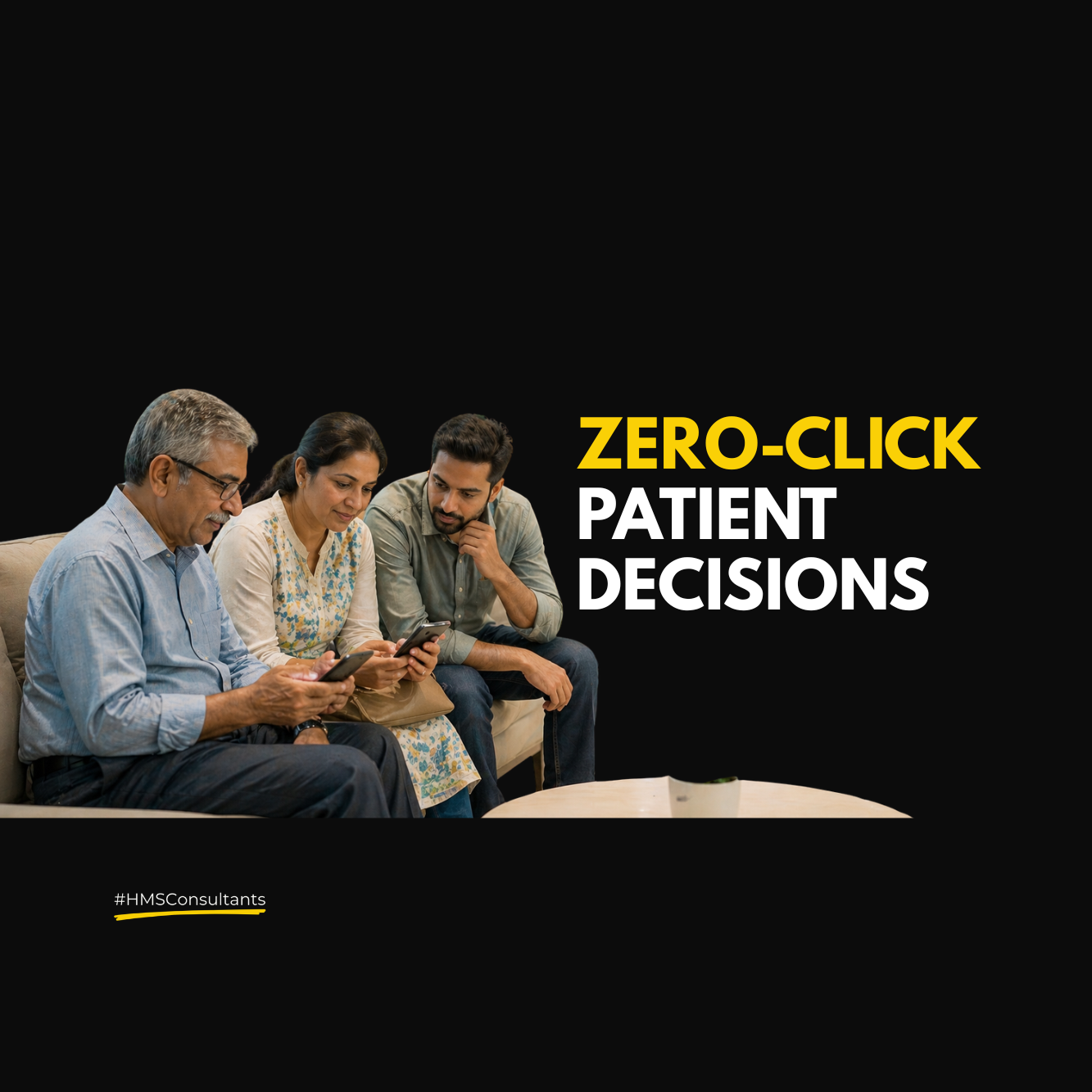
              • Marketing a Hospital in 2026: The Rise of Zero-Click Patient Decisions

                Marketing a Hospital in 2026: The Rise of Zero-Click Patient Decisions

                Marketing a Hospital in 2026: The Rise of Zero-Click Patient Decisions

                Written by
                Published on
                Share This

                For years, many healthcare organisations believed the patient journey began on their website. A person would search online, click a hospital page, compare services, read about doctors, and then decide whether to enquire.

                That journey is changing quickly.

                In 2026, many patient decisions are being shaped before the website visit ever happens. Search results, map listings, reviews, snippets, and AI-generated summaries are influencing choices earlier than most hospitals realise. This shift is redefining marketing a hospital. Today, success is not only about bringing people to a website. It is about winning trust in the moments before the click.

                What Is a Zero-Click Patient Decision?

                A zero-click patient decision happens when someone forms a preference, shortlists a provider, or takes action without opening the hospital website.

                For example:

                A patient searches:

                “Best eye hospital near me”

                They see:

                • Ratings
                • Distance
                • Opening hours
                • Review highlights
                • Call button
                • Photos

                They call directly.

                No website visit.

                Another patient searching for maternity care or orthopaedic treatment may compare visible trust signals and shortlist hospitals instantly.

                This means traditional assumptions around marketing a hospital need to evolve. Website traffic alone no longer tells the full story.

                Why Hospital Marketing Has Changed in 2026

                Older growth strategies often focused on:

                • Website redesign
                • Paid campaigns
                • Social media reach
                • Landing pages
                • Promotional visibility

                These still matter, but they no longer control the first impression.

                Today, hospitals are judged in seconds through search behaviour.

                Patients silently ask:

                • Does this place feel trustworthy?
                • Is it nearby and convenient?
                • Are the reviews recent and credible?
                • Can I contact them quickly?
                • Does the hospital look active and organised?

                If confidence is low, they move on.

                That is why marketing a hospital now depends as much on discoverability and trust as on promotion.
                The Real Homepage Is No Longer the Website

                Many hospitals still treat their website as the main front door.

                But for many users, the first homepage is now:

                • Google Business Profile
                • Google Maps
                • Search result previews
                • Reviews platforms
                • AI-generated answers

                That is where first impressions are formed.

                A hospital may have an excellent website, but if its search presence is weak, many patients may never reach it.

                Modern hospital growth begins where patients actually search.

                Five Signals Driving Patient Choice Today

                1. Review Quality and Recency

                Patients no longer look only at star ratings.

                They examine:

                • How recent reviews are
                • Whether feedback feels genuine
                • Repeated praise patterns
                • Complaint responses
                • Mentions of service quality

                Strong reviews reduce hesitation and improve enquiry intent.

                2. Location Confidence

                Convenience strongly influences healthcare decisions.

                Patients evaluate:

                • Travel time
                • Landmark familiarity
                • Parking ease
                • Emergency accessibility
                • Neighbourhood trust

                This is where GEO (Geographic Optimization) matters. Strong local visibility helps hospitals appear in the right searches at the right time.

                3. Information Completeness

                Missing or outdated information creates doubt quickly.

                Patients expect:

                • Correct phone numbers
                • Timings
                • Specialty details
                • Accurate address
                • Useful photos
                • Current information

                In healthcare, incomplete profiles feel risky.

                4. Easy Next Steps

                Modern users prefer simple actions:

                • Click to call
                • WhatsApp enquiry
                • Directions
                • Appointment request

                If the next step feels effortless, conversions improve.

                If contact feels confusing, interest drops.

                5. Search Summary Perception

                AI summaries and search snippets increasingly shape early impressions.

                If a hospital repeatedly appears associated with:

                • Trusted maternity care
                • Advanced eye treatment
                • Emergency readiness
                • Strong patient feedback

                it enters the shortlist faster.

                This is now a major layer of marketing a hospital in 2026.

                How AEO Is Reshaping Discovery

                AEO (Answer Engine Optimisation) means structuring information so search systems can answer patient questions directly.

                Examples:

                • Which hospital is open now nearby?
                • Best cataract surgery hospital in Bathinda
                • Trusted skin clinic near me
                • Emergency hospital with ICU in Ahmedabad

                Hospitals that publish clear, structured answers become easier to discover and trust.

                Patients increasingly ask questions instead of browsing multiple pages.

                How AI Is Becoming a Silent Referral Source

                Historically, hospitals grew through:

                • Doctor referrals
                • Family recommendations
                • Word of mouth

                Now AI-assisted search is influencing early consideration.
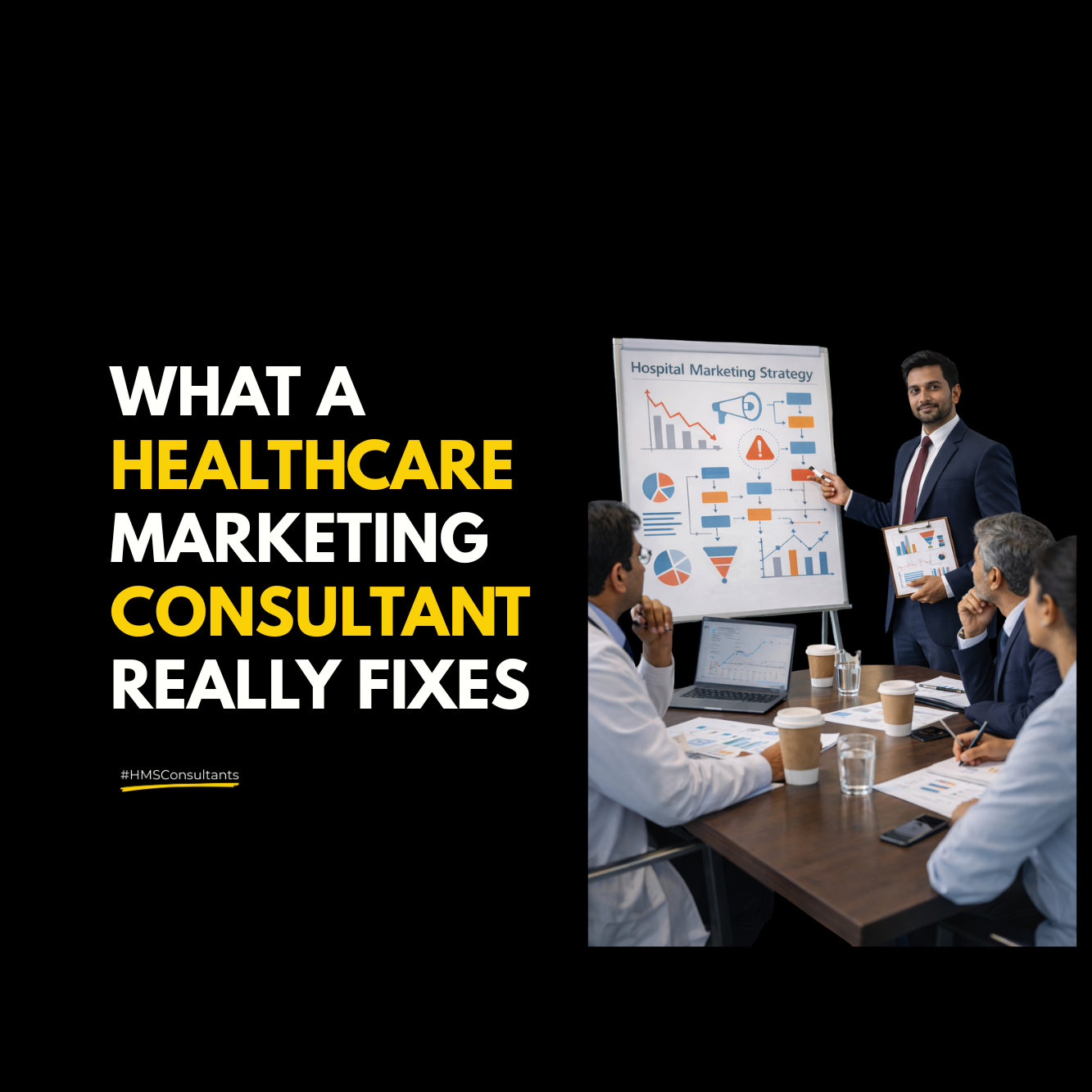
                When users ask healthcare questions, AI tools may summarise visible options using signals such as:

                • Reputation
                • Local relevance
                • Consistency
                • Content clarity
                • Review strength

                This means marketing a hospital now includes preparing for AI-led discovery.

                Why Many Hospitals Misread Performance

                A hospital may say:

                “Our website traffic is low.”

                But that may not reflect reality.

                Patients may be:

                • Calling from Maps
                • Saving listings
                • Checking reviews
                • Comparing profiles
                • Navigating directly
                • Deciding from snippets

                So some hospitals underestimate performance, while others fail to see where interest is leaking away.

                Modern measurement must go beyond sessions and clicks.

                What Smart Hospitals Are Doing Differently

                Hospitals adapting fastest are focusing on:

                • Google profile optimisation
                • Review systems
                • Accurate listings
                • Specialty discoverability
                • Local SEO strength
                • Answer-led content
                • Faster enquiry handling
                • Trust-focused visibility

                They understand that growth is no longer one campaign. It is an ecosystem.

                The Future of Hospital Growth and Discovery

                The future belongs to hospitals that are:

                • Easy to find
                • Easy to trust
                • Easy to understand
                • Easy to contact

                Patients want confidence quickly.

                Hospitals that reduce friction across search, reviews, and first contact will continue to grow steadily.

                Those relying only on advertising may remain visible but not always chosen.

                Conclusion

                Marketing a hospital in 2026 is no longer only about attracting visitors to a website.

                It is about influencing zero-click decisions made through maps, reviews, search snippets, and AI-generated answers before the visit ever begins.

                Hospitals that recognise this shift can build stronger patient pipelines with less wasted effort.

                Because today, many decisions happen before the click.

                Contact Us HMS Consultants

                Zero-click behaviour in marketing a hospital means patients choose, call, or shortlist a hospital directly through maps, ratings, reviews, or search snippets without first visiting the hospital website or landing page.

                Healthcare Marketing I Digital Marketing

                is something we strongly believe in, which means ‘Knowledge without application is the same as having no knowledge at all

                Akhil Dave

                Principle Consultant

                Ready to take your Personal Brand to the next level?

                Share your details below and we will connect with you to discuss your growth strategy.

                • Top 10 Reasons to Hire a Healthcare Marketing Consultant

                  Top 10 Reasons to Hire a Healthcare Marketing Consultant

                  Business, Digital Marketing, Healthcare AI, Healthcare Marketing

                  Top 10 Reasons to Hire a Healthcare Marketing Consultant

                  Written by
                  Published on
                  Share This

                  In the competitive landscape of healthcare in India, building a successful practice requires more than just clinical expertise. For individual doctors and practitioners, focusing solely on patient care while managing the complexities of marketing can be overwhelming. This is where a healthcare marketing consultant can make a significant difference, helping to transform your practice into a recognised brand, increase patient footfall, and ultimately boost your revenue. Here’s why you should consider hiring a healthcare marketing consultant.

                  1. Building a Strong Clinic Brand

                  In today’s digital age, branding is crucial for standing out in the crowded healthcare market. A healthcare marketing consultant can help you create a distinct identity for your clinic, positioning it as a trusted and reliable healthcare provider. From logo design to brand messaging, a consultant ensures that your clinic resonates with patients, establishing a strong and lasting impression. This is particularly important in India, where the healthcare market is diverse and highly competitive.
                  2. Increasing Patient Footfall with Strategic Marketing

                  One of the most significant challenges doctors face in India is attracting new patients while retaining existing ones. A healthcare marketing consultant leverages the latest digital marketing strategies, including SEO services for healthcare, social media marketing, and hospital advertising, to drive more patients to your clinic. By understanding the local market dynamics and patient behaviour, the consultant can develop tailored marketing campaigns that target the right audience, ensuring a steady flow of patients.

                  3. Focus on Practice, Not Marketing

                  Doctors are experts in medicine, not marketing. Yet, studies show that many doctors spend up to 20% of their time on administrative and marketing tasks. This is time that could be better spent caring for patients. By hiring a healthcare marketing consultant, you can delegate the marketing tasks and focus on what you do best—providing excellent patient care. The consultant takes care of everything from hospital marketing to digital healthcare marketing, allowing you to invest your time and energy into your practice. This improves patient outcomes and enhances your clinic’s reputation, leading to more referrals and increased patient loyalty.

                  4. Boosting Revenue with Data-Driven Strategies

                  A key benefit of working with a healthcare marketing consultant is using data-driven strategies to increase your clinic’s revenue. The consultant analyses patient data, market trends, and competitive positioning to develop marketing strategies that are not only effective but also profitable. Whether it’s izing sour digital presence, setting up a hospital, or improving your clinic’s online reputation, the consultant’s goal is to maximise your return on investment.

                  5. Access to Specialised Expertise

                  Healthcare marketing is a specialised field that requires an in-depth understanding of the industry. A consultant brings this expertise to the table, offering insights into the latest trends in digital marketing for hospitals, hospital branding, and public relations management. By staying updated with the latest marketing practices, the consultant ensures that your clinic remains competitive in an ever-changing healthcare landscape.

                  Top 10 Reasons to Hire a Healthcare Marketing Consultant in India

                  1. Specialised Expertise in Healthcare Digital Marketing:
                    • A healthcare marketing consultant has deep knowledge of healthcare digital marketing firms and digital marketing agencies for healthcare, ensuring your clinic or hospital leverages the best practices in the industry.
                  2. Tailored Marketing Strategies:
                    • Unlike generic marketing agencies healthcare, a consultant offers customized solutions that align with your specific needs, whether it’s digital marketing for hospitals or branding for hospitals.
                  3. Enhanced Online Presence:
                    • With expertise in SEO services for healthcare and hospital digital marketing, consultants help improve your clinic’s visibility, making it easier for patients to find you online.
                  4. Efficient Patient Acquisition:
                    • Consultants optimize patient acquisition through targeted strategies, leveraging digital healthcare marketing techniques and hospital advertising to increase patient footfall.
                  5. Focus on Core Medical Practice:
                    • By delegating marketing tasks, you can focus on patient care, while the consultant handles the complexities of digital marketing hospital and hospital marketing.
                  6. Data-Driven Decision Making:
                    • Healthcare marketing consultants use data analytics to guide strategies, ensuring that your marketing efforts, whether for a hospital marketing audit or hospital positioning, are effective and result-oriented.
                  7. Cost-Effective Marketing Solutions:
                    • Hiring a consultant can be more cost-effective than working with large digital marketing companies in India. They provide affordable yet impactful strategies that maximize ROI.
                  8. Comprehensive Branding and Reputation Management:
                    • Consultants assist in hospital branding, ensuring that your clinic or hospital establishes a strong, positive reputation, essential for long-term success.
                  9. Navigating the Challenges of the Indian Healthcare Market:
                    • With their understanding of challenges in healthcare in India and healthcare in marketing, consultants can help you overcome common hurdles and position your practice for success.
                  10. Strategic Use of Digital Tools:
                    • Consultants stay updated on the latest trends in digital marketing in healthcare, ensuring your practice utilizes the most effective tools, whether you’re aiming to build a hospital, improve public relations in a hospital, or engage patients online.

                  Conclusion: The Strategic Advantage of Hiring a Healthcare Marketing Consultant

                  Hiring a healthcare marketing consultant is not just an expense—it’s an investment in the future of your practice. By building a strong brand, increasing patient footfall, and boosting revenue, a consultant helps you achieve your business goals while allowing you to focus on your primary responsibility: patient care. In the competitive Indian healthcare market, this strategic move can be the difference between a struggling practice and a thriving one.

                  If you’re ready to take your practice to the next level, contact HMS Consultants today to learn how we can help you achieve your business goals with our expert healthcare marketing services.


                  “Knowing is Knowing, Doing is Doing”

                  is something we strongly believe in, which means ‘Knowledge without application is the same as having no knowledge at all

                  Akhil Dave

                  Principle Consultant

                  Ready to take your healthcare marketing to the next level?

                  Fill out the form below, and our consultant will contact you for a detailed, personalised consultation.
                  • How to Grow Your Clinic in India: 20 FAQs Answered by Marketing Experts

                    How to Grow Your Clinic in India: 20 FAQs Answered by Marketing Experts

                    How to Grow Your Clinic in India: 20 FAQs Answered by Marketing Experts

                    Written by
                    Published on
                    Share This

                    In the dynamic healthcare landscape, standing out and maintaining a trusted, reputable clinic is more challenging than ever. With over 20 years in healthcare marketing, I’ve witnessed the unique challenges that clinic owners in India face in establishing and growing their practices. Marketing in healthcare isn’t just about visibility; it’s about building trust, nurturing relationships, and creating a community of patients who see value in your expertise and care.

                    The marketing needs of large, multispecialty hospitals and individual clinics vary, but one constant remains: patients are at the heart of every successful healthcare business. As competition grows, clinic owners often ask: How can I attract more patients? How can I market my practice without an extensive budget? What are the key steps to ensure sustained growth?

                    These questions are vital, and answering them effectively can be the difference between a clinic that merely exists and one that thrives with patient loyalty, brand recognition, and steady growth. Over the years, I’ve collaborated with clinics of all sizes across India, helping them implement affordable, practical marketing solutions that focus on local engagement, patient satisfaction, and digital strategies. Today, HMS Consultants aims to empower clinics and individual practitioners with insights that allow them to take their marketing efforts to the next level.

                    In this blog, I’ll address the top 20 questions Indian clinic owners often ask about growing their practices. From marketing tips to digital strategies, each answer is designed to offer actionable insights that any clinic owner can start using immediately. Let’s dive in!

                    1. How do I market my clinic?

                    Marketing a clinic effectively requires a multi-channel approach:

                    • Website: A professional, informative website is essential.
                    • Google My Business (GMB): Keep your GMB profile updated to appear in local searches.
                    • Social Media: Establish a presence on platforms like Facebook and Instagram, posting regularly to engage your community.
                    • Digital Marketing: Use Google Ads and local SEO to reach a broader audience.
                    • Patient Engagement: Creating a strong engagement strategy with patients can turn them into your clinic’s brand ambassadors.

                    2. How do you attract patients to a clinic?

                    Word of mouth remains one of the most powerful ways to attract patients. By providing personalised care, you foster trust and loyalty, encouraging patients to refer others. Supplement this with:

                    • Health Awareness Campaigns: Host events, create educational content, and use social media to spread awareness.
                    • Local Community Engagement: Build a connection by participating in local activities and supporting community health initiatives.

                    3. How do you market a private clinic?

                    Marketing doesn’t need a large budget here’s how to start:

                    • Patient and Staff Ambassadors: Leverage your current patients and staff as advocates.
                    • Community Events: Participate in local fairs, health camps, or workshops to increase visibility.
                    • Collaborate Locally: Partner with community groups, schools, and residential associations to spread awareness.

                    4. How do I market my practice?

                    Before diving into marketing, identify the services you excel in and focus on promoting those:

                    • Niche Marketing: Highlight your core strengths, whether it’s pediatric care, orthopaedics, or dental services.
                    • Local Channels: Create awareness by using pamphlets, WhatsApp groups, or local directories.
                    • Digital Strategy: Utilize social media and Google Ads to reach a wider audience.

                    5. How to run a clinic successfully?

                    Operational efficiency and financial control are key:

                    • Cost Management: Streamline expenses without compromising patient care.
                    • Core Strengths: Focus on marketing your strongest service lines.
                    • Flexible Hours: Schedule clinic hours to match community demand (e.g., morning and evening sessions in residential areas).

                    6. How to see more patients per day?

                    Workflow efficiency is essential for seeing more patients:

                    • Delegation: Have assistants collect basic details, such as medical history, before the consultation.
                    • Health Management System: Invest in a Hospital Management Information System (HMIS) and EMR to improve clinic operations.
                    • Educational Materials: Provide information pamphlets and digital materials to help patients understand their treatment options and FAQs.

                    7. How do you introduce your clinic?

                    • Storytelling: Share the story of why you started your clinic.
                    • Highlight Specialties: Mention your unique services and how they benefit patients.
                    • Patient-Centered Message: Communicate your commitment to quality care and positive patient outcomes.

                    8. How to improve clinic flow?

                    • Efficient Appointment System: Use online booking and reminders to reduce waiting times.
                    • Standard Operating Procedures (SOPs): Establish clear SOPs for common tasks.
                    • Patient Feedback: Collect feedback to identify bottlenecks and improve the patient experience.

                    9. Is clinic a profitable business?

                    A well-managed clinic can be profitable. Profitability depends on:

                    • Expense Management: Control operational costs effectively.
                    • Diversified Services: Offering additional services like diagnostics or pharmacy can increase revenue.
                    • Patient Retention: Loyal patients ensure consistent revenue.

                    10. How to promote a clinic on Google?

                    • Optimize Google My Business: Regularly update GMB with photos, services, and positive reviews.
                    • Local SEO: Use keywords relevant to your area and services.
                    • Google Ads: Run ads targeting local searches like “clinic near me” to reach potential patients.

                    11. How to do digital marketing for clinics?

                    • Website and SEO: Optimize your site for search engines to appear in local searches.
                    • Social Media Content: Post regularly about health tips, clinic updates, and patient testimonials.
                    • Email Campaigns: Send monthly newsletters or health tips to keep your clinic top of mind.

                    12. How to get more patient referrals?

                    • Encourage Feedback: Ask satisfied patients to refer others.
                    • Loyalty Programs: Offer incentives for referrals, such as discounts on services.
                    • Partnerships with Other Providers: Collaborate with specialists or labs for mutual referrals.

                    13. How to increase patient footfall?

                    • Awareness Campaigns: Run targeted digital marketing campaigns for local audiences.
                    • Community Involvement: Participate in local health camps or workshops to engage with the community.
                    • Seasonal Promotions: Offer discounts on health packages during seasonal or festive periods.

                    14. How do I start medicine marketing?

                    • Compliance: Ensure all marketing adheres to local laws and regulations.
                    • Highlight Benefits: Focus on how the medicine or service benefits patients.
                    • Patient Education: Provide informative content about new treatments or medications.

                    15. How to market a new physician?

                    • Introduction Campaigns: Announce the physician’s joining through social media, email, and local advertisements.
                    • Collaborative Events: Host an event or Q&A session with the new physician.
                    • Highlight Credentials: Showcase the physician’s experience and specialities.

                    16. How to sell medical services online?

                    • Telemedicine: Offer online consultations if applicable.
                    • Online Booking: Allow patients to schedule appointments through your website or social media.
                    • Service Descriptions: Provide clear descriptions of services on your website.

                    17. How do you name a clinic?

                    • Location-Based: Consider using the location name in the clinic’s title.
                    • Specialty Focused: Reflect your main specialty, like “Heart Care Clinic.”
                    • Unique & Memorable: Choose a name that’s easy to remember and stands out.

                    18. How to brand my clinic?

                    • Consistent Identity: Develop a logo and color scheme.
                    • Patient-Centered Values: Define and communicate your clinic’s values.
                    • Local Engagement: Build a reputation through consistent, high-quality care.

                    19. How can I increase patients in my clinic?

                    • Build Trust: Provide excellent care and establish rapport with patients.
                    • Community Outreach: Host free check-ups or workshops to engage potential patients.
                    • Digital Marketing: Use SEO, social media, and email campaigns to increase visibility.

                    20. Affordable marketing tips for my clinic

                    • Social Media: Use free platforms like Facebook and Instagram to engage with the community.
                    • Collaborate with Local Businesses: Partner with local shops, schools, or gyms.
                    • Referral Incentives: Offer discounts for referrals to encourage word of mouth.

                    Expert Marketing for Clinic Success

                    Clinic owners in India face unique challenges, from attracting patients to building a sustainable, trusted brand. By addressing these frequently asked questions, I hope to provide actionable insights that you can implement to see real results. At HMS Consultants, we specialize in providing tailored, affordable marketing strategies for clinics and individual practitioners. With our expertise, you can focus on patient care while we help you grow your practice.

                    Are you interested in optimising your Clinic’s marketing efforts? Contact HMS Consultants today to learn how our expertise can help you increase patient footfall, build your hospital’s brand, and improve ROI.

                    Book a free consultation with our Founder and Principal Consultant, Akhil Dave at akhil@hmsconsultants.in or call +91 81550 04010 to explore how HMS Consultants can help your Hospital or Clinic to reach new heights.

                    Digital Marketing I Digital Marketing For Doctors I Doctors Digital Marketing I Healthcare Marketing I Healthcare Marketing Strategy I Social Media Marketing

                    “Knowing is Knowing, Doing is Doing”

                    is something we strongly believe in, which means ‘Knowledge without application is the same as having no knowledge at all

                    Akhil Dave

                    Principle Consultant

                    Ready to take your healthcare marketing to the next level?

                    Fill out the form below, and our consultant will contact you for a detailed, personalised consultation.

                    • Hospital Marketing Strategy: The Complete Guide for 2025

                      Hospital Marketing Strategy: The Complete Guide for 2025

                      Hospital Marketing Strategy: The Complete Guide for 2025

                      Written by
                      Published on
                      Share This

                      A hospital marketing strategy is a structured plan that combines digital, offline, and reputation-building efforts to attract patients and build trust. It typically includes SEO, social media, patient reviews, community outreach, and content marketing all aligned to the hospital’s specialties, target patients, and local competition.

                      Patients and their families are more informed and empowered than ever before. Patients actively research hospitals, Clinics, Doctors’ credentials, and healthcare providers online, comparing reviews, services, and reputations before making a decision. This shift means that hospitals need more than excellent medical care to succeed they also need a strategic marketing approach to stay competitive and attract more patients. In this blog, we will explore actionable hospital marketing strategies that will set you up for success in 2025 and beyond.

                      The Importance of Hospital Marketing in 2025

                      Why Hospital Marketing Matters Now More Than Ever

                      Hospital marketing is essential to reaching potential patients, engaging current ones, and building long-term relationships with the community. With the rise of healthcare consumerism, hospitals and doctors that invest in a strong marketing strategy are better positioned to gain trust and become a preferred choice for healthcare services.

                      Key Benefits:

                      • Boost Patient Acquisition: A strategic marketing plan attracts new patients and encourages existing patients to return for follow-up care or additional services.
                      • Build Brand Trust: Patients choose hospitals or clinics based on their reputation. Marketing helps to establish and strengthen your hospital’s brand, making it more trustworthy in the eyes of potential patients.
                      • Drive Revenue Growth: Increased patient footfall directly impacts a hospital’s revenue, and effective marketing strategies ensure a higher return on investment (ROI).

                      Key Hospital Marketing Strategies for 2025

                      Proven Techniques to Enhance Patient Engagement

                      Leverage SEO for Hospitals:

                      Search Engine Optimisation (SEO) ensures that your hospital appears in search results when potential patients look for healthcare services. Focus on local SEO to target people in your geographic area, searching for terms like “best hospital near me” or “hospital marketing consultant.”

                      Tactics to Implement:

                      • Optimise your website for relevant keywords like “Quality care near me” “Heart Clinic near me” and “Hospital near me”
                      • Create local-specific content, including blog posts on local health issues or hospital services.
                      • Claim and optimise your Google My Business listing.

                      Build a Strong Social Media Presence:

                      With billions of active users on social media platforms like Facebook, Instagram, YouTube, and LinkedIn, social media has become a critical tool for hospital marketing. Social media provides a platform to share patient success stories, health tips, and hospital updates, which helps humanize your hospital brand.

                      Tactics to Implement:

                      • Post regular content like health tips, patient testimonials, and behind-the-scenes hospital activities.
                      • Run targeted ads on platforms like Meta Advertisement YouTube Advertisement to reach your local community.
                      • Engage with your followers by responding to comments and messages.

                      Use Content Marketing to Educate and Engage:

                      Content marketing is one of the most effective ways to provide value to your audience. By publishing informative and educational original content, you position your hospital as a trusted authority in healthcare. Blog articles, videos, and infographics can all be used to educate your audience on health-related topics.

                      Tactics to Implement:

                      • Regularly publish blog posts related to healthcare services offered at your hospital, such as “how to choose the right hospital for surgery” or “importance of preventive healthcare.”
                      • Create video content explaining complex procedures in a patient-friendly way.
                      • Share patient education materials on your website and social media.

                      Focus on Patient Reviews and Reputation Management

                      Patients rely heavily on online reviews when choosing healthcare providers. A strong online reputation builds trust and credibility. Actively managing your hospital’s online reviews is critical for maintaining a positive image.

                      Tactics to Implement:

                      • Encourage satisfied patients to leave positive reviews on platforms like Google and healthcare review sites.
                      • Monitor and respond to all patient reviews, both positive and negative, to demonstrate your hospital’s commitment to patient care.
                      • Use online reputation management tools to track and manage reviews.

                      Run Targeted Hospital Advertising Campaigns:

                      Digital advertising allows hospitals to target specific demographics and regions. Platforms like Google Ads and Facebook Ads provide precise targeting, ensuring your hospital ads reach the right audience.

                      Tactics to Implement:

                      • Create targeted campaigns focusing on specific services like maternity, cardiology, or orthopaedics.
                      • Use retargeting ads to stay top-of-mind with website visitors who initially needed to convert.
                      • Allocate the budget to Google Ads for terms like “best hospital in [your city]” or “hospital marketing expert.”

                      The Role of a Healthcare Marketing Consultant

                      Why Hospitals Should Consider Hiring a Marketing Consultant

                      For hospitals or clinics looking to stay competitive, working with a healthcare marketing consultant or hospital marketing consultants can provide the expertise and strategy needed for long-term success. Consultants specialise in creating tailored marketing strategies that align with a hospital’s goals, budget, and patient demographics.

                      Benefits of Hiring a Healthcare Marketing Consultant:

                      • Access to specialised knowledge and experience in hospital marketing.
                      • Custom marketing strategies designed to attract and retain patients.
                      • Improved efficiency and higher ROI from marketing efforts.

                      Case Study Success with Hospital Marketing

                      How Khushhi IVF Increased Patient Footfall by 37%

                      As the leading IVF Centre in Ahmedabad, Khushhi IVF implemented a comprehensive marketing strategy that included SEO optimisation, reputation management, and social media engagement. Over six months, the hospital saw a 37% increase in patient footfall and significant improvement in online reviews, which enhanced its reputation.

                      Strategies Used:

                      • Local SEO optimisation to target relevant search terms.
                      • Active management of patient reviews across multiple platforms.
                      • Social media campaigns highlighting patient success stories.

                      Start Building Your Hospital’s Success Today

                      A well-rounded hospital marketing strategy is key to increasing patient footfall, building brand trust, and boosting revenue. Whether you are focusing on SEO, social media, content marketing, or reputation management, each strategy plays a crucial role in achieving your hospital’s goals. For hospitals that want to take their marketing to the next level, partnering with a healthcare marketing consultant can provide the expertise and support needed for sustained growth.

                      Interested in optimising your hospital’s marketing efforts? Contact HMS Consultants today to learn how our expertise can help you increase patient footfall, build your hospital’s brand, and improve ROI.

                      Book a free consultation with our Founder and Principal Consultant, Akhil Dave at akhil@hmsconsultants.in or call +91 81550 04010 to explore how HMS Consultants can help your Hospital or Clinic to reach new heights.

                      2025 I Digital Marketing For Doctors I Doctors Digital Marketing I Healthcare Marketing I Healthcare Marketing Strategy I Healthcare Marketing Trends 2025 I Marketing Trends 2025 I Social Media Marketing

                      “Knowing is Knowing, Doing is Doing”

                      is something we strongly believe in, which means ‘Knowledge without application is the same as having no knowledge at all

                      Akhil Dave

                      Principle Consultant

                      Ready to take your healthcare marketing to the next level?

                      Fill out the form below, and our consultant will contact you for a detailed, personalised consultation.