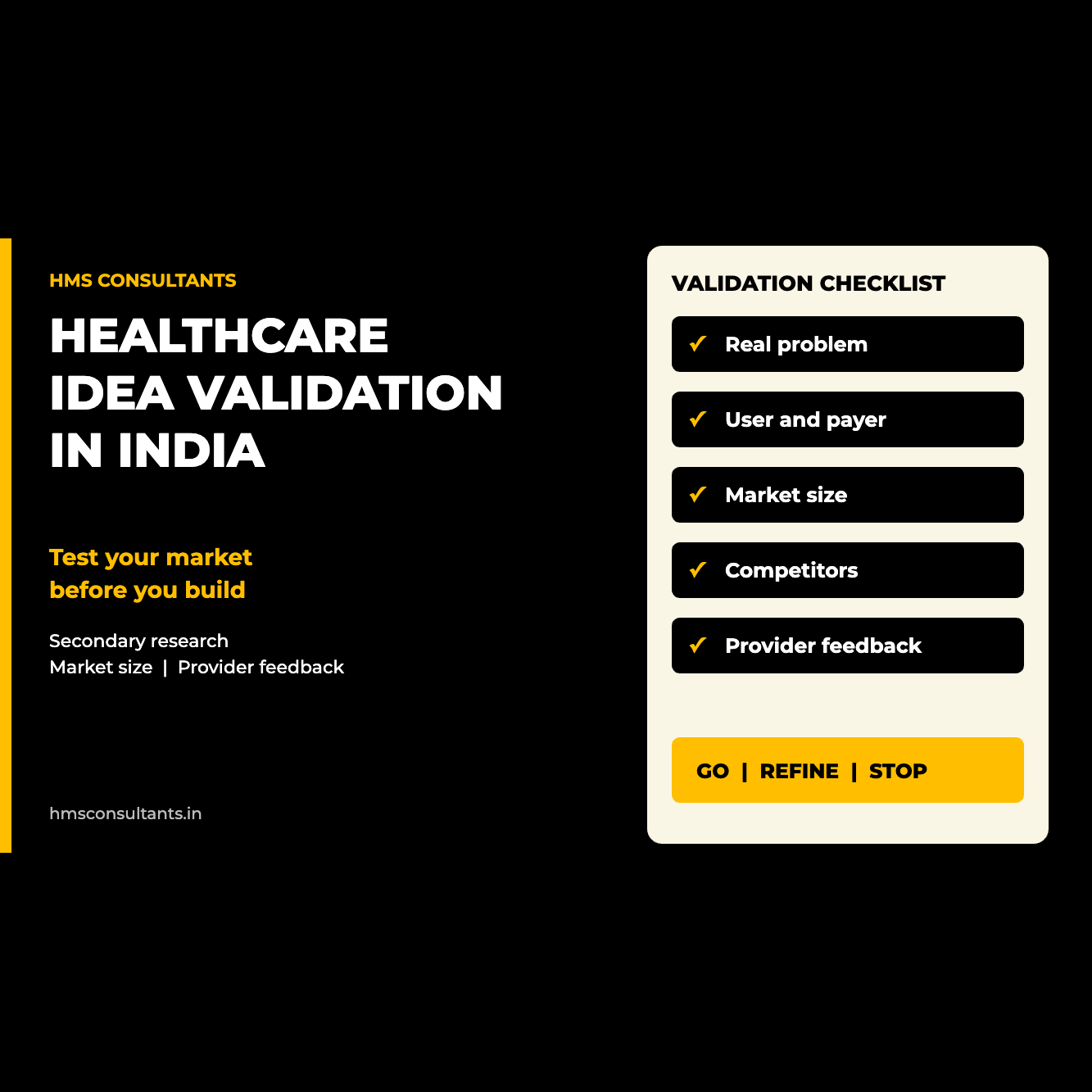
The short answer: Healthcare market validation in India means testing your idea before you build it. You confirm that a real problem exists, identify who uses the product and who pays for it, estimate the market size with clear assumptions, study competitors and pricing, and get honest feedback from doctors and hospital decision makers. The result is a clear go, refine or stop decision.
This guide is for founders, doctors, professionals and corporates with a healthcare startup, app, device or service idea for India. It is written by Akhil Dave, who has spent 25+ years in healthcare marketing strategy and leads HMS Consultants, a healthcare marketing and strategy consultancy that helps innovators validate ideas using secondary research and a wide network of healthcare providers.
- Why validate before you build
- What idea validation really answers
- Step 1: Define the problem, the user and the payer
- Step 2: Estimate the market size the honest way
- Step 3: Run secondary research on the right sources
- Step 4: Test the concept with providers
- Step 5: Scan competitors and pricing
- Go, refine or stop: how to decide
- What HMS Consultants does, and what it does not
- Six validation mistakes healthcare founders make
- A 3-week validation sprint
- Frequently asked questions
Why validate before you build
Most healthcare ideas begin with a strong belief: “this problem is obvious, and my solution will fix it.” Building on belief alone is expensive. CB Insights, in its study of startup shutdown post-mortems, found that 42% of failed startups cited “no market need” as a reason, the most common cause in that sample (as reported by The Week).
Healthcare adds its own traps. The doctor who loves your idea may not control the budget. The hospital that likes the demo may take months to decide. A patient who needs the service may be unwilling or unable to pay. Validation finds these gaps early, when fixing them costs a few weeks and not a few quarters.
What idea validation really answers
| Question | What you need to know | How you find out |
|---|---|---|
| Is the problem real? | Who feels it, how often, how painful it is | Provider conversations, published evidence |
| Who pays? | Patient, hospital, doctor, insurer or employer | Buyer mapping, pricing scan |
| How big is the market? | Number of reachable buyers times realistic price and adoption | Bottom-up and top-down sizing |
| Who else solves it? | Direct, indirect and “do nothing” alternatives | Competitor and pricing scan |
| Will it be adopted? | Workflow fit, trust, switching effort | Concept feedback from providers |
Step 1: Define the problem, the user and the payer
Write the problem in one sentence without mentioning your solution. Then separate three roles that founders often mix up: the user (who touches the product), the beneficiary (who gains) and the payer (who signs the cheque). In Indian healthcare these are often three different people. A patient app may be used by patients, loved by doctors and paid for by a hospital marketing budget, or not paid for at all.
Step 2: Estimate the market size the honest way
Large headline numbers are tempting. For example, IMARC estimates India’s digital health market at about USD 23.78 billion in 2026, growing to USD 90 billion by 2034. These figures show momentum, but they are not your market. Your market is the slice you can actually reach and sell to.
- Bottom-up: number of reachable buyers (for example, 150-bed-plus hospitals in your first five cities) x price per year x realistic adoption rate.
- Top-down: take the relevant industry segment and narrow it by geography, buyer type and use case.
- Reality check: if the two methods are far apart, one of your assumptions is wrong. Find out which.
Always write your assumptions down, so that anyone, including an investor, can challenge and improve them.
Step 3: Run secondary research on the right sources
Secondary research uses information that already exists. It is fast, low cost and usually the right first step. Use sources that match the question:
| Source type | Helps you answer |
|---|---|
| Government and public health data | Disease burden, facility counts, programmes and policy direction |
| Industry and market reports | Segment size, growth, trends (treat as directional) |
| Hospital and company disclosures | Scale, pricing signals, technology adoption |
| Funding and startup trackers | Who is funded, what investors back, crowded or empty spaces |
| Competitor websites and app stores | Features, pricing, reviews, customer complaints |
| Clinical literature | Evidence behind the problem and the solution |
Step 4: Test the concept with providers
Desk research tells you what exists. It cannot tell you how a hospital administrator or a busy specialist will react. Structured conversations with the people who will use or buy your solution close that gap. Prepare a short concept note, ask open questions about how they handle the problem today, and listen for workarounds, budget and who else must approve. This is where HMS’s network of healthcare providers helps: we can arrange candid discussions with the right kind of decision makers, so that you hear honest reactions and not polite encouragement.
Step 5: Scan competitors and pricing
List direct competitors, indirect substitutes (including manual processes) and the option of doing nothing. Note their target buyer, pricing, strengths and gaps. A crowded space is not always bad, since it can prove demand. An empty space is not always good, since it may signal that nobody will pay.
Go, refine or stop: how to decide
| Decision | Signals |
|---|---|
| Go | Clear problem, an identified payer, a reachable market of meaningful size, positive and specific feedback, a defensible edge |
| Refine | Real problem but unclear payer, wrong first customer, price mismatch or weak differentiation |
| Stop or pivot | No budget owner, too small a market, strong free alternatives, or feedback that stays polite but never turns into interest |
Stopping early is a valid and valuable result. It saves money, time and credibility.
What HMS Consultants does, and what it does not
We do: secondary research, market size estimates with clear assumptions, competitor and pricing scans, buyer and payer mapping, concept feedback through our provider network, and an honest go, refine or stop recommendation. If you go ahead, we can help build your India go-to-market strategy.
We do not: build software or medical products, give regulatory, licensing or legal advice, provide clinical validation, or guarantee funding or sales outcomes.
Six validation mistakes healthcare founders make
- Asking friends and family. They are kind, not honest.
- Confusing user with payer. Love from doctors is not a budget.
- Quoting a giant market. “1% of a huge number” is not a plan.
- Researching only online. You miss how hospitals really decide.
- Ignoring the “do nothing” competitor. Manual workarounds are often the toughest rival.
- Treating politeness as interest. Look for commitments, such as a pilot or a named champion.
A 3-week validation sprint
| Week | Focus | Output |
|---|---|---|
| Week 1 | Define and research | Problem statement, user and payer map, secondary research pack, competitor scan |
| Week 2 | Size and test | Bottom-up and top-down market size with assumptions, concept note, provider feedback conversations |
| Week 3 | Decide | Findings summary, go, refine or stop recommendation, suggested next steps and first customer segment |
Frequently asked questions
What is healthcare market validation?
It is the process of checking, before you invest heavily in building, whether a real problem exists, who feels it, who would pay, how big the opportunity is and whether competitors already serve it. For healthcare in India it also means understanding the difference between the user and the payer.
How do I estimate the market size of a healthcare startup in India?
Start bottom-up: count the number of buyers you can realistically reach (for example hospitals of a certain size in your target cities), multiply by the price you can charge and the share likely to adopt. Cross-check it against a top-down figure from industry reports. Treat large headline numbers only as context, not as your market.
Can you validate a healthcare app idea without building it?
Yes. Secondary research, competitor and pricing scans, and structured conversations with doctors and hospital decision makers can show whether the problem is real and whether anyone would pay, before you write much code.
What does HMS Consultants do in idea validation?
We run secondary research, build a market size estimate with clear assumptions, scan competitors and pricing, and gather concept feedback through our network of healthcare providers. We then give you an honest view of go, refine or stop.
Do you build the app or product?
No. HMS Consultants is a healthcare marketing and strategy consultancy. We do not build software or medical products, and we do not provide regulatory, legal or compliance services.
How long does validation take?
A focused validation sprint usually takes about three weeks, depending on how well defined the idea is and how quickly feedback conversations can be arranged.
Is a free discussion call really free?
Yes. The 30-minute idea discussion call is free. We listen to your concept, tell you honestly what we see, and suggest what to validate first.
Discuss your healthcare idea with HMS Consultants
Have a healthcare startup, app or innovation idea for India? Book a free 30-minute idea discussion call. We will listen to your concept, tell you honestly what we see and suggest what to validate first. Write to akhil@hmsconsultants.in or call +91 81550 04010. You may also read our guide to healthcare startup strategy consulting.
Disclaimer: HMS Consultants is a healthcare marketing and strategy consultancy. We are not a law firm, a regulatory consultant or a clinical authority. This article is for general information, based on public sources and our experience. Market figures are estimates and change over time. Confirm regulatory and legal points with qualified professionals before acting.
About the author: Akhil Dave is Founder and Principal Consultant of HMS Consultants, with 25+ years in healthcare marketing strategy.
Sources
Work with HMS Consultants
Testing a healthcare idea before you build? Start with a free 30-minute idea discussion call.

Healthcare Jobs in India vs Consulting: Which Career Path Makes Sense?
Healthcare jobs in India offer stability, learning, and career growth. This blog compares traditional healthcare employment with consulting and explores which career path makes sense for professionals seeking long-term…

Time as Currency: Why Speed of Care is the New Marketing Advantage
Patients value time as much as treatment. Discover how faster consultations, quick reports, and responsive follow-ups can become a clinic’s strongest marketing advantage in India.

What Small Hospitals Can Teach Big Hospitals About Patient Care
Small hospitals win lifelong trust not through technology, but through personal care, time, and human connection. Big hospitals can learn how warmth and presence strengthen patient experience.

Clinic Marketing in 2026: Proven Strategies for Growth
Market your clinic smarter in 2025 with strategies tailored for Indian healthcare. From local SEO to WhatsApp engagement, grow ethically and effectively.

Digital Marketing for Doctors: A Beginner’s Guide
Digital marketing for doctors starts with the basics. Learn how to build a strong online presence using Google Business Profile, a simple website, social media, local SEO, and a…

Personal Branding for Doctors: Build Your Brand, Build Your Practice
Personal branding for doctors is becoming essential in 2026. This blog explains how digital visibility, patient trust, reviews, and educational authority influence long-term practice growth.