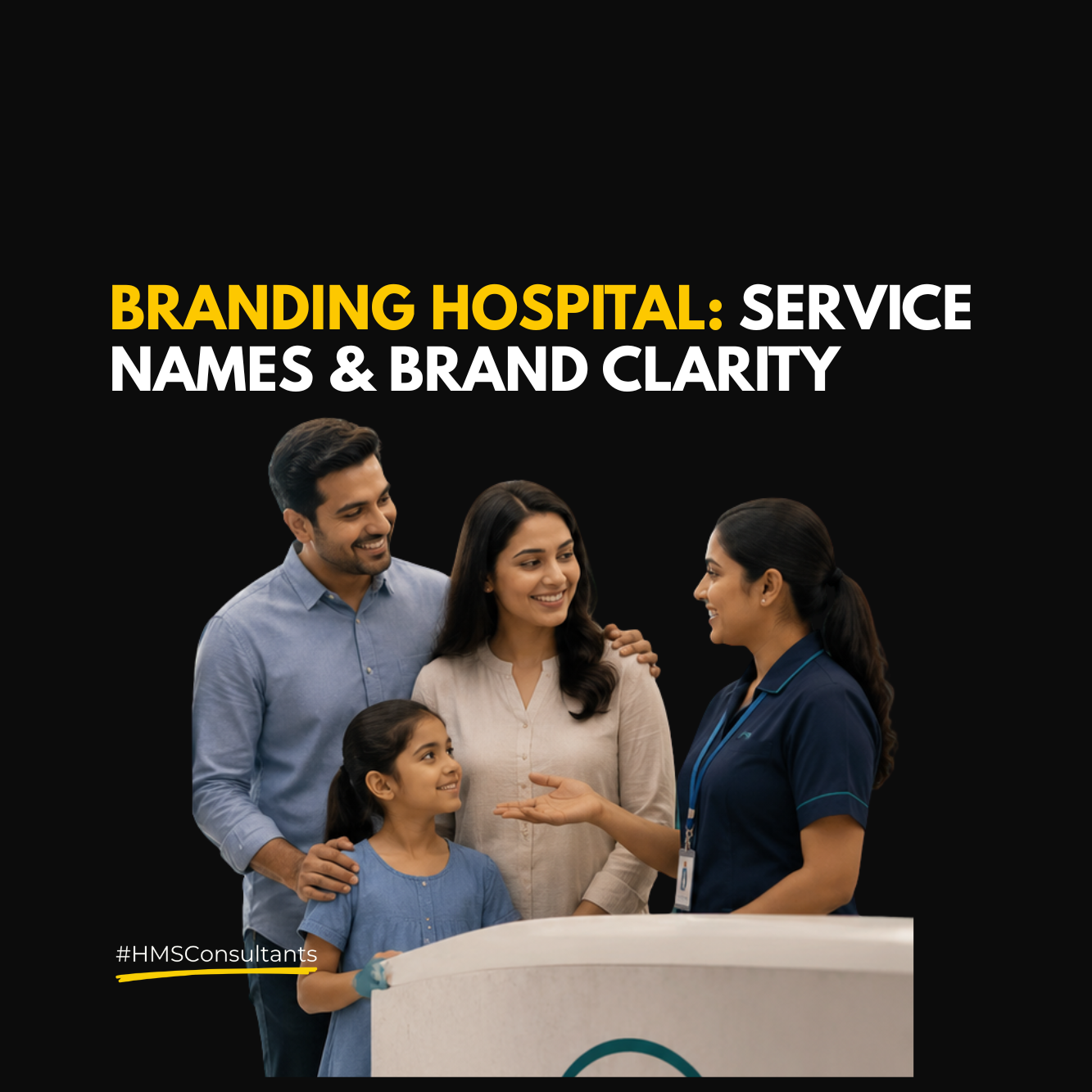
Branding Hospital: Why Service Names and Brand Clarity Matter

Branding hospital is not only about logos, colors, taglines, interiors, or advertisements. One important part of hospital branding that is often ignored is how clearly the hospital names, organizes, and communicates its services.
Many hospitals offer multiple departments, clinics, packages, programs, procedures, doctor-led services, and specialised centres. But when these services are named differently across the website, Google Business Profile, brochures, reception desk, banners, and social media, patients may feel confused.For example, the same service may be called “Heart Care” on one platform, “Cardiology” on another, “Cardiac OPD” in a banner, “Chest Pain Clinic” on social media, and “Heart Specialist Consultation” at the reception desk. Internally, the hospital team may understand what these terms mean. But for a patient, too many names can create uncertainty.
This is why hospital brand clarity matters. A hospital brand should make services easier to understand, not harder to identify.
Why Service Names Matter in Hospital Branding
Patients do not always understand medical terms the way hospital teams do. They search, ask, and enquire in simple language. A patient may not search for “orthopaedic department” first. They may search for “knee pain doctor,” “joint pain treatment,” or “fracture care near me.”
If hospital service names are too technical, unclear, or inconsistent, patients may not understand whether the hospital offers what they need.
Clear hospital service names help patients quickly understand:
- What the service is about.
- Which health concern does it relate to?
- Which doctor or department handles it?
- Whether the service is relevant to their problem.
- What is the next step they should take?
Hospital branding becomes stronger when patients can understand the hospital’s services without confusion.
The Problem With Multiple Names for the Same Service
One common issue in branding a hospital is using different names for the same or related services. This often happens when different teams create content separately.
The website team may use one name. The social media team may use another. The front desk may explain it differently. The doctor may use a clinical term. The brochure may mention a package name. Over time, the hospital communication becomes fragmented.
For example:
- “Women’s Health Clinic”
- “Gynaecology Department”
- “Maternity Care”
- “Pregnancy Clinic”
- “Antenatal Care Services”
All these may be connected, but patients may not know how they relate to each other. Some may think they are separate services. Some may not know which one to choose.
This weakens hospital service communication because the patient has to decode the hospital’s language. A strong hospital brand should reduce this confusion.
Patients Need Simple and Familiar Language
Hospital teams often use clinical or internal terms because they are familiar with them. But patients usually think in terms of symptoms, needs, and concerns.
A patient may think:
- I have chest pain.
- My child has a fever.
- I need pregnancy care.
- I want a health check-up.
- My father has knee pain.
- I need an eye test.
If the hospital only uses technical department names, the patient may not immediately connect their concern with the right service.
This does not mean hospitals should avoid medical terms completely. It means medical terms should be supported with patient-friendly explanations.
For example, instead of only saying “Cardiology,” the hospital can explain it as “heart care for chest pain, blood pressure, heart check-ups, and cardiac concerns.” This makes the service easier to understand.
Healthcare branding should help patients connect their concern with the right care.
How Confusing Service Names Affect Enquiries
Unclear service names can directly affect patient enquiries. When patients do not understand which service to choose, they may delay calling, ask repeated questions, or move to another hospital that explains things more clearly.
Confusion may happen when:
- Service names are too technical.
- The same service has different names across platforms.
- Packages are not explained properly.
- Department names and doctor services are mixed.
- Website pages do not match Google Business Profile listings.
- Social media posts use terms not found on the website.
- Front desk communication is different from online content.
For patients, this can create doubt. They may wonder whether the hospital offers the service, which doctor to meet, what appointment to book, or whether the service is suitable for their concern.
Hospital brand clarity helps reduce these doubts. It makes the enquiry process smoother and more confident.
Organizing Departments, Packages, and Programs
A hospital may have many layers of services. There may be departments, sub-specialities, health packages, screening programs, day-care procedures, emergency services, OPDs, and doctor-led clinics.
If these are not organised properly, the hospital brand can look confusing even if the hospital offers good care.
A clear hospital service structure should answer:
- What are the main departments?
- What services come under each department?
- Which services need separate pages or listings?
- Which packages need a simple explanation?
- Which doctor handles which service?
- Which terms should be used consistently everywhere?
For example, a hospital can use “Orthopaedics” as the department name and then clearly list related services such as joint pain, fracture care, arthritis care, sports injury care, spine problems, and knee replacement.
This helps patients understand both the department and the specific concern it addresses.
Consistency Across Every Platform
Hospital branding becomes stronger when the same service language is used across all patient-facing platforms.
This includes:
- Website service pages.
- Google Business Profile.
- Social media posts.
- Brochures and banners.
- Reception communication.
- WhatsApp replies.
- Doctor profile pages.
- Appointment scripts.
- Health camp communication.
If the website says one thing and the reception says another, the brand feels unorganised. If Google lists a service but the website does not explain it, patients may feel unsure. If social media promotes a service using a name that is not visible anywhere else, the patient journey becomes disconnected.
Consistency does not mean every platform must use the exact same paragraph. It means the service name, meaning, and patient guidance should remain aligned.
Brand Clarity Supports Hospital Positioning
Hospital positioning becomes stronger when patients clearly understand what the hospital offers and what it is known for. A hospital may want to be known for advanced care, specialist services, preventive health, emergency support, maternity care, diagnostics, or multi-speciality treatment. But that positioning becomes weak if the services are not communicated clearly.
Patients should not feel that the hospital is saying too many things in too many different ways.
Clear service naming helps create stronger recall. When patients repeatedly see the same service language across platforms, they begin to connect the hospital name with specific healthcare needs.
For example, if a hospital wants to strengthen its maternity care positioning, the communication around pregnancy care, antenatal visits, delivery support, high-risk pregnancy, and postnatal guidance should be organised clearly under one service structure.
This makes the hospital easier to understand and easier to remember.
What Hospitals Should Avoid
Hospitals should avoid creating service names only to sound advanced or different. If the name is attractive but unclear, it may not help patients.
Hospitals should avoid:
- Using too many names for the same service.
- Creating package names without explaining what they include.
- Using only medical terminology without patient-friendly meaning.
- Promoting services online that staff cannot explain clearly.
- Mixing department names, symptoms, and procedures without structure.
- Changing service names across platforms without a clear reason.
Branding hospital should make communication simpler, not more complicated.
Conclusion
Branding hospital is not only about how the hospital looks. It is also about how clearly patients understand what the hospital offers.
When service names are confusing, inconsistent, or too technical, patients may struggle to connect their health concern with the right department or doctor. This can affect enquiries, patient understanding, and hospital recall.
Clear hospital service names, organised service structure, and consistent communication help make hospital branding stronger. They allow patients to understand services faster, ask better questions, and take the next step with more confidence.
A strong hospital brand is not built only through design. It is also built through clarity.
When patients can easily understand what the hospital offers, the brand becomes easier to trust, remember, and choose.
Branding in a hospital means creating a clear and consistent identity that helps patients understand what the hospital offers. In this blog context, hospital branding also includes clear service names, organised departments, simple communication, and consistency across website, Google profile, reception, and social media.
Health branding is the process of making healthcare services easier to understand, remember, and trust. It includes how a hospital, clinic, doctor, or healthcare service communicates its identity, services, values, patient support, and care experience across different patient-facing platforms.
Branding is used to make a hospital easier for patients to recognise, understand, and remember. Clear branding helps patients connect their health concern with the right service, department, or doctor. It also reduces confusion and supports better patient communication.
Brand health helps a hospital understand whether its brand is clear, consistent, trusted, and easy to recall. Good brand health can improve patient understanding, service recognition, enquiry confidence, reputation, and the hospital’s ability to stand out in a competitive healthcare market.
The 5 pillars of brand strategy are clarity, consistency, positioning, communication, and patient understanding. For hospitals, these pillars help ensure that service names, department structure, patient messages, online content, and enquiry communication all support one clear brand identity.
is something we strongly believe in, which means ‘Knowledge without application is the same as having no knowledge at all
Akhil Dave
Principle Consultant
Ready to take your Personal Brand to the next level?
Share your details below and we will connect with you to discuss your growth strategy.

The Science of Patient Trust: What Content Patients Actually Search For (Not What Hospitals Publish)
Patients don’t search for hospitals they search for clarity. Learn how trust-driven content answers patient fears, reduces uncertainty, and builds confidence even before the first consultation.
Why Hospital Social Media Metrics Lie, And What Metrics Actually Tell You Growth Is Real
Hospitals often mistake likes and reach for growth. This blog explains why social media metrics mislead healthcare marketing and what truly signals patient trust and real growth.

Personal Branding for Doctors: The 2026 Playbook
A practical 2026 personal branding strategy for doctors covering platform priorities, content pillars, video, consistency, and trust-building to turn online visibility into patient enquiries.

Hospital Marketing Techniques That Actually Work in 2026
Hospital marketing techniques are evolving rapidly in 2026. This blog explains how search visibility, Google reviews, patient trust, educational content, and digital systems influence long-term hospital growth.

Demystifying Patient Journey Analytics for Indian Hospitals From First Click to Discharge
Indian hospitals can no longer rely on guesswork. Patient journey analytics reveals how patients move from first click to discharge, helping hospitals improve conversions and experience.

Choosing a Hospital Marketing Expert: What to Know
Discover how to choose the right hospital marketing expert in 2025. Ask these 5 questions to boost patient trust, visibility, and growth.