Category: Hospital Branding

  • Branding in Healthcare: Why Knowing What You Are Not Matters

    Branding in Healthcare: Why Knowing What You Are Not Matters

    Branding in Healthcare: Why Knowing What You Are Not Matters

    Published on
    Share This

    Branding in healthcare is not only about deciding what a hospital, clinic, doctor, diagnostic centre, or healthcare startup wants to be known for. It is also about deciding what the brand should not become.

    Many healthcare brands try to look trusted, advanced, caring, affordable, modern, accessible, specialist, and patient-friendly all at once. But when too many identities are communicated together, the brand can become confusing.

    This is why healthcare branding needs clear boundaries.

    A healthcare brand identity becomes stronger when the brand knows what it stands for and what does not match its positioning. Without this clarity, patients may see many messages but still not understand the brand’s real focus.

    Why Healthcare Brands Try to Be Everything

    Healthcare businesses often feel pressure to appeal to every patient.

    A clinic may want to promote all services. A hospital may want every department to get equal attention. A doctor may want to sound like a specialist and a general advisor at the same time.

    This usually happens because healthcare businesses do not want to miss any opportunity.

    But branding in healthcare becomes weak when the brand tries to speak to everyone in the same way. Patients may see activity everywhere, but they may not understand what the brand is actually known for.

    A strong healthcare brand strategy should help the brand decide:

    • What it should communicate.
    • What it should avoid.
    • Which patient group it mainly serves.
    • Which services should define its identity.
    • What tone does not suit the brand.
    • What type of promotion can weaken its position.

    Strong branding is not about saying more. It is about saying the right things clearly.

    What Brand Boundaries Mean in Healthcare

    Brand boundaries define what a healthcare brand should avoid in its communication, offers, campaigns, tone, and patient-facing identity.

    They help a healthcare business understand what fits the brand and what does not.

    For example:

    • A premium speciality clinic should not communicate like a discount-focused clinic.
    • A preventive health brand should not sound like an emergency hospital.
    • A doctor-led speciality centre should not look like a general multi-service clinic.
    • A wellness brand should not make unsupported medical claims.
    • A serious clinical service should not sound like a casual lifestyle page.

    These boundaries protect brand positioning in healthcare.

    When boundaries are clear, the brand becomes easier to understand. Patients know what kind of healthcare provider they are looking at and whether it is relevant to their needs.

    Knowing What You Are Not Improves Patient Perception

    Patients form opinions from small signals. They notice how a healthcare brand speaks, what it promotes, how it explains services, and how consistent it feels across platforms.

    If one campaign presents the brand as premium and another campaign focuses only on discounts, patients may feel unsure.

    If a speciality clinic communicates like a general clinic, its specialist value may become weaker.

    If a wellness brand uses too much hospital-style language, it may not match what patients expect from that brand.

    Patient perception becomes stronger when the brand is clear.

    A healthcare brand should be able to answer:

    • Are we specialists or general?
    • Are we premium or value-focused?
    • Are we preventive, diagnostic, treatment-focused, or wellness-led?
    • Are we doctor-led, hospital-led, or service-led?
    • Are we speaking to families, working professionals, women, senior citizens, or a specific patient group?

    When these answers are clear, the brand becomes easier to position and easier for patients to remember.

    Not Every Offer Fits Every Healthcare Brand

    Offers and campaigns can support healthcare marketing strategy, but they can also affect brand image.

    Many healthcare businesses use:

    • Discounts.
    • Health packages.
    • Free consultations.
    • Awareness camps.
    • Seasonal campaigns.
    • Screening drives.
    • Social media offers.

    These can work when they match the brand. But not every offer is right for every healthcare brand.

    A premium clinic may weaken its positioning if it constantly promotes heavy discounts.

    A high-end diagnostic centre may lose its premium feel if every campaign looks like a low-cost screening offer.

    A doctor-led practice may lose professional value if it communicates like a general promotional page.

    Before running a campaign, the brand should ask:

    • Does this offer match our healthcare brand identity?
    • Will this support our long-term positioning?
    • Will patients understand the value clearly?
    • Does this campaign attract the right audience?
    • Does this message make us look different or generic?

    Good healthcare branding protects long-term perception, not only short-term attention.

    Language Also Shapes Healthcare Branding

    The words a healthcare brand uses matter.

    Some brands sound too technical. Some sound too promotional. Some sound too casual. Some sounds too broad.

    Language should align with the brand’s role.

    For example:

    • A cancer care service should sound sensitive and clear.
    • A pediatric clinic should sound warm and reassuring.
    • A surgical service should sound professional and responsible.
    • A wellness brand should sound encouraging but not medically misleading.
    • A diagnostic center should sound accurate, clear, and reliable.

    Branding in healthcare becomes stronger when the tone, language, and message align with the service’s actual nature.

    If the language is wrong, the brand may attract attention but lose credibility.

    The Risk of Copying Competitors

    Many healthcare brands copy competitors without checking whether that style suits them.

    They may copy:

    • Campaign styles.
    • Taglines.
    • Content formats.
    • Social media tones.
    • Offer structures.
    • Design themes.
    • Doctor video styles.

    But what works for one healthcare brand may not fit another.

    A small speciality clinic should not copy the communication style of a large hospital. A hospital should not copy the personal tone of an individual doctor. A diagnostic centre should not copy the branding of a wellness brand.

    Copying can create activity, but it does not always create identity.

    A strong healthcare brand strategy should come from the brand’s own services, patient audience, strengths, purpose, and positioning.

    How Healthcare Brands Can Define What They Are Not

    A healthcare brand can begin by making simple decisions about what it does not want to become.

    For example:

    • We are not a discount-first brand.
    • We are not a casual health content page.
    • We are not a general service provider.
    • We are not an emergency care brand.
    • We are not trying to speak to every patient group.
    • We are not going to promote services we cannot support properly.
    • We are not going to copy competitors without checking brand fit.

    These decisions guide content, campaigns, design, service communication, and patient education.

    Once a healthcare brand knows what it is not, it becomes easier to decide what it should communicate.

    Conclusion

    Branding in healthcare is not only about visibility, design, or promotion. It is also about protecting clarity.

    When a healthcare brand tries to be everything, it can lose focus. Patients may see many messages, but they may not understand the brand’s real identity.

    Knowing what the brand is not helps improve brand positioning in healthcare, protect patient perception, and support a stronger healthcare marketing strategy.

    A healthcare brand becomes stronger when it has clear boundaries.

    In healthcare, clarity is not always built by adding more messages. Sometimes, it is built by removing the messages that do not belong.

    Contact Us HMS Consultants

    Branding is important in healthcare because it helps patients understand what a healthcare brand stands for and whether it is relevant to their needs. In this blog context, strong branding also means knowing what the brand is not, so communication stays clear and focused.

    Hospital Branding I healthcare Management I Healthcare Marketing I Healthcare Marketing Strategy I Healthcare Marketing Trends 2025 I hospital marketing

    is something we strongly believe in, which means ‘Knowledge without application is the same as having no knowledge at all

    Akhil Dave

    Principle Consultant

    Ready to take your Personal Brand to the next level?

    Share your details below and we will connect with you to discuss your growth strategy.

    • Hospital Marketing Ideas: Practical Ways to Improve Patient Reach

      Hospital Marketing Ideas: Practical Ways to Improve Patient Reach

      Hospital Marketing Ideas: Practical Ways to Improve Patient Reach

      Published on
      Share This

      Hospital marketing ideas should not be random activities done only to keep the hospital visible. For hospitals, marketing must help patients understand services, trust doctors, find the right department, and take the next step with confidence.

      Many hospitals already do some form of marketing. They post on social media, run ads, organise health camps, print brochures, update Google Business Profile, or share doctor photos.These activities can be useful, but only when they are connected to a clear purpose.

      The goal is not only to promote the hospital.

      The goal is to improve patient reach, build trust, and communicate healthcare services responsibly.

      Here are practical hospital marketing ideas that can help hospitals grow with better direction.

      Create Department-Wise Awareness Content

      A hospital usually has multiple departments such as cardiology, orthopaedics, gynaecology, paediatrics, ophthalmology, dermatology, surgery, emergency care, or diagnostics.

      Instead of promoting the hospital as one general brand all the time, hospitals should create department-wise awareness content.

      For example:

      • Common symptoms patients should not ignore
      • When to consult a specialist
      • Treatment options available
      • Preventive care tips
      • Myths and facts
      • Department-specific FAQs

      This helps patients understand which service they need and when they should seek help.

      Department-wise content also supports hospital digital marketing and improves service visibility.

      Use Doctor Education Videos

      Patients trust doctors when they understand their expertise and communication style. Doctor education videos can help hospitals build this trust.

      These videos do not need to be overly promotional. They can be simple and informative.

      Topics may include:

      • Common patient doubts
      • Symptoms explained by doctors
      • Treatment process
      • Recovery guidance
      • Preventive healthcare tips
      • When to visit the hospital

      Doctor videos make hospital communication more human and trustworthy.

      They also support hospital branding because patients begin to associate the hospital with expertise and guidance.

      Improve Google Business Profile Updates

      Google Business Profile is one of the most important platforms for patient discovery. Many patients search on Google or Maps before calling or visiting a hospital.

      Hospitals should regularly update their profile with:

      • Correct phone number
      • Accurate location
      • Updated timings
      • Department information
      • Hospital photos
      • Service updates
      • Health camp announcements
      • Patient-friendly posts

      A strong Google presence improves local visibility and patient reach.

      This is one of the most practical hospital marketing ideas because it directly affects how patients find and contact the hospital.

      Build a Genuine Review System

      Patient reviews influence hospital trust. Patients often check reviews before choosing a hospital, doctor, or department.

      Hospitals should create a responsible review system where satisfied patients are encouraged to share genuine feedback.

      This should be done ethically.

      Hospitals should also respond professionally to reviews, especially when patients share concerns. Reviews are not only for marketing. They are also a way to understand patient experience.

      A good review system helps improve trust, reputation, and internal service quality.

      Convert Health Camps Into Follow-Up Campaigns

      Health camps are common hospital marketing activities. But many hospitals conduct camps and stop there.

      A better approach is to connect health camps with follow-up communication.

      After a camp, hospitals can:

      • Share health reports clearly
      • Send preventive care tips
      • Guide patients for follow-up visits
      • Share doctor availability
      • Create awareness content from common findings
      • Track how many patients return for consultation

      This makes the health camp more meaningful.

      It also connects offline activity with a stronger hospital marketing plan.

      Create Patient FAQ Content

      Patients often have many questions before visiting a hospital.

      They may want to know:

      • Which doctor should I consult?
      • What symptoms are serious?
      • Is the treatment painful?
      • How long does recovery take?
      • What documents should I bring?
      • How do I book an appointment?
      • Is emergency support available?

      Hospitals can use these questions to create content for websites, social media, videos, brochures, and WhatsApp communication.

      FAQ-based content is simple, useful, and patient-friendly.

      It improves hospital patient communication and helps patients feel more informed.

      Strengthen Local SEO Content

      Many patients search for hospitals and doctors near their location.

      This is why local SEO should be part of hospital marketing strategies.

      Hospitals can create location and service-based content such as:

      • Orthopaedic hospital in the city
      • Maternity hospital near local areas
      • Emergency hospital near me
      • Best diagnostic services in the area
      • Specialist doctor pages
      • Department pages with local relevance

      Local SEO helps hospitals become visible when patients are actively searching for care.

      This is more useful than only posting generic social media content.

      Use Patient Education Campaigns

      Patient education campaigns help hospitals build trust and awareness.

      Campaigns can focus on topics such as diabetes care, heart health, eye health, women’s health, child health, cancer awareness, senior care, preventive check-ups, or emergency preparedness.

      These campaigns can run across social media, blogs, videos, Google updates, local events, and WhatsApp communication.

      The purpose should be to educate first and promote responsibly.

      When hospitals educate consistently, they build stronger patient trust.

      Improve Enquiry and Appointment Communication

      Marketing does not end when a patient calls or sends a message.

      If the enquiry response is slow, unclear, or unhelpful, patients may choose another hospital.

      Hospitals should improve:

      • Call response
      • WhatsApp replies
      • Appointment booking process
      • Front desk coordination
      • Department transfer
      • Follow-up communication
      • Missed call tracking

      This is one of the most ignored hospital marketing ideas.

      A hospital may get good visibility, but weak communication can reduce patient conversion.

      Use a Healthcare Marketing Consultant for Direction

      A healthcare marketing consultant can help hospitals understand which ideas are suitable for their goals.

      Not every hospital needs the same activities. A small hospital, multispeciality hospital, eye hospital, maternity hospital, or diagnostic centre may need different marketing priorities.

      A consultant can review the hospital’s services, digital presence, patient communication, local competition, and enquiry flow before suggesting the right direction.

      This helps hospitals avoid random marketing and follow a more structured approach.

      How HMS Supports This Direction

      Hospital marketing ideas work best when professionals understand healthcare communication, patient behaviour, ethical marketing, digital presence, and service positioning.

      The HMS Certified Healthcare Marketing Consultant Program helps serious professionals learn this consulting-led approach.

      Participants are introduced to healthcare marketing strategy, digital presence review, patient communication, service positioning, clinic and hospital marketing diagnosis, proposal planning, and business development guidance.

      The program is designed for professionals who want to understand how healthcare businesses can grow with practical, ethical, and structured marketing direction.

      Conclusion

      Hospital marketing ideas should not be limited to posts, ads, brochures, or one-time campaigns. Good hospital marketing should improve patient reach, build trust, explain services, support local visibility, and strengthen communication.

      The best ideas are not always the most expensive ones.

      They are the ones that help patients understand the hospital better and take action with confidence.

      For hospitals, marketing should be planned, patient-focused, and responsible.

      For professionals entering healthcare marketing consulting, understanding practical hospital marketing ideas is important because it connects creativity with strategy, patient trust, and real healthcare growth.

      Contact Us HMS Consultants

      Practical hospital marketing ideas include department-wise content, doctor education videos, Google Business Profile updates, genuine reviews, health camp follow-ups, patient FAQs, local SEO, and patient education campaigns.

      healthcare digital marketing I Digital Marketing I Digital Strategy I Hospital Branding I hospital marketing I Hospital Marketing Strategies

      is something we strongly believe in, which means ‘Knowledge without application is the same as having no knowledge at all

      Akhil Dave

      Principle Consultant

      Ready to take your Personal Brand to the next level?

      Share your details below and we will connect with you to discuss your growth strategy.

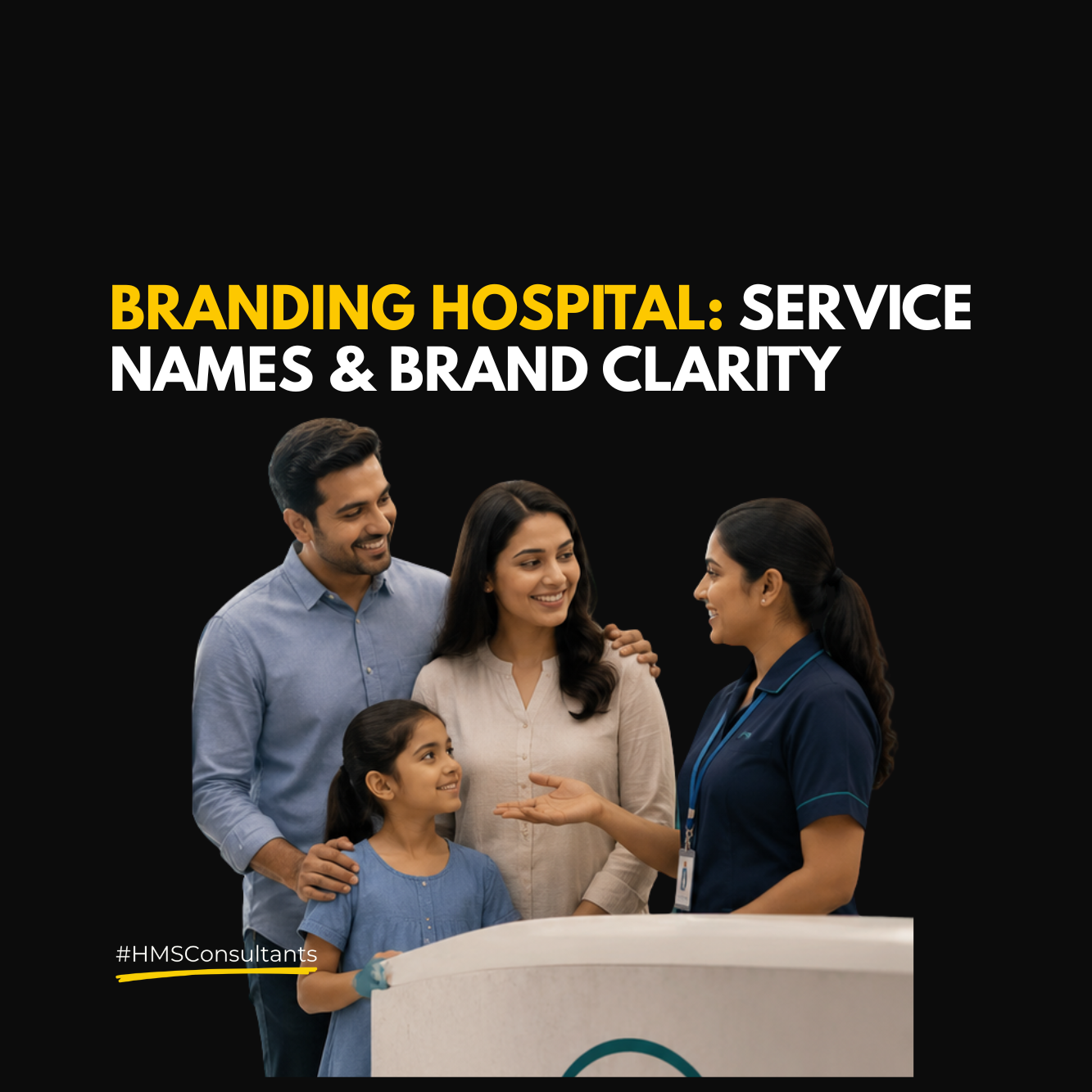
      • Branding Hospital: Why Service Names and Brand Clarity Matter

        Branding Hospital: Why Service Names and Brand Clarity Matter

        Branding Hospital: Why Service Names and Brand Clarity Matter

        Published on
        Share This

        Branding hospital is not only about logos, colors, taglines, interiors, or advertisements. One important part of hospital branding that is often ignored is how clearly the hospital names, organizes, and communicates its services.

        Many hospitals offer multiple departments, clinics, packages, programs, procedures, doctor-led services, and specialised centres. But when these services are named differently across the website, Google Business Profile, brochures, reception desk, banners, and social media, patients may feel confused.

        For example, the same service may be called “Heart Care” on one platform, “Cardiology” on another, “Cardiac OPD” in a banner, “Chest Pain Clinic” on social media, and “Heart Specialist Consultation” at the reception desk. Internally, the hospital team may understand what these terms mean. But for a patient, too many names can create uncertainty.

        This is why hospital brand clarity matters. A hospital brand should make services easier to understand, not harder to identify.


        Why Service Names Matter in Hospital Branding

        Patients do not always understand medical terms the way hospital teams do. They search, ask, and enquire in simple language. A patient may not search for “orthopaedic department” first. They may search for “knee pain doctor,” “joint pain treatment,” or “fracture care near me.”

        If hospital service names are too technical, unclear, or inconsistent, patients may not understand whether the hospital offers what they need.

        Clear hospital service names help patients quickly understand:

        • What the service is about.
        • Which health concern does it relate to?
        • Which doctor or department handles it?
        • Whether the service is relevant to their problem.
        • What is the next step they should take?

        Hospital branding becomes stronger when patients can understand the hospital’s services without confusion.

        The Problem With Multiple Names for the Same Service

        One common issue in branding a hospital is using different names for the same or related services. This often happens when different teams create content separately.

        The website team may use one name. The social media team may use another. The front desk may explain it differently. The doctor may use a clinical term. The brochure may mention a package name. Over time, the hospital communication becomes fragmented.

        For example:

        • “Women’s Health Clinic”
        • “Gynaecology Department”
        • “Maternity Care”
        • “Pregnancy Clinic”
        • “Antenatal Care Services”

        All these may be connected, but patients may not know how they relate to each other. Some may think they are separate services. Some may not know which one to choose.

        This weakens hospital service communication because the patient has to decode the hospital’s language. A strong hospital brand should reduce this confusion.

        Patients Need Simple and Familiar Language

        Hospital teams often use clinical or internal terms because they are familiar with them. But patients usually think in terms of symptoms, needs, and concerns.

        A patient may think:

        • I have chest pain.
        • My child has a fever.
        • I need pregnancy care.
        • I want a health check-up.
        • My father has knee pain.
        • I need an eye test.

        If the hospital only uses technical department names, the patient may not immediately connect their concern with the right service.

        This does not mean hospitals should avoid medical terms completely. It means medical terms should be supported with patient-friendly explanations.

        For example, instead of only saying “Cardiology,” the hospital can explain it as “heart care for chest pain, blood pressure, heart check-ups, and cardiac concerns.” This makes the service easier to understand.

        Healthcare branding should help patients connect their concern with the right care.

        How Confusing Service Names Affect Enquiries

        Unclear service names can directly affect patient enquiries. When patients do not understand which service to choose, they may delay calling, ask repeated questions, or move to another hospital that explains things more clearly.

        Confusion may happen when:

        • Service names are too technical.
        • The same service has different names across platforms.
        • Packages are not explained properly.
        • Department names and doctor services are mixed.
        • Website pages do not match Google Business Profile listings.
        • Social media posts use terms not found on the website.
        • Front desk communication is different from online content.

        For patients, this can create doubt. They may wonder whether the hospital offers the service, which doctor to meet, what appointment to book, or whether the service is suitable for their concern.

        Hospital brand clarity helps reduce these doubts. It makes the enquiry process smoother and more confident.

        Organizing Departments, Packages, and Programs

        A hospital may have many layers of services. There may be departments, sub-specialities, health packages, screening programs, day-care procedures, emergency services, OPDs, and doctor-led clinics.

        If these are not organised properly, the hospital brand can look confusing even if the hospital offers good care.

        A clear hospital service structure should answer:

        • What are the main departments?
        • What services come under each department?
        • Which services need separate pages or listings?
        • Which packages need a simple explanation?
        • Which doctor handles which service?
        • Which terms should be used consistently everywhere?

        For example, a hospital can use “Orthopaedics” as the department name and then clearly list related services such as joint pain, fracture care, arthritis care, sports injury care, spine problems, and knee replacement.

        This helps patients understand both the department and the specific concern it addresses.

        Consistency Across Every Platform

        Hospital branding becomes stronger when the same service language is used across all patient-facing platforms.

        This includes:

        • Website service pages.
        • Google Business Profile.
        • Social media posts.
        • Brochures and banners.
        • Reception communication.
        • WhatsApp replies.
        • Doctor profile pages.
        • Appointment scripts.
        • Health camp communication.

        If the website says one thing and the reception says another, the brand feels unorganised. If Google lists a service but the website does not explain it, patients may feel unsure. If social media promotes a service using a name that is not visible anywhere else, the patient journey becomes disconnected.

        Consistency does not mean every platform must use the exact same paragraph. It means the service name, meaning, and patient guidance should remain aligned.

        Brand Clarity Supports Hospital Positioning

        Hospital positioning becomes stronger when patients clearly understand what the hospital offers and what it is known for. A hospital may want to be known for advanced care, specialist services, preventive health, emergency support, maternity care, diagnostics, or multi-speciality treatment. But that positioning becomes weak if the services are not communicated clearly.

        Patients should not feel that the hospital is saying too many things in too many different ways.

        Clear service naming helps create stronger recall. When patients repeatedly see the same service language across platforms, they begin to connect the hospital name with specific healthcare needs.

        For example, if a hospital wants to strengthen its maternity care positioning, the communication around pregnancy care, antenatal visits, delivery support, high-risk pregnancy, and postnatal guidance should be organised clearly under one service structure.

        This makes the hospital easier to understand and easier to remember.

        What Hospitals Should Avoid

        Hospitals should avoid creating service names only to sound advanced or different. If the name is attractive but unclear, it may not help patients.

        Hospitals should avoid:

        • Using too many names for the same service.
        • Creating package names without explaining what they include.
        • Using only medical terminology without patient-friendly meaning.
        • Promoting services online that staff cannot explain clearly.
        • Mixing department names, symptoms, and procedures without structure.
        • Changing service names across platforms without a clear reason.

        Branding hospital should make communication simpler, not more complicated.

        Conclusion

        Branding hospital is not only about how the hospital looks. It is also about how clearly patients understand what the hospital offers.

        When service names are confusing, inconsistent, or too technical, patients may struggle to connect their health concern with the right department or doctor. This can affect enquiries, patient understanding, and hospital recall.

        Clear hospital service names, organised service structure, and consistent communication help make hospital branding stronger. They allow patients to understand services faster, ask better questions, and take the next step with more confidence.

        A strong hospital brand is not built only through design. It is also built through clarity.

        When patients can easily understand what the hospital offers, the brand becomes easier to trust, remember, and choose.

        Contact Us HMS Consultants

        Branding in a hospital means creating a clear and consistent identity that helps patients understand what the hospital offers. In this blog context, hospital branding also includes clear service names, organised departments, simple communication, and consistency across website, Google profile, reception, and social media.

        Digital Marketing I Hospital Branding I hospital marketing I Hospital Marketing Strategies I Hospital Marketing Strategy

        is something we strongly believe in, which means ‘Knowledge without application is the same as having no knowledge at all

        Akhil Dave

        Principle Consultant

        Ready to take your Personal Brand to the next level?

        Share your details below and we will connect with you to discuss your growth strategy.

        • Marketing Ideas for Hospital: How to Use Local Community Presence for Better Recall

          Marketing Ideas for Hospital: How to Use Local Community Presence for Better Recall

          Marketing Ideas for Hospital: How to Use Local Community Presence for Better Recall

          Published on
          Share This

          Marketing ideas for hospital should not always begin with digital campaigns, paid ads, or social media posts. For many hospitals, especially those serving a specific city or locality, stronger recall is built through regular community presence.

          A hospital may have good doctors, services, facilities, and online visibility. But if people living nearby do not remember the hospital when a healthcare need arises, marketing may still feel incomplete. Local recall matters because patients often choose hospitals they have seen, heard about, or interacted with through trusted community activities.

          This is where local hospital marketing becomes important. A hospital should not only be visible online. It should also be present in the area it serves’s health awareness, preventive care, and community conversations.

          Why Local Recall Matters

          Hospitals are not chosen casually. People may not need a hospital every day, but when a health concern comes up, they remember names that feel familiar, reliable, and accessible.

          Local recall is built when people repeatedly see the hospital in useful and responsible ways.This can happen through health awareness programs, preventive check-up drives, residential society sessions, school health talks, corporate wellness activities, seasonal health campaigns, and local partnerships.

          That is why community presence is one of the most practical marketing ideas for hospital growth, especially for hospitals that depend on patients from nearby areas.

          Community Health Awareness Programs

          Community health awareness is one of the strongest ways to build hospital recall. Hospitals can organise awareness sessions around common health concerns that people often ignore until symptoms become serious.

          These sessions should not sound promotional. They should focus on simple and useful health education.

          Hospitals can create awareness around:

          • Diabetes
          • Heart health
          • Women’s health
          • Bone and joint care
          • Child health
          • Eye care
          • Cancer screening
          • Seasonal infections
          • Mental health

          When doctors explain health concerns in simple language, people begin to see the hospital as a helpful healthcare guide, not only a place for treatment.

          Preventive Health Check-Up Drives

          Preventive check-up drives can support both public health awareness and hospital visibility. Many people delay health check-ups because they do not feel an immediate need. When hospitals take preventive care closer to the community, people become more aware of early detection and regular monitoring.

          These drives can be planned in:

          • Residential societies
          • Schools and colleges
          • Corporate offices
          • Senior citizen groups
          • Community centres
          • Local clubs
          • Industrial areas

          The purpose should not only be to collect leads. It should be to educate people about why preventive health matters and when they should consult a doctor.

          A well-planned preventive drive can improve hospital visibility while also creating useful community engagement.

          Local Partnerships for Better Reach

          Hospitals can build stronger community presence by partnering with local groups and institutions. These partnerships help hospitals reach people in places where health conversations are already relevant.

          Useful partnerships can include schools, colleges, housing societies, corporate offices, NGOs, local associations, senior citizen groups, fitness centres, women’s groups, and industrial units.

          For example, a hospital can conduct a bone health session for senior citizens, a menstrual health awareness session in a college, or a heart health talk for working professionals.

          Among different marketing ideas for hospital visibility, local partnerships are useful because they help the hospital reach targeted groups rather than speaking to a broad audience.

          Seasonal Health Campaigns

          Every local area faces seasonal health concerns. Hospitals can use these concerns to plan timely awareness campaigns that are useful for the community.

          Seasonal campaigns may include:

          • Monsoon fever awareness
          • Dengue and malaria prevention
          • Respiratory care during pollution season
          • Heatstroke awareness in summer
          • Flu prevention
          • Skin and allergy awareness
          • Child health during school reopening
          • Senior care during winter

          These campaigns work well because they connect with what people are already experiencing. When a hospital shares timely health guidance, people see the information as relevant and useful.

          Seasonal communication also helps hospitals remain visible throughout the year without depending only on promotional content.

          Residential Society and Corporate Activities

          Residential societies and corporate offices are important spaces for local hospital marketing. Families, senior citizens, working professionals, and children are part of these communities.

          Hospitals can conduct short, focused sessions on practical topics such as:

          • When to consult for chest pain
          • Early signs of diabetes
          • Joint pain and mobility care
          • Child fever warning signs
          • Women’s health after 40
          • Senior citizen fall prevention
          • Importance of regular screening
          • Stress and lifestyle health

          These sessions should be easy to understand and directly useful. The goal is not to make the activity too technical. The aim is to help people know when to take health concerns seriously and when to seek medical advice.

          Offline Presence Can Support Online Recall

          Community activities should not end after the event. Hospitals can use offline activities to support online recall as well.

          After a health camp, awareness session, or community activity, hospitals can share:

          • Event highlights
          • Doctor education clips
          • Key health tips
          • Photos from the session
          • Short awareness posts
          • Follow-up health guidance

          This helps the hospital extend the impact of offline activities to digital platforms. People who attended the event remember it, while others can still discover the hospital through online updates.

          This balance of offline and online communication makes hospital visibility stronger.

          What Hospitals Should Avoid

          Community presence should be handled responsibly. If every activity looks like direct promotion, people may lose interest.

          Hospitals should avoid:

          • Turning health talks into sales pitches
          • Using fear-based communication
          • Promising guaranteed results
          • Sharing patient-sensitive information
          • Using overly technical language
          • Conducting one-time camps without follow-up
          • Promoting services without patient education

          The purpose of community-based hospital marketing is to educate, connect, and build recall. It should feel helpful before it feels promotional.

          Conclusion

          Marketing ideas for hospital growth should include more than online campaigns and advertisements. For hospitals serving a local area, community presence can play an important role in building long-term recall.

          Health awareness programs, preventive check-up drives, local partnerships, residential society sessions, corporate wellness programs, and seasonal campaigns can help hospitals stay connected with people around them.

          Strong community presence helps people remember the hospital before a healthcare need becomes urgent. Better hospital marketing does not always mean louder promotion. Sometimes, it means being consistently present where the community needs useful health guidance.

          Contact Us HMS Consultants

          Hospital marketing can be done by building both online visibility and local community presence. Hospitals should use health awareness programs, preventive check-up drives, local partnerships, seasonal campaigns, residential society sessions, and useful digital updates to stay connected with nearby patients.

          Digital Marketing I Doctor Branding I healthcare digital marketing I Healthcare Marketing I Hospital Branding I hospital marketing I Hospital Marketing Strategies I Hospital Marketing Strategy I local community building

          is something we strongly believe in, which means ‘Knowledge without application is the same as having no knowledge at all

          Akhil Dave

          Principle Consultant

          Ready to take your Personal Brand to the next level?

          Share your details below and we will connect with you to discuss your growth strategy.

          • Hospital Public Relations: The Silent Gaps That Affect Patient Trust

            Hospital Public Relations: The Silent Gaps That Affect Patient Trust

            Hospital Public Relations: The Silent Gaps That Affect Patient Trust

            Published on
            Share This

            Hospital public relations is often noticed only when something goes wrong. A negative review, a patient complaint, a media issue, or a communication mistake suddenly brings attention to reputation. But hospital public relations does not begin during a crisis. It begins much earlier through everyday patient communication, staff behaviour, online reviews, community presence, and the way the hospital responds to people.

            Many hospitals think PR means press releases, media coverage, or public events. These are part of it, but they are not the full picture. In healthcare, public relations is closely connected with patient trust.

            This means healthcare marketing cannot depend only on random posts, occasional ads, or basic promotion.

            A hospital may have experienced doctors, good facilities, and strong services, but if patients feel confused, unheard, or unsure, trust can slowly weaken. These are silent gaps. They may not look serious at first, but over time they affect hospital reputation and patient confidence.

            Why Silent PR Gaps Matter

            Patients and families do not choose a hospital casually. They search online, read reviews, ask others, check the website, call the hospital, and observe how clearly the hospital communicates.

            A patient may not understand every clinical detail, but they can sense whether the hospital feels organised, responsive, and trustworthy. That is why hospital public relations should not be treated only as publicity. It should be seen as a trust-building system.

            A hospital’s image is shaped by small experiences such as:

            • How quickly calls are answered
            • How clearly staff explain services
            • How reviews are handled
            • How complaints are acknowledged
            • How the website explains important information
            • How patients are guided before and after consultation
            • How the hospital responds during confusion or crisis

            When these areas are ignored, PR becomes reactive. The hospital starts responding only after trust is already affected.

            Gap 1: Unclear Patient Communication

            One of the biggest gaps in hospital public relations is unclear communication. Many hospitals promote their services, but they do not always explain them in a way patients can understand.

            Patients often want simple answers:

            • Which department should I visit?
            • Which doctor handles this condition?
            • How do I book an appointment?
            • What should I expect during consultation?
            • What happens after the visit?
            • Whom should I contact for help?

            If this information is missing or confusing, the patient may delay the decision or choose another hospital. Good hospital PR is not only about speaking to the public. It is about speaking clearly and responsibly.

            Gap 2: Ignoring Patient Feedback

            Patient feedback is one of the strongest signals of reputation. But many hospitals treat feedback only as a complaint, instead of seeing it as an opportunity to improve.

            A delayed response, unclear billing explanation, rude staff interaction, long waiting time, or poor follow-up may seem like a small operational issue. But when these experiences repeat, they become reputation issues.

            Patients may share their experience through:

            • Google reviews
            • Social media comments
            • WhatsApp groups
            • Family discussions
            • Local word-of-mouth
            • Direct complaints

            Hospitals should regularly review feedback and understand what patients are saying. If the same issue appears again and again, it should not be ignored. Reputation management is not only about replying to reviews. It is also about learning from them.

            Gap 3: Inconsistent Staff Messaging

            A hospital may have one brand message, but patients experience the hospital through different people. The front desk may say one thing, the call team may say another, and the department may explain something differently.

            This creates confusion.

            In healthcare, confusion directly affects trust. Patients want to feel that the hospital team is informed, aligned, and confident. If staff members give different answers about appointments, reports, doctor availability, services, or follow-up, the hospital may appear disorganised.

            Hospitals should train patient-facing teams on:

            • Basic service information
            • Appointment guidance
            • Enquiry handling
            • Complaint escalation
            • Patient-friendly language
            • Follow-up communication
            • Sensitive conversations

            Public relations is not handled only by management or marketing teams. Every staff member who speaks to a patient contributes to the hospital’s image.

            Gap 4: Poor Online Reputation Response

            Patients often check reviews before choosing a hospital. A few unmanaged reviews can influence whether someone decides to call, visit, or avoid the hospital.

            Many hospitals either ignore reviews or respond in a very generic way. Some responses sound defensive, while others do not address the concern at all. This can make patients feel that the hospital does not listen.

            A better online reputation response should include:

            • Thanking patients for positive feedback
            • Acknowledging concerns politely
            • Avoiding arguments online
            • Not sharing patient-sensitive details publicly
            • Taking serious concerns offline
            • Tracking repeated complaints
            • Improving internal processes based on feedback

            Online reputation is now a major part of hospital public relations. It cannot be treated as an optional activity.

            Gap 5: Weak Community Presence

            Hospitals are not just treatment centres. They are part of the communities they serve. A hospital may be known for its services, but if it is not visible as a responsible healthcare voice, it may miss an important trust-building opportunity.

            Community presence can include:

            • Health awareness programs
            • Preventive care campaigns
            • Patient education sessions
            • Local health talks
            • School or corporate health awareness
            • Public health messages
            • Community outreach activities

            This does not mean every hospital needs big events. It means the hospital should be seen as active, helpful, and connected to local health needs. A strong community presence builds trust before patients need treatment.

            Gap 6: No Crisis Communication Readiness

            Hospitals often think about crisis communication only after a problem happens. This can create confusion, delay, and inconsistent responses.

            A crisis may come from a patient complaint, social media issue, negative media attention, misinformation, service disruption, or internal communication failure. If the hospital does not know who should respond and what should be communicated, the situation can become worse.

            Hospitals should prepare answers to questions like:

            • Who will respond during a crisis?
            • What information can be shared?
            • How will patient privacy be protected?
            • How will staff be informed?
            • How will online comments be handled?
            • How will leadership communicate?

            Crisis communication should be planned before it is needed. A prepared hospital appears responsible and controlled. An unprepared hospital may appear silent, defensive, or confused.

            Gap 7: Marketing Claims Not Matching Patient Experience

            A hospital may promote care, trust, advanced facilities, and patient-first service. But if the actual patient experience does not match that promise, reputation suffers.

            Patients remember what they experience more than what they see in advertisements.

            If the hospital promotes smooth appointments but patients face confusion, there is a gap. If the hospital talks about compassionate care but staff communication feels cold, there is a gap. If the hospital promises patient support but follows up weakly, trust is affected.

            Hospital public relations must connect marketing promises with real patient experience. The message outside the hospital should match what patients feel inside the hospital.

            Conclusion

            Hospital public relations should not begin after reputation damage. It should be part of everyday hospital communication.

            The silent gaps in hospital PR often appear in small places: unclear information, ignored feedback, weak review response, inconsistent staff messaging, poor crisis readiness, and marketing promises that do not match patient experience.

            These gaps may not create immediate damage, but they slowly affect how patients see the hospital.

            Hospitals that want long-term growth need more than promotion. They need communication systems that support clarity, credibility, patient confidence, and trust. A strong hospital public relations strategy helps hospitals protect their reputation before damage happens and build trust before patients walk in.

            Contact Us HMS Consultants

            PR in a hospital means public relations. It is how a hospital communicates with patients, staff, community, media, and the public to build trust, manage reputation, handle feedback, and respond responsibly during sensitive situations.

            Healthcare Marketing I Digital Strategy I healthcare Management I Hospital Branding I Hospital Marketing Strategy I public relations

            is something we strongly believe in, which means ‘Knowledge without application is the same as having no knowledge at all

            Akhil Dave

            Principle Consultant

            Ready to take your Personal Brand to the next level?

            Share your details below and we will connect with you to discuss your growth strategy.

            • The 5 Pillars of Hospital Branding That Drive Patient Trust – Not Just Footfall

              The 5 Pillars of Hospital Branding That Drive Patient Trust – Not Just Footfall

              The 5 Pillars of Hospital Branding That Drive Patient Trust – Not Just Footfall

              Written by
              Published on
              Share This

              What most hospital leadership teams do not realise is this:
              • Most hospitals in India are not suffering from a visibility problem.
              • They are suffering from a trust problem.

              Here is what is already happening:
              • They are running ads.
              • They are posting on social media.
              • They are showing up on Google.
              • Patients are finding them.

              But the real issue is patients are not choosing them, and when you ask hospital leadership why the answer is almost always the same:

              “Our marketing is not working.”

              But here is the uncomfortable truth – The marketing is working. The brand is not.

              There is a fundamental difference between a hospital that is visible and a hospital that is trusted. Visibility brings patients to the door. Brand is what makes them walk in and come back.

              Hospital branding is not a logo. It is not your hospital’s colours, your tagline, or your website design. Those are the surface. Branding is what lives underneath what patients feel before they arrive, during their visit, and long after they leave.

              This piece is about the five pillars that hold that brand together. Without even one of them, the structure weakens. And most Indian hospitals, right now, are missing at least two.

              What Hospital Branding Really Means

              Walk into the marketing department of most mid-size hospitals in India, and you will find a mood board. Colours. Fonts. A logo concept. A tagline that someone spent three weeks arguing about.

              That is brand design. It is not hospital branding.

              Hospital branding is the total perception a patient carries about your institution formed through every search result, every phone call, every waiting room experience, every conversation with a doctor, every follow-up message they did or did not receive.

              Patients do not evaluate these moments separately. They experience them together. And the cumulative impression of those moments that is your brand. Not what you designed in a boardroom. What you delivered at every touchpoint.

              The 5 Pillars of Hospital Branding That Drive Patient Trust

              Here is what holds a hospital brand together and what breaks it when even one of these is absent.

              PillarWhat It MeansWhat Happens Without It
              1. Brand Promise The specific transformation your hospital commits to delivering not a tagline, but a lived standard. Patients have no reason to choose you over any other hospital in your city or speciality.
              2. Brand Personality The consistent voice, tone, and human character of your hospital how you speak, respond, and behave across every touchpoint. Your hospital feels corporate, cold, or inconsistent trust never forms.
              3. Patient Experience Every physical and emotional interaction from the first search to post-discharge your brand is only as strong as its weakest touchpoint. Strong visibility, weak conversion patients enquire but do not choose.
              4. Proof & Credibility Real outcomes, real patient stories, real clinical data, the evidence that makes your brand promise believable. You say it. Patients do not believe it. And the competitor with better proof wins.
              5. Presence & Consistency Showing up in the same way, same message, same values, same quality across digital, physical, and human channels. Patients see a different hospital every time they interact. Confusion replaces trust.

              Pillar 1: Brand Promise – The Standard You Set Before the Patient Arrives

              Every hospital communicates something to patients before a single consultation happens. It is in the way you respond to an enquiry. The language on your website. The tone of your social media. The speed of your callbacks.

              That communication is your brand promise whether you intentionally set it or not.

              Hospitals that build strong brands define this promise consciously. Not as a tagline, but as a standard. Not “We care about patients” but “Every patient who calls us will receive a callback within 15 minutes, a clear diagnosis, and a follow-up within 72 hours.”

              That kind of specificity is what turns a promise into a brand.

              Pillar 2: Brand Personality – How Your Hospital Speaks When No One Is Watching

              Patients do not just choose hospitals for their equipment or their specialist list. They choose hospitals they feel something about.

              Brand personality is the human character of your hospital: its warmth, its authority, its communication style. It shows up in how your front desk answers the phone. How your discharge summary is worded. How your social media responds to a comment.

              A hospital with a clear brand personality feels consistent. A hospital without one feels different every time a patient interacts with it and inconsistency is the opposite of trust.

              Pillar 3: Patient Experience – Where Brand Promises Are Either Kept or Broken

              This is where most hospital brands collapse.

              A hospital invests in a beautiful website, strong ads, and compelling social content. The patient enquires. Then they call  and the phone rings twelve times before someone answers. Or they visit, and the waiting time is three hours with no communication. Or they are discharged without a single follow-up.

              That is not a patient experience failure. That is a brand failure.

              In hospital branding, every interaction is a brand touchpoint. The receptionist is brand. The signage is brand. The cleanliness of the corridor is brand. Patients are not separating these from your marketing. They are adding them all up  and forming a verdict.

              Pillar 4: Proof and Credibility – Because Trust Cannot Be Claimed. It Can Only Be Earned.

              You can say your hospital is the best. Every hospital in your city says the same thing.

              Proof is what separates a brand from a claim. Real patient outcomes. Genuine testimonials. Clinical data. Doctor credentials that go beyond a list of degrees. Case studies that show what changed for a real person.

              In 2026, patients in India are more informed than ever before. They research before they visit. They compare. They read reviews. They watch doctor reels. A hospital brand without visible, verifiable proof is a brand asking for trust it has not yet earned.

              Proof does not have to be complex. A patient who says  in their own words, with their own face  “I can walk again” does more for your hospital brand than a full-page newspaper ad.

              Pillar 5: Presence and Consistency – The Pillar That Holds All the Others Together

              The most common reason hospital brands fail is not one dramatic mistake. It is slow, quiet inconsistency.

              The hospital that posts on Instagram for three months and then goes silent. The one that promises compassionate care on its website but delivers rushed consultations. The one that has a strong Google presence but a homepage that has not been updated in two years.

              Brand presence is not about being everywhere. It is about being the same reliably, recognisably  wherever you are.

              Patients are pattern-recognition machines. They trust what they can predict. A hospital brand that shows up consistently same values, same quality, same voice becomes predictable. And in healthcare, predictability is a form of safety.

              The Hospital Branding Mistake That Is Costing Indian Hospitals the Most

              Most hospitals in India are investing in marketing without first investing in brand.

              They are spending on ads that bring patients in and losing them to an experience that does not match what was promised. They are building visibility without building trust. And the result is enquiries that do not convert, patients who do not return, and referrals that never happen.

              The hospitals that will lead Indian healthcare in the next decade are not going to be the ones with the biggest buildings or the most expensive equipment.

              They are going to be the ones patients remember. The ones patients return to. The ones patients tell their families about without being asked.

               That is what hospital branding  one right, built on all five pillars delivers.

              Not just footfall. Trust.

              Conclusion

              Most hospitals in India are not losing patients to better hospitals.

              They are losing them to better brands.

              Not bigger. Not more expensive. Not more equipped. Just clearer. More consistent. More trustworthy at every single touchpoint a patient encounters before they ever walk through the door.

              That is the gap the five pillars close.

              And the hospitals that close it first in their city, in their speciality, in their market do not just grow their footfall.

              They become the hospital patients think of first. Return to always. And recommend without being asked.

              That is not marketing.

              That is what hospital branding, done right, actually delivers.

              Contact Us HMS Consultants

              Hospital branding is the structured identity a hospital builds through its promise, personality, patient experience, clinical proof, and consistent presence. It matters because patients in 2026 choose hospitals they trust not just the ones they find.

              Hospital Marketing Strategy I Hospital Branding

              is something we strongly believe in, which means ‘Knowledge without application is the same as having no knowledge at all

              Akhil Dave

              Principle Consultant

              Ready to take your Personal Brand to the next level?

              Share your details below and we will connect with you to discuss your growth strategy.