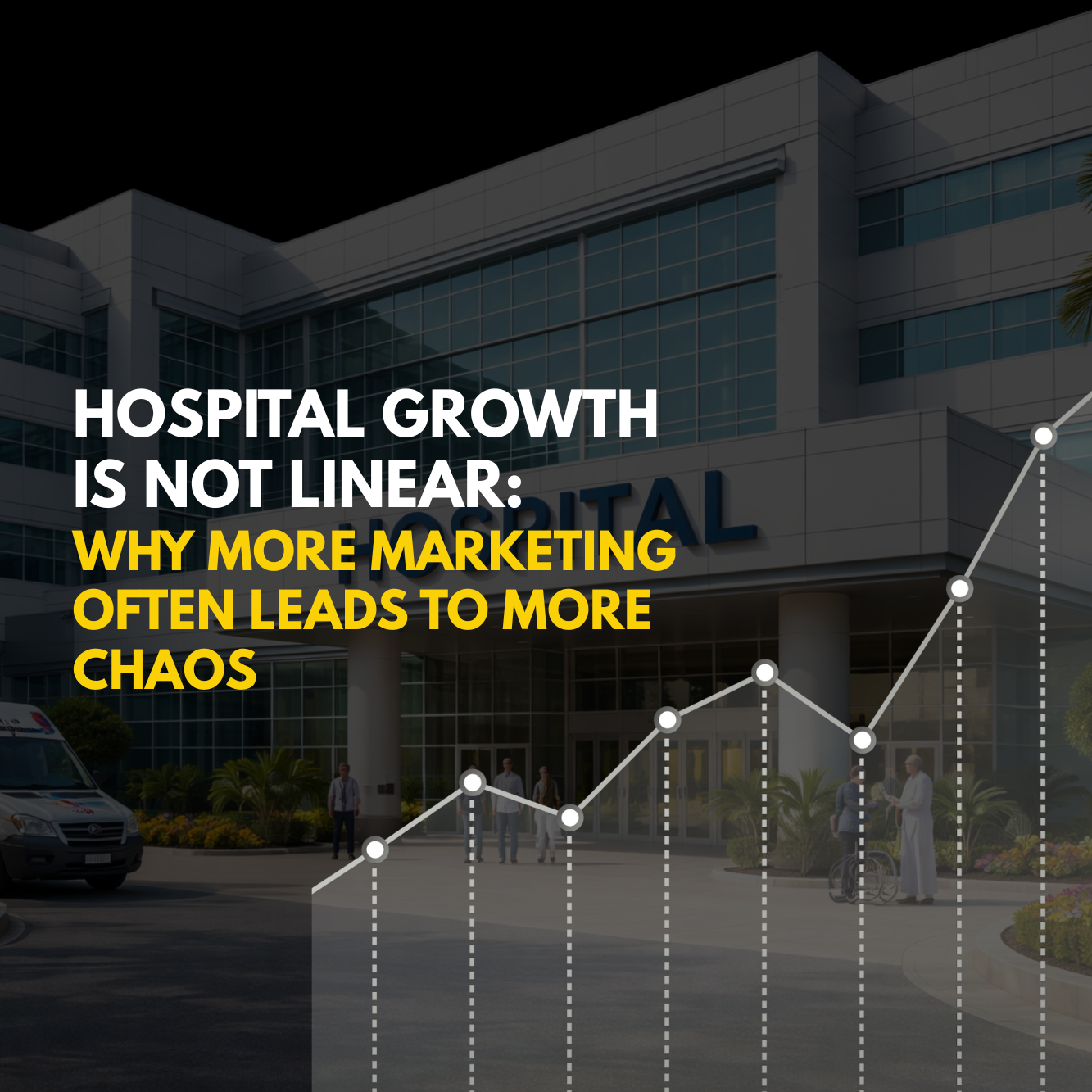
Hospital Growth Is Not Linear: Why More Marketing Often Leads to More Chaos
When Growth Feels Harder Than Before
Many hospital owners reach a confusing phase in their growth journey. Marketing seems to be working, enquiries increase, calls rise, WhatsApp messages flood the system, OPD footfall improves, yet instead of feeling successful, the organisation feels strained. Staff appear overwhelmed, patients complain more often, doctors feel rushed, and internal coordination begins to crack.
At this point, the instinct is to blame operations, staffing, or “growing pains.” But the deeper truth is more uncomfortable: hospital growth is not linear, and marketing does not scale outcomes in a straight line.
In healthcare, growth amplifies reality. If systems are weak, growth exposes them. If processes are unclear, growth magnifies confusion. If communication is inconsistent, growth multiplies dissatisfaction. More marketing does not automatically mean better outcomes, it often means more chaos.
The Myth of Linear Growth in Healthcare
Most hospitals unconsciously believe in a simple equation: more visibility leads to more patients, which leads to more revenue, which leads to stability.
This logic works well in theory, but healthcare does not function like a conventional consumer business. Hospitals are complex systems where clinical care, human behaviour, trust, emotions, staff coordination, infrastructure, and decision-making intersect. When marketing increases demand without strengthening the system underneath, imbalance is inevitable.
Hospital growth is not a straight upward line. It is a series of stress tests. Each increase in patient volume tests reception capacity, doctor bandwidth, communication quality, billing transparency, and follow-up discipline. When these systems are not designed to scale, marketing becomes a pressure cooker rather than a growth lever.
Why More Leads Often Reduce Patient Experience
One of the most common patterns seen in Indian hospitals is this: marketing works, but patient satisfaction drops.
As enquiries increase, response times slow down. Reception teams become transactional rather than empathetic. Doctors shorten consultations to manage volume. Waiting times stretch. Explanations become rushed. Follow-ups are missed. Patients feel processed rather than cared for.
From the hospital’s perspective, this feels like progress, numbers are up. From the patient’s perspective, trust quietly erodes.
This is why many hospitals see an increase in footfall but not in loyalty, referrals, or long-term brand strength. Growth without readiness damages the very experience that marketing promised.
Marketing as an Amplifier, Not a Fix
Marketing does not correct internal problems; it amplifies them.
- If your appointment system is unclear, marketing will expose it faster.
- If staff communication is inconsistent, marketing will bring more people to experience that inconsistency.
- If pricing explanations are weak, marketing will increase objections.
- If follow-up systems are broken, marketing will increase drop-offs.
Hospitals often respond by pushing even harder on marketing, assuming volume will compensate for inefficiency. In reality, this creates a vicious cycle where more leads generate more pressure, more dissatisfaction, and eventually more negative word-of-mouth.
Marketing should be used as an accelerator only after internal systems are aligned. Otherwise, it becomes a stress multiplier.
The Capacity Mismatch Problem
Another reason growth turns chaotic is capacity mismatch. Hospitals increase demand without recalibrating supply, not just in beds or doctors, but in attention, time, and emotional energy.
Clinical capacity may exist on paper, but experiential capacity often does not. A doctor who can technically see 40 patients a day may not be able to meaningfully communicate with all of them. A reception team may be able to handle calls, but not anxious conversations. A billing desk may process payments, but not explain costs calmly under pressure.
When marketing increases volume without addressing these human limits, the system stretches until it begins to fray. True growth requires designing capacity not only for treatment, but for trust delivery.
Why Hospitals Feel “Busy” But Not Stable
Many hospital owners describe this phase with the same words: “We are very busy, but nothing feels settled.”
This happens when growth is activity-driven rather than system-driven. More enquiries create more tasks, but without standardisation, clarity, and delegation, leadership becomes reactive. Decisions become urgent instead of thoughtful. Teams chase daily fires instead of building long-term capability.
Busy hospitals are not necessarily growing hospitals. Stability comes from repeatable systems, not constant motion.
The Leadership Challenge During Growth
Growth demands a shift in leadership style. What worked in the early stages- hands-on control, intuition-based decisions, informal coordination- begins to fail as scale increases.
Leaders must move from solving problems themselves to designing frameworks that prevent problems. They must stop reacting to marketing spikes and start anticipating their impact. This transition is difficult, especially for founder-led hospitals where decision-making has always been personal.
But without this shift, growth remains fragile and exhausting.
When Growth Starts Working in Favour of the Hospital
Hospitals that manage growth successfully do one critical thing differently: they treat marketing as the final layer, not the foundation.
Before scaling visibility, they strengthen appointment flows, communication protocols, patient education, staff training, billing clarity, and follow-up systems. They design experiences that can handle volume without compromising care. Marketing then brings patients into a system that is ready to serve them well.
In such environments, growth feels controlled rather than chaotic. Staff feel confident instead of overwhelmed. Patients feel supported rather than rushed. Leadership regains clarity.
Conclusion: Sustainable Growth Feels Calm, Not Chaotic
Chaos is not a sign of success. It is a signal of imbalance.
When hospital growth is done right, it feels steady, predictable, and composed. Marketing supports the system instead of stressing it. Patient experience improves alongside volume. Teams grow in capability, not just workload.
Hospitals must abandon the idea that more marketing automatically means more growth. In healthcare, growth must be earned systemically, not forced tactically.
The question is not how fast you can grow. The real question is how well your hospital can absorb growth without losing trust.
is something we strongly believe in, which means ‘Knowledge without application is the same as having no knowledge at all
Akhil Dave
Principle Consultant
Ready to take your Personal Brand to the next level?
Share your details below and we will connect with you to discuss your growth strategy.

Digital Marketing for Doctors: A Beginner’s Guide
Digital marketing for doctors starts with the basics. Learn how to build a…

50 Hospital Branding Ideas to Build Patient Trust
Discover 50 practical hospital branding ideas to build patient trust, strengthen hospital brand…

How to Choose a Healthcare Marketing Consultant: A Buyer’s Checklist
Learn how to choose a healthcare marketing consultant with a practical checklist covering…

Healthcare Marketing Agency vs. Consultancy: Key Differences
What is the difference between a healthcare marketing agency and consultancy? Learn how…

Internal Marketing Strategy for Hospitals: A 2026 Guide
Internal marketing for hospitals aligns staff with the hospital’s brand promise, strengthens employee…

SEO & AEO Strategy for Hospitals, Clinics & Doctors (2026)
Learn how hospitals, clinics, and doctors can combine SEO, AEO, and GEO to…