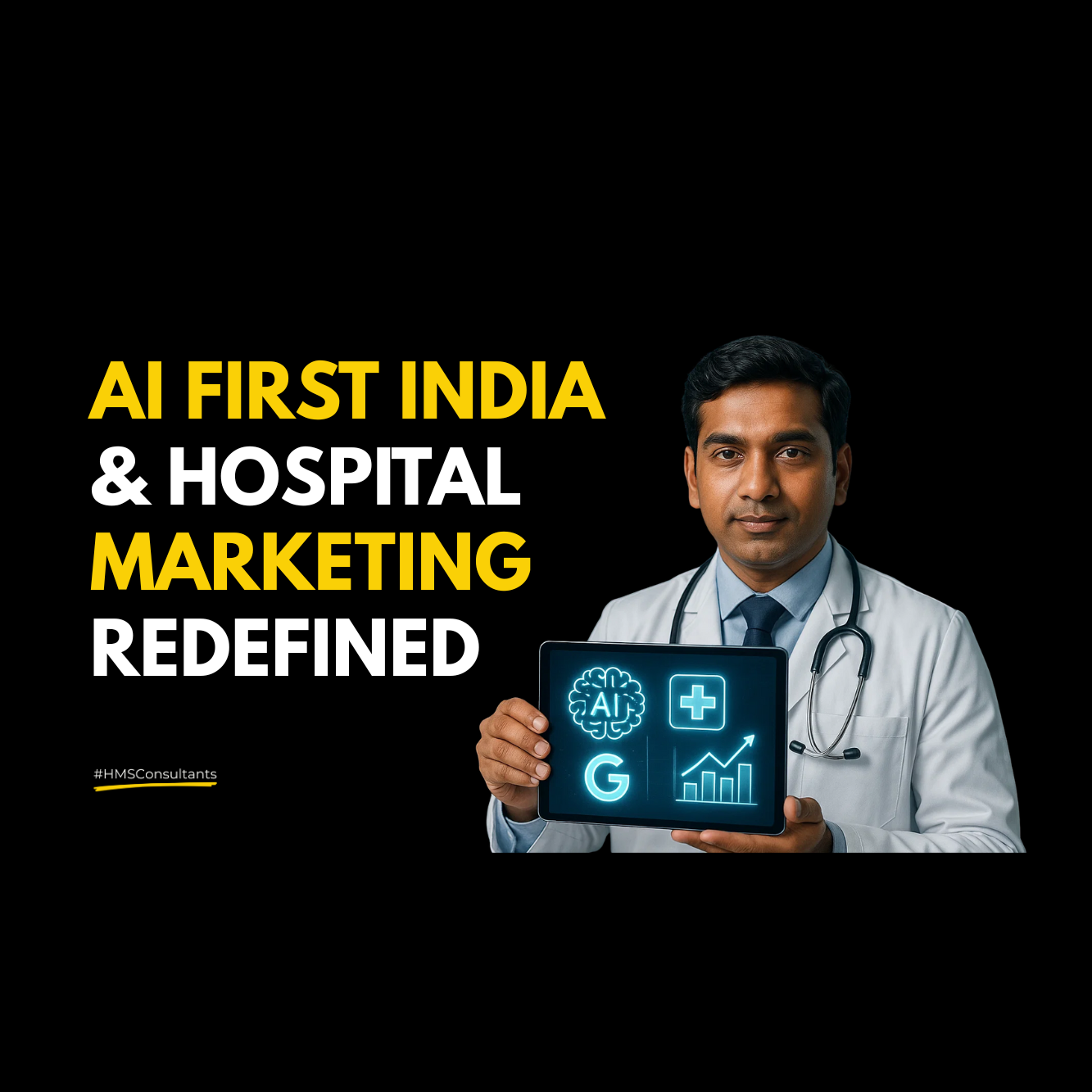
AI First India & Hospital Marketing Redefined
India is rapidly becoming one of the world’s largest hubs for AI innovation. The Google for Startups Accelerator: AI First in India program is only one proof of that. It supports early-stage AI startups (Seed to Series A) building core AI or foundational models.
For hospitals and clinics, this isn’t just tech news. It signals a shift. AI is no longer a futuristic promise. It is a tool that can directly improve patient experience, communication, diagnostics, operations and yes, marketing.
In this blog I’ll share how the AI First accelerator, together with real AI initiatives already in use across India, point to new strategies hospitals should adopt in their marketing.
What Is Google for Startups Accelerator: AI First in India
- It’s a three-month equity-free accelerator program by Google for Startups, aimed at AI First firms based in India. The program is for Seed to Series A stage startups.
- It offers mentorship, access to Google AI tools, cloud credits, support around product, design leadership, growth, etc.
- In the latest cohort, over 1600 applications came in, and 20 startups were selected. This shows strong interest and momentum for AI in India.
Current AI Trends in Indian Healthcare Relevant to Marketing
Before thinking strategy, let’s look at what is already happening on the ground:
- Hospitals like Apollo Hospitals are using AI tools to reduce staff workload by automating routine tasks like documentation, summaries, test result interpretation, etc. (Reuters)
- In Tamil Nadu, government hospitals are piloting AI-aided diagnosis for diseases like TB, cataracts, cancer, using image analysis (X-Ray, CT scans) to speed up screenings and reduce human bottlenecks. (The Times of India)
- SSG Hospital in Vadodara has launched an AI-powered oncology chatbot in multiple languages (Gujarati, Hindi, English) to help patients and caregivers with treatment instructions, side-effect management, follow-up care etc. This improves communication and trust. (The Times of India)
These examples show AI isn’t just in labs; it’s reaching patients, helping clinics and hospitals in practical ways.
How AI First Signals New Marketing Possibilities
Here are ways hospitals can use these AI developments & the AI First momentum to reshape their marketing strategies:
1. Personalised & Predictive Patient Communication
AI models can help segment patient populations. For instance, using past patient data to predict who is likely to return for annual check-ups, or who might need reminders for screening. Marketing messages can be tailored accordingly (via SMS, WhatsApp, email).
2. Smarter Chatbots & Virtual Assistants
The oncology chatbot example shows how chatbots can free up staff, improve access, answer patients in their languages, and deliver relevant information 24/7. For marketing, this builds trust, reduces friction, and becomes a visibility point (patients will share or review this ease).
3. Faster Diagnostics as Marketing Differentiator
If your hospital can promise faster image report turnaround using AI-assisted tools, it can use that as a positioning edge. “Get your X-Ray/CT results in 24 hours” or “AI-assisted screening” can be part of campaign messages.
4. AI for Content & Messaging Optimization
Using AI tools to analyse which content topics perform best, what messaging resonates, which channels have higher engagement. This helps craft marketing content that works, rather than guessing.
5. Operational Efficiency that Reflects in Patient Experience
AI can reduce waiting times, improve scheduling, and help staff focus on patient care. These improvements become stories in your marketing: “We reduced wait time by X,” “Our staff had more time to listen,” etc.
Challenges & What Hospitals Must Keep in Mind
While AI offers huge potential, hospitals must approach it carefully. Marketing messages must be truthful, and AI must not create hype without reliability.
- Accuracy & Ethics: AI-diagnosed suggestions must always be reviewed by doctors. Overpromising can damage reputation.
- Data Privacy: Collecting patient data for AI predictions or segmentation requires compliance with laws, patient consent, secure storage.
- Cost & Infrastructure: Not all clinics can afford or have the tech setup. Starting small is wise.
- Clarity in Claims: Marketing must clearly state “AI-assisted” or “AI-powered,” so patients know what to expect.
Market Size & Forecasts
To give context:
- AI in the healthcare sector in India was estimated at USD 333.16 million in 2024, and projected to grow to over USD 4,165 million by 2033 with a compound annual growth rate (CAGR) of about 30.78%. (IMARC Group)
- With Google’s AI First start, and many AI startups focused on health, digital tools, imaging, diagnostics etc., we are seeing rapid acceleration. )
Practical Steps for Clinics & Hospitals
If you are a hospital or clinic, here’s how you can start using this wave of AI in your marketing strategies:
- Audit Current Patient Journey to Find AI Gaps
E.g., long waits, slow report times, frequent patient queries. Which of these can be improved with AI? - Partner with AI Startups or Tools
Consider joining programs like Google AI First (or using tools built by its alumni), or adopting chatbots, diagnostic AI, etc. - Experiment with Pilot Projects
For example, start with a chatbot for common queries, or AI-assisted test report delivery, or predictive reminders. Measure impact. - Use AI in Messaging
Be transparent: “With AI assistance”, “Powered by AI tools” etc. Use it as a differentiator. - Train Staff & Protect Privacy
Make sure employees understand how to work with AI tools. Also ensure data collection, storage, and usage is ethical and secure.
Conclusion
Google’s AI First Accelerator is more than just another startup program. It indicates India is embracing AI at scale. For healthcare marketing, that opens up new possibilities: more personal communication, faster diagnosis, smarter content, and better operational efficiency.
Clinics that begin to use AI thoughtfully will not only improve patient experience but also stand out in growing digital visibility, trust, and reputation.
Written by Maitri Desai
is something we strongly believe in, which means ‘Knowledge without application is the same as having no knowledge at all
Akhil Dave
Principle Consultant
Ready to take your Personal Brand to the next level?
Share your details below and we will connect with you to discuss your growth strategy.
Why Hospital Patient Experience Breaks Long Before Patients Complain
Hospital patient experience often breaks silently before complaints surface, weakening patient trust, referrals, and long-term loyalty despite strong clinical outcomes.
Why Doctors Digital Marketing Fails When It Is Treated as a Content Problem
Doctors digital marketing fails when it is treated as a content volume problem. Patients do not need more information they need help making…
Why Marketing for Hospitals Should Slow Patients Down Before Asking Them to Decide
Marketing for hospitals works when patients feel guided, not rushed. Clear communication and patience build trust, helping decisions happen naturally.
Why Healthcare Branding Breaks When Hospitals Try to “Look Trusted” Instead of Building It
Healthcare branding breaks when hospitals focus on appearance instead of experience. Trust is built through consistency, clarity, and real patient interactions.
Why Hospital Marketing Strategy Fails When It Starts With Channels Instead of Decisions
Hospital marketing strategy fails when channels are chosen before patient decisions are understood. Growth improves when strategy reduces decision friction, not just increases…
Why Healthcare Marketing Strategy Breaks When Hospitals Copy What Competitors Are Doing
Healthcare marketing strategy fails when hospitals copy competitors instead of understanding patient confusion. Imitation creates visibility, but only patient insight builds trust and…