Category: Social Media Marketing

  • Hospital Marketing Is Not Promotion, It’s Infrastructure

    Hospital Marketing Is Not Promotion, It’s Infrastructure

    Hospital Marketing Is Not Promotion, It’s Infrastructure

    Written by
    Published on
    Share This

    The Costly Misunderstanding at the Core of Hospital Marketing

    Most hospitals think of marketing as promotion. Campaigns, advertisements, social media posts, videos, and visibility initiatives dominate the conversation. Marketing is treated as something external, an activity performed to attract attention, generate enquiries, and increase footfall.

    This narrow understanding is one of the biggest reasons hospital marketing feels expensive, inconsistent, and unreliable.

    In reality, hospital marketing is not promotion.
    It is infrastructure.

    Just like clinical infrastructure supports treatment and operational infrastructure supports delivery, marketing infrastructure supports trust, decision-making, and long-term growth. When hospitals reduce marketing to promotion alone, they ignore the foundation that makes promotion effective.

    Why Promotional Marketing Breaks Down in Healthcare

    Promotional marketing works well in industries where decisions are quick, emotional, and low-risk. Healthcare is the opposite. Decisions are slow, layered, emotionally complex, and deeply personal. Patients do not just buy a service; they entrust their health, finances, and family decisions to an institution.

    When marketing focuses solely on promotion, it attracts attention without providing reassurance. Patients may notice the hospital, but they are not guided through uncertainty. This gap leads to high enquiry volumes, low conversion rates, frequent drop-offs, and dissatisfaction that hospitals often misinterpret as “price sensitivity” or “competition.”

    The real issue is not the offer. It is the absence of marketing infrastructure.

    What Marketing Infrastructure Actually Means in a Hospital Context

    Marketing infrastructure is the system that supports patient understanding before, during, and after contact with the hospital. It includes how information is structured, how communication flows, how expectations are set, and how consistency is maintained across touchpoints.

    A hospital with a strong marketing infrastructure ensures that when a patient searches online, the information they find is clear and reassuring. When they enquire, responses are timely and consistent. When they arrive, the experience matches what was communicated. When they leave, follow-up reinforces trust.

    Promotion can attract attention, but only infrastructure can hold it.

    Why Hospitals Feel They Are “Doing Marketing” But Seeing No Stability

    Many hospitals invest heavily in visible activities while neglecting invisible systems. Social media calendars are maintained, ads are run regularly, and agencies are engaged, yet outcomes fluctuate month after month.

    This happens because promotional efforts are layered on top of weak foundations. Messaging changes frequently. Staff interpret information differently. Patients receive mixed signals depending on whom they speak to. Follow-ups depend on individual initiative rather than system design.

    Without infrastructure, marketing becomes reactive. It responds to pressure instead of guiding growth.

    The Role of Marketing Infrastructure in Patient Decision-Making

    Patients move through healthcare decisions cautiously. They seek patterns, consistency, and reassurance. Marketing infrastructure ensures that at every stage of this journey, patients encounter the same narrative about care philosophy, approach, expectations, and outcomes.

    When infrastructure is strong, patients feel oriented rather than overwhelmed. They understand what will happen next. They know who to trust. They feel less anxious asking questions. This confidence significantly improves conversion, retention, and referrals.

    In such environments, marketing works quietly but powerfully.

    Why Marketing Infrastructure Cannot Be Outsourced Entirely

    Hospitals often expect agencies to “build marketing.” Agencies can execute visibility, but infrastructure must be co-created internally. It requires alignment between leadership, operations, clinical teams, and communication protocols.

    No external partner can design internal clarity without deep collaboration. When hospitals outsource marketing without addressing internal alignment, agencies are forced to operate tactically. Results remain short-lived because the underlying system is unstable.

    Strong hospitals treat marketing infrastructure as a leadership responsibility, not a vendor deliverable.

    How Infrastructure Changes the Nature of Marketing Spend

    When marketing infrastructure is absent, marketing spend feels risky. Outcomes are unpredictable, and every campaign feels like a gamble. Leadership hesitates, budgets fluctuate, and trust in marketing erodes.

    When infrastructure is in place, marketing spend feels more controlled. Campaigns build on existing clarity. Messages reinforce established trust. Each initiative compounds the previous one.

    Marketing stops feeling like an expense and starts functioning like a capital investment, strengthening the organisation over time.

    The Long-Term Advantage of Infrastructure-Led Marketing

    Hospitals that invest in marketing infrastructure experience slower but steadier growth. They attract fewer unqualified enquiries. Patients arrive better informed. Consultations become more productive. Resistance reduces. Teams operate with confidence rather than urgency.

    Over time, these hospitals rely less on aggressive promotion because reputation and trust begin to do the work. Marketing becomes supportive rather than stressful.

    This is how healthcare brands sustain growth without constant escalation of spend.

    Why Infrastructure Matters More as Hospitals Scale

    As hospitals grow, complexity increases. More departments, more doctors, more staff, and more patient touchpoints create more room for inconsistency. Without infrastructure, growth magnifies confusion.

    Marketing infrastructure acts as a stabilising force. It ensures that regardless of size, patients receive a coherent experience. It allows leadership to scale without losing identity or trust.

    This is why scalable hospitals invest in systems before scaling visibility.

    Conclusion: Promotion Attracts Attention, Infrastructure Builds Institutions

    Hospitals do not fail at marketing because they lack creativity or spending. They fail because they mistake promotion for strategy.

    Proper hospital marketing is not about being seen more. It is about being understood better. It is not about generating noise. It is about building confidence. It is not about short-term spikes. It is about long-term viability.

    Promotion without infrastructure creates instability.
    Infrastructure without promotion creates quiet strength.
    Together, they create sustainable growth.

    Hospitals that recognise this shift stop chasing marketing tactics and start building marketing systems. And that is where real, lasting growth begins.

    Contact Us HMS Consultants

    Doctors Digital Marketing I Healthcare Marketing I Hospital Marketing Strategies I Marketing ideas for clinics I Marketing Trends 2025 I Medical Marketing I Social Media Marketing

    is something we strongly believe in, which means ‘Knowledge without application is the same as having no knowledge at all

    Akhil Dave

    Principle Consultant

    Ready to take your Personal Brand to the next level?

    Share your details below and we will connect with you to discuss your growth strategy.

    • Why Most Doctors Struggle With Personal Branding (And What Actually Works in Healthcare)

      Why Most Doctors Struggle With Personal Branding (And What Actually Works in Healthcare)

      Why Most Doctors Struggle With Personal Branding (And What Actually Works in Healthcare)

      Written by
      Published on
      Share This

      Visibility Is Easy, Trust Is Not

      Over the past few years, “personal branding” has become a popular idea in healthcare. Doctors are encouraged to post regularly, make reels, share achievements, speak on camera, and stay visible. Social platforms are filled with medical professionals trying to build an online presence, hoping it will translate into credibility, patient trust, and growth.

      Yet despite all this effort, many doctors feel stuck. Content goes out consistently, engagement fluctuates, and recognition feels shallow. Patients may follow online, but conversion into absolute trust, meaningful consultations, and long-term loyalty remains unpredictable.

      The reason is simple but often misunderstood: most doctors confuse visibility with personal branding. In healthcare, these are not the same thing.

      Why the Usual Personal Branding Advice Fails Doctors

      Most personal branding advice comes from non-healthcare industries. It emphasises frequency, personality, opinions, and attention. While these principles work in creator economies or lifestyle brands, healthcare operates under very different dynamics.

      Doctors are not chosen for being loud or entertaining. They are chosen during moments of vulnerability, uncertainty, and fear. Patients are not looking for influencers; they are looking for reassurance, competence, and clarity.

      When doctors apply generic branding advice without adapting it to healthcare psychology, content may attract attention but fail to build trust. The result is a presence that feels active but hollow.

      The Internal Conflict Doctors Rarely Acknowledge

      Many doctors struggle with personal branding, not because they lack skill, but because of discomfort. There is a deep internal conflict between professional ethics and self-promotion.

      Doctors worry about appearing boastful, commercial, or inauthentic. They hesitate to talk about results, outcomes, or expertise. They fear judgment from peers or misinterpretation by patients. This hesitation often leads to either silence or awkward content that does not reflect their actual competence.

      When branding feels forced, it shows. Patients sense discomfort, and trust weakens rather than strengthens.

      Why Patients Don’t Respond to “Expertise Display” Alone

      Doctors often assume that demonstrating knowledge is enough. They post about degrees, procedures, technologies, and achievements, expecting patients to be impressed.

      Patients, however, interpret expertise differently. They assume competence as a baseline. What they look for is how that competence translates into care.

      They want to know whether the doctor listens, explains, empathises, and guides. They want to understand how decisions will be made, how risks will be communicated, and how supported they will feel.

      Personal branding that focuses only on expertise misses the emotional layer that drives patient choice.

      What Actually Builds a Doctor’s Brand in Healthcare

      Effective personal branding in healthcare is not about self-promotion. It is about contextual authority.

      Doctors who build strong brands consistently do three things well. They educate without overwhelming. They explain without alarming. They communicate in a way that reduces fear rather than amplifies it.

      Their content answers the questions patients are already asking themselves. It anticipates doubt. It clarifies confusion. It demonstrates thinking, not just credentials.

      Over time, patients begin to associate the doctor’s name with understanding, not just treatment.

      Why Consistency of Thought Matters More Than Frequency of Posting

      One of the most prominent mistakes doctors make is chasing frequency. Posting daily without a straightforward narrative leads to fragmentation. Patients see pieces of content but struggle to understand what the doctor truly stands for.

      Strong personal brands are built through consistent thinking, not constant posting. The message may appear in different formats, but the underlying philosophy remains clear.

      Patients should be able to answer a simple question after encountering a doctor’s content multiple times: What kind of doctor is this person, and how do they approach care?

      If that clarity is missing, branding efforts remain ineffective.

      The Role of Institutions in Personal Branding

      Doctors rarely build strong brands in isolation. The surrounding institution either reinforces or weakens credibility.

      When hospital systems are unclear, processes are chaotic, or patient experience is inconsistent, personal branding efforts lose impact. Patients may trust the doctor but hesitate because the ecosystem feels unreliable.

      This is why personal branding works best when aligned with institutional clarity. The doctor’s voice should feel like an extension of a well-designed system, not a compensation for its absence.

      Why Authenticity in Healthcare Looks Different

      In healthcare, authenticity is not about sharing everything. It is about sharing what matters.

      Patients do not need personal opinions on unrelated topics. They need thoughtful explanations, honest limitations, and realistic expectations. They value doctors who acknowledge uncertainty, explain options, and respect patient agency.

      Authenticity here is calm, composed, and grounded. It reassures rather than excites.

      Doctors who understand this stop chasing virality and start building credibility that lasts.

      When Personal Branding Finally Starts Working

      Doctors who approach personal branding with the right mindset notice gradual but meaningful changes. Consultations feel easier because patients arrive informed. Resistance reduces because expectations are aligned. Trust builds faster because familiarity already exists.

      Referrals improve not because of popularity, but because confidence spreads. Patients recommend doctors they understand, not just doctors they admire.

      This is when personal branding stops feeling performative and starts feeling purposeful.

      Conclusion: Personal Branding in Healthcare Is About Being Trusted, Not Being Seen

      Most doctors struggle with personal branding because they are trying to apply the wrong rules to the wrong context.

      Healthcare does not reward noise. It rewards clarity. It does not reward exaggeration. It rewards reassurance. It does not reward frequency alone. It rewards consistency of thought and care.

      Doctors who build meaningful brands do not chase attention. They earn trust by helping patients feel safer, more precise, and more confident in their decisions.

      In healthcare, that is the only personal brand that truly works and the only one that lasts.

      Contact Us HMS Consultants

      Doctors Digital Marketing I Healthcare Marketing I Hospital Marketing Strategies I Marketing ideas for clinics I Marketing Trends 2025 I Medical Marketing I Social Media Marketing

      is something we strongly believe in, which means ‘Knowledge without application is the same as having no knowledge at all

      Akhil Dave

      Principle Consultant

      Ready to take your Personal Brand to the next level?

      Share your details below and we will connect with you to discuss your growth strategy.

      • From Visibility to Viability: Why Hospital Marketing Must Go Beyond Lead Generation

        From Visibility to Viability: Why Hospital Marketing Must Go Beyond Lead Generation

        From Visibility to Viability: Why Hospital Marketing Must Go Beyond Lead Generation

        Written by
        Published on
        Share This

        When Being Visible Still Doesn’t Feel Sustainable

        Many hospitals reach a stage where visibility is no longer the problem. Their name appears on Google. Social media is active. Advertisements run regularly. Enquiries arrive through calls, forms, and WhatsApp. On paper, marketing is doing its job.

        Yet despite this visibility, something feels off. Growth feels unstable. OPD fluctuates. Staff feel stretched. Conversion remains unpredictable. Leadership senses that while attention has increased, viability has not.

        This is the point where hospitals must confront a brutal truth: visibility alone does not build a sustainable healthcare institution. Marketing that focuses only on lead generation creates motion, not momentum. For growth to last, marketing must move beyond visibility and toward viability.

        Why Lead Generation Became the Default Goal

        The dominance of digital platforms has reshaped how marketing success is measured. Impressions, clicks, reach, and leads are easy to track, report, and compare. Over time, these metrics began to define success, even in healthcare.

        Hospitals, under pressure to justify spending, embraced lead generation as a tangible outcome. More leads meant marketing was working. Fewer leads meant something needed to change. This mindset slowly reduced marketing to a numbers game.

        What got lost in this process was a deeper question: What happens to patients after the lead is generated?

        The Hidden Gap Between Leads and Real Growth

        Lead generation captures attention, but attention alone does not translate into trust. Healthcare decisions involve fear, uncertainty, financial considerations, and family influence. Patients may enquire without being ready. They may visit without committing. They may accept consultation without agreeing to treatment.

        When marketing is optimised only to maximise leads, it often ignores readiness. The system becomes efficient at attracting people but ineffective at guiding them through decision-making.

        Hospitals then experience a frustrating paradox. Lead numbers increase, but conversions do not scale proportionately. Marketing dashboards look healthy, while business outcomes feel fragile.

        Why Viability Requires More Than Demand

        Viability in healthcare is not about how many people notice the hospital. It is about how many patients trust it enough to choose it consistently, return when needed, and recommend it to others.

        This level of confidence cannot be manufactured through advertising alone. It is built through clarity, consistency, and experience. Viable hospitals align marketing with their operational reality. They promise only what they can deliver and deliver what they promise.

        Marketing that supports viability does not chase every possible patient. It attracts the right patients and prepares them for what lies ahead.

        When Marketing and Operations Speak Different Languages

        One of the biggest obstacles to viability is the disconnect between marketing narratives and operational experience. Marketing may communicate warmth, efficiency, and expertise, while patients encounter confusion, delays, or inconsistency upon arrival.

        This mismatch erodes credibility quickly. Patients feel misled, even if unintentionally. Over time, this gap increases resistance, reduces loyalty, and weakens brand strength.

        Marketing that aims for viability works closely with operations. It reflects real processes, realistic timelines, and honest outcomes. This alignment may reduce superficial appeal, but it strengthens trust, the most valuable currency in healthcare.

        Why Short-Term Wins Often Undermine Long-Term Stability

        Aggressive lead generation can create temporary spikes in activity, but it often hides structural weaknesses. Hospitals feel busy, but systems struggle to cope. Teams operate in constant urgency. Patient experience deteriorates quietly.

        These short-term wins mask long-term risks. Over time, dissatisfied patients stop returning. Referrals slow down. Reputation suffers. Marketing must work harder each year to maintain the same level of activity.

        Viable marketing avoids this trap by focusing on sustainable flows rather than momentary surges. It prioritises quality of engagement over quantity of leads.

        Redefining the Role of Marketing in a Hospital

        When marketing moves beyond lead generation, its role changes fundamentally. It becomes a bridge between patient expectations and hospital reality. It educates patients before they arrive. It sets the context for decisions. It prepares families for what to expect.

        In this model, marketing supports doctors by creating informed patients. It supports staff by reducing confusion. It promotes leadership by creating predictability.

        Marketing is no longer a standalone function. It becomes an integral part of the hospital’s growth architecture.

        What Viability-Focused Marketing Actually Achieves

        Hospitals that adopt this approach notice subtle but powerful shifts. Enquiries may reduce slightly, but quality improves significantly. Consultations feel smoother. Treatment acceptance increases. Follow-ups become easier. Patients feel more aligned with the hospital’s approach.

        Growth becomes calmer and more manageable. Marketing spends feel justified because outcomes extend beyond immediate numbers. Trust compounds over time.

        This is the difference between being seen and being chosen.

        Conclusion: Sustainable Growth Begins When Marketing Serves the System

        Visibility creates awareness. Viability creates longevity.

        Hospitals that focus only on lead generation remain dependent on constant promotion. Hospitals that focus on viability build systems that sustain growth even when marketing intensity reduces.

        The future of healthcare marketing lies not in louder campaigns, but in smarter alignment. Marketing must serve the system, not strain it. It must guide patients, not overwhelm them. It must support care, not distract from it.

        When hospitals shift from visibility to viability, marketing finally becomes what it was meant to be: a strategic force that enables trust, stability, and long-term success.

        Contact Us HMS Consultants

        Doctors Digital Marketing I Healthcare Marketing I Hospital Marketing Strategies I Marketing ideas for clinics I Marketing Trends 2025 I Medical Marketing I Social Media Marketing

        is something we strongly believe in, which means ‘Knowledge without application is the same as having no knowledge at all

        Akhil Dave

        Principle Consultant

        Ready to take your Personal Brand to the next level?

        Share your details below and we will connect with you to discuss your growth strategy.

        • Why Hospital Marketing Without Patient Journey Mapping Is Bound to Fail

          Why Hospital Marketing Without Patient Journey Mapping Is Bound to Fail

          Why Hospital Marketing Without Patient Journey Mapping Is Bound to Fail

          Written by
          Published on
          Share This

          Marketing That Looks Busy but Feels Ineffective

          Many hospitals invest in marketing with genuine intent. Campaigns are launched, content is posted, ads are run, agencies are hired, and dashboards begin to fill with numbers. On the surface, the activity looks healthy. Visibility improves. Enquiries increase. Yet, despite all this movement, growth feels inconsistent and fragile.

          This disconnect usually leads to one conclusion: marketing is not working.

          In reality, marketing often does exactly what it is supposed to do. The real issue lies elsewhere. Hospital marketing fails not because of poor execution, but because it is built without patient journey mapping.

          When hospitals market without understanding how patients actually move from awareness to decision to care, marketing becomes disconnected from reality. It attracts attention without guiding action, and creates noise without building trust.

          The Fundamental Gap Between Marketing Activity and Patient Behaviour

          Hospitals tend to design marketing from the inside out. Services are listed. Expertise is highlighted. Infrastructure is showcased. Achievements are promoted. While all of this feels logical internally, it rarely aligns with how patients think or decide.

          Patients do not experience hospitals in departments or services. They experience them as a sequence of emotions, questions, doubts, and decisions. They move through uncertainty, fear, comparison, reassurance, and trust before they ever commit to a visit.

          When marketing ignores this journey and focuses only on promotion, it speaks past the patient instead of guiding them.

          Why Marketing Becomes Fragmented Without Journey Mapping

          In the absence of patient journey mapping, marketing decisions are often made in isolation. Social media is handled separately from the website. Ads are judged independently of OPD experience. Lead generation is evaluated without understanding conversion quality. Follow-ups are treated as operational issues rather than part of the marketing continuum.

          This fragmentation creates confusion. Patients receive mixed signals at different stages. What is promised online does not match what is delivered offline. Expectations are set but not fulfilled. Trust weakens quietly.

          Marketing without a mapped journey becomes a collection of disconnected touchpoints rather than a cohesive experience.

          The Illusion of Lead Generation as Success

          One of the most damaging consequences of ignoring patient journey mapping is the overemphasis on leads. When marketing is evaluated primarily on the number of enquiries generated, quality is often overlooked.

          Leads may increase, but patients arrive unprepared, misinformed, or uncertain. Enquiry handling becomes strained. Doctors face resistance during consultations. Drop-offs increase after diagnosis. Follow-ups fail.

          From the hospital’s perspective, marketing appears to be underperforming. From the patient’s perspective, the journey never felt clear enough to commit.

          Journey mapping reveals that lead generation is not the end of marketing. It is merely one step in a longer process that requires guidance, clarity, and reassurance.

          How Patients Actually Move Through Healthcare Decisions

          Healthcare decisions are rarely impulsive. Even in urgent cases, patients seek validation. They look for signs of credibility. They want to know what will happen next, how much it will cost, who will be involved, and how safe they will feel.

          Patient journey mapping forces hospitals to acknowledge this reality. It reveals where patients hesitate, where they seek additional information, where fear overrides logic, and where confusion leads to withdrawal.

          Without this understanding, marketing continues to push messages forward while patients remain stuck at earlier stages of decision-making.

          Why Drop-Offs Are Misdiagnosed Without Journey Insight

          When patients drop off, hospitals often attribute it to price sensitivity, competition, or lack of seriousness. While these factors exist, they are rarely the full story.

          Journey mapping often reveals more uncomfortable truths. Patients drop off because explanations were rushed, family concerns were not addressed, follow-up communication was absent, or the next step was unclear.

          Marketing cannot fix these gaps unless it understands where they occur. Without mapping, hospitals keep optimising the wrong things while real friction points remain untouched.

          The Role of Patient Journey Mapping in Marketing Strategy

          Patient journey mapping is not a documentation exercise. It is a strategic lens that reshapes how marketing is designed and evaluated.

          When hospitals map the journey, marketing becomes contextual. Content addresses real patient questions instead of generic promotion. Campaigns are aligned with decision stages rather than calendar schedules. Communication becomes consistent across touchpoints. Expectations are set accurately.

          Marketing begins to feel helpful rather than persuasive. Patients feel guided rather than sold to.

          Why Agencies and Platforms Cannot Do This Alone

          No agency or platform can accurately map a patient journey without deep involvement from the hospital. Journey mapping requires insight into patient conversations, operational realities, staff behaviour, clinical flow, and emotional touchpoints.

          When hospitals outsource marketing without owning journey clarity, agencies are forced to operate on assumptions. Campaigns are built on an incomplete understanding. Results remain unpredictable.

          Journey mapping must be led internally, with marketing acting as an extension of that clarity rather than a substitute for it.

          When Marketing Finally Starts Working

          Hospitals that invest in patient journey mapping often notice a shift. Marketing becomes calmer. Decisions feel grounded. Enquiry quality improves. Consultations feel smoother. Resistance reduces. Follow-ups become more effective.

          Marketing no longer feels like a gamble. It becomes a system that supports patients through uncertainty and helps them arrive at decisions with confidence.

          This is when marketing stops being questioned every month and starts being trusted as a strategic function.

          Conclusion: You cannot Market What You Do Not Understand

          Hospital marketing without patient journey mapping is not ineffective; it’s just poorly executed. It fails because it lacks empathy and context.

          Patients do not move through hospitals the way hospitals imagine they do. Until marketing reflects the patient’s real journey, emotional, psychological, and practical, it will continue to fall short of its potential.

          The most successful hospitals do not market harder.
          They market more intelligently, guided by a deep understanding of how patients think, feel, and decide.

          Without patient journey mapping, marketing is directionless.
          With it, marketing becomes one of the most potent tools a hospital can use to build trust and sustainable growth.

          Contact Us HMS Consultants

          Doctors Digital Marketing I Healthcare Marketing I Hospital Marketing Strategies I Marketing ideas for clinics I Marketing Trends 2025 I Medical Marketing I Social Media Marketing

          is something we strongly believe in, which means ‘Knowledge without application is the same as having no knowledge at all

          Akhil Dave

          Principle Consultant

          Ready to take your Personal Brand to the next level?

          Share your details below and we will connect with you to discuss your growth strategy.

          • What Most Hospital Owners Get Wrong About Healthcare Marketing ROI

            What Most Hospital Owners Get Wrong About Healthcare Marketing ROI

            What Most Hospital Owners Get Wrong About Healthcare Marketing ROI

            Written by
            Published on
            Share This

            When ROI Becomes the Only Question That Matters

            At some point in every hospital’s growth journey, the conversation inevitably turns to return on investment. Marketing spends increase, visibility improves, activity becomes more frequent, and leadership begins asking a familiar question: “What are we getting in return?”

            This is a valid question. Healthcare marketing must be accountable. However, the way ROI is commonly understood and evaluated in Indian hospitals is deeply flawed. Marketing is often judged through narrow, short-term lenses that ignore how healthcare decisions are actually made and how trust is built over time.

            As a result, hospitals either underinvest in the right areas or abandon marketing prematurely, believing it does not work. In reality, the problem is not marketing ROI itself, but how ROI is defined, measured, and expected.

            The Oversimplified View of Marketing ROI

            Many hospital owners view marketing ROI through a simple equation: money spent versus patients acquired. If advertising costs a certain amount and OPD numbers do not rise proportionately within a short window, marketing is labelled inefficient.

            This approach might work for transactional industries, but healthcare is not transactional by nature. Patients do not make decisions instantly. They evaluate options, consult family members, seek reassurance, and often delay action until urgency builds or trust is established.

            Expecting immediate, linear returns from healthcare marketing misunderstands patient behaviour. It reduces a complex decision-making journey into a single moment of conversion, ignoring everything that happens before and after.

            Why Patient Decisions Do Not Fit Monthly ROI Cycles

            One of the biggest misconceptions in healthcare marketing is the expectation that outcomes should align neatly with monthly review cycles. Hospitals run ads for one month and expect proportional OPD increases in the same month.

            In reality, healthcare decisions often operate on delayed timelines. A patient may see an advertisement today, watch a doctor’s video next week, read reviews over several days, discuss with family, and finally book an appointment weeks later. For chronic conditions, preventive care, or elective procedures, this timeline can extend even further.

            When hospitals fail to account for this delay, marketing appears ineffective on paper, even when it is working in the background.

            The Hidden ROI Most Hospitals Don’t Track

            Hospitals tend to track only visible outcomes: calls, appointments, and admissions. What they rarely track are the invisible effects of marketing.

            Marketing improves brand recall, which influences patient choice when urgency arises. It increases perceived credibility, which reduces resistance during consultations. It shortens decision cycles because patients arrive more informed. It improves staff confidence because patients come with clearer expectations.

            These outcomes directly affect conversion, retention, and referrals, yet they are rarely attributed to marketing in ROI discussions.

            When ROI analysis ignores these layers, marketing is undervalued and misunderstood.

            Why Low ROI Is Often a Symptom, Not a Failure

            When marketing ROI appears low, the instinctive response is to blame campaigns or agencies. However, low ROI is frequently a symptom of deeper issues within the hospital system.

            Poor enquiry handling, unclear communication, long waiting times, rushed consultations, and weak follow-up systems all dilute the impact of marketing. Patients may arrive, but they do not convert or return. The marketing effort did its part, but the system failed to capitalise on it.

            In such cases, improving marketing alone will never improve ROI. The hospital must strengthen its internal processes to ensure marketing outcomes translate into real value.

            The Mistake of Comparing Marketing Channels in Isolation

            Another standard error is comparing marketing channels independently rather than holistically. Hospitals may conclude that Google Ads work better than social media, or referrals outperform digital campaigns, and therefore shift budgets abruptly.

            What this analysis often misses is that channels influence each other. A patient may discover the hospital on social media, verify credibility through Google reviews, visit the website, and then call after a referral from a friend. Attributing the final action to a single channel oversimplifies reality.

            Healthcare marketing ROI is cumulative, not siloed. Channels work together to build confidence. Measuring them in isolation distorts decision-making.

            Why Cost-Per-Lead Is a Misleading Metric in Healthcare

            Cost-per-lead is frequently used as a benchmark for marketing efficiency. While it has value, it can be misleading when used alone.

            A low-cost lead that never converts wastes more resources than a higher-cost lead that results in long-term engagement, follow-ups, and referrals. Healthcare ROI must consider patient lifetime value, not just acquisition cost.

            Hospitals that focus only on cheap leads often attract poorly matched patients, increase drop-offs, and strain staff without meaningful growth.

            The Role of Leadership Expectations in ROI Disappointment

            Leadership expectations also shape marketing ROI. When leaders expect marketing to deliver certainty in an inherently uncertain domain, disappointment is inevitable.

            Healthcare marketing operates within variables that cannot be fully controlled: patient emotions, family influence, clinical urgency, financial capacity, and personal beliefs. Marketing increases probability, not guarantees outcomes.

            Hospitals that understand this nuance evaluate marketing based on trends, patterns, and trajectory rather than on absolute numbers alone. They allow strategies time to mature and be optimised, rather than judging them prematurely.

            What a Mature View of Marketing ROI Looks Like

            Hospitals with a mature understanding of ROI look beyond immediate returns. They assess how marketing improves enquiry quality, consultation readiness, treatment acceptance, repeat visits, and referrals over time.

            They integrate marketing data with operational data. They review outcomes quarterly rather than impulsively. They refine messaging based on patient feedback. They treat ROI as a strategic indicator, not a transactional scorecard.

            In such environments, marketing becomes predictable and controllable, not mysterious or frustrating.

            Conclusion: ROI Improves When Understanding Improves

            Healthcare marketing ROI is not broken. It is often misunderstood.

            When hospitals redefine ROI to reflect patient behaviour, system readiness, and long-term value, marketing begins to make sense. It stops feeling like an expense and starts functioning like an investment.

            The real question is not whether marketing is delivering ROI.
            The real question is whether hospitals are measuring the proper outcomes in the right way.

            Those who answer that honestly discover that marketing, when aligned with systems and expectations, delivers far more than numbers on a monthly report.

            Contact Us HMS Consultants

            Doctors Digital Marketing I Healthcare Marketing I Hospital Marketing Strategies I Marketing ideas for clinics I Marketing Trends 2025 I Medical Marketing I Social Media Marketing

            is something we strongly believe in, which means ‘Knowledge without application is the same as having no knowledge at all

            Akhil Dave

            Principle Consultant

            Ready to take your Personal Brand to the next level?

            Share your details below and we will connect with you to discuss your growth strategy.

            • Why Hiring a Hospital Marketing Agency Fails Without Internal Readiness

              Why Hiring a Hospital Marketing Agency Fails Without Internal Readiness

              Why Hiring a Hospital Marketing Agency Fails Without Internal Readiness

              Written by
              Published on
              Share This

              When Marketing Is Expected to Fix Everything

              For many hospital owners and clinic founders, hiring a marketing agency feels like a turning point. There is a sense of relief; finally, someone will handle visibility, leads, social media, ads, and growth. Expectations rise quickly. OPD should improve. Revenue should stabilise. The brand should become stronger.

              And yet, after a few months, disappointment sets in.

              Leads may come in, but conversions remain weak. Ads run, but outcomes feel unpredictable. Social media looks active, but patient flow does not feel meaningfully different. Eventually, the conclusion is drawn: “The agency didn’t work.”

              In reality, the problem often lies elsewhere. Hospital marketing rarely fails because of agencies alone. It fails because the hospital was never ready for marketing in the first place.

              The Uncomfortable Truth About Marketing Readiness

              Marketing does not operate in isolation. It sits on top of systems: clinical, operational, communicational, and managerial. When these systems are unclear or unstable, marketing amplifies confusion instead of creating growth.

              Hospitals often approach marketing as a solution to low OPD or slow growth without asking a critical question:
              Is the internal environment ready to absorb and convert increased patient attention?

              Without readiness, marketing becomes noise. With readiness, it becomes leverage.

              Why Visibility Without Preparedness Creates Friction

              When marketing works, it increases enquiries. Calls increase. WhatsApp messages multiply. Appointment requests grow. This is precisely what hospitals ask for until it happens.

              Suddenly, the front desk feels overwhelmed. Response times slow down. Information shared becomes inconsistent. Doctors feel rushed. Patients experience confusion instead of clarity. What looked like growth on paper begins to feel chaotic on the ground.

              This is not an agency failure.
              This is a preparedness gap.

              Marketing does its job by increasing demand. If systems are not designed to handle that demand, dissatisfaction grows quietly but steadily.

              The Misalignment Between Marketing and Operations

              One of the most common reasons marketing underperforms is the lack of alignment between what is promised externally and what is delivered internally.

              Marketing messages speak about care, clarity, expertise, and experience. But internally, processes may be fragmented. Appointment flows may be unclear. Staff may not be trained to communicate consistently. Pricing explanations may vary depending on who is asked.

              Patients notice this gap immediately. Trust weakens, even if they do not articulate it.

              No amount of creative content or advertising budget can compensate for this misalignment. Marketing can attract attention, but it cannot hold it if the experience does not match expectations.

              Why Agencies Cannot Fix Structural Problems

              Hospitals often expect agencies to solve problems that sit entirely outside the agency’s control. Agencies can design campaigns, manage platforms, and optimise visibility. They cannot redesign internal workflows, train clinical staff, standardise communication, or fix leadership indecision.

              When internal bottlenecks exist, agencies are forced to operate tactically. They push more leads because that is the only lever they have. Over time, this leads to frustration on both sides, hospitals feel marketing is ineffective, and agencies feel their work is constrained.

              This is why hospitals that skip internal readiness often cycle through agencies without ever achieving stability.

              The Role of Leadership in Marketing Readiness

              Marketing readiness is ultimately a leadership responsibility. It requires clarity on positioning, services, capacity, and priorities. Leaders must decide what kind of patients the hospital wants, what experiences it can consistently deliver, and what outcomes define success.

              Without this clarity, marketing becomes reactive. Strategies change frequently. Campaigns are paused prematurely. Direction shifts based on short-term pressure rather than long-term vision.

              Agencies cannot compensate for indecision. They can only execute within the clarity they are given.

              Why “More Marketing” Is Often the Wrong Response

              When results don’t meet expectations, the instinctive response is to increase activity. More ads. More posts. More platforms. More spending.

              This approach often worsens the problem.

              Increasing marketing without strengthening internal systems accelerates friction. More enquiries lead to more confusion. More footfall leads to more dissatisfaction. More visibility exposes weaknesses faster.

              Marketing is not a repair tool. It is an amplifier. When used prematurely, it amplifies instability.

              What Marketing Readiness Actually Looks Like

              Hospitals that benefit most from marketing share one common trait: internal coherence.

              They have clarity on who they serve and why. Their front desk follows defined communication protocols. Appointment systems are structured. Doctors communicate in a way patients understand. Follow-ups are intentional. Data is reviewed regularly. Decisions are not made in panic.

              In such environments, marketing does not feel stressful. It feels supportive. Increased demand is absorbed smoothly, and patient experience improves alongside visibility.

              Marketing succeeds not because it is louder, but because the system underneath is stable.

              Reframing the Role of Marketing in Healthcare

              The most mature hospitals view marketing not as a rescue mechanism, but as a growth multiplier. They focus first on readiness, aligning teams, processes, and expectations and then invite marketing to scale what already works.

              In this model, agencies are not miracle workers. They are partners operating within a well-defined system. Results become predictable, sustainable, and less emotionally charged.

              This reframing changes the entire relationship with marketing. It shifts the conversation from blame to responsibility, and from tactics to strategy.

              Conclusion: Fix the Foundation Before You Amplify It

              Hiring a hospital marketing agency is not a mistake. Hiring one without internal readiness is.

              Marketing cannot replace clarity. It cannot substitute systems. It cannot compensate for indecision. What it can do exceptionally well is amplify whatever already exists.

              Hospitals that invest time in readiness before visibility experience calmer growth, better patient trust, and stronger long-term outcomes. Those who skip this step often remain trapped in cycles of disappointment.

              Before asking, “Which agency should we hire?”
              The better question is:
              “Is our hospital truly ready for marketing?”

              That answer determines everything that follows.

              Contact Us HMS Consultants

              Doctors Digital Marketing I Healthcare Marketing I Hospital Marketing Strategies I Marketing ideas for clinics I Marketing Trends 2025 I Medical Marketing I Social Media Marketing

              is something we strongly believe in, which means ‘Knowledge without application is the same as having no knowledge at all

              Akhil Dave

              Principle Consultant

              Ready to take your Personal Brand to the next level?

              Share your details below and we will connect with you to discuss your growth strategy.

              • From Doctor-Led to System-Led: Why Hospitals Must Outgrow Personality-Based Growth

                From Doctor-Led to System-Led: Why Hospitals Must Outgrow Personality-Based Growth

                From Doctor-Led to System-Led: Why Hospitals Must Outgrow Personality-Based Growth

                Written by
                Published on
                Share This

                When One Name Carries the Entire Hospital

                Many hospitals in India are built on the reputation of a single doctor. The name on the board, the face in the advertisements, the voice patients trust, everything revolves around one individual. In the early stages, this model works exceptionally well. Patients come because they trust the doctor. Referrals grow organically. The OPD stays full. The hospital gains credibility faster than any marketing campaign could achieve.

                But as the hospital grows, this very strength slowly becomes its biggest vulnerability.

                When growth depends almost entirely on one person, the organisation remains fragile. Decisions bottleneck. Capacity hits limits. The doctor becomes overworked. Patients begin to equate care with an individual rather than an institution. And the hospital, despite its size, struggles to function independently of that personality.

                This is the point where hospitals must make a difficult but necessary transition from doctor-led growth to system-led growth.

                Why Personality-Based Growth Eventually Breaks

                Doctor-led hospitals often believe their biggest asset is personal trust, and they are right. The problem arises when that trust cannot be transferred or scaled.

                A single doctor can only see a limited number of patients, make a finite number of decisions, and handle only so much emotional and cognitive load. As demand increases, compromises begin to appear-  shorter consultations, delayed decisions, postponed follow-ups, and growing dependence on the doctor’s presence for even routine matters.

                The hospital may grow in numbers, but its resilience does not.

                When growth is tied to one individual, the organisation becomes highly sensitive to absence, fatigue, illness, or even personal choices. Any disruption to the doctor’s availability directly impacts revenue, patient satisfaction, and team morale.

                This is not a leadership failure. It is a structural limitation.

                The Hidden Risk Patients Rarely Talk About

                Patients may say they trust a particular doctor, but what they truly seek is reassurance, clarity, and continuity of care. When everything revolves around one personality, patients often feel uncertain about what happens in that doctor’s absence.

                They may ask themselves questions they never voice aloud. Who will explain things if the doctor is unavailable? Will the quality of care remain the same? Can I trust the rest of the team? Is the hospital capable, or is it just the doctor?

                These unspoken doubts quietly affect long-term trust. Patients may comply in the short term, but loyalty remains shallow when confidence in the system is missing.

                Why System-Led Hospitals Scale Trust, Not Just Volume

                System-led hospitals do not remove the doctor from the equation; they reduce dependency on the individual. Trust is distributed across processes, people, and protocols rather than concentrated in one personality.

                In such hospitals, patients experience consistency regardless of who they interact with. Communication feels structured. Information is repeated clearly. Follow-ups happen on time. Billing explanations remain uniform. The care journey feels intentional rather than improvised.

                When systems are strong, patients begin to trust the hospital itself, not just one doctor within it.

                This shift changes everything. Growth becomes sustainable because it is no longer limited by one person’s bandwidth.

                The Leadership Transition Most Doctors Struggle With

                For many founders, letting go is the hardest part of growth. When you have built something with your own credibility, stepping back feels risky. There is fear that standards will drop, patients will feel neglected, or the brand will dilute.

                But holding on too tightly creates a different risk,  stagnation.

                System-led growth does not mean detachment. It means moving from being the centre of execution to becoming the architect of standards. The role of leadership evolves from doing everything to ensuring everything is done right.

                This transition requires deliberate effort, patience, and trust in processes rather than personalities.

                What System-Led Growth Actually Looks Like in Practice

                In system-led hospitals, patients encounter clarity at every stage of their journey. Appointments follow a defined flow. Doctors communicate using shared frameworks. Case notes are structured. Follow-ups are standardised. Staff know how to respond without constantly seeking approval.

                This consistency reassures patients. It also empowers teams. Staff feel confident because expectations are clear. Junior doctors grow faster because guidance is built into the system rather than dependent on constant supervision.

                Most importantly, leadership gains space to think strategically rather than firefighting daily operations.

                Marketing Cannot Fix Personality Dependency

                Many doctor-led hospitals attempt to solve growth limitations by increasing marketing. More videos. More ads. More visibility for the lead doctor. This often worsens the problem.

                Increased marketing increases demand, which further concentrates pressure on the same individual. Instead of scaling the hospital, marketing ends up scaling exhaustion.

                Marketing works best when it amplifies systems, not individuals. When patients walk into a hospital that functions smoothly regardless of who is present, marketing strengthens trust. When systems are weak, marketing only exposes dependency.

                From “My Patients” to “Our Patients”

                One of the most telling signs of maturity in a hospital is language. When teams stop saying “my patient” and start saying “our patient,” a cultural shift has occurred.

                System-led hospitals prioritise continuity over ownership. Care becomes collaborative. Responsibility is shared. Patients feel supported by an ecosystem rather than reliant on one person.

                This mindset is critical for long-term stability, succession planning, and institutional credibility.

                The Long-Term Payoff of System-Led Growth

                Hospitals that successfully make this transition experience calmer growth. Patient experience improves because care feels predictable and reliable. Teams perform better because expectations are clear. Leaders regain bandwidth to focus on vision rather than daily execution.

                Most importantly, the hospital becomes future-ready. It can expand, onboard new doctors, open new units, or evolve services without losing its core identity.

                System-led hospitals do not lose personality, they preserve it within structure.

                Conclusion: The Strongest Hospitals Are Bigger Than Any One Name

                Doctor-led growth is powerful, but it has a ceiling. System-led growth removes that ceiling.

                Hospitals that outgrow personality dependence do not diminish their founders; they honour them by building something that lasts beyond individual presence. Trust becomes institutional. Care becomes consistent. Growth becomes sustainable.

                The future of healthcare does not belong to the loudest names or the most visible faces.
                It belongs to hospitals that can deliver excellence even when the founder is not in the room.

                That is the true mark of a mature, scalable healthcare institution.

                Contact Us HMS Consultants

                Doctors Digital Marketing I Healthcare Marketing I Hospital Marketing Strategies I Marketing ideas for clinics I Marketing Trends 2025 I Medical Marketing I Social Media Marketing

                is something we strongly believe in, which means ‘Knowledge without application is the same as having no knowledge at all

                Akhil Dave

                Principle Consultant

                Ready to take your Personal Brand to the next level?

                Share your details below and we will connect with you to discuss your growth strategy.

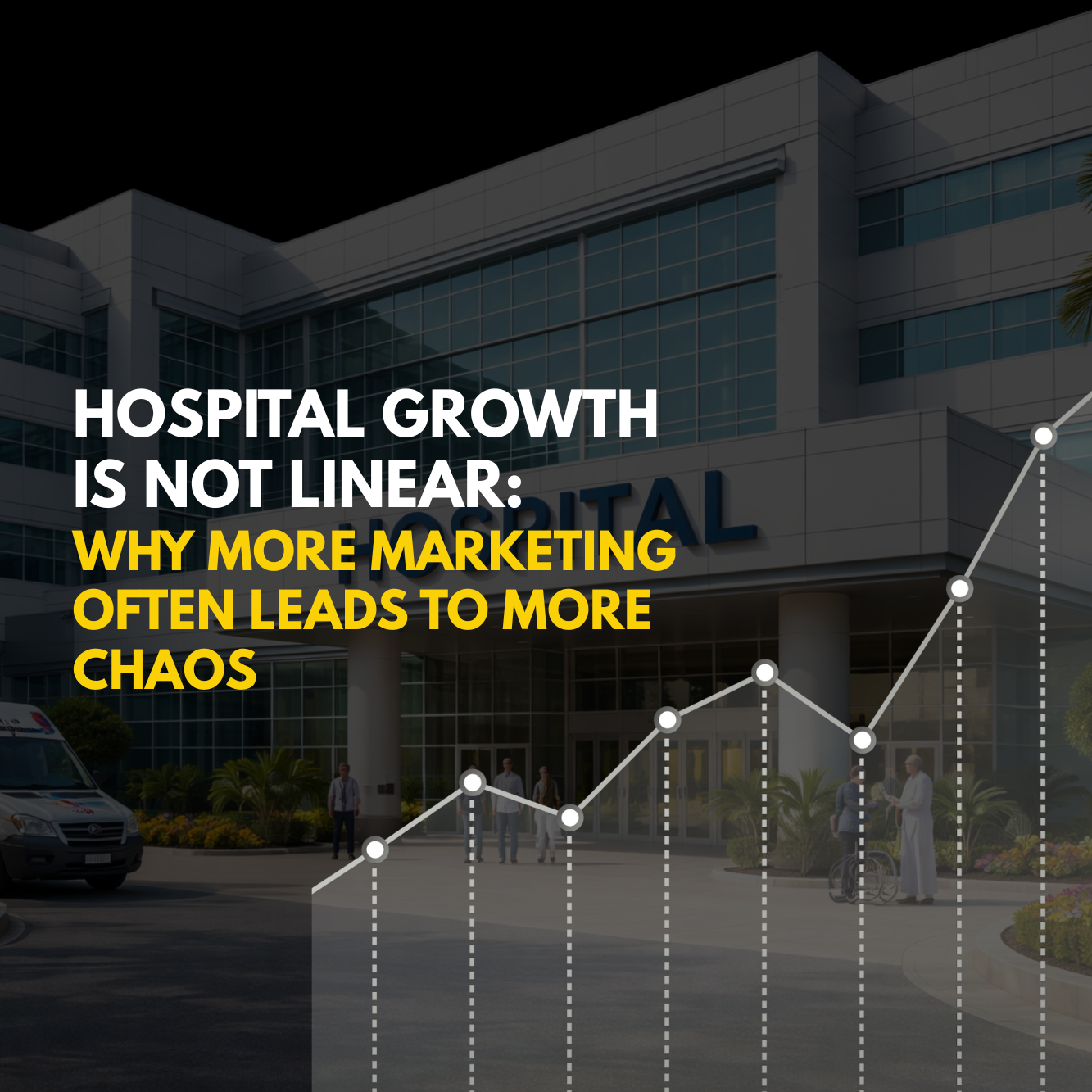
                • Hospital Growth Is Not Linear: Why More Marketing Often Leads to More Chaos

                  Hospital Growth Is Not Linear: Why More Marketing Often Leads to More Chaos

                  Hospital Growth Is Not Linear: Why More Marketing Often Leads to More Chaos

                  Written by
                  Published on
                  Share This

                  When Growth Feels Harder Than Before

                  Many hospital owners reach a confusing phase in their growth journey. Marketing seems to be working, enquiries increase, calls rise, WhatsApp messages flood the system, OPD footfall improves, yet instead of feeling successful, the organisation feels strained. Staff appear overwhelmed, patients complain more often, doctors feel rushed, and internal coordination begins to crack.

                  At this point, the instinct is to blame operations, staffing, or “growing pains.” But the deeper truth is more uncomfortable: hospital growth is not linear, and marketing does not scale outcomes in a straight line.

                  In healthcare, growth amplifies reality. If systems are weak, growth exposes them. If processes are unclear, growth magnifies confusion. If communication is inconsistent, growth multiplies dissatisfaction. More marketing does not automatically mean better outcomes, it often means more chaos.

                  The Myth of Linear Growth in Healthcare

                  Most hospitals unconsciously believe in a simple equation: more visibility leads to more patients, which leads to more revenue, which leads to stability.

                  This logic works well in theory, but healthcare does not function like a conventional consumer business. Hospitals are complex systems where clinical care, human behaviour, trust, emotions, staff coordination, infrastructure, and decision-making intersect. When marketing increases demand without strengthening the system underneath, imbalance is inevitable.

                  Hospital growth is not a straight upward line. It is a series of stress tests. Each increase in patient volume tests reception capacity, doctor bandwidth, communication quality, billing transparency, and follow-up discipline. When these systems are not designed to scale, marketing becomes a pressure cooker rather than a growth lever.

                  Why More Leads Often Reduce Patient Experience

                  One of the most common patterns seen in Indian hospitals is this: marketing works, but patient satisfaction drops.

                  As enquiries increase, response times slow down. Reception teams become transactional rather than empathetic. Doctors shorten consultations to manage volume. Waiting times stretch. Explanations become rushed. Follow-ups are missed. Patients feel processed rather than cared for.

                  From the hospital’s perspective, this feels like progress, numbers are up. From the patient’s perspective, trust quietly erodes.

                  This is why many hospitals see an increase in footfall but not in loyalty, referrals, or long-term brand strength. Growth without readiness damages the very experience that marketing promised.

                  Marketing as an Amplifier, Not a Fix

                  Marketing does not correct internal problems; it amplifies them.

                  • If your appointment system is unclear, marketing will expose it faster.
                  • If staff communication is inconsistent, marketing will bring more people to experience that inconsistency.
                  • If pricing explanations are weak, marketing will increase objections.
                  • If follow-up systems are broken, marketing will increase drop-offs.

                  Hospitals often respond by pushing even harder on marketing, assuming volume will compensate for inefficiency. In reality, this creates a vicious cycle where more leads generate more pressure, more dissatisfaction, and eventually more negative word-of-mouth.

                  Marketing should be used as an accelerator only after internal systems are aligned. Otherwise, it becomes a stress multiplier.

                  The Capacity Mismatch Problem

                  Another reason growth turns chaotic is capacity mismatch. Hospitals increase demand without recalibrating supply, not just in beds or doctors, but in attention, time, and emotional energy.

                  Clinical capacity may exist on paper, but experiential capacity often does not. A doctor who can technically see 40 patients a day may not be able to meaningfully communicate with all of them. A reception team may be able to handle calls, but not anxious conversations. A billing desk may process payments, but not explain costs calmly under pressure.

                  When marketing increases volume without addressing these human limits, the system stretches until it begins to fray. True growth requires designing capacity not only for treatment, but for trust delivery.

                  Why Hospitals Feel “Busy” But Not Stable

                  Many hospital owners describe this phase with the same words: “We are very busy, but nothing feels settled.”

                  This happens when growth is activity-driven rather than system-driven. More enquiries create more tasks, but without standardisation, clarity, and delegation, leadership becomes reactive. Decisions become urgent instead of thoughtful. Teams chase daily fires instead of building long-term capability.

                  Busy hospitals are not necessarily growing hospitals. Stability comes from repeatable systems, not constant motion.

                  The Leadership Challenge During Growth

                  Growth demands a shift in leadership style. What worked in the early stages- hands-on control, intuition-based decisions, informal coordination- begins to fail as scale increases.

                  Leaders must move from solving problems themselves to designing frameworks that prevent problems. They must stop reacting to marketing spikes and start anticipating their impact. This transition is difficult, especially for founder-led hospitals where decision-making has always been personal.

                  But without this shift, growth remains fragile and exhausting.

                  When Growth Starts Working in Favour of the Hospital

                  Hospitals that manage growth successfully do one critical thing differently: they treat marketing as the final layer, not the foundation.

                  Before scaling visibility, they strengthen appointment flows, communication protocols, patient education, staff training, billing clarity, and follow-up systems. They design experiences that can handle volume without compromising care. Marketing then brings patients into a system that is ready to serve them well.

                  In such environments, growth feels controlled rather than chaotic. Staff feel confident instead of overwhelmed. Patients feel supported rather than rushed. Leadership regains clarity.

                  Conclusion: Sustainable Growth Feels Calm, Not Chaotic

                  Chaos is not a sign of success. It is a signal of imbalance.

                  When hospital growth is done right, it feels steady, predictable, and composed. Marketing supports the system instead of stressing it. Patient experience improves alongside volume. Teams grow in capability, not just workload.

                  Hospitals must abandon the idea that more marketing automatically means more growth. In healthcare, growth must be earned systemically, not forced tactically.

                  The question is not how fast you can grow. The real question is how well your hospital can absorb growth without losing trust.

                  Contact Us HMS Consultants

                  Doctors Digital Marketing I Healthcare Marketing I Hospital Marketing Strategies I Marketing ideas for clinics I Marketing Trends 2025 I Medical Marketing I Social Media Marketing

                  is something we strongly believe in, which means ‘Knowledge without application is the same as having no knowledge at all

                  Akhil Dave

                  Principle Consultant

                  Ready to take your Personal Brand to the next level?

                  Share your details below and we will connect with you to discuss your growth strategy.

                  • The Invisible Funnel in Indian Hospitals: Where Patients Drop Off Without Complaining

                    The Invisible Funnel in Indian Hospitals: Where Patients Drop Off Without Complaining

                    The Invisible Funnel in Indian Hospitals: Where Patients Drop Off Without Complaining

                    Written by
                    Published on
                    Share This

                    The Patients You Never Hear From

                    Most hospitals track OPD numbers, admissions, and revenue. Very few track the patients who almost came, but didn’t.

                    These patients don’t complain.
                    They don’t leave negative reviews.
                    They don’t argue with the staff.

                    They simply disappear.

                    This silent disappearance is one of the biggest growth blind spots in Indian healthcare. Hospitals often assume that if no complaint was raised, everything must be fine. In reality, most patients exit quietly, long before reaching the OPD or completing treatment.

                    This blog explores the invisible funnel, the untracked, ignored, and misunderstood stages where patients drop off without ever giving feedback.

                    The Funnel Hospitals Think They Have vs the Funnel Patients Actually Experience

                    Most hospitals visualise their funnel like this:

                    Awareness → Enquiry → OPD → Treatment → Discharge

                    But the patient’s real funnel is far more complex:

                    Search → Compare → Doubt → Verify → Delay → Ask Someone → Re-check → Hesitate → Drop Off → Choose Another Option

                    The majority of drop-offs happen before the hospital even realises a patient was considering them.

                    Without visibility into this invisible funnel, hospitals keep fixing the wrong problems.

                    Silent Drop-Off #1: Google Looked Fine, But Something Felt Off

                    A patient searches for a hospital or doctor. They find your Google listing. They scroll. And then… they leave.

                    Why?

                    Common invisible triggers:

                    • Outdated photos
                    • Low or inconsistent reviews
                    • No recent activity
                    • Poor responses to reviews
                    • Confusing service descriptions
                    • Missing doctor details
                    • Unclear timings or fees

                    The patient doesn’t complain. They simply open the next listing. Hospitals rarely realise how many patients exit at this stage because this drop-off leaves no trace.

                    Silent Drop-Off #2: The Website Didn’t Answer the Real Question

                    A patient clicks on your website. They are not looking for design. They are looking for reassurance.

                    Unanswered questions cause silent exits:

                    • “Is this hospital right for my problem?”
                    • “Will the doctor explain things clearly?”
                    • “How expensive will this be?”
                    • “Is this place trustworthy?”
                    • “What happens after I book?”

                    If the website talks about the hospital instead of to the patient, trust breaks quietly.

                    No feedback is given.
                    No form is filled.
                    The patient leaves.

                    Silent Drop-Off #3: The Enquiry That Didn’t Feel Encouraging

                    Some patients do enquire by call or WhatsApp but still drop off.

                    Why?

                    • Delayed response
                    • Cold or rushed tone
                    • Incomplete answers
                    • No follow-up
                    • Too much jargon
                    • No empathy
                    • No clarity on next steps

                    The patient thinks:
                    “I’ll check somewhere else.”

                    They don’t argue.
                    They don’t say no.
                    They simply stop responding.

                    From the hospital’s side, it looks like “no conversion.”
                    From the patient’s side, it felt like lack of care.

                    Silent Drop-Off #4: The OPD Visit That Didn’t Convert to Trust

                    Even when patients visit the hospital, drop-offs continue. Invisible exit points include:

                    • Long waiting times
                    • Confusing processes
                    • Poor coordination
                    • Unclear billing
                    • Rushed consultation
                    • Lack of explanation
                    • Feeling unheard

                    Patients may complete the consultation, but mentally exit the relationship.

                    They don’t return.
                    They don’t refer.
                    They don’t follow up.

                    Hospitals often assume the visit was “successful” because OPD happened.
                    But trust was never fully built.

                    Silent Drop-Off #5: Treatment Was Offered, But Fear Was Not Addressed

                    Many patients drop off after diagnosis. Not because they doubt the doctor but because:

                    • Risks were not explained clearly
                    • Costs felt uncertain
                    • Timelines were confusing
                    • Family doubts were unanswered
                    • Emotional reassurance was missing

                    Patients rarely say, “I am scared.”
                    They say, “I’ll think about it.”

                    And then they disappear.

                    Hospitals interpret this as price sensitivity or indecisiveness. In reality, it’s unresolved anxiety.

                    Silent Drop-Off #6: Discharge Without Closure

                    Even after treatment, invisible exits continue.

                    If discharge feels:

                    • Rushed
                    • Confusing
                    • Transactional
                    • Emotionless

                    Patients leave without emotional closure. They may recover clinically, but they don’t build loyalty.

                    No repeat visits.
                    No referrals.
                    No positive advocacy.

                    This silent loss is rarely measured, but it directly impacts long-term growth.

                    Why Hospitals Don’t See These Drop-Offs

                    Because most hospital systems are designed to track:

                    • Footfall
                    • Revenue
                    • Admissions

                    Not emotions.
                    Not hesitation.
                    Not confusion.
                    Not fear.
                    Not trust gaps.

                    The invisible funnel exists between numbers and hospitals rarely look there.

                    Making the Invisible Funnel Visible

                    Hospitals that grow sustainably do one thing differently: They track behaviour, not just outcomes.

                    They observe:

                    • Where patients pause
                    • Where they hesitate
                    • Where questions repeat
                    • Where staff struggles
                    • Where follow-ups fail
                    • Where trust weakens

                    They ask:

                    • “Why did patients not convert?”
                    • “Where did we lose clarity?”
                    • “What did the patient feel at this stage?”

                    This mindset transforms marketing, operations, and patient experience together.

                    Growth Happens When You Fix What Patients Don’t Say

                    Patients rarely complain.
                    They rarely confront.
                    They rarely explain.

                    They simply choose differently.

                    Hospitals that rely only on feedback forms and reviews see only the surface.
                    Hospitals that study the invisible funnel see the real story.

                    Growth does not come from adding more marketing. It comes from removing silent friction.

                    Conclusion: The Most Dangerous Drop-Off Is the One You Never Notice

                    Every hospital loses patients.
                    The difference is who knows why.

                    If patients disappear without a trace, the system is broken not the patient.

                    When hospitals learn to see the invisible funnel:

                    • Marketing becomes sharper
                    • OPD improves naturally
                    • Trust deepens
                    • Referrals increase
                    • Growth becomes stable

                    The future of healthcare growth lies not in louder marketing but in listening to what patients never say.

                    Contact Us HMS Consultants

                    Doctors Digital Marketing I Healthcare Marketing I Hospital Marketing Strategies I Marketing ideas for clinics I Marketing Trends 2025 I Medical Marketing I Social Media Marketing

                    is something we strongly believe in, which means ‘Knowledge without application is the same as having no knowledge at all

                    Akhil Dave

                    Principle Consultant

                    Ready to take your Personal Brand to the next level?

                    Share your details below and we will connect with you to discuss your growth strategy.

                    • Your Hospital Doesn’t Have a Marketing Problem, It Has a Decision-Making Problem

                      Your Hospital Doesn’t Have a Marketing Problem, It Has a Decision-Making Problem

                      Your Hospital Doesn’t Have a Marketing Problem, It Has a Decision-Making Problem

                      Written by
                      Published on
                      Share This

                      When Marketing Becomes the Scapegoat

                      When hospital growth slows down, the first reaction is almost always the same:

                      • “Marketing isn’t working.”

                      • “Change the agency.”

                      • “Run more ads.”

                      • “Post more on social media.”

                      But in reality, most hospitals do not have a marketing problem. They have a decision-making problem.

                      Marketing outcomes are not determined by platforms, creatives, or budgets alone. They are determined by how decisions are made inside the hospital, who decides, on what basis, how frequently, and with what clarity.

                      Until hospitals fix the way they take decisions, marketing will continue to feel expensive, unpredictable, and disappointing.

                      How Most Hospitals Actually Make Marketing Decisions

                      In an ideal world, decisions would be data-led, patient-informed, and strategy-driven. In reality, marketing decisions in many Indian hospitals are made based on:

                      • Senior-most person’s opinion
                      • Last conversation with a vendor
                      • What a neighbouring hospital is doing
                      • Urgency (“OPD is low this month”)
                      • Anecdotal feedback (“someone said Instagram works”)
                      • Fear of missing out
                      • One bad week of numbers

                      This creates reactive marketing, not strategic marketing. Decisions change every few weeks, priorities keep shifting, and no initiative is given enough time to mature.

                      Marketing doesn’t fail here, consistency does.

                      Opinion-Led vs Data-Led Decisions: The Silent Gap

                      Most hospitals collect data, but very few use it to decide. They may have:

                      Yet decisions are still driven by gut feeling.

                      For example:

                      • Ads stopped because “they don’t feel useful”
                      • Content changed because “engagement looks low”
                      • Website redesigned because “it looks outdated”
                      • Campaigns paused without analysing conversion lag

                      Data exists, but decision discipline does not. When decisions ignore data, marketing becomes unstable and results fluctuate wildly.

                      The Real Cost of Frequent Direction Changes

                      One of the most damaging patterns in hospital marketing is constant course correction. What happens when decisions change too frequently:

                      • Campaigns never stabilise
                      • Algorithms never optimise
                      • Teams lose clarity
                      • Vendors work in confusion
                      • Messaging becomes inconsistent
                      • Brand recall weakens
                      • Patients receive mixed signals

                      Marketing needs time to learn, adapt, and compound. When hospitals change direction every month, marketing never gets a chance to work and then gets blamed for underperformance.

                      Leadership Bottlenecks: When Everything Needs One Approval

                      In many hospitals, all decisions flow through one or two people, usually the founder or senior doctor. While involvement is important, over-centralisation creates problems:

                      • Delayed decisions
                      • Tactical over strategic thinking
                      • Burnout at the top
                      • Slow execution
                      • Missed opportunities

                      Marketing decisions require:

                      • Speed
                      • Experimentation
                      • Iteration
                      • Learning cycles

                      When every banner, caption, or campaign needs senior approval, marketing becomes rigid and ineffective. Growth requires leaders to design decision frameworks, not control every decision.

                      Why “Vendor Advice” Often Confuses More Than It Helps

                      Another decision-making challenge is who influences decisions. Hospitals often rely on:

                      • Agencies
                      • Freelancers
                      • Platform representatives
                      • Software vendors

                      Each of them pushes decisions that favour their service:

                      • Ads teams suggest more ads
                      • Social media teams suggest more reels
                      • Website teams suggest redesigns
                      • Software vendors suggest automation

                      None of these are wrong, but none of them see the entire system.

                      Without a neutral, strategic lens, hospitals end up stacking tools and tactics without alignment. Decisions become fragmented, and outcomes suffer.

                      Marketing Without a Decision Framework Is Just Activity

                      High-performing hospitals follow clear decision frameworks such as:

                      • What problem are we solving?
                      • Which stage of the patient journey is weak?
                      • What data supports this decision?
                      • What is the expected outcome?
                      • How will we measure success?
                      • How long will we run this before reviewing?

                      Most hospitals skip these questions.

                      As a result:

                      • Campaigns run without clear objectives
                      • Success is judged emotionally, not analytically
                      • Teams chase activity instead of impact

                      Without a framework, marketing becomes noise, not growth.

                      Decision Fatigue: The Hidden Enemy of Consistent Growth

                      Hospital leaders take hundreds of decisions every day clinical, operational, financial, and administrative.

                      Marketing decisions then become:

                      • Rushed
                      • Delayed
                      • Delegated without clarity
                      • Avoided altogether

                      This creates decision fatigue, where marketing is handled inconsistently or impulsively.

                      The solution is not more meetings. The solution is structured decision systems that reduce mental load and improve clarity.

                      What Changes When Decision-Making Improves

                      When hospitals fix how they make decisions, everything changes:

                      • Marketing becomes predictable
                      • Budgets are allocated wisely
                      • Teams work with clarity
                      • Vendors align better
                      • Patients receive consistent messaging
                      • Brand trust improves
                      • Growth becomes sustainable

                      Marketing finally starts delivering results not because tactics changed, but because decisions matured.

                      Conclusion: Fix the Way You Decide Before Fixing Marketing

                      Marketing failures are rarely about platforms or people. They are about:

                      • How decisions are made
                      • Who makes them
                      • On what basis
                      • With what consistency

                      Hospitals that grow sustainably do not chase tactics. They build decision-making maturity.

                      Once that foundation is strong, marketing stops feeling like an expense and starts functioning like a growth engine.

                      Before asking, “Why isn’t marketing working?”
                      Ask instead: “Are we making the right decisions the right way?”

                      Contact Us HMS Consultants

                      Doctors Digital Marketing I Healthcare Marketing I Hospital Marketing Strategies I Marketing ideas for clinics I Marketing Trends 2025 I Medical Marketing I Social Media Marketing

                      is something we strongly believe in, which means ‘Knowledge without application is the same as having no knowledge at all

                      Akhil Dave

                      Principle Consultant

                      Ready to take your Personal Brand to the next level?

                      Share your details below and we will connect with you to discuss your growth strategy.