Where Do Hospital Marketing Budgets Really Go? A Transparent Breakdown
Every hospital wants more patients, better visibility, and stronger brand recall. But when the topic of “marketing budget” comes up, most hospital owners hesitate. They are unsure how much to spend, where to spend it, and what truly yields returns. Many assume marketing is just posters, social media posts or an occasional advertisement. Others believe that hiring an agency alone will solve the problem.
In reality, hospital marketing is a broad ecosystem. The budget does not disappear on creativity or campaigns; it flows into systems, technology, communication, and experience. And unless a hospital understands how each element works, money gets spent without results.
This is why two hospitals with the same budget can have completely different outcomes. One sees patient footfall increase; the other sees nothing change. The difference lies in how the budget is distributed and what it is invested in.
To understand this better, let’s break down where hospital marketing budgets actually go and why each component matters.
1. Digital Identity: The New Front Door of Healthcare
The journey of a hospital begins online. A website, Google Business profile, doctor profiles, reviews, photos, and maps are no longer optional. They form the first impression of the hospital before anyone walks in. A significant portion of modern budgets is spent on building, updating, and improving this digital identity because, without it, patients simply cannot find or trust the hospital.
A clean website is not a design expense; it is an investment in infrastructure. It reduces phone calls, explains services, and collects appointments while the receptionist sleeps. A well-maintained Google profile keeps the hospital visible to thousands of patients every month. In many hospitals, the people who eventually come for consultation are influenced long before reception ever answers a phone call.
Hospitals that cannot be found online lose patients silently. That is why digital identity is often the first and most necessary investment.
2. Patient Education and Content
Marketing is not only about visibility; it is about clarity.
Patients search for information on symptoms, procedures, risks, cost ranges, recovery times, and reassurance. When hospitals publish blogs, videos, FAQs, symptom guides and treatment explanations, they build trust. Good content reduces fear, improves decision-making and positions the hospital as a source of reliable information rather than an advertiser. The budget for medical content, whether created in-house or by specialists, is an essential component of long-term credibility building.
Hospitals that educate do not need to convince. Patients arrive already trusting them.
3. Lead Management and Enquiry Handling
This is where most hospitals lose money without realising it.
A campaign brings enquiries, but if calls are missed, WhatsApp messages go unanswered, or staff provide confused replies, the marketing budget collapses. A hospital may invest in ads, SEO or branding, but if the enquiry is not handled correctly, patients never convert.
Part of the marketing budget goes into systems:
- call tracking
- CRMs
- WhatsApp business setup
- automated responses
- training reception staff
- monitoring conversion rates
This is not promotion; it is operational efficiency. The smartest hospitals invest here because every saved enquiry is a saved rupee.
4. Reputation Management
A single negative review can cancel the effect of twenty advertisements. Responding to feedback, encouraging satisfied patients to share their experiences, and resolving complaints politely are essential parts of modern hospital marketing. It requires time, manpower and coordination. When done right, it turns happy patients into ambassadors.
Hospitals believe reviews “happen naturally.” In reality, reviews happen intentionally. The budget supports someone who actively manages them.
5. Paid Campaigns, Media and Branding
This is where most hospitals assume the entire budget goes. In truth, ads are just one part of the ecosystem. Paid campaigns, such as Google Ads, Meta Ads, print ads, hoardings, or radio ads, are used to reach specific audiences during specific seasons or for specific specialities. The important thing is not the spending, but the strategy behind it.
Hospitals that jump into advertising without first fixing their identity, content, reviews, and enquiry handling end up burning money. Hospitals that advertise after building strong systems see tangible results. The budget is not about shouting louder; it is about being heard by the right people.
6. Photography, Videography and Real Visuals
Stock images don’t build trust. Real photos of doctors, reception, OPD, IPD, OT, staff and patient success stories create authenticity. A portion of the budget is dedicated to visual storytelling because healthcare is emotional. When families see the environment, they feel confident. When they see real faces, they feel safe.
A hospital can have the best infrastructure, but if nobody has seen it, it does not exist in the patient’s mind.
7. Patient Engagement and Retention
The cost of getting a new patient is always higher than retaining an existing one. Engagement tools, such as post-discharge guidance, WhatsApp updates, reminders, preventive care messages, and festival greetings, are part of marketing budgets because they keep the hospital relevant even after treatment ends.
Hospitals that take patient engagement seriously do not have to constantly chase new patients. Their existing patients return and refer others.
8. Technology and Automation
Hospitals that rely solely on human memory often lose enquiries, forget follow-ups, and delay communication. Automation, CRMs, chatbots, appointment systems and WhatsApp workflows solve this problem. These platforms require subscriptions, setup and monitoring, hence they are part of the marketing budget.
A hospital that automates grows. A hospital that waits for staff to remember struggles.
Why do Two Hospitals Spending the Same Amount Get Different Results
One hospital spends on ads first.
Another spends on the foundation first.
The first sees noise.
The second sees conversions.
When a hospital allocates its budget to improve communication, identity, reviews, and enquiry handling, advertising becomes more effective. When those foundations are weak, no marketing agency or designer can save the hospital from losing patients who come, enquire, and disappear.
This is why “How much should we spend?” is not the right question.
The correct question is “Are we spending in the right order?”
Conclusion
Marketing budgets in healthcare are not just creative bills. They fund visibility, communication, reputation, systems, education and patient experience. They ensure that when a family looks for a trustworthy healthcare provider at midnight, in an emergency or from another city your hospital is visible, credible and reachable.
Hospitals that question the value of marketing often see expenses.
Hospitals that understand the value of marketing make informed investments.
Because in 2025, the hospital with the best machines does not win.
The hospital with the best communication does.
is something we strongly believe in, which means ‘Knowledge without application is the same as having no knowledge at all
Akhil Dave
Principle Consultant
Ready to take your Personal Brand to the next level?
Share your details below and we will connect with you to discuss your growth strategy.

Local SEO Checklist for Doctors: Rank Near You in 2026
Local SEO helps doctors appear in Google Maps and “near me” searches when…

Personal Branding for Doctors: The 2026 Playbook
A practical 2026 personal branding strategy for doctors covering platform priorities, content pillars,…
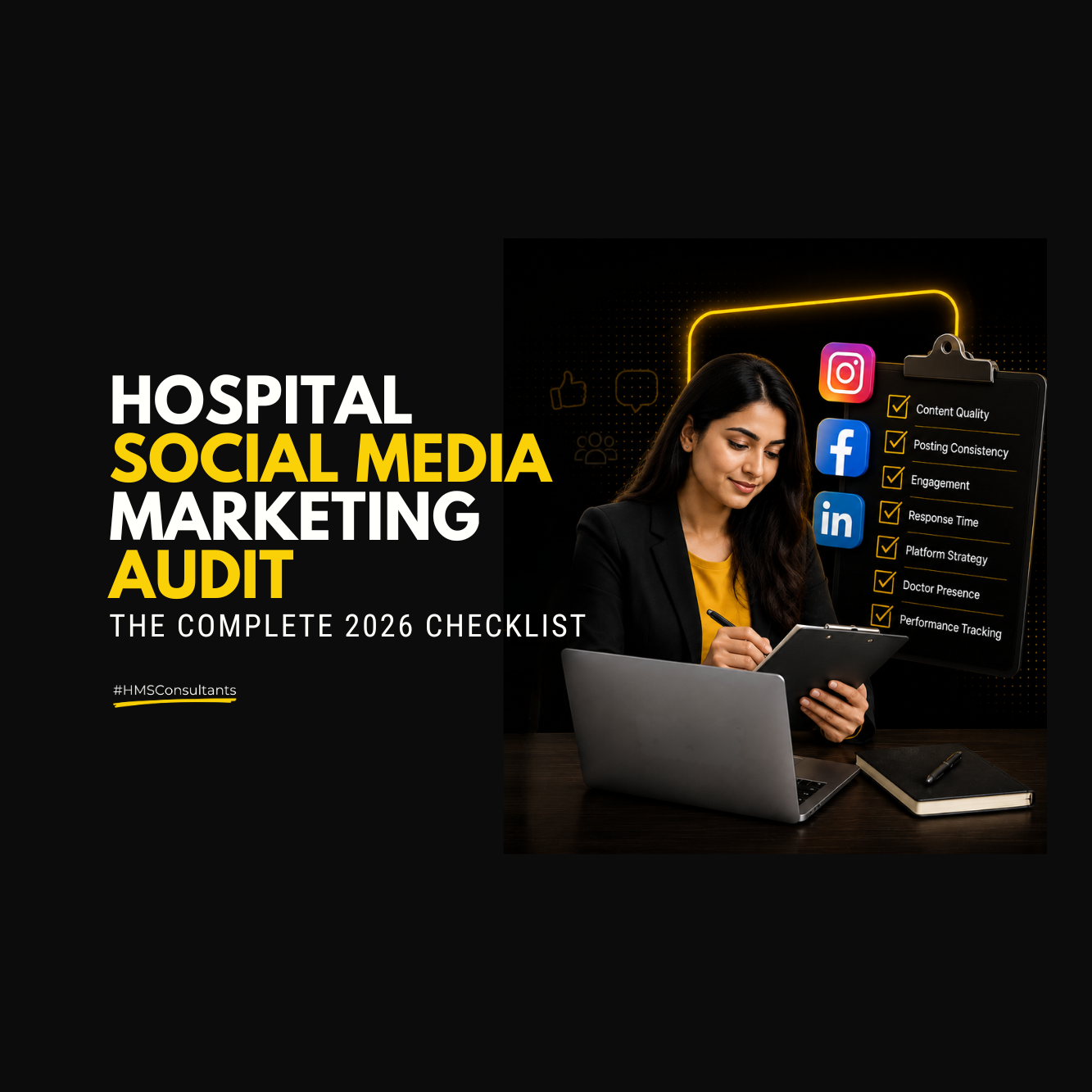
Hospital Social Media Marketing Audit: The Complete 2026 Checklist
A practical social media audit for hospitals covering content, engagement, response time, platform…

Hospital Digital Marketing Audit: The Complete 2026 Checklist
Hospital marketing audit is the first step to identifying what’s helping—or hurting—your hospital’s…

Hospital Marketing Audit: The Complete Checklist for 2026
Hospital marketing audit is the first step to identifying what’s helping—or hurting—your hospital’s…

Marketing for Hospital: A Complete Guide to Attract More Patients and Build Trust in India
Marketing for Hospital is essential for attracting patients, building trust, and driving sustainable…