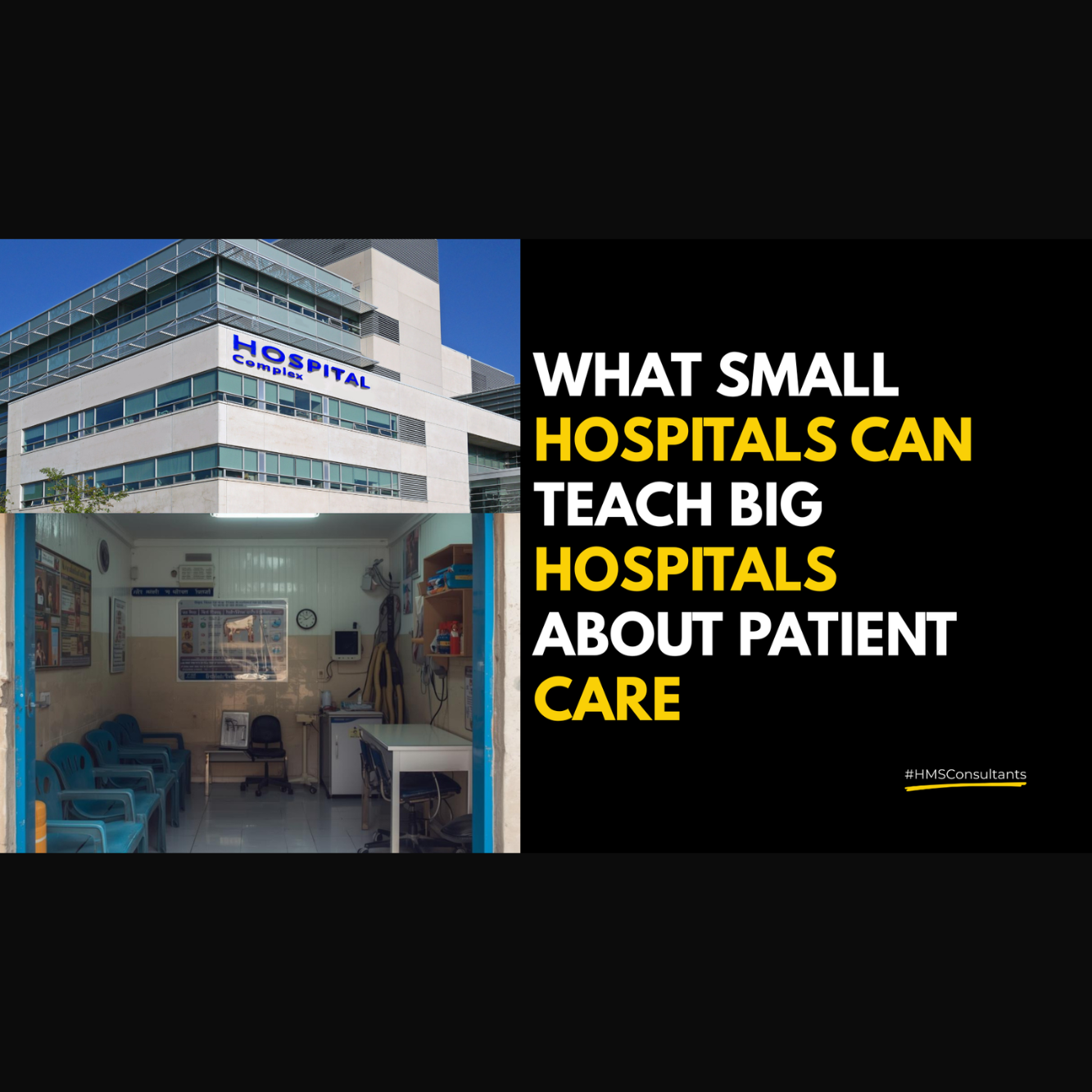
What Small Hospitals Can Teach Big Hospitals About Patient Care
In every Indian city, you’ll find two kinds of healthcare setups: large hospitals with advanced equipment, multiple specialities, and huge staff… and small or mid-sized hospitals that run with limited resources but surprisingly loyal patients.
If size alone created trust, every patient would choose a corporate hospital. But that doesn’t happen.
There are families that have been visiting the same 25-bed hospital for 10, 20, or even 30 years. They deliver babies there, bring parents there, get surgeries done there and recommend others with confidence.
Why?
Because small hospitals offer something big hospitals struggle with: personal care, emotional comfort, and human connection.
While big hospitals perfect operations at scale, small hospitals perfect relationships. And when it comes to healthcare, relationships matter more than marketing.
Here’s what big hospitals can learn from them.
People Don’t Remember Machines. They Remember Behaviour.
A small hospital may not have the latest robotic arm or internationally branded medical equipment, but patients still trust them because the care feels personal.
When you enter a small hospital:
- Someone recognises your face
- The receptionist smiles
- The nurse remembers your child’s name
- The doctor asks about your family
- The staff treats you like a person, not a token number
Most patients don’t understand technology. They understand warmth, familiarity, and human touch.
Small hospitals excel at this without relying on training manuals, CRM tools, or scripts, because patient connection is an integral part of their culture.
Big hospitals invest in machines. Small hospitals invest in time.
In Small Hospitals, Doctors Are Not Busy; They Are Present
In large facilities, patients are prepared for rushed consultations, delayed OPDs, long waiting times, and heavy paperwork. A doctor may see 60–70 patients in a day. Each interaction becomes a race.
In smaller setups, patients feel heard. Doctors sit longer, explain better, answer questions, and reduce anxiety.
Medical outcomes are not just a matter of science; they are also a matter of psychology. When a patient feels understood, they trust the treatment, and when a doctor communicates, half the fear dissolves.
Sometimes, the cure starts before medicines.
Personal Follow-Ups Create Emotional Loyalty
A patient who gets a follow-up call after surgery or a message asking about recovery will never forget it. Small hospitals do this naturally, because they don’t treat patients as footfall. they treat them as families.
A simple phone call:
“Just checking if the pain is reducing.”
“Please don’t hesitate to come in if you feel discomfort.”
“We’ll see you on Wednesday for dressing.”
This is not marketing. It is humanity.
Big hospitals try to scale systems. Small hospitals scale trust.
Small Hospitals Offer Transparency Without Scripts
Ask a billing question in a small hospital, and someone will calmly explain the charges. Ask the same question in a large hospital and you’re often directed to three different counters, a TPA desk, and a printout full of codes.
Patients don’t need corporate communication. They need clarity.
In small hospitals:
- Charges are explained in Hindi, Gujarati, Marathi, Tamil whatever the patient speaks
- Reports are explained slowly
- Next steps are transparent
- Nothing feels hidden
Trust grows faster when nothing feels complicated.
Less Formality. More Comfort.
In a large hospital, patients follow formality:
- Registration slip
- Queue token
- Payment counter
- Wrist band
- Nurse rotation
- Doctor handoffs
- Several signatures
In a small hospital, the process feels human:
- “Come inside, the doctor is free.”
- “Sit, we will bring your file.”
- “Don’t worry, everything will be fine.”
Healthcare is frightening for patients. Comfort is a form of treatment.
Staff in Small Hospitals Don’t Need Training to Be Kind
Large hospitals spend lakhs on “patient communication workshops.” Small hospitals rarely need them; their staff behaves kindly without instructions.
Why?
Because smaller hospitals often hire staff who grew up in the same area.
They speak the same language.
They understand the people they serve.
They treat patients like neighbours, not customers.
Empathy is easier when familiarity is real.
Big Hospitals Win on Technology. Small Hospitals Win on Trust.
Corporate hospitals cannot copy everything small hospitals do, because scale changes behaviour. When thousands of patients walk in daily, processes become mechanical for survival.
But big hospitals can learn to keep humanity alive inside systems:
- Doctors shouldn’t speak only in medical terms
- Reception shouldn’t sound robotic
- Billing shouldn’t feel like a courtroom
- Critical updates shouldn’t be silent
- Patients shouldn’t feel lost in the building
A hospital may save a life through machines, but it earns loyalty through warmth.
Story: The 20-Bed Hospital That Becomes a Family Hospital
Every city has at least one. A small nursing home where:
- three generations are born
- broken bones are treated
- dengue and typhoid come and go
- stitches, dressings, blood tests all done there
No grandeur. No branding. Just trust.
People travel far for specialists, but come back to that small hospital for everything else.
What keeps them loyal?
- Familiar faces
- Familiar voices
- Familiar care
In critical times, reassurance matters more than architecture.
Patients Don’t Want Luxury. They Want Attention.
Corporate hospitals are designed for efficiency:
- check-in counters
- information desks
- queues
- ward allocations
- nursing rotations
This works… until the patient starts feeling invisible.
A small hospital may not have AC waiting rooms or digital kiosks, but the staff looks up when a patient walks in. Someone asks, “Bhookh lagi? Khana khaya?” Someone says, “Don’t worry, it’s a minor procedure.” Someone stays back 5 minutes longer than the shift time because the family is worried.
That care cannot be purchased. It has to come from people.
The Lesson for Big Hospitals
Growth should not erase warmth. Systems should not erase humanity. Efficiency should not erase connection.
The best hospitals in the future will be the ones that combine both:
- the clinical excellence of large hospitals
- the emotional intelligence of small hospitals
Patients want:
- advanced treatment
- but also personal reassurance
- modern machines
- but also a friendly voice
- organised processes
- but also human touch
The most successful hospitals will be those that excel in infrastructure and prioritise care.
Conclusion
Small hospitals often struggle to succeed because they have less to offer. They win because they provide something big hospitals often forget: a human connection.
Medicine is science. Healing is emotional.
Patients decide where to go based on how a hospital makes them feel, not how many floors it has.
Big hospitals can buy machines, design branding, and hire agencies. But the real competitive advantage comes from behaviours:
- empathy
- clarity
- presence
- follow-ups
- care
If large hospitals learn from small ones, Indian healthcare will become not just advanced, but genuinely humane. Because patients don’t remember the colour of the building. They remember the warmth of the experience.
is something we strongly believe in, which means ‘Knowledge without application is the same as having no knowledge at all
Akhil Dave
Principle Consultant
Ready to take your Personal Brand to the next level?
Share your details below and we will connect with you to discuss your growth strategy.

Healthcare Digital Marketing Is Not About Social Media
Healthcare digital marketing is no longer only about social media visibility. This blog…
Most Hospitals Still Misunderstand Medical Marketing
Medical marketing is often misunderstood as advertising alone. This blog explains why hospitals…

Why Most Hospital Marketing Looks Exactly the Same
Most hospital marketing today looks almost identical because hospitals often use the same…

Marketing a Clinic Is Different From Marketing a Hospital
Marketing a clinic requires a different strategy from hospital marketing because patients evaluate…

Marketing Ideas for Hospitals That Target the 3AM Patient
Marketing ideas for hospitals in 2026 must go beyond daytime advertising and focus…

Marketing a Hospital in 2026: The Rise of Zero-Click Patient Decisions
Marketing a hospital in 2026 is shifting beyond websites as patients make zero-click…