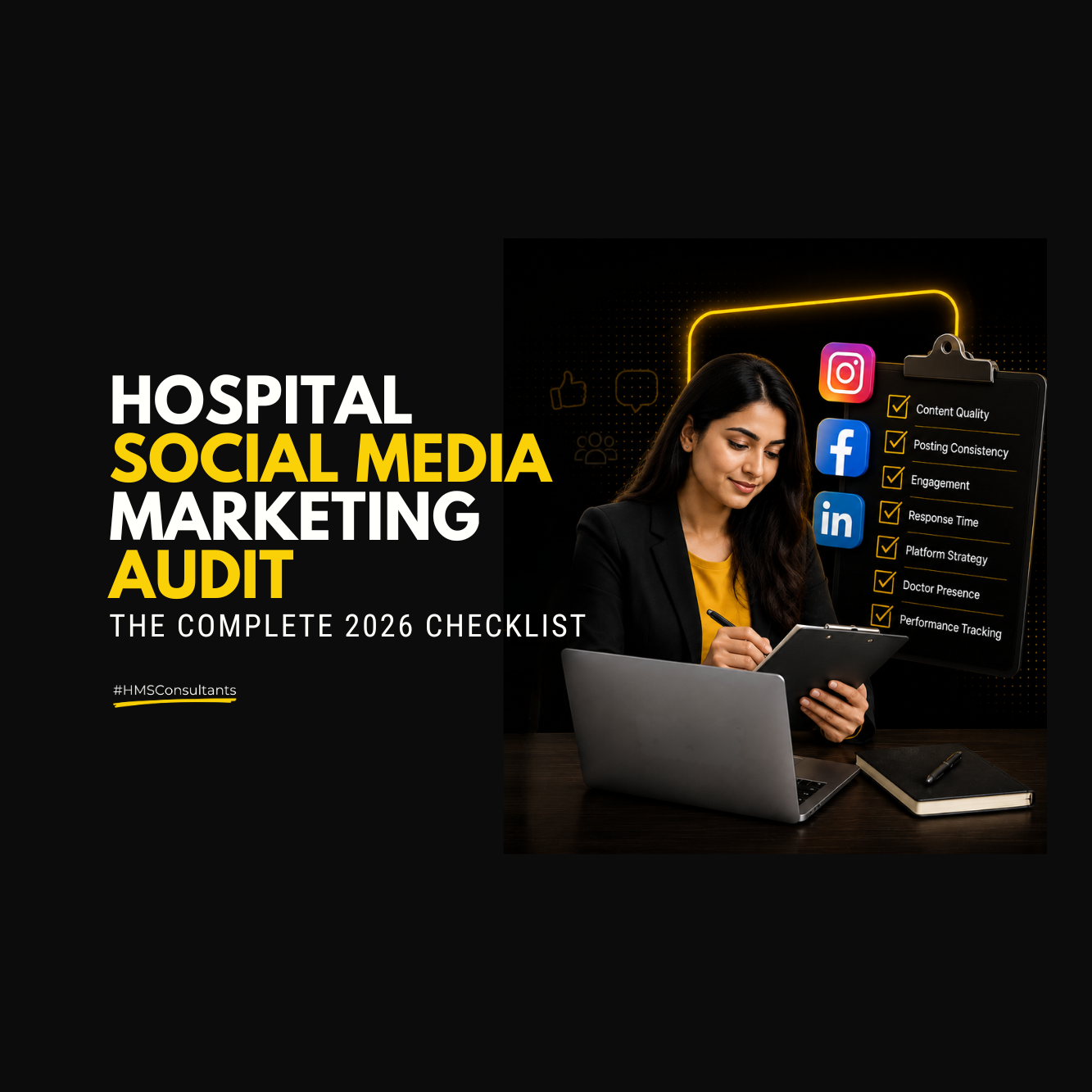

Hospital Social Media Marketing Audit: The Complete 2026 Checklist
A hospital social media marketing audit reviews every social channel a hospital runs, content quality, posting consistency, response time, and platform fit to determine whether the presence is actually building patient trust or just sitting there. Most hospital social pages exist because someone thought they should, not because of a plan.
1. What Is a Hospital Social Media Marketing Audit?
A hospital social media marketing audit is a structured review of every active social channel typically Instagram, Facebook, and LinkedIn, sometimes YouTube assessing content quality, consistency, audience engagement, and response time to patient interactions. It’s the social-specific companion to a broader hospital marketing audit and hospital digital marketing audit, and looks closely at something those broader reviews only touch on briefly: whether the content actually builds trust with the people seeing it.
2. Why Hospitals Can’t Treat Social Media as an Afterthought
A hospital’s social media presence is often the first informal impression a prospective patient gets before the website, before a phone call. An inactive or poorly run page doesn’t just fail to help; it can actively raise doubt. A social media audit matters because:
– Patients increasingly check a hospital’s Instagram or Facebook before calling, the same way they’d check reviews
– Doctors building a personal brand (see our guide on personal branding for doctors) are now expected to have some social presence, and inconsistency between a doctor’s personal page and the hospital’s official page creates confusion
– Response time on social platforms is now a visible, public trust signal an unanswered comment sits there for anyone to see
3. What a Hospital Social Media Audit Covers
– Content quality and consistency – is there a recognizable style, or does every post look different?
– Posting cadence – active weekly, or long gaps followed by bursts?
– Engagement – genuine comments and shares, or just passive views?
– Response time – how quickly patient comments and DMs get a reply
– Platform fit – is the hospital active on platforms its actual patients use, or just the ones that are easiest to post to?
– Doctor-level presence – are any individual doctors building credibility alongside the institutional page?
– Crisis readiness – is there any plan for handling a negative comment or review that goes public?
4. The Hospital Social Media Marketing Audit Checklist
Content
☐ Consistent visual style (colors, fonts, tone) across all posts
☐ Content mix includes patient education, not just hospital announcements
☐ At least one post per week, ideally 2 – 3
☐ Video content present on at least one platform
Engagement
☐ Comments and DMs are answered within 24 hours
☐ Negative comments or reviews have a documented response protocol
☐ Genuine engagement (comments, shares) exists, not just passive follower counts
Platform Strategy
☐ LinkedIn is active if the hospital wants to reach referring doctors or B2B audiences
☐ Instagram/Facebook is active if the goal is patient trust-building
☐ Each platform has a distinct purpose – not the same content copy-pasted everywhere
People
☐ At least 1- 2 senior doctors have some individual social presence
☐ Staff/marketing team knows who owns social media day-to-day
☐ There’s a simple content calendar, even a basic one
Measurement
☐ Follower growth and engagement rate are tracked monthly
☐ Social referral traffic to the website is tracked in GA4
☐ There’s a way to trace an enquiry back to a social media post, even roughly
5. Common Social Media Red Flags
– A hospital Instagram or Facebook page with no post in over a month
– Comments and reviews left unanswered for days or longer
– Every platform posting identical content with no adjustment for audience or format
– No one on the team clearly responsible for the account, so nothing happens unless someone remembers to
6. Platform-by-Platform Considerations
LinkedIn tends to work best for reaching referring doctors, healthcare professionals, and B2B audiences – closer to how AHMP’s own network operates. Instagram and Facebook are stronger for patient-facing trust-building, employer branding, and reaching the broader public, especially content like patient education, department highlights, and doctor introductions. YouTube is an emerging, underused channel for hospitals in India long-form doctor Q&A or facility walkthrough content builds a depth of trust short-form posts can’t match, and doubles as content AI answer engines increasingly pull from when summarizing health topics.
7. How Often to Audit Social Media
A full social media audit twice a year, with a lighter monthly check on posting consistency and response time social platforms and their algorithms shift often enough that a once-a-year review alone will miss meaningful changes.
8. How HMS Consultants Conducts a Social Media Marketing Audit
HMS Consultants’ social media audit looks at content, engagement, and platform fit together not as three separate scorecards and connects findings back to actual website and enquiry data, so recommendations are tied to what drives patients to act, not just what looks good.
Frequently Asked Questions
It reviews content quality and consistency, response time to patient comments and messages, platform fit for the hospital’s actual audience, and whether any of the activity is tied to a measurable goal.
LinkedIn tends to matter most for reaching referring doctors and B2B audiences, while Instagram and Facebook work better for patient-facing trust-building and employer branding. The right mix depends on the hospital’s target audience.
Consistency matters more than frequency 2 to 3 well-made posts a week that get responded to quickly outperform daily posting with no engagement follow-through.
Not directly as a ranking factor, but an active, well-reviewed social presence supports the trust signals search engines and AI answer engines use when deciding which local business to surface.
Yes a hospital page builds institutional trust, but individual doctors building a personal presence adds a layer of personal credibility that institutional pages alone can’t achieve.
is something we strongly believe in, which means ‘Knowledge without application is the same as having no knowledge at all
Akhil Dave
Principle Consultant
Ready to take your Personal Brand to the next level?
Share your details below and we will connect with you to discuss your growth strategy.
Online Marketing for Doctors: India
Online marketing is no longer optional for doctors in India. Learn how digital tools like SEO, GMB, and social media can grow your clinic in 2025.
Healthcare Marketing Strategies: What Clinics and Hospitals Really Need
Healthcare marketing strategies help clinics and hospitals move beyond random posts and ads. This blog explains how patient trust, SEO, reviews, Google Business Profile, enquiry handling, and clear communication…
The Science of Patient Trust: What Content Patients Actually Search For (Not What Hospitals Publish)
Patients don’t search for hospitals they search for clarity. Learn how trust-driven content answers patient fears, reduces uncertainty, and builds confidence even before the first consultation.
Digital Marketing in Indian Healthcare
Discover how digital marketing is transforming Indian healthcare by enhancing patient engagement, trust, and hospital growth in 2025.
Why Marketing for a Hospital Fails When It Tries to “Convince” Instead of Reassure
Marketing for a hospital fails when it tries to convince patients instead of reassuring them. In healthcare, trust and emotional safety drive decisions more than promotion.
Healthcare Marketing Services: What Professionals Should Understand Before Consulting
Healthcare marketing services go beyond social media and advertising. From websites and SEO to branding, patient communication, and reputation management, each service plays a role in improving visibility, building…