

Hospital Marketing Audit: The Complete Checklist for 2026
A hospital marketing audit is a structured review of every channel a hospital uses to attract and retain patients website, SEO, social media, offline branding, referrals, and internal communication designed to find what’s working, what’s wasted spend, and what’s costing you enquiries. Most hospitals in India have never had one done.
1. What Is a Hospital Marketing Audit?
A hospital marketing audit is a systematic evaluation of a hospital’s marketing activities digital and offline against what actually drives patient enquiries. It answers three questions: what is currently working, what is quietly failing, and what isn’t being tracked at all. Unlike a one-off website review, a proper audit looks across channels, because a hospital’s marketing rarely fails in just one place a weak website, an inactive Google Business Profile, and a marketing team without clear KPIs usually show up together.
2. Why Most Indian Hospitals Are Overdue for One
Hospital marketing budgets in India have grown steadily, but most hospitals still allocate spend based on habit rather than evidence a newspaper ad because “we’ve always run one,” a social media page updated inconsistently by whoever has time. Three things make an audit overdue in most cases:
– No one has measured which channel actually brings admissions versus which one just generates likes
– Marketing responsibility sits with someone without formal training (see our hospital marketing team training guide for a related read)
– Competitor hospitals in the same city have visibly stepped up their digital presence in the last 12–18 months
3. What a Hospital Marketing Audit Actually Covers
A complete audit is broader than most hospitals expect. At minimum, it should assess:
– Digital presence – website, SEO rankings, Google Business Profile, online reviews
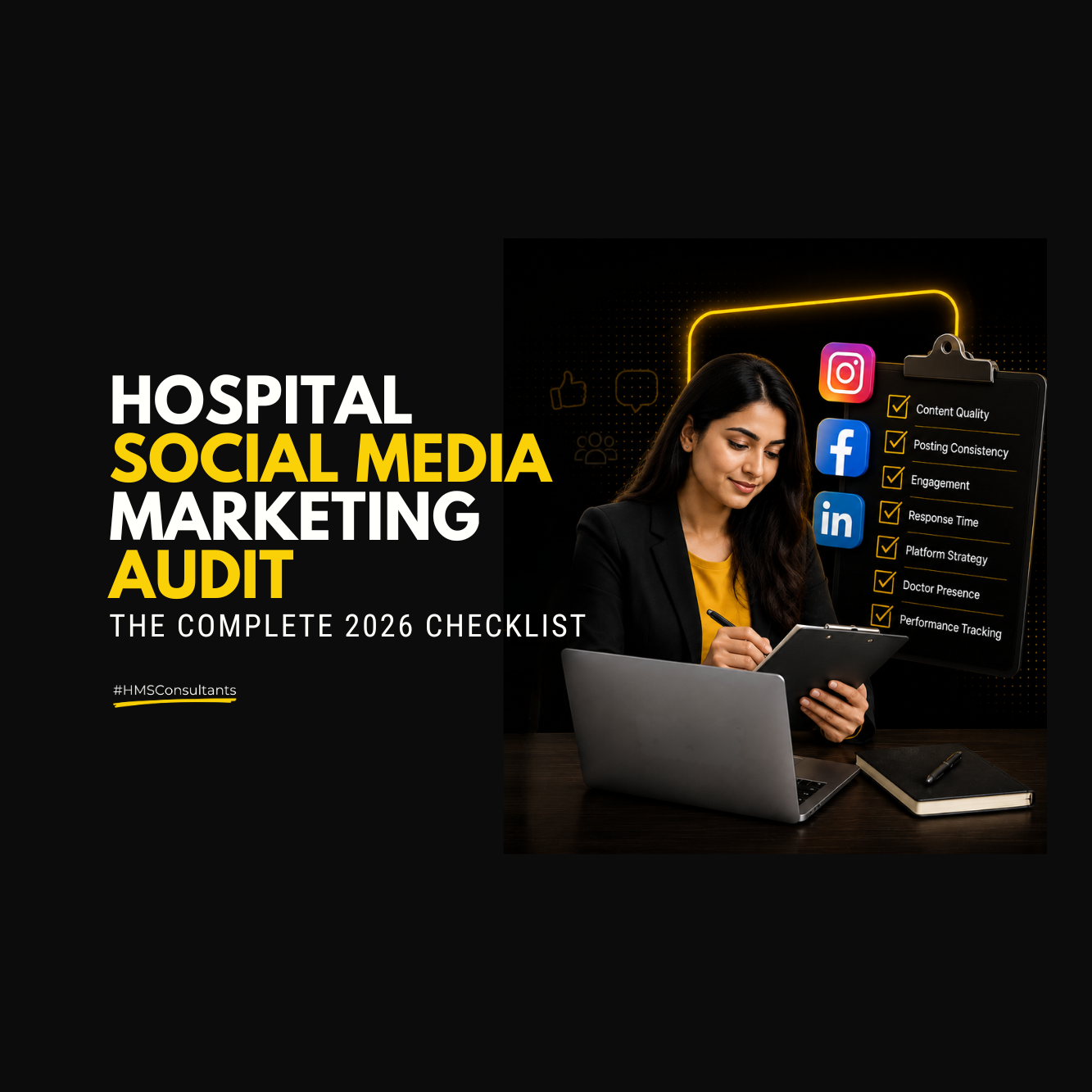
– Social media – activity, content quality, engagement, response time to patient queries
– Brand consistency – name, logo, tagline, signage, and messaging across every touchpoint
– Patient experience touchpoints – how enquiries are handled from first contact to appointment
– Referral network health – relationships with referring doctors and how they’re nurtured
– Team capability – whether the internal team has the skills the channel mix demands
– Reporting – whether any of the above is actually being measured monthly
4. The Hospital Marketing Audit Checklist
Use this as a working checklist a genuine audit will go deeper into each item, but this is enough to self-assess where the obvious gaps are.
Digital
☐ Website loads in under 3 seconds on mobile
☐ Google Business Profile is claimed, verified, and updated monthly
☐ Hospital ranks on page 1 for its own name + “hospital in [city]”
☐ Website has clear calls-to-action (appointment booking, enquiry form, click-to-call)
☐ Schema markup (LocalBusiness, Service) is present on key pages
Content & SEO
☐ Department/specialty pages exist and are kept current
☐ Blog or patient-education content is published at least monthly
☐ Content answers real patient questions, not just hospital announcements
Social & Reputation
☐ Active on at least the 2 platforms the target patient demographic actually uses
☐ Google review count and rating are tracked monthly, with a response protocol for negative reviews
☐ Patient testimonials (with consent) are used in marketing materials
Brand & Offline
☐ Name, logo, and tagline are used consistently across signage, prescriptions, and digital assets
☐ Print/hoarding spend is tied to a specific, trackable objective — not habit
Team & Process
☐ Someone owns marketing full-time, with defined KPIs
☐ Monthly reporting exists and is reviewed by leadership
☐ There is a documented process for handling and converting enquiries
5. Red Flags a Marketing Audit Commonly Uncovers
Across audits, a handful of issues show up repeatedly:
– A Google Business Profile that hasn’t been updated in over a year, with no one responsible for it
– Marketing spend concentrated in one channel (usually print) with no way to measure its return
– A website that ranks well for the hospital’s own name but is invisible for the searches an actual prospective patient would use
– No system for following up on website or WhatsApp enquiries within the same day
6. How Often Should a Hospital Run One?
A full audit once a year is the baseline, with a lighter digital-only check-in every quarter. Hospitals should also run one immediately after any major event a new competitor opening nearby, a leadership change, or a noticeable dip in enquiries with no obvious cause.
7. DIY Audit vs. Professional Audit
The checklist above is a genuinely useful starting point, and any hospital administrator can work through it in an afternoon. Where it falls short is benchmarking knowing whether “page 1 ranking” is actually competitive in your city, or whether your enquiry-to-admission conversion rate is healthy compared to similar hospitals. A professional audit adds that context, plus a prioritized action plan instead of just a list of gaps.
8. How HMS Consultants Runs a Hospital Marketing Audit
HMS Consultants‘ audit process benchmarks a hospital against its actual local competitors not generic industry averages across digital, offline, brand, and team capability, and returns a prioritized 90-day action plan rather than just a scorecard.
Frequently Asked Questions
Cost depends on hospital size and how many channels are being reviewed a digital-only audit is faster and less expensive than a full audit covering offline branding and team capability as well.
A typical audit takes 2–3 weeks from data collection to a final report with recommendations.
Clinics benefit as much as large hospitals the checklist scales down naturally, and smaller setups often have the most to gain from fixing basic gaps like an inactive Google Business Profile.
A digital marketing audit only covers online channels (website, SEO, social, reviews). A full hospital marketing audit also covers offline branding, referral relationships, and internal team capability.
An audit assesses what’s currently happening and where the gaps are. A strategy is the plan for what to do about it. An audit should always come first.
is something we strongly believe in, which means ‘Knowledge without application is the same as having no knowledge at all
Akhil Dave
Principle Consultant
Ready to take your Personal Brand to the next level?
Share your details below and we will connect with you to discuss your growth strategy.
Digital Marketing in Indian Healthcare
Discover how digital marketing is transforming Indian healthcare by enhancing patient engagement, trust, and hospital growth in 2025.
Hospital Marketing Executive: Why the Role Needs Strategy, Not Just Field Work
Discover why the role of a hospital marketing executive now requires more than field visits. Learn how strategy, patient communication, digital awareness, reporting, and ethical healthcare marketing help hospitals…
What a Hospital Marketing Expert Sees in the First 30 Days That Others Miss for Years
A hospital marketing expert can identify hidden friction in the patient journey within the first 30 days. Learn how patient hesitation, messaging gaps, and experience misalignment quietly affect hospital…
How to Turn Patient Referrals Into Real Growth for Clinics and Hospitals
Referrals are healthcare’s most trusted growth channel. This guide shows how clinics and hospitals can build a simple referral system that turns trust into steady patient flow.
Hospital Marketing Strategy: Why Enquiry Quality Matters More Than Enquiry Volume
Hospital marketing strategy is not about generating more enquiries—it is about generating the right ones. Focusing on enquiry quality helps hospitals attract relevant patients, improve conversions, and achieve better…
WhatsApp is the New OPD: How Hospitals in India Can Convert 3X More Patients With Smart Automations
WhatsApp has become the first point of contact for hospitals in India. Learn how smart WhatsApp systems help convert patient enquiries into OPD visits.