

Why Hospital Marketing Budgets Don’t Fix Growth
Hospital marketing budgets often increase when growth slows, but higher spending rarely fixes...
Hospitals tend to design marketing from the inside out. Services are listed. Expertise is highlighted. Infrastructure is showcased. Achievements are promoted. While all of this feels logical internally, it rarely aligns with how patients think or decide.
Patients do not experience hospitals in departments or services. They experience them as a sequence of emotions, questions, doubts, and decisions. They move through uncertainty, fear, comparison, reassurance, and trust before they ever commit to a visit.
When marketing ignores this journey and focuses only on promotion, it speaks past the patient instead of guiding them.
In the absence of patient journey mapping, marketing decisions are often made in isolation. Social media is handled separately from the website. Ads are judged independently of OPD experience. Lead generation is evaluated without understanding conversion quality. Follow-ups are treated as operational issues rather than part of the marketing continuum.
This fragmentation creates confusion. Patients receive mixed signals at different stages. What is promised online does not match what is delivered offline. Expectations are set but not fulfilled. Trust weakens quietly.
Marketing without a mapped journey becomes a collection of disconnected touchpoints rather than a cohesive experience.
One of the most damaging consequences of ignoring patient journey mapping is the overemphasis on leads. When marketing is evaluated primarily on the number of enquiries generated, quality is often overlooked.
Leads may increase, but patients arrive unprepared, misinformed, or uncertain. Enquiry handling becomes strained. Doctors face resistance during consultations. Drop-offs increase after diagnosis. Follow-ups fail.
From the hospital’s perspective, marketing appears to be underperforming. From the patient’s perspective, the journey never felt clear enough to commit.
Journey mapping reveals that lead generation is not the end of marketing. It is merely one step in a longer process that requires guidance, clarity, and reassurance.
Healthcare decisions are rarely impulsive. Even in urgent cases, patients seek validation. They look for signs of credibility. They want to know what will happen next, how much it will cost, who will be involved, and how safe they will feel.
Patient journey mapping forces hospitals to acknowledge this reality. It reveals where patients hesitate, where they seek additional information, where fear overrides logic, and where confusion leads to withdrawal.
Without this understanding, marketing continues to push messages forward while patients remain stuck at earlier stages of decision-making.
When patients drop off, hospitals often attribute it to price sensitivity, competition, or lack of seriousness. While these factors exist, they are rarely the full story.
Journey mapping often reveals more uncomfortable truths. Patients drop off because explanations were rushed, family concerns were not addressed, follow-up communication was absent, or the next step was unclear.
Marketing cannot fix these gaps unless it understands where they occur. Without mapping, hospitals keep optimising the wrong things while real friction points remain untouched.
Patient journey mapping is not a documentation exercise. It is a strategic lens that reshapes how marketing is designed and evaluated.
When hospitals map the journey, marketing becomes contextual. Content addresses real patient questions instead of generic promotion. Campaigns are aligned with decision stages rather than calendar schedules. Communication becomes consistent across touchpoints. Expectations are set accurately.
Marketing begins to feel helpful rather than persuasive. Patients feel guided rather than sold to.
No agency or platform can accurately map a patient journey without deep involvement from the hospital. Journey mapping requires insight into patient conversations, operational realities, staff behaviour, clinical flow, and emotional touchpoints.
When hospitals outsource marketing without owning journey clarity, agencies are forced to operate on assumptions. Campaigns are built on an incomplete understanding. Results remain unpredictable.
Journey mapping must be led internally, with marketing acting as an extension of that clarity rather than a substitute for it.
Hospitals that invest in patient journey mapping often notice a shift. Marketing becomes calmer. Decisions feel grounded. Enquiry quality improves. Consultations feel smoother. Resistance reduces. Follow-ups become more effective.
Marketing no longer feels like a gamble. It becomes a system that supports patients through uncertainty and helps them arrive at decisions with confidence.
This is when marketing stops being questioned every month and starts being trusted as a strategic function.
Hospital marketing without patient journey mapping is not ineffective; it's just poorly executed. It fails because it lacks empathy and context.
Patients do not move through hospitals the way hospitals imagine they do. Until marketing reflects the patient’s real journey, emotional, psychological, and practical, it will continue to fall short of its potential.
The most successful hospitals do not market harder.
They market more intelligently, guided by a deep understanding of how patients think, feel, and decide.
Without patient journey mapping, marketing is directionless.
With it, marketing becomes one of the most potent tools a hospital can use to build trust and sustainable growth.
Share your details below and we will connect with you to discuss your growth strategy.
Hospital marketing budgets often increase when growth slows, but higher spending rarely fixes...
A hospital marketing consultant is often hired too late when growth slows and...

Public relations in a hospital is not about media or advertising, but about...
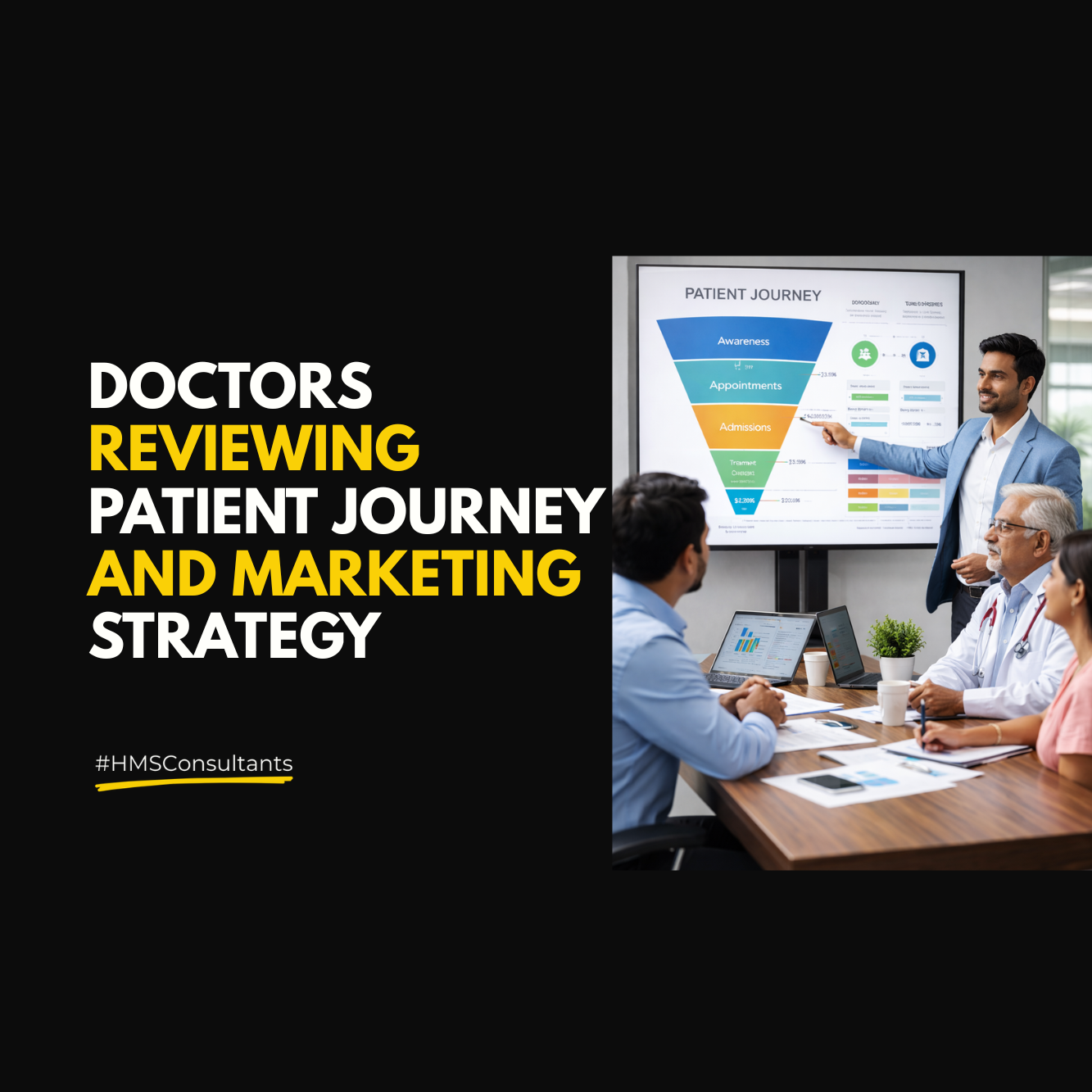
A hospital marketing expert can identify hidden friction in the patient journey within...

Patients often decide which hospital to visit before their first consultation. Searches like...

Clinic marketing strategy guide for doctors explaining why OPD becomes inconsistent, why patients...