

Why Hospital Marketing Budgets Don’t Fix Growth
Hospital marketing budgets often increase when growth slows, but higher spending rarely fixes...
Many hospital owners view marketing ROI through a simple equation: money spent versus patients acquired. If advertising costs a certain amount and OPD numbers do not rise proportionately within a short window, marketing is labelled inefficient.
This approach might work for transactional industries, but healthcare is not transactional by nature. Patients do not make decisions instantly. They evaluate options, consult family members, seek reassurance, and often delay action until urgency builds or trust is established.
Expecting immediate, linear returns from healthcare marketing misunderstands patient behaviour. It reduces a complex decision-making journey into a single moment of conversion, ignoring everything that happens before and after.
One of the biggest misconceptions in healthcare marketing is the expectation that outcomes should align neatly with monthly review cycles. Hospitals run ads for one month and expect proportional OPD increases in the same month.
In reality, healthcare decisions often operate on delayed timelines. A patient may see an advertisement today, watch a doctor’s video next week, read reviews over several days, discuss with family, and finally book an appointment weeks later. For chronic conditions, preventive care, or elective procedures, this timeline can extend even further.
When hospitals fail to account for this delay, marketing appears ineffective on paper, even when it is working in the background.
Hospitals tend to track only visible outcomes: calls, appointments, and admissions. What they rarely track are the invisible effects of marketing.
Marketing improves brand recall, which influences patient choice when urgency arises. It increases perceived credibility, which reduces resistance during consultations. It shortens decision cycles because patients arrive more informed. It improves staff confidence because patients come with clearer expectations.
These outcomes directly affect conversion, retention, and referrals, yet they are rarely attributed to marketing in ROI discussions.
When ROI analysis ignores these layers, marketing is undervalued and misunderstood.
When marketing ROI appears low, the instinctive response is to blame campaigns or agencies. However, low ROI is frequently a symptom of deeper issues within the hospital system.
Poor enquiry handling, unclear communication, long waiting times, rushed consultations, and weak follow-up systems all dilute the impact of marketing. Patients may arrive, but they do not convert or return. The marketing effort did its part, but the system failed to capitalise on it.
In such cases, improving marketing alone will never improve ROI. The hospital must strengthen its internal processes to ensure marketing outcomes translate into real value.
Another standard error is comparing marketing channels independently rather than holistically. Hospitals may conclude that Google Ads work better than social media, or referrals outperform digital campaigns, and therefore shift budgets abruptly.
What this analysis often misses is that channels influence each other. A patient may discover the hospital on social media, verify credibility through Google reviews, visit the website, and then call after a referral from a friend. Attributing the final action to a single channel oversimplifies reality.
Healthcare marketing ROI is cumulative, not siloed. Channels work together to build confidence. Measuring them in isolation distorts decision-making.
Cost-per-lead is frequently used as a benchmark for marketing efficiency. While it has value, it can be misleading when used alone.
A low-cost lead that never converts wastes more resources than a higher-cost lead that results in long-term engagement, follow-ups, and referrals. Healthcare ROI must consider patient lifetime value, not just acquisition cost.
Hospitals that focus only on cheap leads often attract poorly matched patients, increase drop-offs, and strain staff without meaningful growth.
Leadership expectations also shape marketing ROI. When leaders expect marketing to deliver certainty in an inherently uncertain domain, disappointment is inevitable.
Healthcare marketing operates within variables that cannot be fully controlled: patient emotions, family influence, clinical urgency, financial capacity, and personal beliefs. Marketing increases probability, not guarantees outcomes.
Hospitals that understand this nuance evaluate marketing based on trends, patterns, and trajectory rather than on absolute numbers alone. They allow strategies time to mature and be optimised, rather than judging them prematurely.
Hospitals with a mature understanding of ROI look beyond immediate returns. They assess how marketing improves enquiry quality, consultation readiness, treatment acceptance, repeat visits, and referrals over time.
They integrate marketing data with operational data. They review outcomes quarterly rather than impulsively. They refine messaging based on patient feedback. They treat ROI as a strategic indicator, not a transactional scorecard.
In such environments, marketing becomes predictable and controllable, not mysterious or frustrating.
Healthcare marketing ROI is not broken. It is often misunderstood.
When hospitals redefine ROI to reflect patient behaviour, system readiness, and long-term value, marketing begins to make sense. It stops feeling like an expense and starts functioning like an investment.
The real question is not whether marketing is delivering ROI.
The real question is whether hospitals are measuring the proper outcomes in the right way.
Those who answer that honestly discover that marketing, when aligned with systems and expectations, delivers far more than numbers on a monthly report.
Share your details below and we will connect with you to discuss your growth strategy.
Hospital marketing budgets often increase when growth slows, but higher spending rarely fixes...
A hospital marketing consultant is often hired too late when growth slows and...

Public relations in a hospital is not about media or advertising, but about...
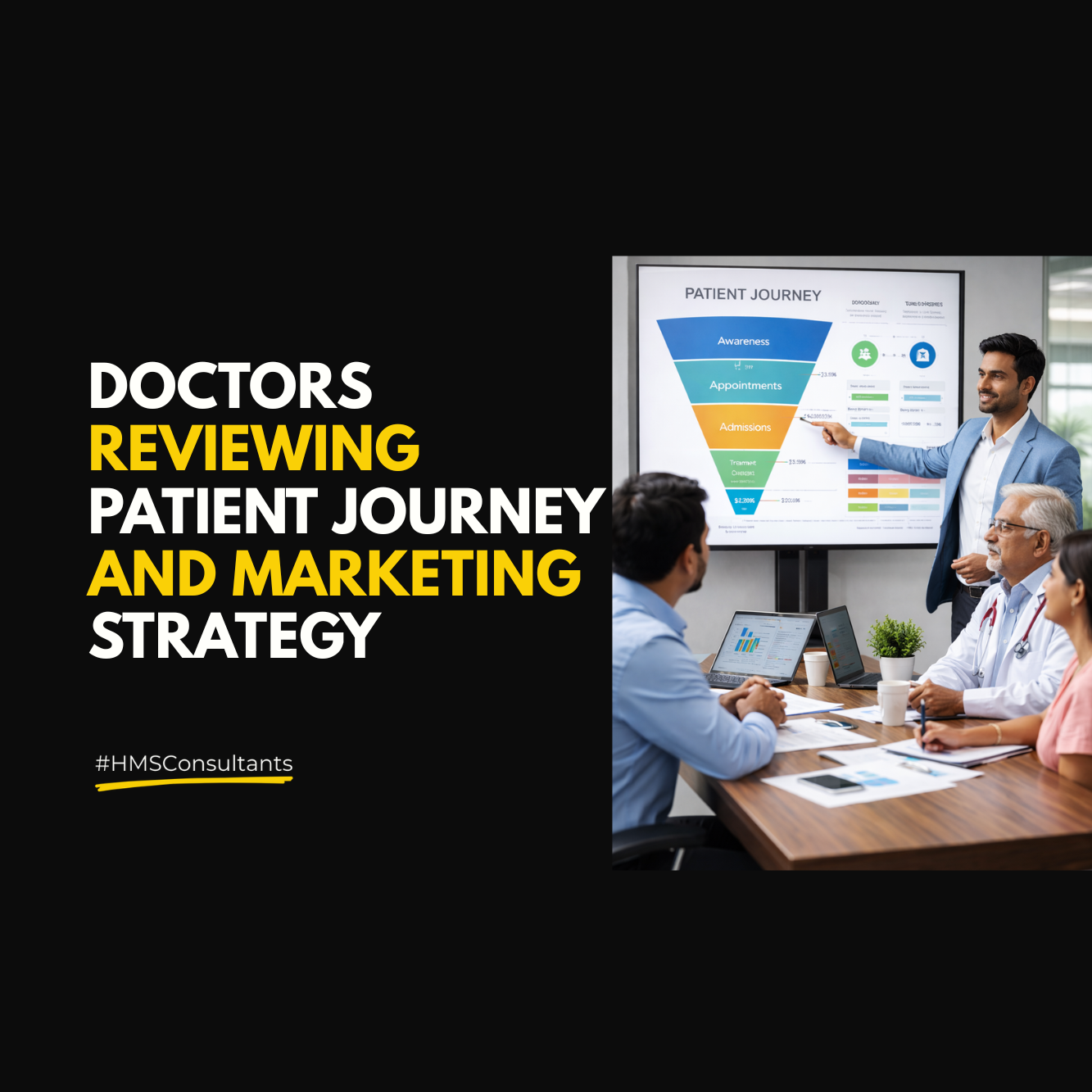
A hospital marketing expert can identify hidden friction in the patient journey within...

Patients often decide which hospital to visit before their first consultation. Searches like...

Clinic marketing strategy guide for doctors explaining why OPD becomes inconsistent, why patients...