

Why Hospital Marketing Budgets Don’t Fix Growth
Hospital marketing budgets often increase when growth slows, but higher spending rarely fixes...
Doctor-led hospitals often believe their biggest asset is personal trust, and they are right. The problem arises when that trust cannot be transferred or scaled.
A single doctor can only see a limited number of patients, make a finite number of decisions, and handle only so much emotional and cognitive load. As demand increases, compromises begin to appear- shorter consultations, delayed decisions, postponed follow-ups, and growing dependence on the doctor’s presence for even routine matters.
The hospital may grow in numbers, but its resilience does not.
When growth is tied to one individual, the organisation becomes highly sensitive to absence, fatigue, illness, or even personal choices. Any disruption to the doctor’s availability directly impacts revenue, patient satisfaction, and team morale.
This is not a leadership failure. It is a structural limitation.
Patients may say they trust a particular doctor, but what they truly seek is reassurance, clarity, and continuity of care. When everything revolves around one personality, patients often feel uncertain about what happens in that doctor’s absence.
They may ask themselves questions they never voice aloud. Who will explain things if the doctor is unavailable? Will the quality of care remain the same? Can I trust the rest of the team? Is the hospital capable, or is it just the doctor?
These unspoken doubts quietly affect long-term trust. Patients may comply in the short term, but loyalty remains shallow when confidence in the system is missing.
System-led hospitals do not remove the doctor from the equation; they reduce dependency on the individual. Trust is distributed across processes, people, and protocols rather than concentrated in one personality.
In such hospitals, patients experience consistency regardless of who they interact with. Communication feels structured. Information is repeated clearly. Follow-ups happen on time. Billing explanations remain uniform. The care journey feels intentional rather than improvised.
When systems are strong, patients begin to trust the hospital itself, not just one doctor within it.
This shift changes everything. Growth becomes sustainable because it is no longer limited by one person’s bandwidth.
For many founders, letting go is the hardest part of growth. When you have built something with your own credibility, stepping back feels risky. There is fear that standards will drop, patients will feel neglected, or the brand will dilute.
But holding on too tightly creates a different risk, stagnation.
System-led growth does not mean detachment. It means moving from being the centre of execution to becoming the architect of standards. The role of leadership evolves from doing everything to ensuring everything is done right.
This transition requires deliberate effort, patience, and trust in processes rather than personalities.
In system-led hospitals, patients encounter clarity at every stage of their journey. Appointments follow a defined flow. Doctors communicate using shared frameworks. Case notes are structured. Follow-ups are standardised. Staff know how to respond without constantly seeking approval.
This consistency reassures patients. It also empowers teams. Staff feel confident because expectations are clear. Junior doctors grow faster because guidance is built into the system rather than dependent on constant supervision.
Most importantly, leadership gains space to think strategically rather than firefighting daily operations.
Many doctor-led hospitals attempt to solve growth limitations by increasing marketing. More videos. More ads. More visibility for the lead doctor. This often worsens the problem.
Increased marketing increases demand, which further concentrates pressure on the same individual. Instead of scaling the hospital, marketing ends up scaling exhaustion.
Marketing works best when it amplifies systems, not individuals. When patients walk into a hospital that functions smoothly regardless of who is present, marketing strengthens trust. When systems are weak, marketing only exposes dependency.
One of the most telling signs of maturity in a hospital is language. When teams stop saying “my patient” and start saying “our patient,” a cultural shift has occurred.
System-led hospitals prioritise continuity over ownership. Care becomes collaborative. Responsibility is shared. Patients feel supported by an ecosystem rather than reliant on one person.
This mindset is critical for long-term stability, succession planning, and institutional credibility.
Hospitals that successfully make this transition experience calmer growth. Patient experience improves because care feels predictable and reliable. Teams perform better because expectations are clear. Leaders regain bandwidth to focus on vision rather than daily execution.
Most importantly, the hospital becomes future-ready. It can expand, onboard new doctors, open new units, or evolve services without losing its core identity.
System-led hospitals do not lose personality, they preserve it within structure.
Doctor-led growth is powerful, but it has a ceiling. System-led growth removes that ceiling.
Hospitals that outgrow personality dependence do not diminish their founders; they honour them by building something that lasts beyond individual presence. Trust becomes institutional. Care becomes consistent. Growth becomes sustainable.
The future of healthcare does not belong to the loudest names or the most visible faces.
It belongs to hospitals that can deliver excellence even when the founder is not in the room.
That is the true mark of a mature, scalable healthcare institution.
Share your details below and we will connect with you to discuss your growth strategy.
Hospital marketing budgets often increase when growth slows, but higher spending rarely fixes...
A hospital marketing consultant is often hired too late when growth slows and...

Public relations in a hospital is not about media or advertising, but about...
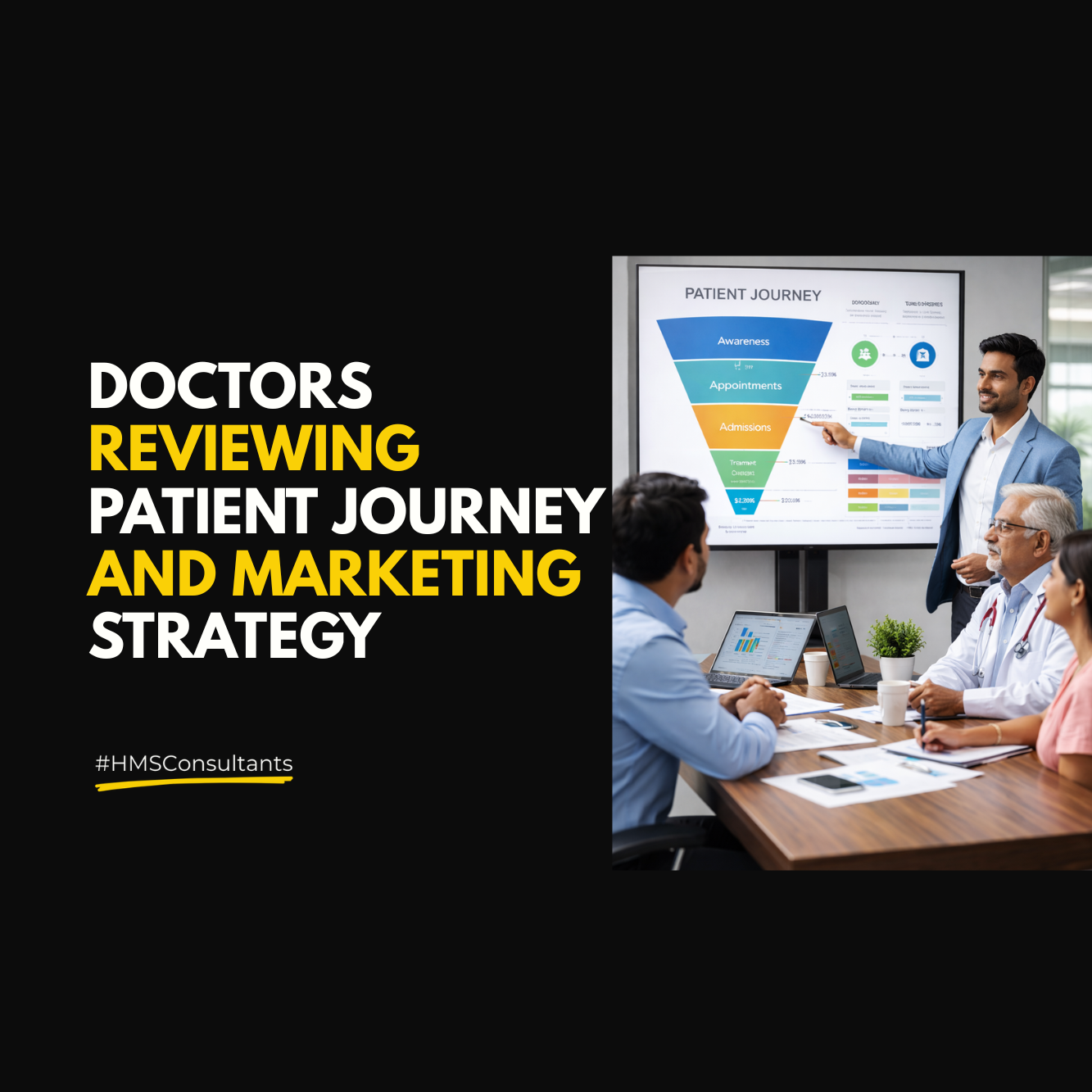
A hospital marketing expert can identify hidden friction in the patient journey within...

Patients often decide which hospital to visit before their first consultation. Searches like...

Clinic marketing strategy guide for doctors explaining why OPD becomes inconsistent, why patients...