Search results for: “Advertising”

  • NMC Advertising Guidelines 2026: A Complete Compliance Guide for Doctors and Hospitals

    NMC Advertising Guidelines 2026: A Complete Compliance Guide for Doctors and Hospitals

    NMC Advertising Guidelines 2026: A Complete Compliance Guide for Doctors and Hospitals

    Published on
    Share This

    NMC advertising guidelines 2026 for doctors and hospitals

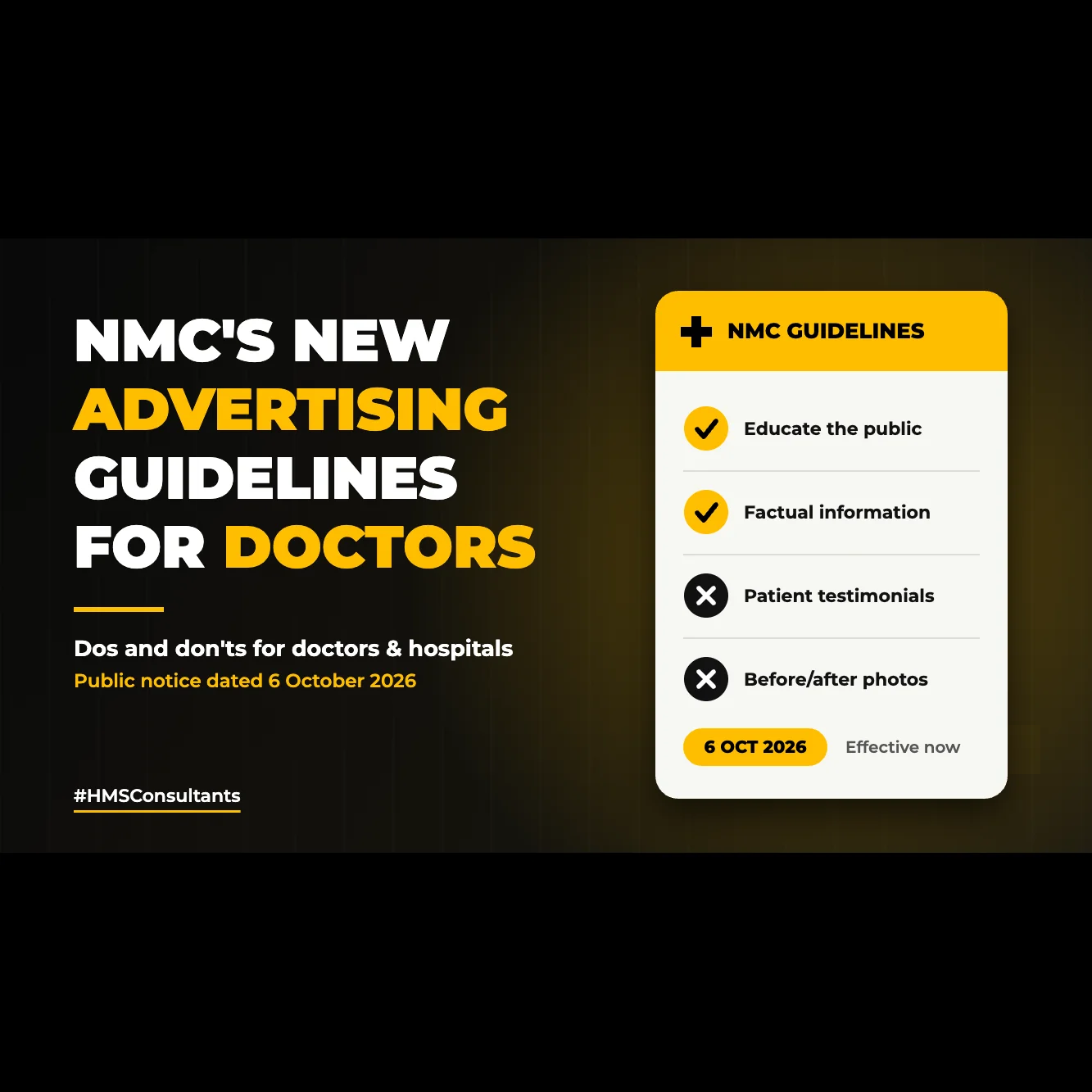
    NMC advertising guidelines now apply to every doctor, clinic and hospital in India. The National Medical Commission (NMC) has issued its Guidelines on Ethical Advertising and Public Communication through a public notice dated 6 October 2026 (No. R-13014/01/2024-Ethics). They apply from publication, with no grace period stated, and were framed in connection with a Supreme Court writ petition (WP(C) 1160/2023). One principle has not changed: a doctor still cannot promote their own practice. What has changed is clarity. The 2002 Regulations spoke in principles; these NMC guidelines for doctors and hospitals name the channels (social media, WhatsApp, podcasts, influencers, online platforms, AI) and list specific prohibitions.

    Want to know if your website and social media comply?

    Our NMC Compliance Audit reviews your website, YouTube, Instagram, Facebook, LinkedIn and Google profile against these guidelines, with a Red-Amber-Green report in 7 working days. ₹25,000 for doctors, ₹50,000 for hospitals.

    See the NMC Compliance Audit →

    What the NMC advertising guidelines change: five things every doctor should know today

    1. Digital promotion is advertising. Sponsored posts, influencer content and AI-assisted promotion are all covered (clause 3.2).
    2. Testimonials, before-and-after images, success stories, and claims such as “best” or “100% success” are barred for promotion (clause 8.1).
    3. Patient consent does not make a prohibited practice acceptable (clause 6.2).
    4. Using an agency or influencer does not shift responsibility away from you (clause 4.4).
    5. Penalties are graded, from a warning to removal from the medical register for 1 to 3 years (clause 10.1).

    Who is covered, and the legal footing

    The guidelines apply to Registered Medical Practitioners (RMPs) and to hospitals and medical institutions. They operate alongside the NMC Act, 2019 and the Indian Medical Council (Professional Conduct, Etiquette and Ethics) Regulations, 2002, and do not override either (clauses 2.1 and 4.2).
    • Doctors (RMPs): read with the 2002 Regulations and the NMC Act. Where the two cannot be reconciled, the statute prevails.
    • Hospitals and clinics: read with the Clinical Establishments Act or the relevant state Act, which prevails in a conflict (clause 4.3).
    • Healthcare platforms hosting doctors: must follow the same norms, must not offer paid ranking of doctors, and must keep listings transparent (clause 9.4).
    • Agencies and influencers: hiring them does not absolve you of content you authorised, commissioned or knowingly permitted (clause 4.4).
    A point of confusion worth clearing: the NMC’s 2023 professional conduct regulations were put on hold by a gazette notification dated 23 August 2023. The 2002 Regulations remain the operative code, and these new guidelines are read with them.

    What you can still do

    Education and factual information remain permitted. The test is whether the content informs the public or promotes you. Doctors (clauses 5.1 and 8.2)
    • Announce starting practice, a change of practice type or address, temporary absence, resumption or succession of practice, and your charges.
    • Publish research case studies in reputed journals.
    • Give public health talks on TV, radio or electronic media in your own name and designation, without promoting an employer.
    • Share patient health-education pamphlets free of guarantees, superiority claims or misleading content.
    • Post greetings on national or professional days, without professional promotion.
    • Join awareness campaigns and educational content that do not promote your practice, solicit patients or earn money from the promotion.
    Hospitals and clinics (clauses 5.2, 8.3 and 9.1)
    • Publish factual, verifiable details: name, location, contact information, departments, facilities, equipment, emergency services, accreditation and charges.
    • Maintain a factual doctor directory with names, recognised qualifications, specialties, registration details and availability. The guidelines treat this as patient information, distinct from paid promotion.
    • Use hoardings for factual infrastructure information only.

    What is now prohibited

    Clause 8.1 sets out twelve restrictions for doctors, and clause 9.2 adds one on photographs. Hospitals have their own list in clause 8.3.
    PracticeWhat the guidelines sayClause
    Demand creation and fearNo ads that create unnecessary demand for procedures or diagnostics, or use fear-based marketing8.1(i)
    SolicitationNo direct or indirect solicitation or self-promotion; no third-party marketing; no lending your name, image or voice for promotion8.1(ii)
    Success claimsNo personal success rates or patient numbers; no “guaranteed cure” or “100% success”8.1(iii)
    Product endorsementNo endorsing drugs, devices or health products using your name, image or professional status8.1(iv)
    Case publicityNo before-and-after photos, surgical results, celebrity patients or success stories; scientific or educational use with anonymised consent is the exception8.1(v)
    Unrealistic expectationsNo concealed risks, unrealistic promises or unproven therapies8.1(vi)
    Referral paymentsNo commissions, referral fees or lead-generation payments tied to referrals8.1(vii)
    Pay-per-patient contractsAgency, influencer or platform contracts must not pay per patient procured or referred8.1(viii)
    Comparative claims“Best”, “No. 1” and “leading” only if objectively verifiable; awards and rankings must disclose methodology, date and awarding body8.1(ix)
    Offers and inducementsNo discounts, contests, coupons, gifts, cashbacks, referral benefits or free procedures that encourage unnecessary care; fees must be stated factually8.1(x)
    Testimonials and endorsementsNo testimonials from celebrities, influencers, patients, staff or others; no indirect advertising through intermediaries; disclose material commercial ties8.1(xi)
    Fake engagementNo fake followers, likes, reviews, ratings or views; no manipulation of search or algorithms8.1(xii)
    Doctor photographsNo photograph that works as self-advertisement; self-photos on letterheads and signboards are governed by 2002 Regulations 6.1.1 and 6.1.29.2
    For hospitals (clause 8.3): no patient solicitation or inducement, no superiority claims, no cure or outcome guarantees, no exaggerated claims, and no promotion of individual doctors. Factual information stays factual, but the form or frequency of communication cannot turn it into promotion.

    Social media, reviews, SEO, influencers and AI

    Online, one test decides whether the rules apply: does the content have a promotional character? If it does, it is advertising, whatever the medium (clause 3.2).
    • Mandatory disclosure: Electronic posts must show the doctor’s name, qualifications, registration status and State or National Medical Register number. Establishments must disclose the same details for their doctors (clause 3.2, Explanations III and IV).
    • Social media: Educational content is fine. Self-promotion and soliciting patients are not (8.1(ii)). Treat posts published before 6 October as in scope and audit them.
    • Reviews and testimonials: Testimonials are prohibited (8.1(xi)), and fake, paid or manipulated reviews are barred (clause 3.2, Explanation V; 8.1(xii)). The text does not clearly address a patient’s own unsolicited review on a third-party platform. Until NMC clarifies, our advice is not to solicit, reproduce or showcase patient reviews in your promotion.
    • SEO and search: Manipulating search rankings or algorithms to create a false impression of standing is prohibited (8.1(xii)). Factual website content on services, facilities, qualifications and fees is permitted. Superlatives are not. Platforms may not sell paid ranking of doctors (9.4).
    • Influencers and agencies: No payment may be tied to patients procured or referred (8.1(vii) and (viii)). Influencer testimonials are barred, material commercial relationships must be disclosed (8.1(xi)), and you stay responsible for what they publish (4.4).
    • Artificial intelligence (clause 7.2): AI-generated promotional campaigns for commercial interest are prohibited. Permitted AI content must carry a source mark stating it is AI-generated. AI may not be used to create or alter patient images, testimonials, voices or outcomes, or to make misleading claims about diagnosis, treatment or qualifications. Government public-interest campaigns are exempt (7.3).
    • Live surgery: Broadcasts must follow NMC’s live-surgery framework on safety, consent, privacy and commercialisation (7.5).
    Some terms, such as the “commercial character” of AI content and what counts as “material” AI alteration, are not yet defined, as MediaNama’s analysis notes. Expect NMC clarifications and SOPs (clause 12).

    Patient data, consent and the DPDP Act

    Patient information can appear in communication only where the law permits it and consent and safeguards are in place (clause 6.1). Even then, consent does not rescue a practice the guidelines otherwise prohibit, such as a testimonial or a before-and-after image (6.2). What valid consent looks like (clause 6.3): specific, informed, voluntary, documented and verifiable, and in a form that meets applicable privacy law. Identifiers (clauses 6.4 and 7.4): names, faces, birthmarks and identification marks must be cropped, blurred or blacked out. Identifiable patient data must not be shared. DPDP Act link (clause 7.6): digital use of personal data must comply with the IT Act, 2000 and the Digital Personal Data Protection Act, 2023 with its 2025 Rules, as applicable and in force. The timing matters:
    DPDP Rules 2025 provisionCommencement
    Board framework (Rules 1, 2 and 17 to 21)Immediate on notification in November 2025
    Consent Manager registration (Rule 4)12 months, around November 2026
    Core fiduciary duties: notice, security safeguards, breach reporting, retention (Rules 3, 5 to 16, 22 and 23)18 months, around May 2027
    Source for the phased timeline: Storyboard18’s report on the final DPDP Rules. Confirm exact dates against the Gazette notification. So the DPDP duties on notice, security and breach reporting are not yet fully in force, but the NMC consent standard already applies. Build to the stricter of the two now. Practical steps: a separate marketing-use consent form (distinct from treatment consent), a written log of who approved each use, and a rule that no patient data goes into any AI tool without safeguards. For medical practices, the DPDP Rules also include carve-outs for healthcare providers processing children’s data, subject to conditions, so check which apply to you.

    Telemedicine, consumer law and drug advertising: the other rules that apply

    The NMC guidelines are one layer. The same content can also be tested against the following. 1. Telemedicine Practice Guidelines, 2020. India has no standalone Telemedicine Act. These are guidelines issued on 25 March 2020 and incorporated into the 2002 Regulations on 12 May 2020. Per the guidelines’ text:
    • Your State Medical Council or national registration number must appear on prescriptions, websites, electronic communications such as WhatsApp or email, and receipts (section 3.2.5).
    • You may not solicit patients for telemedicine through advertisements or inducements (section 3.7.1.4).
    • Patient confidentiality, the IT Act and data protection law apply, and misuse of patient images or data is prohibited (sections 3.7.1.1 to 3.7.1.4).
    • Platforms must list each doctor’s name, qualifications, registration number and contact details (section 5.2). AI-based platforms cannot counsel patients or prescribe (section 5.4).
    2. Consumer Protection Act, 2019 and the CCPA Guidelines, 2022. The CCPA guidelines on misleading advertisements and endorsements were notified on 9 June 2022. Advertisements must be truthful, disclaimers cannot contradict the main claim, and endorsers must act with due diligence and disclose material connections. Under Section 21, penalties reach up to Rs 10 lakh (up to Rs 50 lakh for later violations), and endorsers can be barred for up to one year (three years for repeat violations). Section 89 provides up to two years’ imprisonment for causing prejudicial false advertisements. Medical services fall within consumer law following the Supreme Court’s 1995 ruling in Indian Medical Association v. V.P. Shantha. The practical implication: a claim you publish can be cited in a consumer complaint as a promise you made. Keep every claim you publish verifiable. 3. Drugs and Magic Remedies (Objectionable Advertisements) Act, 1954. Section 3 bars advertisements suggesting a drug can diagnose, treat or prevent conditions in the Act’s Schedule of 54 conditions, including cancer, diabetes, heart disease, epilepsy and cataract. A first conviction can bring up to six months’ imprisonment, a fine, or both. Keep any medicine-related content clear of cure or prevention claims for these conditions. 4. Supreme Court self-declaration directions (2024). In Indian Medical Association v. Union of India, the Court required advertisers and advertising agencies to file a Self-Declaration Certificate before publishing an advertisement, through the Broadcast Seva portal for TV and radio and the Press Council of India portal for print and digital. If your hospital runs paid advertising through an agency, confirm with them how this applies.

    Penalties and appeals

    State Medical Councils (SMCs) enforce the guidelines against doctors through graded action (clause 10.1):
    ViolationAction
    FirstWarning and mandatory ethics training
    SecondCensure and a monetary penalty
    ThirdSuspension of registration for 3 to 6 months
    Serious (misleading cure claims, patient inducement, digital mass solicitation)Suspension for 6 to 12 months
    RepeatedRemoval from the register for 1 to 3 years
    Process safeguards: a show-cause notice and an opportunity to respond must come first (10.2), and the SMC must issue a reasoned order (10.3). Appeals (clause 11): a first appeal lies to the Ethics and Medical Registration Board of NMC within 60 days under section 30(3) of the NMC Act, 2019. A second appeal lies within 60 days of the first decision under section 30(4). Hospitals are dealt with under the Clinical Establishments Act or the applicable state Act. Doctors who personally authorised or endorsed prohibited content may also be examined separately (11.5).

    A 10-step compliance checklist for doctors and hospitals

    The guidelines apply from publication, so start with an audit this week.
    1. Inventory every channel that carries your name: website, Google Business Profile, Instagram, Facebook, YouTube, LinkedIn, WhatsApp broadcasts, listing platforms and hospital pages.
    2. Add disclosures. Name, qualifications, registration status and registration number on every electronic post, website page and prescription.
    3. Remove testimonials and review screenshots, before-and-after images, success stories and celebrity-patient mentions.
    4. Remove claims you cannot prove: “best”, “No. 1”, “100% success”, “guaranteed”, “painless”. Keep award or ranking claims only with the methodology, date and awarding body stated.
    5. Withdraw inducements: discounts, coupons, cashbacks, referral benefits and free-procedure offers. State fees factually.
    6. Review every agency, influencer and platform contract. No payment per patient or per lead, and no referral commissions.
    7. Stop AI-generated promotion. Label any permitted AI content, and never feed patient data into AI tools without safeguards.
    8. Fix patient consent. Use a separate, documented consent for any educational use of patient material, and mask every identifier.
    9. Align telemedicine communication: registration number on electronic communication, and no solicitation or inducement.
    10. Keep an approval log recording who wrote, approved and published each item, and brief your front-desk and social-media teams.

    Finished the checklist? Get it done for you.

    HMS Consultants audits your last 3 months of posts and every public channel, then walks you through the fixes. Not legal advice; a marketing compliance review.

    See the NMC Compliance Audit →

    Compliance is a strategy question, not only a legal one

    The guidelines do not end your ability to build trust with patients. They move it to the right place: accurate information, credible education and a clear professional identity, instead of claims and inducements. Diagnosis before promotion. Strategy before execution. Patient trust before visibility. If you would like a structured review of your website, Google presence and social channels against these guidelines, HMS Consultants offers an NMC Compliance Audit for Doctors & Hospitals. Write to akhil@hmsconsultants.in or visit hmsconsultants.in. Disclaimer: HMS Consultants is a healthcare marketing consultancy. We are not medico-legal experts or a law firm. This article reflects our understanding of the NMC public notice dated 6 October 2026, based on detailed research of public sources. It is for general information only and is not legal advice. Guidelines may be clarified or amended, so please read the official notice and consult a qualified healthcare lawyer before acting. About the author: Akhil Dave is Founder & Principal Consultant of HMS Consultants, with 25+ years in healthcare marketing. Sources
    Healthcare Marketing Strategy

    is something we strongly believe in, which means ‘Knowledge without application is the same as having no knowledge at all

    Akhil Dave

    Principle Consultant

    Ready to take your Personal Brand to the next level?

    Share your details below and we will connect with you to discuss your growth strategy.

    • Advertising and Media Planning

      Advertising and Media Planning

      Advertising and Media Planning

      Strategic Healthcare Advertising and Media Planning for Maximum Reach and Impact

      At HMS Consultants, our Advertising and Media Planning service is designed to help healthcare providers create and execute effective advertising campaigns. With our extensive expertise in healthcare marketing, we develop strategic media plans that ensure your message reaches the right audience at the right time. Our goal is to maximize the impact of your advertising efforts, driving patient engagement and growth.

      What is Healthcare Marketing?
      Watch the Video

      HMS Consultants

      Why You Need This Service

      Effective advertising and media planning are crucial for healthcare providers to stand out in a competitive market. Without strategic planning, you may face:

      Low Advertising ROI

      Wasting budget on ineffective advertising channels.

      Poor Audience Targeting

      Difficulty in reaching the right audience with your message.

      Inconsistent Brand Messaging

      Lack of a cohesive and consistent advertising strategy.

      Missed Advertising Opportunities

      Failing to leverage the most effective advertising platforms and trends.

      Limited Patient Engagement

      Inability to capture the attention and interest of potential patients.

      HMS Consultants

      What to Expect from Our Consultancy Services

      When you choose HMS Consultants for WhatsApp for Patient Engagement, you can expect:

      Comprehensive Media Planning

      Detailed planning of advertising campaigns across various media platforms.

      Target Audience Analysis

      Identifying and understanding the demographics and behaviors of your target audience.

      Creative Campaign Development

      Crafting compelling and effective advertising messages and visuals.

      Integrated Marketing Communication (IMC)

      Strategies to integrate all forms of communication and marketing to deliver a consistent message.

      Multi-Channel Strategies

      Utilizing a mix of traditional and digital media channels to maximize reach and engagement.

      Performance Monitoring

      Continuous tracking and analysis of advertising performance to optimize campaigns.

      Cost-Effective Strategies

      Guidance on cost-effective advertising methods, especially for traditional media, to ensure every penny is well-spent.

      Healthcare advertising promotes hospitals, clinics, and medical services in a way that builds trust while staying compliant with ethical guidelines. At HMS Consultants, we ensure ads are clear, accurate, and sensitive to patient needs. Unlike generic ads, healthcare advertising requires responsibility in messaging, and we specialize in creating campaign strategies that inform, connect, and convert without compromising credibility.

      Help Center

      FAQs

      Get expert answers to common questions about healthcare marketing strategies.

      Need More Answers?

      Click the button below and fill up the form, our team will reach out to you related to your project’s queries.

      “Knowing is Knowing, Doing is Doing”

      is something we strongly believe in, which means ‘Knowledge without application is the same as having no knowledge at all

      Akhil Dave

      Principle Consultant

      Ready to take your healthcare marketing to the next level?

      Fill out the form below, and our consultant will contact you for a detailed, personalised consultation.

        Learning by HMS Consultants

        Stay Updated and Connected

        Stay ahead with our expert insights and latest updates in healthcare marketing. Visit our blogs for valuable tips, industry trends, etc.

        What more we have to offer?

        Discover other services

        If you’re finding some other services fit for your business, you’ll probably find it right here!

      • NMC Compliance Audit for Doctors & Hospitals

        NMC Compliance Audit for Doctors & Hospitals

        NMC Compliance Audit for Doctors & Hospitals

        What is an NMC compliance audit? It is a structured review of a doctor’s or hospital’s website, social media channels and Google profile against the National Medical Commission’s Guidelines on Ethical Advertising and Public Communication (public notice dated 6 October 2026, effective immediately). HMS Consultants reviews your last 3 months of public content and gives you a red-amber-green report with a fix for every finding in 7 working days.

        Written by Akhil Dave, Founder & Principal Consultant, HMS Consultants · Last updated 10 October 2026

        Is your website and social media safe for your medical registration?

        Doctors and hospitals promote online every day: posts, reels, bios, Google profiles, patient stories, offers. On 6 October 2026 the NMC issued detailed guidelines on what registered medical practitioners (RMPs) and hospitals may and may not communicate publicly. Many everyday posts that were common practice yesterday may now invite a complaint.

        The NMC Compliance Audit from HMS Consultants helps you find out where you stand, in plain language, before someone else points it out.

        What do the NMC ethical advertising guidelines cover?

        The guidelines apply to hospitals, medical institutions and registered medical practitioners across websites, social media, messaging apps, podcasts, influencer marketing, sponsored posts and AI-generated content. In summary, they address:

        • Claims: unverifiable or exaggerated claims such as “best doctor”, “100% success”, “guaranteed cure” or “painless treatment”.
        • Testimonials and reviews: requesting or sharing patient testimonials for promotion, and fake, paid or manipulated reviews and ratings.
        • Before-and-after content: before-and-after photos, surgical results, success stories and success rates; case material only for scientific or educational use with anonymised consent.
        • Patient privacy and consent: identifiers must be removed, and consent does not make a prohibited practice acceptable.
        • Offers and referrals: discounts, limited-time offers, contests, coupons or free procedures that encourage unnecessary consultations, tests or treatment, and referral commissions.
        • Influencers and third parties: using an agency or influencer does not shift responsibility.
        • AI-generated content: a clear AI label is required, and AI may not be used to create patient images, testimonials or outcomes.
        • Mandatory disclosures: name, qualifications, registration status and registration number on electronic posts.
        • Rankings and platforms: paid ranking of doctors and manipulated followers, likes or search rankings.

        This is an awareness summary, not a substitute for the notice itself. Read the original on the NMC website.

        What does the NMC Compliance Audit include?

        We review your public presence in two packages, each covering the last 3 months of posts.

        Area reviewedIndividual DoctorHospital / Multi-Doctor Centre
        WebsiteYour clinic or personal websiteHospital website
        Social mediaYouTube, Instagram, Facebook, LinkedInHospital YouTube, Instagram, Facebook, LinkedIn channels
        GoogleGoogle Business ProfileGoogle Business Profile
        Content periodLast 3 months of postsLast 3 months of posts
        Investment₹25,000₹50,000

        The checks we run

        • Claims, superlatives and outcome promises
        • Testimonials, patient stories and how reviews are requested or displayed
        • Before-and-after images, case content and celebrity patients
        • Patient photos, videos, identifiers and consent practices
        • Offers, pricing and promotional language
        • Name, qualification and registration number disclosures
        • Personal photographs and self-promotion
        • Influencer, agency and third-party content
        • AI-generated content and AI labelling
        • Drug, device or product endorsements
        • Website disclaimers, privacy policy and data practices (DPDP Act)

        What will you receive?

        • A Red / Amber / Green compliance report
        • For every finding: what we found, where it appears, the guideline area it relates to, the risk level and a recommended fix
        • Compliant rewrite samples for your bio or About text and sample posts
        • A 30-minute walkthrough call with HMS Consultants
        • Delivery within 7 working days
        RatingWhat it means
        RedContent that appears to conflict with the guidelines. Fix first.
        AmberBorderline or unclear content. Review, and take legal advice where needed.
        GreenNo concern identified.

        How does the audit work?

        1. Enquire: contact us and share your website, social media and Google profile links.
        2. Review: we assess the last 3 months of public content against the NMC guidelines.
        3. Report: you receive the red-amber-green report within 7 working days.
        4. Walkthrough: a 30-minute call to explain each finding and the fix.

        HMS Consultants provides independent strategic guidance. The corrections can be carried out by your internal team, your marketing agency, your website developer or any vendor you choose.

        How much does an NMC compliance audit cost?

        Individual Doctor

        ₹25,000

        Website, YouTube, Instagram, Facebook, LinkedIn and Google profile. Last 3 months of posts. Report and 30-minute walkthrough in 7 working days.

        Hospital / Multi-Doctor Centre

        ₹50,000

        Hospital website, YouTube, Instagram, Facebook and LinkedIn channels and Google profile. Last 3 months of posts. Report and 30-minute walkthrough in 7 working days.

        GST is not charged at present.

        Book Your NMC Compliance AuditWhatsApp Us

        Who should get an NMC compliance audit?

        • Doctors across specialties, including dermatologists, dentists, IVF specialists, gynaecologists, diabetologists, orthopaedic surgeons, cardiologists, oncologists and eye specialists
        • Clinics, polyclinics and day-care centres
        • Small and mid-size hospitals and multi-specialty centres
        • Diagnostic centres, IVF centres and wellness centres
        • Healthcare startups and health-tech companies

        Why choose HMS Consultants?

        HMS Consultants is a healthcare marketing strategy consultancy led by Akhil Dave, who has over 25 years of experience in healthcare marketing strategy and has trained more than 1,500 doctors on digital marketing and AI tools. Our approach is diagnosis before promotion, strategy before execution, patient trust before visibility. We advise; we do not run your ads or sell you content packages.

        Related services: Hospital Marketing Audit · Medical Practice Growth · AI Discovery Optimisation for Healthcare · All services

        Important disclaimer: This is a marketing compliance review based on publicly available NMC guidelines. HMS Consultants is not a legal advisor and this service does not constitute legal advice. For legal interpretation, please consult a qualified legal professional.

        Frequently asked questions about NMC compliance

        What is an NMC compliance audit?

        An NMC compliance audit is a structured review of a doctor’s or hospital’s website, social media channels and Google profile against the National Medical Commission’s Guidelines on Ethical Advertising and Public Communication. HMS Consultants reviews your last 3 months of public content and delivers a red-amber-green report with a recommended fix for every finding.

        What are the new NMC advertising guidelines?

        The NMC issued its Guidelines on Ethical Advertising and Public Communication by Hospitals/Medical Institutions and Registered Medical Practitioners through a public notice dated 6 October 2026, effective immediately. They cover websites, social media, messaging apps, podcasts, influencer marketing, sponsored posts and AI-generated content, and build on the Indian Medical Council (Professional Conduct, Etiquette and Ethics) Regulations, 2002.

        Can doctors post patient testimonials or before-and-after photos on social media?

        Under the guidelines, registered medical practitioners may not request or share patient reviews or testimonials for promotion, and before-and-after photos, surgical results and personal success stories are prohibited. Case material is permitted only for scientific or educational purposes with anonymised patient consent. Patient consent does not make a prohibited practice acceptable.

        Can a doctor or hospital use words like ‘best’ or ‘No.1’?

        No. The guidelines prohibit unverifiable or exaggerated claims such as ‘best doctors’, ‘100% success’, ‘guaranteed cure’, ‘painless treatment’ and ‘miracle treatment’. Comparative or ranking claims are allowed only if they are objectively verifiable, with the methodology, date and awarding body disclosed where needed.

        Do the guidelines apply to hospitals and clinics, or only to individual doctors?

        They apply to both. Hospitals and medical institutions may publish factual, verifiable information such as departments, facilities, equipment, emergency services, accreditation and charges, but may not make superiority or outcome claims or promote individual doctors. Hospital violations are handled under the Clinical Establishments Act or the applicable State law.

        What happens if a doctor violates the guidelines?

        Penalties for registered practitioners are imposed by the State Medical Council and are graded: a warning and mandatory ethics training for a first violation, then censure and a monetary penalty, then suspension of registration for repeated or serious violations. A show-cause notice and a chance to respond come first, and appeals go to the Ethics and Medical Registration Board of the NMC within 60 days.

        Does AI-generated content need a label?

        Yes. AI-generated or AI-assisted content that otherwise complies with the guidelines must carry a clear source label stating that it is AI-generated. AI may not be used to create or alter patient images, testimonials, voices or clinical outcomes, and AI-generated promotional campaigns for commercial interest are prohibited.

        What do I need to display on my website and social media posts?

        Electronic posts by a registered medical practitioner must disclose the practitioner’s name, qualifications, registration status and State or National Medical Register registration number. Posts by a clinical establishment must disclose the names of the practitioners involved, with their qualifications, registration status and registration numbers.

        How much does the NMC Compliance Audit cost and how long does it take?

        The audit costs ₹25,000 for an individual doctor and ₹50,000 for a hospital or multi-doctor centre. GST is not charged at present. The report is delivered within 7 working days of receiving your website, social media and Google profile details.

        Is this legal advice?

        No. This is a marketing compliance review based on publicly available NMC guidelines. HMS Consultants is not a legal advisor. Where a finding needs legal interpretation, we mark it amber and recommend that you consult a qualified legal professional.

        Book Your NMC Compliance Audit

      • The 7 Ps of Healthcare Marketing: A Framework Guide

        The 7 Ps of Healthcare Marketing: A Framework Guide

        The 7 Ps of Healthcare Marketing: A Framework Guide

        Published on
        Share This

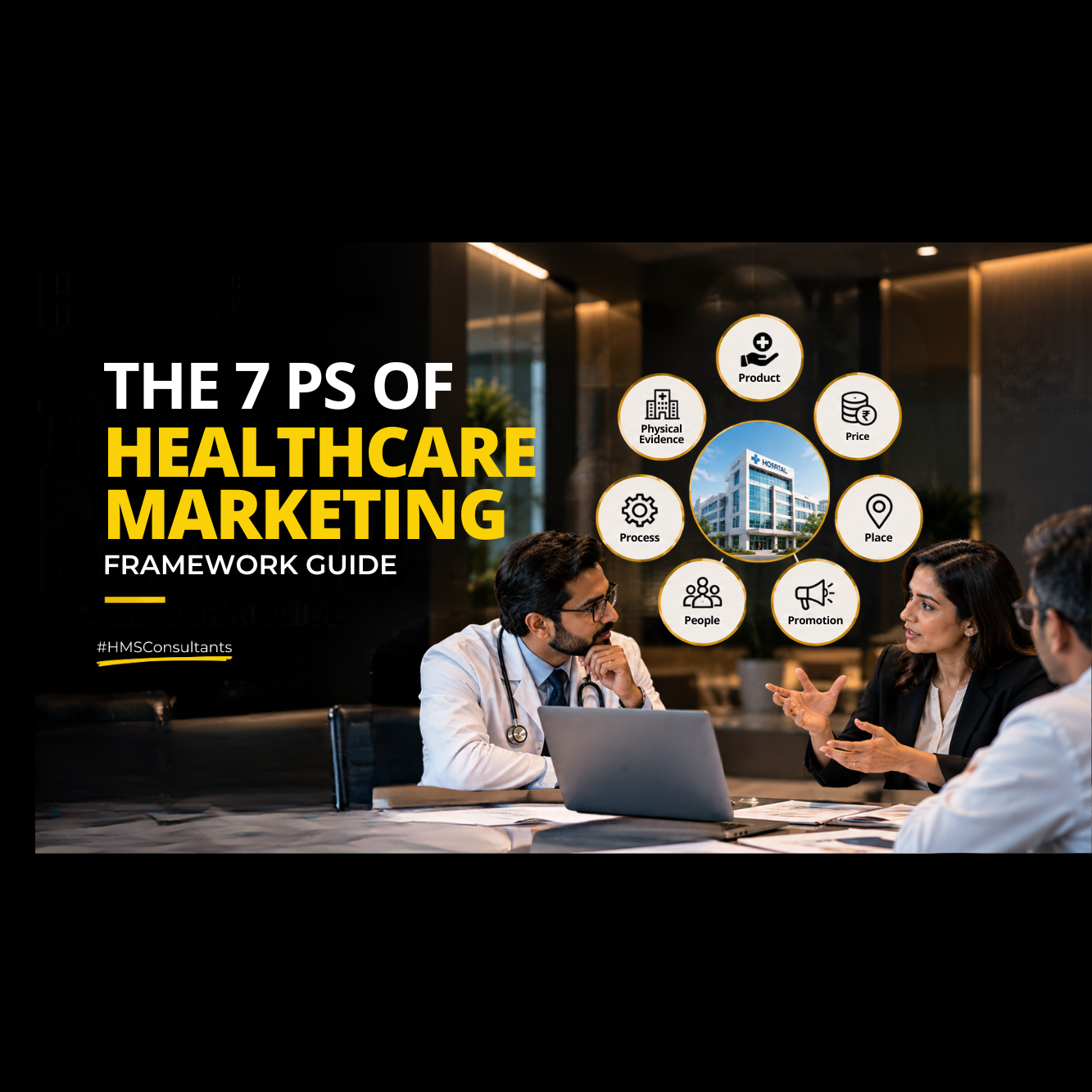
        The 7 Ps of marketing Product, Price, Place, Promotion, People, Process, and Physical Evidence is a services-marketing framework that maps directly onto healthcare, since healthcare is fundamentally a service delivered by people, through a process, in a physical setting. Most hospitals only actively manage Promotion, leaving the other six Ps to happen by default rather than by design.

        1. What Are the 7 Ps, Applied to Healthcare?

        The original 4 Ps of marketing (Product, Price, Place, Promotion) were extended to 7 for services businesses, adding People, Process, and Physical Evidence the three elements that matter enormously for something intangible and experience-based, like a hospital visit. Nearly every hospital marketing effort concentrates on Promotion alone; the other six Ps are just as important to how a patient experiences and judges the hospital, whether anyone is actively managing them or not.

        2. Product: What Are You Actually Offering?

        In healthcare, “product” is the specific service or specialty being offered not just “healthcare” broadly, but the specific procedures, specialties, and quality of care that differentiate one hospital from another. Clarity here matters: a hospital that can’t articulate what it specifically does well has nothing concrete for any of the other six Ps to communicate.

        3. Price: Transparency and Trust

        Pricing in healthcare carries unique sensitivity patients often make decisions under financial and emotional stress simultaneously. Transparent, clearly communicated pricing (even when the answer is “it depends, and here’s why”) builds more trust than vague or hidden pricing, which tends to create anxiety and erode confidence regardless of whether the actual cost is reasonable.

        4. Place: Accessibility and Location Strategy

        Place covers physical accessibility location, parking, ease of finding the facility and increasingly, digital accessibility as well, since a hospital’s website and online presence are effectively where many patients first “visit.” A hospital with a great physical location but a hard-to-navigate website is failing at “Place” in the modern sense just as much as one in an inconvenient physical location.

        5. Promotion: Ethical, Trust-First Promotion

        This is the P hospitals already spend the most time on advertising, content, social media. In healthcare specifically, promotion needs to lead with trust and education rather than urgency or aggressive sales tactics, given the sensitivity of medical decision-making. Our SEO and AEO strategy guide covers how promotion increasingly needs to work across both traditional search and AI answer engines simultaneously.

        6. People: Staff as a Marketing Asset

        Every staff member a patient interacts with reception, nursing, billing is effectively part of the marketing experience, whether trained to think of it that way or not. A hospital can run excellent external promotion and still lose trust at this stage if staff don’t reflect the same standard the marketing promised. This is explored in more depth in our guide to internal marketing strategy for hospitals.

        7. Process: The Patient Journey as a Touchpoint

        Process covers how smoothly a patient moves from first enquiry to appointment to follow-up. A confusing booking process, long unexplained wait times, or unclear discharge instructions all undermine trust regardless of how good the clinical care itself was the process is often what a patient remembers and describes to others, for better or worse.

        8. Physical Evidence: What Patients See and Feel

        Physical Evidence covers every tangible, observable element of the experience facility cleanliness and design, staff appearance, signage, printed materials, even the condition of the waiting area. These signals are processed by patients constantly and often subconsciously, shaping trust well before or entirely apart from any interaction with a doctor. Our hospital branding ideas guide covers many practical ways to strengthen this specific P.

        9. Using the Framework: A Simple Self-Assessment

        For each of the 7 Ps, ask: is this being actively, deliberately managed, or is it happening by default? Most hospitals find Promotion is actively managed, Product is reasonably clear, and the remaining five Price, Place, People, Process, and Physical Evidence are managed inconsistently or not at all. This gap is usually where the highest-leverage, least-expensive improvements are found, since they often require attention and consistency rather than new budget.

        10. How HMS Consultants Applies This Framework

        HMS Consultants uses the 7 Ps as a foundational lens in every hospital marketing audit, ensuring that strategy addresses the full patient experience rather than defaulting to promotion alone, which is where most hospital marketing effort and most hospital marketing failure tends to concentrate.

        Frequently Asked Questions

        The 7 Ps are Product, Price, Place, Promotion, People, Process, and Physical Evidence a framework originally developed for services marketing that applies directly to healthcare, since healthcare is fundamentally a service.

        Healthcare Marketing Strategy

        is something we strongly believe in, which means ‘Knowledge without application is the same as having no knowledge at all

        Akhil Dave

        Principle Consultant

        Ready to take your Personal Brand to the next level?

        Share your details below and we will connect with you to discuss your growth strategy.

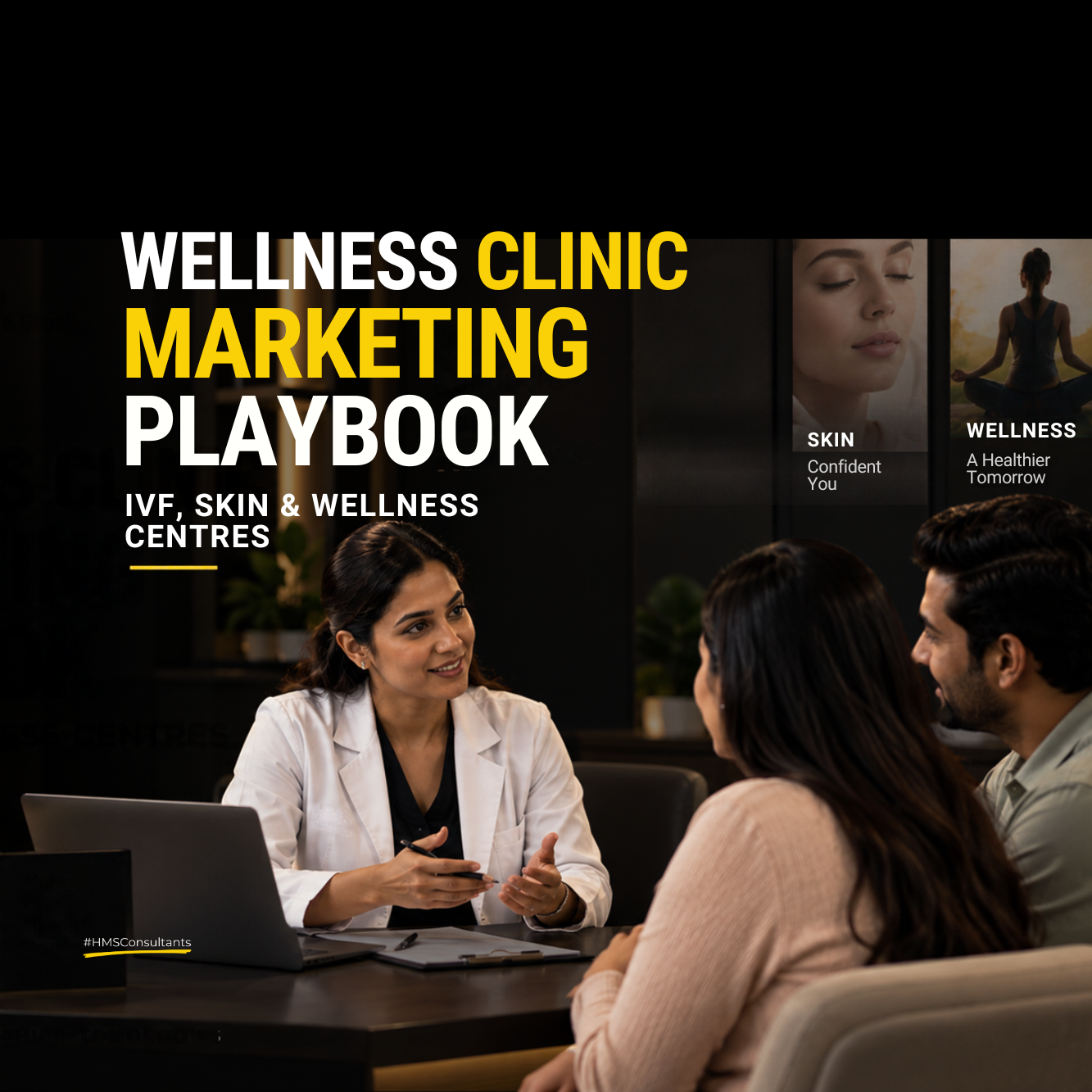
        • Wellness Clinic Marketing Playbook: IVF, Skin & Wellness Centres

          Wellness Clinic Marketing Playbook: IVF, Skin & Wellness Centres

          Wellness Clinic Marketing Playbook: IVF, Skin & Wellness Centres

          Published on
          Share This

          Wellness clinic marketing for IVF, skin and aesthetic, and general wellness centres requires a different approach than general hospital marketing because the patient journey involves longer consideration, higher emotional investment, and more privacy sensitivity. What works for a routine hospital visit often falls flat, or worse, feels tone-deaf, applied to a fertility or aesthetic decision.

          1. What Makes Wellness Clinic Marketing Different

          General hospital marketing often deals with more immediate, less emotionally layered decisions choosing a hospital for a scheduled procedure, or responding to an urgent need. Wellness categories like IVF, aesthetics, and broader wellness services usually involve a much longer consideration window, more research, more comparison between providers, and considerably more emotional weight attached to the decision. Marketing that treats these categories the same way as general hospital care tends to underperform, because it misses what patients are actually looking for at each stage.

          2. Why This Guide Is for Beginners, Not Marketing Experts

          A prospective IVF or aesthetic patient typically moves through a longer arc: initial awareness and research (often extending over months), emotional processing of the decision, comparison across multiple providers, and finally consultation and commitment. Marketing needs to serve each of these stages differently early-stage content should educate and build trust without pressure, while later-stage content can more directly address specific questions and next steps. Rushing a patient from awareness to a hard sell, common in more transactional marketing, tends to erode trust rather than build it in this category.

          3. IVF Clinic Marketing: What Works

          – Educational content that demystifies the IVF process step by step, reducing the anxiety of the unknown

          – Realistic expectation-setting around success rates and timelines, rather than overly optimistic messaging

          – Anonymized patient journey content, always with explicit consent, since privacy sensitivity is especially high in this category

          – A visibly calm, unhurried tone across all content the opposite of urgency-driven marketing common elsewhere

          – Clear, accessible information about cost and process, since uncertainty about either is a common source of patient anxiety

          4. Skin & Aesthetic Clinic Marketing: What Works

          – Before-and-after content used carefully and compliantly, with clear consent and appropriate disclaimers

          – Content addressing common misconceptions about specific procedures

          – Doctor-led content (see our personal branding playbook for doctors) that builds individual credibility, since aesthetic decisions are often tied closely to trust in a specific practitioner

          – Transparent information about recovery time, realistic outcomes, and cost, avoiding overpromising results

          – Strong visual consistency across platforms, since aesthetic clinics are judged partly on visual presentation itself

          5. General Wellness Centre Marketing: What Works

          – Content around specific, tangible outcomes (better sleep, stress management, specific health goals) rather than vague wellness language

          – Community-building content group programs, wellness events that reflects the more social, ongoing nature of wellness engagement compared to a one-time procedure

          – Educational content connecting lifestyle factors to the specific services offered

          – Membership or ongoing-engagement messaging where relevant, since wellness centres often depend more on repeat visits than one-time transactions

          6. Content That Builds Trust Across All Three

          Regardless of category, certain content types consistently build trust in these higher-stakes, higher-consideration categories: doctor or practitioner Q&A content answering real patient questions, transparent process explanations that reduce uncertainty, and genuine (consented) patient experiences rather than generic marketing claims. Content that acknowledges the emotional weight of the decision rather than only focusing on clinical or aesthetic outcomes tends to resonate more strongly in these categories than in general hospital marketing.

          7. Compliance & Sensitivity Considerations

          Each of these categories carries specific considerations beyond general hospital marketing compliance. IVF and fertility marketing involves significant privacy sensitivity and should never imply guaranteed outcomes. Aesthetic and skin clinic marketing involving before-and-after imagery and outcome claims often falls under specific medical council and advertising guidelines that vary by procedure type legal review of promotional material in this category is worth the investment. Wellness centre marketing has fewer strict compliance requirements but still benefits from avoiding exaggerated health claims not backed by evidence.

          8. Local SEO & Reviews for Wellness Clinics

          Patients researching IVF, aesthetic, or wellness services tend to read reviews far more thoroughly than for routine care, given the financial and emotional investment involved a strong, consistently managed Google Business Profile and review strategy (see our local SEO checklist for doctors) matters even more in this category than in general hospital marketing. Detailed, specific reviews mentioning the actual experience carry more weight in this category than a high volume of brief, generic ones.

          9. Common Mistakes in Wellness Clinic Marketing

          – Using urgency-driven, transactional messaging borrowed from unrelated industries

          – Overpromising outcomes, particularly around fertility success rates or aesthetic results

          – Treating all three categories (IVF, aesthetic, wellness) with an identical content strategy despite their different patient journeys

          – Underinvesting in review management despite reviews mattering more in this category than most others

          – Neglecting compliance review on before-and-after content or outcome claims

          10. How HMS Consultants Approaches Wellness Clinic Marketing

          HMS Consultants tailors strategy specifically to each wellness category’s distinct patient journey and compliance considerations, rather than applying a single generic healthcare marketing template drawing on direct experience across IVF, skin and aesthetic, and wellness centre clients.

          Frequently Asked Questions

          Wellness clinic categories like IVF and aesthetics involve longer decision timelines, higher emotional stakes, and more privacy sensitivity than general hospital care, requiring a different content and trust-building approach.

          Healthcare Marketing Strategy

          is something we strongly believe in, which means ‘Knowledge without application is the same as having no knowledge at all

          Akhil Dave

          Principle Consultant

          Ready to take your Personal Brand to the next level?

          Share your details below and we will connect with you to discuss your growth strategy.

          • Digital Marketing for Doctors: A Beginner’s Guide

            Digital Marketing for Doctors: A Beginner’s Guide

            Digital Marketing for Doctors: A Beginner’s Guide

            Published on
            Share This

            Hospital branding is every consistent, deliberate signal visual, verbal, and experiential that tells a patient what to expect before they’ve even met a doctor. Below are 50 practical ideas across six categories: pick the ones that fit your hospital’s size and budget rather than treating this as a mandatory checklist.

            1. What Is Digital Marketing for Doctors?

            Digital marketing for doctors covers everything an individual practitioner does online to become findable and trustworthy to prospective patients a Google Business Profile, a website, social media, and basic search visibility. It’s a smaller, more personal version of what a hospital does at scale, but with the advantage that a solo doctor can move faster and doesn’t need a large team to get the fundamentals right.

            2. Why This Guide Is for Beginners, Not Marketing Experts

            This guide deliberately avoids advanced tactics paid advertising strategy, complex SEO, multi-platform content calendars because most doctors starting from zero don’t need any of that yet. The goal here is the smallest set of actions that produce a real, findable, trustworthy online presence. Once those fundamentals are solid, more advanced approaches (covered in our local SEO checklist and personal branding playbook) become worth the additional effort.

            3. Step 1: Get Your Google Business Profile Right

            This is the single highest-impact, lowest-effort starting point. Claim and verify the profile if it isn’t already, select the correct specialty as the primary category, add accurate hours and contact information, upload real photos of the practice, and post an update at least monthly. This alone often produces more visible results than any other single action on this list, because it directly affects whether the doctor appears in “near me” and local searches.

            4. Step 2: Build a Simple, Functional Website

            A website doesn’t need to be elaborate to be effective. At minimum it should clearly state the doctor’s name, specialty, location, and how to book an appointment, load quickly on mobile, and include a simple bio that builds credibility. Elaborate design and extensive content can come later a simple, working, fast website beats an ambitious one that’s still half-finished a year later.

            5. Step 3: Choose One Social Media Platform to Start

            Rather than trying to maintain Instagram, Facebook, and LinkedIn simultaneously, pick the one platform where the target patient audience is most likely to be, and post consistently there before expanding. For most individual doctors, Instagram works well for patient-facing trust-building, while LinkedIn works better for those focused on referrals from other doctors. Our social media content strategy for doctors goes deeper into building out a sustainable content plan once this first platform is chosen.

            6. Step 4: Understand Basic Local SEO

            Local SEO doesn’t need to be complicated at the beginner stage the core idea is making sure the doctor’s name, address, and phone number are identical everywhere they appear online (the website, Google Business Profile, and any directory listings like Practo or Justdial), and that the website mentions the doctor’s specialty and city naturally in its text. Our full local SEO checklist for doctors covers this in more depth once the basics here are in place.

            7. Step 5: Set Up Simple Tracking

            Even at a beginner level, it’s worth knowing whether any of this is working. At minimum, install Google Analytics on the website, and simply ask new patients how they found the practice this low-tech tracking method is often more informative than any dashboard for a doctor just starting out, and costs nothing to implement.

            8. Common Beginner Mistakes

            – Trying to be active on every platform at once instead of doing one well

            – Building an elaborate website before getting the Google Business Profile right first

            – Posting inconsistently, then giving up after a few weeks of low engagement

            – Copying generic health content instead of sharing genuine expertise and perspective

            – Never checking whether any of the activity is actually bringing in patients

            9. A Realistic First 90 Days

            Weeks 1-2: Claim and fully complete the Google Business Profile

            Weeks 3-4: Build or update a simple website with clear contact and booking information

            Weeks 5-8: Choose one social platform and post consistently, twice a week

            Weeks 9-12: Review what’s working check Google Business Profile insights, website traffic, and ask new patients how they found the practice and adjust from there

            This pace is deliberately conservative. A doctor who consistently does these five things well over 90 days will typically be ahead of most local competitors who either do nothing or spread themselves thin across too many channels at once.

            10. How HMS Consultants Helps Doctors Get Started

            HMS Consultants works with individual doctors to set up these fundamentals correctly from day one, avoiding the common trial-and-error most doctors go through on their own, and builds toward more advanced strategy once the basics are solid.

            Frequently Asked Questions

            Start with the Google Business Profile it’s free, takes under an hour to set up properly, and has an outsized impact on whether the doctor appears in local search results.

            Digital Marketing for Hospitals

            is something we strongly believe in, which means ‘Knowledge without application is the same as having no knowledge at all

            Akhil Dave

            Principle Consultant

            Ready to take your Personal Brand to the next level?

            Share your details below and we will connect with you to discuss your growth strategy.

            • Healthcare Marketing Agency vs. Consultancy: Key Differences

              Healthcare Marketing Agency vs. Consultancy: Key Differences

              Healthcare Marketing Agency vs. Consultancy: Key Differences

              Published on
              Share This

              A healthcare marketing agency typically executes campaigns running ads, managing social media, producing content. A healthcare marketing consultancy typically starts by diagnosing what’s actually working and what isn’t, then builds a strategy before any execution begins. Many hospitals hire an agency when what they actually need first is a consultancy, and the mismatch is one of the most common, avoidable reasons a marketing budget underperforms.

              1. What’s the Real Difference?

              The distinction isn’t about size or price it’s about what comes first. An agency relationship typically starts with “what should we run this month” a campaign, a content calendar, a social media package. A consultancy relationship starts with “what’s actually happening right now, and why” an audit and a strategy, before any execution decision is made. Both have real value; the mismatch happens when a hospital hires for execution before anyone has diagnosed what execution should even look like. This confusion is common enough in India’s healthcare sector that many hospitals use the two terms interchangeably, even though the underlying engagement models are quite different.

              2. What a Healthcare Marketing Agency Typically Does

              – Runs paid advertising campaigns (Google Ads, Meta Ads)

              – Manages and posts to social media accounts

              – Produces content videos, graphics, blog posts

              – Reports on campaign-level metrics (impressions, clicks, spend)

              Agencies are generally structured around ongoing execution and are compensated accordingly retainers or percentage-of-spend models tied to deliverables produced. A good agency can be highly effective at what it’s built for: consistent, high-volume output across channels. The limitation isn’t competence; it’s scope most agencies aren’t structured to step back and question whether the underlying strategy is right before executing against it.

              3. What a Healthcare Marketing Consultancy Typically Does

              – Audits current marketing activity across channels (see our hospital marketing audit checklist)

              – Diagnoses specific gaps in targeting, messaging, tracking, or team capability

              – Builds a prioritised strategy and roadmap

              – Advises on which channels, team structure, or partners are needed to execute that strategy

              A consultancy is generally structured around strategic outcomes rather than deliverable volume, and is compensated for the thinking and diagnosis, not the output of campaigns run. This also means a consultancy engagement typically has a defined start and end tied to a specific strategic question, rather than running indefinitely, as an agency retainer often does.

              4. How a Healthcare Management Consulting Firm Fits In

              It’s worth distinguishing a specialised healthcare marketing consultancy from a broader healthcare management consulting firm. A management consulting firm typically covers operations, finance, staffing, and strategy across the entire hospital, with marketing as one slice of a much larger scope. If the specific, pressing problem is patient acquisition and marketing performance, a specialised marketing consultancy will generally go deeper faster than a generalist firm treating marketing as one line item among many.

              5. Which One Does Your Hospital Actually Need?

              If a hospital already knows exactly what it wants done “run our Instagram,” “manage our Google Ads” an agency can execute that directly. If a hospital is spending on marketing without clarity on why it isn’t working, or has never had a structured strategy at all, a consultancy should come first hiring an agency at that stage risks paying for well-executed activity against the wrong plan. A useful test: if leadership can’t clearly answer “which channel actually brings us admissions,” that’s a strategy gap, not an execution gap, and a consultancy is the right starting point.

              6. Why Strategy Should Come Before Execution

              The most common expensive mistake in hospital marketing isn’t poor execution it’s confident execution against a strategy that was never actually validated. A well-run social media campaign for the wrong audience, or a beautifully designed website with no SEO or conversion thinking behind it, both fail for the same underlying reason: no diagnosis happened first. This is the core idea behind our own positioning at HMS Consultants diagnosis before promotion, strategy before execution, patient trust before visibility. A hospital that skips this step often ends up replacing agencies every 12–18 months, blaming each one for underperformance that was actually rooted in strategy the agency was never asked to question.

              7. How Pricing Models Differ

              Agencies commonly charge either a flat monthly retainer tied to specific deliverables (a set number of posts, campaigns managed) or a percentage of ad spend for paid media management. Consultancies more often charge a project fee for a defined engagement an audit plus a strategy roadmap, for example separate from any ongoing execution cost. Understanding this distinction upfront prevents a common point of confusion: a hospital expecting “marketing help” for a flat monthly fee may be surprised that a consultancy engagement is scoped and priced differently from an agency retainer.

              8. Questions to Ask Before Hiring Either

              – Has anyone audited our current marketing activity in the last 12 months?

              – Do we know which channel actually brings admissions versus which one just generates activity?

              – Are we hiring for a specific deliverable, or for a diagnosis of what deliverable we actually need?

              – If we hire an agency now, who validates that the plan they’re executing against is the right one?

              – Is the person or firm we’re evaluating being asked to question our current approach, or simply asked to run more of it?

              9. Can You Need Both?

              Yes, and it’s common a consultancy defines the strategy and priorities, while an agency or an internal team handles ongoing execution against that plan. The sequencing matters more than the labels: strategy work should generally happen first, or at minimum happen periodically to check execution is still aligned with what’s actually working. Some hospitals structure this as an annual consultancy check-in that re-validates the strategy an agency is executing against, catching drift before it becomes a wasted year of spend.

              10. How HMS Consultants Approaches This

              HMS Consultants is positioned deliberately as a strategy consultancy, not an agency audits and diagnoses first, builds the roadmap, and then guides execution, whether that’s through an internal hospital team, an external agency, or HMS’s own execution support.

              Frequently Asked Questions

              A healthcare marketing agency typically executes campaigns ads, social media, content production. A healthcare marketing consultancy typically diagnoses problems and builds strategy first, then either executes it or guides an internal team or agency to do so.

              Hospital Marketing Strategy

              is something we strongly believe in, which means ‘Knowledge without application is the same as having no knowledge at all

              Akhil Dave

              Principle Consultant

              Ready to take your Personal Brand to the next level?

              Share your details below and we will connect with you to discuss your growth strategy.

              • Hospital Digital Marketing Audit: The Complete 2026 Checklist

                Hospital Digital Marketing Audit: The Complete 2026 Checklist

                Hospital Digital Marketing Audit: The Complete 2026 Checklist

                Published on
                Share This

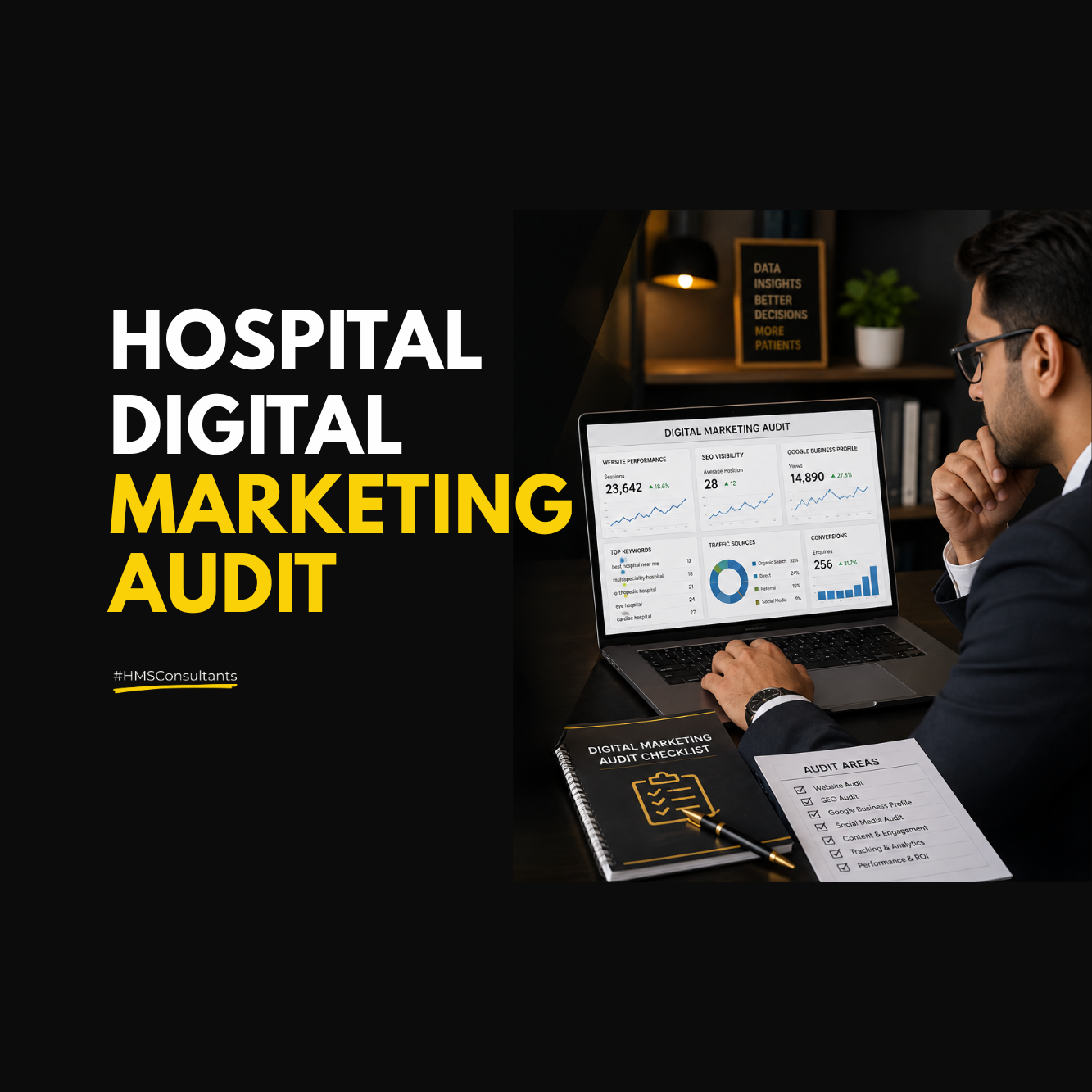
                A hospital digital marketing audit is a focused review of every online channel a hospital uses to attract patients website performance, SEO rankings, Google Business Profile, paid campaigns, and whether any of it is actually being measured. Most hospitals invest in a website and a few campaigns but have never checked whether they’re working together or working at all.

                1. What Is a Hospital Digital Marketing Audit?

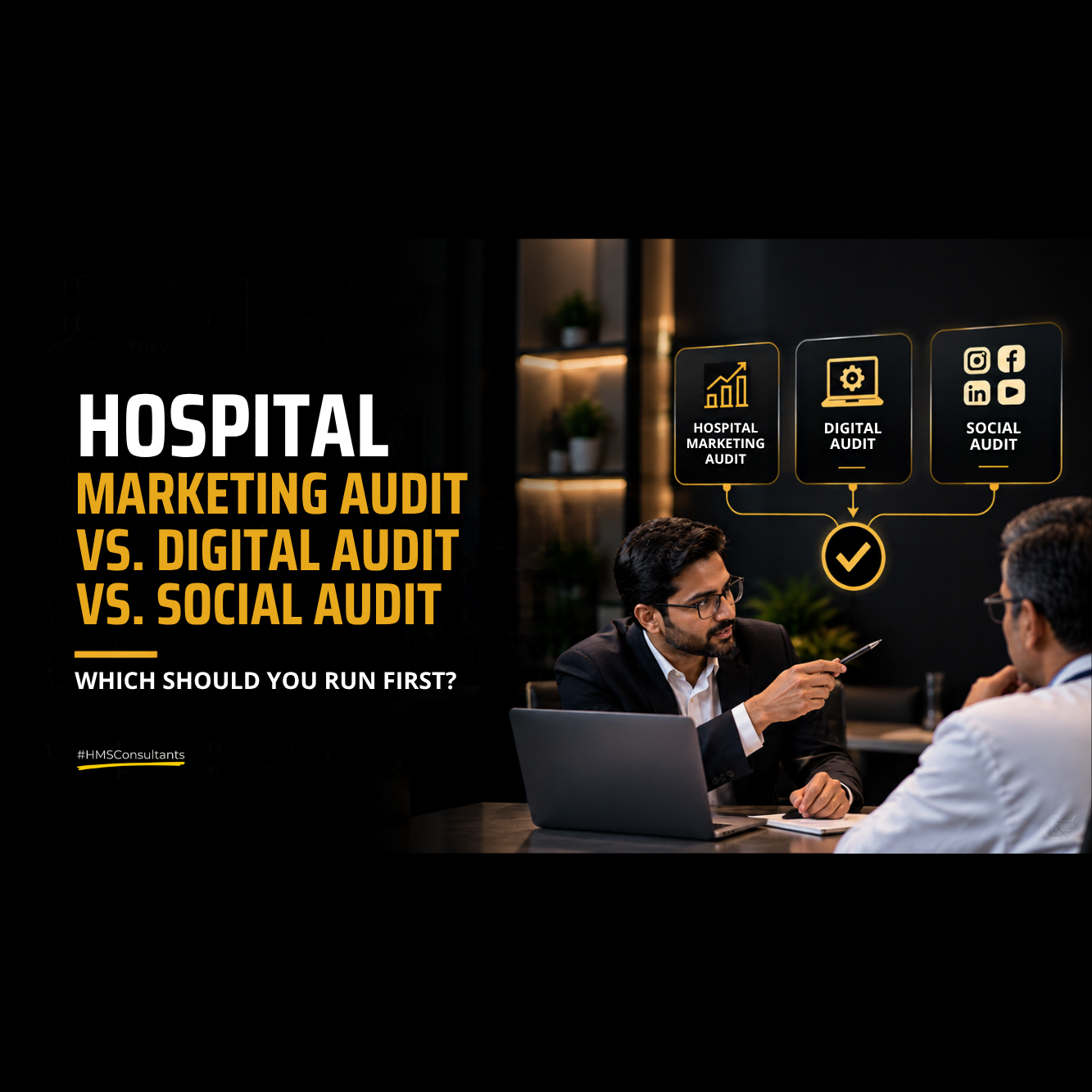
                A hospital digital marketing audit narrows in on everything measurable online: the website, search rankings, local listings, paid advertising if it exists, and the tracking infrastructure behind all of it. Where a full hospital marketing audit also looks at offline branding and team capability, a digital audit answers a more specific question is the hospital’s online presence actually generating enquiries, and can anyone prove it either way?

                2. Why Digital Deserves Its Own Audit

                Digital channels change faster than offline ones, and most hospital websites were built once and never revisited. A digital-specific audit matters because:

                – Search engine algorithms and AI answer engines (ChatGPT, Google AI Overviews) now influence how patients find hospitals, and most sites haven’t adjusted for this

                – Tools like Google Analytics and Search Console are often installed but never actually reviewed see our related guide on hospital marketing audits for the broader picture

                – A hospital’s digital presence can look active (a website exists, a Facebook page posts occasionally) while quietly failing every measurable goal

                3. What a Hospital Digital Marketing Audit Covers

                – Website — speed, mobile experience, structure, and calls-to-action

                – SEO — rankings for the hospital’s name, city, and key specialties

                – Google Business Profile — accuracy, review volume, and update frequency

                – Tracking — whether GA4 and Search Console are installed and whether anyone reviews them

                – Paid campaigns — if running, whether spend is tied to a measurable outcome

                – AI/answer-engine visibility — whether the hospital appears when patients ask ChatGPT or Google AI Overviews health-related local questions

                – Technical schema — structured data (LocalBusiness, Service) that helps both search engines and AI tools understand the hospital correctly

                Social media presence is reviewed separately in our dedicated hospital social media marketing audit guide, since it deserves its own depth of review.

                4. The Hospital Digital Marketing Audit Checklist

                Website

                ☐ Page load time under 3 seconds on mobile

                ☐ Mobile-friendly design (test on an actual phone, not just a browser resize)

                ☐ Every key page has a clear call-to-action

                ☐ Contact/appointment forms are tested end-to-end and actually deliver enquiries to someone

                SEO

                ☐ Hospital ranks on page 1 for its own name

                ☐ Hospital ranks for “[specialty] in [city]” for at least its top 2–3 departments

                ☐ Meta titles and descriptions exist and are unique on every page

                ☐ LocalBusiness and Service schema markup is present

                Google Business Profile

                ☐ Profile is claimed and verified

                ☐ Hours, address, and phone number are current

                ☐ At least one post or update in the last 30 days

                ☐ Review response rate is above 80%

                Tracking & Reporting

                ☐ GA4 is installed and someone reviews it monthly

                ☐ Search Console is set up and checked for indexing errors

                ☐ Conversion events (form submissions, click-to-call) are actually configured, not just assumed

                Paid & Emerging Channels

                ☐ If running paid ads, cost-per-enquiry is tracked, not just spend

                ☐ AI referral traffic (ChatGPT, Perplexity) is tracked as its own segment in GA4, not lumped into “other”

                5. Common Digital Red Flags

                – Google Analytics installed years ago, generating data nobody has looked at since

                – A Google Business Profile with outdated hours or a phone number that’s no longer in service

                – A website that ranks well for the hospital’s brand name but nowhere for the searches an actual new patient would use

                – No difference in messaging or design between mobile and desktop, despite most searches happening on mobile

                6. Tools Used in a Digital Marketing Audit

                A credible digital audit draws from multiple data sources rather than one dashboard: Google Analytics (GA4) for behavior, Google Search Console for search performance, a rank-tracking tool (e.g. Ubersuggest) for keyword position history, and a manual review of the Google Business Profile and top 5–10 pages. Any audit relying on just one of these is incomplete.

                7. How Often to Run a Digital Audit

                A full digital audit annually, with a lighter monthly check on Google Business Profile activity, review response time, and whether analytics are still reporting correctly. Run one immediately after any website redesign or CMS migration, since these frequently break tracking without anyone noticing.

                8. How HMS Consultants Conducts a Digital Marketing Audit

                HMS Consultants pulls data directly from GA4, Search Console, and independent rank-tracking tools rather than relying on a single dashboard, and benchmarks findings against the hospital’s actual local competitors surfacing not just what’s broken, but what’s costing enquiries right now.

                Frequently Asked Questions

                A hospital digital marketing audit reviews the website, SEO rankings, Google Business Profile, paid campaigns if any, and whether conversions like appointment bookings and enquiries are being tracked at all.

                digital marketing audit I digital healthcare marketing I digital marketing audit for hospitals I Google Business Profile I hospital digital marketing audit I hospital online presence I hospital SEO audit I hospital website audit

                is something we strongly believe in, which means ‘Knowledge without application is the same as having no knowledge at all

                Akhil Dave

                Principle Consultant

                Ready to take your Personal Brand to the next level?

                Share your details below and we will connect with you to discuss your growth strategy.

                • Marketing for Hospital: A Complete Guide to Attract More Patients and Build Trust in India

                  Marketing for Hospital: A Complete Guide to Attract More Patients and Build Trust in India

                  Marketing for Hospital: A Complete Guide to Attract More Patients and Build Trust in India

                  Published on
                  Share This

                  The healthcare industry in India has become increasingly competitive. Patients today have more choices than ever before, and their decision-making process has changed significantly. Instead of relying solely on referrals or word-of-mouth recommendations, many patients begin their healthcare journey by searching online, reading reviews, comparing hospitals, and evaluating the quality of information available.

                  This shift has made marketing for hospital an essential part of healthcare growth. However, hospital marketing is very different from marketing products or traditional businesses. Hospitals deal with people’s health, emotions, trust, and well-being. Every communication must therefore be ethical, informative, and patient-focused.

                  Successful hospital marketing is not about promoting services aggressively. It is about helping patients find reliable healthcare information, building credibility, improving accessibility, and creating long-term relationships with the community.

                  What Is Marketing for Hospital?

                  Marketing for hospital refers to the planned activities that help hospitals communicate with patients, increase awareness about their services, strengthen their reputation, and encourage patients to choose them when healthcare needs arise.

                  A successful marketing strategy focuses on creating value for patients rather than simply promoting treatments. It ensures that patients can easily find accurate information, understand available healthcare services, and connect with the right specialists when required.

                  Hospital marketing combines traditional relationship-building with modern digital communication to create a seamless patient experience.
                  Why Marketing for Hospital Is More Important Than Ever

                  Healthcare is becoming increasingly patient-centric. Patients expect transparency, convenience, and easy access to information before selecting a hospital.

                  Several factors have contributed to the growing importance of hospital marketing:

                  • Increased competition among hospitals and clinics
                  • Growing use of Google Search for healthcare information
                  • Higher expectations for patient experience
                  • Expansion of digital healthcare services
                  • Greater influence of online reviews and ratings
                  • Increased awareness about preventive healthcare

                  Hospitals that actively communicate with their communities are more likely to build trust and remain competitive.

                  Understanding the Difference Between Hospital Marketing and Healthcare Marketing

                  Although these terms are often used interchangeably, they have slightly different meanings.

                  Healthcare Marketing is a broad concept that includes marketing activities for hospitals, clinics, diagnostic centres, pharmaceutical companies, healthcare startups, wellness brands, and other healthcare organisations.

                  Hospital Marketing specifically focuses on promoting hospitals, their departments, specialists, facilities, and patient services.

                  Marketing for hospital is therefore a specialised branch of healthcare marketing that addresses the unique needs of hospitals and their patients.

                  The Foundation of Effective Marketing for Hospital

                  Before investing in advertising or promotional campaigns, hospitals should establish a strong marketing foundation.

                  This includes:

                  Understanding the Target Audience

                  Every hospital serves different patient groups depending on its specialties, location, and facilities.

                  Understanding patient demographics, healthcare needs, and behaviour helps hospitals communicate more effectively.

                  Building Patient Trust

                  Healthcare decisions are based on trust.

                  Patients look for:

                  • Qualified doctors
                  • Transparent communication
                  • Positive patient experiences
                  • Clinical expertise
                  • Hospital reputation
                  • Reliable information

                  Marketing should consistently reinforce these trust signals.

                  Developing a Strong Brand Identity

                  A hospital’s brand extends beyond its logo or colours. It reflects the organisation’s values, quality of care, professionalism, and patient experience.

                  A strong brand creates confidence before patients even visit the hospital.

                  Digital Marketing for Hospital: Why It Matters

                  Digital platforms have transformed the way patients search for healthcare providers.

                  Today, many patients begin with searches such as:

                  • Best hospital near me
                  • Orthopaedic hospital
                  • Cardiology specialist
                  • Maternity hospital
                  • Emergency hospital

                  This makes Digital Marketing for Hospital an essential part of modern healthcare marketing.

                  Digital marketing allows hospitals to:

                  • Reach patients when they actively search for healthcare
                  • Improve online visibility
                  • Share educational content
                  • Build trust through informative communication
                  • Generate qualified patient enquiries
                  • Strengthen long-term patient relationships

                  Unlike traditional advertising, digital marketing provides measurable insights that help hospitals continuously improve their strategies.

                  Essential Components of Hospital Marketing

                  1. A Professional Hospital Website

                  A hospital website is often the first interaction patients have with the organisation.

                  It should include:

                  • Hospital overview
                  • Doctor profiles
                  • Specialties
                  • Treatment information
                  • Appointment booking
                  • Contact details
                  • Emergency services
                  • Patient education resources

                  A well-designed website improves both patient confidence and search engine visibility.

                  2. Search Engine Optimisation (SEO)

                  Search Engine Optimisation helps hospitals appear in Google when patients search for healthcare services.

                  SEO involves:

                  • Publishing educational blogs
                  • Optimising service pages
                  • Improving website performance
                  • Using relevant healthcare keywords
                  • Maintaining accurate local business information

                  SEO is one of the most cost-effective long-term hospital marketing strategies.

                  3. Google Business Profile

                  For local healthcare providers, Google Business Profile plays a significant role in patient discovery.

                  Hospitals should ensure that their profile includes:

                  • Correct address
                  • Phone number
                  • Working hours
                  • Department details
                  • Photos
                  • Patient reviews

                  Regular updates improve local visibility and credibility.

                  4. Content Marketing

                  Patients appreciate healthcare providers who educate them before they become patients.

                  Useful content includes:

                  • Blogs
                  • Health awareness articles
                  • Doctor interviews
                  • Frequently asked questions
                  • Preventive healthcare tips
                  • Treatment guides

                  Educational content positions the hospital as a trusted source of information.

                  5. Social Media Marketing for Hospital

                  Social media is not simply a platform for promotions.

                  Effective Social Media Marketing for Hospital focuses on meaningful engagement with the community.

                  Hospitals can share:

                  • Health awareness campaigns
                  • Doctor introductions
                  • Patient education videos
                  • Wellness tips
                  • Community events
                  • Healthcare observance days
                  • Behind-the-scenes hospital initiatives

                  Social media helps strengthen relationships and humanise the hospital brand.

                  Patient Experience Is the Best Marketing Strategy

                  No marketing campaign can compensate for a poor patient experience.
                  Patients remember:

                  • Appointment scheduling
                  • Reception staff behaviour
                  • Waiting time
                  • Doctor communication
                  • Nursing care
                  • Billing process
                  • Follow-up support

                  Satisfied patients become advocates who recommend the hospital to family and friends, contributing to long-term growth through positive word of mouth.

                  Marketing should therefore work alongside operational excellence rather than independently.

                  Measuring the Success of Marketing for Hospital

                  Hospital marketing should be evaluated using meaningful performance indicators instead of vanity metrics.

                  Useful metrics include:

                  • Website traffic
                  • Appointment enquiries
                  • Organic search rankings
                  • Google Business interactions
                  • Patient conversion rates
                  • Online reviews
                  • Repeat patient visits
                  • Referral sources
                  • Patient satisfaction scores

                  Tracking these indicators helps hospitals refine their marketing strategies over time.

                  Common Mistakes in Hospital Marketing

                  Many hospitals invest in marketing without a structured strategy.

                  Some common mistakes include:

                  • Focusing only on advertisements
                  • Ignoring patient education
                  • Having an outdated website
                  • Inconsistent branding
                  • Neglecting online reviews
                  • Posting irregularly on social media
                  • Measuring likes instead of patient enquiries
                  • Publishing inaccurate or overly promotional healthcare content

                  Avoiding these mistakes helps hospitals build stronger and more sustainable marketing programmes.

                  Future Trends in Healthcare Marketing

                  Healthcare marketing continues to evolve with patient expectations and technological advancements.

                  Some emerging trends include:

                  • Artificial intelligence for patient communication
                  • Personalised healthcare experiences
                  • Telemedicine integration
                  • Video-based patient education
                  • Voice search optimisation
                  • Data-driven marketing decisions
                  • Local SEO for hospitals
                  • Online reputation management

                  Hospitals that embrace these trends responsibly will be better prepared for future patient expectations.

                  Creating a Sustainable Hospital Marketing Strategy

                  An effective marketing strategy should combine multiple channels rather than relying on a single activity.

                  A sustainable hospital marketing framework includes:

                  • Understanding patient needs
                  • Defining clear marketing objectives
                  • Building a strong digital presence
                  • Creating educational content
                  • Improving search visibility
                  • Strengthening patient communication
                  • Monitoring performance
                  • Continuously improving patient experience

                  Marketing becomes far more effective when every activity supports a common long-term goal.

                  Conclusion

                  Marketing for hospital is no longer optional in today’s healthcare environment. As patient behaviour continues to evolve, hospitals must communicate more effectively, build trust consistently, and create meaningful experiences across every touchpoint.

                  Successful hospital marketing is not about making the loudest promotional claims. It is about ensuring that patients can easily find reliable information, connect with experienced healthcare professionals, and feel confident in their healthcare decisions.

                  By combining ethical healthcare marketing, strategic digital marketing for hospital, informative content, local search optimisation, and meaningful social media marketing for hospital, healthcare organisations can strengthen their reputation while supporting sustainable growth.

                  Ultimately, the most successful hospitals are those that view marketing not as advertising, but as an extension of patient care.

                  Contact Us HMS Consultants

                  Marketing for hospital involves strategies that help hospitals increase awareness, improve patient engagement, strengthen their reputation, and attract patients through ethical communication.

                  Hospital Marketing Strategies I Business I clinic marketing I Digital Marketing I Digital Strategy I Healthcare Marketing I hospital marketing I Medical Marketing

                  is something we strongly believe in, which means ‘Knowledge without application is the same as having no knowledge at all

                  Akhil Dave

                  Principle Consultant

                  Ready to take your Personal Brand to the next level?

                  Share your details below and we will connect with you to discuss your growth strategy.

                  • Healthcare Marketing Trends in India: What Hospitals, Clinics, and Healthcare Professionals Should Know

                    Healthcare Marketing Trends in India: What Hospitals, Clinics, and Healthcare Professionals Should Know

                    Healthcare Marketing Trends in India: What Hospitals, Clinics, and Healthcare Professionals Should Know

                    Published on
                    Share This

                    Healthcare marketing has changed significantly over the last few years. Earlier, hospitals and clinics relied mainly on referrals, outdoor advertising, local reputation, and word of mouth to attract patients. While these factors continue to play an important role, today’s patients expect much more before they decide to consult a healthcare provider.

                    Patients now search online, compare healthcare providers, read reviews, watch doctor videos, explore hospital websites, and look for educational content before making healthcare decisions. As technology continues to evolve, healthcare businesses must also adapt their communication and marketing strategies.

                    However, following every new marketing trend without understanding its purpose can lead to unnecessary spending and poor results. The most successful healthcare organizations focus on trends that improve patient experience, strengthen trust, and support long-term business growth.

                    This article explores the most important healthcare marketing trends shaping the Indian healthcare industry and explains why they matter for hospitals, clinics, diagnostic centres, healthcare startups, and healthcare marketers.

                    What Are Healthcare Marketing Trends?

                    Healthcare marketing trends refer to the changing approaches, technologies, patient behaviours, and communication strategies that influence how healthcare organisations connect with patients.

                    A marketing trend is not simply a new digital tool or social media platform. It reflects how patient expectations are evolving and how healthcare providers need to respond.

                    For example, patients today expect faster communication, transparent information, online accessibility, and educational content before they choose a doctor or hospital. These changing expectations directly influence healthcare marketing strategies.

                    Understanding these trends helps healthcare organisations make informed decisions instead of following every new marketing technique that appears in the market.

                    Why Healthcare Marketing Trends Matter

                    Healthcare is one of the most trust-driven industries. Patients do not choose a hospital only because of advertisements. They look for confidence, credibility, expertise, accessibility, and clear communication.

                    Healthcare marketing trends matter because they help organizations:

                    • Improve patient communication
                    • Increase online visibility
                    • Build long-term patient trust
                    • Strengthen their digital presence
                    • Enhance patient engagement
                    • Stay competitive in a growing healthcare market
                    • Make better marketing decisions based on patient behaviour

                    Healthcare marketing should always support better patient experiences rather than simply increasing promotional activity.

                    Trend 1: Patient Education Is Becoming More Valuable Than Promotion

                    Modern patients prefer healthcare providers who educate rather than constantly advertise.

                    Whether someone is searching for symptoms, treatments, preventive healthcare, or specialist services, they appreciate organisations that provide useful information before asking them to book an appointment.

                    Educational blogs, treatment guides, FAQs, awareness campaigns, and doctor videos help patients make informed decisions while building confidence in the healthcare provider.

                    Healthcare organisations that consistently educate patients often develop stronger long-term relationships than those that rely only on promotional campaigns.

                    Trend 2: Google Search Continues to Influence Patient Decisions

                    Most healthcare journeys now begin with an online search.

                    Patients commonly search for:

                    • Hospitals near me
                    • Best orthopaedic doctor
                    • Diabetes specialist
                    • Dental clinic
                    • IVF centre
                    • Diagnostic laboratory
                    • Physiotherapy clinic

                    Because of this behaviour, search visibility has become one of the most important healthcare marketing trends.

                    Hospitals and clinics that maintain updated websites, optimise their Google Business Profile, and publish relevant healthcare content are more likely to appear when patients are actively looking for medical services.

                    Being visible at the right moment often creates opportunities that traditional advertising cannot.

                    Trend 3: Trust-Based Branding Is Replacing Aggressive Marketing

                    Healthcare branding today is about credibility rather than visibility alone.

                    Patients increasingly evaluate healthcare providers based on factors such as:

                    • Doctor expertise
                    • Hospital reputation
                    • Patient reviews
                    • Clinical experience
                    • Transparency
                    • Communication quality
                    • Community presence

                    A strong healthcare brand answers an important patient question:

                    “Can I trust this healthcare provider?”

                    Marketing activities that strengthen trust are becoming more valuable than campaigns that focus only on increasing impressions or clicks.

                    .

                    Trend 4: Video Content Is Becoming a Preferred Communication Format

                    Many patients prefer watching a doctor explain a treatment instead of reading lengthy medical information.

                    Short educational videos can help explain:

                    • Medical procedures
                    • Preventive healthcare
                    • Common health myths
                    • Treatment options
                    • Recovery expectations
                    • Lifestyle recommendations

                    Video content also allows doctors to communicate naturally, making healthcare information easier to understand.

                    Instead of replacing written content, videos complement blogs, websites, and patient education initiatives.

                    Trend 5: Artificial Intelligence Is Supporting Healthcare Marketing

                    Artificial Intelligence (AI) is becoming an important part of healthcare marketing.

                    Healthcare organisations are using AI to support activities such as:

                    • Content planning
                    • Marketing research
                    • Data analysis
                    • Patient communication
                    • Chat support
                    • Campaign optimisation

                    However, AI should support healthcare professionals rather than replace them.

                    Healthcare communication requires empathy, ethical responsibility, and medical accuracy. Human expertise remains essential when building patient trust.

                    The future of healthcare marketing will combine technology with responsible human communication.

                    Trend 6: Personalised Patient Communication Is Growing

                    Patients no longer expect generic communication.

                    Different patient groups have different healthcare needs, concerns, and decision-making processes.

                    Healthcare organisations are increasingly personalising communication through:

                    • Appointment reminders
                    • Follow-up messages
                    • Preventive healthcare campaigns
                    • Health awareness emails
                    • WhatsApp updates
                    • Patient education based on specific services

                    Personalised communication improves patient experience while strengthening long-term relationships.

                    .

                    Trend 7: Websites Are Becoming the Centre of Healthcare Marketing

                    Earlier, many healthcare organisations considered websites to be digital brochures.

                    Today, a healthcare website functions as a complete patient information platform.

                    Patients expect to find:

                    • Doctor profiles
                    • Service details
                    • Treatment explanations
                    • Frequently asked questions
                    • Contact information
                    • Appointment options
                    • Patient testimonials
                    • Educational articles

                    A well-structured website supports both patient trust and digital marketing efforts.

                    Without a strong website, many other marketing activities become less effective.

                    Trend 8: Online Reputation Has Become a Business Asset

                    Patient reviews have become one of the strongest influences on healthcare decisions.

                    Before choosing a doctor or hospital, patients often read online reviews to understand other people’s experiences.

                    Healthcare organisations are increasingly focusing on:

                    • Encouraging genuine patient feedback
                    • Responding professionally to reviews
                    • Learning from patient concerns
                    • Improving service quality
                    • Strengthening patient satisfaction

                    Reputation management should always reflect real patient experiences rather than artificially improving ratings.

                    Trend 9: Data-Driven Marketing Is Replacing Guesswork

                    Healthcare marketing decisions are becoming more evidence-based.

                    Instead of assuming which campaigns work, organisations now analyse information such as:

                    • Website traffic
                    • Patient enquiries
                    • Search behaviour
                    • Conversion rates
                    • Appointment sources
                    • Campaign performance

                    These insights help healthcare businesses allocate marketing budgets more effectively and continuously improve their strategies.

                    Good marketing decisions should be supported by meaningful data rather than assumptions.

                    Trend 10: Integrated Marketing Is Becoming the New Standard

                    Healthcare marketing works best when different activities support one another.

                    For example:

                    • Educational blogs improve SEO.
                    • SEO increases website visibility.
                    • The website builds trust.
                    • Google Business Profile supports local discovery.
                    • Social media distributes educational content.
                    • Positive patient experiences generate reviews.

                    Instead of treating every marketing activity separately, successful healthcare organisations build an integrated strategy where every channel contributes to a common objective.

                    Conclusion

                    Healthcare marketing trends are not simply about adopting new technologies or following popular digital platforms. They reflect changing patient expectations and the growing importance of trust, transparency, education, and meaningful communication.

                    Hospitals, clinics, diagnostic centres, and healthcare businesses should evaluate every new marketing trend based on one important question:

                    Does this improve the patient experience while supporting long-term organisational growth?

                    When healthcare marketing is guided by patient needs instead of short-term promotional goals, it creates stronger relationships, better engagement, and sustainable business success.

                    As the Indian healthcare industry continues to evolve, organisations that embrace relevant marketing trends with a strategic and ethical approach will be better positioned to serve patients and strengthen their market presence.
                    Contact Us HMS Consultants

                    Healthcare marketing trends are evolving strategies, technologies, and communication practices that help hospitals, clinics, and healthcare businesses connect more effectively with patients.
                    Hospital Marketing Strategies I Digital Strategy I healthcare digital marketing I Healthcare Marketing I Healthcare Marketing Trends 2025 I hospital marketing

                    is something we strongly believe in, which means ‘Knowledge without application is the same as having no knowledge at all

                    Akhil Dave

                    Principle Consultant

                    Ready to take your Personal Brand to the next level?

                    Share your details below and we will connect with you to discuss your growth strategy.